Dan Feidt's log on Minnesota, Information Operations, spinstorms and latent contradictions.
"When I ran into the drugs I was told that if I mentioned the money to the drugs around 9/11 that would be the end of me."
--Indira Singh
The 9/11 terror plot itself, intersected with the activities of a drug trafficking network of international scope, in ways that form a "crystal clear" picture of what was going on -- to quote Sibel Edmonds.
Fintan Dunne, Editor BreakForNews.com (at this link, Daniel Ellsberg's support of Edmonds is noted - Ellsberg was cool on Colbert Report this week)
SIBEL: Essentially, there is only one investigation – a very big one, an all-inclusive one. Completely by chance, I, a lowly translator, stumbled over one piece of it. But I can tell you there are a lot of people involved, a lot of ranking officials, and a lot of illegal activities that include multi-billion-dollar drug-smuggling operations, black-market nuclear sales to terrorists and unsavory regimes, you name it. And of course a lot of people from abroad are involved. It's massive. So to do this investigation, to really do it, they will have to look into everything.
CD: But you can start from anywhere –
SIBEL: That's the beauty of it. You can start from the AIPAC angle. You can start from the Plame case. You can start from my case. They all end up going to the same place, and they revolve around the same nucleus of people. There may be a lot of them, but it is one group. And they are very dangerous for all of us.
Now THIS is what I call a map. This comes directly from the National Drug Intelligence Center in the Department of Justice, National Drug Threat Assessment 2006, January 2006. Today I'm going to post a lot of stuff that I certainly don't consider the Gospel Truth. It's purely for your careful consideration with barrels of salt. So let's kick things off with the DOJ:
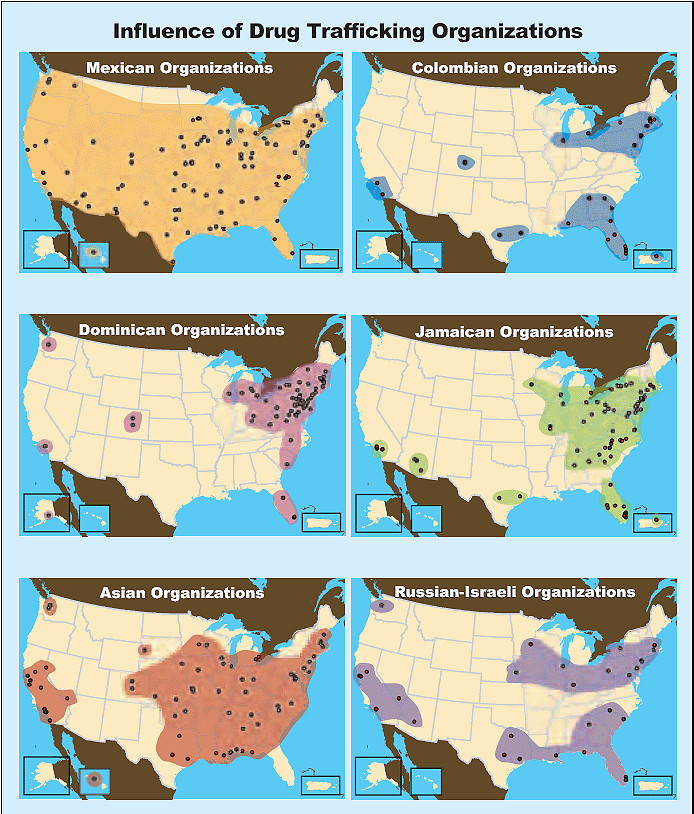
And this is just funny. I suspect the purple patches are notorious 'rebel zones' in the War on Drugs, where the federal and state government policies have split apart entirely. But they forgot eastern Tennessee... and of course everywhere else.
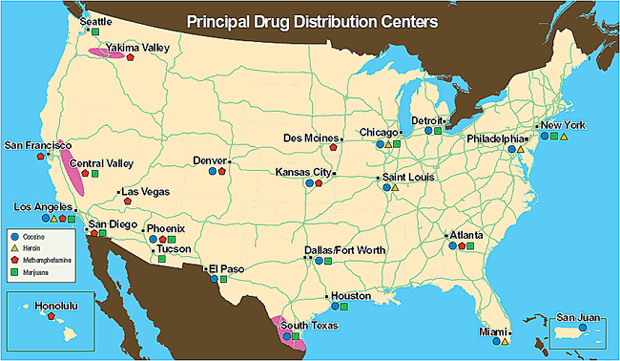
We will be returning to the one about the Russian-Israeli crime organizations. Florida drug money is connected to some of the loose ends around 9/11. The 9/11 drug money connection has many potential angles, but first note here that the DEA marks Miami as a key heroin and cocaine distribution area.
Now we're going into stuff that seems hard to believe, and beyond here, I don't claim that any of these people are telling the truth.
This is just a small slice of the material on the internet about how the rich & powerful skim huge amounts of cash out of the addicted masses of America through the profitable geopolitics of illicit drugs. Some people claim there is a strong connection between drug trafficking and 9/11 financing. Certainly all the players in Afghanistan since 1979 have been up to their ears in it, including the CIA and its favored contractors (who make up around half the CIA personnel these days).
This is certainly part of a trend towards the criminalization of war, which corresponds to the increasing privatization of war. We will have more on this angle in the coming days. Even if there are no operational links to the real September 11 conspiracy itself, the drug-militarization angle really needs to be investigated seriously, perhaps by a Democratic Congress with subpoena and immunity powers. Even snooping at possible loose 9/11 connections immediately reveals a world awash in drug money, with Bush and the Establishment generating vast cash flows from conflict zones - and enforcing loyalties among players from Afghanistan to South America by aligning these cash flows with military force. Sometimes privatized paramilitary forces. Why not?
 "Kill the Messenger:" Sibel Edmonds is on the radar a bit more than usual, as they have apparently whipped up a documentary to expose more of her surreal role in the weird world of intelligence after 9/11, named appropriately enough, Kill the Messenger. (perhaps she shouldn't be trusted, one guy suggests) A blog supporting Edmonds' film, sibeledmonds.blogspot.com is operated by Lukery at wotisitgood4.blogspot.com, who has covered her case in detail. To recap what I have posted before, Edmonds worked as a translator at the FBI, where she discovered a conspiracy within her unit to cover up a Turkish espionage ring in the United States. One of her co-translators was spoofing the wiretaps for FBI agents, and when Edmonds tried to bring this to her superiors, they suppressed the whole thing. Also Dennis Hastert was taking big bribes from the Turks, and there is some kind of global nuclear parts trafficking conspiracy connected to the AQ Khan network and some Israeli mobster types - probably Marc Rich type guys. The guys running the secret nuclear trafficking network were enemies of the CIA's Brewster-Jennings counter-proliferation operations and Valerie Plame, adding yet another twisted concourse to that scandal. And the AIPAC stuff and Chalabi are laterally related, since so much of it revolves around the same neo-con cats in DC and their foreign allies.
Lukery summarized:
Sibel makes 2 specific related claims: a) Sibel claims that she has information which proves that senior officials knew that there were plans to attack America months before 9/11.
Specifically: "There was general information about the time-frame, about methods to be used but not specifically about how they would be used and about people being in place and who was ordering these sorts of terror attacks. There were other cities that were mentioned. Major cities with skyscrapers." and "President Bush said they had no specific information about 11 September and that is accurate but only because he said 11 September," she said. There was, however, general information about the use of airplanes and that an attack was just months away."
b) Sibel claims that she has evidence of a global multi-billion dollar smuggling/dealing network of weapons and drug which is hidden in plain view. Of course, there is also the requisite money-laundering infrastructure. She claims that the network comprises senior american government officials, terrorists, and 'unsavoury regimes.'
and they merge, giving us: "drug trafficking, money laundering, foreign names and American names directly involved in the financing of the 9-11 attacks on WTC (World Trade Center) and the Pentagon."
After a mere 3 months in the FBI, Edmonds publicly claims that all this stuff was going on, covered up at numerous levels in the federal government – though Ashcroft-era gag orders prevent her from sharing many aspects of the story. A virtual hailstorm of individual criminal conspiracies, involving top neo-cons, drug trafficking, all kinds of crazy shit. She has mentioned Coleen Rowley as an ally in the whistleblower field.
There is another potential side to this: Edmonds is herself possibly a red herring, a player or a dupe in the conspiracy, posing as an opponent. Conspiracy gurus suggest she might be a "limited hangout," or a channel to expose parts of the story, and fill other parts with disinformation. Edmonds comes from a prominent family in Turkey, so perhaps she has a bit of Turkish partisanship against some groups back home. One blogger named xymphora suggested she speaks the conspiracy-ese a bit too well:
"Edmonds sometimes makes me a bit nervous as she seems overly adept with the terms and arguments of conspiracy theory for someone who is supposed to have been a lowly FBI translator (it's like she's been reading Peter Dale Scott!). Is she part of the battle in Washington between the Bush Administration enablers involved in the drugs/arms business who don't mind directly or indirectly supporting al Qaeda if it is good for business, and those old-fashioned types who still consider that dealing with American enemies is treason?"
And she gives interviews with patently crazy people like Tom Flocco. Here is a fragment tying some of the neo-cons to some nasty shit:
Although Grossman "has not been as high profile in the press" FBI whistleblower Sibel Edmonds cryptically told me the other day, "don't overlook him – he is very important." She was not speaking about the Plame affair, though Grossman did indeed have a key role there, as we will see.
According to her, Grossman was one of three officials – the other two, she says, are Richard Perle and Douglas Feith – who had been watched by both Valerie Plame's Brewster Jennings & Associates CIA team, and by the major FBI investigation of organized crime and governmental corruption on which she herself was working until being terminated in April 2002.
Marc Grossman has served in a number of interesting countries and positions over the past 29 years. From 1976-1983, at a pivotal point in the Cold War, he was employed at the U.S. embassy in Pakistan – America's key regional ally, through which millions of dollars in weapons and other "aid" were delivered by Pakistan's ISI intelligence service to the mujahedin following the Soviet invasion of Afghanistan in 1979.
Grossman is definitely part of the Valerie Plame scandal, no doubt.
Well, it all still makes her story worth adding to the mixture. Here is the documentary trailer. Please let's take some bets if this will be aired in the United States.
 Florida drug money angles (and there are many!) There was this funny story about one of the flight school proprietors in Florida who trained the 9/11 hijackers. The flight school owner was caught with 43 pounds of heroin just after the 9/11 hijackers got to his school, and somehow this story never got fully explored. See MadCowProd.com for a lot of amusing tales of south Floridian drug trafficking. It's worth considering what the site's proprietor Daniel Hopsicker says, "THE 9.11 HEROIN CONNECTION" is "The Biggest Censored Story of the 21st Century." He cites Thomas Pynchon: "If they can get you asking the wrong questions, they don’t have to worry about answers."
More recently, and quite funny, is the "SkyWay Aircraft" case, where Tom DeLay's buddy + Homeland Security defense contractor accidentally getting busted with 5.5 tons of cocaine on a DC9 connected with the Titan defense contractor. Naturally, the DEA ducking and covering from obvious political pressure ensued. Good times. And perhaps this link is connected to Zacharias Moussaoui and 9/11 financing. (Bonus: MadCowProd says Adnan Kashoggi finances the 9/11 Truth Movement? Now that's what I call a conspiracy!)
Ruppert on Hawalas, PTECH, PROMIS, 9/11 and some heroin networks, BCCI-style. From Mike Ruppert's FromTheWilderness.com last year, "PTECH, 9/11, and USA-SAUDI TERROR: PART II" which offers some evidence that PROMIS software connected to 9/11, and possible narcotics / heroin money connections to 9/11. Ruppert himself offers a theory that advanced software like PROMIS was capable of manipulating computers throughout the financial sphere and the federal government. Ruppert's book Crossing the Rubicon suggests that Dick Cheney could have executed 9/11 himself by using PROMIS and other whizbang technologies to, for example, insert extra radar blips in air traffic control towers across America. It seems kind of like a Deus Ex Machina conspiracy argument to me, but it is still an interesting, if far-fetched hypothetical argument that raises serious questions about how PROMIS and the rest of the fed's information technology really is run. At a dense 675 pages, crossing the Rubicon is one hell of a book, summarized thusly:
"In my book I make several key points:
1. I name Vice President Richard Cheney as the prime suspect in the mass murders of 9/11 and will establish that, not only was he a planner in the attacks, but also that on the day of the attacks he was running a completely separate Command, Control and Communications system which was superceding any orders being issued by the FAA, the Pentagon, or the White House Situation Room;
2. I establish conclusively that in May of 2001, by presidential order, Richard Cheney was put in direct command and control of all wargame and field exercise training and scheduling through several agencies, especially FEMA. This also extended to all of the conflicting and overlapping NORAD drills -- some involving hijack simulations -- taking place on that day.
3. I demonstrate that the TRIPOD II exercise being set up on Sept. 10th in Manhattan was directly connected to Cheney's role in the above.
4. I also prove conclusively that a number of public officials, at the national and New York City levels, including then-Mayor Rudolph Giuliani, were aware that flight 175 was en route to lower Manhattan for 20 minutes and did nothing to order the evacuation of, or warn the occupants of the South Tower. One military officer was forced to leave his post in the middle of the attacks and place a private call to his brother - who worked at the WTC - warning him to get out. That was because no other part of the system was taking action.
5. I also show that the Israeli and British governments acted as partners with the highest levels of the American government to help in the preparation and, very possibly, the actual execution of the attacks."
"There is more reason to be afraid of not facing the evidence in this book than of facing what is in it."
Approach #2: Peter Dale Scott's "The Global Drug Meta-Group: Drugs, Managed Violence, and the Russian 9/11". haven't looked through all of it, but it seems an interesting source to begin looking at how the gears really turn in Central Asia and thereabouts.
it also seems possible that the U.S. government might contemplate using Hizb ut-Tahrir and the meta-group for political changes in Russia itself, even while combating the Islamism of al-Qaeda elsewhere. This would be far from the first time that the U.S. Government had used drug-trafficking proxies as assets, and would do a lot to explain the role of the U.S. in 2001 in restoring major drug traffickers to power in Afghanistan. Dubious figures like Nukhaev, Khodorkovskii, and Khashoggi have already shown their interest in such initiatives; and western business interests have shown their eagerness to work with these allies of the meta-group.
It is fitting to think of most U.S. intelligence assets as chess pieces, moved at the whim of their controllers. That is however not an apt metaphor for the meta-group, which clearly has the resources to negotiate and to exert its own influence interactively upon the governments it works with.
Since first hearing about the meta-group's role in the Russian 9/11, I have pondered the question whether it could have played a similar role in the American 9/11 as well. At this point I have to say that I have found no persuasive evidence that would prove its involvement. The fact remains that two informed and credible witnesses, Sibell Edmonds and Indira Singh, have spoken independently of the importance of international drug trafficking in the background of 9/11.
The Bush Administration has paid Sibell Edmonds the tribute of silencing her on the grounds of national interest. She has nonetheless made it clear that what she would talk about concerns that part of the world where the meta-group has influence:
SE [Sibel Edmonds]: It's interesting, in one of my interviews, they say "Turkish countries," but I believe they meant Turkic countries – that is, Turkey, Azerbaijan, and all the 'Stans, including Tajikistan and Kyrgyzstan, and [non-Turkic countries like] Afghanistan and Pakistan. All of these countries play a big part in the sort of things I have been talking about.
CD [Chris Deliso]: What, you mean drug-smuggling?
SE: Among other things. Yes, that is a major part of it. It's amazing that in this whole "war on terror" thing, no one ever talks about these issues.[120]
Indira Singh, who lost her high-tech job at J.P. Morgan after telling the FBI about Ptech and 9/11, was even more dramatic in her public testimony at a Canadian event:
I did a number of things in my research and when I ran into the drugs I was told that if I mentioned the money to the drugs around 9/11 that would be the end of me.[121]
The False Dilemmas of 9/11 Theories
I said earlier that by suppressing awareness of the role of drug-trafficking in our society, we give drug traffickers a de facto franchise to exert political influence without criticism or opposition. An example of this is the discussion of 9/11 in America, which usually fails to consider the meta-group among the list of possible suspects.
I have tried to suggest in this paper that in fact the meta-group had both motive – to restore the Afghan opium harvest and increase instability and chaos along the trade routes through Central Asia – and opportunity – to utilize its contacts with both al-Zawahiri in al Qaeda and the CIA in Washington. It is furthermore the best candidate to explain one of the more difficult anomalies (or indeed paradoxes) of the clues surrounding 9/11: that many of the clues lead in the direction of Saudi Arabia, but some lead also in a very different direction, towards Israel.[122]
Here it is worth quoting again the well-informed remark of a Washington insider about the meta-group's predecessor, BCCI: "Who else could wire something together to Saudi Arabia, China, Israel, and the U.S.?"[123] The current meta-group fills the same bill, for it unites supporters of Muslim Salafism (Saidov) with at least one Israeli citizen (Kosman).
The meta-group's involvement in the Russian 9/11 of course does nothing to prove its involvement in the American one. However awareness of its presence – as an unrecognized Force X operating in the world – makes previous discussions of 9/11 seem curiously limited. Again and again questions of responsibility have been unthinkingly limited to false dilemmas in which the possible involvement of this or any other Force X is excluded.
An early example is Michael Moore's naïve question to President Bush in Dude, Where's My Country: "Who attacked the United States on September 11 – a guy on dialysis from a cave in Afghanistan, or your friends, Saudi Arabia?"[124] A far more widespread dilemma is that articulated by David Ray Griffin in his searching critique of the 9/11 Commission Report:
There are two basic theories about 9/11. Each of these theories is a "conspiracy theory." One of these is the official conspiracy theory, according to which the attacks of 9/11 were planned and executed solely by al-Qaeda terrorists under the guidance of Osama bin Laden....Opposing this official theory is the [sic] alternative conspiracy theory, which holds that the attacks of 9/11 were able to succeed only because they were facilitated by the Bush administration and its agencies.[125]
Griffin of course is not consciously excluding a third possible theory – that a Force X was responsible. But his failure to acknowledge this possibility is an example of the almost universal cultural denial I referred to earlier. In America few are likely to conceive of the possibility that a force in contact with the U.S. government could be not just an asset, but a force exerting influence on that government.
My personal suggestion to 9/11 researchers is that they focus on the connections of the meta-group's firm Far West, Ltd. – in particular those which lead to Khashoggi, Berezovskii, Halliburton and Dick Cheney, and Diligence, Joe Allbaugh, and Neil Bush.
As a grain of salt, we should remember that Florida is so thoroughly laden with drug money that it is quite likely people would catch false leads to September 11 among the huge forest of shady people getting rich from the Business. The loose end about how the DEA was tracking Israelis who lived virtually around the corner from the 9/11 hijackers is an interesting one, but perhaps the density of shady business in Hollywood, Florida is just that high, one block of criminal enterprises after another. This IS Florida we're talking about.
The Israeli 9/11 angles are still worth checking out – the supposed Mossad front company Urban Moving Systems and the rest. From one of America's most respected Jewish periodicals, Forward:
Spy Rumors Fly on Gusts of Truth: Americans Probing Reports of Israeli Espionage
MARCH 15, 2002
By MARC PERELMAN, FORWARD STAFF
"Despite angry denials by Israel and its American supporters, reports that Israel was conducting spying activities in the United States may have a grain of truth, the Forward has learned.
However, far from pointing to Israeli spying against U.S. government and military facilities, as reported in Europe last week, the incidents in question appear to represent a case of Israelis in the United States spying on a common enemy, radical Islamic networks suspected of links to Middle East terrorism.
In particular, a group of five Israelis arrested in New Jersey shortly after the September 11 attacks and held for more than two months was subjected to an unusual number of polygraph tests and interrogated by a series of government agencies including the FBI's counterintelligence division, which by some reports remains convinced that Israel was conducting an intelligence operation. The five Israelis worked for a moving company with few discernable assets that closed up shop immediately afterward and whose owner fled to Israel.
Other allegations involved Israelis claiming to be art students who had backgrounds in signal interception and ordnance. (See related story, Page 8.)
Sources emphasized that the release of all the Israelis under investigation indicates that they were cleared of any suspicion that they had prior knowledge of the September 11 attacks, as some anti-Israel media outlets have suggested.
The resulting tensions between Washington and Jerusalem, sources told the Forward, arose not because of the operations' targets but because Israel reportedly violated a secret gentlemen's agreement between the two countries under which espionage on each other's soil is to be coordinated in advance.
Most experts and former officials interviewed for this article said that such so-called unilateral or uncoordinated Israeli monitoring of radical Muslims in America would not be surprising. In fact, they said, Israeli intelligence played a key role in helping the Bush administration to crack down on Islamic charities suspected of funneling money to terrorist groups, most notably the Richardson, Texas-based Holy Land Foundation last December.
"I have no doubt Israel has an interest in spying on those groups," said Peter Unsinger, an intelligence expert who teaches justice administration at San Jose University. "The Israelis give us good stuff, like on the Hamas charities." According to one former high-ranking American intelligence official, who asked not to be named, the FBI came to the conclusion at the end of its investigation that the five Israelis arrested in New Jersey last September were conducting a Mossad surveillance mission and that their employer, Urban Moving Systems of Weehawken, N.J., served as a front.
After their arrest, the men were held in detention for two-and-a-half months and were deported at the end of November, officially for visa violations. However, a counterintelligence investigation by the FBI concluded that at least two of them were in fact Mossad operatives, according to the former American official, who said he was regularly briefed on the investigation by two separate law enforcement officials.
"The assessment was that Urban Moving Systems was a front for the Mossad and operatives employed by it," he said. "The conclusion of the FBI was that they were spying on local Arabs but that they could leave because they did not know anything about 9/11."
However, he added, the bureau was "very irritated because it was a case of so-called unilateral espionage, meaning they didn't know about it."
Spokesmen for the FBI, the Justice Department and the Immigration and Naturalization Service refused to discuss the case. Israeli officials flatly dismissed the allegations as untrue. However, the former American official said that after American authorities confronted Jerusalem on the issue at the end of last year, the Israeli government acknowledged the operation and apologized for not coordinating it with Washington.
The five men — Sivan and Paul Kurzberg, Oded Ellner, Omer Marmari and Yaron Shmuel — were arrested eight hours after the attacks by the Bergen County, N.J., police while driving in an Urban Moving Systems van. The police acted on an FBI alert after the men allegedly were seen acting strangely while watching the events from the roof of their warehouse and the roof of their van............
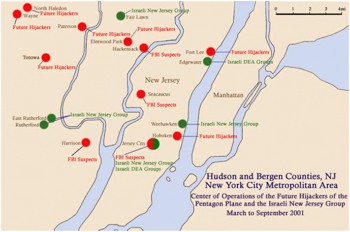
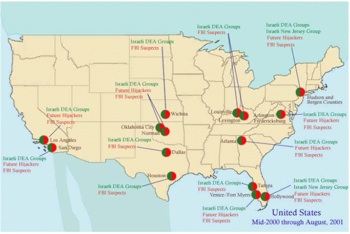
A retired corporate lawyer, Gerald Shea, put together all the government reports on Israeli DEA groups he could find, and corroborated the locations of Israeli groups the DEA monitored and where in Florida the 9/11 hijackers lived when they were training. The results had interesting geographic distribution (which correlates with the Russian-Israeli organizations in Florida admittedly monitored by the Department of Justice as I noted above). These maps are from the Shea's PDF file:


All righty then. That's a lot of heady stuff to consider. I'll note again that I am not a true believer in anything in today's post. I just want to offer some of the interesting things out there on the internet today. I strongly believe that the Republican establishment in America today is very complicit in international drug trafficking – especially since we've got a lot of the same guys who ran cocaine angles in Central America during the Iran-Contra affair. Past behavior is a guide towards future actions, if not ironclad proof.
Arbitrage is power: the buying and selling of goods across geographic space supports the global "shadow economy" that makes up a huge proportion of economic activity. Whoever controls the space, controls the money. Half of Afghanistan's economy is heroin production, for example. Follow the cash: it's one heck of a loose end of September 11, and the war on terror.
We are not posting much until the new drupal site is rolled out. There has been a setback in the last couple days, as the image uploader mysteriously stopped working. Frustrating to have feature collapse!
Neoconservative intelligence spoofing alert (via wotisitgood4.blogspot.com):
Laura Rozen:
"Interesting Warren Strobel/John Wolcott piece on an eerie echo of phony pre-war Iraq intelligence from discredited exile groups and figures being injected into the system via unconventional US government offices, this time on Iran
[......]
And they nod to a piece I reported in the LAT a couple months back -- that a new "Iranian directorate" has been set up inside the same Pentagon policy shop that oversaw the Office of Special Plans.
[....]
It's hard to imagine that this office would wittingly use Ghorbanifar directly for Iran intelligence; but you don't have to go far to find the model that is more likely to being employed. Check out how Ghorbanifar worked with Congressman Curt Weldon -- using a cut-out, "Ali," Ghorbanifar's longtime business partner. And read the Chalabi section of the new Senate Intel committee Phase II report to see the pattern writ large -- the system by which almost a dozen fabricators were pushed forward by the INC to ply their wares on the US government, echoing and providing "confirmation" for the fabrications put forward by an earlier one; some of them have now totally disappeared. Some were pushed forward by the likes of Jim Woolsey through the DOD. I would think that responsible parties in the US government, say at the National Security Council where Stephen Hadley should by now know about Ghorbanifar because he approved the origial Pentagon meetings with him in 2001, would want to be very careful with what they're getting this time on Iran from places like DIA and DoD, and be pressing back hard to question the validity and chain of custody of the original sources."
So they are fabricating another war in the usual ways. Fuck it.
Chavez pledges to support Iran in invasion: Sep. 14, 2006. 09:20 PM
ASSOCIATED PRESS
HAVANA — Venezuela's president pledged Thursday his country would support Iran if it was invaded as a result of its nuclear standoff with the UN Security Council.
The UN has demanded Iran suspend uranium enrichment amid concerns by some nations that it could be used for nuclear weapons. Iran insists the enrichment is aimed solely at producing electricity.
"Iran is under threat; there are plans to invade Iran, hopefully it won't happen, but we are with you," Hugo Chavez told Iranian President Mahmoud Ahmadinejad at a meeting of the Group of 15 developing nations on the sidelines of a Nonaligned Movement summit in Cuba.
Anti-U.S. states try to cement accord Sat Sep 16, 2006 5:00 PM By Anthony Boadle
HAVANA (Reuters) - Iran, North Korea, Venezuela and Cuba moved to cement an anti-U.S. alliance and support Tehran's right to nuclear technology at a summit of Non-Aligned nations on Saturday.
More than 40 heads of state and leaders from over 100 developing countries were debating a document supporting Iran's right to nuclear technology for peaceful ends and another sharply critical of Israel's recent war in Lebanon. But governments with friendly ties to Washington, among them India, Pakistan, Chile, Peru and Colombia, sought to steer the summit way from confrontation and finger-pointing at the United States.
North Korea blasted the United States for unilateral actions against individual countries and called for a revitalised NAM to raise a united voice. "The United States is attempting to deprive other countries of even their legitimate right to peaceful nuclear activities," North Korea's second-ranking leader, Kim Yong-nam, said.
A batch of info mostly from JuanCole.com, the indispensable guide to all things Middle Eastern. For example, dissecting a Republican report on Iran packed with disinformation (more here). Cole's recap of 9/11 myths is a good one. Also Steve Clemons' TheWashingtonNote.com is doing good things, such as predicting ahead of time that John Bolton's recent re-nomination was sunk.
Indian guys observe that some World Trade Center scrap found its way to India, since of course there was no reason to keep evidence around.
Valerie Plame scandal flips upside down? CNN.com - Outed CIA agent Plame adds Armitage to lawsuit. The Armitage thing is a strange angle since Armitage was definitely not part of the neo-con camp in the run-up to the war - he was more of a Powell loyalist. It seems like in reality he was burned by his co-Deputy at State at the time, Marc Grossman, who is a shady neoconservative connected with drug trafficking since the good old days of Pakistan in the 1980s. According to some sources, Grossman sent Armitage a memo with Plame's name that did not flag her status as a covert agent.
In a tiny tidbit, Sibel Edmonds has noted that on the morning of September 11, Marc Grossman was meeting with then-Rep. Porter Goss, Senator Bob Graham, and Mahmoud Ahmed, the director of Pakistan's ISI intelligence agency, the guys that created the Taliban! Ahmed apparently wired $100,000 to Mohammed Atta before September 11. If you want some mind-blowingly weird shit about Sibel Edmonds, Douglas Feith, Richard Perle, financing around 9/11 and other intrigues, check this post, this and this one on wotisitgood4.blogspot.com. Nice.
In the recently released Bin Laden tape, there were odd discrepancies in how global media like chinese Xinhua and Al Jazeera described the hijackers. Either media errors or Vast Conspiracy, I guess.
BAE profit rises 28% on US orders for Iraq:
Thursday, September 14, 2006
LONDON, SEPT 13: BAE Systems Plc, Europe’s biggest weapons maker, said first-half profit rose 28%, more than analysts estimated, on US orders for Bradley fighting vehicles used in Iraq.
Net income increased to 405 million pounds ($759 million), or 12.4 pence a share, from 317 million pounds a year earlier, BAE said on Wednesday in a statement. Profit beat the 354 million-pound estimate of six analysts surveyed by Bloomberg. BAE purchased United Defense Industries Inc, the maker of the Bradley, in June 2005 to become the Pentagon’s seventh-biggest contractor. London-based BAE on September 6 recommended shareholders approve the sale of its 20% stake in Airbus SAS to concentrate on US defence acquisitions.
The sale ‘‘will allow BAE to focus on the defense sector and not be distracted by some serious problems that Airbus is facing,’’ David Hart, an analyst at Fat Prophets in London, said in an interview. ‘‘Refitting Bradleys will be a strong market for them for years to come.’’
The spooky new pope, in his infinite wisdom, decided to quote some fossilized Byzantine emperor named Manuel II Palaiologos, who hated Muslims and was therefore worth quoting.
The U.S. military is starting to fray in a lot of ways, with gang members and white supremacists now getting recruited.
Sen. Tom Harkin down in Iowa talking about the situation. John Bolton's gonna fuck everything up. Great Britain's role in the war in Lebanon - many details of nitty gritty that Blair is going to pay for. Your Iraq statistic reference.
A little humor: Top ten dumbest secret identities. Bert Blyleven drops the F-BOMB twice during a Twins game broadcast!! Awesome. Five great comedians that have totally lost it. Excellent.
Colbert scores a Hungarian bridge, or does he? Watch the video!
Most middle eastern leaders tell Kofi the war has been a disaster for them. Al Qaeda in Iraq - or not: check out the reasonable overview from a UPI analysis of the Iraq Sunni fundie situation:
Eye on Iraq: The al-Qaida myth, By MARTIN SIEFF UPI Senior News Analyst
Why did the tactical U.S. successes against al-Qaida within Iraq fail to have any positive impact on quelling the insurgency? Part of the answer is that al-Qaida and its allies had already succeeded in pulverizing the credibility of Iraq's three democratically elected governments by the time U.S. forces could make real inroads against them.
Also, U.S. planners failed disastrously to bring in enough American troops right after the fall of Saddam Hussein in April 2003 to ensure stability and the rapid restoration of basic government services in Iraq.
The U.S. obsession with ambitious, cumbersome constitutional processes distracted American planners and military from being able to focus on the primary issues of restoring power, running water and having enough reliable U.S. and allied troops to ensure law and order in Iraq's cities and towns. As a result, every one of the three civilian governments Iraq has so far had no grassroots credibility or been able to deliver basic protection or reliable services to a significant element of the population by itself.
Even in supposedly peaceful Shiite majority provinces across southern Iraq, the government forces only operate in alliance with, or at the sufferance of, a patch-quilt of Shiite militias that they do not control.
However, the real reason is that al-Qaida was never the only, or even the main, part of the Sunni resistance against U.S. forces in Iraq. By the time Zarqawi was killed, he was only the first among equals in a shifting coalition of anti-American Sunni militia groups. And when Zarqawi succeeded in provoking an overwhelming Shiite violent reaction after the Al-Askariya bombing, he achieved his ultimate strategic goal of making Iraq ungovernable through the U.S.-guided democratic political process that had been set up.
U.S. grand strategy in Iraq, in its obsession with Zarqawi and al-Qaida, never confronted the messy religious and ethnic political and paramilitary realities of the country. President George W. Bush, Vice President Dick Cheney and Defense Secretary Donald Rumsfeld remained convinced through June that once Zarqawi was hunted down and killed and al-Qaida's operational command structure was smashed, then the Sunni insurgency would evaporate and peaceful, democratic political processes would at last triumph in Iraq.
But it has not happened that way and there is no real sign that it will. The condition we have described in these columns as "Belfast rules" or "Beirut rules" -- the condition of ongoing, many-sided sectarian war between different militias after a central governing authority has collapsed -- continues to be the case in Iraq. Conditions in that unhappy country will only start to improve when U.S. policymakers finally confront this unpleasant fact.
Doomed Palestinians trapped in Iraq: Talk about double jeopardy: Palestinians that resettled after the Nakba (catastrophe of Israel's creation) in Iraq are now pretty much screwed, in particular since Shiites don't like them. This is yet another material reason that West Bank settlements are extremely bad for the world, Arabs and the United States.
Reuters: IRAQ: Palestinian refugees targeted by militants receive no help
13 Sep 2006 13:29:12 GMT
BAGHDAD, 13 September (IRIN) - The deteriorating conditions of Palestinians in Iraq have been highlighted in a report by US-based NGO Human Rights Watch (HRW).
The report, released on 10 September, said that Palestinian refugees living in Iraq are being targeted by mostly Shi'ite militant groups and are also being harassed by the government.
"Since the fall of [former president] Saddam Hussein's government, Palestinian refugees in Iraq have increasingly become targets of violence and persecution," said Sarah Leah Whitson, HRW's Middle East director.
"Shi'ite militant groups have murdered dozens of Palestinian refugees, and the Iraqi government has made it difficult for these refugees to stay legally in Iraq by imposing onerous registration requirements," she added.
Since we are posting Prof. Juan Cole-derived goodies today, I'm going to have to pilfer his post on 9/11 and Al Qaeda because it makes 1000% more sense than any other bullshit in the media in the last week. I hope he understands!
September 11, 2006: The War with al-Qaeda
The war with al-Qaeda has many dimensions. There is the war with the organization itself. There is the struggle against its offshoots and copycats. There is cooperation with Muslim governments and communities in derailing the threat. There is the question of the strength of Sunni fundamentalist parties that might support al-Qaeda. And there is winning hearts and minds in the Muslim world.
The war with the organization itself largely succeeded by 2003 and no further progress seems to have been made since that time. Some 600 al-Qaeda operatives were captured in Pakistan, many of them through a sting arranged inside the Karachi Western Union office, according to Ron Susskind. The original al-Qaeda has been badly disrupted as to command and control.
It is not, however, dead. Every evidence is that the London subway bombings of a little over a year ago had a strong connection to Ayman al-Zawahiri. He appears to have worked with a Pakistani terrorist group such as Jaish-i Muhammad or Lashkar-i Tayyibah or whatever they are calling themselves these days to recruit the young Britons that carried out the attack. Al-Zawahiri had in his possession their suicide tapes, and broadcast them on Aljazeera. It is urgent that Usamah Bin Laden and Ayman al-Zawahiri be captured. Declan Walsh explains why this is is difficult.
It may well be that the Egyptian Islamic Jihad offshoot operating in the Sinai, which conducted the Sharm El Shaikh and Taba bombings of tourist hotels, has a link to Zawahiri.
Al-Qaeda's popularity is declining in some quarters. A Pew poll in 2005 found that significantly fewer numbers of Moroccans, Turks and Indonesians were confident in Bin Laden that year than the two previous years. On the other hand, a majority of Jordanians and Pakistanis continued to have a high regard for his competency.
The Madrid train bombings show the severe challenge posed by local copycat groups that do not have a direct connection to al-Qaeda, but take up one of its calls to action and learn techniques from the internet. If a group has at least some email connections to a known terror group or individual already under surveillance, at least there is a chance of cracking the plot. If they are all "newskins," that makes them invisible.
US cooperation with Middle Eastern governments is at a high level, from all accounts. The operation against Abu Musab al-Zarqawi appears to have been very significantly a Jordanian operation. Egypt and the US conduct joint military exercises. I have a sense that the relationship with Morocco has deepened. Algeria's government fought a decade-long civil war against Islamist political forces, some of them very violent, and has reason to cooperate.
On the negative side, the Sunni Arabs of Iraq appear ever increasingly to be organized by radical Muslim fundamentalist forces of various sorts. This population of some 5 million had been among the bulwarks of secular Arab nationalism in the past, but those days are long gone.
The Islamic Action Council in Pakistan, some members of which sympathize with al-Qaeda and the Taliban, continues to rule the Northwest Frontier Province. The central government, however, which is more secular, has stopped it from implementing Islamic law and hisbah (measures that give anyone standing in enforcing morality on others). Parliament has even moved to rewrite Pakistan's flawed rape law, which is based on Gen. Zia ul-Haq's Islamization measures and is so poorly framed that it often ends up allowing the victims to be punished!
Four MPs from the Muslim Brotherhood in Jordan went to mourn Zarqawi's death with his family, triggering sanctions against them. The incident raised questions about how much distance there is between the Salafi Jihadis, the violent revivalists, and the conservative religious parties that seem to eschew violence and pursue ordinary politics.
The US pressured Egypt to open up its parliamentary elections last fall, and the Mubarak regime took revenge by letting 88 Muslim Brother delegates be seated in a chanber with a little over 400 members. These supported Hizbullah in the recent Israel-Lebanon War and have demanded that the Camp David Accords be revoked.
Hamas won the elections in the Palestine Authority. The Israelis have taken many of the elected Hamas representatives and officials into custody, however, and have repeatedly bombed the Interior Ministry in Gaza. These developments have added to the popularity of Hamas and radical fundamentalism while making a mockery of the Bush administration's stated commitment to democratization.
Hizbullah itself achieved enormous popularity, and enhanced the prestige of radical Muslim fundamentalism, by its ability to make a stand before the Israeli military machine. This development will ripple through the region, to the disadvantage of more secular, moderate forces.
The evidence with regard to hearts and minds is mixed. The Pew Global Attitudes Project reports on Indonesia, the world's largest Muslim country, with a population of 224 mn. In 2000, 70 percent of Indonesians viewed the United States favorably. (Such numbers were typical for US Muslim allies in areas not consumed by the Arab-Israeli conflict). In 2002 as a result of the Afghanistan war, the number fell to 60 percent. Then in 2003 after Bush invaded Iraq, it fell to 15 percent. After Bush sent the US Navy to help Indonesia in the aftermath of the tsunami, the numbers rebounded in 2005 to 38 percent. In 2006 they have fallen again, down to 30 percent.
So since 2000, we have fallen from 70 percent approval in Indonesia to only 30 percent, and at some points we were way down. This story contains a caution and also some encouraging news. The caution is that we are losing the Indonesia public because of this Iraq occupation. It is true in Turkey, as well, and lots of other places. The good news is that it is not irreversible. Do some nice things for someone, and the numbers go up. (The numbers also went up in Pakistan after we diverted some military helicopters to help the victims of the Kashmir earthquake). If we ended our Iraq presence, there is a chance we could repair these relationships with some munificent gestures.
In Turkey, the favorability rating of the US in 2002 was 52 percent. It is now 15 percent. That is a scary plummet! I suspect it is all about Iraq, and particularly the feeling that the US is letting the Iraqi Kurds harbor the PKK terrorists, who are blowing things up in Turkey.
The only really good news in the Pew findings is that the US has grown in popularity in Morocco, to nearly 50%, and is especially popular with youth and women. Moroccans have said they are worried about terrorism and about too much influence of religion in politics. I don't entirely understand what is driving the Morocco numbers, since they were pretty upset about Iraq, but the change should be studied for what it can tell us about doing things right. One thing that helps is that Morocco is a long way from the Arab-Israeli conflict, and, in fact, has good behind the scenes relations with Israel.
The Arab world mostly just dislikes US policy, mainly because of kneejerk support for Israeli depredations against Palestinians. The dislike doesn't change that much, though we reached a nadir in 2003-2004. In 2002 76 percent of the Egyptian public disapproved of us. In 2004 that rose to 98 percent. It has fallen down to 86 percent in 2006. Very few Egyptians approve of US foreign policy. They don't even like US intervention to open up the Egyptian political system.
To the extent that small terrorist groups benefit in their recruitment and in motivating recruits from deeply negative attitudes to the United States, these polling numbers are extremely disturbing. The main things driving a polarization between Muslim publics and the US are not al-Qaeda or terrorism, however. They are Iraq, Palestine and Lebanon. It is the policy. The policy can provoke anger and engender threat, and that is why it had better be a damn good policy. It can also make for friendships, which is what we should be aiming at.
It wouldn't take much now to settle the Israel-Palestine thing, and the time is ripe to have Israel give back the Golan to Syria and the Shebaa Farms to Lebanon in return for a genuine peace process. The Israelis are not made more secure by crowding into the West Bank or bombing Gaza daily. South Lebanon has demonstrated the dangers of ever more sophisticated microwars over rugged territory. It is time for Israel, and for the United States, to do the right thing and rescue the Palestinians from the curse of statelessness, the slavery of the 21st century. Ending this debilitating struggle would also be the very best thing for the Israelis themselves. In one fell swoop, the US would have solved 80 percent of its problems with the Muslim world and vastly reduced the threat of terrorism.
But of all the things this administration has done badly, it has been worst of all at making friends in the region. That could end up hurting us most of all, and playing into Bin Laden's increasingly ghostly hands.
Well that does it for now. Have a nice weekend.

Knesset Member Effi Eitam (National Religious Party): 'It is impossible with all of these Arabs.' (BauBau/Archive)
Last update - 15:53 11/09/2006 Haaretz: Leftist MKs blast Eitam's statements on Arabs, urge AG to investigate
By Jack Khoury, Haaretz Correspondent, and Haaretz Service
Left-wing lawmakers reacted furiously Monday to statements made by rightist Knesset Member Effi Eitam against Israeli Arab politicians and Palestinians in the West Bank, and called for attorney general Menachem Mazuz to open an investigation into Eitam's comments on grounds of incitement to racism.
Eitam, a member of the right-wing National Union-National Religious Party sparked a political firestorm Monday when he said that the great majority of Palestinians in the West Bank should be expelled, and that Arabs should be ousted from Israeli politics as a fifth column and "a league of traitors."
The remarks, broadcast Monday on Army Radio, were made during a Sunday speech at a memorial service for a soldier killed in Lebanon during the recent war.
It was the first time that Eitam, who heads the Religious Zionism faction within the National Union, has publicly supported deportation of Palestinians, a concept espoused by assassinated National Union founder Rehavam Ze'evi as "transfer."
"We will have to expel the great majority of the Arabs of Judea and Samaria," Eitam urged, referring to the whole of the West Bank.
According to Eitam, experience showed that Israel cannot give up the area of the West Bank. "It is impossible with all of these Arabs, and it is impossible to give up the territory. We've already seen what they're doing there."
Turning to the subject of Israeli Arabs, Eitam said, "We will have to take another decision, and that is to sweep the Israeli Arabs from the political system. Here, too, the issues are clear and simple.
"We've raised a fifth column, a league of traitors of the first rank. Therefore, we cannot continue to enable so large and so hostile a presense within the political system of Israel."
Beilin: Bring Eitam to trial
Yossi Beilin, the leader of the left-wing Meretz party, urged Attorney General Menachem Mazuz Monday to bring Eitam to trial on charges of incitement to racism.
Beilin's call was based on an amendment to the law which grants lawmakers immunity from prosecution. The amendment lifts the immunity from legislators who incite to racism or ethnic prejudice. Earlier in the day, Meretz MK Avshalom Vilan called on Mazuz to open an investigation against Eitam, on suspicion of incitement and sedition.
Arab MK Ahmed Tibi (Ra'am-Ta'al) said Monday that "Eitam's remarks would have been more authentic, had they been delivered in German."
"These are irresponsible statements," Tibi told the radio, "directed at the lowest level of the racism surging within Israeli society."
"A long time ago the racists and fascists moved from the Israeli street to the Israeli government and the halls of power" added Tibi.
Peace Now leader Yariv Oppenheimer said that the words of Eitam "show that the dogma of [slain extreme right-wing Rabbi Meir] Kahane is alive and well. In a moment of candor, the mask was removed from Eitam's face, exposing him as a leader of fantasy and racism."
Arab MK Mohammed Barakeh said that the attack on the representatives of Arab citizens of Israel was an attempt to "delegitimize the Arab population entirely and to negate their right to voice their opinions and participate in the political process."
According to Barakeh, the measures proposed by Eitam are already being implemented, as the Palestinians, "are witness to many steps to push them aside and expel them from their homeland, among them the security fence in Jerusalem and the West Bank. The policies of siege, starvation, and negation of the basic right of human dignity are a means of extremely dangerous ethnic expulsion.
"You don't need trucks to transfer Palestinians."
Just after I noted the tricky matter between Keith Ellison and the Jewish community over in the Fifth District, I get an email from the Ellison campaign proclaiming that he's been endorsed by the local paper American Jewish World. They seem to think he's sort of a Muslim Wellstone, and that's pretty sweet. Here's the email in full:
Keith Ellison for U.S. Congress

Dear Friend,
Keith Endorsed by American Jewish World!
Keith Ellison’s historic campaign for Congress gained the extremely valued and valuable endorsement today of the influential Twin Cities newspaper American Jewish World.
Keith said, “I am humbled, and just plain thrilled, by the confidence the American Jewish World has placed in my vision of a just future where there are no throw-away people and peace is our guiding principle. Indeed, this is a collective vision of tens of thousands of us in our uniquely progressive district, a vision we have built together out of our most deeply-held values.
“I am proud that the American Jewish World has honored us with their support and has joined our extraordinary coalition of progressive people of good will who represent all faiths, all colors and all our neighborhoods.”
“This is how we will win – by creating a powerful force of real people unified behind a passion for justice.”
Below are excerpts from their endorsement, with our highlighting added:
“Regarding the 5th District DFL Primary, there are three fairly conventional candidates who would bring particular strengths to service in the U.S. House and would likely provide competent representation for their constituents. However, voters could make an emphatic statement – one that would gain national and international attention – by casting their ballots for Keith Ellison. The 43-year-old state representative would bring a singular passion and intelligence to the job of representing citizens of Minnesota Fifth District; in many ways, Ellison represents the progressive populist vision that Minnesota lost with the untimely passing of Paul Wellstone in 2002.”
“Ellison acted as the lawyer for the House DFL caucus in an ethics proceeding against former representative Arlon Lindner, who contended that gays were not victims of Nazi oppression in the Holocaust. Ellison understands the importance of guarding against Holocaust denial and revisionism, and links the lessons of the Shoah to more recent cases of genocide in Rwanda and Darfur. Further, he supports the State of Israel and the continuation of U.S. aid to Israel. He holds to the mainstream position of a negotiated two-state solution regarding the long-standing Israeli-Palestinian conflict.”
“We all know that nobody is perfect and no political candidate is without shortcomings. We are now in Elul, the last month of the Hebrew year and the month preceding Rosh Hashanah and Yom Kippur…During this period of heightened spirituality, we find ourselves considering the choices before us as citizens of a free nation. We cannot take our civil liberties for granted, especially in the face of well-reported government actions to curb our constitutional rights and consolidate political power. In the trying times ahead, we will need courageous political leadership and we must hold our elected representatives accountable.”
“We think that Keith Ellison has the attributes to be a dynamic and effective representative in Congress. In Ellison, we have a moderate Muslim who extends his hand in friendship to the Jewish community and supports the security of the State of Israel. He is a person with a vision of a more humane and equitable society and he is the candidate we favor in the Fifth District DFL election.’
Above all, they are making a $1200 Swiss Army knife with every single tool. Yes. 85 tools including screwdrivers, a laser and a flashlight. And a "fine fork for watch spring bars."
Dig the Bush BeatBox video. Diabolical orange cat Jeff has a blog of what things he's killed.

 Check out AllPeers: A new plugin for Firefox on Linux, Windows and OS X that combines buddy lists and BitTorrent, allowing people to share files at high speed with their friends. It's in beta now, and there could be security holes, but I really want to try it. I am registered at feidt@macalester.edu so shoot me a message if you want to try it. It has just been released to Public Beta. A review notes it has 'performance issues:'
As I write this, the beta is just a day old, and the company is still ironing out some server issues. Initially, I had a problem actually downloading the tool, and once I did get it installed, performance was spotty. I had trouble signing up to the service, and the service itself went down several times while I was testing it. When it did work, the speed was acceptable.
In theory, performance should eventually be quite good. AllPeers uses a customized version of BitTorrent to swap files. So if you're sending the same file with multiple people, once others receive the file—or just parts of the file—they can help you send it to everyone else. Let's say I decide to share a file to my colleagues Sean Carroll and Lance Ulanoff. Once Sean downloads the file from my machine, AllPeers can use both his copy and mine to send it quickly to Lance. Some of the bits will come from my machine even as other bits are coming from Sean.
Despite current performance I like the basic design. It's simple—and that's what you want from a tool like this. It integrates completely with Firefox, adding a toolbar and various browser "panes" that open and close as need be. Simply by keying in e-mail addresses or AllPeers user names, you add friends and family to a contacts list, and once you've chosen a name from the list, you can start sending files via drag-and-drop (or good old-fashioned dialog boxes).
Russia and Central Asian countries nervous about US military action, conducting training exercises. Michel Chossudovsky writes that Russia and Central Asian Allies Conduct War Games in Response to US Threats, including Taijikistan, Kyrgyzstan, Russia, Kazakhstan and Uzbekistan. Things are also moving with China and India. Quoted:
"The growing militarisation is connected with mutual mistrust among countries in the region, say analysts. Iranian media have speculated that the United States is using Azerbaijan to create a military counterweight to Iran on the Caspian. It is possible that the exercise conducted by the CSTO – in which Russia is dominant – represents a response to concerns about United States involvement in developing Kazakstan’s navy. Observers say Russia is leaning more and more towards the Iranian view that countries from outside should be banned from having armed forces in the Caspian Sea."
Experts say the US is trying to step up the pressure on Iran, as well as to defend its own investments in Azerbaijan and Kazakstan. It is also trying to guarantee the security of the strategically vital Baku-Tbilisi-Ceyhan pipeline.
A military presence on the Caspian would give the United States an opportunity to at least partially offset its weakening influence in Central Asia, as seen in the closure of its airbase in Uzbekistan, the increased rent it is having to pay for the Manas base in Kyrgyzstan, and the diplomatic scandal that resulted in the expulsion of two Americans from Kyrgyzstan.
According to analysts, genuine security in the region can be achieved only if the military interests of all five Caspian countries are coordinated. At an international conference in Astrakhan in July 2005, Russia proposed the formation of a Caspian naval coordination group, but to date the initiative has not had much of a response.
And this is alarming:
The entire region seems to be on a war footing. These CSTO war games should be seen in relation to those launched barely a week earlier by Iran, in response to continued US military threats. These war games coincide with the showdown at the UN Security Council and the negotiations between permanent members regarding a Security Council resolution pertaining to Iran's nuclear program. "They are taking place within the window of time that has been predicted by analysts for the initiation of an American or an American-led attack against Iran" (see Mahdi Darius Nazemroaya, Global Research, 21 August 2006):
"War games and military exercises are now well underway within Iran and its territory. The Iranian Armed Forces—the Regular Armed Forces and the Revolutionary Guards Corps—began the first stage of massive nationwide war games along border areas of the province of Sistan and Baluchistan1 in the southeast of Iran bordering the Gulf of Oman, Pakistan, and NATO garrisoned Afghanistan to the east on Saturday, August 19, 2006. These war games that are underway are to unfold and intensify over a five week period and possibly even last longer, meaning they will continue till the end of September and possibly overlap into October, 2006".
Neo-cons are trying to hype up an Iran war, of course. Neo-cons looked foolish when the apocalypse didn't happen August 22nd like they predicted. Old Israeli spymaster Rafi Eitan said Israel should be prepared for an attack by Iran.
Raw Story: Less than half of Americans satisfied with 9/11 investigations. The NIST is going to probe if WTC 7 was brought down by bombs.
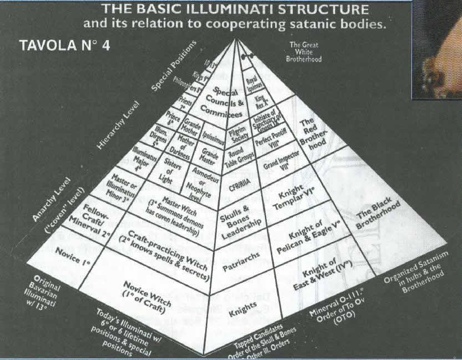
Is Cartoon Network making light of the Illuminati? A little bit...

Moral quagmire and moral clarity, based on this good bit by James Dobbins on Moral clarity in the mideast. More on this.
From the Daily Show, Bush's desperate soundbites:
According to WWTDD.com, Saddam Hussein got a personal screening of the South Park movie.
A Lockheed Martin engineer used YouTube to put his whistleblower message out, covered by the Washington Post. Check the video:
The Israel Lobby matter churns on: with the AIPAC espionage trial around the corner and a disastrous war between Israel and Lebanon, the underpinnings of the 'special relationship' between Israel and the United States seem to be front and center.
On Antiwar.com, Justin Raimondo looks at "Two Elephants in the room: Israel and its amen corner", looking at how the Washington Post's high-handed reporter Dana Milbank attacked top international politics professors John Mearsheimer and Stephen Walt for speaking at the Council on American-Islamic Relations. Mearsheimer and Walt have sparked big controversy by writing on the influence of what they termed "the Israel Lobby" on America's foreign policy. I would call it "the right-wing Israel Lobby" since there are Jewish groups like Peace Now and Tikkun who are silenced, gagged and marginalized in Washington by AIPAC and its neoconservative allies. One purpose of what they call the "Israel lobby" is to silence the more liberal Jewish lobby. (Antiwar is messed up so try this printable version)
Reporters like Milbank generally speak in favor of the corrupt neo-con foreign policy establishment, denigrating anyone looking critically at the fake Iraq war intelligence, and the role of AIPAC in influencing America's middle east policy. Milbank's mockery of Democratic hearings on the Downing Street Memo is a truly disgusting piece of reporting. For a background on AIPAC, look at AIPAC's Overt and Covert Ops by Juan Cole from 2004.
Other randomness: Israeli-style air security may head west.
Godwin's Law strikes again: Islamo-fascism: It is suddenly trendy to call America's opponents "Islamic fascists" that we can't "appease". Right now on MSNBC one of Bush's toadies is telling the Hardball host that they are basically the same as Nazis. It reminds me that political identities are shaped by words, and merging ethnic or religious words with menacing political formations is an effective way to demonize enemies. Terms like "Islamofascist" cut off critical thinking and processing actual reality, hoping to replace thought with emotional cues. This is why the real Nazis called the Jews "Judeo-Bolsheviks" – "one of the central themes of fascist ideology" as a paper on the official site of Israel's Holocaust museum puts it. "Islamofascist" is just the Judeobolshevik of the 21st century, and it serves pretty much the same purpose: to rationalize annihilation.
Local trickle-down: This is becoming a more-than-latent issue in local political campaigns, especially Keith Ellison's primary contest in Minnesota's Fifth Congressional District. Ellison is a Black Muslim, and the strongly Jewish St. Louis Park composes a large chunk of the Fifth District. While Jewish folks, like any other identified voting 'bloc', have a variety of views on the race, there were a lot of awkward stories about Ellison and the Nation of Islam, tying Ellison to the rather anti-semitic organization. I don't really know if these stories have stuck, but it certainly was a story that the anti-Ellison parts of the establishment latched onto.
Today, Ellison has been markedly more sympathetic to Lebanon than his primary opponents, which seems reasonable to me, but this promises to bring out the wrath of the hard core of the Israeli government's supporters. Stand by for what that's going to add up to by the September 12 primary...
Well that's all for now. Catch ya on the flip side. I'm going to the fair tomorrow.
Iraqi intuition: As Joe Biden and Chris Matthews talked about on Hardball the other night, apparently President Bush did not expect Iraqi Shiites to support Hezbollah. This is the shrewd leadership of the War on Terror, folks. Sy Hersh was talking about how Cheney's office spoofed the intelligence on Lebanon and Israel. Again, the rosy shock-and-awe type scenarios failed tactically and stategically, as they always do. Strategic bombing never really works.
Apparently, The Pentagon's Air Force types were convinced Israel's planned tactical air campaign (long planned) would work. According to Hersh and others, the Marines and the Army are very skeptical about attacking Iran, since they would get sent in to invade Iran when the Air Force plan fails. It turns out that the intuitions of the Pentagon skeptics were right, not surprisingly. Any kind of military action on Iran would make our whole Middle East situation completely fall apart – and yes, the Iranians have a lot of fancy missiles they've bought with all the oil money. Iran's mountainous terrain makes South Lebanon look like a golf course.
 This image comes from former Defense Intelligence Agency officer Pat Lang's blog, Sic Semper Tyrannis, which has had some of the best commentary on the tactics between the IDF and Hezbollah.
Various commentaries: "How I found myself with the Islamic fascists" by Jonathan Cook. This essay would make Bill O'Reilly's head explode. "Israel, Defeated: Round one: Lebanon, 1 – Israel, 0" by Justin Raimondo at AntiWar.com.
Huzzah for Shias: Check out the book review of The Shia Revival.
Hezbollah's suicide bombers in past campaigns were mostly not Shiite: this is fascinating because it indicates that 'religion' per se is not the motivating factor for suicide attacks. What is? Foreign military occupation. Evidence: Professor Robert Pape found this, posted in the Guardian: What we still don't understand about Hizbollah, August 6:
This week, world terrorism expert Robert Pape will share with the FBI the findings of his remarkable study of 462 suicide bombings. He concludes that such acts have little to do with religious extremism and that the West must engage politically to halt the relentless slaughter: Israel has finally conceded that air power alone will not defeat Hizbollah. Over the coming weeks, it will learn that ground power won't work either. The problem is not that the Israelis have insufficient military might, but that they misunderstand the nature of the enemy.
In terms of structure and hierarchy, it is less comparable with, say, a religious cult such as the Taliban than to the multi-dimensional American civil rights movement of the 1960s. What made its rise so rapid, and will make it impossible to defeat militarily, was not its international support but the fact that it evolved from a reorientation of pre-existing Lebanese social groups.
Evidence of the broad nature of Hizbollah's resistance to Israeli occupation can be seen in the identity of its suicide attackers. Hizbollah conducted a broad campaign of suicide bombings against American, French and Israeli targets from 1982 to 1986. Altogether, these attacks, which included the infamous bombing of the marine barracks in Beirut in 1983, involved 41 suicide terrorists. Researching my book, which covered all 462 suicide bombings around the globe, I had colleagues scour Lebanese sources to collect martyr videos, pictures and testimonials and biographies of the Hizbollah bombers. Of the 41, we identified the names, birth places and other personal data for 38. We were shocked to find that only eight were Islamic fundamentalists; 27 were from leftist political groups such as the Lebanese Communist Party and the Arab Socialist Union; three were Christians, including a female secondary school teacher with a college degree. All were born in Lebanon. What these suicide attackers - and their heirs today - shared was not a religious or political ideology but simply a commitment to resisting a foreign occupation. Nearly two decades of Israeli military presence did not root out Hizbollah. The only thing that has proven to end suicide attacks, in Lebanon and elsewhere, is withdrawal by the occupying force.
Previous analyses of suicide terrorism have not had the benefit of a complete survey of all suicide terrorist attacks worldwide. The lack of complete data, together with the fact that many such attacks, including all those against Americans, have been committed by Muslims, has led many in the US to assume that Islamic fundamentalism must be the underlying main cause. This, in turn, has fuelled a belief that anti-American terrorism can be stopped only by wholesale transformation of Muslim societies, which helped create public support of the invasion of Iraq. But study of the phenomenon of suicide terrorism shows that the presumed connection to Islamic fundamentalism is misleading.
There is not the close connection between suicide terrorism and Islamic fundamentalism that many people think. Rather, what nearly all suicide terrorist campaigns have in common is a specific secular and strategic goal: to compel democracies to withdraw military forces from territory that the terrorists consider to be their homeland. Religion is rarely the root cause, although it is often used as a tool by terrorist organisations in recruiting and in other efforts in service of the broader strategic objective. Most often, it is a response to foreign occupation.
Understanding that suicide terrorism is not a product of Islamic fundamentalism has important implications for how the US and its allies should conduct the war on terrorism. Spreading democracy across the Persian Gulf is not likely to be a panacea as long as foreign troops remain on the Arabian peninsula. The obvious solution might well be simply to abandon the region altogether. Isolationism, however, is not possible; America needs a new strategy that pursues its vital interest in oil but does not stimulate the rise of a new generation of suicide terrorists. The same is true of Israel now.....
 The backdrop is energy resources, and water too. From The Wilderness teased a pay story:
AS THE WORLD REELS FROM ISRAELI ATTACKS ON INNOCENT CIVILIANS DURING THE PAST THREE WEEKS, CULMINATING IN THIS WEEKEND'S ATROCITIES AT QANA, WE HEAR LITTLE ABOUT THE PIPELINE POLITICS AND WATER ISSUES BEHIND THE SCENES. BUT ISRAEL'S DESPERATE MILITARY MADNESS CANNOT BE FULLY UNDERSTOOD WITHOUT GRASPING THE FRANTIC RESOURCE WARS THAT FORM THE BACKDROP OF THE CURRENT MIDDLE EAST CARNAGE.
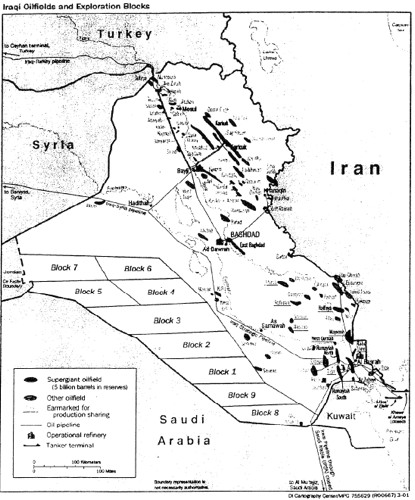
True enough. Encircling the Shiite's area of oilfields is important to guys like Dick Cheney. The situation in Iraq is fueled by the conflict over Iraq's oil revenue, of course. That crazy relief map is from here. It shows the Rumaila and other key oilfields around the Kuwaiti-Iraqi border. Rumaila was one of the key reasons Saddam invaded Kuwait. He claimed they were slant-drilling under the border, which was probably true since the Kuwaitis are dickheads.
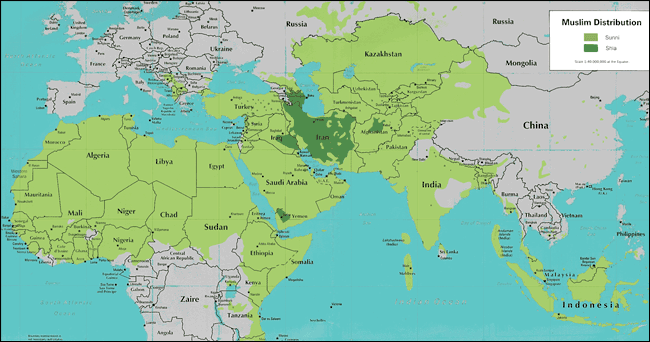
Here is a map of the Sunni-Shiite distribution. In my opinion it actually doesn't show the Shiites of eastern Saudi Arabia correctly, but oh well... Shiites are darker.
And here is the famous Iraq oil map (PDF) from Cheney's energy task force:
There is this kind of strategy to encircle the general area... The Christian Science Monitor had this badass map showing where American troops are, relative to the pipelines: (more on this here)

I don't know what the hell this is, some kind of "heat map", but it looks cool from a cool-looking site:

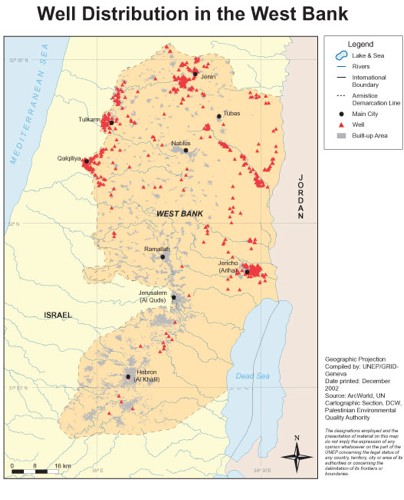
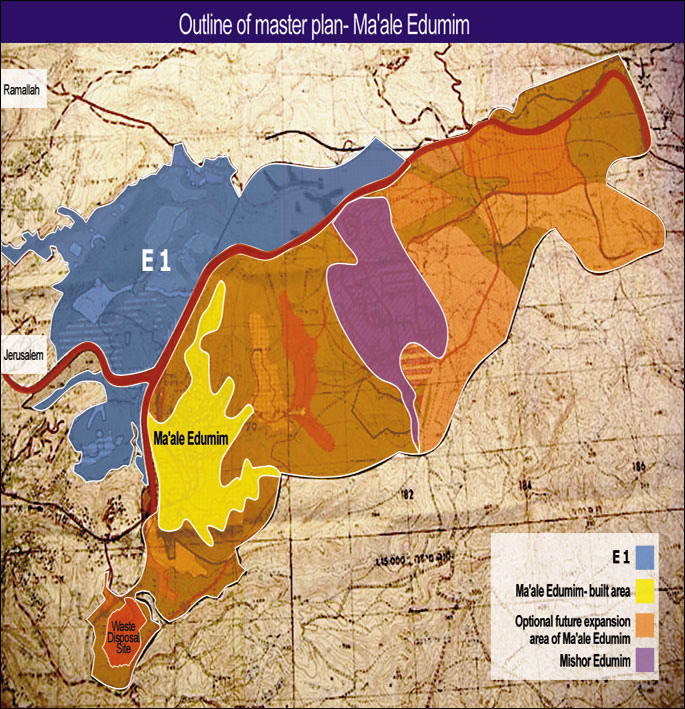
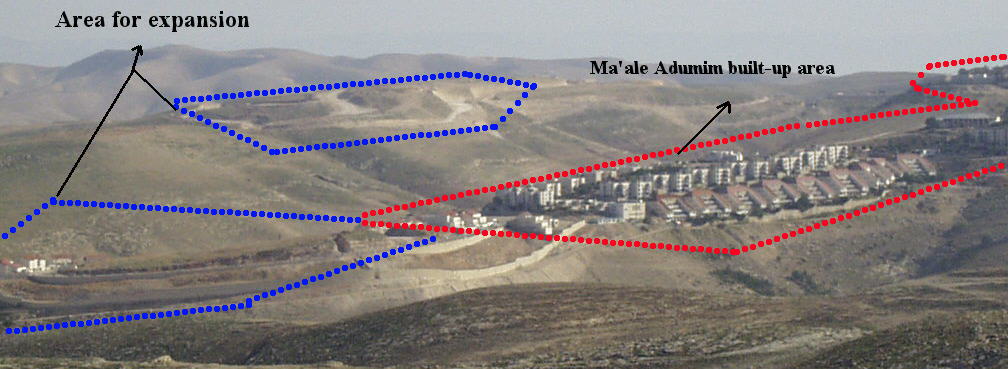
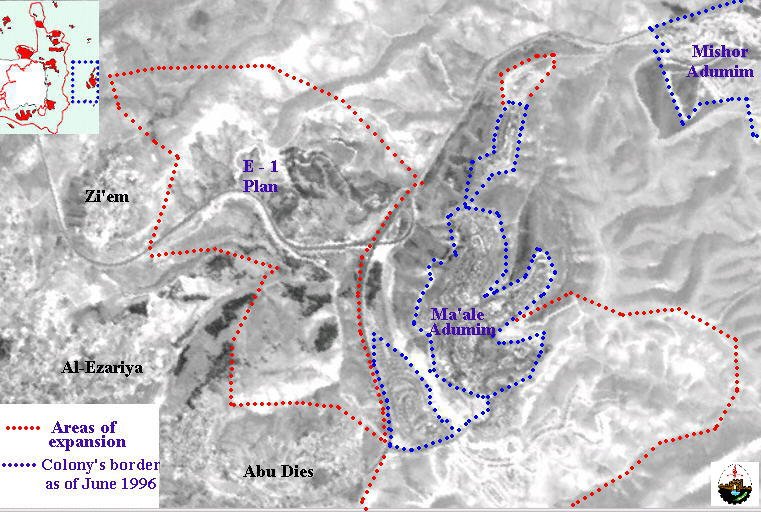
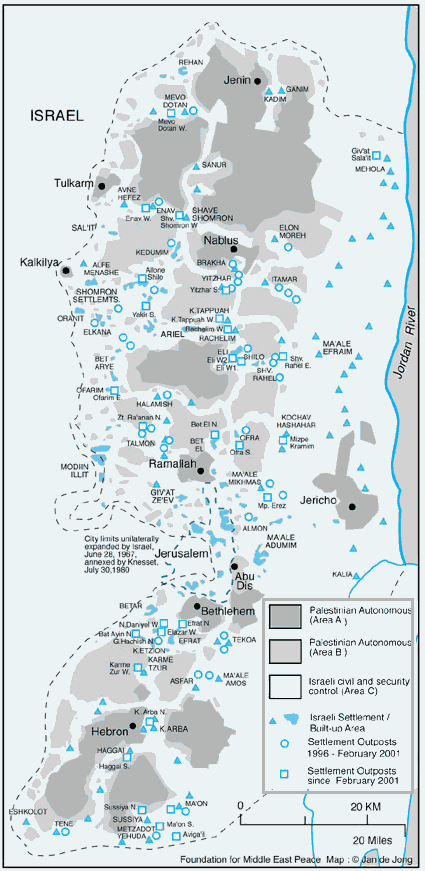
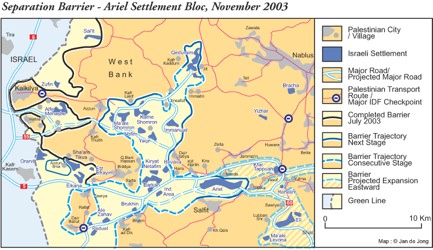
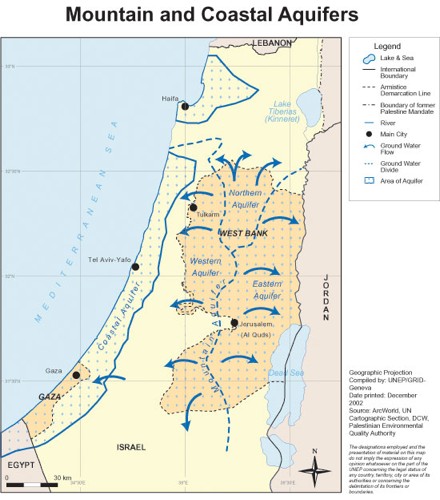
The Israelis are holding the Golan Heights because of water, as they tell you, and the West Bank wall is laid out to cut off many wells from Palestinian access. The largest settlement in the West Bank, Ariel, is situated on a ridge area in the north, directly above the main aquifer. One wonders why the Litani River is such a big deal anyway. More on Ariel.
I recommend reading this page about Israel's water wars. It's very relevant. For your comparison here, the 'nose' of the West Bank that juts just outside of the red mountain aquifer is Kalkilya - the northern West Bank's westernmost Palestinian city. Ariel, the most horizontal blob, is centered on the red aquifer, as you can see with the power of imagination (since the American media is never going to fucking tell you this).

Iran noise: so we've gathered that this whole thing was an overture to a war in Iran (aka "World War III"). As one pretty pissed off international studies professor, Alon Ben-Meir put it:
The war of perception: Israel`s failure will undoubtedly embolden Iran to challenge it at a different time and circumstance, while Syria may decide that Israel is not such a formidable military after all and resort to more aggressive tactics to regain the Golan.
Hamas` resolve to resist Israel may harden, and Hezbollah which, by every objective military standard, suffered a strategic defeat, has already emerged as triumphant in the eyes of the Arab world for having withstood the Israeli onslaught with valor, may be emboldened to lie in wait for the next confrontation.
Having lost the war of perception Israel must be careful not to translate this into real strategic losses in dealing with the Arab-Israeli conflict or with Iran.
.......
The real danger in the future comes from Iran, and it looms extremely large. If it is to respond effectively, Israel must develop strategies that deny Iran not just the opportunity to meddle in the Arab-Israeli conflict but make Tehran fear for its very existence, and so refrain from even contemplating any act of hostility against Israel.
An Israel that is, rightly or wrongly, perceived as weak, will simply invite more serious military challenges because Israel`s real enemies like Iran are relentless, and now they smell blood.
That's all for now. I really like maps!
Now that the dust is settling, we are hearing reports from the field about what exactly Hezbollah was doing down in South Lebanon. For more military analyses look at this excellent thread on Agonist.org Lessons Learned. Guys like William Lind have good stuff too.
For the moment, we are going to post a big chunk of Anthony Cordesman's summary of the whole damn thing. The press conference is here (PDF), the actual doc is here.
Center for Strategic and International Studies
1800 K Street, N.W. • Suite 400 • Washington, DC 20006
Phone: 1 (202) 775-3270 • Fax: 1 (202) 457-8746
Web: http://www.csis.org/burke/
Preliminary “Lessons” of the Israeli-Hezbollah War (PDF)
Anthony H. Cordesman, Arleigh A. Burke Chair in Strategy acordesman@aol.com
Working Draft for Outside Comment, Revised: August 17, 2006
[Page 16]....
Lessons and Insights into Various Tactical,
Technological, and Other Military Aspects of the War
Once again, it is important to stress that many key details of the tactics, technology, and
other aspects of the fighting are not yet clear. There are, however, several additional
lessons that do seem to emerge from the conflict.
High Technology Asymmetric Warfare
There is virtually no controversy over whether the fighting with the Hezbollah shows just
how well a non-State actor can do when it achieves advanced arms, and has strong
outside support from state actors like Iran and Syria. Top-level Israeli intelligence
personnel and officers stated that most aspects of the Hezbollah build-up did not surprise
them in the six years following Israel’s withdrawal in Lebanon.
Mosad officials stated that they had tracked the deployment of some 13,000 Katyushas,
far more sophisticated Iranian medium and long-range artillery rockets and guided
missiles (Zelzal 3), better surface-to-air missiles like the SA-14, SA-16, and possibly SA-
8 and SA-18, the CS-801 anti-ship missile, and several more capable anti-tank weapons
like the AT-3 Sagger Two and Kornet. They also identified the armed UAV the
Hezbollah used as either the Iranian Mirsad-1 or Ababil-3 Swallow.
Israeli intelligence officials also stated that they knew some 100 Iranian advisors were
working with the Hezbollah, and that they knew Iran not only maintained high volumes
of deliveries, but also had created a Hezbollah command center for targeting and
controlling missile fire with advanced C2 assets and links to UAVs. They noted that they
had warnings of better sniper rifles, night vision devices, and communications as well as
of technical improvements to the IEDs, bombs, and booby traps that the Hezbollah had
used before the Israeli withdrawal.
Israeli officials and officers were not consistent about the scale or nature of the
technology transfer to the Hezbollah or of how many weapons they had. In broad terms,
however, they agreed on several points.
Hezbollah Rocket and Missile Forces
Israel faced a serious local threat from some 10,000-16,000 shorter-range regular and
extended range versions of the Kaytusha. These are small artillery rockets with individual
manportable launchers. The rockets have small warheads and ranges of 19-28 kilometers
(12-18 miles) that can only strike about 11-19 kilometers (7-12 miles) into Israel unless
launched right at the border. They can easily be fired in large numbers from virtually any
position or building, and the Hezbollah had a limited capacity for ripple fire that partly
made up for the fact that such weapons were so inaccurate that they hit at random, could
only be aimed at town-sized targets, and had very small warheads. They were, however,
more than adequate to force substantial evacuations, paralyze local economic activity,
and drive the Israelis that remained to shelters.
Israeli officers and officials made it clear that Israel’s real reason for going to war,
however, was the steady deployment of medium and longer range systems, and the
potential creation of a major Iranian and Syrian proxy missile force that could hit targets
throughout Israel.
This force included Syrian 220mm rockets and systems like the Fajr 3, with ranges of 45-
75 kilometers, capable of striking targets as far south as Haifa and Naharia. The IAF was
able to destroy most of the Iranian Fajr 3 launchers the first night of the war, but the IDF
did not know the Syrian rockets were present.
The Fajr 3, or Ra’ad, has a range of 45 kilometers, a 45-kilogram warhead, a 240-mm
diameter, a 5.2-meter length, and a weight of 408 kilograms.
A total of some 24-30 launchers and launch vehicles, carrying up to 14 rockets each, seem to have been present.
The IAF feels it destroyed virtually all launchers that fired after the first few days, but
Israeli officers did not provide an estimate of how many actually survived.
They also included the Syrian 302-mm artillery rockets and Fajr 5, with ranges of 75 and
higher kilometers. The IAF again feels that it was able to destroy most of the Iranian Fajr
5 launchers the first night of the war, but the IDF again did not know the Syrian 302-mm
rockets were present.
The Fajr 5 is launched from a mobile platform with up to four rockets per launcher, and
has a maximum range of 75 kilometers, a 45-kilogram warhead, a 333-mm diameter, a
6.48-meter length, and a weight of 915 kilograms.
A total of some 24-30 launchers and launch vehicles seem to have been present. Again, the IAF feels it destroyed virtually all
launchers that fired after the first few days, but Israeli officers did not provide an estimate
of how many actually survived.
The level of Hezbollah capabilities with the Zelzal 1, 2, and 3 and other possible systems
has been described earlier. These missiles have ranges of 115-220 kilometers. The Zelzal
2 is known to be in Hezbollah hands and illustrates the level of technology involved. It is
a derivative of the Russian FROG 7, and has a range in excess of 115 kilometers. It has a
610-mm diameter, a 8.46-meter length, and a weight of 3,545 kilograms.
It requires a large TEL vehicle with a large target signature.
Anti-Ship Missiles
The Hezbollah C-802 missile that damaged an Israeli Sa’ar 5, one of Israel’s latest and
most capable ships, struck the ship when it was not using active countermeasures. It may
or may not have had support from the coastal radar operated by Lebanese military fires
destroyed by IAF forces the following day.
According to Global Security, the Yingji YJ-2 (C-802) is powered by a turbojet with
paraffin-based fuel. It is subsonic (0.9 Mach), weighs 715 kilograms, has a range 120
kilometers, and a 165 kilogram (363 lb.). It has a small radar cross section and skims
about five to seven meters above the sea surface when it attacks the target. It has good
anti-jamming capability.
Anti-Armor Systems
The IDF faced both older anti-tank guided missile (ATGM) threats like the AT-3 Sagger,
AT-4 Spigot, and AT-5 Spandrel—each of which is a wire-guided system but which
become progressively more effective and easier to operate as the model number
increases.
The IDF also faced far more advanced weapons like the Russian AT-13 Metis-
M which only requires the operator to track the target, and the AT-14 Kornet-E, a third
generation system, that can be used to attack tanks fitted with explosive reactive armor,
and bunkers, buildings, and entrenched troops. Many of these systems bore serial
numbers that showed they came directly from Syria, but others may have come from Iran.
The AT-14 is a particularly good example of the kind of high technology weapon the US
may face in future asymmetric wars. It can be fitted to vehicles or used as a crew-portable
system.
It has thermal sights for night warfare and tracking heat signatures, and the
missile has semi-automatic command-to-line-of-sight laser beam-riding guidance. It flies
along the line of sight to engage the target head-on in a direct attack profile. It has a
nominal maximum range of 5 kilometers. It can be fitted with tandem shaped charge
HEAT warheads to defeat tanks fitted with reactive armor, or with high
explosive/incendiary warheads, for use against bunkers and fortifications. Maximum
penetration is claimed to be up to 1,200mm.
Other systems include a greatly improved version of the 105.2-mm rocket-propelled
grenade called the RPG-29 or Vampire. This is a much heavier system than most
previous designs. It is a two-man crew weapon with a 450-meter range, and with an
advanced 4.5-kilogram grenade that can be used to attack both armor and bunkers and
buildings. Some versions are equipped with night sights.
The IDF saw such weapons used with great tactical skill, and few technical errors,
reflecting the ease with which third generation ATGMs can be operated. They did serious
damage to buildings as well as armor. The Hezbollah also showed that it could use the
same “swarm” techniques to fire multiple rounds at the same target at the same time often
used in similar ambushes in Iraq. As of August 11th, however, a total of 60 armored
vehicles of all types (reports these were all tanks are wrong) had been hit. Most continued
to operate or were rapidly repaired in the field and restored to service. Only 5-6 of all
types represented a lasting vehicle kill.
Anti-Aircraft
The IDF estimates that the Hezbollah at least have the SA-7 and SA-14 manportable
surface-to-air missile system, probably have the SA-16, and may have the SA-18. The
SA-14 and SA-16 are much more advanced than the SA-7, but still possible to counter
with considerable success. The SA-18 Grouse (Igla 9K38) is more problematic.
According to the Federation of American Scientists, it is an improved variant of the SA-
14 that uses a similar thermal battery/gas bottle, and the same 2 kilogram high-explosive
warhead fitted with a contact and grazing fuse. The missile, however, is a totally new
design and has much greater operational range and speed. It has a maximum range of
5200 meters and a maximum altitude of 3500 meters, and uses an IR guidance system
with proportional convergence logic, and much better protection against electro-optical
jammers.
It is possible that it may have been given a few SA-8 Gecko (Russian 9K33 Osa) SAM
systems that are vehicle mounted, radar-guided systems with up to a 10-kilomter range,
and six missiles per vehicle.
The IDF is concerned that these systems would allow the Hezbollah to set up “ambushes”
of a few IAF aircraft without clear warning—a tactic where only a few SA-8s could
achieve a major propaganda victory. This concern, coupled to the risk of SA-16 and SA-
18 attacks, forced the IAF to actively use countermeasures to an unprecedented degree
during the fighting.
Low Signature; Asymmetric Stealth
One key aspect of the above list is that all of the systems that are not vehicle-mounted
are low signature weapons that very difficult to characterize and target and easy to bury
or conceal in civilian facilities. Stealth is normally thought of as high technology. It is
not. Conventional forces still have sensors geared largely to major military platforms and
operating in environments when any possible target becomes a real target. None of these
conditions applied to most Hezbollah weapons, and the problem was compounded by the
fact that a light weapon is often easier to move and place without detection in a built-up
area than a heavy one.
This signature issue applies to small rockets like the Qassam and Kaytusha that require
only a vestigial launcher that can be place in a house or covert area in seconds, and fired
with a timer. Israeli video showed numerous examples of Hezbollah rushing into a home,
setting up a system, and firing or leaving in a time in less than a minute.
It also applies to UAVs. Israel’s normal surveillance radars could not detect the Iranian
UAVs, and the IDF was forced to rush experiments to find one that could detect such a
small, low-flying platform. (This may be an artillery counterbattery radar but Israeli
sources would not confirm this.)
Technological Surprise
Israeli officers and experts did indicate that the IDF faced technological surprise and
uncertainty in some areas.
Syria evidently supplied nearly as many medium range artillery rockets—220 mm and
302 mm—as Iran, and a major portion of the Katyushas. The RPG-29 anti-tank weapon
and possible deployment of more advanced anti-tank guided weapons was not
anticipated. It was not possible to determine how advanced the surface-to-air missiles
going to Hezbollah forces were. It was not possible to determine the exact types and level
of capability for Iran’s long-range missile transfers because the three types of Zelzal are
so different in performance, and other Iranian systems (including ones with much better
guidance) are similar to what Israel calls the Zelzal 2 and 3.
The fact Israel faced some degree of technological surprise should not, however, be a
source of criticism unless there is evidence of negligence. If there is a lesson to be drawn
from such surprise, it is that it is almost unavoidable when deliveries are high and many
weapons are small and/or are delivered in trucks or containers and never seen used in
practice.
It is even more unavoidable when rapid transfer can occur in wartime, or new facilities
are created, such as the joint Iranian-Syrian-Hezbollah intelligence (and advisory?) center
set up during the fighting in Damascus to give the Hezbollah technical and tactical
intelligence support. The lesson is rather that the war demonstrates a new level of
capability for non-state actors to use such weapons.
Cost
The US and Israel quote figures for the cost of these arms transfers that can reach the
billions, and talk about $100-$250 million in Iranian aid per year. The fact is that some
six years of build-up and arms transfers may have cost closer to $50-$100 million in all.
The bulk of the weapons involved were cheap, disposable or surplus, and transfers put no
strain of any kind on either Syria or Iran.
This is a critical point, not a quibble. Playing the spoiler role in arming non-state actors
even with relatively advanced weapons is cheap by comparison with other military
options. The US must be prepared for a sharp increase in such efforts as its enemies
realize just how cheap and easy this option can be.
Reevaluating the Level of Tactical and Technological Risk in the Forces of
Asymmetric and Non-State Actors
Experts like Sir Rupert Smith have already highlighted the risk posed to modern military
forces and states by opponents that fight below the threshold in which conventional
armies are most effective. Iraq has shown that even comparatively small transfers of
technology like motion sensors, crude shaped charges, and better triggering devices can
have a major impact in increasing the ability of insurgents and terrorists.
The Hezbollah have raised this to a whole new level, operating with effective sanctuary
in a state and with major outside suppliers—which Al Qa’ida has largely lacked. It is also
only the tip of the iceberg. It does not seem to have used the advanced SAMs listed
above, but the very threat forces IAF fighters and helicopters to constantly use
countermeasures. The use of ATGMs and RPG-29 not only inhibits the use of armor, but
sharply reduces the ability to enter buildings and requires dispersal and shelter.
The simple risk of long-range rocket attacks requires constant air and sensor coverage in
detail over the entire Hezbollah launch front to be sure of hitting launchers immediately.
The IDF’s task also could grow sharply if Iran/Syria sent the Hezbollah longer-range
rockets or missiles with precision guidance—allowing one missile to do serious damage
to a power plant, desalination plant, refinery/fuel storage facility with little or no warning.
The lesson here is not simply Hezbollah tactics to date. It is the need to survey all of the
weapons systems and technology that insurgents and terrorists could use in future strikes
and wars with the thesis that technology constraints are sharply weakening, and the US
and its allies face proliferation of a very different kind. It is to explore potential areas of
vulnerability in US forces and tactics non-state or asymmetric attackers can exploit,
carefully examine the holdings of state sponsors of such movements, and reexamine web
sites, training manuals, etc, to track the sharing or exploration of such technology.
Like Israel, the US and its other allies face long wars against enemies that have already
shown they are highly adaptive, and will constantly seek out weaknesses and the ability
to exploit the limits to conventional warfighting capabilities. The US must anticipate and
preempt when it can, and share countermeasure tactics and technologies with its allies.
Informal Networks and Asymmetric "Netcentric Warfare"
Like insurgent and terrorist groups in Iraq and Afghanistan—and in Arab states like
Algeria, Egypt, Saudi Arabia, and other states threatened by such groups—the Hezbollah
showed the ability of non-state actors to fight their own form of netcentric warfare. The
Hezbollah acted as a "distributed network" of small cells and units acting with
considerable independence, and capable of rapidly adapting to local conditions using
media reports on the, verbal communication, etc.
Rather than have to react faster than the IDF's decision cycle, they could largely ignore it,
waiting out Israeli attacks, staying in positions, reinfiltrating or reemerging from cover,
and choosing the time to attack or ambush. Forward fighters could be left behind or
sacrificed, and "self-attrition" became a tactic substituting for speed of maneuver and the
ability to anticipated IDF movements.
Skilled cadres and leadership cadres could be hidden, sheltered, or dispersed. Rear areas
became partial sanctuaries in spite of the IDF. Aside from Nasrallah, who survived, no
given element of the leadership cadre was critical.
A strategy of attrition and slow response substituted for speed and efficiency in command
and control. The lack of a formal and hierarchical supply system meant that disperse
weapons and supplies—the equivalent of "feed forward logistics"—accumulated over six
years ensured the ability to keep operating in spite of IDF attacks on supply facilities and
resupply.
The ability to fight on local religious, ideological, and sectarian grounds the IDF could
not match provided extensive cover and the equivalent of both depth and protection. As
noted earlier, civilians became a defensive weapon, the ability to exploit civilian
casualties and collateral damage became a weapon in political warfare, and the ability to
exploit virtually any built up area and familiar terrain as fortresses or ambush sites at
least partially compensated for IDF armor, air mobility, superior firepower, and sensors.
The value and capability of such asymmetric "netcentric" warfare, and comparatively
slow moving wars of attrition, should not be exaggerated. The IDF could win any clash,
and might have won decisively with different ground tactics. It also should not be
ignored. The kind of Western netcentric warfare that is so effective against conventional
forces has met a major challenge and one it must recognize.
Well that sounds like some badass shit. More later, but for now, dig the asymmetrical networkality of the low apogee swarm missile strategy. It delivers the goods!
The next three paragraphs are horror incarnate. It's like we wrapped everything wrong about the whole last six years into one little ball and fucking nuked the world. Seymour Hersh's latest:
Cheney’s office supported the Israeli plan, as did Elliott Abrams, a deputy national-security adviser, according to several former and current officials. (A spokesman for the N.S.C. denied that Abrams had done so.) They believed that Israel should move quickly in its air war against Hezbollah. A former intelligence officer said, “We told Israel, ‘Look, if you guys have to go, we’re behind you all the way. But we think it should be sooner rather than later—the longer you wait, the less time we have to evaluate and plan for Iran before Bush gets out of office.’ ”
Cheney’s point, the former senior intelligence official said, was “What if the Israelis execute their part of this first, and it’s really successful? It’d be great. We can learn what to do in Iran by watching what the Israelis do in Lebanon.”
The Pentagon consultant told me that intelligence about Hezbollah and Iran is being mishandled by the White House the same way intelligence had been when, in 2002 and early 2003, the Administration was making the case that Iraq had weapons of mass destruction. “The big complaint now in the intelligence community is that all of the important stuff is being sent directly to the top—at the insistence of the White House—and not being analyzed at all, or scarcely,” he said. “It’s an awful policy and violates all of the N.S.A.’s strictures, and if you complain about it you’re out,” he said. “Cheney had a strong hand in this.”
Securing the Northern Border:
Syria challenges Israel on Lebanese soil. An effective approach, and one with which American can sympathize, would be if Israel seized the strategic initiative along its northern borders by engaging Hizballah, Syria, and Iran, as the principal agents of aggression in Lebanon, including by:
• striking Syria’s drug-money and counterfeiting infrastructure in Lebanon, all of which focuses on Razi Qanan.
• paralleling Syria’s behavior by establishing the precedent that Syrian territory is not immune to attacks emanating from Lebanon by Israeli proxy forces.
• striking Syrian military targets in Lebanon, and should that prove insufficient, striking at select targets in Syria proper.
"A Clean Break: A New Strategy for Securing the Realm" by Richard Perle, Douglas Feith & other neo-cons (1996).
Emphasis mine on 'precedent,' or 'demo', as it was called in Washington during the Lebanon planning stage earlier this year.
Ten years on, the clean break has run its course:
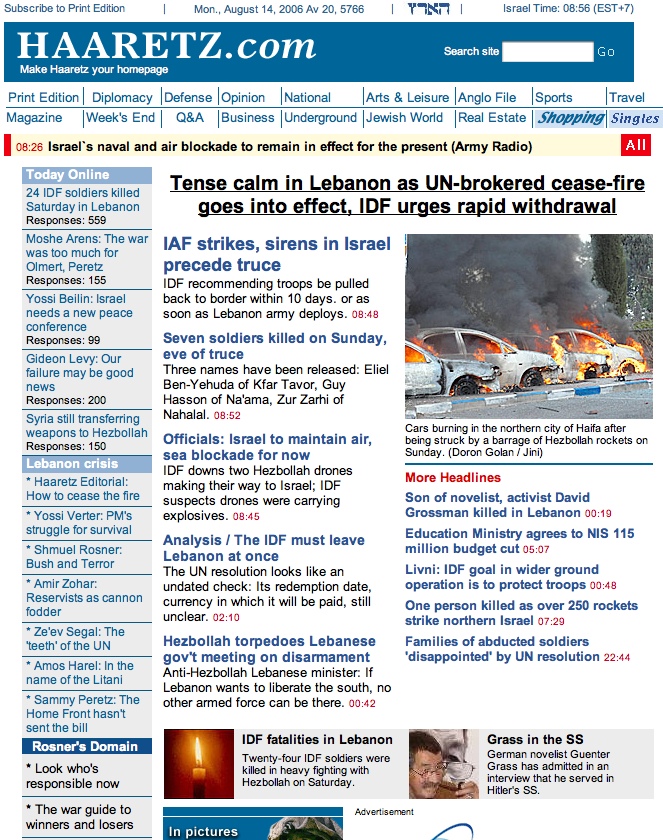
The clock just ran out. And now we find out that they were winding it up weeks before Hezbollah captured the Israeli soldiers. The captures were just a pretext: Israel and the United States wanted to smack Hezbollah around to demonstrate how weak the Iranian proxy was, and also to prepare American military planners for an Iranian attack with a "demo" of bombing (Shiite) missiles, bunkers and tunnels.
Of course, the demo failed. Failed Big Time. Thousands of dead all around, an inhuman consequence of the war Israel launched with American backing, but it's quite possible that Hezbollah's performance in the war has blown all the Pentagon's Iran fantasies to smithereens. In Washington, Bush and Cheney planned to kill lots of Lebanese in order to weaken Hezbollah and prepare the Iran war. That alone should chill you for a while.
It should chill you almost as much as witnessing the complete failure of the Western military style's beloved "full spectrum dominance", which we pretty much just did. Strategy, intelligence, tactics, training, logistics: all were complete failures. The Bush Administration misread Lebanon in a way that Ariel Sharon never would have. Now Israel's vaunted military "posture" has been crushed, revealed to all the world as incapable of defeating a well-armed modern infantry playing defense.
Israel's weak, almost meaningless military performance was one of the 21st century's signature moments – and the cruel ideologies endorsing the carpet bombing of Lebanon – this is the face of the Neoconservative world to come, if we do nothing.
The sense that Israel's military power would create order in the Middle East, forcing the Arabs to accept a peace deal on Israel's dictated terms, was one of the major principles of the Neoconservative philosophy, and the Revisionist flavor of Zionism before it. In the 1920s, Vladimir Jabotnisky wrote in the Iron Wall that only force would or could bring the Arabs to moderation – and today the Neoconservatives refuse, in principle, to negotiate with Evil Ones. Their fantasy that Israel and America could create a new, hard hegemonic (imperial?) alliance over the Middle East, on a foundation of splintered ethnic groups and military force, would never work. (Partly because those pesky subjects of the alliance tend to unite when they get bombed). Today, a core element of the Neoconservative philosophy has just evaporated as the UN saves the day. Its gears are gone.
Part of the Bush administration's plan here, according to Hersh, was to set Lebanon's other minorities against Hezbollah by bombing the common infrastructure of the country. This appears to me a pretty good example of the Iron Wall intended to divide Arabs so they cut a nicer deal with Israel. And yet again, it failed because it's a stupid fucking idea that has ruined Israel's fortunes with illusory violence at every turn. Hersh:
The long-term Administration goal was to help set up a Sunni Arab coalition—including countries like Saudi Arabia, Jordan, and Egypt—that would join the United States and Europe to pressure the ruling Shiite mullahs in Iran. “But the thought behind that plan was that Israel would defeat Hezbollah, not lose to it,” the consultant with close ties to Israel said.
Maybe Ariel Sharon learned this one the hard way in Beirut. He never wanted to try for the Litani River again, I think we can guess.
The information operation to justify the war was cynical and employed a "family == nation" metaphor designed to help the American audience psychologically project support for the war agenda, in a way that the ordinary spats between Israel and Arabs don't. The Israeli soldiers captured were just the 'morality' window dressing of the war makers. They were nothing but symbolic pawns, deliberately used to inspire the Israeli and American populations to support their leaders. They were just an opening bracket, a façade fronting a sinister "demonstration war" blasted through Lebanon, intended to enhance Israel and America's strategic might – and the Republican Party's dark political prospects in November.
Sy Hersh is giving us the goods again. He will probably be the one man who holds back the Iran war from happening. What he reports here is the hardest version of what I suspected: in DC they egged this war on, they planned it, they wanted to blow the shit out of Lebanon, and then Iran. They've wanted to run the Clean Break program since 1996. It is clear today that it's a failure at every level, but soon they'll hand out medals to make themselves feel better.
You need to read this whole article right away. This is another disastrous execution of an ideology that has critically damaged Israel, the United States, Lebanon and Iraq. The big winners are Al Qaeda and Iran. Tell me again why it's such a fucking good idea.
WATCHING LEBANON: Washington’s interests in Israel’s war.
by SEYMOUR M. HERSH
Issue of 2006-08-21, Posted 2006-08-14
In the days after Hezbollah crossed from Lebanon into Israel, on July 12th, to kidnap two soldiers, triggering an Israeli air attack on Lebanon and a full-scale war, the Bush Administration seemed strangely passive. “It’s a moment of clarification,” President George W. Bush said at the G-8 summit, in St. Petersburg, on July 16th. “It’s now become clear why we don’t have peace in the Middle East.” He described the relationship between Hezbollah and its supporters in Iran and Syria as one of the “root causes of instability,” and subsequently said that it was up to those countries to end the crisis. Two days later, despite calls from several governments for the United States to take the lead in negotiations to end the fighting, Secretary of State Condoleezza Rice said that a ceasefire should be put off until “the conditions are conducive.”
The Bush Administration, however, was closely involved in the planning of Israel’s retaliatory attacks. President Bush and Vice-President Dick Cheney were convinced, current and former intelligence and diplomatic officials told me, that a successful Israeli Air Force bombing campaign against Hezbollah’s heavily fortified underground-missile and command-and-control complexes in Lebanon could ease Israel’s security concerns and also serve as a prelude to a potential American preëmptive attack to destroy Iran’s nuclear installations, some of which are also buried deep underground.
[snip.........]
The U.S. government consultant with close ties to Israel told me, however, that, from Israel’s perspective, the decision to take strong action had become inevitable weeks earlier [than the kidnapping], after the Israeli Army’s signals intelligence group, known as Unit 8200, picked up bellicose intercepts in late spring and early summer, involving Hamas, Hezbollah, and Khaled Meshal, the Hamas leader now living in Damascus.
One intercept was of a meeting in late May of the Hamas political and military leadership, with Meshal participating by telephone. “Hamas believed the call from Damascus was scrambled, but Israel had broken the code,” the consultant said. For almost a year before its victory in the Palestinian elections in January, Hamas had curtailed its terrorist activities. In the late May intercepted conversation, the consultant told me, the Hamas leadership said that “they got no benefit from it, and were losing standing among the Palestinian population.” The conclusion, he said, was “ ‘Let’s go back into the terror business and then try and wrestle concessions from the Israeli government.’ ” The consultant told me that the U.S. and Israel agreed that if the Hamas leadership did so, and if Nasrallah backed them up, there should be “a full-scale response.” In the next several weeks, when Hamas began digging the tunnel into Israel, the consultant said, Unit 8200 “picked up signals intelligence involving Hamas, Syria, and Hezbollah, saying, in essence, that they wanted Hezbollah to ‘warm up’ the north.” In one intercept, the consultant said, Nasrallah referred to Olmert and Defense Minister Amir Peretz “as seeming to be weak,” in comparison with the former Prime Ministers Ariel Sharon and Ehud Barak, who had extensive military experience, and said “he thought Israel would respond in a small-scale, local way, as they had in the past.”
Earlier this summer, before the Hezbollah kidnappings, the U.S. government consultant said, several Israeli officials visited Washington, separately, “to get a green light for the bombing operation and to find out how much the United States would bear.” The consultant added, “Israel began with Cheney. It wanted to be sure that it had his support and the support of his office and the Middle East desk of the National Security Council.” After that, “persuading Bush was never a problem, and Condi Rice was on board,” the consultant said.
The initial plan, as outlined by the Israelis, called for a major bombing campaign in response to the next Hezbollah provocation, according to the Middle East expert with knowledge of U.S. and Israeli thinking. Israel believed that, by targeting Lebanon’s infrastructure, including highways, fuel depots, and even the civilian runways at the main Beirut airport, it could persuade Lebanon’s large Christian and Sunni populations to turn against Hezbollah, according to the former senior intelligence official. The airport, highways, and bridges, among other things, have been hit in the bombing campaign. The Israeli Air Force had flown almost nine thousand missions as of last week. (David Siegel, the Israeli spokesman, said that Israel had targeted only sites connected to Hezbollah; the bombing of bridges and roads was meant to prevent the transport of weapons.)
The Israeli plan, according to the former senior intelligence official, was “the mirror image of what the United States has been planning for Iran.” (The initial U.S. Air Force proposals for an air attack to destroy Iran’s nuclear capacity, which included the option of intense bombing of civilian infrastructure targets inside Iran, have been resisted by the top leadership of the Army, the Navy, and the Marine Corps, according to current and former officials. They argue that the Air Force plan will not work and will inevitably lead, as in the Israeli war with Hezbollah, to the insertion of troops on the ground.)
[.......]In the early discussions with American officials, I was told by the Middle East expert and the government consultant, the Israelis repeatedly pointed to the war in Kosovo as an example of what Israel would try to achieve. The NATO forces commanded by U.S. Army General Wesley Clark methodically bombed and strafed not only military targets but tunnels, bridges, and roads, in Kosovo and elsewhere in Serbia, for seventy-eight days before forcing Serbian forces to withdraw from Kosovo. “Israel studied the Kosovo war as its role model,” the government consultant said. “The Israelis told Condi Rice, ‘You did it in about seventy days, but we need half of that—thirty-five days.’ ”
.....Get ready for the New October Surprise. Michael Ledeen is pissed right now. He's gonna pull some shit to stage an Iran conflict, as James Bamford warned you in Rolling Stone.

Who, me?
It's just another disaster for the Jews and the Arabs, and certainly a disaster for America. When will these folks realize that their leaders are the real enemies, paralyzing their nations with fear to secure their own power?
And what about War Crimes charges? Billions of people want to know...
If the Israelis don't get the hell out of Lebanon, soon, then Hezbollah's "real war" starts. And Robert Fisk, at least, expects that it probably will. On the other hand, Haaretz is saying that the IDF wants to get out "within 10" days. So consider this the worst-case scenario, but this comes from one of the most experienced and battle-hardened journalists of the Middle East.
Robert Fisk: As the 6am ceasefire takes effect... the real war begins
Published: 14 August 2006
The real war in Lebanon begins today. The world may believe - and Israel may believe - that the UN ceasefire due to come into effect at 6am today will mark the beginning of the end of the latest dirty war in Lebanon after up to 1,000 Lebanese civilians and more than 30 Israeli civilians have been killed. But the reality is quite different and will suffer no such self-delusion: the Israeli army, reeling under the Hizbollah's onslaught of the past 24 hours, is now facing the harshest guerrilla war in its history. And it is a war they may well lose.
In all, at least 39 - possibly 43 - Israeli soldiers have been killed in the past day as Hizbollah guerrillas, still launching missiles into Israel itself, have fought back against Israel's massive land invasion into Lebanon.
Israeli military authorities talked of "cleaning" and "mopping up" operations by their soldiers south of the Litani river but, to the Lebanese, it seems as if it is the Hizbollah that have been doing the "mopping up". By last night, the Israelis had not even been able to reach the dead crew of a helicopter - shot down on Saturday night - which crashed into a Lebanese valley.
Officially, Israel has now accepted the UN ceasefire that calls for an end to all Israeli offensive military operations and Hizbollah attacks, and the Hizbollah have stated that they will abide by the ceasefire - providing no Israeli troops remain inside Lebanon. But 10,000 Israeli soldiers - the Israelis even suggest 30,000, although no one in Beirut takes that seriously - have now entered the country and every one of them is a Hizbollah target.
From this morning, Hizbollah's operations will be directed solely against the invasion force. And the Israelis cannot afford to lose 40 men a day. Unable to shoot down the Israeli F-16 aircraft that have laid waste to much of Lebanon, the Hizbollah have, for years, prayed and longed and waited for the moment when they could attack the Israeli army on the ground.
Now they are set to put their long-planned campaign into operation. Thousands of their members remain alive and armed in the ruined hill villages of southern Lebanon for just this moment and, only hours after their leader, Sayed Hassan Nasrallah, warned Israel on Saturday that his men were waiting for them on the banks of the Litani river, the Hizbollah sprang their trap, killing more than 20 Israeli soldiers in less than three hours.
Israel itself, according to reports from Washington and New York, had long planned its current campaign against Lebanon - provoked by Hizbollah's crossing of the Israeli frontier, its killing of three soldiers and seizure of two others on 12 July - but the Israelis appear to have taken no account of the guerrilla army's most obvious operational plan: that if they could endure days of air attacks, they would eventually force Israel's army to re-enter Lebanon on the ground and fight them on equal terms.
Hizbollah's laser-guided missiles - Iranian-made, just as most Israeli arms are US-made - appear to have caused havoc among Israeli troops on Saturday, and their downing of an Israeli helicopter was without precedent in their long war against Israel.
In theory, aid convoys will be able to move south today to the thousands of Lebanese Shia trapped in their villages but no one knows whether the Hizbollah will wait for several days - they, like the Israelis, are physically tired - to allow that help to reach the crushed towns.
Atrocities continue across Lebanon, the most recent being the attack on a convoy of cars carrying 600 Christian families from the southern town of Marjayoun. Led by soldiers of the Lebanese army, they trailed north on Saturday up the Bekaa valley only to be assaulted by Israeli aircraft. At least seven were killed, including the wife of the mayor, a Christian woman who was decapitated by a missile that hit her car.
In west Beirut yesterday, the Israeli air force destroyed eight apartment blocks in which six families were living. Twelve civilians were killed in southern Lebanon, including a mother, her children and their housemaid.
An Israeli was killed by Hizballoh's continued Katyusha fire across the border. The guerrilla army - "terrorists" to the Israelis and Americans but increasingly heroes across the Muslim world - have many dead to avenge, although their leadership seems less interested in exacting an eye for an eye and far more eager to strike at Israel's army.
At this fatal juncture in Middle East history - and no one should underestimate this moment's importance in the region - the Israeli army appears as impotent to protect its country as the Hizbollah clearly is to protect Lebanon.
But if the ceasefire collapses, as seems certain, neither the Israelis nor the Americans appear to have any plans to escape the consequences. The US saw this war as an opportunity to humble Hizbollah's Iranian and Syrian sponsors but already it seems as if the tables have been turned. The Israeli military appears to be efficient at destroying bridges, power stations, gas stations and apartment blocks - but signally inefficient in crushing the "terrorist" army they swore to liquidate.
"The Lebanese government is our address for every problem or violation of the [ceasefire] agreement," Israel's Prime Minister, Ehud Olmert, said yesterday, as if realising the truce would not hold.
And that, of course, provides yet another excuse for Israel to attack the civilian infrastructure of Lebanon.
Far more worrying, however, are the vague terms of the UN Security Council's resolution on the multinational force supposed to occupy land between the Israeli border and the Litani river.
For if the Israelis and the Hizbollah are at war across the south over the coming weeks, what country will dare send its troops into the jungle that southern Lebanon will have become?
Tragically, and fatally for all involved, the real Lebanon war does indeed begin today.
Be sure to look at LebanonUnderSeige.gov.lb. Recently posted was a piece by Azmi Bishara, an Israeli Arab and MK. This is one of the harshest things I have read in a while, but there is something very disturbing about how they use all this aircraft – and the distinct lack of morality to the whole thing... Bombs from planes are MoralityPlusGoodBoeingYay!!!
For news today keep an eye on Antiwar.com - and please give them some money, the world needs their work pretty bad. Also Haaretz in Israel and Lebanon's Daily Star. Agonist.org and Juancole.com are also good to check.
Also check out Uri Averny's "Lust for war".


When the skies rain death
13/08/2006 12:39:00
Azmi Bishara (Arab Israeli Member of the Israeli Knesset, Native of Nazareth)
The culture of the fighter plane is the culture of annihilation. The fighter plane is the quintessence of modern civilisation, the modern goddess. It is the product of the collective input of all the sciences and the neutralisation of all morals and values. In it converge the laser, micro-optics, microelectronics and high-tech aerodynamics, allowing for precision flying, hairline fine guidance, dead-on targeting and surgical destruction. It is hygienic and ultra-precise and its factories, hangars and assembly plants are as tall and spacious cathedrals. These planes are only manufactured in the most industrially developed states, assembled by huge corporations whose employees inhabit equality-oriented societies and receive high salaries. They can only be piloted by highly qualified individuals. They are simultaneously the product of absolute individualism and institutionalised collective labour. The employees who contribute to their manufacture embody societies that have achieved much; they are the elite, a cut above the rest, the chosen ones, the new Aryan race.
As with any goddess of consumerist society it has a built-in obsolescence; a new plane has to be produced every two or three years in order to keep up with demand, incorporating the latest technological developments and scientific discoveries in order to preserve her superiority over the gods of other people. The fighter plane makes the immoral moral. It soars above good and evil, a celestial goddess with an insatiable thirst for sacrificial tribute. The pilot does not see the blood; he doesn't see the bayonet or the bullet piercing through the body of the victim. He does not get dirty because he does not have to crawl. Or see the eyes of his victims.
Nor does he break the commandment thou shalt not kill. All he does is press a button from a long way away. All the victims hear is the screech of the oncoming missile. Then the world shakes around them and they topple over, without so much as swaying. Perhaps they feel excruciating pain before passing into nothingness. All people are helpless before the fighter planes; no father or mother can protect their child. Children are torn to pieces, or buried beneath the rubble of buildings that collapse with an echoing groan that blends with the sound of limbs being torn. Stones, planks of wood, shreds of steel crash into human bone and pulverise skulls -- all in the twinkling of an eye.
Meanwhile, from up there in the pilot's seat, all that can be seen are a plume of smoke and a cloud of dust. "Mission accomplished," radios the pilot to the base, as he executes a neat turn overhead in skies beyond the sea of morals. Then he lands, jumps out of the plane and heads to the barracks, helmet tucked under his arm like a motorcyclist. He goes for coffee in the cafeteria, exchanges jokes with his fellow pilots, with the female staff on the base, and with the mechanics who will be getting his plane ready for another sortie of death. Then he heads home. On his way he listens to some music, clowns around with some children and, maybe, engages in a conversation about politics. He might be earnest, or indifferent or incensed. He could be a leftist or a rightist, in support of gay rights or against them, a self- acclaimed dove or a rabid hawk. But these are not the criteria that qualified him to push the button. All such thoughts and criteria fade into meaninglessness in the religion of the fighter bomber.
The peoples of the world are divided into the haves and have-nots of F-15s and F-16s. The haves are divided into countries that own these planes and countries that are possessed by them. The Arabs are divided not only into the have-nots, but those who don't have and yet have made the planes into golden cows.These fighter planes are omnipresent. They can be visible or invisible. But there is no escaping their venom, nowhere to hide from their missiles. The planes remain in the air but their missiles will swoop down on the passengers of a fleeing car, a bus, an ambulance, and they will bore through the ceilings of bunkers and shelters until they reach the tender bodies within. Human flesh stands no chance against a missile flying toward it from a fighter plane. The body stands naked before the goddess who roams the heavens as edifices of stone and reinforced cement crumble before her. The planes wreak massive destruction, but they cannot resolve the battle against those who have right on their side. To do that the goddess's followers have to fight a ground war. But once the inhabitants of that civilisation start fighting on the ground, they start to die and begin to cry. This phenomenon has given rise to a curious belief, which is that while their soldiers have the right to kill, others do not have the right to kill their soldiers, even in war. This is why when one of their soldiers is struck they are overcome by shock and why when their armies suffer a defeat at the hands of the forces of the weak and oppressed they take it as an affront to the prestige of their army and their military superiority. At such a point Israel stealthily withdraws the ground forces and unleashes the F-16s to bomb "terrorist" locations, be they homes or villages.
It is a cowardly and vindictive way to behave, open to those who possess an air force which enable them to become arrogant airborne tyrants. On the ground they are human beings like everyone else: fragile and brittle. But in the air, with the protection of their goddess, they can stomp around, invisible to the naked eye but certain to make their thunder heard as they pass overhead, taking full advantage of the fragility of those who are left on the ground without planes, and even those who have taken refuge in the holes in the ground. They avenge themselves not just because they have the will to do so -- they hold no monopoly on will -- but because their goddess makes it possible for them to do so.
And the Lord said unto Joshua: "See, I have given into thine hand Jericho, and the king thereof, and the mighty men of valour.
"And ye shall compass the city, all ye men of war, and go round about the city once. Thus shalt thou do six days.
"And seven priests shall bear before the ark seven trumpets of rams' horns. And the seventh day ye shall compass the city seven times, and the priests shall blow with the trumpets...
" ...[A]nd it came to pass, when the people heard the sound of the trumpet, and the people shouted with a great shout, that the wall fell down flat, so that the people went up into the city, every man straight before him, and they took the city.
And they utterly destroyed all that was in the city, both man and woman, young and old, and ox, and sheep, and ass, with the edge of the sword...
And they burnt the city with fire, and all that was therein.
Only the silver, and the gold, and the vessels of brass and of iron, they put into the treasury of the house of the Lord.
And Joshua saved Rahab the harlot alive, and her father's household, and she dwelleth in Israel even unto this day; because she hid the messengers, which Joshua sent to spy out Jericho.
(Joshua 6)
It is destructive power that fills them with pride... the sort that comes before the fall. The death of a child, two children, three; the death of a woman or two; the destruction of an ambulance – when does brute force against innocent people become unacceptable? Thirty children? Fifty? In front of the cameras? How many when there are no cameras at hand? At what point do the scales tip? Cameras, incidentally, do not transmit the putrid odor of bodies crushed beneath the rubble.
It is difficult to pinpoint exactly when the cup slips out of the hand of an Arab or western official as he stares at the television screen. Which image of dying children got through to him? Did his mouth drop agape as his cup crashed to the floor? Did he choke on the food he was eating? Does he think that he should have listened to his aides sooner and called for an immediate ceasefire? Does he groan at the horror of the crimes committed by Israel or slump in despair at Israel's folly in forfeiting yet another opportunity?
Israel was built on targeting civilians. In 1948 it targeted them in order to displace them and usurp their land. It targeted entire villages that it alleged were fedayeen -- resistance fighter -- bases. The "strategy" was founded upon two tenets: the need to deter civilians from supporting the resistance, which is to say to repress the expression of any political or social position, and the need to feed and quench the Israeli thirst for revenge. This two- pronged military creed was epitomised by Unit 101, led by Ariel Sharon in the early 1950s. It raided villages, blew up houses and slaughtered the residents. Among the most notorious fruits of this philosophy were the massacres of Qubya,Nahalin and Al-Bureij in the fifties, and the massacres of Jabalya, Beit Hanoun, Al-Shajaiya, Qasba in Nablus and Jenin in more recent times. To perform these deeds Israel needed butchers, though it called them "legendary warriors". It was a hands-on approach. It did not involve F-16s. With these all that are needed are spoiled youths of the appropriate religious affiliation and with their hearts set on an American consumerist lifestyle.
Israel is deliberately targeting civilians in Lebanon, capitalising on an expedient moment. Its aims are to punish anyone who might have supported the resistance, to displace civilians northward in order to aggravate sectarian tensions in the country and to quench its barbaric thirst for revenge. The current attack, in all its ferocity and with its toll of innocent victims, was planned well in advance, with malice aforethought. Israel is a terrorist state. The diabolical logic of this state is actively supported by another terrorist state led by George Bush, a very dangerous, pathologically violent and sadistic man surrounded by a gang of cool and calculating Machiavellians and apologists for state terrorism. They ardently believe that civilians who don't own fighter planes are so far down the rungs of the ladder in the survival of the fittest that if they die well that's their own fault, a result of their own lack of realism.
This logic has one flaw that makes it unpardonable, a curse that will haunt that civilization, a permanent indictment of its control of the skies: how can children be expected to be "realistic"? How can anyone blame them for their own death?
It is wrong to sing the praises of dead children as if they were heroes, a disgrace to put their bodies on display. These children were not warriors. They were not in the resistance. They did not die in order to achieve a victory for others who didn't die and who hadn't put their lives on the line. These children died because they couldn't escape in time or manage to hide from the planes. They are the victims of the criminally barbaric civilization of fighter planes. Their murderers must be brought to account and the resistance against the aggression must be sustained.
The test of the Zionist left. By Yossi Beilin (Haaretz)
There are those who expect the Zionist left to join in the revelry of war, in the pathetic slogans such as "We will win" and in the fiery comments such as "Nasrallah will remember who Amir Peretz is."
There are those who expect us to join the non-Zionist left, which is calling for a unilateral cease-fire, accuses Israel of war crimes, demands that Hamas and Hezbollah be given what they want, and opposes all use of force. Both sides say this is the test of the Zionist left - and they are right.
We have a deep belief in the right of the Jewish people to a democratic and secure state, which has a stable Jewish majority: the state of the Jewish people and all of its citizens. We are convinced our national interest is in completing the moves toward peace with the Palestinians, Syria and Lebanon, and that there is no alternative to an agreement.
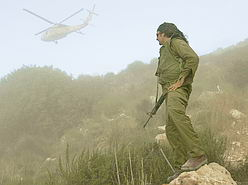 I am not gonna feel like writing tomorrow, so it's either now or the weekend. Here are a lot of bits from the past couple weeks in the Lebanon-Israel conflict. The window after the first two weeks was Israel's chance to capture the initiative against Hezbollah and attempt to achieve their hazily articulated goals in this vicious little war. It's a big war, but the space is very small.
 Escalations for the weekend: Haaretz: Security cabinet okays decision to expand ground operation in Lebanon:
.......PM wavered on expansion decision
Olmert was hesitant prior to the meeting on whether to approve the proposed expansion of the IDF ground operation in south Lebanon.
Olmert was concerned that the plan presented by the defense establishment would result in hundreds of casualties, and therefore, wanted to subject it to a careful cost-benefit analysis. In Tuesday's fighting in Lebanon five soldiers were killed and 23 others wounded, two of them seriously. According to a government source, Olmert had also asked the army to present him with several different options for a ground operation.
A decision to send troops deeper into Lebanon is fraught with considerable risk. In doing so, Israel could set itself up for new criticism that it is sabotaging diplomatic efforts. Also, a wider ground offensive might do little to stop Hezbollah rocket fire on Israel, while sharply increasing the number of casualties among Israeli troops.
While most of the cabinet was expected earlier to back whatever Olmert decides, sources in the Prime Minister's Office said that three to four ministers were likely to oppose a large-scale ground operation regardless of Olmert's position. The IDF's proposal was for a two-week ground operation that would involve conquering the entire area south of the Litani River, and even a few areas north of it, in order to reduce Hezbollah's short-range rocket launching capabilities.
IDF Chief of Staff Dan Halutz said Tuesday that such an operation was necessary "in order to end this war differently." People who participated in discussions of the plan with him said they had never heard him speak as forcefully in favor of anything as he did in favor of the proposed ground operation. Peretz fully supports the army's plan, which he considers essential for Israel to achieve its diplomatic goals.
 Nine paratroopers killed in attack on home in Dibel; 15 soldiers killed Wednesday in south Lebanon
By Amos Harel and Eli Ashkenazi, Haaretz Correspondents, and Agencies Last update - 01:59 10/08/2006
Fifteen Israel Defense Forces troops were killed on Wednesday, the IDF announced late Wednesday night, as fierce fighting with Hezbollah guerillas raged in the southern Lebanon villages of Ayta al-Shaab and Debel.
The 15 IDF soldiers were killed in a series of firefights across the front. In the most serious incident, nine reserve paratroopers were killed and 11 wounded by antitank missiles fired on a house in the village of Debel, in the central sector. Four reservists from an armored brigade were killed in a tank explosion, apparently caused by antitank missiles, in the town of Ayta al-Shaab. An infantryman was killed late Wednesday when he was hit by a mortar in Marjayoun.
DEBKAFile: Israeli official spokesman say deep ground push into Lebanon approved Wednesday to reduce rocket attacks is put on hold for 48 hours to give more time for diplomacy August 10, 2006, 9:26 AM (GMT+02:00)
DEBKAfile adds: On the ground, the first troop and tank elements of the advance began moving Wednesday overnight and are continuing Thursday, Aug. 10.
The decision Wednesday, Aug. 9, by 9 votes, none against and 3 abstentions, includes areas up to the Nabatea plateau and Arnoun beyond the Litani River. The objectof the extension is to reach and eliminate Hizballah's rocket-launch centers. It deepens Israel's thrust to some 45 km from the border and calls for a further large influx of army reserves.
DEBKAfile’s military sources add the extended operation does not promise the total stoppage of all rocket fire against Israel, but could potentially bring about a sizeable reduction from up to 200 a day to some 30 or 50.
Also: The stakes of the Lebanon War have shot up with the expansion of the Israeli offensive up to the Litani and Nasrallah’s rejection of diplomacy in favor of battle
Israel's military of old was specialized in quick, mechanized warfare. As they settled into the occupied territories, despite all the heavy weapons, the IDF reoriented itself to battling Palestinians, typically armed with rifles, handguns or machine guns. The Palestinians have some rocket-propelled grenades, as well, but they lack advanced infantry weapons. So the IDF has phased away from preparing for war with real infantries, and instead play supercop on the hapless residents of the West Bank.
They really thought that Hezbollah was only as "thick" as HAMAS, I guess. The Israelis went storming in without realizing that Hezbollah had lots of anti-tank missiles - on rocky terrain that doesn't give a lot of space for tanks. The IDF doctrine failed in the face of a new kind of conflict.
Right now we are watching a turning point in the nature of warfare. Everything from pack mules to to hacking to encrypted satellite feeds fits into fourth-generation warfare (pdf). Sub-state actors will basically be able to fight a top-notch modern army.
ANALYSIS: IDF still not in control of strip along Lebanon's border By Ze'ev Schiff, Haaretz Correspondent 08:57 10/08/2006
The large number and the location of the casualties that the Israel Defense Forces sustained Wednesday indicate that the army does not yet control the narrow strip along the border, although this stage of the ground operation was supposed to have been completed already.
The two battles also reveal a great deal about Hezbollah's method of fighting. They took place in two relatively small communities, Ayta al-Shab and Debel, close to the international border, on territory that until May 2000 was in Israel's Security Zone.
The ground operation, dubbed "Change of Direction 8," was intended to conquer this border strip. First it was to be a two- to three-kilometer strip. Then it was expanded to five to six kilometers, including numerous Lebanese villages and towns. The mission was to blow up all Hezbollah's outposts in this strip and drive its forces out.
What happened in Bint Jbail recurred in Ayta al-Shab. Although it seemed that the town had been conquered, it transpired again and again that there were still Hezbollah men in it. Once again, clashes and battles took place, and again, the IDF suffered dead and wounded. Although the army had conquered the town, Hezbollah men were hiding in underground bunkers well camouflaged from the outside. The bunkers had been stocked with large quantities of food, enough to last for weeks, and ammunition, including antitank missiles and, in several cases, short-range rockets.
The bunkers are connected to electricity and, according to one report, are air conditioned. When the fighting dies down, Hezbollah fighters emerge from the bunkers and set up ambushes for IDF soldiers and armored vehicles. That is why soldiers are hit repeatedly in the same places.
On several occasions, there have been difficulties evacuating wounded soldiers under fire. At times, Hezbollah fighters have fired rockets at Israel from areas close to the border that the IDF had supposedly conquered already. The means available to flush the guerrillas out of their underground shelters are not always employed.
Senior officers have suggested, inter alia, that the army bombard these towns heavily and even destroy them. But in any case, a decision has been made not to reenter them at this stage. The IDF could forge ahead, as it has done in the last two days in the Marjayoun area. But even after such an incursion, Hezbollah fighters who remain in the bunkers could continue launching rockets. In other words, they could fire toward Israel from behind the lines of IDF forces that have progressed deep into Lebanon. It is clear that the Hezbollah men who stayed behind are equipped with two-way radios and receive information from scouts hiding near the border. This explains the difficulties in managing the fighting in south Lebanon, which the IDF has not encountered before.
Even if Hezbollah "loses", the writing is on the wall. In the 21st century "the State" itself is weakening. Sub-national organizations like Hezbollah, with economic, military, political, social, educational, medical (and often spiritual) branches are displacing the State.
One should remember that the Middle East's artificial European-drawn boundaries have left many overlapping ethnic groups. The Pashtuns now at the core of the Taliban straddle Afghanistan/Pakistan. The Kurds are organized a bit like Hezbollah, and the ruthless pursuit of the Kurds' interests has rewarded them well since the US toppled Saddam. But they too are divided between parties that ruthlessly fight each other.
In Syria, only a few dozen miles east of Israel's bombing campaign lie many major Arab Sunni tribes like the Dulaimis, who especially live in cities along the river into Iraq, where their cousins' tribes live, sparring with Kurds and Shiites.
In this kind of region, everyday people are going to direct their primary loyalties towards sub-national groups that they believe represent their interests. By the early 1990s, Hezbollah, which the Iranians helped create by binding together different Lebanese Shiites, was seen as something of a successful model – social, political, military: robustly structured to resist political pressure, infiltration and military assaults from the Israelis and others.
Before Saddam fell, The Iranians used the Lebanese sub-state model inside Iraq, to lay the framework for the Shiite rise to power. Very quickly, SCIRI, Muqtada Sadr's people, and the Dawa Party all had organized cadres of armed guys, but more importantly, social services and methods for trying to restore any sense of law and order shattered with the US invasion. If the guys on the block with guns keep the thieves away, then they are pretty much your state, even if they don't report to Baghdad.
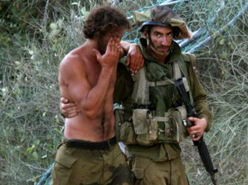 The news in Israel right now is that 15 reservists got killed in Lebanon, with heavy fighting around Bint Jbail, a site the IDF captured and subsequently evacuated. As the maps made clear, Bint Jbail is not more than a few kilometers from the border, yet the Israeli forces, despite all the bombing and everything, have not been able to hold that area, once they reached it and tried to occupy.
Reports in the Israeli media indicate that Hezbollah is able to keep attacking in areas the Israelis have already 'captured.' I think it's pretty likely that Hezbollah has drilled tunnels hundreds, if not thousands of meters long, attached to deeply hidden bunkers with all the necessary weapons and supplies. It is an amazing intelligence failure that the Israelis didn't anticipate this, and still, within a very small space the IDF has not been able to block out Hezbollah. The tempo of rocket attacks has not been curtailed in any serious way, and Israeli military analysts don't really think it can be shut down without a wide invasion. Hezbollah is winning the tactical situation by playing very hard-core defense with lots of anti-tank missiles. So far, it's mostly been a successful military strategy.
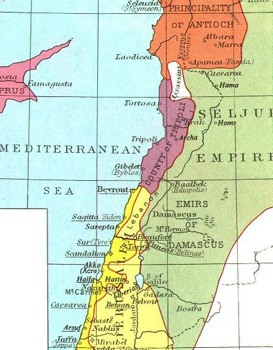 This is in keeping with the local style: in the good old days of the Seljuk Empire (c. 1100), the Hashshashin, or Assassins, would hang out somewhere between Damascus and Antioch - the home of the Holy Hand Grenade. The map's white spot shows a patch of mountainous land where the Assassins held sway. Mountainous redoubts are easier to defend, and such clever methods have migrated about 200 miles south, where nearly a millennia later, some pretty insane shit is going down.
Well then, thats enough rambling background. Here's some damn links.
The rockets keep coming: Hizbollah rockets kill 15 in northern Israel. Hapless reservists. An ugly scene. IDF Raids near Tyre.
Emotional reaction in Israel propels poor policy:
`Peace' is a term not used in the public space in Israel anymore...No one expects any dialogue on a real practical level. The military always offers a shortsighted immediate way out. The wish to identify with the power of the gun and the uniform is still alive in Israeli tribal DNA. Revenge is a word not used in the open; it is there in the undercurrent of the emotions expressed by the public, our bombardment of Gaza had the same motive behind it.
UK Guardian: Israeli pilots 'deliberately miss' targets: Fliers admit aborting raids on civilian targets as concern grows over the reliability of intelligence
You need to give money to AntiWar.com. Their work is important and kinda spooky. Rumors that apocalyptic Christian writers are visiting the White House. Stratfor has free podcasts. Updates on the Tikkun Olam blog (תקון עולם: Make the World a Better Place).
Iranian dimensions:
Haaretz: Nasrallah's dilemma By Amos Harel and Avi Issacharoff
As the war progresses, the depth of Iranian involvement in Hezbollah activity is increasingly being revealed. Hezbollah has established a Tehran-sponsored forward outpost here, under the noses of the Israelis. When the war ends, Iranian soul-searching will include the question as to whether the activity here was not premature: whether the strategic card of the rocket battery was not revealed too early, for the sake of a negligible goal like the release of the four prisoners, instead of saving it for the day of judgment, for the eruption surrounding its nuclear program.
The Iranians are involved up to their necks in Hezbollah activity: Their advisers participated in the firing of the missiles at Israeli ships and in the firing of Strela (SA-7) antiaircraft missiles at Israeli planes and helicopters. During Israel Defense Forces operations in the south, sophisticated listening rooms were discovered, via which the Iranians eavesdropped on Israeli communications and telephone networks, both civilian and military.
Guardian: Bloody night in Beirut as Israel intensifies aerial bombardment: IDF warns UN troops will be attacked if they repair bridges (aug 8)
 Information warfare sector: Olmert meets with spokespeople to sharpen PR message. PrisonPlanet says: Another Israeli Myth Exposed: There Were No Hezbollah Rockets In Qana but Israeli media alleges Qana killing was staged, dubbing this pattern Hezbollywood. With a certain sense of weird horror, Haaretz features "Where there's smoke, there's liars": "1. The Muslim Lie Mode, or The Dead as Visual Aid (When Arabs report what Israel has done) 2. The Israeli Lie Mode, or The Dead as Enemy Weapon (When Israelis report what Israel has done). 3. The American Lie Mode, or The Dead as Nonexistent." Anyway, Half of U.S. Still Believes Iraq Had WMD.
The US-Israeli link: this looks at Condi and an IDF spokesperson as two flipsides: Between two friends by Tom Segev:
During the past 39 years since the Six-Day War, the United States did not force Israel to pull out of the West Bank, but more than once acted to block Israeli military actions. Over time, we have grown accustomed to the Americans saving us, not only from the Arabs, but from ourselves too. Not in this war. It is still unclear whether this war was coordinated with the United States; only the release of government records of the past three weeks will shed light on this. Whatever the case may be, the impression is that the Americans are linking the events in Lebanon to their failing adventure in Iraq.
Israel's elites, in all fields, are made up of people who spent a number of years in the United States and returned with not only professional skills but also an appreciation for the value of the individual and basic freedoms. For the most part, this was a useful process, even though it did contribute to a fading of social compassion. This process of Americanization has led Israel in recent years to covet a role in what Bush has described as a war on the "axis of evil."
As such, Israel has adopted the moral values of Hezbollah: Whatever they are doing to the residents of northern Israel, we can also do to the citizens of Lebanon, and even more. Many Israelis tended to look at the Qana incident primarily as a media disaster and not as something that imposed on them any ethical responsibility. After all, the restrictions of humanitarian warfare are not applicable to the "axis of evil." Just like in Iraq, the lessons of Vietnam have been forgotten. It is hard to avoid the impression that the routine brutality of oppression in the Gaza Strip and the West Bank is also reflected in the unbearable ease with which Israel has forced out of their homes hundreds of thousands of Lebanese and bombed civilians.
Tense situation with Israel's own Arab population (20%): Border Police search Israeli Arab homes without warrants.
Loss of Momentum by Amir Oren (Haaretz):
The IDF's greatest loss was momentum. The first week of the campaign went reasonably well, borne on the wave of the stunning success of the attack of Hezbollah's long-range rockets. Between the middle of the second week and the middle of the third week the IDF lost a week, not least because of its reaction to the eight Golani Brigade soldiers who were killed in Bint Jbail. That lost week, as the rain of Katyusha rockets continued to fall from on high, undermined the army's self-confidence and thrust it into a posture of public self-defense. It shifted into recovery mode only because of the time it was granted by Washington. Fear of a large number of casualties was the major factor in the government's hesitations, for almost a week, about whether to send more divisions into the fray, entailing a call-up of reserve units.
The General Staff admitted the IDF did not work fast enough. They did not grasp the fact that the context had changed and that this was not just one day of battle or a routine-security incident, but a war, which has its own laws. Commanders who were used to operations in the territories did not internalize the need for speed, persistence and continuity.....
The sweeping criticism did an injustice to Division 91 and to the "hunt" concept in the air force. A colonel in the division said this week that for months the division's senior command "drove officers crazy with alerts to prevent abductions, turned over every stone and laid down new stones in order to turn them over, too." The abduction, the colonel noted, was comparable to a special operation by an IDF commando unit, which, in the absence of precise intelligence, is difficult to thwart even after all the preparations across the sector.
Various people yelling at each other: ADL: Hugo Chavez comparison of IDF and Hitler is Outrageous. Yesha (settler) Rabbinical Council objects to ridicule of Chief IDF Rabbi.
Hawks crow: Win that war! (Haaretz). Peace Index: July 2006 / Support for the war and the IDF holds up.
A final batch: I got nothing left after these Haaretz bits: ANALYSIS: There appears to be a command problem in the north. From war, an opportunity. Snatch a possible victory. Down but not out. Little Satan has big teeth. ANALYSIS: Deployment of Lebanese army may be good for both sides.
Well, that's all for a while. Enjoy.
Currently I am putting together a sweet Google Earth view of the south Lebanon tactical situation. In these images, various map overlays have been turned on and off. The first image shows bookmarks and tactical IDF troop maps from Stratfor. These locations are estimated and perhaps tainted with disinformation, but still probably roughly right.
The major overlay map is farther below. I lined all these up by eye, and made use of the transparency of PNG files to make nice translucent edges on the images. Israeli flags mark Lebanese villages (theoretically) occupied by Israeli forces. The blue boxes are notable Israeli units - their types are noted in the big image, which you can go get yourself from the Agonist's fine coverage.
You can download the complete Google Earth animation I put together so far at this link. It should drop right into your Google Earth Browser. Just run the folder as an animation (press play), and toggle the image overlays on and off for various views of the military situation.
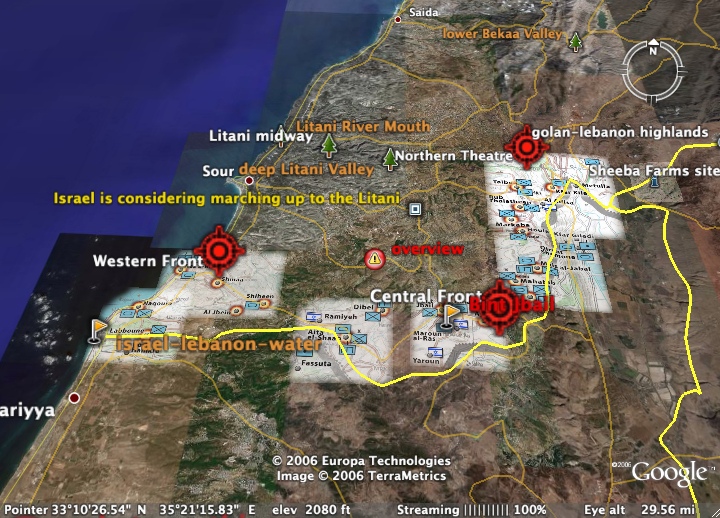
This is in the close quarters around the Kiryat Shmona (Qiryat Shmona), an Israeli city that has been heavily pounded with dozens of rockets every day.
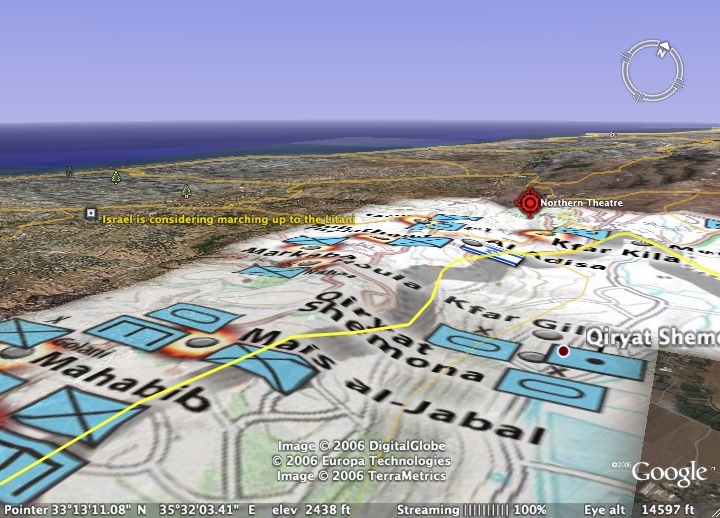
Here is (almost) the same view, just satellite, without tactical overlay:
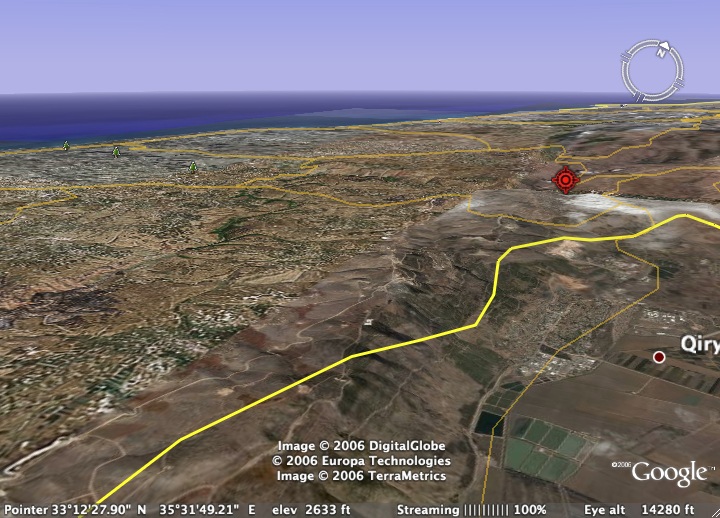
This shot faces back south. The white line here indicates the line to the Israeli border, about 11 miles. This is the upper part of the Litani River valley, a very deep feature running from the Bekaa Valley to the Mediterranean, well north of Tyre. The Israelis occupied up to the Litani River until they were defeated by Hezbollah and withdrew sans peace agreement in 2000.
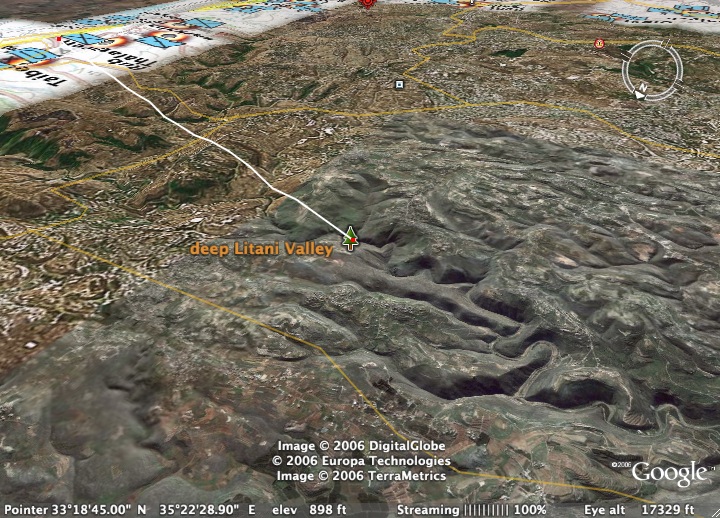
If we zoom back a bit farther, this image adds the original large Stratfor map, placed on top of the landscape - higher altitude, same angle. THe whole area up and to the right is where the Israelis would try to conquer and destroy Hezbollah. However, as we can see, Israel has had little luck getting securing the immediate few thousand meters of the Lebanese south border region - the line of explosions along the top here: (we are facing south-southeast)
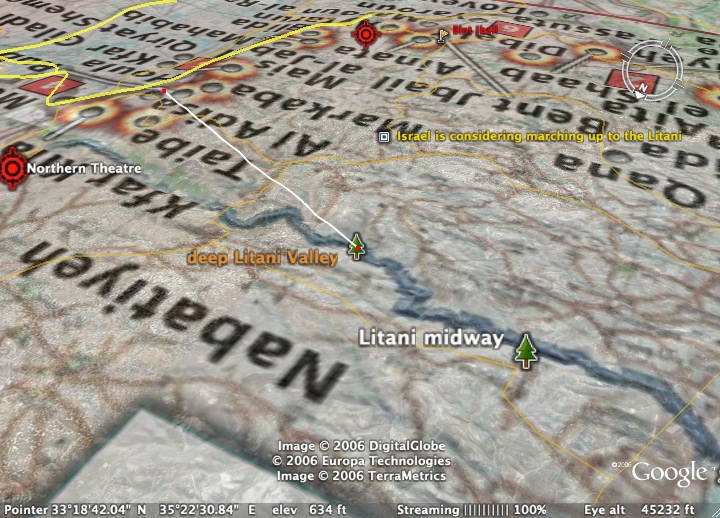
If we flip it around, facing north from above northern Israel, look here. This is the big Stratfor master map, not the detailed tactical views noted above.
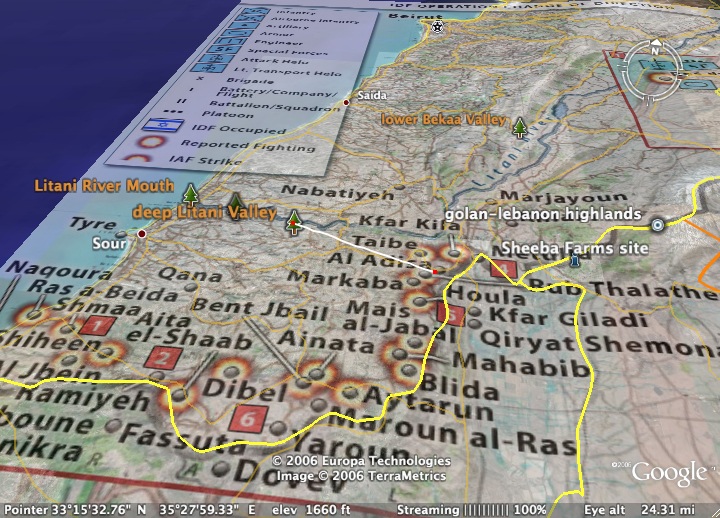
Well that is all for now. Oh wait no it isn't. From the bowels of eccentric retired Israeli hawks come a couple stories from DEBKAFile – a weird news source to be taken with grains of salt. Still, there is much of interest from Debka:
DEBKAfile’s military sources disclose: Hizballah’s rocket offensive against Israel is orchestrated from a rear command located in the Syrian town of Anjar
August 7, 2006, 12:41 PM (GMT+02:00)
While Israeli officials keep on insisting that Syria must be kept out of the conflict, the fact is that the Assad regime is already in it up to their ears – with a leading role in the Hizballah rocket attacks on northern Israel.
The command which coordinates the pace of those attacks is located at the Anjar base of the Syrian Army’s 10th Division opposite the Lebanese town of Az Zabdani. It is manned by Iranian and Hizballah officers, who take their orders from a Syrian military intelligence center in Damascus to which Iranian Revolutionary Guards intelligence officers are attached. It is headed by a general from one of Syria’s surface missile brigades. This joint command is provided with the most up-to-date intelligence and electronic data available to Syria on targets in Israel and IDF movements. The timing and tempo of Hizballah rocket strikes are set according to that information.
To keep the rockets coming without interruption, the joint Hizballah-Syrian-Iranian command is also responsible with keeping Hizballah supplied with an inflow of rockets and launchers. They use smuggling rings to slip the supplies into Lebanon by mule and donkey which ply the 5,000-7,000 feet mountain paths that straddle the Syrian-Lebanese frontier.
A senior Israeli officer told DEBKAfile: We can go on bombing Lebanon for many weeks, but that will not stop the rockets..
 Meanwhile Zarqawi-Mark-2 has arrived to save the day. This story smacks of some truth and a lot of hot air. But still interesting:
Tehran Sends Archterrorist Mughniyeh to Rescue Hizballah
DEBKAfile’s Exclusive Military Report: August 5, 2006, 4:57 PM (GMT+02:00)
In the middle of the fourth week of the Lebanon War, the tide began to turn in Israel’s favor. DEBKAfile’s military sources report the battlefield finally responded to the effect of Israel’s air might, its tank columns, the pounding by mobile artillery and naval craft and its repeated armored infantry assaults.
After losing 44 fighting men, more than 30 civilians, many thousands of wounded and billions of dollars of damage, finally, the Israeli military was given the chance to do what it does best: focus its firepower instead of spreading it out thin over too many targets.
The setbacks of the first three weeks were partly due to tactical incompetence and laggard decision-making on the part of prime minister Ehud Olmert and defense minister Peretz. Israeli troops therefore spent too long in abrading combat against stubborn Hizballah resistance in such places as Maroun er Ras and Bint Jubeil. But as soon as Israeli ground forces shifted to the massive, long-distance firing mode which they knows best, the impact on the warfront was immediate. The battle went their way with a minimum of casualties. In places where Israeli troops adhered to the close combat tactics practiced in the first three weeks, they continued to suffer high casualties.
Hizballah soon showed signs of distress. Lacking the weapons and resources to stand up to IDF’s precise-shooting juggernaut, their commanders quickly pulled their men out most combat sectors of South Lebanon and ordered them to regroup in five places:
1. The Western Sector and the center of Tyre.
2. The Wadi Hajar pocket east of Tyre.
3. The Central Sector surrounding Bint Jubeil, where the outcome is still unresolved after many days of fighting.
4. The Wadi Saluki area northwest of the northernmost Israeli town of Metullah.
5. The Eastern Sector, including al Khiam, the Shabaa Farms and Mt Dov, which has seen little fighting - although last week Israeli forces began - then stopped - a major offensive before it got underway.
These pockets are now the main launching-pads for rockets fired into Israel. Outside, there is no ground fighting in South Lebanon but for Israeli air strikes.
Hizballah also has also been using the Tapuach and al-Haroub areas south and northeast of Sidon for shooting rockets. It is from this region that Hizballah fired the long-range Khaibar-1 missiles at Hadera Friday night, August 4, which came 45 km short of Tel Aviv. Saturday morning, Sidon’s 200,000 inhabitants and its outlying villages up to the Zahrani River were warned to leave their homes and head north to escape the coming Israeli air offensive.
Until the Khaibar attack on Hadera, the concentration of Hizballah’s rocket launchers and stores in and around Sidon had been immune from Israeli attack – largely because Olmert and his senior ministers refused to increase the number of ground troops deployed in Lebanon. The military commanders had to do their best with the limited numbers available.
In other words, with the right manpower level, Hizballah’s abilty to fire rockets can be dented, notwithstanding claims by Israel officials and generals that there is no way to do this when most of Hizballah’s 13,000-rocket stockpile remains intact.
But even cutting down on the daily 200-plus rocket blitz on northern Israel is not plain sailing because:
First, Neither the Israeli Air Force nor any other air force is capable of completely halting rocket fire from the ground. In the relatively small distances between Lebanon and Israel, the short-range Katyusha rockets have the effect of medium-range weapons, while the short-to-medium range rockets perform like long-range missiles.
Second, Israel does not have enough infantry on the ground to make substantial inroads on Hizballah’s rocket-firing capabilities.
Third, Iran and Syria are constantly restocking Hizballah’s diminishing supplies of rockets of all types, launchers and operating manpower by a round- the-clock airlift from Iran via Syrian military air fields. Some of the incoming supplies are destroyed by Israeli air attacks as they cross into Lebanon, but a substantial part is conveyed to Hizballah by smuggling networks employing mules to traverse Lebanese mountain paths. Even if 2,000 have been wiped out and a similar amount has been fired, no one knows how many are left in stock because it is replenished. As long as that corridor is not severed by bombing the Syrian stopover air facilities, Iran will continue to top up Hizballah’s stockpile. Therefore, the rocket offensive cannot be reduced by very much.
Fourth, Israeli forces do not operate in all parts of South Lebanon.
Hizballah’s withdrawal to five pockets in South Lebanon affords the IDF certain tactical advantages - although liabilities too.
The Advantages:
It is now possible to carve the region the Israeli army controls into three sections, western, central and eastern, a tactic familiar from the Gaza Strip, for encumbering Hizballah guerrilla movement between the sections. The goal is to confine Hizballah to the five pockets and place them under blockade. They can then be made to capitulate or face liquidation.
The Liabilities:
Leaving the two banks of the Litani River, the Nabatea plain and Hazbaya to the north of the river in Hizballah hands leaves a route open for its reinforcements to come through and to strike Israeli forces from the rear.
Nonetheless, by Thursday, August 3, Hizballah was showing signs of being in trouble.
A. Local Hizballah village commanders signaled repeated appeals for more manpower and ammunition. The appeals were not met because outside forces cannot break through the defense lines held by the advancing Israeli troops. The village commanders were therefore told by their superiors to fight to the last man and last bullet and reserve the last grenade for suicide.
B. Hizballah’s shadowy leader, the long-wanted Imad Mughniyeh, was hurriedly appointed commander of the southern front as a last resort to save South Lebanon from falling to Israel.(picture from the 1980s)
DEBKAfile’s military and counter-terror sources maintain that this appointment raises the conflict to a new and dangerous level on several counts.
Mughniyeh, wanted for a quarter of a century by the FBI for the huge bombing attacks he orchestrated on the US embassy in Beirut and American and French troops, as well as a spate of hijackings and murders, is important enough to take orders from no-one ranking lower than Iran’s supreme ruler, Ayatollah Ali Khamenei. Those orders come through the Revolutionary Guards commander Gen. Rahim Safavi.
Therefore, placing Mughniyeh at the head of Hizballah forces in South Lebanon confronts prime minister Olmert uncomfortably close to Iran’s supreme leader; ranges defense minister Peretz opposite his Iranian counterpart Mustafa Najer and chief of staff Lt. Gen Dan Halutz opposite Gen. Safavi, while on the warfront, Israel’s war leaders face the formidable Mughniyeh, Tehran’s secret weapon for rescuing Hizballah from collapse.
Informed circles in the West have a high opinion of Mughniyeh’s military, intelligence and tactical skills. His hand was seen in the transformation of al Qaeda’s 2001 defeat in Afghanistan into a launch pad for its anti-US campaign in Iraq and many other ventures in the terror war against America. After the death of Abu Musab al Zarqawi, Mughniyeh is rated the world Islamic terror movement’s most outstanding field commander.
Therefore, while the appointment is a measure of Israel’s belated military success in the Lebanese war, it also brings the conflict ever closer to two dangerous orbits – Tehran and al Qaeda. Mughniyeh is the only undercover agent in the Middle East who enjoys the complete personal trust of Khamenei and Osama bin Laden, on both of whom he is in a position to call for aid.
On the diplomatic front, even if the United States and France can get together on a unified UN Security Council ceasefire resolution, DEBKAfile’s military sources report that neither Iran nor Hizballah has any intention of complying with a resolution dictated by the United States, France and Israel.
Well at the very least, that last bit is exactly the message a bunch of neo-Likudniks would want to be saying, regardless of whether or not it's true. But it might be true. I think these guys are far too optimistic about Israel's situation.
Anyhow that's pretty much the lay of the land, so to speak.
The scene from Israel-Lebanon border according to Stratfor, laid by yours truly over a google earth situation. Google added transparency in overlaid PNG files in Google Earth 4, so it is possible to do nice translucent images.
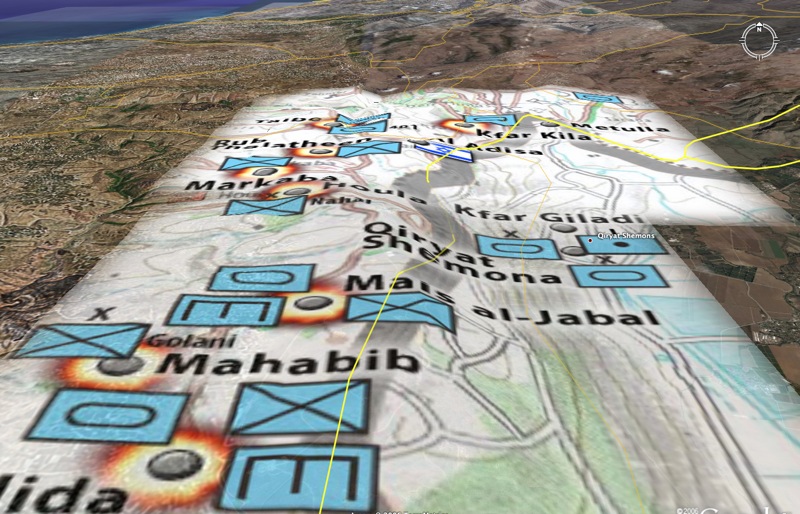
It is not perfectly accurate, but you can get a good sense of how things are laid out. This is a little project for the evening.
Be advised there are graphic images of violence in this post, partly because the American TV networks have suppressed such imagery. Nothing is quite as elusive as Arab blood on American eyeballs. Now that's information warfare.
When God looks down on a "proportionate response," what does S/He see (via the agonist)? Beirut satellite image:
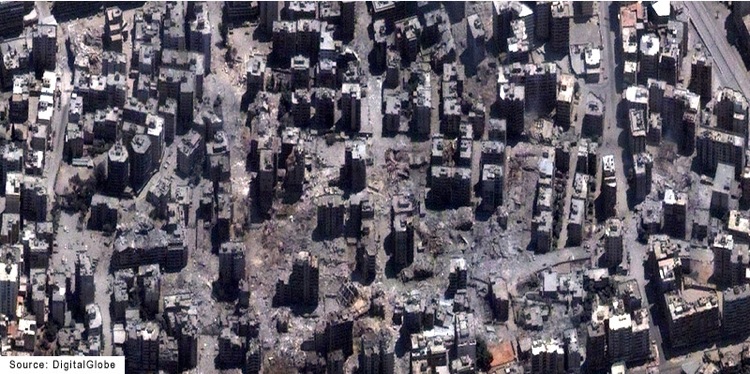
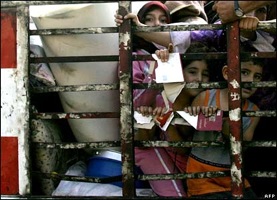
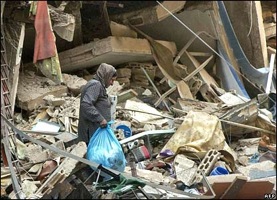
I won't go into details, but always look at Juan Cole's site. Some of the links come from there today. The Agonist is also essential reading, and Antiwar.com's blog. Good points about Western hypocrisy, and said today:
This whole thing was about Olmert proving he had stones as big as Sharon. (Shades of Fallujah in 2004 if you ask me.)
Pat Lang, formerly a top dog at the Defense Intelligence Agency, observes of the IDF withdrawal from Bint Jbeil:
Sounds Like They Couldn't Stand The Heat.
The IDF pulled its ground forces out of Bint Jbeil Saturday all the way back into Galilee. They fought there for days to take the town, lost some men and then started house demolitions. According to my Israeli sources, Hizbullah counter-attacked in strength starting Friday night. The next day Israel withdrew from the town.
It sounds like the politicians couldn't stand the prospect of real war. Or, more fancifully the IAF has laid an elaborate trap for HA. Some of the members of our seminar will prefer that idea.
A week ago the Jerusalem Post said that a "civil administration" (i.e. occupation) government for South Lebanon was being prepared, but it looks like it won't be needed at all.
 Essential reading (and not just because I interviewed the guy!) in the Nation:
Anger in the Arab World by Rashid I. Khalidi - posted July 27
In what passes for analysis of the war involving Israel, Lebanon and Palestine in US and Israeli government circles, in the well-oiled PR machine that shills for them, and in much of the US media, we are told about a struggle against terrorism by a state under siege. The basic argument is that Israel is "responding to terrorist violence," and that the only real question is, How soon will Israeli force, backed by American determination, prevail? But this scenario has little to do with reality in the Middle East.
There will be no "destruction" of Hezbollah, and no "uprooting" of its infrastructure or that of Hamas, whatever the results of Israel's siege of Gaza and its merciless attacks against Lebanon. The rhetoric about "terrorism" has mesmerized those who parrot it, blinding them to the fact that Hezbollah and Hamas are deeply rooted popular movements that have developed as a response to occupation--of the West Bank and Gaza for nearly forty years, and of southern Lebanon from 1978 to 2000. Whatever one might say about the two movements' callousness in targeting civilians (a subject on which Israel's defenders are hardly in a position to preach), both have won impressive victories in elections and have provided social services and protection to their people.......
.....Much depends on whether an Israeli, American or Israeli-American war with Syria and, much more serious, Iran can be avoided. If escalation of what is already a major war in Gaza and Lebanon can be prevented, the conflict's regional effects will be mitigated. Much depends on how fast European public opinion, turning rapidly, expresses its revulsion at what is happening in Lebanon. Tales of the massive destruction and civilian casualties are being carried home by tens of thousands of French, British, Italian and German evacuees, many of them dual nationals, appearing on French and British TV talking about the atrocities they have seen. Much also depends on how adventurous Iran and Syria choose to be, how much punishment Hezbollah can take and still keep fighting, and how wise the Palestinians are in dealing with their difficult internal situation. And much depends on how far the man in the White House will go with his instincts. If he reins in his darker impulses and those of the Israeli general staff, which is running the show on that end of the alliance, the current slide into the abyss can yet be halted. If not, the Middle East and the United States are headed for catastrophe.
Sidney Blumenthal in The Guardian: The neocon resurgence: The delusional US mindset that made the Iraq war a disaster has resurfaced in Lebanon. Lebanon Daily Star: "America's credibility will be a casualty of Israel's war: Whatever reasons arabs ever had to trust washington are going up in smoke".
Osama Bin Laden wins BIG: July 21: "Doing bin Laden's Work for Him" by Michael Scheuer, the CIA guy that ran the Bin Laden unit for years. Gotta read this one:
Most damaging for G-8 leaders will be this week's validation for Muslims of bin Laden's assertion that the West considers Muslim lives cheap and expendable. They will see that three kidnapped Israeli soldiers and several dozen dead Israelis are worth infinitely more to the West than the thousands of Muslims held for years in Israel's prisons, the hundreds already killed in Lebanon, and the eradication of Lebanon's modern infrastructure.
So bin Laden wins without lifting a finger........The impact of this Israel-Hezbollah round will not stop with the inevitable truce that will be declared after Israel ruins Lebanon. While temporary order may return to the Levant, America, Britain, and the West should not fool themselves. They have again gratuitously picked sides in a fight between two inconsequential nations; the survival of neither is a genuine national security interest for any G-8 state. Led by Washington's absurd, 30-year obsession with the minimal Shia threat to America, and blind to the hatred generated among Muslims by their foreign policies, the G-8 have mightily strengthened the enmity, durability, and resolve of the Sunni extremist movement that bin Laden leads and personifies.
Egyptian Al-Ahram Weekly On-Line: First Iraq, now Lebanon: Mainstream media is making the same excuses furnished in Iraq for the destruction of infrastructure and the mass killing of civilians in Lebanon, writes Firas Al-Atraqchi.
Where were those Israeli soldiers captured? Obviously the moral foundation of the war is that Hezbollah captured those Israeli soldiers over the 'Blue Line', inside Israel. But there are stories burbling up that they were actually captured inside Lebanon on some kind of Israeli commando raid. It seems implausible, but the story is out there.
 Neo-cons ginning up Iran war NOW: This is a MUST-read: Iran: The Next War:
Even before the bombs fell on Baghdad, a group of senior Pentagon officials were plotting to invade another country. Their covert campaign once again relied on false intelligence and shady allies. But this time, the target was Iran. BY JAMES BAMFORD
This story HAS to be read. It explains the AIPAC spy scandal, how Ahmed Chalabi told the Iranians that the U.S. was reading their encrypted messages, how Michael Ledeen is gearing up the Iranian opposition to stir up more trouble in Iran. This is a very big deal. I won't quote a lot from here, but this story tracks with a lot of the stuff we've tried to cover here on HongPong in the past. And now it is really getting put into motion. Some jackass on National Review denies everything.
Lebanon Daily Star reports yesterday that Israeli military casualties has forced a change in Israel's military strategy, abandoning a large expansion of ground warfare.
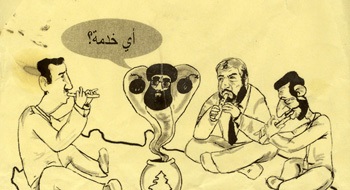
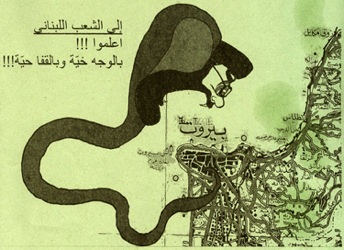 Middle East Report: Israel's War Against Lebanon's Shiites by Jim Quilty in Beirut - July 25. Features copies of Israeli propaganda leaflets (pictured here). Lots of details about those tricky complexities of Lebanese politics.
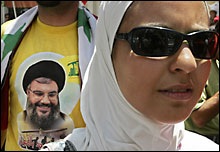 CSM: UN deaths prompt 'diplomatic firestorm': Annan calls attack on observers in Lebanon 'apparently deliberate,' but Israel angrily denies charge. July 28: "Israeli strikes may boost Hizbullah base: Hizbullah support tops 80 percent among Lebanese factions." July 26: Asia Times Online: Hezbollah banks on home-ground advantage By Sami Moubayed.
 Antiwar.com: Be sure to read Fourth Generation War in Lebanon by Ehsan Ahrari. Justin Raimondo: Lebanon: Are the Yanks Coming? Let's hope not…. and Lebanon: Winners and Losers: Bin Laden wins, and we lose. Also, Israel is winning the battle, but not the war on July 25. However, it appears they have lost the battle too. The Fire Next Time by Osamah Khalil about the impact on the rest of the Arab world. Lawless by Nebojsa Malic. Israeli Offensive Targeting Relief Efforts? by Aaron Glantz. Five Myths that sanction Israel's war crimes by Jonathan Cook. (This article was too long though)
On Iraq check out the review of Unembedded, about freelance photo-journalists in Iraq. The photo below was in the book.
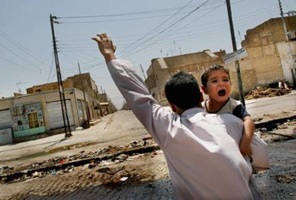
Voice of America News conveys Lebanese refugee stories:
'Tehfa says the bombs are not the only danger. Yaroun is all but cut off from the outside world. "Plus, the people die without food. There is no water, no electricity, no gas. Nothing!" she added. Tehfa literally walked to safety, wearing a pair of black flip-flop sandals and carrying nothing but her shiny black handbag. After nearly two weeks under siege, she and a group of about 70 townspeople - waving a large white flag - walked six kilometers to the nearest village, a place called Rmeich. Another Australian, Fatima Salim, managed to find a car to take her to Rmeich, and then slept in a cramped apartment with 80 other people for three days. "I lost my mother, my brother, my sister-in-law. I do not know where they are gone," she said. "Because I go out from one door, they go out from another door. And for one minute, I cannot see my parents. I do not know where they are." '
Some angry Lebanese post photos of wounded Lebanese children, and photos of Israeli children writing messages on bombs. Graphic. They also posted images of the "Marwaheen Massacre" where Israeli jets pounded and killed a fleeing Lebanese familiy earlier in fighting. The family had previously been turned away from a UN post, which is why the Blue Helmets had to pick up the pieces, literally:
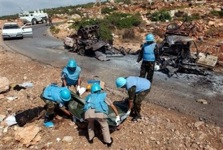
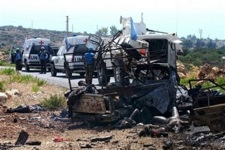
Washington Post editorial from Tuesday: "Air Power Won't Do It" as I said earlier. Interview from a week ago with a former Bush hand on Lebanon in Harpers.
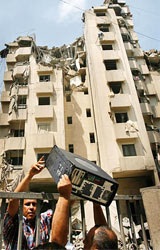 News updates from Wednesday, noted because the Dell this fleeing Beirut guy is heaving over the fence looks just like the old HongPong server. Civilians killed as Israelis target ambulances. From nearly a week ago, the AP was reporting the tenacity of Hezbollah fighters against Israel. Hezbollah fighters popped up in Beirut shortly after Israeli bombings without delay. On the 26th, UK Times said Ferocity of Hezbollah comes as a surprise as Israeli intelligence turns out to be incredibly shitty:
[Israeli] domestic support remains strong, but the first cracks have appeared, with media commentators accusing the army of providing an “insulting level of intelligence” about Hezbollah’s defences. As they munched watermelon yesterday, sweating Israeli soldiers were visibly shocked by the stiff opposition they had encountered, describing their Hezbollah opponents as a “guerrilla army” with landmines and anti-tank missiles capable of crippling a Merkavah battle tank.
“It was really scary. Most of our armoured personnel carriers have holes,” a paramedic told The Times after recovering three wounded tank soldiers. “It’s a very hard situation. We were in Lebanon before but it wasn’t like this for a long time.” A tank commander said: “It’s a real war.” In the Galilee town of Safed, Brigadier-General Shuki Shachar, deputy commander of the northern forces, conceded that the foe was not an easy one. “Hezbollah is a fanatical organisation. It is highly motivated to fight. I don’t want to give grades to the enemy, but they are fighting. They are not escaping,” he said. He insisted, however, that Israel was “changing the balance” after a belated recognition that the Shia group was dug in deeper than expected.
“After a few days we realised that Hezbollah prepared itself over the last six years with thousands of rockets, with hundreds of shelters, bunkers, with hundreds of rockets hid in houses of civilians inside south Lebanon,” he said. [this is one of those small things you figure out BEFORE you launch a war --Dan]
His forces had never intended to “conquer every square inch” of Bint Jbeil but had now achieved their objectives of taking the high ground. Wherever the Israel Defence Forces decided to act, the general said, “we have no problem to do so, no restrictions”.
Which is why they have already departed Bint Jbeil. Because they launched a war unaware of the honeycombs of bunkers and rockets. Hmm.
Things are definitely getting worse in Iraq but at least we got Lasers now?!! under the radar, it seems. News analysis: U.S. could face a showdown with al-Sadr, even more so as the U.S. eggs Israel on to kill more Shiites. In a shrewd move, the U.S. Army fired a gay Arab linguist. War Crimes trials for abusing and torturing detainees are a possibility. Time magazine: How the Lebanon Crisis Complicates U.S. Prospects in Iraq. Democracy Now reports: Star Wars in Iraq: Is the U.S. Using New Experimental Tactical High Energy Laser Weapons in Iraq? It doesn't quite sound like a laser. My money is on directed microwave radiation... I won't make a joke, because this is too creepy:
MAJID AL GHEZALI: Just the head was burnt, and the other parts of the bodies wasn’t anything happened on it.
NARRATOR: Al Ghezali reported that he had seen three passengers in a car, all dead, with their faces and teeth burnt, the body intact, and no sign of projectiles.
MAJID AL GHEZALI: There wasn’t any bullet. I saw the teeth, just the teeth and no eyes, all of them. With the body, nothing for the bodies. Just the teeth, and all the -- I mean, the heads were burnt.
NARRATOR: There were other inexplicable aspects. The terrain where the battle took place was dug up by the American military and replaced with other fresh earth. The bodies that were not hit by projectiles had shrunk to just slightly more than one meter in height.
......DOCTOR NO. 2: It seems to be a new weapon.
SAAD AL FALLUJI: Yes, a new weapon.
DOCTOR NO. 2: They are trying to do experiments on our civilians. Nobody can identify what the type of this weapon.
Ohohoho those crazy Iraqis and their stories. "How could such a thing be true?" says the skeptic. One possibility: half a billion dollars in spending may have produced something larger than a pen laser to fuck around with occupied Muslim populations. The last bit of the article:
WILLIAM ARKIN: So, right now you have about $50 million a year being spent on non-lethal weapons. You have about another $200 million or so being spent on high power microwaves, active denial-type systems. You’ve got probably another $100 to 200 million being spent on secret black laser programs. And then you’ve got the big lasers, the high energy laser of the Air Force and the other tactical lasers. So probably, when you add all of that up, you know, the United States is probably spending a half of a billion dollars a year right now on directed-energy weapons, you know, probably somewhere in the order of 300-400 million euros. So this is a significant amount of money. This is the size of the defense budgets of some countries in Europe.
On a lighter note, Joe Klein on Lieberman's Last Stand and another one of his friends ditches him. Polls are showing Lamont doing real, real well. Oddly, we discover that John Ashcroft was against torture, which is part of the reason they got rid of him.
Blog bits: The Guns of August on DailyKos.com was an interesting roundup of everything. William Arkin tries pretty hard at the WaPo to keep tabs on this stuff. Al Qaeda says it ought to fight alongside Hezbollah and Hamas, a surprising twist. Some general remarks from Obsidian Wings. Neo-con blather about Arab governments supporting Israel turns out to be false. Arab-American Abu Aardvark notes that the Rome conference was a failure.
Idiot on Fox talks about how great it is that Israel attacked UN peacekeeping posts. Greek antiwar protesters toppled a statue of Harry Truman (bet you didn't see that one coming). Kind of a funny video of these cute (Iranian?) girls talking about how much they like Hezbollah.
More Haaretz of course: Haaretz has an interesting feature on how Israeli intelligence agencies have attempted to wrap their heads around Hezbollah's tactical reality. Opening a window on intelligence. "No Time to Lose" by Amir Oren is about the peculiarity of the blaring American "green light" to bomb the shit out of Lebanon. The plan was 2 kilometers "cleared", but it ain't happening. Hezbollah, an empire of millions. Big questions, great frustration indeed. Moral Muddle - interesting questions at an IDF base about the morality of killing Lebanese civilians. A kind of funny article about Arab journalists. Check out The turnabout will come quickly By Meron Benvenisti, a peace guy explaining why the war will be abandoned in Israel. From Wednesday, The war so far / No goals attained By Ze'ev Schiff. Was there a proper decision process? By Aluf Benn. Has the army failed? By Amos Harel Finally,
Morality is not on our side By Ze'ev Maoz
There's practically a holy consensus right now that the war in the North is a just war and that morality is on our side. The bitter truth must be said: this holy consensus is based on short-range selective memory, an introverted worldview, and double standards.
This war is not a just war. Israel is using excessive force without distinguishing between civilian population and enemy, whose sole purpose is extortion. That is not to say that morality and justice are on Hezbollah's side. Most certainly not. But the fact that Hezbollah "started it" when it kidnapped soldiers from across an international border does not even begin to tilt the scales of justice toward our side.
German paper Der Spiegel has INTERVIEW WITH LEBANESE PRESIDENT EMILE LAHOUD: 'Hezbollah Freed Our Country'.
Mitch Prothero in Salon.com on the bullshit about Hezbollah hiding among civilians:
Throughout this now 16-day-old war, Israeli planes high above civilian areas make decisions on what to bomb. They send huge bombs capable of killing things for hundreds of meters around their targets, and then blame the inevitable civilian deaths -- the Lebanese government says 600 civilians have been killed so far -- on "terrorists" who callously use the civilian infrastructure for protection.
But this claim is almost always false. My own reporting and that of other journalists reveals that in fact Hezbollah fighters -- as opposed to the much more numerous Hezbollah political members, and the vastly more numerous Hezbollah sympathizers -- avoid civilians. Much smarter and better trained than the PLO and Hamas fighters, they know that if they mingle with civilians, they will sooner or later be betrayed by collaborators -- as so many Palestinian militants have been.
For their part, the Israelis seem to think that if they keep pounding civilians, they'll get some fighters, too.
The Anglican Christian Bishop in Jerusalem gets blown off by American Christians. Pretty scathing letter from the Bishop:
.....Movement of residents of the West Bank is difficult or impossible as “security measures” are heightened to break the backs of the Palestinian people and cut them off from their place of work, schools, hospitals, and families. It is family and community that has sustained these people during these hopeless times. For some, it is all that they had, but that too has been taken away with the continued building of the wall and check points. The strategy of ethnic cleansing on the part of the State of Israel continues.
This week, war broke out on the Lebanon-Israeli border (near Banyas where Jesus gave St. Peter the keys to heaven and earth). The Israeli government’s disproportionate reaction to provocation was consistent with their opportunistic responses in which they destroy their perceived enemy.
In her recent article, “The Insane Brutality of the State of Israel,” American, Kathleen Christison, a former CIA analyst says, “The state lashes out in a crazed effort, lacking any sense of proportion, to reassure itself of its strength.” She continues, “A society that can brush off as unimportant an army officer’s brutal murder of a thirteen year old girl on the claim that she threatened soldiers at a military post (one of nearly seven hundred Palestinian children murdered by Israelis since the Intifada began) is not a society with a conscience.” The “situation” as it has come to be called, has deteriorated into a war without boundaries or limitations. It is a war with deadly potential beyond the imaginations of most civilized people.
As I write to you, I am preparing to leave with other bishops for Nablus with medical and other emergency supplies for five hundred families, and a pledge for one thousand families more. On Saturday we will attempt to enter Gaza with medical aid for doctors and nurses in our hospital there who struggle to serve the injured, the sick, and the dying.
My plan is that I will be able to go to Lebanon next week - where we are presently without a resident priest - to bury the dead, and comfort the victims of war. Perhaps as others have you will ask, “What can I do?” Certainly we encourage and appreciate your prayers. That is important, but it is not enough. If you find that you can no longer look away, take up your cross. It takes courage as we were promised.
Write every elected official you know. Write to your news media. Speak to your congregation, friends, and colleagues about injustice and the threat of global war. If Syria, Iran, the United States, Great Britain, China and others enter into this war - the consequence is incalculable. Participate in rallies and forums. Find ways that you and your churches can participate in humanitarian relief efforts for the region. Contact us and let us know if you stand with us. I urge you not to be like a disciple watching from afar.
2 Corinthians 6.11:
“We have spoken frankly to you Corinthians, our heart is wide open to you. There is no restriction in our affections, but only in yours. In return - I speak as to children - open wide your hearts also.”
Blackwater blowback: As I just mentioned, the incident with the Blackwater guys in Fallujah was a big deal – so big, it may have crashed the American war effort altogether.
Well that took a long time. I am done blogging for a while, at least a few days. Things are too horrible to leave my mind in this frame. It's the last Saturday in July, and here I am, presenting all this death and doom. I don't want to spend precious days doing stuff like this any more.
Pretty Twisted:
Nasrallah threatens to fire missiles at central Israel, says Israel wants cease-fire, U.S. opposed
By Yoav Stern, Haaretz Correspondent and News Agencies
Hezbollah leader Sheikh Hassan Nasrallah on Saturday vowed to fire rockets on communities in central Israel if the military operation in Lebanon continued, and accused Israel of being an American "slave."
"The bombardment of Afula and its military base is the beginning ... Many
cities in the center [of Israel] will be targeted in the 'beyond Haifa' phase if the savage aggression continues on our country, people and villages," Nasrallah said in a speech aired on Hezbollah's Al-Manar television.
"The Israelis are ready to halt the aggression because they are afraid of the unknown. The one pushing for the continuation of the aggression is the U.S. administration. Israel has been exposed as a slave of the U.S.," he said.
"There are developments on the diplomatic front, and attempts to end the crisis, thanks to our strong position. The enemy attained no military achievements. They admit this," Nasrallah said, claiming that Israel suffered a "serious defeat" in ground fighting around Bint Jbial. Nasrallah said U.S. Secretary of State Condoleezza Rice aimed to impose conditions on Lebanon and to serve Israeli interests during her diplomatic mission to the region.
"Now Ms. Rice is returning to the region to try and impose her conditions again on Lebanon to serve her project, the new Middle East and to serve Israel," he said. Nasrallah pledged to cooperate with the Lebanese government, which has presented a peace package that could lead to the eventual disarming of Hezbollah. The guerrilla group's politicians in the government agreed to the package.
Nasrallah did not mention the proposals specifically. But he suggested that Hezbollah would not follow through with disarmament if the government compromises on conditions outlined in the Lebanese proposal.
"We are keen to cooperate with the government," Nasrallah said. But "for Lebanon to win the battle, it needs political will no less than the will of the resistance fighters in the field ... The government is required to act in a way that reflects the Lebanese people's steadfastness and unity," he said.
"We have a historic opportunity in Lebanon to liberate every inch of our land, regain of our prisoners and guarantee our national sovereignty, so that our skies, water, land and our people are no longer subject to Zionist violation and aggression," he said.
Over the last couple days, a ton of links have piled up. I'm going to break them up by source. There may be a few quotes but I just want to blast through them.
Haaretz - center-left Israeli paper "of record":
IDF leaves Bint Jbail; 6 soldiers hurt in clashes with Hezbollah
Israel rejects UN call for 72-hour halt in fighting; France 'regrets' decision; UN to remove observers from Israel-Lebanon border; Israel cool on UN role in peacekeeping force
Ahmadinejad: Israel pushed self-destruct button in Lebanon - July 28
Addressing the clerical staff of the Friday prayer sermons in Tehran, Ahmadinejad said Israel and its supporters "should know that they cannot end the business that they have begun."
"The occupying regime of Palestine has actually pushed the button of its own destruction by launching a new round of invasion and barbaric onslaught on Lebanon," the official Islamic Republic News Agency quoted the president as saying.
No hidden agenda - By Uzi Benziman - Olmert is going to be fucked over by this mess.
Analysis / The alternative to Hezbollah may be occupation By Zvi Bar'el, Haaretz Correspondent
Nasrallah: Our rockets will hit beyond Haifa:
Nasrallah charges Israel with having planned its attack on Lebanon that came after Hezbollah abducted two IDF soldiers for about a year. He hinted that Hezbollah had not anticipated the severity of the Israeli strikes, but said that by kidnapping the soldiers, Hezbollah had saved itself from a surprise Israeli attack.
"We eliminated Israel's element of surprise before its plans were completed," he said.
A glossary of delusions By Aluf Benn - very pissed at Israeli left, right, Hezbollah and the international community
Apache crash probably caused by friendly fire - back on Monday
3 reserve divisions to start training after call-up okayed - also has details of disagreements inside the Israeli cabinet.
Wounded troops describe Bint Jbail battle as 'hell on earth' - July 27
20 new words and sentences from the dictionary of war clichés by Shmuel Rosner. This might be my favorite:
Green light: The American green light has a down side. When you have a green light - you're expected to win!
We'd love to have a cease-fire (Tony Snow): When Hezbollah runs out of ammunition.
An 'e-mail from Nasrallah' by Tom Segev. Some guy named Nasrallah wants the kids to grow up in peace... Yousry Nasrallah, an Egyptian film director. There are a lot of good reflections from Robert McNamara and the documentary Fog of War:
The seventh lesson that McNamara offers to history is the most important of all: Very often, heads of states and armies do not really see what they think they see. They see what they expect to see, what they want to see, what's convenient for them to see. McNamara suggests that leaders take a second look at their assumptions at the moment of reckoning: Not only can intelligence be faulty, the basic conceptions guiding them may also be flawed. The communist threat that stood at the center of the Western world's thinking turned out years later to be an optical illusion. Today the Western world believes in the Islamic threat. The rhetoric accompanying the war in Lebanon sounds in part like it was borrowed from the Vietnam War.
This article was pissed at all sides: Justified, essential and timely By Avraham Tal
Contrary to what the critics are arguing, the IDF is not fighting a small guerrilla organization. It is dealing with a trained, skilled, well-organized, highly motivated infantry that is equipped with the cream of the crop of modern weaponry from the arsenals of Syria, Iran, Russia and China, and which is very familiar with the territory on which it is fighting. In such a showdown, even when you have tanks and fighter planes, the going is very slow, and, sadly, you must also pay a heavy price in terms of casualties.
Hawk suggesting they never considered all the missiles that would rain down on Israel: With a thunderous roar by Yoel Marcus.
Very recommended: Diminishing expectations By Doron Rosenblum:
This war, with all its hundreds of casualties and tremendous damage, broke out not because of the abduction of the soldiers, but because of a speech: Hassan Nasrallah's short, bragging speech in which he provoked Israel's new leaders.
Was it a clever trap laid by the wily fox, or perhaps one uncalculated moment of catastrophic hubris when, with that defiant smile, the Hezbollah leader told his listeners that Ehud Olmert, Amir Peretz and Dan Halutz are inexperienced and "small" as compared with Ariel Sharon? And, as though to add fuel to the fire, he emphasized the "small" with his fingers.
It's possible that the war would at least have been postponed if the prime minister or the defense minister had been a woman, or if Hezbollah had made do only with the incident in which soldiers were killed and abducted, without the provocative speech. But with that speech, and with this kind of cast on our side - bad-tempered Olmert, egocentric Peretz, arrogant Halutz - Nasrallah had a better chance of emerging unscathed if he stood barefoot in a puddle and stuck a nail into an electric outlet.... So the war, whatever its price, was unavoidable. Let us therefore not be surprised that it has no well-defined "strategic goals." It burst out reflexively, like a blow delivered below the belt.
The U.S. may have to resume talks with Syria By Shmuel Rosner: The U.S. realizes that Israel will probably not succeed in destroying Hezbollah's infrastructure.
Sources: Shin Bet issues warning to families of terrorists ahead of strikes
Now for other sources: I really recommend this overview of Hezbollah that tells pretty much the whole arc of the story, from the 1980s civil war to just before today: Boston Review: Hizbullah’s New Face: In search of a Muslim democracy by Helena Cobban (April/May 2005):
In 1985, the IDF withdrew from a large region stretching southward from Beirut and consolidated its positions within the so-called security zone, a broad strip of land inside Lebanon, running the length of its L-shaped border with Israel. Much of South Lebanon then became a free-fire zone for Israeli artillery, aerial bombardments, and periodic ground operations, all of which inflicted considerable casualties in the southern Shiite villages. But with the IDF’s permanent positions now removed far from Beirut, Hizbullah was able to establish a national headquarters in the Dahiyeh, and from there a group of talented political organizers set about building Hizbullah into a single, very effective nationwide party with its roots reaching deeply into the Shiite communities of the south, the Beqaa, and Greater Beirut.
All kinds of people, from hardscrabble farmers to well-educated members of the liberal professions, were brought into the constellation of mass organizations that the party established in every region, every profession, and every sector of the economy. Timur Goksel, who last year retired after 24 years as the chief political advisor to the UN’s (highly constrained) peacekeeping force in south Lebanon, told me how surprised he was to discover that the members of the first Hizbullah delegations sent to deal with him, in the mid-1980s, were not wild-eyed Islamist radicals but calm, serious men who were doctors, engineers, or businessmen: men of real substance in their local communities.
[snip]........Nasrullah’s leadership strategy—combining efforts at mass organizing and inter-group negotiating with a “militant” image and targeted violence—has many parallels with that pursued by the African National Congress leaders in South Africa in the 1980s and 1990s. And just as the ANC realized its longtime goal of establishing a one-person-one-vote system in South Africa, so too did Hizbullah succeed in May 2000 in winning an unconditional Israeli withdrawal from Lebanon.
The contribution of mass organizing to Hizbullah’s early growth and to its success in winning Israel’s withdrawal has seldom been recognized in the west. It is true that Hizbullah built a smart, bold, and well-disciplined military wing that inflicted nontrivial harm on the IDF and its proxy forces from the so-called South Lebanon Army. That violence never came anywhere close to overwhelming the IDF militarily, but it did continue relentlessly, and the IDF was never able to suppress it. Meanwhile, over time, the IDF’s continuing losses in Lebanon spurred the emergence of a broad pro-withdrawal movement inside Israel that by 1999 had propelled the withdrawal issue to the top of the national agenda. The promise of withdrawal helped the Labor Party’s Ehud Barak win the 1999 election, and in late May 2000 he followed through.
That withdrawal was very popular inside Israel. But since 2000, a number of Israelis have expressed concern that Hizbullah’s success had “significantly dented Israel’s deterrent capability throughout the region.” Proponents of this view are largely right in judging that Hizbullah’s 2000 victory served as an inspiration to, among others, militant nationalists and Islamists inside the Palestinian territories. But they are wrong to attribute the victory solely to Hizbullah’s military capabilities. For what actually brought Barak to his very sensible decision to withdraw was his realization that winning the military battle in Lebanon (which Israel did many times between 1982 and 2000) could never be translated into winning lasting political gains there; Hizbullah always survived to fight another day. And the roots of Hizbullah’s remarkable resilience lay in the success of its mass organizing.......
......Nasrallah can be seen, then, as an extremely pragmatic political operator, both in his policies toward Israel and (as noted earlier) in the policies he has adopted within Lebanon. Several researchers have noted the tactical agility with which Hizbullah leaders have been able to develop and pursue a pragmatic political “program” (al-burnamij al-siyasi) containing realizable short- and medium-term goals while at the same time keeping in mind the political “ideology” (al-fikr al-siyasi) that defines their long-term goals. But these men’s political choices can also helpfully be seen (as Judith Harik has suggested) as the result of their shifting use of the four intersecting ideological “frames” within which they operate: Islamism, Lebanese nationalism, Arab nationalism, and global anti-imperialism.
All right, this post is getting too long. I will post a few more links in a while, from a more varied set of sources.
Mossad and IDF disagree over damage to Hezbollah
By Ze'ev Schiff and Amos Harel, Haaretz Correspondents, and The Associated Press
Last update - 11:05 28/07/2006
The heads of two Israeli intelligence agencies disagree over how much the Israel Defense Forces assault has damaged Hezbollah, although both agree that the group has been weakened.
The Mossad intelligence agency says Hezbollah will be able to continue fighting at the current level for a long time to come, Mossad head Meir Dagan said.
However, Military Intelligence chief Amos Yadlin disagrees, seeing Hezbollah as having been severely damaged.
Both intelligence chiefs agree that Hezbollah remains capable of command and control and still holds long-range missiles in its arsenal, they said at a security cabinet meeting Thursday.
Yesterday there were protesters at Grand & Summit Avenues here in St. Paul. The first were a group of Jewish guys - Hassids I think. I stopped by to talk with them for a minute, but I didn't want to get confrontational. I mentioned how the Israeli government's decision-making process had been hasty, as reported in Haaretz (and noted here), the government hadn't actually looked at the possible consequences of its action. 'What about Hezbollah's process?' one replied. True enough. I wished them luck and was on my way. Later some peace protesters showed up across the street. I had no camera, but the photos would have been interesting.
That's the rough thing about it all. Everyday people in the middle of it get fucked over, injured and dead. Their societies are set back years as the belligerent groups get the upper hand, and the wheel keeps turning around and around.
It was Friday evening, the sun was setting, and soon it was Shabbas, one of the more perilous periods of reflection in some time. I can't say I would know what to do, what Israel's shrewd decision at this next turn ought to be. It is now clear to the directors of Israel's intelligence services that Hezbollah's ability to fire rockets into Israel is not going to be curtailed by military action anytime soon, and they are perfectly aware that Hezbollah's strategy is to bog Israel down in a very hot occupation as long as possible. If the Shiite organization survives (which it will, in one form or another) then they can claim their victory – a pyrrhic one, as always. Hezbollah has a new type of rocket with a range of around 90 kilometers that they launched at Afula.
Hezbollah unveils new rocket; UN official fears war will last into late August; Canada winds down evacuation from Lebanon
Jul. 29, 2006. 01:00 AM; KATHY GANNON - ASSOCIATED PRESS
NAQOURA, Lebanon—A top UN peacekeeping official said yesterday he feared the war in southern Lebanon would continue until late August and voiced fears Israel would flatten Lebanon's southern villages and destroy Tyre "neighbourhood by neighbourhood'' if Hezbollah rockets keep landing in the Jewish state.
At UN peacekeeping headquarters in Naqoura, barely a stone's throw from Israel, political affairs officer Ryszard Morczynski said Tyre would become a target of intense Israeli attacks because Hezbollah was firing rockets from the city's suburbs into Israel's northern port of Haifa.
Hezbollah boasted yesterday of a new kind of rocket it called the Khaibar-1 that it fired deeper inside Israel than the hundreds of others since the outbreak of fighting more than two weeks ago........
The guerrillas said they used the Khaibar-1 — named after the site of a historic battle between Islam's Prophet Muhammad and Jewish tribes in the Arabian peninsula — to strike the Israeli town of Afula.
"With this, the Islamic Resistance begins a new stage of fighting, challenge and confrontation with a strong determination and full belief in God's victory," Hezbollah said in a statement.
Five of the rockets crashed into empty fields outside Afula, causing no injuries. Still, Israel deployed a Patriot interceptor missile battery north of Tel Aviv, believing the area could be in range of Hezbollah's barrages.
Israel said the Khaibar-1 rockets were renamed, Iranian-made Fajr-5s. They have four times the power and range of Katyusha rockets, making them able to hit Tel Aviv's northern outskirts.
The United Nations decided to remove 50 observers from the Israeli-Lebanon border, locating them instead at better-protected posts with 2,000 lightly armed UN peacekeepers. The move comes days after Israeli bombs hit a UN observer station, killing three observers, while a fourth — Canadian Maj. Paeta Hess-von Kruedener — is missing and presumed dead.
About 12,500 Canadians have fled Lebanon, out of about 40,000 believed to be in the country, and Foreign Affairs officials said the evacuation effort is in its final phase. Ships ferrying Canadians out of Beirut yesterday and today were the last planned daily trips.
 Grand Strategy or Lack Thereof: Beyond those battered few thousand meters of South Lebanon, there is the matter of Grand Strategy, the highest order of statecraft and international politics. The whole thing still looks like a Clean Break war. It's built on the same fanciful foundation as the war in Iraq. The true neo-conservatives launched the war in Iraq with a set of goals – among them was rebalancing the Middle East to make Israel and the United States the dominant or hegemonic powers. The major Neo-con strategy was to manipulate the balance of power between Sunnis and Shiites. Oddly, President Bush himself apparently didn't know the difference between Sunnis and Shiites when he invaded Iraq, according to some reports, so he didn't realize that his war would turn Iraq into an Iranian satellite state, and apparently his advisors didn't tell him. This is peculiar (video/source):
Oborne: I traveled to Boston to meet a former U.S. diplomat who had been a leading authority on Iraq for over a decade. A chance remark made just two months before the war, hinted at how the complexities of Iraq had bewildered Americans at the highest levels.
Peter Galbraith - former U.S. diplomat: January 2003 the President invited three members of the Iraqi opposition to join him to watch the Super Bowl. In the course of the conversation the Iraqis realized that the President was not aware that there was a difference between Sunni and Shiite Muslims. He looked at them and said, "You mean...they're not, you know, there, there's this difference. What is it about?"
....For the United States to launch a war where the president is not aware of this very fundamental difference between Sunni and Shiite Arabs is really stunning. It's a bit like the U.S. president intervening in Ireland and being unaware that there are two schools of Christianity - Catholics and Protestants.
Bush might have thought twice about invading, had he known that the majority religious Shiite parties are very, very much like Hezbollah. (the Neo-cons knew it: they thought it would be a great way to scare the hell out of Saudi Arabia).
 Iraq's ruling Dawa Party: Hezbollah's Cousin: Right now, the Iraqi Dawa Party and Prime Minister Maliki support Hezbollah, infuriating Israel's supporters in Washington. It is obvious why they do. Dawa, one of the core Shiite parties now controlling (most of) Baghdad, and its government backed with so much American blood and treasure, well, those Dawa guys support Hezbollah over Israel. Dawa and Hezbollah are not "the same" but as political and religious movements, they are part of the same current, very close in their interests, and their work as Iranian allies. Dawa has a history of operating like a secret society, terrorist organization and mysterious influencer of events from the East, essentially. (the Hashshashin - the mythical Cult of the Assassins - were called al-da'wa al-jadīda - and seemed a bit similar) Dawa operated a secret connection to fellow Shiites through the worst of times in Lebanon, Iraq and elsewhere. They were tied right into the bloody 1991 Shiite rebellion in Iraq. Be sure to check out Juan Cole's background on Dawa here and here.
In 1980s Lebanon, branches of Dawa were part of the Shiite side of the civil war – and they wanted the West out of there. 200 million Americans are hearing every day that Hezbollah blew up the Marine Barracks. But the vast "Hezbollah" entity of today didn't exist at all then. Who blew up Western stuff all the time? Shiite "fanatics" linked to the Dawa Party. Hezbollah and Dawa are very hard groups of people, enmeshed deeply within the whole population.
As Juan Cole added:
February 11, 1984, Saturday: Trial Of Bomb Blast Defendants Opens
By ALY MAHMOUD (KUWAIT) - Associated Press
Twenty-one defendants accused of bombing the U.S. and French Embassies last December were formally arraigned today, as their trial began under extreme security.....
Five people were killed and 86 injured in the rash of bombings on Dec. 12. Besides the U.S. and French embassies, four Kuwaiti targets were bombed.
The prosecution has demanded the death penalty for 19 of the defendants. The others are believed to have played a lesser role in the bombings in and around the capital of this oil-rich Arab nation . . . Of the other defendants, 17 are Iraqis; two, Lebanese, three, Kuwaitis and two are stateless. Most of them said they belonged to Al-Dawa (Islamic Call) Party, an Iraqi movement of Shiite Moslem fanatics who are pro-Iranian, said court sources who asked not to be identified.
 The Chinese are furious: The Israelis have bombed the hell out of UN positions in South Lebanon, killing 4 UN observers including a Chinese one, and the Chinese are furious about it, as well as America's actions in the UN to take the pressure off Israel. This was part of a strategy to get that pesky international community out of the way where it won't see Israeli atrocities. Fortunately for the Lebanese, their country isn't sealed off like the West Bank and Gaza, and even if American viewers don't see a lot of carnage, the rest of the world does.
It should be noted that China has many interests in Iran's oil and natural gas fields. If the crisis with Iran escalates, China will be directly involved, defending Iran.
Lebanese Refugee Tsunami: And of course, the Lebanese population is churning all over the place, tossed out of their homes, with results unknown. Chris Allbritton at Back-to-iraq.com is reporting on this situation, currently down in the battered Lebanese city of Tyre. This chaos will take a few more weeks to become fully realized by the world. These refugees will slosh around this hot, hot summer, and who knows where they'll end up? That alone is a huge, shocking problem that the Israelis have generated with an unreal, frightening vigor. I didn't expect this right now, especially from a dorky-looking non-general named Ehud Olmert.
Neo-cons expanding the war: For some of them (of course, Michael Ledeen type guys, obviously) goal was to spark a broader regional war, a great settling of scores, a Battle Royale from the Mediterranean, across the Levant, into Iran, Afghanistan, Pakistan, Central Asia and Saudi Arabia. Whenever the crisis heightened, Ledeen said, "Faster Please," and there it went.
After the neo-conservatives' crappy war plan in Iraq shattered the country, I thought that would be the last massive war they'd be allowed to spark. I thought that the "realists" and experienced military people would sense that they were in too deep, and would reel things back. Clearly, I didn't give the neo-cons enough credit.
That's the spooky subtext to everything happening now. Israel has local interests in setting a deterrent on their northern border, while the United States has an interest in a stable Lebanon that isn't folded into some massive war. That's the reality, but to the Neo-cons and other lunatic hawks that yet again dominate our televisions, there's a vast illusion that Hezbollah can be made to evaporate like a saucer of water with a touch of strategic bombing, and HAMAS will topple after the U.S. sends a few letter bombs to Syria's president Assad. The Neo-cons still have a firm belief they have that demonstrations of force will make all these boisterous Arabs fold their cards. They see this as a golden opportunity to join Israel and American wars into one colossal mega-war... They always forget that Israel's enemies are not America's.
These guys don't understand fourth-generation warfare at all. They are trapped in a mindset of total war against enemy populations. They want to bomb away the enemy populations, rather than negotiate on shared interests. They view these enemies as an existential threat, rather than a threat to the interests of their state. And of course, these days all the hawks cannot even explain a difference between the interests of the United States and Israel.
The Prisoner's Dilemma: The jail is the heart of the state. (all this time we thought it was General Motors - but they're pretty much fucked)
Aside from the actual acts of the war, the presentation of this war to the Israeli and American publics is interesting. It revolves around the morality of negotiations, pure and simple. Is it moral to force Israel to negotiate with HAMAS and Hezbollah on the issue of their captured prisoners – and, as we never hear about, the thousands of Arab prisoners, including Lebanese, held by Israel. The morality of Israel's Arab prisoners is marked at "terrorist," and that is the end of an unspoken rule here in the United States.
Of course, the Bush Administration is facing its own prisoner crises, as their clever decision to quit the legal system altogether has produced a creepy shadow zone – of secret prisons that infuriate the Europeans, extraordinary renditions, torture: a vast, violent cancer in America's intelligence system.
 Iraq's Abu Ghraib was a prisoner's dilemma as much as the Extremely Bloody Deal About Four Soldiers ripping up vast, unstable areas of the Middle East right now. In Iraq we have a matrix of private contractors who: develop "intelligence" by holding prisoners, interrogating them, running teams around, going out to on raids with U.S. troops. This kind of stuff is how those Blackwater mercenaries got hung from the bridge in Fallujah.
No less an authority than Janis Karpinski, the general blamed for Abu Ghraib, announced that Israelis had operated in Abu Ghraib, evidently as contractors. Regardless of how proper it is for "third-party nationals" to roam America's foreign (expanding!) military prisons, the matter of Iraqi prisoners is... salient, to say the least. It is obvious that the U.S. practice of rounding up lots of people and dumping them in places like Abu Ghraib is resonating with the Israeli prisoner issue.
 Bomb your way out: And then there is the matter of tons upon tons of American bombs subtly being passed to Israel and blown up all over the place, pissing off British citizens. Subtle as... bombs all over the place, killing the "innocent" and the "guilty." It is eerie, to say the least, that the United States is propelling the conflict higher and higher, quite apart from Israel's actual interests.
Well, that's all for now. Check out this video of the ambassador to the Arab League on Lou Dobbs. He gives Lou the old-one-two, and Lou sucks. Glad I don't have CNN now.
Haaretz: Four people hurt, one seriously, as over 120 rockets hit northern Israel
By Nir Hasson, Eli Ashkenazi, Jack Khoury, and Tomer Levi, Haaretz Correspondents
Four people were wounded Wednesday, one seriously and the rest lightly, as more than 100 rockets slammed into northern Israel. Another 14 people were treated for shock.
Two people were wounded by shrapnel while driving in a Haifa suburb, one of them seriously. Another two were hurt Wednesday afternoon in Ma'alot.
A barrage of rockets was fired at the Galilee and Kiryat Shmona. Dozens more struck the Haifa suburbs, Tiberias, Safed, Carmiel, the village of Jish and the Hula Valley during the day.
Based on this report I have prepped the following map:
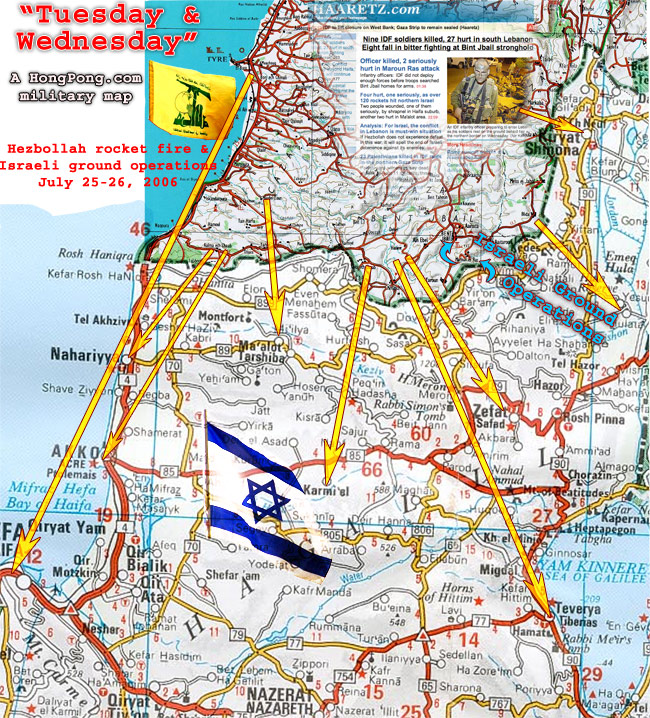
The blue arrow farther north is the regional Lebanese capital of Bint Jbail. The site closer to the border is Maroun Ras. Note that the Israelis have not yet secured the Maroun Ras area from Hezbollah's anti-tank missile teams. Also note that despite Israel's heavy casualties, they haven't really gotten very far at all. Obviously I am guessing about the specific source locations of Hezbollah's rockets. The map was stitched together imperfectly from a couple different ones. And of course this doesn't feature the wide-ranging Israeli airstrikes on enemy chicken coops and kitchen sinks...
Five troops hurt in Hezbollah attack in Maroun Ras: Nine IDF soldiers killed in bitter south Lebanon fighting
By Amos Harel and Eli Ashkenazi, Haaretz Correspondents
Nine Israel Defense Forces soldiers died Wednesday and 27 others were injured in the hardest day of fighting in southern Lebanon since the war began two weeks ago. Five of the injured soldiers are in serious condition. The IDF believes that Hezbollah lost 15 of its fighters in Wednesday's fighting.
Eight of the IDF dead - five soldiers and three officers - were from the Golani Brigade; they were killed in fighting in the town of Bint Jbail. The ninth soldier, a paratrooper, was killed last night in Maroun Ras. The IDF began its operation against Bint Jbail on Monday morning. By Tuesday evening, troops from the Golani and Paratroops Brigades had taken up positions on the outskirts of the town, and Golani soldiers had also entered some of the homes.
At approximately 5 A.M. Wednesday, Golani infantry entered Bint Jbail from the northeast and headed toward the center of town. The aim of the operation was to find and engage Hezbollah guerrillas and destroy their stores of arms.
According to initial reports, the guerrillas managed to ambush the IDF forces as they approached several homes on the outskirts of the town. Many of the Golani casualties occurred during this initial encounter, which took place at very close range. The initial battle raged for about an hour. During the next three hours, other platoons entered the area in an attempt to extricate the force that was pinned down. Hezbollah forces fired antitank missiles and threw grenades at the force it had caught in its ambush, and it also used mortars to attack the supporting IDF units. A total of 22 soldiers suffered injuries, including two platoon commanders. Three of the casualties were seriously wounded, four were moderately hurt and 15 had light wounds. The evacuation of the injured was particularly difficult because of the heavy fire in the area.
The IDF's Northern Command was initially reluctant to deploy attack helicopters in the battle, due to concerns that Hezbollah might succeed in shooting down one of them. However, the delay in the evacuation of the wounded led to a decision to deploy the helicopters. The evacuation, which was finally accomplished only six hours after the start of the battle, utilized four Blackhawk helicopters that landed two kilometers from the scene of the fighting. The soldiers carried their injured comrades on foot to the improvised landing strip.
While the operation was being carried out, Bint Jbail was subjected to heavy and sustained fire, and the helicopter landing area was covered in smoke in order to conceal the choppers' presence from Hezbollah snipers and missiles. The helicopters stayed on the ground no more than a minute each before evacuating the wounded to Rambam Medical Center in Haifa. The fighting in the town continued into the evening, and included aerial attacks on the center of the town by the Israel Air Force.
Later in the evening, in the nearby town of Maroun Ras, Hezbollah guerrillas fired an antitank missile at a force of paratroopers, killing one and seriously wounding two others. Another paratrooper suffered moderate injuries and two others were lightly hurt. All were evacuated to Rambam Medical Center in Haifa. Major General Udi Adam, the GOC Northern Command, said Wednesday that "the soldiers displayed sangfroid, bravery and professionalism after they came under fire, and they succeeded in killing many terrorists. In the IDF, we estimate that at least 15 Hezbollah guerrillas were killed in the village. There are also assessments that put the number of casualties on the Lebanese side at 40 to 50 dead fighters."
Senior officers in the Northern Command said Wednesday night that at this stage, they have a very limited picture of what transpired. However, officers in the Golani and Paratroops Brigades charged that the IDF employed insufficient force before the soldiers were deployed to search the homes. They said that once the civilians had been told to leave the town, the army should have regarded Bint Jbail as a battlefield and destroyed any home where Hezbollah guerrillas were suspected of hiding.
They also charged that not enough aircraft were used to attack targets. The IDF's modus operandi in southern Lebanon in recent days has sparked great debate among all ranks of the army. Many field officers argue that insufficient forces are being deployed in the fighting and that the army is being ineffective against Katyusha rocket launchers.
Armies are criticized because the excess of power that they accumulate enables them to dictate steps of political significance during a time of crisis. In these situations, military contingency plans become the principal alternative available to the politicians, which is why they tend to accept the army's viewpoint. But this time we have before us a particularly extreme case. Not only was the military plan the only one, but the political leadership voluntarily relinquished its duty to discuss it thoroughly. This places political thinking, to which military thinking is supposed to be subordinate, in a particularly inferior situation.
A voluntary 'putsch' By Yagil Levy - Haaretz
"The enemy is deceiving its own people and the world by presenting the occupation of Maroun al-Ras as a great military achievement," a Hizbullah statement said. "An army using its elite forces and tanks backed by its air force that can enter a frontier village only after days of fighting ... is a defeated and useless army."
Lebanon Daily Star, July 24, 2006
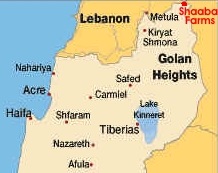 Major diplomatic movement on all fronts as Israel finds itself in the middle of a sputtering yet shockingly ugly military campaign. However, Hezbollah has apparently said they will become an entirely defensive force if Israel vacates the small Shebaa Farms area, which is considered either part of Lebanon or Syria, depending on whose map you go with. (that link was pro-Israel, here's a Wikipedia one and one from Joshua Landis at SyriaComment.com) Blame this particular line in the sand on the French. Anyway... It's all up in the air, but it's clear that Israel's more fanciful goals have fallen flat, yet they may still get some sort of international armed force involved, but probably only if Hezbollah permits it.
Phosphorus chemical weapons used by Israel, alleges Lebanese Prime Minister, doctor on CNN: Story on RawStory, a segment on CNN placed on YouTube: Very graphic - actually showing injured, severely burned Arabs, which I thought had been banned on American television:
Reuters: Lebanon president says Israel uses phosphorous arms 24 July 14:16:57 GMT
There have been previous reports of white phosphorus chemical weapons use in Fallujah... The irony of these methods is not subtle. Naturally, when the regular weapons aren't getting it done, the dirty stuff becomes appealing...
Anti-Iranian war propaganda: The same shady Iranian neo-con guy, Amir Taheri, who made up the fake "yellow stars for Jews in Iran" story is now visiting the White House. It's guys like him that are grooming Bush, telling him what he wants to hear, playing the new Chalabis, expecting to stir up trouble, TPMmuckrakers report. It's Taheri's little cronies that are going to spoon-feed the damn corporate media with stories about WMD or whatever else to scare the shit out of America again, likely right before the election. This guy Taheri is in with Ledeen and the rest of them. Taheri proclaims:
"The mini war that is taking place between Israel and Hezbollah is, in fact, a proxy war in which Iran’s vision for the Middle East clashes with the administration in Washington."
And who's gonna play the proxy? Ahmed Chalabi Amir Taheri. The Iran propaganda spigot is on full until election day. Meanwhile...
How the Israeli military manipulated policy to start the war: As the kidnapping's fallout unfolded inside Israel, the top military echelon's off-the-shelf plans to bomb the shit out of Lebanon were quickly approved and put into execution, superseding any grand political process to evaluate the consequences and prepare alternative choices. Prime Minister Olmert and Defense Minister Peretz, lacking a certain respect because they aren't generals but "civilians," deferred to the IDF's plans. This is not a portrait of a rational decision-making process:
Haaretz: A voluntary 'putsch' By Yagil Levy:
In Israeli historical memory, two incidents have been metaphorically defined as a military "putsch": the pressure applied by Israel Defense Forces generals on then prime minister Levi Eshkol to embark on the Six-Day War in 1967, and the "quiet putsch" as journalist Ofer Shelach termed the behavior of the army at the outbreak of the Al-Aqsa Intifada. Nevertheless, neither of these resembles the move that led to the start of "Lebanon War II."
On July 12, 2006, the Israeli government decided to bring about "a new order in Lebanon" by means of a massive military attack, which would cause the Lebanese government to disarm Hezbollah, or at least to remove it from the border with Israel and to deploy the Lebanese Army in its place. Like the expanded goals of "Lebanon War I," an attempt is being made here to reshape Lebanon's fragile political order by means of force.
In the history of the relationship between the political and military leaderships of Israel, the government has never made such a significant decision so quickly, operating in crisis mode just a few hours after the kidnapping of the soldiers. Under these circumstances, the military contingency plan was the main plan presented to the ministers, if not the only one. As absurd as it may sound, the government decision to embark on the Lebanon War I in 1982 was the result of a longer and more orderly decision-making process.
An expedited discussion in the cabinet does not enable an examination of non-military options - or, alternatively, a discussion of the full significance of a military operation and a positing of realistic political goals. The accelerated process did not enable the ministers to discuss the practicality of the demand to deploy the Lebanese Army, part of which is Shiite, along the border, as a force that is capable of imposing its authority on the independent Shiite militias that will remain after the dismantling of Hezbollah, if it is in fact dismantled.
It is doubtful whether the significance of the two possible results of the Israeli military blow - a change in the fragile inter-ethnic balance of power in Lebanon as a result of the disintegration of Hezbollah as the center of power that will not be replaced by another, or, alternatively, its success in surviving the attack - could be discussed in such a pressured time framework.
.......Armies are criticized because the excess of power that they accumulate enables them to dictate steps of political significance during a time of crisis. In these situations, military contingency plans become the principal alternative available to the politicians, which is why they tend to accept the army's viewpoint. But this time we have before us a particularly extreme case. Not only was the military plan the only one, but the political leadership voluntarily relinquished its duty to discuss it thoroughly. This places political thinking, to which military thinking is supposed to be subordinate, in a particularly inferior situation.
This inferiority stems, paradoxically, from the "civilian" label of the present leadership. The term "civilian" does not relate in this case only to the biography of the leaders, but to their political agenda as well - i.e., the convergence plan. A civilian leadership often tends to increase the army's freedom of operation, particularly when it operates in a cultural-political environment in which half of the voters favor the use of force to solve political problems. Under these circumstances, the civilian leadership needs the army as a political instrument for the purpose of implementing the civil agenda. After all, the "disengagement" plan was implemented thanks to the support of the army, and the same will be true of the convergence plan in the future.
This dependence makes it difficult for the political leadership to hold the army back in times of crisis - not to mention the fear of losing legitimacy by demonstrating "hesitancy" as compared to the determination of the army. Political leaders with a military past, or "hawkish" civilian leaders, have a greater ability to restrain the army in similar circumstances, as seen in the difference between former prime ministers Yitzhak Shamir (the Gulf War) and Benjamin Netanyahu (the Western Wall tunnel episode), on the one hand, and Moshe Sharett (the retaliatory operations), Levi Eshkol (the Six-Day War) and Shimon Peres (Operation Grapes of Wrath), on the other. Prime Minister Olmert now joins the second group.
Haaretz opinion: Stop now, immediately By Gideon Levy:
This war must be stopped now and immediately. From the start it was unnecessary, even if its excuse was justified, and now is the time to end it. Every day raises its price for no reason, taking a toll in blood that gives Israel nothing tangible in return. This is a good time to stop the war because both sides can claim they won: Israel harmed Hezbollah and Hezbollah harmed Israel. History shows that no situation is better for reaching an arrangement. Remember the lessons of the Yom Kippur War.
Israel went into the campaign on justified grounds and with foul means. It claims it has declared war on Hezbollah but, in practice, it is destroying Lebanon. It has gotten most of what it could have out of this war. The aerial "target bank" has mostly been covered. The air force could continue to sow destruction in the residential neighborhoods and empty offices and could also continue dropping dozens of tons of bombs on real or imagined bunkers and kill innocent Lebanese, but nothing good will come of it.
Those who want to restore Israel's deterrent capabilities have succeeded. Hezbollah and the rest of its enemies know that Israel reacts with enormous force to any provocation. South Lebanon is cleaner now of a Hezbollah presence. In any case, the organization is likely to return there, just as it is likely to rearm. An international agreement could be achieved now, and it won't be possible to achieve a better deal at a reasonable price in the future.
.......Now Israel is hoping for the elimination of Nasrallah. That's an atavistic impulse, even if understandable, which seeks the head of the enemy in order to prove our victory over him. There's no wisdom or practicality in it. Once again it is worth reminding ourselves of the dozens of people Israel assassinated in Lebanon and the territories, from Sheikh Abbas Mussawi to Sheikh Ahmed Yassin, each replaced by someone new, usually more talented and dangerous than the predecessor. The goals of the war should not be dictated by dark impulses, even if they come in response to the wishes and demands of the mob. The only advantage that would benefit Israel from the elimination of Nasrallah would be that maybe it would bring about an end to the warring. But it can be halted even without that. The other desired goal, the return of the prisoners, will anyway only be achieved through negotiations to release prisoners. Israel could have done that before the war.
It is still too early to weigh out the balance of achievements and failures of this war. The day will come when it will become clear that it was purposeless, as are all wars of choice. Ceasing it now guarantees a limited achievement at a limited price. Continuing it guarantees a heavy price without any guarantee of a suitable reward. Therefore, Israel must cease and desist. The president of the United States can push us to continue the war all he wants, the prime minister of Britain can cheer us in parliament, but in Israel and Lebanon, the blood is being spilled, the horror is intensifying, the price is rising and it is all for naught.
Billmon is top notch these days, observing plates shifting throughout the Mideast in, as always, unlikely yet ugly ways: The All Against the All:
I've been waiting to see whether the Turks are going to flatter the Israelis by imitating their invasion of neighboring country -- Kurdistan, in this case. So far, there've been no official cross-border troop movements (although Turkish special forces have been operating inside Iraq since just after our cross-border troop movement, if not before.)
But today the Kurds accused the Iranians of intervening in their internal affairs, with a cross-border movement of artillery shells:
"A senior Iraqi-Kurdish official accused Iranian forces on Thursday of shelling Kurdish guerrillas in northern Iraq.
"Othman Mahmoud, interior minister of the Kurdish regional government in the north, said shelling was going on along the border about 170 km (105 miles) north of the city of Sulaimaniya....."
......So many hatreds, so little time!
Let's see. We've got: Israeli Jews fighting Lebanese Shi'a and Palestinian Sunnis; Palestinian Fatah militants who've stopped fighting Hamas militants, but only because they're both fighting the Israelis; Saudi Sunni fundamentalists issuing fatwas against Hezbollah Shi'a fundamentalists; Egyptian Sunni fundamentalists backing those same Hezbollah Shi'a fundamentalists; Iraqi Sunnis killing Iraqi Shi'a and vice versa; Iraqi Shi'a (the Mahdi Army) jousting with Iraqi Shi'a (the Badr Brigade); Iraqi Kurds trying to push Sunni Arabs and both Sunni and Shi'a Turkomen out of Kirkuk; Turks threatening to invade Kurdistan; Iranians allegedly shelling Kurdistan, Syrian Kurds rebelling against Syrian Allawites who are despised by Syria's Sunni majority but allied with the Lebanese Shi'a who are hated and feared by the House of Saud and its Sunni fundamentalist minions. Oh, and American and Israeli neocons threatening to bomb both Syria and Iran......
......There is a passage in Kanan Makiya's book Republic of Fear that has haunted me ever since I read it. I've quoted it before to explain why I expected nothing but horror from the "liberation" of Iraq. It describes what happened in the summer of 1959 in the city of Mosul (a patchwork of ethnic, religious, tribal and class distinctions, then and now):
"For four days and four nights Kurds and Yezdis stood against Arabs; Assyrian and Aramean Christians against Arab Moslems; the Arab tribe of Albu Mutaiwat against the Arab tribe of Shammar; the Kurdish tribe of al-Gargariyyah against Arab Albu Mutaiwat; the peasants of the Mosul country against their landlords; the soldiers of the Fifth Brigade against their officers; the periphery of the city of Mosul against the center; the plebians of the Arab quarters of Al-Makkawi and Wadi Hajar against the aristocrats of the Arab quarter of ad-Dawwash; and within the quarter of Bab al-Baid, the family of al-Rajabu aggainst its traditional rivals, the Aghawat. It seemed as if all social cement dissolved and all political authority vanished."
Did you get that?? You better...
You also might be interested on Antiwar.com: July 25: Syria Emerges Front and Center by Pat Buchanan and Israel Is Winning the Battle, but Not the War by Ivan Eland.
July 25: Haaretz: ANALYSIS: The road to peace runs through Shaba Farms By Zvi Bar'el
The Lebanese government is pleased with itself, and Syria, too, has reasons to smile. As the fighting continues, Lebanese government officials are coming up with new definitions for what is known as "the complete arrangement," the one that is supposed to replace the arrangement that existed before July 12.
And so July 12 is joining the long line of historical dates that mark the stages of Lebanon's "new" independence just like February 14, the date of Rafik Hariri's assassination in 2005; or May 25, the date of the Israel Defense Forces withdrawal from Lebanon.
Saturday saw another development in the status of Fuad Siniora's government versus the strength of Hezbollah. After the government received "a franchise" to enter into negotiations on a prisoner-exchange deal, Energy Minister Mohammed Fneish, a Hezbollah representative, announced that once the IDF withdrew from the Shaba Farms area, Hezbollah's role as a "liberating" army would be over, and it would stick to a purely a defensive role.
This is a very significant statement, because it begins to define the conditions for Hezbollah's disarmament.
The government of Lebanon, Hezbollah, the United States, France and the United Nations have all realized now that the key to achieving a long-term and sustainable cease-fire by means of the deployment of the Lebanese Army in the south lies in a resolution to the Shaba Farms dispute.
At this stage, however, it is not enough for only Hezbollah and the Lebanese government to agree that the return of the Shaba Farms area would spell an end to the movement's "liberating" role. Syria is no less an important player in this regard. In keeping with maps approved by the UN, the Shaba Farms area lies in Syrian territory, so an official document in which Damascus relinquishes the area would be required too. For years now, Damascus has refused to provide such a document.
Will Syria agree to grant one now? An agreement to this end may be reached later in the week, when Syria learns both that it is the only one standing in the way of a settlement, and more importantly, according to Lebanese sources, that Washington is likely to offer Damascus a generous benefits package and a warm return to the "family of nations."
The next stage would have to be securing Israel's consent to withdraw from the Shaba Farms area, as this would then be a withdrawal from Lebanese territory; and only then could the Lebanese Army take up positions in the south, perhaps with the assistance of a multinational force if Hezbollah gives its okay.
The Lebanon Daily Star is a badass paper, no doubt.
Hizbullah gives government negotiation power
Daily Star staff: By Nada Bakri and Mohammed Zaatari
Monday, July 24, 2006
BEIRUT/SIDON: Israeli warplanes continued their bombardment of Lebanon on Sunday, killing at least eight and wounding 45, as Hizbullah gave the Lebanese government the green light to negotiate on its behalf for a prisoner swap with Israel. Any swap would include the two Israeli soldiers captured by Hizbullah in a cross-border raid on July 12, and Lebanese and Arab prisoners in Israeli jails.
"The Lebanese government will lead the exchange through the intermediary of a third party. This has been accepted by Hizbullah," Speaker Nabih Berri said Sunday.
It was not immediately known who the third party would be. Foreign Minister Fawzi Salloukh said Sunday that the two Israeli soldiers were "in good health" and called on "the United Nations or any third friendly party to engage in discussions of a prisoners' exchange."
"Germany has played an important and prominent role between Lebanon and Israel in the past, and it can play a similar role now," Salloukh said after a meeting with Peter Witteg, the head of international affairs at Germany's Foreign Ministry.
Meanwhile the Israeli offensive continued for the 12th straight day, bringing the overall death toll to at least 380 with over 1,000 wounded, according to Lebanese authorities.
A Lebanese press photographer, Layal Najib, 23, was also killed when an Israeli missile struck near her car on the road between the villages of Qana and Siddiqine. Najib worked at Al-Jaras (The Bell) magazine and was also a freelance photographer for AFP and several other news outlets.
Israel on Saturday attacked telecommunications installations in the North of Lebanon, killing a technician with the Lebanese Broadcasting Corporation, Suleiman Chidiac, and wounding two others. The station's signal was cut in several areas across the country. The destroyed relay stations were used by TeleLiban, LBCI and Future TV, and several radio stations.
Israeli air strikes also hit a mini-bus carrying 16 people fleeing the village of Tairi as it worked its way through the mountains from the Southern port city of Tyre.
A missile hit the bus near the village of Yaatar, killing three and wounding the rest of the passengers, who were taken to hospitals in Tyre. The Israeli military had told residents of Tairi and 12 other nearby villages Saturday to evacuate by 7 p.m. The villages form a corridor about 6 kilometers wide and 18 kilometers deep, believed to be the "buffer zone" desired by Israel.
At least four other people were killed by Israeli strikes in the South, Lebanese television reported, but the deaths could not be confirmed. Some 45 people were wounded in Israeli air raids that targeted villages and towns around Tyre on Sunday, security and hospital officials said.
Israeli warplanes also targeted Hizbullah strongholds in the southern suburbs of Beirut.
On Sunday, Israel hit the Southern port city of Sidon for the first time, destroying a religious complex linked to Hizbullah and wounding four people. More than 5,000 people have sought refuge in the city from other Southern villages. Four people were wounded in the strike. Israel also targeted Hizbullah's power base in the Bekaa Valley, hitting three factories, a house and bridges and roads. The air strikes ignited large fires, killed at least one civilian and wounded two others.
Three rescuers from the Civil Defense personnel of the Islamic Scout Mission, an association affiliated with the Amal Movement, were wounded after Israeli air raids struck their ambulance as it transported wounded civilians to nearby hospitals, according to Hassan Hamdan, the association's official in the South. "After the rescuers succeeded in crossing the fields and arrived in Bourj Rahal, Israeli warplanes launched missiles, leaving three of them wounded," he added.
Israeli troops continued to hold a Lebanese border village that they battled their way into the day before, but did not appear to be advancing, Lebanese security officials said. But warplanes and artillery were battering areas across the South. Hizbullah confirmed on Sunday that Israeli forces had occupied a key Lebanese frontier village and said three of its fighters had been killed there.
"The enemy is deceiving its own people and the world by presenting the occupation of Maroun al-Ras as a great military achievement," a Hizbullah statement said. "An army using its elite forces and tanks backed by its air force that can enter a frontier village only after days of fighting ... is a defeated and useless army."
"Our steadfast fighters have presented through the Maroun al-Ras confrontations and the losses of the enemy - in troops, tanks and helicopters - an example of what the confrontations will be in every town, village and position," it said. A spokesman for UN peacekeepers stationed along the Blue Line between Lebanon and Israel confirmed for AFP the Israeli advance. "Israeli troops and tanks are now inside Maroun al-Ras," said UNIFIL adviser Milos Strugar.
In the latest salvo into Israel, Hizbullah launched rocket attacks across northern Israel, including Haifa. Some of the rockets slammed into a house, an apartment building and a major road, killing at least two people, Israeli police said.
With the attacks Sunday, a total of 17 civilians have been killed by Hizbullah rockets over the past 12 days and 19 Israeli soldiers in fighting in Lebanon. - With agencies
Meanwhile, in Gaza a prisoner deal may be afoot as well. Perhaps the realists around the world's governments are actually motivated to help put something together before the neo-cons start armageddon.
Haaretz: IDF artillery shelling kills 2 children, 4 others in northern Gaza Strip
Gaza groups ready to deal on cease-fire, release of Shalit
Last update - 05:36 25/07/2006 By Avi Issacharoff, Haaretz Correspondent
All groups in Gaza, including Hamas, would now accept a cease-fire deal with Israel which would include releasing Gilad Shalit, according to the Palestinian Agriculture Minister, who also heads the coordinating committee of Palestinian organizations there.
Ibrahim Al-Naja said the factions were ready to stop the Qassam rocket fire if Israel's ceased all military moves against the Palestinian factions in Gaza. They are also ready to release Shalit in exchange for guaranteeing the future release of Palestinian prisoners. Hamas leaders did not confirm this report on Monday, but if it is true, then this is the first time that Hamas has indicated its acceptance of the Egyptian proposal to solve the crisis.
Egypt's proposal did not include an Israeli commitment to the immediate release of Palestinian prisoners, only guarantees for their future release. Al-Naja said the Palestinian faction's conditions were that the cease-fire would be mutual and Israel would stop all its actions against the Palestinians.
He also said Israel must provide clear guarantees to free veteran prisoners, minors and female prisoners incarcerated in Israel. "This initiative was presented in an attempt to alleviate Palestinian suffering, but now it depends on Israel, which is showing no indication yet of its willingness for a cease-fire," he said.
PA chairman Mahmoud Abbas will present the understandings among the Palestinian factions to U.S. Secretary of State Condoleezza Rice at their meeting on Tuesday, Palestinian sources said.
It looks like, well, everyone is refactoring... Tuesday's gonna be interesting.
In any event, the present IDF effort to "cleanse" the south of guerrillas by fire will fail. The IAF and its associated heavy artillery simply lacks the weight of fire needed to drive this enemy from its prepared positions in the stony ground of South Lebanon.
Col. Pat Lang (retired) - former top Middle East guy at the U.S. Defense Intelligence Agency
 We'll have a little more later from Haaretz about how, from the start of this war, the Israeli military establishment, led by Dan Halutz (pictured, thanks Wikipedia), basically cut off Israel's political options, dumped the blitzkreig plan on the heads of Olmert and Defense Minister Peretz, who, in turn, needed to 'look tough' to them... but first, the problem with Air Power.
Bombing the shit out of people can produce a good tactical situation sometimes, but as a military strategy it only makes sense if it's backed up with appropriate ground forces, and since war is an extension of politics by other means, a political strategy. The problem is that the U.S. Air Force strategic thinking that produced the carpet bombing of Vietnam is at work again in the halls of the Israeli Defense Force headquarters.
This way of thinking believes that dropping enough bombs is enough to evaporate enemy will. There is supposed to be a folding of the enemy's hand, since booms from the sky are sort of perceived like God's unavoidable vengeance, or something.
Donald Rumsfeld suffers from this badly – he was an Air Force boy, he never had to get neck deep in the Vietnamese mud. After Vietnam the U.S. Army had to rebuild its whole doctrine to never get bogged down on land like that again. The Air Force, on the other hand, thought it kicked a lot of ass in Vietnam, since you can make a metric out of identified targets destroyed. This, of course, leaves out the part where the surviving people on the ground are still willing to die fighting you, and they will still be able to get guns from somewhere and mess up your political agenda.
It is also plainly obvious that "shock and awe" was supposed to cause Iraqi will to evaporate from the beginning, and it didn't. Now, sadly, the chief of staff of the Israeli Defense Force is an Israeli Air Force propeller-head who never had to slog around and get sniped at around Ramallah, Nablus or Gaza.
Instead, like Rummy, he thinks he can bomb his way through. And this never really takes care of the problem. Now, the Israeli ground forces are flailing around in far too small of numbers, barely able to get a few hundred yards into Lebanon, and shitloads of airstrikes all over the hapless Lebanese North are supposed to prove the brilliance of this strategy?
Mark my words, the people of this world will have some kind of reckoning with the use of air forces once the dust settles on this round of shit. Killing civilians by the dozen from planes is equal in morality to killing them with suicide bombers. You can say the policy is better or worse in its goals, but in death, the morality of the act has the same balance. Innocent blood remains so, even when spilled from a flying object.
So we will add these words from an old hand in America's intelligence community, Pat Lang.
Now, I "get it."
Dan Halutz is the first IDF chief of staff who is not a soldier. He is a military aviator. I had missed that, but a statement attributed to a "senior officer" of the IDF in a New York Times story today caused me to look at IDF leadership. The "scales" have fallen from my eyes. "I believe in AIR POWER," the officer told the Times and Halutz is likely to be the officer who was interviewed
He has no ground forces experience at all. He reminds me a bit of Rumsfeld, the one time naval aviator and opponent of the use of sizable ground forces. Like Rumsfeld he is a proponent of "modern" warfare, gee-whiz techno- equipment and disdainful of big, heavy armored forces. He has re-organized the armed forces so that the ground forces no longer report directly to him.
Someone will say that Chaim Laskov had been head of the Israel Air Force (IAF) before becoming chief of staff in the early '50s. This is essentially irrelevant as a comparative situation. Laskov was not a pilot and was a ground force commander and a founder of the IDF Armored Corps before he became head of the air force.
Halutz is an ally of right wing political forces in Israel and an extreme proponent of the "Air Power" ideology that has been an active force in military affairs ever since it was enunciated by the Italian fascist Giulio Douhet in the '20s. The doctrine was taken up by Hugh Trenchard in Britain, Mitchell in the U.S., and the pre-war 2 German Luftwaffe. It persists in many air forces today.
The "Air Power" ideology in its purest form holds that ground forces have largely been made obsolete and useless by the invention and development of aircraft and other air delivered weapons, missiles, etc. "Air Power" theorists believe that this is true at the tactical, operational and strategic levels.
In Lebanon the IDF appears to be following a strategy at all levels that is entirely dictated by "Air Power" theory.
At the tactical and operational levels of war, Israel seems to be intent on destroying Hizballah south of the Litani River and north of Metulla to some unknown depth. Thus far, just about all the attacks against Hizballah have been made by air weapons and artillery. These weapons are inherently indiscriminate in their application, especially in the hands of "Air Power" theorists who typically want to "make the rubble bounce." This is especially true if the aforesaid airplane enthusiasts see that their theories are not yielding the desired result. If you still believe in "surgical strikes," look at the pictures from Lebanon. The IAF is "leafleting" all of south Lebanon urging citizens to leave their homes and flee northward. They appear to be intent on "herding the cats" away from their border through the use of aerial firepower. They know that Hizballah is a LEBANESE Shia guerrilla army with its roots in the Shia portion of the Lebanese population. Most of the people of the south are Shia, and the IDF knows that if they remain where they are they will support the Hizballah guerrillas both now and in the future. Indeed, the guerrillas, are, in many cases, villagers from this area. In any event, the present IDF effort to "cleanse" the south of guerrillas by fire will fail. The IAF and its associated heavy artillery simply lacks the weight of fire needed to drive this enemy from its prepared positions in the stony ground of South Lebanon. The actual ground maneuver attempted thus far is a joke and typical of the role imagined by "Air Power" advocates for ground forces. "Maroun al-Ras" is a tiny village less than a mile from the Israeli border, and no amount of fancy graphics on TV "gushed" over by retired generals can alter the fact that its capture is an insignificant achievement that has had and will have no effect on the amount of fire going into northern Israel.
At the strategic level, the IDF under Halutz is following classic "Air Power" theory which holds that crushing the "Will of the People" is the correct objective in compelling the acceptance of one's own "will" by an adversary or neutral. With that objective in mind, all of the target country is considered to be one, giant target set. Industry, ports, bridges, hospitals, roads, you name it. It is all "fair game." In this case the notion is to force the Lebanese government and army to accept a role as the northern jaw in a vise that will crush Hizballah and subsequently to hold south Lebanon against Hizballah. Since Lebanon is a melange of ethnic and religious communities of which Shia LEBANESE are a major element and since many Lebanese Shia are supporters of Hizballah, the prospect of getting the Lebanese government to do this is "nil." As for the Lebanese Army, the US attempted for two years (1982-84) to re-structure and re-train the Lebanese Army to make it a "national" non-sectarian force only to learn when this army was committed to battle in 1984 against Druze and Christian forces, that it simply fell apart. The US then abandoned the effort. Nothing much has changed in Lebanon since then.
Bottom Lines:
-Air Power and artillery will not decisively defeat Hizballah or force it to withdraw from rocket range of Israel.
-The Lebanese government and army are not what the Israelis have once again dreamt of and they should have known that. The policy that Israel is following is truly a triumph of hope over experience.
-An international force that will fight Hizballah in the south to disarm it is a pipe dream. Who will do that? The only realistic candidate would be France in terms of military capacity. This would be a major irony of history.
Bottom Line Advice for Israel: Occupy the ground or expect to suffer the effects of failure.
Seems sort of obvious, doesn't it?
DEBKAfile’s military sources report that Israeli military chiefs have just begun studying Hizballah’s arts of camouflage. A senior officer told DEBKAfile grimly: “Now we know that when a stand of five or six trees suddenly starts walking, we are seeing a 14-barreled Fajr 3 rocket launcher on the move; one or two trees in motion may conceal a couple of Hizballah fighters.”This I found to be quite interesting. DEBKAFile is a somewhat unusual site closely linked to the Israeli military, and they report a most unusual strategy employed by Hezbollah: clusters of trees are actually multi-rocket launcher units, and individual Hezbollah guerrillas appear to be one or two trees, which move around a bit. When Israeli forces attempt to attack one batch of trees, lots of them fire. Also, the Hezbollah guerrillas are so effectively entrenched in urban areas that Israeli ground troops face such 'lossy' battle situations that they are unwilling to advance with casualties.
In other words, Hezbollah is the trees, and with their honeycombing of tunnels, under the rocks too. Now that's some guerrilla warfare. Israeli analysts "have got a very bad feeling about this," at least, if they were Han Solo, that's what they would say. Note that no one in the IDF is really claiming that the rockets can be stopped by military action so far. For each team eliminated by the Israelis, another one can basically go in... sometimes you just can't see the forest for the trees.
Hizballah Brings Iwo Jima Tactics to Baffle Israeli Forces in South Lebanon
DEBKAfile Exclusive Military Report
July 24, 2006, 12:46 PM (GMT+02:00)
Israeli forces have pushed forward from the mountaintop village of Maroun er Ras captured Sunday to the fringes of Bint Jubeil, Hizballah’s south Lebanese capital. Monday they suffered nine wounded in face to face combat. Whereas TV cameras showed much footage of the Maroun er Ras engagement, the IDF’s other battle pockets are kept under wraps.Hizballah chief Hassan Nasrallah, who has an overall view, warned Israel in an interview to the Lebanese A Safir Monday, July 24, that its ground incursions in Lebanon would not stop Hizballah rocket fire against its cities.
He certainly meant this as a morale-depressant for Israel troops. At the same time, DEBKAfile’s military experts say that what he says is correct and must be taken into account in any diplomatic formula sought to end the warfare.
1. He could go on firing his rockets even when a multinational force is posted on the Lebanese-Israeli border. The force currently contemplated by Israeli prime minister Ehud Olmert at this early stage of international diplomacy would consist of German, French and Czech units.
2. And even if multinational troops were deployed additionally on the Lebanese-Syrian border, they would not hamper Hizballah’s rocket offensive. Therefore a buffer zone would offer no solution to a cessation of cross-border hostilities.
DEBKAfile’s military analysts say that the way the Israel-Hizballah war has been prosecuted up until Monday, July 24, is more likely to bring Nassrallah closer to his war objectives than Olmert.
Notwithstanding the IDF’s important battle gains at a number of focal South Lebanese points in the last 24 hours – including the latest raids on the outskirts of Bint Jubeil on the heels of the capture of Maroun er Ras – only one multiple firing rocket launcher (picture) and 6 single-barrel launchers have been destroyed.
This figure will certainly multiply substantially in the coming days. Yet it will not change the essential strategic picture or stop the rocket fire from holding northern Israel and more than a million inhabitants to siege.
Last week, Israel’s army chiefs believed they had encountered Hizballah’s primary war tactic – Viet Cong-style guerrilla warfare out of hundreds of small bunkers scattered across the country. This week had scarcely begun when a still more formidable impediment was discovered: Hizballah camouflage techniques borrowed from the Japanese in the 1945 Iwo Jima battle. To stop the rockets coming, Israeli special forces must continue to blow up the tunnels and also adopt the methods the US Army’s methods for overcoming the Japanese dug in at Iwo Jima and other Pacific islands at the end of World War II. Without regard to losses, they stormed Japanese dug-in positions and camouflaged units. using flame throwers and gasoline to burn the foliage concealing the enemy.
DEBKAfile’s military sources report that Israeli military chiefs have just begun studying Hizballah’s arts of camouflage. A senior officer told DEBKAfile grimly: “Now we know that when a stand of five or six trees suddenly starts walking, we are seeing a 14-barreled Fajr 3 rocket launcher on the move; one or two trees in motion may conceal a couple of Hizballah fighters.”
But the situation is more difficult when the trees or bushes stand still and blend in with the surrounding dense foliage. By the time IDF spotters report five suspicious trees or bushes to overhead aircraft, helicopters or the nearest ground units, the Hizballah launchers or the fighters have moved on and changed their camouflage outfits. The small Israeli special operations units called in to hunt and destroy the last-seen mobile vegetation face a mystifying task.
“This is a high-precision operation,” said the officer. “It is time-consuming – could take weeks if not months - dangerous and calls for larger numbers of troops than we have available.”
In the first ten days of the war, therefore, the Israeli air force bombed out empty Hizballah premises in South Beirut and Baalbek, but missed the moving woods and vegetation which concealed the rocket launchers – which explains why the blitz continued notwithstanding heavy Israeli air force assaults on Hizballah’s centers and strongholds.
But Israel military strategists have got a handle on Hizballah’s rocket-launching methods. Each rocket crew, carefully camouflaged, advances independently to its firing position and fires a volley, never a single rocket. If one crew chances on another, they all loose their rockets simultaneously.
DEBKAfile’s military analysts assert that the rocket offensive against Israel will go on for the following reasons:
1. While the IDF has begun to understand Hizballah’s tactics and methods of warfare, the Olmert government has decided to deny the operation sufficient ground troops to come to grips with the small knots of moving rocket crewmen.
Some of DEBKAfile’s military experts fear the Israeli government may be falling into the Bush administration’s disastrous error of allocating too few troops to the Iraq war for attaining its goals.
2. Iran is constantly pumping through Syria fresh rocket teams to replace those wiped out by Israeli forces.
3. Hizballah’s leader wants no part in the diplomatic initiatives led by US secretary of state Condoleezza Rice in conjunction with the Europeans, Olmert, the Lebanese government and moderate Sunni Arab rulers. Nasrallah is playing his own game and will not be a party to a ceasefire at this point or stop firing his rockets – except on his terms.
4. He will show the same contempt for a multinational force, however effective, deployed on Lebanon’s borders with Israel and Syria, and simply keep on shooting. He knows as well as anyone that German or French troops will never go chasing through Lebanon’s woods and hay stacks to tackle his fighters in face-to-face combat. He may not stick to as many as 100 rockets a day – as at present, but he will keep his hand on the button and push it whenever it suits him. Nasrallah will only end the war when he can claim victory – or is finally eliminated.
Most Israeli generals agree that going for a multinational force, which appears to be the direction seriously contemplated by Ehud Olmert, would constitute a repeat of the blunder Ariel Sharon and Olmert himself perpetrated when, in their haste to evacuate the Gaza Strip last summer, they handed security over the Gazan-Egyptian Philadelphi border to Egyptian forces and the crossing to European monitors.
Nasrallah has already struck the pose of victor and is dictating terms. Monday, July 24, he handed the Lebanese government a list of the prisoners in Israeli jails whom he wants released as the price for returning the kidnapped Israeli soldiers, Ehud Goldwasser and Eldad Regev. He has not budged an inch from his initial demand for their release: indirect negotiations for a prisoner swap.
The Israeli prime minister, who has switched his war objectives several times, is heading for a course that may at best restore the three abducted Israeli solders, Gilead Shalit in Hamas’ hands, as well as Goldwasser and Regev. But this course will not rescue northern Israel and a third of the country from the nightmare of rockets falling night and day and destroying their lives or the Palestinian Qassam missiles from Gaza making life intolerable for Israel’s south.
There's a whole clutch of stuff to put up here. I will restrict it to a few major items right now: how the Israelis coordinated starting this war with the United States since a year ago (when the Syrians got chased out – funny); the work covering damage to Arab civilization at Electronic Intifada, the stuff at AntiWar.com and a little bit from those totems of neoconservative doom at the Weekly Standard. Also a bit about how Israel is taking American diplomatic options off the table by sparking this – perhaps it was more important to stop America from dealing with the Arabs than the actual Hezbollah and Hamas threats themselves!
This limited batch should help illustrate various dimensions of the conflict. More are on the way, I just want something bite-sized out there....
A war pre-planned: One of those questions to reflect on, is simply how the casus belli, the root cause of the war, actually came about. The Iraq war was engineered with stuff like fake WMD stories pretty seriously, and now we are supposed to believe that the Lebanon invasion materialized in history 15 minutes after Hezbollah made off with a couple soldiers from a war front. Not bloody likely.
In this case we have ready evidence that the whole plan has been pulled off the shelf, and American officials got the full persuasive case over the last year. In other words, this is more about an entrenched policy than the actual kidnappings of the soldiers. Fortunately, the soldiers are a useful pretext for hawkish Democrats and others to bandwagon around on.
In a certain, kind of obvious sense, you could call this a conspiracy. Also interesting that the Lebanese recently caught an assassination cell working for the Mossad. (I wonder who really wanted Rafik Hariri out of the way )and who's benefiting now that the Syrian army is gone?)
San Francisco Chronicle: Israel set war plan more than a year ago: Strategy was put in motion as Hezbollah began gaining military strength in Lebanon
Matthew Kalman, Chronicle Foreign Service : Friday, July 21, 2006
(07-21) 04:00 PDT Jerusalem -- Israel's military response by air, land and sea to what it considered a provocation last week by Hezbollah militants is unfolding according to a plan finalized more than a year ago.
In the six years since Israel ended its military occupation of southern Lebanon, it watched warily as Hezbollah built up its military presence in the region. When Hezbollah militants kidnapped two Israeli soldiers last week, the Israeli military was ready to react almost instantly.
"Of all of Israel's wars since 1948, this was the one for which Israel was most prepared," said Gerald Steinberg, professor of political science at Bar-Ilan University. "In a sense, the preparation began in May 2000, immediately after the Israeli withdrawal, when it became clear the international community was not going to prevent Hezbollah from stockpiling missiles and attacking Israel. By 2004, the military campaign scheduled to last about three weeks that we're seeing now had already been blocked out and, in the last year or two, it's been simulated and rehearsed across the board."
More than a year ago, a senior Israeli army officer began giving PowerPoint presentations, on an off-the-record basis, to U.S. and other diplomats, journalists and think tanks, setting out the plan for the current operation in revealing detail. Under the ground rules of the briefings, the officer could not be identified.
In his talks, the officer described a three-week campaign: The first week concentrated on destroying Hezbollah's heavier long-range missiles, bombing its command-and-control centers, and disrupting transportation and communication arteries. In the second week, the focus shifted to attacks on individual sites of rocket launchers or weapons stores. In the third week, ground forces in large numbers would be introduced, but only in order to knock out targets discovered during reconnaissance missions as the campaign unfolded. There was no plan, according to this scenario, to reoccupy southern Lebanon on a long-term basis.

The Electronic Intifada franchises for ugly reasons: The site Electronic Intifada has expanded laterally to Electronic Lebanon, a site originally intended to provide Palestinian perspectives is now focused on Lebanon. Worth considering: Precarious conditions in mountain shelters for fleeing Lebanese, and diaries such as "What will happen to us when this is all over?"
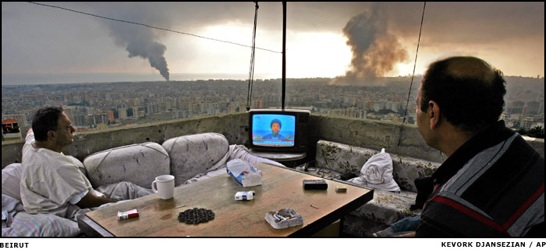
Time to get real with AntiWar.com: There has never been a more clear moment for Antiwar.com, and certainly, Justin Raimondo has done more than his share of advising us that "the Middle East escalator" still controlled by the neo-conservatives means more escalations, more spreading warfare. All the columns on this latest war are worth reading, particularly America Held Hostage, Will We Go to War for Israel?, and Playing the Sunni Card:
The U.S.-Israeli strategy aims at atomizing the Arab-Muslim world: the invasion of Iraq smashed the Ba'athist state and split it into three distinct and warring pieces – the Shi'ite south, the infamous Sunni Triangle, and Kurdistan. The same method is being employed in Lebanon, where the fragile state apparatus is about to come undone under the impact of the Israeli assault – and, soon enough, in Syria and Iran, where Kurds and other restive ethnic groups are being encouraged by the regime-changers of the West.
Divide and rule: it's the oldest strategy in the book, and particularly effective when it comes to the Arab-Muslim world, which is rife with internecine strife that only needs a bit of provocation to come to the surface in violent form.
As to whether this strategy will work, the question is: do we want it to? What "work" means, in this context, is the metastasis of Iraq's civil war. They told us Iraq would be a "model" for the region – what they didn't say is that it would be a "model" of how to destroy an entire civilization.
The goal of the War Party is to keep up the momentum for intervention created by the Iraq war and allow the conflict there to naturally spill over Iraq's borders into Syria, Lebanon, Saudi Arabia, and beyond. There are many, including within this administration, who do not share this goal, and there were signs that, until recently, this "realist" faction might prevail.
.........The crushing of Lebanon beneath the Israeli boot achieves two goals for the War Party: it outflanks their enemies in Washington, and it divides their enemies in the Middle East. It is a one-two punch that could plunge much of the world into a conflict that we will never see the end of in our lifetimes: the opening shots of what the neocons refer to as "World War IV." (Note: World War III was the Cold War, according to this thinking.)
Israel is removing America's options from the Middle East Table: Strongly worth considering, perhaps more than most arguments. Steve Clemons, a DC Dem on the security scene: Some Questions Regarding Israel's Objectives: Is Israel Trying to Curb America's Deal-Making in Middle East?
Why is Israel pounding most of Lebanon rather than just the South and rather than pinpointing its attack against Hezbollah assets? Why the dramatic bombing of explosive fuel centers? The attacks both in Gaza and in Beirut seem made for Fox News, CNN and the next Schwarzenegger movie.
I think that there is little doubt that a significant part of the explanation can be attributed to the fact that Prime Minister Ehud Olmert and his more liberal partner in this effort, Amir Peretz -- now Defense Minister -- are not former field command generals and want to demonstrate that they can be responsible stewards of Israel's national security -- and that they won't be timid in using Israel's military capabilities.
But that doesn't explain it all. The Israeli response to the Hezbollah incursion is exactly what Hezbollah wanted. Adversaries rarely give each other the behaviors the other actually desires unless there are other objectives involved.
My view is that three broad threats were evolving for Israel from the American side of the equation. One one front, the U.S. will be attempting to settle some kind of new equilibrium in Iraq with fewer U.S. forces and some face-saving partial withdrawal. To accomplish this and maintain any legitimacy in the eyes of important nations in the region -- particularly among close U.S. partners among the Gulf Cooperation Council states -- America "might have" tried to do some things that constituted a broad new bargain with the Arab Middle East. The U.S. had even previously flirted, along with the Brits, in trying to get Syria on a Libya like track and out of the international dog house.
There was also pressure building to push Hamas -- or at least the "governing wing" of it -- towards a posture that would move dramatically closer to a recognition of Israel. Abbas was becoming increasingly entrepreneurial in creating opportunities for the constructive players in Hamas to squirm towards eventual negotiations with Israel that could possibly be packaged in terms of "final status negotiations" on the borders and terms of a new Palestinian state. George W. Bush is the first President to actually call the Palestine territories "Palestine" and may have eventually come around on trying to pump up Abbas's legitimacy as the father of a new and different state. I am doubtful of this scenario -- but some in Israel had serious concerns about this unfolding.
Lastly, despite lots of tit-for-tat tensions and enormous mistrust, Iran and the U.S. were tilting towards a deal to negotiate about Iran's nuclear pretensions and other goals. Some in Israel viewed all three of these potential policy courses for the U.S. -- a broad deal with the Arab Middle East, a new push on final status negotiations with the Palestinians, and a deal to actually negotiate directly with Iran -- as negative for Israel.
The flamboyant, over the top reactions to attacks on Israel's military check points and the abduction of soldiers -- which I agree Israel must respond to -- seems to be part establishing "bona fides" by Olmert, but far more important, REMOVING from the table important policy options that the U.S. might have pursued.
Israel is constraining American foreign policy in amazing and troubling ways by its actions. And a former senior CIA official and another senior Marine who are well-versed in both Israeli and broad Middle East affairs, agreed that serious strategists in Israel are more concerned about America tilting towards new bargains in the region than they are either about the challenge from Hamas or Hezbollah or showing that Olmert knows how to pull the trigger.
Another well respected and very serious national security public intellectual in the nation wrote this when I shared this thesis that Israeli actions were ultimately aimed at clipping American wings in the region. His response:
the thesis of your paper is right-on. whether intentional or coincidental, that is what is being done right now.
I share these other views only to establish the fact that there is not a consensus either in support of or opposed to Israeli action -- but some are beginning to scrutinize what Israel is seeking to achieve with such flamboyant displays of power that are antagonizing whole societies on their borders.
Keeping America from cutting new deals in the region -- which many in the national security establishment thinks are vital -- may actually be what is going on, and the smarter-than-average analysts are beginning to see that. To take one moment though and argue a counter-point to this, one serious analyst I spoke to this morning who stopped by to talk after attending synagogue raised a good point. He said that he thought that Olmert's insecurity about military management was driving the over-reaction.
But he also said that the QUALITY of the attacks against Israel were freaking out the Israeli military and intelligence leaders. Complex incursions that included abductions along with a successful attack on an Israeli gunship show that the enemy is no longer an unimpressive, rag-tag lot. Training and armaments have been improved, and Israel is scrambling to figure out how this happened.
For the right wind scare-your-shit view, try the Weekly Standard. They have been pining away on this for a long time, and now it looks like they are going to get their wishes fulfilled...
 Combining anti-semitic generalizations and anti-Palestinian hate speech, the remarkably ugly: "When Will They Ever Learn... Why do so many American Jews hate the president who stands by Israel? by David Gelernter from the American Enterprise Institute. Concludes:
One thing is certain: Palestinians and left-wing American Jews would understand each other beautifully if they ever got together for a conference on refusing to face reality.
 For more wigging out, see Hezbollah's Arsenal and worst of all, Bill Kristol's It's Our War:
For while Syria and Iran are enemies of Israel, they are also enemies of the United States. We have done a poor job of standing up to them and weakening them. They are now testing us more boldly than one would have thought possible a few years ago. Weakness is provocative. We have been too weak, and have allowed ourselves to be perceived as weak.
The right response is renewed strength--in supporting the governments of Iraq and Afghanistan, in standing with Israel, and in pursuing regime change in Syria and Iran. For that matter, we might consider countering this act of Iranian aggression with a military strike against Iranian nuclear facilities. Why wait? Does anyone think a nuclear Iran can be contained? That the current regime will negotiate in good faith? It would be easier to act sooner rather than later. Yes, there would be repercussions--and they would be healthy ones, showing a strong America that has rejected further appeasement.
But such a military strike would take a while to organize. In the meantime, perhaps President Bush can fly from the silly G8 summit in St. Petersburg--a summit that will most likely convey a message of moral confusion and political indecision--to Jerusalem, the capital of a nation that stands with us, and is willing to fight with us, against our common enemies. This is our war, too.
Holy shit, we're fucked! Too bad this genius helped start the war in Iraq that handed Mesopotamia over to Iran. Small irony, that one. Since of course, the goal was perpetual warfare... Another step closer.
Pre-1982 war ethnic layout of Lebanon: What could go wrong?
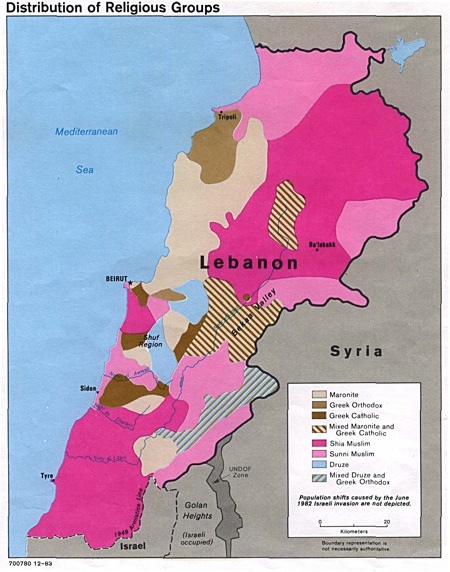
(Via the sweet UTexas map collection)
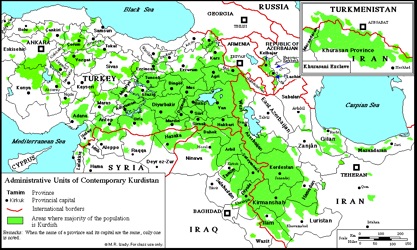 There is a sense that this is finally the Clean Break scenario happening, but there is one more problem yet to be un-tethered from order into chaos. What happens when the chaos spills into Syria? As Stratfor notes, the Israelis are 'terrified' of any regime after Bashar Assad, since it would be made of A) rebellious Kurds - who are somewhat friendly, if not allied, to Israel. B) Sunni tribes branching down into Iraq, into Anbar province and beyond, deep into the Iraqi insurgency. C) Small religious minorities like Alawites, Christians, Druze and Armenians D) A pretty good number of Palestinians. That is not a good situation for Israel, and they probably won't try to topple Assad's government. But someone else might. (Kurdish map from here, the Vladimir-Kurdistan blog)
A couple bits from Stratfor to post. They don't want people reposting their special report alerts, so I will make do with excerpts. They have a pretty close view of what the thinking is inside the Israeli military.
Basically, Stratfor makes it clear that their view is that Hezbollah's strategy is to fight until the bitter end, trapping Israel in a very high-intensity occupation and 'counter insurgency' situation, but Hezbollah has the kind of advanced anti-ship, surface-to-surface, anti-tank and anti-personnel missiles (from Iran, who knows where else? China? Russians?) to make the Israeli mission an impossible weight, far beyond what the Palestinian militant groups could achieve on their own.
So Stratfor has a pretty intricate description of what the Israelis think they can accomplish. However, if I were playing this situation in a video game like, say "Command and Conquer: Generals", the Bekaa Valley with hundreds, if not thousands, of hidden Hezbollah rockets is the last place anyone sane would want to go.
The neo-cons often harbor fantasies about breaking up ethnically diverse states like Iran and Syria, then attempting to create dominating power relationships with the US and Israel at the top, and the various bickering ethnic groups below, set against each other in high British colonial style. The Baluchis and Azeris are two that neocons are known to court in Iran, and look what has happened in Iraq. Anyone who tries to stop them is another 'terrorist,' usually a 'fascist' to boot.
This is like what Ariel Sharon thought he could engineer in Lebanon in 1982, putting the Christian Phalangists on top in a bloody civil war, crushing the Shia and other sects supported by Syria and Iran, as well as the PLO. While occupying Lebanon, Israel managed to kick the PLO out to Tunisia, which bought more time to throw settlement colonies into the West Bank. As the occupation dragged on, the Iranians helped band the Shia in southern Lebanon together under Hezbollah, and they organized a guerrilla war of attrition to force Israel to withdraw in 2000. This was a prime example of 'fourth-generation warfare,' and it now appears that the 'warfare' part of that equation is back in full force again.
Yet absorbing more of the West Bank is clearly where Israel's real interests lie: (wikipedia)
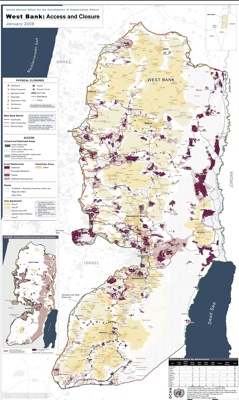
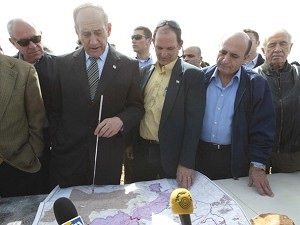
Epoch Times: Israeli acting Prime Minister Ehud Olmert (Center-L), his Defence Minister Shaul Mofaz (2nd-R) and former Israeli Prime Minister Shimon Peres (R) gather together in front of a map as they visit March 14, 2006 the Israeli west bank town of Ariel. (Pavel Wolberg-Pool/Getty Images)
Apart from the sheer bloodiness and hellish horror of such an 'ethnic re-engineering', which disgusts me deeply, setting that aside, the strategy doesn't fucking work. The basic concept in Revisionist Zionism – and now, obviously the Bush doctrine – that more bombs will inspire surrender and obedience has failed every time. Hezbollah is well-prepped for the current Israeli strategy – they know how the airstrikes work, they know from experience how Israeli intelligence has tried to catch them in this area. Most of all, they know they won straight up last time, and this time, the Israelis have better technology, but Hezbollah sure does too. They can keep falling back farther north, while still tossing long-range rockets into Haifa, and resisting all the Israelis' brutal methods by folding the organization into thousands of unstoppable, independent, rocket-bearing cells, or teams of about three, surrounded by a radicalized populace. Far better terrain for the guerrilla than the occupier, in 4GW terms.
Another point is that Israel and the United States (who obviously planned this all in tandem - hence, more U.S.-manufactured bombs on their way today to Israeli planes, Lebanese craters and Arab blood generally) have grossly underestimated the quality of Hezbollah's arsenal. This was a classic, grievous mistake on the order of Israel's foolish idea in 1973 that the Arabs were far too weak to attack – then came the Yom Kippur war.
Believing your enemies too weak and too strong, simultaneously, is a key marker of Fascist thinking.
Listen carefully to what Stratfor is saying: you can sense a waning confidence that Hezbollah could be 'eliminated' tactically, no matter how many bombs are dropped. Also, note the lack of brakes on the situation: Israel doesn't want Syria's government to fall, even while attacking the nearby Bekaa Valley. However, if, say, Al Qaeda or the Muslim Brotherhood happened to have a little luck with assassinations, anarchy across the Levant, all the way to Iran, Afghanistan, would be certain. That would not be in the interests of Israel, the United States, Iran, the EU, Turkey (especially!) or any other states.
It would be just another winning round for Al Qaeda, whose record so far in 'sharpening contradictions,' erasing stability to create 'the base', seems to be on a winning tack. The vast numbers of refugees generated in the last few days (hours!) will also help Al Qaeda style militants find converts among South Lebanon's "New Palestinians" of the 21st century. Another well thought out strategy from Washington.
Also note in particular the loss of Israeli initiative. From Sun Tzu to Clausewitz, a key aspect of warfare, especially 4GW, is retaining the initiative (PDF) – staying on the move, massing up & picking battles – but Hezbollah's dispersed, long-range nature has taken Israel's initiative apart. Israel will fight where and when Hezbollah wants them to, in a sense. Yesterday at noon from Stratfor I got:
Red Alert: The Battle Joined
The ground war has begun. Several Israeli brigades now appear to be operating between the Lebanese border and the Litani River. According to reports, Hezbollah forces are dispersed in multiple bunker complexes and are launching rockets from these and other locations.
Hezbollah's strategy appears to be threefold. First, force Israel into costly attacks against prepared fortifications. Second, draw Israeli troops as deeply into Lebanon as possible, forcing them to fight on extended supply lines. Third, move into an Iraqi-style insurgency from which Israel -- out of fear of a resumption of rocket attacks -- cannot withdraw, but which the Israelis also cannot endure because of extended long-term casualties. This appears to have been a carefully planned strategy, built around a threat to Israeli cities that Israel can't afford. The war has begun at Hezbollah's time and choosing.
Israel is caught between three strategic imperatives. First, it must end the threat to Israeli cities, which must involve the destruction of Hezbollah's launch capabilities south of the Litani River. Second, it must try to destroy Hezbollah's infrastructure, which means it must move into the Bekaa Valley and as far as the southern suburbs of Beirut. Third, it must do so in such a way that it is not dragged into a long-term, unsustainable occupation against a capable insurgency.
Hezbollah has implemented its strategy by turning southern Lebanon into a military stronghold, consisting of well-designed bunkers that serve both as fire bases and launch facilities for rockets. The militants appear to be armed with anti-tank weapons and probably anti-aircraft weapons, some of which appear to be of American origin, raising the question of how they were acquired. Hezbollah wants to draw Israel into protracted fighting in this area in order to inflict maximum casualties and to change the psychological equation for both military and political reasons.
Israelis historically do not like to fight positional warfare. Their tendency has been to bypass fortified areas, pushing the fight to the rear in order to disrupt logistics, isolate fortifications and wait for capitulation. This has worked in the past. It is not clear that it will work here. The great unknown is the resilience of Hezbollah's fighters. To this point, there is no reason to doubt it. Israel could be fighting the most resilient and well-motivated opposition force in its history. But the truth is that neither Israel nor Hezbollah really knows what performance will be like under pressure.
Simply occupying the border-Litani area will not achieve any of Israel's strategic goals. Hezbollah still would be able to use rockets against Israel. And even if, for Hezbollah, this area is lost, its capabilities in the Bekaa Valley and southern Beirut will remain intact. Therefore, a battle that focuses solely on the south is not an option for Israel, unless the Israelis feel a defeat here will sap Hezbollah's will to resist. We doubt this to be the case.
The key to the campaign is to understand that Hezbollah has made its strategic decisions. It will not be fighting a mobile war. Israel has lost the strategic initiative: It must fight when Hezbollah has chosen and deal with Hezbollah's challenge. However, given this, Israel does have an operational choice. It can move in a sequential fashion, dealing first with southern Lebanon and then with other issues. It can bypass southern Lebanon and move into the rear areas, returning to southern Lebanon when it is ready. It can attempt to deal with southern Lebanon in detail, while mounting mobile operations in the Bekaa Valley, in the coastal regions and toward south Beirut, or both at the same time.
There are resource and logistical issues involved. Moving simultaneously on all three fronts will put substantial strains on Israel's logistical capability. An encirclement westward on the north side of the Litani, followed by a move toward Beirut while the southern side of the Litani is not secured, poses a serious challenge in re-supply. Moving into the Bekaa means leaving a flank open to the Syrians. We doubt Syria will hit that flank, but then, we don't have to live with the consequences of an intelligence failure. Israel will be sending a lot of force on that line if it chooses that method. Again, since many roads in south Lebanon will not be secure, that limits logistics. [Get ready for this one, it's been key in Iraq -Dan]
Israel is caught on the horns of a dilemma. Hezbollah has created a situation in which Israel must fight the kind of war it likes the least -- attritional, tactical operations against prepared forces -- or go to the war it prefers, mobile operations, with logistical constraints that make these operations more difficult and dangerous. Moreover, if it does this, it increases the time during which Israeli cities remain under threat. Given clear failures in appreciating Hezbollah's capabilities, Israel must take seriously the possibility that Hezbollah has longer-ranged, anti-personnel rockets that it will use while under attack.
Israel has been trying to break the back of Hezbollah resistance in the south through air attack, special operations and probing attacks. This clearly hasn't worked thus far. That does not mean it won't work, as Israel applies more force to the problem and starts to master the architecture of Hezbollah's tactical and operational structure; however, Israel can't count on a rapid resolution of that problem.
........
An extended engagement in southern Lebanon is the least likely path, in our opinion. More likely -- and this is a guess -- is a five-part strategy:
1. Insert airmobile and airborne forces north of the Litani to seal the rear of Hezbollah forces in southern Lebanon. Apply air power and engineering forces to reduce the fortifications, and infantry to attack forces not in fortified positions. Bottle them up, and systematically reduce the force with limited exposure to the attackers.
2. Secure roads along the eastern flank for an armored thrust deep into the Bekaa Valley to engage the main Hezbollah force and infrastructure there. This would involve a move from Qiryat Shimona north into the Bekaa, bypassing the Litani to the west, and would probably require sending airmobile and special forces to secure the high ground. It also would leave the right flank exposed to Syria.
3. Use air power and special forces to undermine Hezbollah capabilities in the southern Beirut area. The Israelis would consider a move into this area after roads through southern Lebanon are cleared and Bekaa relatively secured, moving into the area, only if absolutely necessary, on two axes of attack.
4. Having defeated Hezbollah in detail, withdraw under a political settlement shifting defense responsibility to the Lebanese government.
5. Do all of this while the United States is still able to provide top cover against diplomatic initiatives that will create an increasingly difficult international environment.
In my view, this is the part where Israel is "proper fucked." Maybe only one of these will actually work, at best:
There can be many variations on this theme, but these elements are inevitable:
1. Hezbollah cannot be defeated without entering the Bekaa Valley, at the very least.
2. At some point, resistance in southern Lebanon must be dealt with, regardless of the cost.
3. Rocket attacks against northern Israel and even Tel Aviv must be accepted while the campaign unfolds.
4. The real challenge will come when Israel tries to withdraw.
No. 4 is the real challenge. Destruction of Hezbollah's infrastructure does not mean annihilation of the force. If Israel withdraws, Hezbollah or a successor organization will regroup. If Israel remains, it can wind up in the position the United States is in Iraq. This is exactly what Hezbollah wants. So, Israel can buy time, or Israel can occupy and pay the cost. One or the other.
[..........]
Hezbollah has dealt Israel a difficult hand. It has thought through the battle problem as well as the political dimension carefully. Somewhere in this, there has been either an Israeli intelligence failure or a political failure to listen to intelligence. Hezbollah's capabilities have posed a problem for Israel that allowed Hezbollah to start a war at a time and in a way of its choosing. The inquest will come later in Israel. And Hezbollah will likely be shattered regardless of its planning. The correlation of forces does not favor it. But if it forces Israel not only to defeat its main force but also to occupy, Hezbollah will have achieved its goals.
Sounds like Israel has blundered into a pretty ugly situation, if not an outright trap. Apart from the moral horror of injecting Israel into a giant war, killing hundreds of civilians, there is the more cold horror that it's not even going to fulfill the outwardly proclaimed goals.
Unless the goal is simply to escalate the region into a huge war, causing panicked Americans to rally round the flag again.
The problem is that once Israel has a really bad stalemate on its hands, the neo-cons will 'flight forward' from the crisis, escalating like Nazis going into Russia. And that means a war with Iran. In all likelihood, we will soon see all the theatrical staged shit like WMDs in Iran, and perhaps some false flag terror attacks will drive things into a frenzy, apart from the brinkmanship of guys like Iran's Ahmedinejad. I can't believe I'm saying this kind of shit these days, but hey, look where we are.
Unless, of course, more sane elements in the U.S. and elsewhere can intervene.
This, by the way, is the basic shape of your "October Surprise" intended to get people to vote Republican this fall. There will be plenty of well-packaged sequels until November, but we can basically see now that Clean Break is the 2006 Congressional Campaign Roadmap, and the Democrats ought to fucking act to put the brakes on and articulate an alternative, NOW.
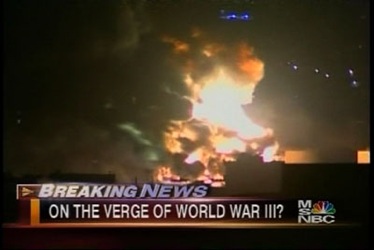
I just noted how the neoconservative Clean Break strategy appears to have been put into action. It offered a plan for Israel to "roll back" Syria with a massive war in Lebanon, theoretically giving the Israelis hegemony and an ability to dictate terms to the Arabs. The problem is that it's a dumb plan that won't fucking work, but they are going to kill hundreds (thousands?) more to keep trying it. Also word comes that Michael Ledeen is prepping the Iran war in a hardcore kind of way right now while trumpeting "World War IV."
Now that arch "conspiracy theorist" Wayne Madsen is saying that Ledeen is preparing to help Iranian dissidents plant WMDs inside Iran, to provide a staged "discovery" soon, thus providing a pretext for the U.S. to attack Iran. Once upon a time, of course, I met the man, and I wrote in the Mac Weekly:
I asked why the Iranians would bomb Jerusalem if it would kill so many Muslims. He said that the Iranians murderously hate Arabs and kill them all the time. In fact, he said, the Iranians are killing “hundreds” of Arabs in Iraq today, sending in money and munitions.
His scheme to free Iran was to supply the opposition with the tools to destabilize the regime, “but not a single bullet.” I have a hard time believing he could resist arming the Iranian opposition. In fact, many say that the Pentagon, administered by Ledeen’s allies, has courted a weird, cultish anti-regime Iranian guerilla group based in eastern Iraq called the Mujahideen al-Khalq. If Bush wins, it’s quite unlikely that the neo-cons will be able to resist using forces like these to harass Tehran, but we have no idea what sort of reaction this would provoke from the highly mobilized, nationalist Iranians.
And this appears to be exactly what is happening now. The odd thing about the following clips from Madsen's site is that these are exactly what we would have expected to hear a few years ago - that is, the old-school Neo-con conspiracy for middle eastern war is still unfolding, exactly like we feared it would. Antiwar.com's Justin Raimondo now pretty much proved to be accurate in this school of thinking.
So consider the following - and as always, take Madsen with a grain of salt. But consider how closely this follows what you expected the neo-cons to be doing:
July 21, 2006 -- Informed sources have told WMR that arch-neocon Michael Ledeen, who acts as an unofficial foreign policy adviser to Karl Rove, was at the White House yesterday with a group of Iranian opposition figures. Among the topics discussed was a promised $25 million grant by the Bush administration to the Iranian insurgents. The money is to be used to plant Desert Storm-vintage biological and chemical weapons shells, confiscated by U.S. forces in Iraq, on the Iranian side of the Iraqi border. The weapons will be used as "proof" of Iran's plan to "attack" U.S. troops in Iraq. That will be used to justify, ex post facto, the coming U.S. attack on Iran. Our sources report that George W. Bush dropped by the White House meeting to offer his support to the Iranian opposition operatives.
Pretext for war with Iran: White House plans to move chem-bio weapons from Iraq into Iranian side of this desolate border.
*********
July 21, 2006 -- The current Israeli assault on Lebanon was stage-managed between the government of Israeli Prime Minister Ehud Olmert and neocons in the Bush administration, according to well-connected sources in the nation's capital. The Bush administration had prior knowledge of and supported Israel's planned attacks on Gaza and Lebanon, the sources have revealed. In addition, there was no move by the Bush administration to warn Americans in the Occupied Palestinian Territories or Lebanon to leave the areas before the Israeli invasions. No travel warnings were issued to U.S. citizens in an attempt to mask Israeli attack plans, an action that resulted in last-minute Dunkirk-like sea evacuations of foreigners from Lebanon.
The first indication that Israel pre-planned its assault on the Palestinians came early this month when the Israelis began denying entry to the West Bank to Palestinians holding U.S. passports. The U.S. Embassy in Tel Aviv and the U.S. Consulate in Jerusalem refused to intervene with Israel, claiming it was the decision of a sovereign nation. The denial of entry to Palestinian-Americans was a violation of the Oslo Accords and the Geneva Conventions. The United States does not officially recognize Israeli sovereignty over the Occupied Palestinian Territories.
Washington insiders report that the Bush administration's coordination with Israel in the attacks on Hamas and Hezbollah involve the official adoption of the white paper, "A Clean Break: New Strategies for Securing the Realm," as U.S. policy. The "Clean Break" document, authored in 1996 by Israeli Prime Minister Binyamin Netanyahu, Richard Perle, Douglas Feith, and other neocon operatives, was written at the same time the program for the invasion and occupation of Iraq was drawn up by the same neocon players.
The current U.S.-Israeli strategy of bombing and invading Lebanon is a follow-up to four years of covert activities by the Pentagon, White House, and Mossad in Lebanon that involved the car bombing assassinations of top Lebanese officials in order to clear out Syrian forces from Lebanon. The assassinations of Elie Hobeika, George Hawi, and Rafik Hariri were all carried out to destabilize Lebanon and force the withdrawal of Syria from Lebanon. Syria was blamed by the Bush administration for all the car bombing assassinations in Lebanon.
Israel's border exercise that saw the capture by Hezbollah of two Israeli soldiers on the Lebanese side of the border and the contingency plans involving the kidnapping of an Israeli soldier by Hamas in Israel, near the Israeli-Gazan border, provided a pre-text for the Israeli attack on Gaza and Lebanon. Similar plans have been drawn up to respond to a Syrian "capture" of Israeli troops in Lebanon near the Syrian border or from the Golan Heights. That will be used to justify a joint Israeli and American attack on Syria, with Israel entering from Lebanon and the U.S. entering from Iraq.
The carrying out of the joint Israeli-U.S. attack plan for Lebanon, Syria (and eventually, Iran) is the reason why the United States has stymied UN attempts to seek an immediate cease-fire. The intent of the Bush administration is to see a widening of the conflict. Unconfirmed UN ambassador to the UN John Bolton, appearing on Fox News, laid out the future blueprint for the joint U.S.-Israeli regionalization of the war in the Middle East when he stated, "I think that if you look at the support that Iran and Syria have given groups like Hamas, Hezbollah, Palestinian Islamic Jihad that really the reckoning we need here is a reckoning, not just with the terrorist groups, but with the states that finance them."
WMR has also learned that top Israeli and U.S. military officers are adamantly opposed to the Clean Break policy. Many Israeli generals, remembering Israel's bloody occupation of Lebanon in the 1980s, favored negotiating a prisoner swap with Hezbollah. The Olmert government is purging the last remnants of the Yitzhak Rabin elements who favored negotiations from the Israeli military and intelligence agencies much in the same way that opponents of the Bush regime have been purged from the U.S. military, CIA, and State Department.
********
July 21, 2006 -- The son of David Gribben, Vice President Dick Cheney's boyhood friend and his chief of staff at the Pentagon and Vice President for Corporate Affairs at Halliburton, has reportedly joined Cheney's White House staff as an assistant. The elder Gribben is an active player in the corporate-religious tax dodge known as The Fellowship, an Arlington, Virginia-based contrivance that uses religious tax-exempt status to lobby the U.S. and foreign governments on behalf of the military-industrial complex. With the carrying out of the Clean Break by Israel and the United States, profits for companies like Halliburton are bound to skyrocket. The Israeli attack on Lebanon is already estimated to have resulted in $2 billion in damage to Lebanon's infrastructure. WMR previously reported that Jacobs/Sverdrup has been promised a lucrative Pentagon contract to build a large U.S. airbase in northern Lebanon.
************
July 20, 2006 -- WMR reported that the Israeli military was using poison gas on villages in south Lebanon. According to a former U.S. weapons expert who served in Iraq, the artillery shell in a photo taken in Lebanon (below) is a chemical weapon delivery device. It is being handled by an Israeli Defense Force soldier and Hebrew lettering can be clearly seen on the armored vehicle. Another chemical weapons shell of the same type can be seen lying on the ground to the right. It is not known what type of chemical is in the chemical canister, however, gas dropped by the Israelis in villages in southern Lebanon has resulted in severe vomiting among the civilian population.
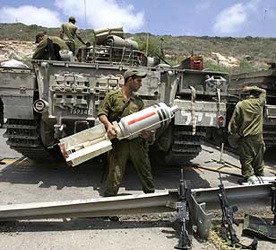
Media commentators have scoffed that Israel, with its relatively unique history, would ever use chemical weapons or poison gas in any war. It is precisely because of that perception that they are using such weapons. The deniability factor prevents the media from taking seriously the credible reports of banned weapons being used by the Israelis.
Alright, that's the maximum neo-con conspiracy theory case. But go back and read the Clean Break again, and maybe you'll finally fucking get it, if you don't already.
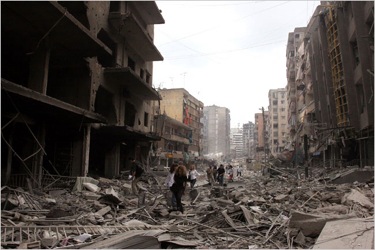
Fadi Ghalioum/Reuters. NY Times:
Journalists inspected damaged buildings Thursday after Israeli air raids in southern Beirut. (photo feature)
I would like to examine the many layers of what is going on in the mideast right now, a tricky proposition. I haven't posted a ton of stuff on the 9 days of heavy fighting so far, as the various blog commentaries and disturbing hawkish proclamations have the air of armchair morons who know nothing about the region, yet still are convinced that lots of people have to die, and then it will all make sense.
When Newt Gingrich calls it World War III, that's really... uh, something.
First I have to subtract the particular aura of doom that has settled over events, an aura deliberately fostered by all sides' political leaders that I call 'Apocalypse Chic.' In the next post I'll start into the concrete tactical reality of the situation - but first we need a little better metaphysical footing.
Last week I shared a certain moment with my former roommate on the stoop of my new building on Grand Avenue. "Shit! It's the Apocalypse!" I lamented. It seemed a juncture with eerie precedents in years past, hanging around Macalester bitching about the war and the latest lurch towards Armageddon. Later my caretaker said, "You know, it's always some damn thing - one crisis after another." Yet somehow the world keeps turning.
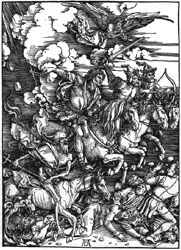 After Iraq started, I used to fear that total destabilization - the Eschaton or the Apocalypse - the point of no return, the end of predicting the future, since chaos renders it opaque. I thought that our leaders had embraced a creepy kind of foreshadowing, a sidewinding dance towards a destiny of doom. Yeah, they still do. But I don't really believe in the Eschaton anymore. It just gets more complicated each time. (image filched from Wikipedia)
The concept of "Judgment Day," (in my view a fiction since I don't believe in organized religion) first came about with the Zoroastrians in Persia, and from there integrated into Judaism (during the Babylonian captivity), Christianity and Islam. (That's definitely part of why the Book of Daniel is so kooky). Its purpose, in part, is to structure social and political authority, as decisions of the leadership can be represented as actions designed to face their societies for the imminent (and immanent) Rapture.
To fundamentalists in America, this is definitely compounded by Iraq's history as the site of wicked Babylon, and a fealty towards a highly militarized Israel, preparing to settle all the Promised Land - especially the West Bank - as a preparation for the End.
Many times in history, from the Nazis to Khmer Rouge, the American apocalypse brigades, Israel's messianic ultra-Orthodox West Bank settler organizations like Gush Emunim, and of course various Islamic movements, all of these have a foundation of belief that God dispensed order and disorder into the world, and free will counts for a limited time only, until S/He cancels the lease. Therefore, the leaders claim to be positioning their societies before this 'ultimate judgment,' and anyone who challenges their decisions is fucking up the preparations for the End of Days.
At this late date in the Middle East, "propaganda by deed" and demonstrations of lethal force are intended to both create new norms of behavior and solidify the obedience of the followers behind the leaders. The latest violence is like a kind of inverted Calvinism, where instead of Good Works demonstrating how you are a blessed one, the latest violence is represented as an act on the "cosmic plane," a kind of formal complaint or argument to the Metaphysical Other, to be scored on the approaching Last Day.
The aura of doom is a very disabling one - it tells you that everyday people are incapable of intervening in some blessed, fated order of events. It tells you that there is a veil of the supernatural behind which the government acts. It's a toxic fog sitting on your mind, cutting off all the alternative options and frames of reference before you've even had a cup of coffee. It's death in life. And it's the devil's greatest lie, told by all the totems of the highest morality in our societies.
It's very trendy these days, and it certainly brings out the worst in all the players. Bin Laden's style of bringing in a certain tone of eschatology has been incorporated into the tactics, strategy and Public Relations moves of Israel, the United States, Hezbollah, Iran, and the other actors in the region. That's why all the sides make their tactical moves for relatively simple reasons, while each vesting themselves in Apocalypse Chic. You just can't avert your eyes from the spectacle. You Have To Watch.
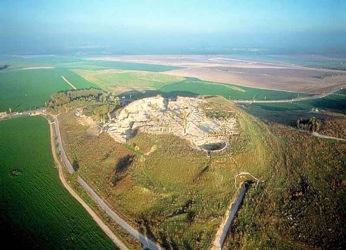
Jezreel Plain, the site of Megiddo, (Biblical Armageddon).
Karl Rove scheduled the Ultimate Battle for October 2012, just before the Presidential Election
From one blog, Green Beans and Drool, by a grad student named Jennifer who recently stayed in Beirut (via Juan Cole):
Monday, July 17, 2006: intimate dispatch from Beirut:
Evelyne forwarded an email from her brother, Lucien, who is a humanitarian activist and pastor at an Evangelical church in Beirut..... [photos of the pastor]
This is my translation (from French) of his email:
The sky is blue
The sky is red
The sky is black
It's raining fire
It's raining ashes
It's raining blood
A woman howls in sadness
A little girl is frozen in terror
A child is fixed in horror
Thank you for thinking about us! The country is screaming through the spew of bombs. Officials from all borders cry for vengeance. There is a god with a black beard who claims to speak for God. A commotion as the sorcerer's apprentices cook up all their magic potions. Meanwhile crowds of thousands give way and fold to the suffering of perpetual exile, of destruction without end.
Finally, among these thousands of displaced people, some familiar faces emerged. Thirty people who escaped from the furnace. A ring on the phone informed me - it was my friend Kazem. He told me about his village. Members of his family escaped the disaster and made their way toward Beirut. They were here finally after a long journey, and the visage of the group was hagard. They had hoped to find a place in a hotel somewhere, as they had the means, but they searched in vain.
A second call from the Hajjeh family shook my cell phone. The call was a swoon of sadness, a sinister scream. The 25-year-old husband of Eva, a daughter of the Hajjeh family, had been missing since the morning and was found dead. He had been with an emergency group who was trying to distribute food to displaced families. He was torn apart in the bombing of a nine-floor building in Tyre, a city already martyred a hundred times over -
Sorry. I'm weeping.*
Lucien
* "Sorry je pleure," it reads in the original French.
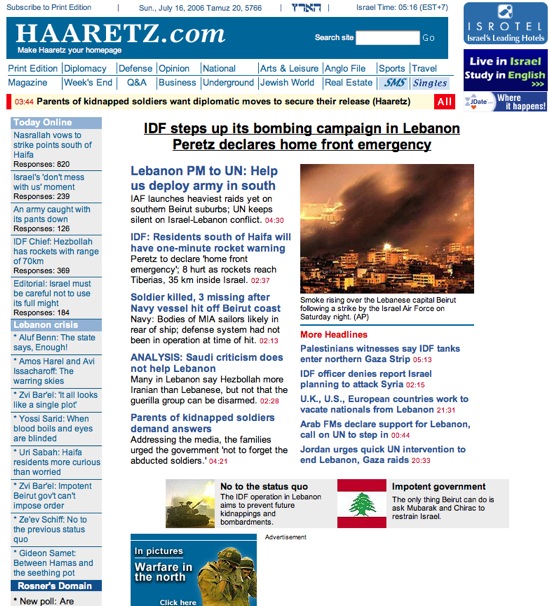
Ahh, Haaretz - you indefatigable old center-left Israeli paper whose words for peace are far more valuable than America's right-wing garbage
Today's explosive escalation is deeply tied to the situation in the Palestinian occupied territories. Make no mistake, the 1982 invasion of Lebanon was all about determining the fate of the West Bank: Israel was under pressure to negotiate with the PLO then, and this would have meant a peace deal for the West Bank. Instead, Ariel Sharon abruptly decided to invade Lebanon and try to obliterate the PLO, which created a bloody stalemate and a pointless occupation, and that, in turn, generated Hezbollah as a powerful occupation resistance / terrorist / [other word] organization.
However it bought some time to fill the West Bank with more settlements. And here we are today, via the indispensable Foundation for Middle East Peace:
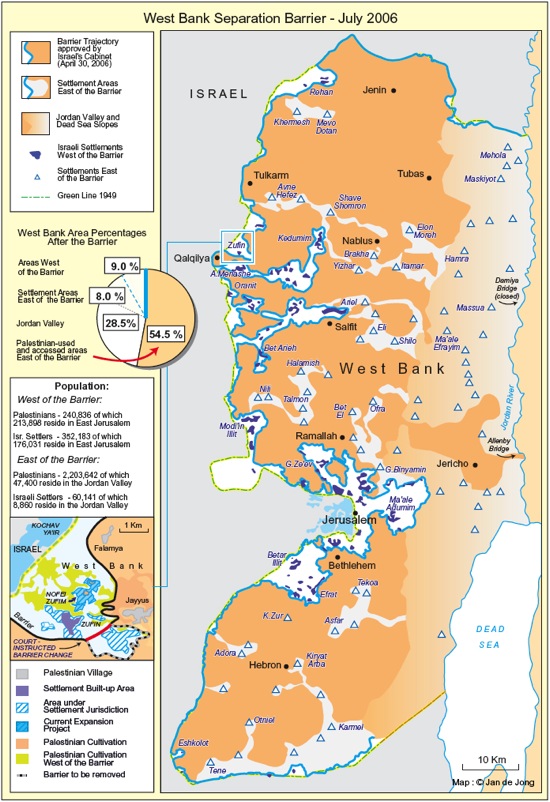
Now you must ask yourself: What is this? Do I say "Yummy Land!" Do I ask, "Why haven't I seen this kind of map anywhere else?" Do I say, "This is a really poor use of American tax dollars." Do I wonder, "Does such a plan court the apocalypse while making the Arabs angry and paranoid about American purposes?"
More precisely, are the West Bank settlement colonies the insane, unspeakable elephant in the room, the central contradiction around which the clouds of war are building higher and higher? Is this really what Bush wants to see? His apocalyptic Christian Rapture groupies?
The lines are being drawn all over right now - and the violently shifting lines in the West Bank are among the most important of them all. Democrats can't say shit about this; Republicans vaguely imply that they are morally constructive. American Jews are split, but Evangelicals are fanatically excited about it for all the wrong reasons. And 1/3 of the Jewish settlers would leave tomorrow, if their home mortgages hadn't trapped them in this limbo of eschatological construction, urban violence, and sprawling guerrilla war zone that composes the neo-conservatively managed West Bank. This is apparently what Douglas Feith wanted to see, given what is posted below.
The complexity of this layer is simply pouring out into Lebanon, with bloody and destabilizing results. Given the circumstances of what appears to be about 4 km short of bombing Syria, I will put up the following documents in the complete, unabridged forms, adding emphasis to some segments. I say give it the complete read.
Jabotinsky was one of the founders of Revisionist Zionism, and the Herut Party which later became the Likud Party. He is considered to be an iconic founder of the Likud Party - which is why his stern visage was mounted behind Ariel Sharon at some event. His essential view of imposing a surrender on the Arabs through violence - and rejecting negotiations at all costs - runs to the core of Israeli policy today, as well as the Bush Administration's fanatical refusal to talk to people like Iran, Iraqi insurgents, Syria, Hezbollah, Palestinian militants, or much anyone else, instead telling America that "shock and awe" style tactics shall bring compliance and peace.
Revisionist Zionism's obsession with the demonstrative power of Force has definitely found a new incarnation in Bush Administration policies, I think the following documents demonstrate well.
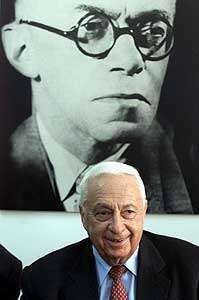 Vladimir Jabotinsky: The Iron Wall (We and the Arabs) - 1923
First published in Russian under the title O Zheleznoi Stene in Rassvyet, 4 November 1923.
Published in English in Jewish Herald (South Africa), 26 November 1937.
Transcribed & revised by Lenni Brenner.
Marked up by Einde O’Callaghan for REDS – Die Roten.
Contrary to the excellent rule of getting to the point immediately, I must begin this article with a personal introduction. The author of these lines is considered to be an enemy of the Arabs, a proponent of their expulsion, etc. This is not true. My emotional relationship to the Arabs is the same as it is to all other peoples – polite indifference. My political relationship is characterized by two principles. First: the expulsion of the Arabs from Palestine is absolutely impossible in any form. There will always be two nations in Palestine – which is good enough for me, provided the Jews become the majority. Second: I am proud to have been a member of that group which formulated the Helsingfors Program. We formulated it, not only for Jews, but for all peoples, and its basis is the equality of all nations. I am prepared to swear, for us and our descendants, that we will never destroy this equality and we will never attempt to expel or oppress the Arabs. Our credo, as the reader can see, is completely peaceful. But it is absolutely another matter if it will be possible to achieve our peaceful aims through peaceful means. This depends, not on our relationship with the Arabs, but exclusively on the Arabs’ relationship to Zionism.
After this introduction I can now get to the point. That the Arabs of the Land of Israel should willingly come to an agreement with us is beyond all hopes and dreams at present, and in the foreseeable future. This inner conviction of mine I express so categorically not because of any wish to dismay the moderate faction in the Zionist camp but, on the contrary, because I wish to save them from such dismay. Apart from those who have been virtually “blind” since childhood, all the other moderate Zionists have long since understood that there is not even the slightest hope of ever obtaining the agreement of the Arabs of the Land of Israel to “Palestine” becoming a country with a Jewish majority.
Every reader has some idea of the early history of other countries which have been settled. I suggest that he recall all known instances. If he should attempt to seek but one instance of a country settled with the consent of those born there he will not succeed. The inhabitants (no matter whether they are civilized or savages) have always put up a stubborn fight. Furthermore, how the settler acted had no effect whatsoever. The Spaniards who conquered Mexico and Peru, or our own ancestors in the days of Joshua ben Nun behaved, one might say, like plunderers. But those “great explorers,” the English, Scots and Dutch who were the first real pioneers of North America were people possessed of a very high ethical standard; people who not only wished to leave the redskins at peace but could also pity a fly; people who in all sincerity and innocence believed that in those virgin forests and vast plains ample space was available for both the white and red man. But the native resisted both barbarian and civilized settler with the same degree of cruelty.
Another point which had no effect at all was whether or not there existed a suspicion that the settler wished to remove the inhabitant from his land. The vast areas of the U.S. never contained more than one or two million Indians. The inhabitants fought the white settlers not out of fear that they might be expropriated, but simply because there has never been an indigenous inhabitant anywhere or at any time who has ever accepted the settlement of others in his country. Any native people – its all the same whether they are civilized or savage – views their country as their national home, of which they will always be the complete masters. They will not voluntarily allow, not only a new master, but even a new partner. And so it is for the Arabs. Compromisers in our midst attempt to convince us that the Arabs are some kind of fools who can be tricked by a softened formulation of our goals, or a tribe of money grubbers who will abandon their birth right to Palestine for cultural and economic gains. I flatly reject this assessment of the Palestinian Arabs. Culturally they are 500 years behind us, spiritually they do not have our endurance or our strength of will, but this exhausts all of the internal differences. We can talk as much as we want about our good intentions; but they understand as well as we what is not good for them. They look upon Palestine with the same instinctive love and true fervor that any Aztec looked upon his Mexico or any Sioux looked upon his prairie. To think that the Arabs will voluntarily consent to the realization of Zionism in return for the cultural and economic benefits we can bestow on them is infantile. This childish fantasy of our “Arabo-philes” comes from some kind of contempt for the Arab people, of some kind of unfounded view of this race as a rabble ready to be bribed in order to sell out their homeland for a railroad network.
This view is absolutely groundless. Individual Arabs may perhaps be bought off but this hardly means that all the Arabs in Eretz Israel are willing to sell a patriotism that not even Papuans will trade. Every indigenous people will resist alien settlers as long as they see any hope of ridding themselves of the danger of foreign settlement.
That is what the Arabs in Palestine are doing, and what they will persist in doing as long as there remains a solitary spark of hope that they will be able to prevent the transformation of “Palestine” into the “Land of Israel”.
Some of us imagined that a misunderstanding had occurred, that because the Arabs did not understand our intentions, they opposed us, but, if we were to make clear to them how modest and limited our aspirations are, they would then stretch out their arms in peace. This too is a fallacy that has been proved so time and again. I need recall only one incident. Three years ago, during a visit here, Sokolow delivered a great speech about this very “misunderstanding,” employing trenchant language to prove how grossly mistaken the Arabs were in supposing that we intended to take away their property or expel them from the country, or to suppress them. This was definitely not so. Nor did we even want a Jewish state. All we wanted was a regime representative of the League of Nations. A reply to this speech was published in the Arab paper Al Carmel in an article whose content I give here from memory, but I am sure it is a faithful account.
Our Zionist grandees are unnecessarily perturbed, its author wrote. There is no misunderstanding. What Sokolow claims on behalf of Zionism is true. But the Arabs already know this. Obviously, Zionists today cannot dream of expelling or suppressing the Arabs, or even of setting up a Jewish state. Clearly, in this period they are interested in only one thing – that the Arabs not interfere with Jewish immigration. Further, the Zionists have pledged to control immigration in accordance with the country's absorptive economic capacity. But the Arabs have no illusions, since no other conditions permit the possibility of immigration.
The editor of the paper is even willing to believe that the absorptive capacity of Eretz Israel is very great, and that it is possible to settle many Jews without affecting one Arab. “Just that is what the Zionists want, and what the Arabs do not want. In this way the Jews will, little by little, become a majority and, ipso facto, a Jewish state will be formed and the fate of the Arab minority will depend on the goodwill of the Jews. But was it not the Jews themselves who told us how ‘ pleasant’ being a minority was? No misunderstanding exists. Zionists desire one thing – freedom of immigration – and it is Jewish immigration that we do not want.”
The logic employed by this editor is so simple and clear that it should be learned by heart and be an essential part of our notion of the Arab question. It is of no importance whether we quote Herzl or Herbert Samuel to justify our activities. Colonization itself has its own explanation, integral and inescapable, and understood by every Arab and every Jew with his wits about him. Colonization can have only one goal. For the Palestinian Arabs this goal is inadmissible. This is in the nature of things. To change that nature is impossible.
A plan that seems to attract many Zionists goes like this: If it is impossible to get an endorsement of Zionism by Palestine's Arabs, then it must be obtained from the Arabs of Syria, Iraq, Saudi Arabia and perhaps of Egypt. Even if this were possible, it would not change the basic situation. It would not change the attitude of the Arabs in the Land of Israel towards us. Seventy years ago, the unification of Italy was achieved, with the retention by Austria of Trent and Trieste. However, the inhabitants of those towns not only refused to accept the situation, but they struggled against Austria with redoubled vigor. If it were possible (and I doubt this) to discuss Palestine with the Arabs of Baghdad and Mecca as if it were some kind of small, immaterial borderland, then Palestine would still remain for the Palestinians not a borderland, but their birthplace, the center and basis of their own national existence. Therefore it would be necessary to carry on colonization against the will of the Palestinian Arabs, which is the same condition that exists now.
But an agreement with Arabs outside the Land of Israel is also a delusion. For nationalists in Baghdad, Mecca and Damascus to agree to such an expensive contribution (agreeing to forego preservation of the Arab character of a country located in the center of their future “federation”) we would have to offer them something just as valuable. We can offer only two things: either money or political assistance or both. But we can offer neither. Concerning money, it is ludicrous to think we could finance the development of Iraq or Saudi Arabia, when we do not have enough for the Land of Israel. Ten times more illusionary is political assistance for Arab political aspirations. Arab nationalism sets itself the same aims as those set by Italian nationalism before 1870 and Polish nationalism before 1918: unity and independence. These aspirations mean the eradication of every trace of British influence in Egypt and Iraq, the expulsion of the Italians from Libya, the removal of French domination from Syria, Tunis, Algiers and Morocco. For us to support such a movement would be suicide and treachery. If we disregard the fact that the Balfour Declaration was signed by Britain, we cannot forget that France and Italy also signed it. We cannot intrigue about removing Britain from the Suez Canal and the Persian Gulf and the elimination of French and Italian colonial rule over Arab territory. Such a double game cannot be considered on any account.
Thus we conclude that we cannot promise anything to the Arabs of the Land of Israel or the Arab countries. Their voluntary agreement is out of the question. Hence those who hold that an agreement with the natives is an essential condition for Zionism can now say “no” and depart from Zionism. Zionist colonization, even the most restricted, must either be terminated or carried out in defiance of the will of the native population. This colonization can, therefore, continue and develop only under the protection of a force independent of the local population – an iron wall which the native population cannot break through. This is, in toto, our policy towards the Arabs. To formulate it any other way would only be hypocrisy.
Not only must this be so, it is so whether we admit it or not. What does the Balfour Declaration and the Mandate mean for us? It is the fact that a disinterested power committed itself to create such security conditions that the local population would be deterred from interfering with our efforts.
All of us, without exception, are constantly demanding that this power strictly fulfill its obligations. In this sense, there are no meaningful differences between our “militarists” and our “vegetarians.” One prefers an iron wall of Jewish bayonets, the other proposes an iron wall of British bayonets, the third proposes an agreement with Baghdad, and appears to be satisfied with Baghdad’s bayonets – a strange and somewhat risky taste’ but we all applaud, day and night, the iron wall. We would destroy our cause if we proclaimed the necessity of an agreement, and fill the minds of the Mandatory with the belief that we do not need an iron wall, but rather endless talks. Such a proclamation can only harm us. Therefore it is our sacred duty to expose such talk and prove that it is a snare and a delusion.
Two brief remarks: In the first place, if anyone objects that this point of view is immoral, I answer: It is not true; either Zionism is moral and just or it is immoral and unjust. But that is a question that we should have settled before we became Zionists. Actually we have settled that question, and in the affirmative.
We hold that Zionism is moral and just. And since it is moral and just, justice must be done, no matter whether Joseph or Simon or Ivan or Achmet agree with it or not.
There is no other morality.
All this does not mean that any kind of agreement is impossible, only a voluntary agreement is impossible. As long as there is a spark of hope that they can get rid of us, they will not sell these hopes, not for any kind of sweet words or tasty morsels, because they are not a rabble but a nation, perhaps somewhat tattered, but still living. A living people makes such enormous concessions on such fateful questions only when there is no hope left. Only when not a single breach is visible in the iron wall, only then do extreme groups lose their sway, and influence transfers to moderate groups. Only then would these moderate groups come to us with proposals for mutual concessions. And only then will moderates offer suggestions for compromise on practical questions like a guarantee against expulsion, or equality and national autonomy.
I am optimistic that they will indeed be granted satisfactory assurances and that both peoples, like good neighbors, can then live in peace. But the only path to such an agreement is the iron wall, that is to say the strengthening in Palestine of a government without any kind of Arab influence, that is to say one against which the Arabs will fight. In other words, for us the only path to an agreement in the future is an absolute refusal of any attempts at an agreement now.
The other document worth considering is the widely famous "Clean Break" document, a 1996 policy paper by noted neoconservatives, including Richard Perle and Douglas Feith. Perle has since denied that he had a role in the final piece, produced from some kind of brainstorming session. "A Clean Break: A New Strategy for Securing the Realm" seems to form an eerie preface to today's situation, as Justin Raimondo on antiwar.com observes.
In the context of the escalating war, it's now worth reading for its broad prescription of a massive war in Lebanon, and in turn, east into Syria and the Levant. Long ago I posted The Clean Break to Everything2 where it was popular. I inserted lots of links to other E2 pages to add a sense of the surreal.
##########
A Clean Break:
A New Strategy for Securing the Realm
(original source)
Following is a report prepared by The Institute for Advanced Strategic and Political Studies' "Study Group on a New Israeli Strategy Toward 2000." The main substantive ideas in this paper emerge from a discussion in which prominent opinion makers, including Richard Perle, James Colbert, Charles Fairbanks, Jr., Douglas Feith, Robert Loewenberg, David Wurmser, and Meyrav Wurmser participated. The report, entitled "A Clean Break: A New Strategy for Securing the Realm," is the framework for a series of follow-up reports on strategy.
Israel has a large problem. Labor Zionism, which for 70 years has dominated the Zionist movement, has generated a stalled and shackled economy. Efforts to salvage Israel's socialist institutions-which include pursuing supranational over national sovereignty and pursuing a peace process that embraces the slogan, "New Middle East"--undermine the legitimacy of the nation and lead Israel into strategic paralysis and the previous government's "peace process." That peace process obscured the evidence of eroding national critical mass- including a palpable sense of national exhaustion-and forfeited strategic initiative. The loss of national critical mass was illustrated best by Israel's efforts to draw in the United States to sell unpopular policies domestically, to agree to negotiate sovereignty over its capital, and to respond with resignation to a spate of terror so intense and tragic that it deterred Israelis from engaging in normal daily functions, such as commuting to work in buses.
Benjamin Netanyahu's government comes in with a new set of ideas. While there are those who will counsel continuity, Israel has the opportunity to make a clean break; it can forge a peace process and strategy based on an entirely new intellectual foundation, one that restores strategic initiative and provides the nation the room to engage every possible energy on rebuilding Zionism, the starting point of which must be economic reform. To secure the nation's streets and borders in the immediate future, Israel can:
This report is written with key passages of a possible speech marked TEXT, that highlight the clean break which the new government has an opportunity to make. The body of the report is the commentary explaining the purpose and laying out the strategic context of the passages.
A New Approach to Peace
Early adoption of a bold, new perspective on peace and security is imperative for the new prime minister. While the previous government, and many abroad, may emphasize "land for peace"- which placed Israel in the position of cultural, economic, political, diplomatic, and military retreat - the new government can promote Western values and traditions. Such an approach, which will be well received in the United States, includes "peace for peace," "peace through strength" and self reliance: the balance of power.
A new strategy to seize the initiative can be introduced:
TEXT:
We have for four years pursued peace based on a New Middle East. We in Israel cannot play innocents abroad in a world that is not innocent. Peace depends on the character and behavior of our foes. We live in a dangerous neighborhood, with fragile states and bitter rivalries. Displaying moral ambivalence between the effort to build a Jewish state and the desire to annihilate it by trading "land for peace" will not secure "peace now." Our claim to the land -to which we have clung for hope for 2000 years--is legitimate and noble. It is not within our own power, no matter how much we concede, to make peace unilaterally. Only the unconditional acceptance by Arabs of our rights, especially in their territorial dimension, "peace for peace," is a solid basis for the future.
Israel's quest for peace emerges from, and does not replace, the pursuit of its ideals. The Jewish people's hunger for human rights - burned into their identity by a 2000-year old dream to live free in their own land - informs the concept of peace and reflects continuity of values with Western and Jewish tradition. Israel can now embrace negotiations, but as means, not ends, to pursue those ideals and demonstrate national steadfastness. It can challenge police states; enforce compliance of agreements; and insist on minimal standards of accountability.
Securing the Northern Border
Syria challenges Israel on Lebanese soil. An effective approach, and one with which American can sympathize, would be if Israel seized the strategic initiative along its northern borders by engaging Hizballah, Syria, and Iran, as the principal agents of aggression in Lebanon, including by:
Israel also can take this opportunity to remind the world of the nature of the Syrian regime. Syria repeatedly breaks its word. It violated numerous agreements with the Turks, and has betrayed the United States by continuing to occupy Lebanon in violation of the Taef agreement in 1989. Instead, Syria staged a sham election, installed a quisling regime, and forced Lebanon to sign a "Brotherhood Agreement" in 1991, that terminated Lebanese sovereignty. And Syria has begun colonizing Lebanon with hundreds of thousands of Syrians, while killing tens of thousands of its own citizens at a time, as it did in only three days in 1983 in Hama.
Under Syrian tutelage, the Lebanese drug trade, for which local Syrian military officers receive protection payments, flourishes. Syria's regime supports the terrorist groups operationally and financially in Lebanon and on its soil. Indeed, the Syrian-controlled Bekaa Valley in Lebanon has become for terror what the Silicon Valley has become for computers. The Bekaa Valley has become one of the main distribution sources, if not production points, of the "supernote" - counterfeit US currency so well done that it is impossible to detect.
Text:
Negotiations with repressive regimes like Syria's require cautious realism. One cannot sensibly assume the other side's good faith. It is dangerous for Israel to deal naively with a regime murderous of its own people, openly aggressive toward its neighbors, criminally involved with international drug traffickers and counterfeiters, and supportive of the most deadly terrorist organizations.
Given the nature of the regime in Damascus, it is both natural and moral that Israel abandon the slogan "comprehensive peace" and move to contain Syria, drawing attention to its weapons of mass destruction program, and rejecting "land for peace" deals on the Golan Heights.
Moving to a Traditional Balance of Power Strategy
TEXT:
We must distinguish soberly and clearly friend from foe. We must make sure that our friends across the Middle East never doubt the solidity or value of our friendship.
Israel can shape its strategic environment, in cooperation with Turkey and Jordan, by weakening, containing, and even rolling back Syria. This effort can focus on removing Saddam Hussein from power in Iraq - an important Israeli strategic objective in its own right - as a means of foiling Syria's regional ambitions. Jordan has challenged Syria's regional ambitions recently by suggesting the restoration of the Hashemites in Iraq. This has triggered a Jordanian-Syrian rivalry to which Asad has responded by stepping up efforts to destabilize the Hashemite Kingdom, including using infiltrations. Syria recently signaled that it and Iran might prefer a weak, but barely surviving Saddam, if only to undermine and humiliate Jordan in its efforts to remove Saddam.
But Syria enters this conflict with potential weaknesses: Damascus is too preoccupied with dealing with the threatened new regional equation to permit distractions of the Lebanese flank. And Damascus fears that the 'natural axis' with Israel on one side, central Iraq and Turkey on the other, and Jordan, in the center would squeeze and detach Syria from the Saudi Peninsula. For Syria, this could be the prelude to a redrawing of the map of the Middle East which would threaten Syria's territorial integrity.
Since Iraq's future could affect the strategic balance in the Middle East profoundly, it would be understandable that Israel has an interest in supporting the Hashemites in their efforts to redefine Iraq, including such measures as: visiting Jordan as the first official state visit, even before a visit to the United States, of the new Netanyahu government; supporting King Hussein by providing him with some tangible security measures to protect his regime against Syrian subversion; encouraging - through influence in the U.S. business community - investment in Jordan to structurally shift Jordan's economy away from dependence on Iraq; and diverting Syria's attention by using Lebanese opposition elements to destabilize Syrian control of Lebanon.
Most important, it is understandable that Israel has an interest supporting diplomatically, militarily and operationally Turkey's and Jordan's actions against Syria, such as securing tribal alliances with Arab tribes that cross into Syrian territory and are hostile to the Syrian ruling elite.
King Hussein may have ideas for Israel in bringing its Lebanon problem under control. The predominantly Shia population of southern Lebanon has been tied for centuries to the Shia leadership in Najf, Iraq rather than Iran. Were the Hashemites to control Iraq, they could use their influence over Najf to help Israel wean the south Lebanese Shia away from Hizballah, Iran, and Syria. Shia retain strong ties to the Hashemites: the Shia venerate foremost the Prophet's family, the direct descendants of which - and in whose veins the blood of the Prophet flows - is King Hussein.
Changing the Nature of Relations with the Palestinians
Israel has a chance to forge a new relationship between itself and the Palestinians. First and foremost, Israel's efforts to secure its streets may require hot pursuit into Palestinian-controlled areas, a justifiable practice with which Americans can sympathize.
A key element of peace is compliance with agreements already signed. Therefore, Israel has the right to insist on compliance, including closing Orient House and disbanding Jibril Rujoub's operatives in Jerusalem. Moreover, Israel and the United States can establish a Joint Compliance Monitoring Committee to study periodically whether the PLO meets minimum standards of compliance, authority and responsibility, human rights, and judicial and fiduciary accountability.
TEXT:
We believe that the Palestinian Authority must be held to the same minimal standards of accountability as other recipients of U.S. foreign aid. A firm peace cannot tolerate repression and injustice. A regime that cannot fulfill the most rudimentary obligations to its own people cannot be counted upon to fulfill its obligations to its neighbors.
Israel has no obligations under the Oslo agreements if the PLO does not fulfill its obligations. If the PLO cannot comply with these minimal standards, then it can be neither a hope for the future nor a proper interlocutor for present. To prepare for this, Israel may want to cultivate alternatives to Arafat's base of power. Jordan has ideas on this.
To emphasize the point that Israel regards the actions of the PLO problematic, but not the Arab people, Israel might want to consider making a special effort to reward friends and advance human rights among Arabs. Many Arabs are willing to work with Israel; identifying and helping them are important. Israel may also find that many of her neighbors, such as Jordan, have problems with Arafat and may want to cooperate. Israel may also want to better integrate its own Arabs.
Forging A New U.S.-Israeli Relationship
In recent years, Israel invited active U.S. intervention in Israel's domestic and foreign policy for two reasons: to overcome domestic opposition to "land for peace" concessions the Israeli public could not digest, and to lure Arabs - through money, forgiveness of past sins, and access to U.S. weapons - to negotiate. This strategy, which required funneling American money to repressive and aggressive regimes, was risky, expensive, and very costly for both the U.S. and Israel, and placed the United States in roles it should neither have nor want.
Israel can make a clean break from the past and establish a new vision for the U.S.-Israeli partnership based on self-reliance, maturity and mutuality - not one focused narrowly on territorial disputes. Israel's new strategy - based on a shared philosophy of peace through strength - reflects continuity with Western values by stressing that Israel is self-reliant, does not need U.S. troops in any capacity to defend it, including on the Golan Heights, and can manage its own affairs. Such self-reliance will grant Israel greater freedom of action and remove a significant lever of pressure used against it in the past.
To reinforce this point, the Prime Minister can use his forthcoming visit to announce that Israel is now mature enough to cut itself free immediately from at least U.S. economic aid and loan guarantees at least, which prevent economic reform. (Military aid is separated for the moment until adequate arrangements can be made to ensure that Israel will not encounter supply problems in the means to defend itself). As outlined in another Institute report, Israel can become self-reliant only by, in a bold stroke rather than in increments, liberalizing its economy, cutting taxes, relegislating a free-processing zone, and selling-off public lands and enterprises - moves which will electrify and find support from a broad bipartisan spectrum of key pro-Israeli Congressional leaders, including Speaker of the House, Newt Gingrich.
Israel can under these conditions better cooperate with the U.S. to counter real threats to the region and the West's security. Mr. Netanyahu can highlight his desire to cooperate more closely with the United States on anti-missile defense in order to remove the threat of blackmail which even a weak and distant army can pose to either state. Not only would such cooperation on missile defense counter a tangible physical threat to Israel's survival, but it would broaden Israel's base of support among many in the United States Congress who may know little about Israel, but care very much about missile defense. Such broad support could be helpful in the effort to move the U.S. embassy in Israel to Jerusalem.
To anticipate U.S. reactions and plan ways to manage and constrain those reactions, Prime Minister Netanyahu can formulate the policies and stress themes he favors in language familiar to the Americans by tapping into themes of American administrations during the Cold War which apply well to Israel. If Israel wants to test certain propositions that require a benign American reaction, then the best time to do so is before November, 1996.
Conclusions: Transcending the Arab-Israeli Conflict
TEXT: Israel will not only contain its foes; it will transcend them.
Notable Arab intellectuals have written extensively on their perception of Israel's floundering and loss of national identity. This perception has invited attack, blocked Israel from achieving true peace, and offered hope for those who would destroy Israel. The previous strategy, therefore, was leading the Middle East toward another Arab-Israeli war. Israel's new agenda can signal a clean break by abandoning a policy which assumed exhaustion and allowed strategic retreat by reestablishing the principle of preemption, rather than retaliation alone and by ceasing to absorb blows to the nation without response.
Israel's new strategic agenda can shape the regional environment in ways that grant Israel the room to refocus its energies back to where they are most needed: to rejuvenate its national idea, which can only come through replacing Israel's socialist foundations with a more sound footing; and to overcome its "exhaustion," which threatens the survival of the nation.
Ultimately, Israel can do more than simply manage the Arab-Israeli conflict though war. No amount of weapons or victories will grant Israel the peace it seeks. When Israel is on a sound economic footing, and is free, powerful, and healthy internally, it will no longer simply manage the Arab-Israeli conflict; it will transcend it. As a senior Iraqi opposition leader said recently: "Israel must rejuvenate and revitalize its moral and intellectual leadership. It is an important -- if not the most important--element in the history of the Middle East." Israel - proud, wealthy, solid, and strong - would be the basis of a truly new and peaceful Middle East.
Participants in the Study Group on "A New Israeli Strategy Toward 2000:"
Richard Perle, American Enterprise Institute, Study Group Leader
James Colbert, Jewish Institute for National Security Affairs
Charles Fairbanks, Jr., Johns Hopkins University/SAIS
Douglas Feith, Feith and Zell Associates
Robert Loewenberg, President, Institute for Advanced Strategic and Political Studies
Jonathan Torop, The Washington Institute for Near East Policy
David Wurmser, Institute for Advanced Strategic and Political Studies
Meyrav Wurmser, Johns Hopkins University
#########
All right, wasn't that fun? I'm going to throw a third one in. This was a piece that Douglas Feith wrote in the Washington Times around the same time... It's ten years and one month old, but combined with the Clean Break, the picture of neoconservatives close to Israel starting a huge war in Lebanon and Syria in order to protect their 'Reaganesque' West Bank settlements becomes a bit more obvious.
This piece is archived on the Center for Security Policy's website, a hardcore neocon thinktank organization run by Frank Gaffney that is extremely supportive of Israel's right wing. Nasty characters like Max Boot, James Woolsey, and Charles Krauthammer are tied into this place, whose site is mocking the 'peace' movement, among other angles of a place promoting Peace through Strength. They gave a "Freedom Flame" award to Richard Perle, which pretty much sums it up.

About as radical as the Reaganites: by Douglas J. Feith: The Washington Times, June 18, 1996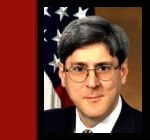
Not since Ronald Reagan beat Jimmy Carter in 1980 has an election triggered such consternation from commentators anxious about peace. Benjamin Netanyahu, Israel's prime minister-elect, is being depicted as a radical right-winger, planter of settlements and opponent of peace. In fact, his Likud party is in general about as radical as our Republican Party. Mr. Netanyahu favors diplomatic, defense and economic policies for Israel similar in principle to the kind of policies that Reaganites favored (and favor) for the United States.
Though Mr. Reagan rejected his predecessor's "arms control process," symbolized by the hug Mr. Carter gave Leonid Brezhnev when they signed SALT II, Mr. Reagan did not reject diplomacy. He approached the negotiating table, however, with a frame of mind different from that of Mr. Carter. Mr. Netanyahu,too, inevitably, will continue diplomacy, but not the particular approach to the "peace process" symbolized by Shimon Peres' embracing Yasser Arafat and declaring, as Mr. Carter did with Mr. Brezhnev, that the two men actually share a vision of peace.
Due to the crappiness of MovableType this post has been split into two, please keep reading for the goods!
Hezbollah's television station, Al Manar, was attacked by Israel in Lebanon. Their website appears to be offline, or perhaps the US has cut it off.
The question is whether anyone will be able to walk down this crisis. Literally we are looking at a combination of the Six Day War, Lebanon 1982 (Big Pines) and the Cuban Missile Crisis, though a shitload of missiles have already been fired on both sides. It will be a great feat if the diplomats can fish the world out of this one.
LA Times had a good story on it.
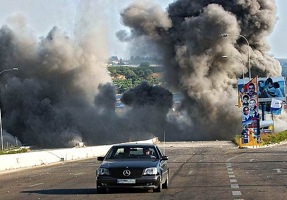
Israel Enters Lebanon After Militants Capture 2 Soldiers
Olmert, now facing conflicts on two fronts, calls Hezbollah’s raid an act of war. The group’s leader issues a taunt, the U.S. a condemnation.
By Laura King and Vita Bekker, Special to The LA Times
8:25 PM PDT, July 12, 2006
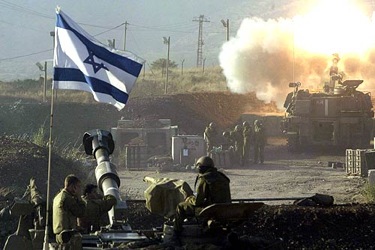
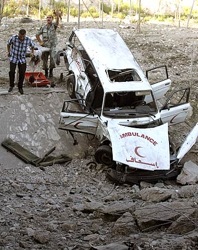
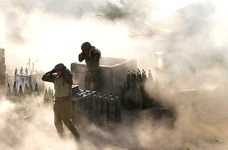 SAFAT, Israel — Israeli troops and tanks Wednesday drove deep into Lebanon for the first time in six years after guerrillas with the Shiite Muslim group Hezbollah seized two Israeli soldiers in a meticulously planned cross-border raid.
Eight Israeli soldiers died in fighting on both sides of the frontier, the army said. At least one Hezbollah fighter and two Lebanese civilians also were reported killed.
Israel's thrust across its northern border left it waging simultaneous warfare on two fronts: in the Gaza Strip, where nearly 80 Palestinians have been killed during a 2-week-old offensive that also began after the seizure of an Israeli soldier, and in Lebanon, where Israeli troops spent two decades locked in a debilitating and inconclusive conflict.
Israeli Prime Minister Ehud Olmert described Hezbollah's raid as an act of war, for which he said the Lebanese government bore responsibility.
The ramifications threatened to spread across the region. The White House and Israeli officials quickly cast blame on Syria and Iran, Hezbollah's patrons.
Haaretz: ANALYSIS: Israel is at risk of embarking on three-front war
By Ze'ev Schiff, Haaretz Correspondent
Two weeks after the start of the IDF's extensive operation in the Gaza Strip, Hezbollah opened a second front on the northern border. The second front, which could expand into Israel, started just as the first did - with the abduction of soldiers from inside Israel and the deaths of others.
Israel faces the danger of a third front if Syria steps in to assist Hezbollah. Strategically, Israel faces an extreme foursome: Hamas, Hezbollah, Syria and Iran. Two extremist Islamic organizations considered terror organizations, and two states Washington names in the Axis of Evil.
Israel has no choice but to hold Lebanon responsible for what happens in its borders and for what comes out of it. Lebanon will likely wail as Israel strikes inside its territory and hits its infrastructure, but the Lebanese government must see itself as responsible for what Hezbollah does out of Lebanon. Particularly since Lebanon essentially rejected UN resolution 1559, which called for disarming the militia. Hamas and Hezbollah made the rules of the game with the ongoing rocket fire into Israel and the abduction of Israeli soldiers. If Israel loses in handling this, its strategic and military standing in the region will change and its deterrence of guerrilla warfare and high-trajectory weapons will be undermined.
From the moment the ground incursion into Gaza started, it was possible Hezbollah would try to help Hamas by attacking on the Lebanese border. This option was rejected by most military analysts. No unusual alert was evident.
In addition to the desire to help Hamas, Hezbollah has its own grudge to bear with Israel. On May 28, Hezbollah taunted Israel with a Katyusha barrage at an IDF base on Mt. Meron. In response, Israel immediately hit a number of Hezbollah positions along the border. It was clear that Hezbollah, whose leader has often declared his organization would abduct Israelis, was waiting for the right moment, which came Wednesday. There is no need for (res.) Major General Giora Eiland to investigate the event in the north as he did the one in the south. It is better to focus on upcoming developments and the question of how to conduct a war on two and maybe three fronts. Hopefully Israel's leaders will give up the harsh words and exaggerated threats we have seen in the past two weeks.
Israel's options now are aggression on two fronts. Israeli would best act cautiously in order not to open a third front with Syria, unless Damascus taunts Israel.
Clearly Israel will strike Lebanese infrastructure related to Hezbollah and may expand its targets in its wrath. For years, Israel neglected the rocket system Hezbollah built in Lebanon with Iranian and Syrian help. It took no preventative measures against the convoys and storehouses of weaponry. We thought they would rust and now they are directed at Israel. There is also an absurd situation where we ignored Hezbollah positions adjacent to the border and to our Galilee communities. Some of those positions were once IDF outposts.
Israel must not allow Hezbollah to return to border positions. This is a clearcut defensive tactic and, in any case, Hezbollah is taking the offensive against Israel. Israel's operation in Gaza is not enough. The Gaza front will become secondary if the fighting in the north expands. If Israel wants even partial international support, it must avoid causing a humanitarian crisis in Gaza. After Wednesday's events on the northern border, international efforts to mediate on the matter of the abductees and the prisoners will increase and address additional issues. In which case, Israel will have little time for a broad military operation.
Israeli woman killed in Katyusha attack on Nahariya; IAF attacks Beirut airport, Hezbollah TV station
29 Israelis also hurt in rocket attack on north
By Jack Khoury, Amos Harel, Aluf Benn and Gideon Alon, Haaretz Correspondents and Agencies
A Katyusha rocket fired from Lebanon hit a house in the northern border town of Nahariya on Thursday morning, killing an Israeli woman and wounding 29 others, including a number of children.
Despite IDF orders to all residents to stay in shelters, the 40-year-old woman had been sitting on her fifth-floor balcony when the rocket hit the floor above, cutting through the ceiling and killed her, Israel Radio reported.
Most of the casualties were lightly wounded; one person sustained serious wounds.
The Israel Defense Forces began preparing Wednesday night for a widespread aerial assault on Lebanon, after the cabinet approved a "severe" response to Hezbollah's attack on the northern border on Wednesday, which ended with eight soldiers dead and two kidnapped.
Although nothing is definitely known about the condition of the abducted soldiers, they are believed to be alive, since little of their blood was found at the scene of the attack.
Israel said on Thursday its naval vessels were in Lebanon's territorial waters and blocking access to ports as part of its offensive.
"Since this morning Israeli naval vessels have enforced a full naval closure on Lebanon, because Lebanon's ports are used to transfer both terrorists and weapons to the terror organizations operating in Lebanon," an IDF spokesman said.
The IDF confirmed that several rockets landed more than 20 kilometers south of the border, signaling that Hezbollah is becoming increasingly successful in expanding the reach of the crude projectiles. The group has declared it has over 10,000 rockets to use against Israel.
A resident of the northern town of Zirit was lightly wounded by a Katyusha earlier Thursday. Hezbollah fired another 10 Katyushas overnight at an IDF base on Mount Meron. No injuries were reported in that incident.
Nahariya Mayor Jackie Sabag said the whole town, about 10 kilometers south of Israel's border with Lebanon, has shut down. Sabag urged all residents to comply with army orders to stay in underground shelters. At Nahariya Hospital, patients were moved to secure rooms on lower floors.
As Israel widened its offensive against Hezbollah overnight, an Israel Air Force aircraft fired a rocket into the Hezbollah's al-Manar television station in the group's stronghold in Beirut's southern suburb on Thursday, wounding six people, witnesses and a security source said. The station continued to broadcast, reporting that an Israeli rocket had hit a "minor transmission unit."
The IAF also struck the runway of the country's only international airport in the suburbs of Beirut, forcing its closure, and blasting southern Lebanon for a second day, police and airport officials said.
A shell crashed shortly after 6 A.M. on the eastern runway, one of three, airport employees reported. Another impact was heard shortly afterward.
Two flights approaching the airport were diverted to Larnaca airport on the island of Cyprus. A senior airport official announced the facility had been closed and diverted scheduled flights to Cyprus.
The main terminal building of the $500 million airport, which was built in the late 1990s, remained intact.
It was not clear if all the shells came from aircraft or if gunboats participated in the attack on the airport, which lies close to the sea in the southern suburbs of Beirut, a stronghold of Hezbollah guerrillas.
The IDF confirmed it had struck Beirut airport, saying the facility is "a central hub for the transfer of weapons and supplies to the Hezbollah terrorist organization."
It was the first time since Israel's 1982 invasion of Lebanon and occupation of Beirut that the airport was hit by Israel. In 1968, Israel sent commandos to Beirut airport, blowing up 13 passenger planes on the runway in retaliation for Arab militants firing on an Israeli airliner in Athens.
Israel said its air offensive was the fiercest since its 1982 invasion of Lebanon. The last major air, ground and sea offensive against Lebanon was in 1996 when about 150 Lebanese civilians were killed.
In southern Lebanon, at least 26 civilians were reported killed in overnight IAF attacks, including a family of 10 and another family of seven in the village of Dweir, Lebanese officials said.
The IDF response was to include a series of aerial attacks against Hezbollah, and particularly against the batteries of rockets aimed at Israel that the organization has stationed along the northern border. This operation is expected to last for several days. The IDF also recommended various operations aimed at the Lebanese government and strategic targets in Lebanon.
In a sharp departure from Israel's response to previous Hezbollah attacks, the late-night cabinet session unanimously agreed that the Lebanese government should be held responsible for Wednesday's events. In the past, Israel has generally pointed its finger at Hezbollah's patrons, Syria and Iran.
"Israel holds the sovereign government of Lebanon as responsible for the action which emanated from its territory and for the safe return of the abducted soldiers," the government said in a statement issued after the meeting.
"Israel must act with appropriate severity in response to this attack and it will do so. Israel will respond in a forthright and severe manner against the perpetrators responsible and will act to prevent future efforts and actions directed against Israel."
Ministers declined to give details of the measures approved last night, saying that Prime Minister Ehud Olmert had asked them to stay mum. However, the IDF's recommendations including attacks on Lebanon's power grid, which Israel struck once before, in 1999. The army also recommended imposing a partial or complete naval and aerial blockade on Lebanon - for instance, preventing civilian aircraft from landing in Beirut.
The IDF did not recommend moving ground forces into Lebanon at this time.
Hezbollah is likely, however, to respond to the Israeli attacks with massive rocket launches at Israel, and in that case, the IDF might move ground forces into Lebanon, both to create a temporary buffer zone in the southern part of the country and to destroy Hezbollah's network of outposts and rockets along the border. The goal of any such operation would also be to ensure that this network could not be rebuilt.
Residents of northern border communities have already been ordered into shelters, and Defense Minister Amir Peretz ordered the Home Front Command to prepare for the defense of dozens of other communities that were not vulnerable to Hezbollah fire in the past, but are now reachable with the
long-range rockets Hezbollah has deployed in recent years.
"We may be facing a completely different reality, in which hundreds of thousands of Israelis will, for a short time, find themselves in danger from Hezbollah's rockets," said a senior defense official. These include residents of the center of the country.
The army also began preparing for a limited call-up of the reserves, since this might be necessary if a ground operation in Lebanon is approved. Thus far, however, no call-up has been approved.
Wednesday's attack, the cabinet agreed, had created a completely new situation on the northern border, and government sources said that Israel must take steps that will "exact a price" and restore its deterrence.
Olmert rejected Hezbollah's demand that Israel purchase the kidnapped soldiers' freedom by releasing Lebanese and Palestinian terrorists jailed in Israel.
The cabinet also decided to demand that the international community enforce UN Security Council resolutions calling for the Lebanese army to disarm Hezbollah and assume control of the border with Israel. Currently, Hezbollah effectively controls southern Lebanon, and the Lebanese army stays away.
On Wednesday, Olmert accused Lebanon of an act of war against Israel and threatened a painful Israeli response. "This morning's events are not a terror attack, but the act of a sovereign state that attacked Israel for no reason and without provocation," he said. "The Lebanese government, of which Hezbollah is a part, is trying to undermine regional stability. Lebanon is responsible, and Lebanon will bear the consequences of its actions."
He also lashed out at Syria, calling it a "terrorist government by nature that supports, backs and encourages terrorist operations." However, he did not blame Damascus for the Hezbollah attack, and in contrast to his harsh threats against Beirut, said merely that "suitable preparations must be made to deal with this behavior by Syria's government."
"The State of Israel and the citizens of Israel are currently facing a test," Olmert continued. "We have managed to pass difficult tests [in the past], even more difficult and complex than the current ones. We, the State of Israel, the entire nation, will also succeed in overcoming those who are trying to harm us now."
Peretz also placed the blame for the attack squarely on Beirut. "We're skipping the stage of threats and going straight to action," said Peretz. "The goal is for this incident to end with Hezbollah so badly beaten that not a man in it does not regret having launched this incident."
The IDF General Staff took a similarly hard line, with one senior officer declaring that Israel should send Lebanon's infrastructure "30 years backward" in response to the attack.
Well that's pretty much fucked. Compare this to the Gulf of Tonkin - that was just a weird radar ping. This is a full-blown invasion (of sorts) combined with massive air assault. What more do you really need? Nukes?
The question is: A) how far does this go? Pakistan? B) Who the fuck is in charge in Israel? Defense Minister Amir Peretz or a military establishment launching wars all day long?
And the Beirut airport was bombed too.... Israeli video news from JerusalemOnline.com...
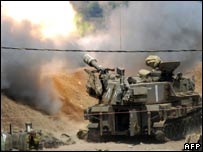
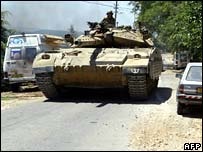
Haaretz charts what will surely be a banner day for the middle east :
Government okays massive strikes on Lebanon
By Amos Harel, Aluf Benn and Gideon Alon, Haaretz Correspondents and Agencies
The Israel Defense Forces began preparing Wednesday night for a widespread aerial assault on Lebanon, after the cabinet approved a "severe" response to Hezbollah's attack on the northern border on Wednesday, which ended with eight soldiers dead and two kidnapped.
Although nothing is definitely known about the soldiers' condition, they are believed to be alive, since little of their blood was found at the scene of the attack.
The response will include a series of aerial attacks against Hezbollah, and particularly against the batteries of rockets aimed at Israel that the organization has stationed along the northern border. This operation is expected to last for several days. The IDF also recommended various operations aimed at the Lebanese government and strategic targets in Lebanon.
In a sharp departure from Israel's response to previous Hezbollah attacks, the late-night cabinet session unanimously agreed that the Lebanese government should be held responsible for Wednesday's events. In the past, Israel has generally pointed its finger at Hezbollah's patrons, Syria and Iran.
"Israel holds the sovereign government of Lebanon as responsible for the action which emanated from its territory and for the safe return of the abducted soldiers," the government said in a statement issued after the meeting.
"Israel must act with appropriate severity in response to this attack and it will do so. Israel will respond in a forthright and severe manner against the perpetrators responsible and will act to prevent future efforts and actions directed against Israel."
Ministers declined to give details of the measures approved last night, saying that Prime Minister Ehud Olmert had asked them to stay mum. However, the IDF's recommendations including attacks on Lebanon's power grid, which Israel struck once before, in 1999. The army also recommended imposing a partial or complete naval and aerial blockade on Lebanon - for instance, preventing civilian aircraft from landing in Beirut.
The IDF did not recommend moving ground forces into Lebanon at this time.
However, Hezbollah is likely to respond to the Israeli attacks with massive rocket launches at Israel, and in that case, the IDF might move ground forces into Lebanon, both to create a temporary buffer zone in the southern part of the country and to destroy Hezbollah's network of outposts and rockets along the border. The goal of any such operation would also be to ensure that this network could not be rebuilt.
Residents of northern border communities have already been ordered into shelters, and Defense Minister Amir Peretz ordered the Home Front Command to prepare for the defense of dozens of other communities that were not
vulnerable to Hezbollah fire in the past, but are now reachable with the
long-range rockets Hezbollah has deployed in recent years.
"We may be facing a completely different reality, in which hundreds of thousands of Israelis will, for a short time, find themselves in danger from Hezbollah's rockets," said a senior defense official. These include residents of the center of the country.
The army also began preparing for a limited call-up of the reserves, since this might be necessary if a ground operation in Lebanon is approved. Thus far, however, no call-up has been approved.
Wednesday's attack, the cabinet agreed, had created a completely new situation on the northern border, and government sources said that Israel must take steps that will "exact a price" and restore its deterrence.
Olmert rejected Hezbollah's demand that Israel purchase the kidnapped soldiers' freedom by releasing Lebanese and Palestinian terrorists jailed in Israel.
The cabinet also decided to demand that the international community enforce UN Security Council resolutions calling for the Lebanese army to disarm Hezbollah and assume control of the border with Israel. Currently,
Hezbollah effectively controls southern Lebanon, and the Lebanese army
stays away.
Olmert was informed of the Hezbollah attack while he was meeting with the
parents of Corporal Gilad Shalit, the soldier who was kidnapped on the Gaza border last month. After that, he held a scheduled meeting with Japanese Prime Minister Junichiro Koizumi, who is on his first visit to Israel. The joint press conference afterward, however, inevitably focused on the events in the north.
At the conference, Olmert accused Lebanon of an act of war against Israel and threatened a painful Israeli response. "This morning's events are not a terror attack, but the act of a sovereign state that attacked Israel for no reason and without provocation," he said. "The Lebanese government, of which Hezbollah is a part, is trying to undermine regional stability. Lebanon is responsible, and Lebanon will bear the consequences of its actions."
He also lashed out at Syria, calling it a "terrorist government by nature
that supports, backs and encourages terrorist operations." However, he did not blame Damascus for the Hezbollah attack, and in contrast to his harsh threats against Beirut, said merely that "suitable preparations must be made to deal with this behavior by Syria's government."
"The State of Israel and the citizens of Israel are currently facing a
test," Olmert continued. "We have managed to pass difficult tests [in the past], even more difficult and complex than the current ones. We, the State of Israel, the entire nation, will also succeed in overcoming those who are trying to harm us now."
Peretz also placed the blame for the attack squarely on Beirut. "We're skipping the stage of threats and going straight to action," said Peretz. "The goal is for this incident to end with Hezbollah so badly beaten that not a man in it does not regret having launched this incident."
The IDF General Staff took a similarly hard line, with one senior officer
declaring that Israel should send Lebanon's infrastructure "30 years
backward" in response to the attack.
BBC: Israel attacks Beirut's airport
Israeli aircraft have fired rockets at the runways of Beirut's international airport, forcing its closure and the diversion of flights.
The attack comes as 27 civilians were killed in overnight Israeli raids on southern Lebanon.
Militant group Hezbollah says it has fired rockets into northern Israel. One person has been reported killed.
The violence follows the capture of two Israeli soldiers by Hezbollah. Israel has said it holds Lebanon responsible.
The Beirut airport is Lebanon's only international airport.
It is located in the Lebanese capital's Hezbollah-controlled southern suburbs.
'Weapons hub'
The Israeli military confirmed that its aircraft had struck the facility.
"The airport is used as a central hub for the transfer of weapons and supplies to the Hezbollah terrorist organisation," an Israeli army spokesman said.
Shortly after Israeli shells began falling on the runways, a senior airport official announced the facility was closed and asked scheduled flights to divert to Cyprus.
There were no immediate reports of casualties at the airport.
Bridges destroyed
Israeli PM Ehud Olmert said the soldiers' capture was an "act of war", but Hezbollah leader Hassan Nasrallah insisted the two would only be returned via talks.
Mr Olmert said he held Beirut responsible, but Lebanese Prime Minister Fuad Siniora denied any knowledge of the Hezbollah operation and refused to take responsibility for the soldiers' capture.
Before targeting the airport, Israel launched night air strikes on bridges and roads in southern Lebanon. Many bridges were destroyed.
The BBC's Kim Ghattas in Beirut says it is the first time in a decade that Beirut airport had been hit by Israeli fire.
The airport, rebuilt after the civil war, is a symbol of national pride for the people of Lebanon, our correspondent adds.

 Massive 5 ton cocaine bust tied to Bush cronies?: Yummy stuff. This weird company called SkyWay Aircraft, which claimed to sell security products to the Department of Homeland Security, got busted with a huge amount of cocaine from Mexico, and both Mexican and American authorities are being curiously silent about it. The Mexican press, on the other hand, has been speculating that high-ranking members of Vincente Fox's government are involved. Of course, SkyWay is based in Venice, Florida, right by where some of the 9/11 hijackers trained.
MadCowProd.com is offering the goods in this case. They conclude:
DC9’s cost money. But the twin airliners weren’t being used to demonstrate SkyWay’s products, for the simple reason that the company never had a product to demonstrate. The fact is both inescapable and mind-boggling at the same time. Two DC9’s painted to impersonate U.S. Government planes were being used for an as-yet unknown purpose… for almost two years.
Like the FAA, the attitude of the DEA toward a drug trafficking case involving 5.5 tons of cocaine seems remarkably laissez faire. A call to the DEA to inquire whether the Agency had mounted an investigation of an American-owned airliner busted with 5.5 tons of cocaine elicited a terse “no comment.”
The duty officer at the Tampa Office of the Drug Enforcement Administration revealed no indication that the DEA has taken any interest in the case. Two days of phone calls to the Agency’s Public Information Officer in Miami yielded nothing but busy signals.
.........The answer, both here in the U.S. as well as in Mexico, appears to be: Damage Control, for what clearly appears to have been officially-sanctioned drug trafficking. The silence in the U.S. and Mexico is a tell-tale sign of clandestine activity gone horribly awry. The bust was a mistake.
Once again, low-level personnel just hadn't been "clued-in" to the protected nature of the trade. Because of the sensitivity, everything is on a need to know basis. This creates a continuing problem.
You can't tell just anyone.
Cheney seems to be investing in securities that favor a weak dollar: That's pretty fucked up, observed at Attu Sees All and dissected on Kiplinger's Personal Finance Magazine.
Are they going to gut the Freedom of Information Act under the mask of 'counter-terrorism'? (via The Agonist)
The Mexican election is starting to look pretty ugly. How could there possibly be voting fraud south of the US?? More here.
UK Times: Leftist calls supporters onto streets in Mexican crisis
Mexico's electoral crisis deepened today after a recount separated the two leading candidates by less than 0.5 per cent of the vote and the leftist, Andres Manuel López Obrador, called his supporters onto the streets to protest against the result.
With 99.48 per cent of the vote reviewed by election officials, Felipe Calderon, a pro-business former energy secretary, led Señor López Obrador, a former mayor of Mexico City, by 0.41 per cent, or just 170,000 of the 41 million votes cast on Sunday.
Señor Calderon appeared relaxed at a party in the headquarters of the ruling National Action Party (PAN), saying: "Now is the hour for unity and agreements between Mexicans."
But Señor López Obrador said he would challenge the result in Mexico's highest electoral court, the Federal Electoral Tribunal. He asked his supporters to rally in Mexico City's huge Zócalo square on Saturday afternoon.
"We have taken the decision to challenge the electoral process," he told a press conference. "We cannot recognize or accept these results. There are lots of irregularities."
......
Señor López Obrador, whose Party of the Democratic Revolution (PRD) was founded by a populist famously cheated of the presidency in a rigged election in 1988, has alleged throughout the week that PAN activists had counted votes twice in some districts and ignored votes in others.
Today he said that a case before the Federal Electoral Tribunal would expose the "lack of transparency, the lack of independence of the electoral body".
"We have triumphed and this is what we will demonstrate to the tribunal," he said.
Aryan Nations & other hate groups infiltrating the US Army: An army desperate for recruits might be handing guns to unsavory criminal lunatics: NY Times:
A decade after the Pentagon declared a zero-tolerance policy for racist hate groups, recruiting shortfalls caused by the war in Iraq have allowed "large numbers of neo-Nazis and skinhead extremists" to infiltrate the military, according to a watchdog organization.
The Southern Poverty Law Center, which tracks racist and right-wing militia groups, estimated that the numbers could run into the thousands, citing interviews with Defense Department investigators and reports and postings on racist Web sites and magazines.
"We've got Aryan Nations graffiti in Baghdad," the group quoted a Defense Department investigator as saying in a report to be posted today on its Web site, www.splcenter.org. "That's a problem."
.......
The report quotes Scott Barfield, a Defense Department investigator, saying, "Recruiters are knowingly allowing neo-Nazis and white supremacists to join the armed forces, and commanders don't remove them from the military even after we positively identify them as extremists or gang members."
Mr. Barfield said Army recruiters struggled last year to meet goals. "They don't want to make a big deal again about neo-Nazis in the military," he said, "because then parents who are already worried about their kids signing up and dying in Iraq are going to be even more reluctant about their kids enlisting if they feel they'll be exposed to gangs and white supremacists."
The 1996 crackdown on extremists came after revelations that Mr. McVeigh had espoused far-right ideas when he was in the Army and recruited two fellow soldiers to aid his bomb plot. Those revelations were followed by a furor that developed when three white paratroopers were convicted of the random slaying of a black couple in order to win tattoos and 19 others were discharged for participating in neo-Nazi activities.
.......
An article in the National Alliance magazine Resistance urged skinheads to join the Army and insist on being assigned to light infantry units. The Southern Poverty Law Center identified the author as Steven Barry, who it said was a former Special Forces officer who was the alliance's "military unit coordinator." "Light infantry is your branch of choice because the coming race war and the ethnic cleansing to follow will be very much an infantryman's war," he wrote. "It will be house-to-house, neighborhood-by-neighborhood until your town or city is cleared and the alien races are driven into the countryside where they can be hunted down and 'cleansed.' "
He concluded: "As a professional soldier, my goal is to fill the ranks of the United States Army with skinheads. As street brawlers, you will be useless in the coming race war. As trained infantrymen, you will join the ranks of the Aryan warrior brotherhood."
Holy shit. And let's not forget about Gulf War vet Timothy McVeigh.
The twisted Internal Disinformation of the Bush Regime:
I thought this was pretty nuts. Ron Suskind's new "One Percent Doctrine" is selling pretty well, and the
review in the NY Times was disturbing, for it paints a portrait of a president protectively misinformed in order to defend the illogical madness of the war. This is madness:
During a November 2001 session with the president, Mr. Suskind recounts, a C.I.A. briefer realized that the Pentagon had not told Mr. Bush of the C.I.A.'s urgent concern that Osama bin Laden might escape from the Tora Bora area of Afghanistan (as he indeed later did) if United States reinforcements were not promptly sent in. And several months later, he says, attendees at a meeting between Mr. Bush and the Saudis discovered after the fact that an important packet laying out the Saudis' views about the Israeli-Palestinian situation had been diverted to the vice president's office and never reached the president.
Keeping information away from the president, Mr. Suskind argues, was a calculated White House strategy that gave Mr. Bush ''plausible deniability'' from Mr. Cheney's point of view, and that perfectly meshed with the commander in chief's own impatience with policy details. Suggesting that Mr. Bush deliberately did not read the full National Intelligence Estimate on Iraq, which was delivered to the White House in the fall of 2002, Mr. Suskind writes: ''Keeping certain knowledge from Bush -- much of it shrouded, as well, by classification -- meant that the president, whose each word circles the globe, could advance various strategies by saying whatever was needed. He could essentially be 'deniable' about his own statements.''
''Whether Cheney's innovations were tailored to match Bush's inclinations, or vice versa, is almost immaterial,'' Mr. Suskind continues. ''It was a firm fit. Under this strategic model, reading the entire N.I.E. would be problematic for Bush: it could hem in the president's rhetoric, a key weapon in the march to war. He would know too much.''
Plainly nuts.
The situation in Gaza is pretty ugly right now. On the one hand, the Israeli strategy is brutal, but even worse, it's pointless. HAMAS has offered a prisoner swap, like the old days with Hezbollah. Check out "The Ideology of Occupation, Revisited" from Israeli peacenik Ran HaCohen. James Zogby observes the Deadly Silence over the matter. I haven't said much about it, but this piece pretty much sums up the problem.
 Captive in Gaza: Israel has several objectives in Gaza -- all mutually exclusive, writes Graham Usher
There are four aims behind operation "Summer Rain", the Israeli army's latest invasion of Gaza, according to ministers, officers and analysts. The first is to free "unconditionally" Gilad Shalit, the Israeli soldier captured by Palestinian guerrillas just outside the Strip on 25 June. The second is to end Palestinian "rocket fire" that, in the last month, has peppered Sederot and other Israeli areas on the Gaza border, so far without serious injury.The third aim -- undeclared but acknowledged -- is to force the Palestinian government from office via a rising curve of pre-emptive strikes. So far this has included tightened economic and political blockades, destruction of civilian power plants and bridges, military re-occupation, rocket attacks on the prime and interior ministers' offices and the wholesale arrest of Hamas ministers, members of parliament and local authority officers.
The ouster has little to do with the government's refusal to recognise the legitimacy of the Jewish state -- a rejection that suits Israel since it frees it from having to deal with an elected Palestinian Authority. It has more to do with Hamas's success not only in surviving the siege but in enshrining resistance as a central policy in its and any future National Unity Palestinian government, courtesy of the recently agreed Prisoners' Document.
The fourth aim is to repair the battered status of Israel's "deterrence". It is now clear to most Israelis that the relative quiet they enjoyed for the last year or so was not due to their army's military prowess. It was due to the Palestinian ceasefire, observed above all by Hamas's military arm, Izzeddin El-Qassam (IQ). Since it was renounced, 200 mortars have been fired into Israel, four soldier abductions have been attempted or carried out and two soldiers and one settler have been killed.
Threats Hamas may now take the fight "deep into Israel" reminds most Israelis of the bloodiest days of the Intifada. It destroys the illusion that the Gaza disengagement was somehow a military success. And it casts Israeli Prime Minister Ehud Olmert's project to determine unilaterally Israel's eastern border as absolute folly.
Vanity Fair had a lengthy feature on the Duke Cunningham/hookergate scandal and here's a summary.
Italian intrigues: In a small tidbit perhaps related to the Valerie Plame scandal, some of the top-ranking guys in Italy's SISMI intelligence service were arrested, as noted in the Italian media and the AP. This probably has more to do with furious Italian judges going after SISMI and CIA agents who helped get some terror suspect abducted.
.....the Italian military intelligence organization's deputy director and director of the first "foreign" or counterintelligence division Marco Mancini has been arrested in Italy, allegedly for his role in the CIA extraordinary rendition of Egyptian cleric Abu Omar from Milan in 2003. When I was in Rome on a few recent reporting trips, Mancini was the guy who everybody was literally frightened of even saying his name. I mean literally, people just referred to him as Marco. He was highly involved in Sismi's Middle East affairs, as well, apparently, I am hearing from Rome, in several recent cases of illegal wiretapping and illegal domestic spying in Italy. Arrest warrants have apparently been issued in the same Abu Omar case for four more CIA officials as well, including for the former CIA station chief in Rome.
In fact, on Sismi's behalf, Farina and Libero led the bogus charge that France was responsible for the Niger forgeries. Farina was also the beneficiary of illegal wiretaps seemingly conducted by friends of Sismi. Interesting times indeed.
From my brief exposure to politics there, I would say Mancini is far more comparable to a Lewis Libby figure than to his ex-CIA deputy director counterpart John McLaughlin, far more wired into the Byzantine politics of the Berlusconi project than a straight intel professional. Although this arrest would seem to be lapping pretty high on the ankles of the ex-Berlusconi administration itself, a friend in Rome writes that it may not go any further, and Prodi is giving indications he may not wish it to, especially as far as Sismi is concerned.
.......
Update: A reader in Rome writes that Libero's Farina is "under investigation not for his articles but because he has allegedly been identified as a Sismi source code-named 'Betulla.' ... [Sismi's] Mancini and Pignero are suspected of having studied Abu Omar’s habits and having prepared an initial plan for his abduction which would have the airport of Ghedi as the first destination of Abu Omar after his kidnapping. The plan went otherwise, as Aviano was opted for. They are also accused of spying on Repubblica's Giuseppe D’Avanzo as of May 12th..."
If I understand this and other recent Italian news reports correctly, Mancini was allegedly a liaison to several private Italian dirty tricks intelligence operations.
Ann Coulter's plagarism situation seems not that serious, but here's the comprehensive index. Xenu, the Scientology warlord, is involved.
The LA Times tries to claim that anti-Lieberman-ism is a "purge" of the Democratic Party by antiwar fanatics, while in fact it's more of a reaction to the fact that Lieberman is a crappy senator all around.
Around the paranoid side: I was advised to check out "The Resistance" on MySpace. As always PrisonPlanet will fill your daily conspiratoria quotient. Some Montana guy that sold (legal) gun kits was raided by the FBI, ATF and Canadian law enforcement for handing out 'subversive' Alex Jones material, according to... Alex Jones. In a crossposted story from the Sacramento Bee, Homeland Security denies tracking political activity after the state office got word of a peace rally on April 18. There was a new al-Qaeda video released to mark the 7/7 London bombings, and PrisonPlanet asks a bunch of questions about 7/7 anomalies, suggesting as they have from the beginning it was staged by the UK government.
The guy who invented Ren & Stimpy (a particularly raunchy but funny one that never went on TV is here) is in a battle with Warner Bros. because he's been posting their really good but forgotten cartoons on YouTube as Examples of the Art.
Worse than a Star Trek 'red shirt': 10 worst jobs to have in the action film universe.
Well that should tide folks over for a bit of the weekend here...
I am going up to Hibbing to see my aunt's Dylan documentary until Saturday afternoon and probably won't have time to post until Sunday.
A tantalizing nugget: my friend's dad stumbled across a massive embezzlement scheme in the Chicago branch of the Head Start education program. This is only now coming into public view and I will try to get something real on it later.
So the Administration wants to eat reporters who spill classified information. This lends itself to a new strategy: classify everything embarrassing and evil. Now that's your tax dollars at work!
Wednesday night I was hanging out with some folks soon parting ways with Minnesota, and it was a good time. In exchange for a nice old hat, various objects were offered for barter, including a Krazy Kat book. Krazy Kat was a weird old comic from the 1920s that has reached a kind of Major Art status, while really it's just pretty weird. I noticed that Itchy & Scratchy seems to be kind of based on it, including the cat's androgynous quality. Anyway.

Finally a Democrat in the House is getting busted for a scandal. Poor Jefferson was caught taking major cash in a pretty blunt kind of way and they're saying indictments next month, yet there is a big ruckus from Republicans after the FBI searched his Congressional office and took boxes of documents. Due to the bipartisan uproar, Bush has sealed the docs from the FBI, at least temporarily.
It's an interesting case. I feel that Republicans are a bit terrified that a potential future Democratic president could find evidence of all kinds of illegal stuff in their offices. For the whole history of this country, the executive hasn't been able to storm these places (or had the guts to). I tend to think that this is appropriate, that there ought to be a sphere of immunity of some sort to protect Congress from the executive. On the other hand, I would like to see Hastert, DeLay and all the other homies get nailed for all their Abramoff corruption. Just because you're in Congress doesn't mean you're above the law. Laura Rozen asks, is it panic?
But, what if (and certainly this has happened), member X has lots of evidence proving that Gonzales is a lawbreaker himself, that Rummy is a psychopath who permits war crimes, that Cheney helped channel Halliburton contracts and Porter Goss partied with hookers at the Watergate for a decade? In other words, what if I had Sen. Carl Levin's file cabinet? Well, that file cabinet would serve as a crucial check in the pretty corrupt system we've got now, and it seems clear that the founders intended to privilege stuff like that file cabinet. I also think that it should be impossible to charge Rep. Cynthia McKinney for slapping that Capitol police officer (in particular since it's been said that the Capitol police corps have been taken over by southern GOP good-ol-boy sheriff types).
We should note that the great Joseph McCarthy could not be sued for all the crazy slanderous and libelous garbage he puked onto the floor of the Senate during the 1950s, because, well, it was his constitutional right as a Senator to say plainly false and libelous things there. If the legislative branch gets under that kind of pressure, well, they will be 'chilled' in the legal speech sense, and it's curtains for that supposedly equal branch of the government. Never forget that people with their hands on executive power don't necessarily care about the truth, but they'll try to silence those who get in their way. McKinney has been a pretty vocal anti-imperialist (not to mention 9/11 skeptic), despite her silly style, and that whole thing reeks of an effort to kill the messenger. Movin' on.
Al Gore stares into the distance: From New York magazine, via the Brad Blog:
Does he, like many Democrats, think the election was stolen?
Gore pauses a long time and stares into the middle distance. "There may come a time when I speak on that,” Gore says, "but it’s not now; I need more time to frame it carefully if I do.” Gore sighs. "In our system, there’s no intermediate step between a definitive Supreme Court decision and violent revolution."
Later, I put the question of Gore’s views on the matter to David Boies, his lawyer in the Florida-recount battle. "He thought the court’s ruling was wrong and obviously political," Boies says. So he considers the election stolen? "I think he does—and he’s right."
Brad Blog was a leading place for tracking the election fraud in Ohio, and while I don't read regularly, it's well done.
Check out Wot is it Good 4 by Lukery, which has especially followed the case of former FBI translator Sibel Edmonds - with its bizarre stories of drug money laundering, 9/11 links, FBI corruption, the whole bit. Sibel herself (official site), under many federal gag orders, has said that Lukery has been able to digest the known facts of the case better than anyone else. There's fresh stuff on a daily basis. For example, if you want to get waist-deep in some weird defense contractor shit, connected laterally with Manucher Ghorbanifar, Rep. Curt Weldon (of Able Danger fame), plus Edmonds' belief that Weldon has been kind of duped about some of the fake Iraq intelligence, well this story is what you need, and this one about some kind of corrupt link between neoconservatives, Turkey and military-industrial defense contractors, which Edmonds is also tied up in, another good one. Read this and trip out: Bing Bang Boom Shazam. The Edmonds case is way under the radar, extremely weird, but it seems to connect to the AIPAC scandal, Chalabi and the fake Iraq intelligence, some kind of secret 9/11 financing arrangements, drug money laundering, Turkish spies, and perhaps illegal money in the campaign coffers of people like Rep. Dennis Hastert. Or maybe not (Hastert is getting sucked into the Abramoff scandal, either way). I think at some point, Sibel Edmonds will finally break out into a major scandal and I'd like to say that we got a bit of the early word out here. SourceWatch on Sibel Edmonds too. (tiny side note: Lukery suggests this woman's skillful negotiation sites)
But who are Sibel Edmonds, Curt Weldon, Able Danger and what do these have to do with 9/11?? Fortunately in the expanding field of 9/11 conspiracy videos, a new one introduces these issues in an accessible way. Check out Everybody's Gotta Learn Sometime. I thought it was better than Loose Change, in terms of consisting of actual information and loose ends. However it doesn't have as many fun video clips. It has a pretty good introduction to the Able Danger, the pre-9/11 military intelligence project that apparently pinpointed some of the hijackers, and then was abruptly shut down with its terabytes of records vaporized. But ironically the problem perhaps might have been that it was based on illegal data mining?
Chinese spy update: Pretty cool stuff on the next hurrah about Katrina Leung, a pro-Republican Chinese spy who is basically getting let off by the Justice Department. She admitted tipping off the Chinese to the identities of FBI agents investigating nuclear sales to China (which mighta been tied to Iran-contra - whew). Evidently, she fed disinformation to the FBI to go after the unfortunate scientist Wen Ho Lee.
OS X operating system design: Check out this Flash animation if you want to know how OS X is structured internally. This guy's book will kick ass if you are into kernel hacking.
Israel claims Iran gets nukes in "months": My Ass. Antiwar.com's Raimondo, in a column bitching about the Iran badge story, the peripheral Israeli connections to the fake Iraq intelligence, and new and shiny paranoia from Israel about Iran, notes that well, Israel is definitely going to jerk the U.S. down this path.
AIPAC notes: I thought this was a good writeup about the power of the Israel lobby from Stephen Zunes: FPIF Special Report: The Israel Lobby: How Powerful is it Really? He points out an interesting example of a Congressman, who, when challenged about his heavily anti-Palestinian votes, basically says that the Jews made him do it for fear of losing fundraising, but even after he announces he won't run again, he still votes against Palestinians. The Jews are just - wait for it - a scapegoat for his actual anti-Arab bias. And of course there's the basic fact that Bush depends a lot more on the hardcore rightwing (and often apocalyptic) Christian Zionists that Jewish ones.
Misc notes: Watch Lazy Ramadi, a video from some troops with a video camera. You won't regret it.

Sidney Blumenthal notes Iraq is doomed. Of course, it has literally the most corrupt government ever created (although maybe DC actually wins that right now). Duly noted by the brave Patrick Cockburn:
Iraq is disintegrating as ethnic cleansing takes hold:
Across central Iraq, there is an exodus of people fleeing for their lives as sectarian assassins and death squads hunt them down. At ground level, Iraq is disintegrating as ethnic cleansing takes hold on a massive scale.
By Patrick Cockburn in Khanaqin, North-East Iraq (20 May)
The state of Iraq now resembles Bosnia at the height of the fighting in the 1990s when each community fled to places where its members were a majority and were able to defend themselves. "Be gone by evening prayers or we will kill you," warned one of four men who called at the house of Leila Mohammed, a pregnant mother of three children in the city of Baquba, in Diyala province north-east of Baghdad. He offered chocolate to one of her children to try to find out the names of the men in the family.
Mrs Mohammed is a Kurd and a Shia in Baquba, which has a majority of Sunni Arabs. Her husband, Ahmed, who traded fruit in the local market, said: " They threatened the Kurds and the Shia and told them to get out. Later I went back to try to get our furniture but there was too much shooting and I was trapped in our house. I came away with nothing." He and his wife now live with nine other relatives in a three-room hovel in Khanaqin.
The same pattern of intimidation, flight and death is being repeated in mixed provinces all over Iraq. By now Iraqis do not have to be reminded of the consequences of ignoring threats.
I liked this list from Juan Cole:
There are now four distinct wars going on in Iraq simultaneously
1) The Sunni Arab guerrilla war to expel US troops from the Sunni heartland
2) The militant Shiite guerrilla war to expel the British from the south
3) The Sunni-Shiite civil war
4) The Kurdish war against Arabs and Turkmen in Kirkuk province, and the Arab and Turkmen guerrilla struggle against the encroaching Peshmerga (the Kurdish militia).
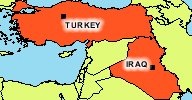 The struggle of the Turkmen is starting to branch out into Turkey. Note how Turkey is now red on the lovely Reuters map, seems ominous:
Kurds say Turkish shells land in Iraq, Turkey denies: By Sherko Raouf
SULAIMANIYA, Iraq, May 17 (Reuters) - The government of Iraq's autonomous Kurdistan region accused Turkish forces of shelling an area inside northern Iraq on Wednesday.
A Turkish government official dismissed the accusation as "total fabrication."
Ankara traditionally launches a spring offensive against Kurdistan Workers Party (PKK) guerrillas in southeastern Turkey, an area which borders Iraq.
Earlier this month, villagers in Iraq's Kurdistan accused neighbouring Iran of hitting targets inside Iraq, a charge Tehran denied.
Khaled Salih, a senior official of the Kurdish regional government in Arbil, said by telephone that no one was hurt when three shells slammed into a mountainous area close to the town of Kani Masi a few km (miles) inside Iraq.
"A village ... has been bombarded from the Turkish side. There were no casualties, but there was material damage," Salih told Reuters. "This is the second time in a week villages have been bombarded in the north."
"We will report this to the government in Baghdad so that they can contact the Turkish government and ask for an explanation," he said.
Salih said there were no PKK fighters in the area where the shells landed. NATO member Turkey has stationed some 1,500 troops stationed inside northern Iraq since the late 1990s when it launched regular raids into the region to hunt PKK fighters.
In Turkey, a government official told Reuters: "This is not true ... All the measures are on our side of the border." Turkey has sent 40,000 troops to its own Kurdish areas to reinforce the 220,000 already there, the biggest build-up in years after an increase in PKK attacks.
The PKK, seeking a Kurdish homeland including southeastern Turkey, accuses Ankara and Tehran of mounting coordinated operations against the group and its Iranian wing, PJAK.
NSA Total My Phone Bill Awareness: Crusty CIA veteran Ray McGovern rails against NSA monitoring of Americans. Sy Hersh with a few bits and pieces on the NSA situation. Congressional Quarterly reports on mysterious data links between Homeland Security and the NSA. TPMM observes how DOJ sends out TONS of subpoenas for data daily, apparently outside of judicial oversight. National Security Letters. Someday, the Letter will come for you (or more likely, me). TPMM also looks at how there is a cottage industry of companies that handle all our phone records, passing them from the telcos to the government, allowing AT&T to claim that they aren't giving Big Brother the records directly. Check this: Fuck NeuStar, the "scapegoat" for hire.
Billmon hung out in Egypt for some conference. Egypt is autocratic, the Teflon pharaoh. I like that phrase.
As always, Prof. Cole is the go-to man for direct analysis of the situation and Arab media. He also follows up further on the fake Iran Jew Badge story. Firedoglake traces back the root of the fake Badge story. The National Post had to retract the story:
Last Friday, the National Post ran a story prominently on the front page alleging that the Iranian parliament had passed a law that, if enacted, would require Jews and other religious minorities in Iran to wear badges that would identify them as such in public. It is now clear the story is not true. Given the seriousness of the error, I felt it necessary to explain to our readers how this happened.
Then, of course, the bastards require you to register to read the rest. Fuck! (this early, erroneous bit on the badge story struck me for its interesting historical content, but also classic pompous ignorati*-style writing)[ * "Ignorati" has been trademarked by Mordred]
We noted earlier a report about 200,000 AK-47s from Bosnia, that were purchased by the US for the Iraqi security forces, but now there are more reports that the AKs basically vanished and are now in the hands of insurgents because of - you guessed it - private defense contractors!! BBC reports on how the guns that ruined Yugoslavia are getting dumped straight into the Iraqi civil war.
Ah, the irony of how shitty neoconservatism worked out to be.
Murray Waas reports that Rove and Novak may have hatched a conspiracy to cover up the Valerie Plame leak (via TPMM):
On September 29, 2003, three days after it became known that the CIA had asked the Justice Department to investigate who leaked the name of covert CIA officer Valerie Plame, columnist Robert Novak telephoned White House senior adviser Karl Rove to assure Rove that he would protect him from being harmed by the investigation, according to people with firsthand knowledge of the federal grand jury testimony of both men. . . .
Rove and Novak, investigators suspect, might have devised a cover story to protect Rove because the grand jury testimony of both men appears to support Rove's contentions about how he learned about Plame.
Chinese PCs feared to be bugged: There's always time for Sinophobia.
Blockquotes are plagarism?! Plagarism Today (what a name for a site) talks about how the practice of blockquoting from other sources is really the new plagarism. I think that's a bit retarded since if you're naming your source, it's not plagarism at all. However, there are sites that exclusively skim off content and pass it as their own for spamming purposes. There are actually Hongpong.com fragments on spam sites out there. We blockquote a lot here, but damn, no one can read the whole damn Internet themselves! It seems like a silly argument, but on the other hand, the game ought to be about original content. However, I like to put lots of sources in here, since, well, you gotta at least weigh their credibility apart from mine in order for my arguments to sink in. Anyway, slashdot reacts.
Long ass random post. However more than enough stuff to keep anyone busy for a while. True?
It's a really nice day right now, which makes it even more shameful to post such random Internet conspiracy material as this. However, I am giving myself a pass since the Da Vinci Code came out today, with heavy melodrama, poor pacing and flat characters. The George Washington Illuminati letters are really pretty good by today's standard. So stick with us, because the traces of Atlantis are here by the Mississippi, and there's a global power grab going on to enslave the masses and beam McDonald's ads into our brains.
 First of all, I should put the impressive Internet Sacred Text Archive, which has unadulterated source texts from across the spectrum, from Theosophy and Jainism to I Ching, Forteanism, and Freemasonry, as well as two versions of the probably fake Necronomicon (which is where that grinning box thing comes from). So at the least, these are primary sources you can check out about all manner of esoteric human beliefs.
 Here's some official Masonic material about their favorite contributions to American "National Treasures". Some of the many cornerstones of federal buildings laid by Masons, including the Washington Monument. They really like their funny hats. Washington's Masonic National Memorial is bigtime. There is even a Washington Trowel revered as a Masonic symbol, used often in special ceremonies, including the cornerstones of the Supreme Court and the Library of Congress.
Strom Thurmond re-enacts the Capitol Masonic cornerstone ceremony 200 years later. (via the dubious pair.com)

But is the other shit you find around the Internet really even worth looking at? Well no, not generally. This should straighten everything out: from NoGW.com's "The Illuminati & the New World Order".
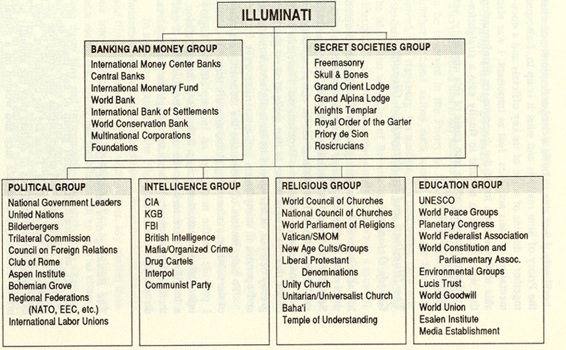
Now that's what I call political science. Here's some other stuff: TheWatcherFiles.com is mostly about aliens and stargates but also has The Satanic bloodlines including the Merovingian Bloodline. "Project Earth: Satan is on the Prowl" and Reptilian Watch! Fortunately there's a guide to stopping the beams, aliens and military attacks in your head:
If you are a real nuisance you may find yourself being attacked by their electromagnetic weapons, abducted out of your sleep, or chip implanted with their tracking chips that also serve as 2-way transistors where they can harass you by speaking thoughts to your mind or just communicating with you in a sort of telepathic way. I don't' know how else to describe it. Most people don't recognize that one and so think they are hearing from "God" or just thinking the thoughts they are having are from themselves, or think it's just a demonic attack instead of coming directly from military technology. Other people can recognize voices and think they are schizophrenic. Sometimes some people just are, but for most people it's usually just the military and the black technology they're using to invade and torment you with.
We are in the middle of a war and it is a battle for your mind and for your soul. And for most, it's daily.
Crystalinks.com, run by a self-described new-agey "nice Jewish girl from Brooklyn" seemed less militantly angry and more merely reflective about arcane history such as the Priory of Sion, Grail legends, various mystery schools and Kabala.
The Daily Grail and its Red Pill wiki is pretty much what it sounds like.
When I was searching for the exact George Washington-Illuminati letters, I first found them here on watch.pair.com and I looked around that site a bit. As it turned out, whoever runs that site is a raving anti-semite and I was so disturbed by some of the content that I wrestled with even linking to it. The author approvingly quotes the "Protocols of the Elders of Zion" and Henry Ford's "The International Jew", which is just plain horrible. (the site hosting Ford's evil tract has its own conspiracy stuff as well)
But seeing as how we have already featured links to, say, Hezbollah's Al-Manar television station, we'll let it go today. There is a pretty weird giant conspiracy going on in pair.com-land. Masons are big, naturally, apparently as a way for Zionists to control America and prepare for the Antichrist to rule Israel and then the world. They claim the Antichrist may be a Solomon-like figure probably from the Merovingian dynasty. King Solomon was bad because he integrated the "Babylonian mystery religion" into Judaism, in their view, and the Masonic reverence for Solomon is part of this problem.
Pair.com's really quite strange "Death of the Phoenix" feature was highly anti-semitic, yet also included the following "facts": A Judeo-Masonic conspiracy controls most everything; Atlantis placed colonies from Louisiana to the headwaters of the Mississippi; a fake or authentic Ark of the Covenant was brought to the New World and "Arcadia" in Nova Scotia by the Knights Templar; Hurricanes George and Katrina were generated by the Priory of Sion - which was proven by the 'P' and 'S' paths the hurricanes traced; the Priory of Sion is a front for the B'nai B'rith, which of course is a front for the Elders of Zion; strange riots in Detroit and Los Angeles are prophesied; this summer, fake biblical relics will be found to undermine traditional Christianity and support the Merovingians; Evil Jews ("Crypto-Jew" is a common term) created Opus Dei; Christianity's Calvin was really a Jew named Cohen provoking splits among the gentiles; since Justices John Roberts, Samuel Alito and Antonin Scalia are all Opus Dei sympathizers or members, plus with the Jews Stevens and Ginsberg, so the U.S. Supreme Court is going to be converted into a Jewish Sanhedrin court that will try to destroy Christianity, institute martial law and implement "Noahide laws" to subjugate the gentiles.
That's pretty appalling stuff. I'm sorry if you think it's offensive, but I did too. Here's the table of contents, which is one of the more peculiar things I've seen:
DEATH OF THE PHOENIX: FINAL ACT FOR THE UNITED STATES OF AMERICA
ACT I. Sleepy Hollow Revisited - The Templar symbolism of Hurricane Katrina - Judeo-Freemasonry / Zionist agents orchestrate downfall of the U.S. - Why the United States must be sacrificed
ACT II. The Ark & The Grail - Jewish discovery and settlement of the New World - Ark of the Covenant in the “New Jerusalem” - The Judeo-Masonic history of Louisiana - The “Sionist” conspiracy to repossess the Holy Land
ACT III. The Dawn of Aquarius - New “Radical” Reformation planned for the West Coast - Prophecies of Kim Clement & Chuck Pierce for Los Angeles / San Francisco - Zionist plan to take out the Muslim community in Detroit
ACT IV. Death of the Phoenix - Prophecies of imminent New Madrid earthquake with epicenter in St. Louis - Destruction of U.S. agriculture belt and manufacturing infrastructures - Destruction of Christianity to begin with the Bible Belt
ACT V. Exodus / Aliya - Jewish exodus from the U.S. before it self-destructs - Secular media to preach Kabbalist gospel to the Jews - Reestablishment of Sanhedrin in Israel to administer Noahide Laws - Plans to establish subsidiary Sanhedrin in the U.S.
ACT VI. The New Reformation - Opus Dei Supreme Court and 2nd Vatican Inquisition - Dominionist theocracy to precipitate 2nd U.S. Civil War - Sanhedrin to rescue civilization from Christian terrorists - Noahide Laws to exterminate Christians
ACT VII. Atlantis Rising - Merovingian bloodline to avenge Atlantean gods via weathermancing - Pre-flood civilization expected to rise on ruins of the U.S.
ACT VIII. A Better Country - The United States of America may fall before the Tribulation begins. - Persecution of U.S. Christians. How to prepare for martyrdom
Ok then. There were links offsite to various other things, and my favorite was Michael Ledeen's "What Machiavelli (A Secret Jew?) Learned From Moses." This was of course turned to make an anti-semitic argument, but it is still classic Ledeen:
After receiving the Commandments and crushing the heretics of the golden calf, he continued on to the borders of the Promised Land. There, at G-d's instructions, Moses organized an espionage mission headed by Joshua and Caleb, in preparation for the invasion and occupation of the country. After 40 days the spies returned. The good news was that the land was beautiful and bountiful; the bad news was that the inhabitants were big and strong, impressively armed and well fortified. All the spies, save Joshua and Caleb, argued it was suicidal to attack, and the vast majority of the people agreed. Fearing they were about to be destroyed in battle, they turned against Moses. "And they said one to another: 'Let us appoint a captain, and let us return into Egypt.'" Recently freed from Egyptian slavery, the Israelites nonetheless demanded a return to bondage rather than fight for freedom.
....
The revolt against Moses in the name of slavery is one of the most powerful of the "infinite examples" to which Machiavelli refers in order to show the difficulties in leading to freedom a people that has become accustomed to living in slavery, a fundamental Jewish theme that is as important to us today as it was in the Italian Renaissance. As Machiavelli puts it, "It is as difficult to make a people free that is resolved to live in servitude, as it is to subject a people to servitude that is determined to be free."
How, then, do we achieve the mentality of free men and women, and not of slaves?
.....
Listen to his political philosophy, and you will hear the Jewish music.
.....
These are not ideas that abound in the Christian liturgy. The notion that G-d wants us, above all, to devote our lives to the creation of the good society is, however, a very Jewish idea. Medieval and early modern Christianity relegated the accomplishment of justice to the hereafter. In this life, the important thing was fulfilling the sacraments. Insofar as politics was a religious concern, it was dominated by the notion that man should "render unto Caesar that which is Caesar's," and give G-d his due in other activities.
Machiavelli will have none of this, insisting that achieving glory for one's country is the single act most pleasing to G-d.
So: Was Machiavelli Jewish? Well, maybe not entirely, but certainly quite Jewish, maybe even very Jewish. If his great contemporary, Christopher Columbus, was most likely a secret Jew, if many crew members of the Niña, the Pinta and the Santa Maria were baptized on the gangplank, if, a century later, a majority of the founders of the Jesuit order were recent, probably opportunistic converts from Judaism, the notion that Machiavelli might have embraced much of Judaism is not so far-fetched.
Infowars.com had a feature about the occult activities of Thomas Jefferson. Check AmericanMafia.com for stories on the mafia.
This was a very silly post, loaded with bad and apocryphal material. Hopefully I haven't alienated any readers - I just wanted to throw in some weird shit to mark the weird popular-conspiracy riff that culture is into right now. Time for my tinfoil hat.
 The Pentagon released some new video footage of Flight 77 hitting the Pentagon on September 11, which provoked reaction from the usual quarters of the Internet. Oddly, it seems like the "Pentagon missile theory" is actually being promoted in the major media. But in a sublime twist that some expect in the near future, this theory would be promoted as the "keystone" of all 9/11 conspiracies, and then suddenly debunked with a future release of crystal-clear footage of the real damn plane hitting that five-sided building. This, in turn, would discredit all the other arguments that something fishy was going on 9/11.
And then of course, the government confiscated security tapes from a gas station next to the Pentagon, which in all likelihood captured the crash really well. Where is that fucking tape?
I feel dubious about Loose Change, the 9/11 conspiracy video (watch here) that is wildly popular on the Internet, but hey, they're going to get a chunk of the British Parliament to watch it in June.
To be perfectly clear, I am skeptical about everything around 9/11, all the explanations, official and otherwise. I like to post them on my website because they seem controversial and intriguing, but I don't stand for one school of thought or the other. It is a hell of a lot easier to offer questions, then blockquote various theories, rather than determine who was actually on the Grassy Knoll. Make your own damn judgments – and always be skeptical of the authority structure of information. I like to offer our casual readers a broad selection of the latest and greatest theories around the Internet, but I won't claim that any of them are true.
Alex Jones is basically the dean of 9/11 conspiracies, so why not offer their take on it:
Release Of Pentagon Images Direct Assault On 9/11 Truth Movement Paul Joseph Watson & Alex Jones/Prison Planet.com | May 16 2006
The release of new video images of Flight 77 hitting the Pentagon is both a direct assault against a 9/11 truth movement that has flourished in recent months and an attempt to reinforce the attendant propaganda of 9/11 in light of Bush's 29% approval rating.
Before the release of the new frames news networks immediately went on the attack, saying that the images finally put to rest "conspiracy theories" and questions about the official story. In addition, Fox News commentators related with pensive looks and pursed lips that this footage answers the furore over secret NSA wiretaps and surveillance by 'reminding Americans why it was being done'.
Fox anchors also attacked Charlie Sheen's 'ridiculous assertions' after the actor went public with his 9/11 doubts in late March. News networks hyped the video as some kind of hot tip yet when it was played the anchors looked disappointed because it barely shows anything we haven't already seen, a grainy shot spoiled by sun glare of a blurry object and then a fireball....
Alex Jones and this website have always approached the Pentagon subject with caution because we were wary that it was a potential honey pot that would be used to distract and later discredit the 9/11 truth movement. We asked why mainstream hit pieces always seemed to obsess over the Pentagon issue while ignoring other far weightier facets of the 9/11 inside job evidence. The tactic has always been to create a straw man argument that can be set up and knocked down at a convenient time.
This is also a political boon for President Bush. The timing is precise and has nothing whatsoever to do with the fact that the Moussaoui trial has ended. Bush's approval ratings are at 29% and his administration is being battered from pillar to post over the NSA spying scandal. What better time to replay the horror of 9/11 and attempt to reinforce fealty to the government's lauded efforts to keep us all safe from terrorists by taking our rights away?
The release of these images comes at a time when the 9/11 truth movement is at its most prominent. This is a targeted assault intended to quash questions about 9/11 and discredit the movement. TV news anchors are already uniform in their talking points in using the video images to attack 9/11 skeptics.
What remains clear is the fact that news networks are steadfast to ask questions about the real issues surrounding 9/11, such as the implosion of Building 7, the NORAD stand down and the fact that all the evidence points towards the hijackers being US government agents.
Such other 9/11 [truth/conspiracy] sites as WhatReallyHappened.com suggest that the missile angle is a form of "poisoning the well," a misdirection, which a reader's letter compared to strange testimony in the JFK assassination:
During the Jim Garrison trial of Clay Shaw in the JFK assassination, a witness showed up who linked Lee Oswald and Shaw. Despite warnings from his staff, Garrison used this witness. But once he was on the stand, the witness claimed that he fingerprinted his own daughter every night to prevent substitutions by "them". During the House Select Committee on Assassinations, the committee made a point of calling a witness who claimed that the open umbrella by the motorcade route in Dallas was actually a poison dart gun that had fired a dart at JFK to paralyze him, in order to make him an easier target. The actual umbrella was then displayed amidst jokes and laughter and great rolling of eyes, and shown to be merely an umbrella.....
In all three cases the witnesses were plants by the government whose job it was to taint any real questions of what the government was up to with silliness that the media could use to make fun of the whole issue and those who dared question the official story. The media focused on the "fingerprint man" to ridicule Jim Garrison. (Years later Richard Secord admitted under oath that Clay Shaw had been a CIA contract agent after all.) The story about the umbrella at Dealey Plaza was focused on by the media to show how silly the entire issue of questioning the Warren Report was (but fell flat on its face when the HSCA concluded that there had been more than one gunman in Dealey Plaza that day)
....The game is an old one, to plant bogus and easily disproved claims in any inquiry into what the government is doing, in order to ridicule those asking questions. In the old days it worked, because the media was under government control and could be counted on to withhold exposure of the fraud until it could most damage those who asked questions. These days, in the age of the Internet, such planted hoaxes do not survive because the questions the media should ask but refuse to do so ARE asked and answered.
So in other words, if a conspiracy sounds too good to be true, that's because it's a meta-double-super-conspiracy designed to cover up the primary conspiracy. Got that?!
I will throw in some more bits and pieces around the internet. Why not go with Wayne Madsen yet again? He's a weird source, but it's all quite tantalizing. Too tantalizing??
May 17, 2006 -- Add Cuba and Venezuela to the list of countries that knew of and informed the Bush administration about a "major terrorist attack" prior to 911. In addition to Russia, Jordan, France, Germany, and other nations, Venezuelan and Cuban intelligence picked up chatter about a "major terrorist attack" on the United States prior to 911. Cuban intelligence, which has an extensive network in Florida -- a home base of the hijackers and their handlers -- initially picked up reports about the attack and passed the information to both the United States and Venezuela. However, the Bush administration failed to react to this and other foreign warnings. Venezuelan intelligence, likely from its own sources in Florida and elsewhere, confirmed that something major would occur in the United States. The failure of the Bush administration to heed these warnings coupled with subsequent intelligence picked up by the Cuban and Venezuelan security services have led them to conclude that 9-11 was carried out as a result of an "inside job" within the Bush administration. Venezuelan President Hugo Chavez has announced plans to hold an international 9-11 commission of inquiry in Caracas that will bring together a host of international government, security, and political leaders. Already, preliminary meetings in Caracas for the conference have attracted the attention of the FBI. Recently, an FBI agent asked for the guest list of a hotel on Margarita island to check on names of guests, including Americans, associated with the preliminary planning meetings for the conference.
May 16, 2006 -- Interesting confluence of activities surround Sky Way's aircraft confiscated in Mexico with 5.5 tons of cocaine and pre-911 Drug Enforcement Administration (DEA) investigation of Israeli art students involved in suspicious activities in Dallas-Fort Worth area and Venice, Florida in close proximity to some of the 911 hijackers. That DEA investigation was shut down on orders from Attorney General John Ashcroft and FBI Director Robert Mueller.
This is a further clue that those who planned and carried out the 911 attacks were heavily involved with drug smuggling. These reportedly include elements of Russian-Israeli-Ukrainian (RUIM) organized crime, Latin American narco-dealers, U.S. operatives of the radical right-wing Israeli Kach Party, Saudi billionaire businessmen and Pakistani intermediaries, and political officials close to the GOP in Texas and Florida. For example, links have been established between Red Sea Management in Costa Rica, a company linked to the Sky Way cocaine plane, and the Israeli embassy in San Jose.
May 9, 2006 -- World leaders suspect the Bush administration of involvement in the 911 attacks. The first skeptics to question what role the Bush administration played in the 9-11 terrorist attacks were a few Cabinet ministers in the governments of America's NATO allies. They included German Science and Technology Minister Andreas Von Bulow and British Environment Minister Michael Meacher. They were joined by Belgian European Parliament Member Paul Lannoye.
However, in recent months the former Cabinet ministers have been joined in their skepticism about the "official" version of the 911 events by Venezuela's President Hugo Chavez and Iran's President Mahmoud Ahmedinejad. In March, Chavez said Venezuela will open an official investigation into the 9-11 attacks. Now, Chavez has been joined by Ahmedinejad, who in a recent letter to President George W. Bush, asked, "Why have the various aspects of the [9-11] attacks been kept secret?" Ahmedinejad indicated that the attacks could not have been carried out without the knowledge of the U.S. "security services."
The fact that the Venezuelan and Iranian leaders suspect Bush administration complicity in 9-11 is interesting. These leaders have at their disposal two highly-capable intelligence agencies. A major priority of the intelligence services of Venezuela and Iran (DISIP and VEVAK, respectively) is counter-intelligence against the United States. However, that is not likely where Venezuela and Iran may have gleaned information about who was behind the 9-11 attacks. Venezuela and Iran are members of the Organization of Petroleum Exporting Countries (OPEC) and a major priority of their intelligence services is collecting information on oil deals, including the Bush administration negotiations with the Taliban in Tashkent and Berlin prior to 9-11 that quickly went sour and likely provided the impetus for the Muslim insurgents to attack New York and Washington on 9-11. VEVAK, a sworn enemy of the Taliban and Al Qaeda, had successfully penetrated the Taliban's and Pakistan's security services and would have been well aware of the attack plans and any U.S. foreknowledge of them, including knowing about money movements from Pakistan to the hijackers in Florida. DISIP was well aware of the smuggling of cocaine from Colombia, trans-shipped on a Saudi diplomatic Boeing 737 through Venezuela, by Saudi Royal family members who then used the proceeds to support Al Qaeda's attack on America.
As more and more governments are wrested from the control of the global neo-cons -- Italy, Britain, Mexico, and others -- additional intelligence may be obtained from various espionage agencies that will prove that the Bush administration was not an idle bystander in the events that led up to 9-11.
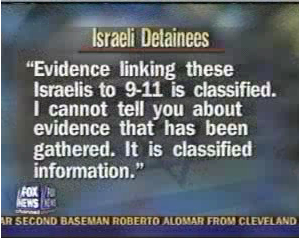 The Sky Way aircraft thing was first mentioned by Madsen on May 10. Evidently, he's tying this to the fun story that has been around the Internet since shortly after 9/11 about the Israeli spy rings that were allegedly shadowing the 9/11 hijackers in Florida, New Jersey, and elsewhere. This is of course Plenty Controversial to even talk about - the ADL believes it's inherently anti-semitic to even discuss (PDF). ("Urban Moving Systems" of New Jersey has also been named as a Mossad or espionage front tied to 9/11) But best of all, Carl Cameron at FOX News did a really amazing four part series on the Israeli spy ring (watch here 1 2 3 4). Worth putting Cameron's words again:
There is no indication that the Israelis were involved in the 9-11 attacks, but investigators suspect that they Israelis may have gathered intelligence about the attacks in advance, and not shared it. A highly placed investigator said there are "tie-ins." But when asked for details, he flatly refused to describe them, saying, "evidence linking these Israelis to 9-11 is classified. I cannot tell you about evidence that has been gathered. It's classified information." Fox News has learned that one group of Israelis, spotted in North Carolina recently, is suspected of keeping an apartment in California to spy on a group of Arabs who the United States is also investigating for links to terrorism.
Last fall I posted the following interesting map of Israeli spies that were apparently shadowing the 9/11 hijackers in Florida, mainly based on a compilation of public arrest records. Read the really quite strange report on this (PDF) and Antiwar.com's Justin Raimondo on it. Make your own judgments on it. Personally I think it's entirely possible that in 2001 the Bush administration outsourced the monitoring of domestic Arab fundamentalists to Israeli espionage teams, but let's see the evidence, then. Also, hypothetically, it would have endangered the Republican/Likud alliance that masqueraded as the American/Israeli alliance to have the American public discover that Israel didn't do everything to stop 9/11.
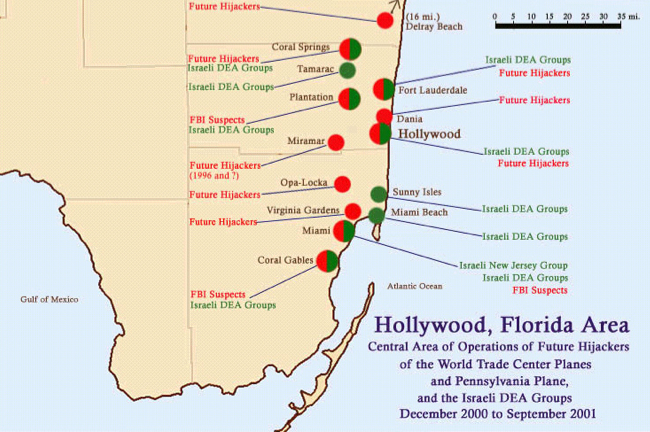
Well, that's enough 9/11 conspiracies for one day. I think I'm going to smoke some crack now and visualize controlled demolitions.
What's fun about ^^all this shit^^ is that most people think it is either complete bullshit or else so dangerously controversial that they could never ever touch it. As for me, well, I'm always looking for the truth, because you never know where the hell you'll find it. FOX News?
More entertaining than this rehash are the BBC reports that "Pentagon plans cyber-insect army" and "US 'plans stealth shark spies'". That's freakin' awesome.

I hate it when butterflies get into government espionage conspiracies. Fuck it.
For real, I am digging around very seriously for a job today. It's my birthday tomorrow, but I really need to make sure that the coming year has the kind of stability and confidence that the last year just really hasn't had at all. And by that, I mean full time work that will get me away from wasting my time with such really productive hobbies as this site. But hey that ain't yet, so lets waste some time:
Without BAGNewsNotes, where would we get such photos? Since politics is all images these days, its nice such a site specifically checks out the visual side: Psychology Watch: The Obvious Boy For Next Secretary Of Defense:

Nuclear gas release in Prairie Island containment vessel: A story from that new Twin Cities Daily Planet site, which sort of left ambiguous the nature of a recent nuclear leak down in Red Wing:
Prairie Island accident raises questions: A nuclear industry watchdog group Tuesday called the May 5 accident at the Prairie Island nuclear plant in which 100 workers were contaminated with radioactive iodine the most serious release of radiation there in 20 years and raised questions about the federal reporting process.
My understanding from the article is that the gas never got outside the containment vessel... The wording is a bit hazy, but the Daily Planet just started up, so they've got a couple kinks to get out. I admire the clever structure of the new Twin Cities news aggregating / indie features site, though, and I wish 'em the best.
Macalester alumni mag faces Scrotum-gate: I had declined to speak of this on the Internet but then they covered it in the Mac Weekly. Basically one of the Bad Comedy boys got his balls into a group photo that was submitted to Mac's fawning glossy alumni magazine. This was a brilliant maneuver in every sense, and a good (wait for it) extension of Bad Comedy's nudity-tinged oeuvre. I'd heard some rumors of this conspiracy in advance and I'm glad it went off well.
Obnoxious 'faux liberal' Washington Post columnist complains about angry bloggers: complaining about the 'anger' factor is just another way to deflect from the substance. In this case, it was Cohen's whining about how Colbert shouldn't have dared ruffle those mega-eagle feathers, which set off some pissed off emails. Digby: "In case Cohen hasn't noticed nobody on the fucking planet likes squishy faux liberal courtiers." And Salon's Daou Report on that and on the DailyKos.
Random as hell: (but seemed interesting enough): Old Afghan warlord Gulbuddin Hekmatyar "vows allegiance to bin Laden". Actually I thought this was old news, but it's interesting he's still kicking around since the old days when Reagan helped him fight the commies and pretty much everyone else. Tariq Ali on Iran. Muqtada al-Sadr wants to model the Mahdi Army on Hezbollah, which is a logical progression from boisterous militia to political party with lotsa guns and social services. AlJazeera.com (not affiliated with the TV network): Handicapped U.S. intel. on Iran challenges new CIA man.
This interview with the frontman of Godsmack about why the hell they sold songs into military recruiting commercials is pretty funny, if sad. (via Firedoglake)
"America's Geopolitical Nightmare and Eurasian Strategic Energy Arrangements" by F. William Engdahl from the idiosyncratic Centre for Research on Globalization, which always has interesting things. "The Next World War" from Antiwar.com's Justin Raimondo.
Suddenly all these guys, Joe Biden among them, are saying "let's just break Iraq in three" and feeling clever about themselves. I think that's a bit insane, but hardly surprising. George Packer, a skilled journalist, says in the New Yorker:
The choice in Iraq should not be between the Administration’s failed eschatology and the growing eagerness of most politicians to be rid of the problem.
Nobody likes Joe Lieberman, not even his supporters. Bizarre.
Jews Jeer Mehlman: JTA: Republican chairman booed at AJCommittee event:
The room burst into applause, however, when AJCommittee board member Edith Everett asked Mehlman to “take a message” to President Bush to stop linking Israel and Iran. “It does not help Israel and it does not help American Jews to appear to be stimulators of any action against Iran,” Everett said.
Something about Hitchens and Juan Cole: Noted rightwing drunkard Christopher Hitchens broke into a private email server where one of my favorite academics on the internet, Juan Cole, was explaining that the term "wipe Israel off the map" is an idiom that doesn't actually exist in Farsi, therefore every time you hear it, it's actually a distortion of meaning that serves war propaganda. Basically Hitchens published all these chunks of Cole's reasoning out of context in Slate, and this was a dick thing to do, since no one likes Hitchens, so he does this kind of B.S. hit piece. Anyway here is a bit about it. More here. As always, Cole's site is absolutely key.
Kos calls my boss a "wingnut": Teh sweet. Duly noted on the dailykos:
Last week I opened up in Minneapolis, where I got a ridiculously good reception. I started with a book signing at Arise Books, which is a small indy bookstore run by volunteers. I hadn't ever heard of anything like that before. The place was packed, and in the crowd was Fighting Dem Tim Walz in MN-01, who got a chance to update me on his race (which really is looking good). Also present was CW Wisconsin, who drove three hours for the event and left some great beer behind for me.
I did some radio, including wingnut radio on a show following Hannity. It was the first wingnut radio I'd done, since quite frankly, I'd rather not waste my time talking to people who won't buy my book anyway. But I had a blast batting around callers like a cat toying with a mouse. Seriously, what a bunch of morons.
Counter-AIPAC academics strike back: The Mearsheimer/Walt paper about the Israel Lobby and AIPAC has generated a predictable round of finger-pointing and scurrilous charges of anti-semitism, because they dared to directly dissect with blunt academic Neo-Realist style the way that A) Israel's right-wing policies are fully supported by the United States B) for totally irrational reasons that undermine our real national interests and C) no one is ever ever ever supposed to talk about this. Obviously it is a controversial topic to ramble on about, but not now. Anyway Mearsheimer and Walt wrote a big letter reacting to the reactions. These guys will have to sacrifice a lot in order to take on such a dicey topic, and we owe it to them to look at the matter carefully. But not now, damnit. Also there is an academic Freedom of Speech petition Juan Cole started against the charges of anti-semitism directed towards M&W.
Bits on CIA chief candidate Hayden: For some bizarre reason, Dennis Hastert is lashing out at John Negroponte for trying to do a "power play" by getting his deputy Hayden into running the CIA. I would recommend Steve Clemons' Washington Note stories on this matter, and the counter-intuitive "Misreading Michael Hayden's Role in the Intelligence Bureaucracy Wars: Negroponte Wants Hayden to Battle with -- Not Help -- Rumsfeld" (also noted here). The TPM muckies managed to link Hayden to Wilkes' corrupt MZM contractor. Check out Rozen following the case as well as Marshall. Tuesday, WaPo reports FBI probing Foggo's CIA contracts. The Sun reports Pentagon Is Winner Over CIA. Today, NY Times says Clash Foreseen Between C.I.A. and Pentagon.
Wayne Madsen - a peculiar journalist who used to be in the NSA, (read caveats about him in Wikipedia), well he doesn't like Michael Hayden one bit, and he has a lot of weird goods on the guy and the NSA generally. Check this this this this this and this for quite a trip down the rabbit hole. Madsen was the guy who stirred up that story that John Bolton was improperly reading NSA intercepts of Bill Richardson. Never got disproven.

Big Ol love letter from Ahmadinejad: It is a very interesting thing to read, and it seems to be targeted more at a Middle Eastern audience than the White House as such. NY Times on it here and Le Monde has the full letter here. By the way Steve Clemons also talks about this funny letter gambit. I would include more, but this is interesting by itself:
Mr President,
September Eleven was a horrendous incident. The killing of innocents is deplorable and appalling in any part of the world. Our government immediately declared its disgust with the perpetrators and offered its condolences to the bereaved and expressed its sympathies.
All governments have a duty to protect the lives, property and good standing of their citizens. Reportedly your government employs extensive security, protection and intelligence systems – and even hunts its opponents abroad. September eleven was not a simple operation. Could it be planned and executed without coordination with intelligence and security services – or their extensive infiltration? Of course this is just an educated guess. Why have the various aspects of the attacks been kept secret? Why are we not told who botched their responsibilities? And, why aren't those responsible and the guilty parties identified and put on trial?
All governments have a duty to provide security and peace of mind for their citizens. For some years now, the people of your country and neighbours of world trouble spots do not have peace of mind. After 9.11, instead of healing and tending to the emotional wounds of the survivors and the American people – who had been immensely traumatised by the attacks – some Western media only intensified the climates of fear and insecurity – some constantly talked about the possibility of new terror attacks and kept the people in fear. Is that service to the American people? Is it possible to calculate the damages incurred from fear and panic?
American citizen lived in constant fear of fresh attacks that could come at any moment and in any place. They felt insecure in the streets, in their place of work and at home. Who would be happy with this situation? Why was the media, instead of conveying a feeling of security and providing peace of mind, giving rise to a feeling of insecurity?
Some believe that the hype paved the way – and was the justification – for an attack on Afghanistan. Again I need to refer to the role of media. In media charters, correct dissemination of information and honest reporting of a story are established tenets. I express my deep regret about the disregard shown by certain Western media for these principles. The main pretext for an attack on Iraq was the existence of WMDs. This was repeated incessantly – for the public to, finally, believe – and the ground set for an attack on Iraq.
Will the truth not be lost in a contrive and deceptive climate? Again, if the truth is allowed to be lost, how can that be reconciled with the earlier mentioned values? Is the truth known to the Almighty lost as well?
[snip]........What has been said, are some of the grievances of the people around the world, in our region and in your country. But my main contention – which I am hoping you will agree to some of it – is : Those in power have specific time in office, and do not rule indefinitely, but their names will be recorded in history and will be constantly judged in the immediate and distant futures.
The people will scrutinize our presidencies.
Did we manage to bring peace, security and prosperity for the people or insecurity and unemployment? Did we intend to establish justice, or just supported especial interest groups, and by forcing many people to live in poverty and hardship, made a few people rich and powerful – thus trading the approval of the people and the Almighty with theirs'? Did we defend the rights of the underprivileged or ignore them? Did we defend the rights of all people around the world or imposed wars on them, interfered illegally in their affairs, established hellish prisons and incarcerated some of them? Did we bring the world peace and security or raised the specter of intimidation and threats? Did we tell the truth to our nation and others around the world or presented an inverted version of it? Were we on the side of people or the occupiers and oppressors? Did our administration set out to promote rational behaviour, logic, ethics, peace, fulfilling obligations, justice, service to the people, prosperity, progress and respect for human dignity or the force of guns. Intimidation, insecurity, disregard for the people, delaying the progress and excellence of other nations, and trample on people's rights? And finally, they will judge us on whether we remained true to our oath of office – to serve the people, which is our main task, and the traditions of the prophets – or not?
Well fine, then, Ahmadinejad better damn well figure a way out of this one now, if he is going to talk all altruistic and shit...
Very bad video games: Islamists using US video games in youth appeal (May 4)
WASHINGTON (Reuters) - The makers of combat video games have unwittingly become part of a global propaganda campaign by Islamic militants to exhort Muslim youths to take up arms against the United States, officials said on Thursday.
Tech-savvy militants from al Qaeda and other groups have modified video war games so that U.S. troops play the role of bad guys in running gunfights against heavily armed Islamic radical heroes, Defense Department official and contractors told Congress.
....Devlin spoke before the House Permanent Select Committee on Intelligence, at which contractors from San Diego-based Science Applications International Corp., or SAIC, gave lawmakers a presentation that focused on Iraq as an engine for Islamic militant propaganda from Indonesia to Turkey and Chechnya.
....One of the latest video games modified by militants is the popular "Battlefield 2" from leading video game publisher, Electronic Arts Inc of Redwood City, California. Jeff Brown, a spokesman for Electronic Arts, said enthusiasts often write software modifications, known as "mods," to video games.
"Battlefield 2" ordinarily shows U.S. troops engaging forces from China or a united Middle East coalition. But in a modified video trailer posted on Islamic Web sites and shown to lawmakers, the game depicts a man in Arab headdress carrying an automatic weapon into combat with U.S. invaders.
"I was just a boy when the infidels came to my village in Blackhawk helicopters," a narrator's voice said as the screen flashed between images of street-level gunfights, explosions and helicopter assaults.
Then came a recording of President George W. Bush's September 16, 2001, statement: "This crusade, this war on terrorism, is going to take a while." It was edited to repeat the word "crusade," which Muslims often define as an attack on Islam by Christianity.
I think we all want to know which mods they are running. Are Islamic militants closing the American game-modding gap? Here in America, video games serve Freedom: "America's Army", literally a first-person shooter designed to indoctrinate the youth into joining the military. Better to spend that defense cash on manipulating teen pop culture and upping polygon counts, rather than body armor, I suppose. SAIC is shady, too, but I will let that go for now.
WASHINGTON TIMES: CIA mines 'rich' content from blogs
By Bill Gertz April 19, 2006
President Bush and U.S. policy-makers are receiving more intelligence from open sources such as Internet blogs and foreign newspapers than they previously did, senior intelligence officials said.
The new Open Source Center (OSC) at CIA headquarters recently stepped up data collection and analysis based on bloggers worldwide and is developing new methods to gauge the reliability of the content, said OSC Director Douglas J. Naquin.
"A lot of blogs now have become very big on the Internet, and we're getting a lot of rich information on blogs that are telling us a lot about social perspectives and everything from what the general feeling is to ... people putting information on there that doesn't exist anywhere else," Mr. Naquin told The Washington Times.
I'm gonna throw some random stuff at you. It's not a waste of time to look at, but it won't tell you one coherent story, so much as some shades of what went down over the last week while I was wrapped up in all the Macalester festivities... which I will elaborate on later.
Tony Snow for WH press sec.?: Lying water carrier for Republicans + doesn't stammer or sweat so much == why not? Tony Snow's many lies make him an unacceptable press sec'y
New protest album: NEIL YOUNG - Living With War, reviewed positively. Won't be in stores until the beginning of May, but online purchases later this week.
A.Norman sends along the following cartoon:

Spam keywords auto-pass NSA filter?: The odd internet journalist Wayne Madsen offered that
April 20, 2006 -- Beating Bush's NSA e-mail surveillance simple. According to NSA sources, there is a simple method to avoid having one's e-mail captured by NSA Internet filters that have been installed within major Internet exchanges, such as the AT&T facility in San Francisco, which is the subject of a class action suit against AT&T. By typing "Viagra" or "Cialis" in the message text, the filters will automatically identify the e-mail as spam and ignore it. The e-mail could contain the words "Al Qaeda" or "Bin Laden," but as long as Viagra or Cialis are also contained in the text, the e-mail will pass through the filters without being intercepted.
(Madsen's site design now looks much better, BTW)
Execrable writing: Powerline has an odd poop fetish. They use 'execrable' to describe everyone from Rybak to Kofi. I will have to remember to give Scott Johnson a wedgie when I see him.
Earth Day: This House site is fucking crazy: On Earth Day website, House Republican Committee seeks to 'dispel environmental myths'. Really crazy.
 Time to kiss some Caucasian ass as the rather autocratic president of Azerbaijan visits the White House. Bush still claims that final Iraq war decisions happened after an ultimatum. Rolling Stone features: is Bush the worst President in History?
A really long article in the American Prospect (a liberal mag) about how the Democrats need to find some values and stuff. It may have been a good article but it was too long even for me.
If you have an online group, try Frappr to map them globally.
Rice is getting roped into AIPAC case: A lot seems to be transpiring in the AIPAC case for this summer, and we'll have to dig into the AIPAC angle a lot later. But for now, AP reports:
Secretary of State Condoleezza Rice leaked national defense information to a pro-Israel lobbyist in the same manner that landed a lower-level Pentagon official a 12-year prison sentence, the lobbyist's lawyer said Friday.
Goss CIA analyst crackdown: RawStory: The CIA announced today that it has fired an employee for leaking classified information to Washington Post reporter Dana Priest. Also a big story in the NY Times on it. Pretty fucked up. Juan Cole compares how in DC these days, it is good to leak Valerie Plame's name, but bad to inform the American public about a network of secret prisons in eastern Europe.
Secret torture flights: There is a global shadow detention gulag of sorts, and all kinds of rumors about it around the Internet. Perhaps we'll stir up a little trouble later with some of those exotic stories, but in the meantime consider: Amnesty International claims CIA used private airlines to hide CIA torture flights (from a couple weeks ago).
Apple lawyers say blogs not journalism: Apple is trying to sue some blogger-type guy at PowerPage.org and say he's not a journalist with journalist-style credentials because of a story about Apple developing a consumer-oriented Firewire-based GarageBand music interface - codenamed 'Asteroid' according to AppleInsider.
Corporate dudes are suing against NSA wiretaps along with the ACLU. NSA wiretaps were a prominent part of Sunday's West Wing episode, wherein President-elect Santos calls up the Chinese premier to do some saber rattling over Kazakhstan – I don't know why the hell Bartlett, or anyone, would place thousands of US troops between the Russian and Chinese armies, but to the West Wing's credit, Santos doesn't like it either.
I loathe that Clifford May and his neocon ways. But "What to make of the anti-antis?" is a pretty sublime exercise in Orwellian labeling and slanders. Also the Zarqawi psyops story makes an angular appearance I don't really understand – but it appears that he supports the psyops because it manipulates perceptions against "anti-antis"... WTF?
The media, too, have more than their share of anti-antis, and I'm not talking here only about the left-wing blogs that compare President Bush unfavorably to Saddam Hussein and Osama bin Laden. Recently, the top story on the Washington Post's front page was headlined: "Military Plays Up Role of Zarqawi: Jordanian Painted as Foreign Threat to Iraq's Stability."
Is there anyone -- even Ward Churchill -- who would argue that Abu Musab al-Zarqawi, the commander of Al-Qaida in Iraq, is not a "foreign threat to Iraq's stability"?
A seemingly more cogent reason for the Post to object to what it blasts as a U.S. military propaganda campaign: An American colonel is quoted as saying that Zarqawi and other "foreign insurgents" are only "a very small part of the actual numbers" of those fighting Iraqi government forces and the American-led coalition.
The Moussaoui case distracts from profound problems in the legal system that need to get unraveled.
 Is Bush ripping Beatles onto his iPod? The RIAA is arguing in court that turning your own CDs into MP3s is not fair use, which is insane. But since you can't buy Beatles digitally at all, this means that Bush must have been ripping them. Should the RIAA bust his yarblockoes? Well as this guy says, "They nailed Al Capone for tax evasion, didn't they?"
Boston Globe says Bloggers fanning the controversy over Rumsfeld. Describing a few milblogs, the blogs in turn hasten to redefine themselves. I am in favor of military blogs, as they open new and interesting channels of information. Among those mentioned: COUNTERCOLUMN: All your bias are belong to us, and Guidons. OPFOR is apparently the standard bearer these days. Is it part of military.com? Features such bits as "Somalia Remains Free of US Imperialism, Food, Laws, Prosperity, Peace…" under the category "The Long War." Real progressive. The mil blog wire is an aggregator which looks interesting.
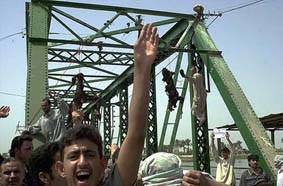 The Blackwater lawsuit: Those Defense contractor guys hung on the bridge probably shouldn't have been in Fallujah -- but can their widows sue over it? After the Fallujah hangings, did Blackwater cover up their own negligence and fake documents to protect their Pentagon contract? More on it here in the DailyKos. In the broader context, it's evidence that these private companies treat their employees like shit while causing the military industrial complex to spiral out of control:
The Nation: Blood Is Thicker Than Blackwater by JEREMY SCAHILL [from the May 8, 2006 issue]
It is one of the most infamous incidents of the war in Iraq: On March 31, 2004, four private American security contractors get lost and end up driving through the center of Falluja, a hotbed of Sunni resistance to the US occupation. Shortly after entering the city, they get stuck in traffic, and their small convoy is ambushed. Several armed men approach the two vehicles and open fire from behind, repeatedly shooting the men at point-blank range. Within moments, their bodies are dragged from the vehicles and a crowd descends on them, tearing them to pieces. Eventually, their corpses are chopped and burned. The remains of two of the men are strung up on a bridge over the Euphrates River and left to dangle. The gruesome image is soon beamed across the globe.
In the Oval Office the killings were taken as "a challenge to America's resolve," according to the Los Angeles Times. President Bush issued a statement through his spokesperson. "We will not be intimidated," he said. "We will finish the job." Brig. Gen. Mark Kimmitt vowed, "We will be back in Falluja.... We will hunt down the criminals.... It's going to be deliberate. It will be precise, and it will be overwhelming." Within days of the ambush, US forces laid siege to Falluja, beginning what would be one of the most brutal and sustained US operations of the occupation.
.....
Shortly after Helvenston left that message, the men left the base and set out for their destination. Without a detailed map, they took the most direct route, through the center of Falluja. According to Callahan, there was a safer alternative route that went around the city, which the men were unaware of because of Blackwater's failure to conduct a "risk assessment" before the trip, as mandated by the contract. The suit alleges that the four men should have had a chance to gather intelligence and familiarize themselves with the dangerous routes they would be traveling. This was not done, according to Miles, "so as to pad Blackwater's bottom line" and to impress ESS with Blackwater's efficiency in order to win more contracts. The suit also alleges that McQuown "intentionally refused to allow the Blackwater security contractors to conduct" ride-alongs with the teams they were replacing from Control Risk Group. (In fact, the suit contends that Blackwater "fabricated critical documents" and "created" a pre-trip risk assessment "after this deadly ambush occurred.")
AP: Israel Preparing to Retake Gaza Strip. Probably saber rattling, but the situation is getting really bad. Some other newsbits:
Senate Bill Shorts Gear for Troops By ANDREW TAYLOR, AP Thu Apr 20, 3:46 PM ET
WASHINGTON - A Senate measure to fund the war in Iraq would chop money for troops' night vision equipment and new battle vehicles but add $230 million for a tilt-rotor aircraft that has already cost $18 billion and is still facing safety questions.
Kyrgyz Leader Threatens to Expel US Troops By KADYR TOKTOGULOV , 04.19.2006, 10:36 PM
Kyrgyzstan's president threatened Wednesday to expel U.S. troops if the United States does not agree by June 1 to pay more for stationing forces in the Central Asian nation.
Some random DailyKos goodies: What is the 'center' in American politics? What of the innocent people in Guantanamo? (and what of that Abbasi guy?) Are we becoming the Republic of Gilead?
Some random Israel goodies: "We could lose the next war" - an interview with idiosyncratic Likud hawk Yuval Steinitz, wherein he suggests that the Israeli military leads its government, not vice versa. Really interesting stuff. He is also paranoid about Egypt. Editorial: The UN versus Hezbollah. Hebron settlers assault two female international aid workers. I had some more links but they disappeared because of that damn Haaretz auto-reload thing.
I promise that the Big Lebowski-themed Iran exegesis is on its way. It's a new week now... Gotta get real before oil goes $80+/barrel.....
I got a raise at my other part-time job yesterday - while driving down Nicollet with A. Cheng, who returned from China for a few days to deal with immigration matters (such timing). Anyhow this is good news but it means I have stuff to do right now.

 I am listening to Unknown Prophets' latest CD, 'The road less traveled'. There is a lot of weird stuff going on right now. HAMAS and the Fatah/Old Guard Palestinian factions are locked in a weird conflict as Abbas tries to set up 'parallel structures', according to a HAMAS guy. Bush authorized Libby to leak, Homeland Security guys are internet child molesting freaks, Carl Pohlad is at CostCo.
MPR had a really good lineup today. Religion, oil, debt and American politics was the subject of a recorded talk from Kevin Phillips (author of American Theocracy and the author of 1969's Emerging Republican Majority) at the Edina Barnes & Noble. He took head-on the financial-services-debt complex, the moral delusions of empire across history, the estimated 55% of Bush voters that believe in the apocalypse, and the weird sense that God speaks through Bush doesn't bother these people (idolators?!). Also mentioned how more extremist Jewish sects like the Lubovitch folks are voting for Republicans - and this is intertwined with Christian apocalyptic views of the West Bank. Reminded us that the Southern Baptists refused to reunify after the Civil War, but have since then taken over Union southern states like Missouri. He talks about the symbolic antichrist and how the Antichrist in Pop Apocalyptica (Left Behind especially) ties into Iraq and oil, thus providing a 'message problem' between the wartime White House, pursuing the oil, and the base, who needed to hear a quasi-apocalyptic or near-eschatological kind of message to rationalize the war.
Which is what we've been saying out here on the internet for a while now... But Phillips really brings it together. With a broad historical scope of the patterns of declining empires, crossing lots of really excellent currents, and a cynicism towards religion that I found extra nice, this one was damn sweet. (RealPlayer stream here)
Midmorning had a segment on the hip-hop nation I heard part of. And of course they were all over the Libby thing today. Thumbs up for another fine day for Minnesota Public Radio.
Lastly the Book of Judas - a testament discovered on papyrus in Middle Egypt - is apparently out and about, turning a good chunk of Christianity sideways. Should he be the most revered disciple because he set the spirit free from the body (which is apparently in this text)??

Oh yeah, Apple is releasing a system called Boot Camp ("enter the Alt Reality" they say) that allows people to boot between OS X and Windows on Intel-based Macs. Suddenly the Windows foundation is missing a pillar. Apple:
More and more people are buying and loving Macs. To make this choice simply irresistible, Apple will include technology in the next major release of Mac OS X, Leopard, that lets you install and run the Windows XP operating system on your Mac. Called Boot Camp (for now), you can download a public beta today.
As elegant as it gets
Boot Camp lets you install Windows XP without moving your Mac data, though you will need to bring your own copy to the table, as Apple Computer does not sell or support Microsoft Windows.(1) Boot Camp will burn a CD of all the required drivers for Windows so you don't have to scrounge around the Internet looking for them.
Ah I gotta take care of stuff now. We'll get some more substantive goodies up sooner, rather than later. :-/
March 20: CLEVELAND, United States (AFP) - US President George W. Bush said he hoped to resolve the nuclear dispute with Iran with diplomacy, but warned Tehran he would "use military might" if necessary to defend Israel.
AIPAC Offensive: Ah what a sublime concept. "Defense". On the same day, news spread of a report by two high-octane professors of international studies criticizing the United States' alliance with Israel, and a detailed dissection of how AIPAC intimidates all opposition to Israeli government policies on Capitol Hill. John Mearsheimer and Stephen Walt are big wheels in the international politics arena, and not doctrinaire liberals, nor terrorists. Of course Justin Raimondo at Antiwar has his take on this.
This is a pretty big ol' bombshell to put in the beginning: "The Israel Lobby and U.S. Foreign Policy," (PDF, 70+ pages)
"The U.S. national interest should be the primary object of American foreign policy. For the past several decades, however, and especially since the Six Day War in 1967, the centerpiece of U.S. Middle East policy has been its relationship with Israel. The combination of unwavering U.S. support for Israel and the related effort to spread democracy throughout the region has inflamed Arab and Islamic opinion and jeopardized U.S. security. This situation has no equal in American political history. Why has the United States been willing to set aside its own security in order to advance the interests of another state?"
I won't spend any more time on that now. But it's a certainly a big deal, and we will stick around the AIPAC case to see what turns up. Also worth considering: WHY IRAN WANTS THE BOMB.
Corporate media sucks: 1) Chris Matthews is taking corporate cash to speak places. Wow, big surprise that MSNBC is in awash in corporate cash. 2) The WaPo really uses sloppy terms a lot, such as:
For months the Democrats have resisted calls from their liberal base to more aggressively challenge President Bush.
...as a way to defuse what Feingold is saying and discredit the majority of the country that doesn't believe in White House policies. And to suck at the Teat. At least the Christian Broadcasting Network has the guts to go with their fanaticism properly.
The WaPo gave this young rightwing RedState jackass a blog on their site. Some negative reactions from the liberal side, since this guy is apparently allowed to pretty much make shit up all day long.
From the sphere of friends with websites: PBG has some new stuff up at InfantFoundation.com. I liked this photo. Something about those gay atheist liberals, via the Norman.
For the occasion of the Fourth Year of the war, it is good to look back and remember the insane propaganda we lived in, that sparked the whole fucking mess in the first place. Fortunately, Fairness & Accuracy in Reporting pulled together: "The Final Word Is Hooray!" Remembering the Iraq War's Pollyanna pundits:
"Tommy Franks and the coalition forces have demonstrated the old axiom that boldness on the battlefield produces swift and relatively bloodless victory. The three-week swing through Iraq has utterly shattered skeptics' complaints."
(Fox News Channel's Tony Snow, 4/27/03)
"The only people who think this wasn't a victory are Upper Westside liberals, and a few people here in Washington."
(Charles Krauthammer, Inside Washington, WUSA-TV, 4/19/03)
"We had controversial wars that divided the country. This war united the country and brought the military back."
(Newsweek's Howard Fineman--MSNBC, 5/7/03)
"We're all neo-cons now."
(MSNBC's Chris Matthews, 4/9/03)
And it goes on and on. And for reasons that escape me, these people still control the fucking debate. DAMN IT.
Some random bits: well, conservatives are skittish right now. Duh. Pundits suck. Duh. In an interview, ABC Nightline refuses to acknowledge that Billy Graham's son Franklin is a fanatical hater of Islam.
Antiwar.com, some goodies: How to fix the intelligence process by Charles Peña. Also "Why Libertarians Should be Critical of War," Raimondo: "American Megalomania"; TomDispatch: "Reprogramming the Infinite Loop: The NSA Spying Debate", Solomon: "War-Loving Pundits".
Check out the DailyKos straw poll of 2008 presidential candidates. Feingold's kickin ass!!
It's not impossible: Jim Webb, a conservative Democrat running for Congress, says: “The Reagan Democrats” – and how to get them back. A general criticizes Rummy's total incompetence.
Points in Case: Ten things to believe in. Way to go, Keith Olbermann.
Nasty neocon Max Boot suggests that George Clooney has been pimping the neo-con line throughout his career, noting that Three Kings provides a neocon-certified Moral Basis for attacking Iraq in 2003 (not really true but it reads well), and The Peacemaker alerted people to the hazards of WMD attacks and such.
Bush White House overdoes 'manliness'. But the problem is that they are sort of gay, but weird about it.
Something called the Iraq Study Group has been set up, with a bunch of mostly shady Washington insiders and defense contractors, etc., who are probably going to attempt to whitewash aspects of the war policy, and perhaps some fake intelligence after lunch and tea. And for some of them, keep selling lots of weapons to the government.
Helen Thomas on the Lap Dogs of the Press. Her recent press conference moment with Bush was pretty badass.
Even more random: Top 10 weirdest animals.
A Franz Ferdinand kinda place? Milosevic's death has afforded hawks an opportunity to reminisce about how warm and fuzzy it made them feel to bomb Serbia and stop the ethnic cleansing, although oddly, it seems that the mass graves in Kosovo never really turned up in the kinds of numbers we were led to believe at the time.
Of course, the Kosovo intervention was mainly about gaining more American control over the oil and gas energy pathways leading west from the Black Sea (and the surrounding political structures). The AMBO pipeline (Albania-Macedonia-Bulgaria) and the massive Camp Bondsteel in Southern Kosovo were the two major products of the war in Kosovo. Aside from these goodies the US doesn't much care what happens over there.
Israel Goodies: "Settlers, you have failed" by Aluf Benn. Good to hear. Guess what? Israel has its own dickhead spoiler politician named Lieberman, and better yet, Avigdor Lieberman is a fanatical settler and is the leader of the far-right Yisrael Beiteinu Party. Apparently National Union, pretty much a fascist party that essentially supports the ethnic cleansing of Palestinians, once had a coalition with Yisrael Beiteinu, but they split up a while ago. They are messing around with Netanyahu and maneuvering to his right. "Right-wing parties mull ways to contend with rise of Lieberman". Joe and Avigdor are apparently distant cousins.
Also "Of love and anger" as young Israelis, some of them born and raised ex-Gaza settlers, raise doubts about whether or not the IDF can still be an instrument to bring about the return of the messiah.
Here is a funny story that indicates that "Syria was ready for peace" in the mid-1990s. Bishara acted as Syria-Israel mediator in 1990s talks. Also funny: Saddam Hussein maintained pretense of chemical arms to prevent Israeli attack. Ha. Ha. Ha.
Netanyahu says the next Israeli election will be a kind of referendum on the whole damn mess. "A referendum indeed" by Uzi Benziman. and The cynicism of Olmert and Lieberman By Israel Harel. Nerds for Netanyahu? Augh.
On the left side of the spectrum, see the interview with Meretz leader Yossi Beilin in "'Not afraid of 'autonomy' By Nurit Wurgaft." (there's a bit about Lieberman's ethnic cleansing plans at the end) And don't forget the Israeli Arabs! Not pawns on the board By Nurit Wurgaft.
Some cool thoughts on Islamic Archaism from one of Islam's best writers. I lost the link to a Haaretz story about Lafif Lakdar, but check out: Why the Reversion to Islamic Archaism? (also featured here), and The modern schizophrenia of Islamic integralism. On AnarchistNews.org see the links to "Islam and (communist) Anarchism" as they term it, (far be it from me to try to control their semiotics). And InfoShop.org's page on Iran.
Well that was some stuff I had piled up. Sorry, no pictures. You can enjoy that for the weekend, I think I just want to go watch movies the whole time.
Batch O Goodies: Small victory for the First Amendment. And bongs.
SAN FRANCISCO (Reuters) - An Alaska high school violated a student's free speech rights by suspending him after he unfurled a banner reading "Bong Hits 4 Jesus" across the street from the school, a federal court ruled on Friday.
Joseph Frederick, a student at Juneau-Douglas High School in Alaska, displayed the banner -- which refers to smoking marijuana -- in January 2002 to try to get on television as the Olympic torch relay was passing the school. Friday's ruling by the U.S. 9th Circuit Court of Appeals in San Francisco overturned a decision by a federal court in Alaska that backed Frederick's suspension and said his rights were not violated. "Public schools are instrumentalities of government, and government is not entitled to suppress speech that undermines whatever missions it defines for itself," Judge Andrew Kleinfeld wrote in the court's opinion. The court also cleared the way for Frederick to seek damages, saying Morse was aware of relevant case law and should have known her actions violated his rights.
Joe Fuckin Lieberman spends some quality time with Rush Limbaugh at a 50th anniversary party for National Review. Nuke him and support Democratic challenger Ned Lamont in the primaries.
Russ Feingold is on point these days, and CNN sucks in their coverage of the censure thing. What else is new?
Guardian: US postwar Iraq strategy a mess, Blair was told. In pretty blunt language, the British staff was honest about so much of the bad stuff, so long ago.
Israel is the New Athens: Time to gank some land already: Guardian: Israel sets four year deadline to draw final borders:
Mr Olmert, who is strongly favoured to win a general election in three weeks, told the Jerusalem Post that by 2010 he intended to "get to Israel's permanent borders, whereby we will completely separate from the majority of the Palestinian population and preserve a large and stable Jewish majority in Israel".
He did not specify the route of the new frontier, which he said would be decided after an "internal dialogue inside Israel" and consultations with Israel's foreign allies. But he repeated his intention to annex the main settlement blocks in the West Bank and retain control of the Jordan river area "as a security border", resulting in a Palestinian state entirely surrounded by territory under Israeli control.
The plan outlined by Mr Olmert would require the removal of about 60,000 Israelis from settlements deeper inside the West Bank but leave about 350,000 in the main blocks and East Jerusalem.
As they used to say in the Greek times, "Take it, bitch." The Thrasymachus principle of political power. Things haven't changed much since 431 BC: "History of the Peloponnesian War" by Thucydides: Chapter XVII: Sixteenth year of the war: The Melian Conference (aka The Melian Dialogue):
The Melians are a colony of Lacedaemon that would not submit to the Athenians like the other islanders, and at first remained neutral and took no part in the struggle, but afterwards upon the Athenians using violence and plundering their territory, assumed an attitude of open hostility. [Athenian generals] Cleomedes and Tisias, encamping in their territory with the above armament, before doing any harm to their land, sent envoys to negotiate. The Athenian envoys spoke as follows:
.....Athenians: For ourselves, we shall not trouble you with specious pretences - either of how we have a right to our empire because we overthrew the Mede, or are now attacking you because of wrong that you have done us - and make a long speech which would not be believed; and in return we hope that you, instead of thinking to influence us by saying that you did not join the Lacedaemonians, although their colonists, or that you have done us no wrong, will aim at what is feasible, holding in view the real sentiments of us both; since you know as well as we do that right, as the world goes, is only in question between equals in power, while the strong do what they can and the weak suffer what they must.
....Athenians: When you speak of the favour of the gods, we may as fairly hope for that as yourselves; neither our pretensions nor our conduct being in any way contrary to what men believe of the gods, or practise among themselves. Of the gods we believe, and of men we know, that by a necessary law of their nature they rule wherever they can. And it is not as if we were the first to make this law, or to act upon it when made: we found it existing before us, and shall leave it to exist for ever after us; all we do is to make use of it, knowing that you and everybody else, having the same power as we have, would do the same as we do. Thus, as far as the gods are concerned, we have no fear and no reason to fear that we shall be at a disadvantage.
Thucydides: Summer was now over. ...the Melians again took another part of the Athenian lines which were but feebly garrisoned. Reinforcements afterwards arriving from Athens in consequence, under the command of Philocrates, son of Demeas, the siege was now pressed vigorously; and some treachery taking place inside, the Melians surrendered at discretion to the Athenians, who put to death all the grown men whom they took, and sold the women and children for slaves, and subsequently sent out five hundred colonists and inhabited the place themselves.
Old boss, same as the new boss. Thanks, Leo Strauss. Power => Morality.
Dubai deal and racism: Raimondo: Dubai and Demagoguery. Juan Cole basically notes that, well, if you spend five years whipping up racist nationalism, it can sort of spill over in ways you don't expect. Not that it's happened before. The Big Lie eventually catches up with you. There's more good stuff in this one about Islamic theology & how it relates to Christians... in other words, the backstory that the 'hatemongers' never ever talk about.
The hatemongers are well known. Rupert Murdoch's Fox Cable News, Rush Limbaugh's radio program and its many clones, telebimbos like Ann Coulter, Evangelical leaders like Franklin Graham, Congressmen like Tom Tancredo, and a slew of far rightwing Zionists who would vote for Netanyahu (or Kach) if they lived in Israel-- Frank Gaffney, Daniel Pipes, Michael Rubin, David Horowitz, etc., etc. And finally, there are many Muslims who have an interest in whipping up anti-Islamic feeling. Ahmad Chalabi and his Iraqi National Congress helped maneuver the US into a war against Iraq with lies about a Saddam-al-Qaeda connection and illusory WMD. The dissident Islamic Marxist group, the Mojahedin-e Khalq (MEK) is now placing equally false stories about Iran in the Western press and retailing them to Congress and the Pentagon.
More goodies coming. I had to get the Melian thing in though.
Paranoia strikes deep
Into your life it will creep
Starts when you're always afraid
Step out of line, the men come and take you away
You better stop, hey what's that sound, everybody look what's goin down...
There is one thing you really ought to reflect on this week. Halliburton has a contract to build detention centers in the United States now. Upon some random catastrophic event (or as they say in conspiracy land, a False Flag terrorist attack orchestrated by the government to start Fascism®™), then all the political subversives get taken away. This is the Angry Paranoia™ version from PropagandaMatrix: "Halliburton Detention Camps For Political Subversives" (admittedly it's funny, and I personally nearly ended up in the New York Political Dissident Holding Tank pictured, so I can relate). But this is totally for  real. Here is the KBR/Halliburton press release:
KBR Awarded U.S. Department of Homeland Security Contingency Support Project for Emergency Support Services
ARLINGTON, Va.--(BUSINESS WIRE)--Jan. 24, 2006--KBR announced today that the Department of Homeland Security's (DHS) U.S. Immigration and Customs Enforcement (ICE) component has awarded KBR an Indefinite Delivery/Indefinite Quantity (IDIQ) contingency contract to support ICE facilities in the event of an emergency......
With a maximum total value of $385 million over a five-year term, consisting of a one-year based period and four one-year options, the competitively awarded contract will be executed by the U.S. Army Corps of Engineers, Fort Worth District. KBR held the previous ICE contract from 2000 through 2005.
"We are especially gratified to be awarded this contract because it builds on our extremely strong track record in the arena of emergency operations support," said Bruce Stanski, executive vice president, KBR Government and Infrastructure. "We look forward to continuing the good work we have been doing to support our customer whenever and wherever we are needed."
The contract, which is effective immediately, provides for establishing temporary detention and processing capabilities to augment existing ICE Detention and Removal Operations (DRO) Program facilities in the event of an emergency influx of immigrants into the U.S., or to support the rapid development of new programs. [sounds juicy!] The contingency support contract provides for planning and, if required, initiation of specific engineering, construction and logistics support tasks to establish, operate and maintain one or more expansion facilities.
The contract may also provide migrant detention support to other U.S. Government organizations in the event of an immigration emergency, as well as the development of a plan to react to a national emergency, such as a natural disaster. In the event of a natural disaster, the contractor could be tasked with providing housing for ICE personnel performing law enforcement functions in support of relief efforts.
Ahh the Post-Nuclear Bird Flu concentration camps of North Dakota. 2008 will really be a doozy.
I am intrigued by the Russian moves on HAMAS, because Russia is always intriguing. Russia is huge, they are playing games with the energy (when they shut off the European gas, it was a clever way to remind everyone they can make the European winter very cold & expensive). Israelis are plenty pissed with Russia about the Hamas thing -- Bee stings not bear hugs in Haaretz. More on this later but I don't want to deal with it now. Raimondo on this.
Hamas Assumes Control of Parliament. On the new Hamas agenda: 'learn to queue like the British'
Meanwhile all these strange things are happening in Israel (what else is new). "Hilltop - or down-to-earth? By Avraham Burg" about the crisis of religious Zionism - the Gaza withdrawal kinda shattered the settler messianic theology of "build this settlement or God breaks out the lightning bolts for YOU." So are religious Zionists going to get pragmatic or not?
Favorite Internet List via the geniuses of GorillaMask: The 213 Things Skippy is No Longer Allowed to Do in the U.S. Army: This guy who was in psychological operations (around Albania apparently) made a list of things that were expressly forbidden - either because he did them, or was asked about it and ordered not to do said things. There are some damn good ones:
2. My proper military title is "Specialist Schwarz" not "Princess Anastasia".
3. Not allowed to threaten anyone with black magic.
4. Not allowed to challenge anyone's disbelief of black magic by asking for hair.
7. Not allowed to add “In accordance with the prophesy” to the end of answers I give to a question an officer asks me.
10. Not allowed to purchase anyone's soul on government time.
11. Not allowed to join the Communist Party.
12. Not allowed to join any militia.
13. Not allowed to form any militia.
14. Not allowed out of my office when the president visited Sarajevo.
20. Must not taunt the French any more.
21. Must attempt to not antagonize SAS.
22. Must never call an SAS a “Wanker”.
23. Must never ask anyone who outranks me if they've been smoking crack.
24. Must not tell any officer that I am smarter than they are, especially if it's true.
26. Never tell a German soldier that “We kicked your ass in World War 2!”
29. The Irish MPs are not after “Me frosted lucky charms”.
31. Not allowed to let sock puppets take responsibility for any of my actions.
32. Not allowed to let sock puppets take command of my post.
41. “Keep on Trucking” is *not* a psychological warfare message.
44. I am not the atheist chaplain.
49. Not allowed to trade military equipment for “magic beans”.
51. Not allowed to quote “Dr Seuss” on military operations.
54. “Napalm sticks to kids” is *not* a motivational phrase.
58. The following words and phrases may not be used in a cadence- Budding sexuality, necrophilia, I hate everyone in this formation and wish they were dead, sexual lubrication, black earth mother, all Marines are latent homosexuals, Tantric yoga, Gotterdammerung, Korean hooker, Eskimo Nell, we've all got jackboots now, slut puppy, or any references to squid.
59. May not make posters depicting the leadership failings of my chain of command.
60. “The Giant Space Ants” are not at the top of my chain of command.
66. There is no “Anti-Mime” campaign in Bosnia.
67. I am not the Psychological Warfare Mascot.
68. I may not line my helmet with tin foil to “Block out the space mind control lasers”.
69. May not pretend to be a fascist stormtrooper, while on duty.
71. I must not flaunt my deviances in front of my chain of command.
75. May not conduct psychological experiments on my chain of command.
84. Must not use military vehicles to “Squish” things.
85. Not allowed to make any Psychological Warfare products depicting the infamous Ft. Bragg sniper incident.
94. Crucifixes do not ward off officers, and I should not test that.
106. I may not trade my rifle for any of the following: Cigarettes, booze, sexual favors, Kalishnikovs, Soviet Armored vehicles, small children, or bootleg CD’s.
140. I am not authorized to sell mineral rights.
155. Teaching Albanian children to taunt other soldiers is not nice.
158. The revolution is not now.
162. Past lives have absolutely no effect on the chain of command.
174. Furby ® is not allowed into classified areas. (I swear to the gods, I did not make that up, it's actually DOD policy).
198. Not allowed to lead a “Coup” during training missions.
I was a bit suspicious this was recently written by some recruiter-like guy to make the military seem more palatable, but it's apparently quite a few years old, and he's not in the military any more. It is too bad they are tangled up in all this mess - really such sarcasm ought to be the general mission. Mineral rights?
Blogs are getting big at the U for classwork. Strib website is messed up. Can you believe it takes three steps to even find the index of reporters & staff?
If you can do this ridiculous bouncing object thing for more than 18 seconds, you are amazing.
United Arab Emirates chosen for sub-orbital tourism spaceport. What more can I say?
Christopher Hitchens is a fat boozy British son of a bitch who has believed in everyone from Trotsky to Wolfowitz. Which admittedly isn't very far. But between bottles of scotch he likes to act like some kind of demented nanny: "Garrison Keillor, Vulgarian". Who cares? I don't know. Sorry I wasted your time.
The Recording Industry Jihad. They are trying to screw everyone using the DMCA to say that you can't make backups of your own CDs, as they claim this is basically the same as piracy. So, for them, "Freedom" means "if you break your CD, you are free to go to Sam Goody and Buy a New One," rather than the current legal arrangement, "you are allowed to make fucking backups, because this is not East Germany."
The [submitted arguments in favor of granting exemptions to the DMCA] provide no arguments or legal authority that making back up copies of CDs is a noninfringing use. In addition, the submissions provide no evidence that access controls are currently preventing them from making back up copies of CDs or that they are likely to do so in the future.
A bit more here.
The Onion: Senate Ethics Committee To Meet In New Ethics Committee Mansion.
Sorry that's all for now. Happy Mattress Sale Day.
Cheney 'Authorized' Libby to Leak Classified Information
By Murray Waas, National Journal
Vice President Dick Cheney's former chief of staff, I. Lewis (Scooter) Libby, testified to a federal grand jury that he had been "authorized" by Cheney and other White House "superiors" in the summer of 2003 to disclose classified information to journalists to defend the Bush administration's use of prewar intelligence in making the case to go to war with Iraq, according to attorneys familiar with the matter, and to court records.
Libby specifically claimed that in one instance he had been authorized to divulge portions of a then-still highly classified National Intelligence Estimate regarding Saddam Hussein's purported efforts to develop nuclear weapons, according to correspondence recently filed in federal court by special prosecutor Patrick J. Fitzgerald.
As we say on the Internet, LOL. Atrios notes it's slightly hypocritical. Another CIA official has come out of the woodwork to accuse the Bush Administration of cherrypicking Iraq intelligence – and guess what, Robert Novak hated him too! Paul R. Pillar, thanks for being a patriot. We need guys like you. WaPo: "Ex-CIA Official Faults Use of Data on Iraq":
The former CIA official who coordinated U.S. intelligence on the Middle East until last year has accused the Bush administration of "cherry-picking" intelligence on Iraq to justify a decision it had already reached to go to war, and of ignoring warnings that the country could easily fall into violence and chaos after an invasion to overthrow Saddam Hussein.
"It has become clear that official intelligence was not relied on in making even the most significant national security decisions, that intelligence was misused publicly to justify decisions already made, that damaging ill will developed between [Bush] policymakers and intelligence officers, and that the intelligence community's own work was politicized," Pillar wrote.
......Pillar was identified in a column by Robert D. Novak as having prepared the assessment and having given a speech critical of Bush's Iraq policy at a private dinner in California. The column fed the White House's view that the CIA was in effect working against the Bush administration, and that Pillar was part of that. A columnist in the Washington Times in October 2004 called him "a longstanding intellectual opponent of the policy options chosen by President Bush to fight terrorism."
Add these two bits together, and boom, there you go, they smoked Valerie Plame in an attempt to protect all their fake intelligence and swat at the CIA. But why the hell do I bother repeating myself for the 124,639th time?
Fair and Balanced Editing of Applause: Fox "Memory Hole" News edited out anti-Bush applause at the Coretta Scott King funeral, then Morty Kondracke said that the audience obviously didn't like the partisanship. Now that's a reality distortion field. MSNBC was caught in a Harry Reid-Abramoff headline changing dodge. More on yesterday's Reid smear below.
<woozy> What's going on everyone? After my wisdom teeth were yanked, I have been popping Vicodin like candy for the last couple days, but everything seems to be going pretty well so far. No dry sockets yet. I had never been under general anesthesia before, so I was a little nervous because it can supposedly kill you. But it was plainly awesome to wake up with all my wisdom teeth yanked, loaded up with drogas.
Hilarious stuff from Mordred. Well done. </woozy>
ADVISE is the New Total Information Awareness: Yes, this "Analysis, Dissemination, Visualization, Insight, and Semantic Enhancement" program will know your favorite soda and pornography. Of course they will be totally responsible when drunk on Ultimate Power. CSM: "US plans massive data sweep: Little-known data-collection system could troll news, blogs, even e-mails. Will it go too far?" More here.
The CounterTerrorism Blog looks good. They are skeptical of Bush's latest West Coast marquee terrorist conspiracy. So a good place to start.
Israeli Shin Bet director says Israel 'may rue Saddam overthrow' to young Israeli settlers: You can't make this shit up:
The head of Israel's domestic security agency, Shin Bet, has said his country may come to regret the overthrow of former Iraqi President Saddam Hussein. Yuval Diskin said a strong dictatorship would be preferable to the present "chaos" in Iraq, in a speech to teenage Jewish settlers in the West Bank.
He also said the Israeli security services and judiciary treated Arabs and Jewish suspects differently.
.....His speech to the students at the Eli settlement as they prepared for military service was secretly recorded and broadcast on Israeli TV.
When asked about the growing destabilisation of Iraq, Mr Diskin said Israel might come to rue its decision to support the US-led invasion in 2003. "When you dismantle a system in which there is a despot who controls his people by force, you have chaos," he said. "I'm not sure we won't miss Saddam."
This goes into my theory that Shin Bet directors are actually quite sane, and are in fact opposed to neo-con bullshit because they can understand that widespread chaos is not really in Israel's interests at all. 1995-2000 Shin Bet director Ami Ayalon was not the only one to speak against this garbage. Also, from the New Yorker, a cynical old Israeli intelligence operator who wasn't surprised that about HAMAS' victory and rising fundamentalism all over the place. Just wait until this gets to Syria and Jordan.
Cryptome.org spills secrets: Cryptome is a totally sweet site and I'd like to throw out a few goodies. One: the somewhat suppressed Official CIA History of the Bay of Pigs Operation. Plausible Deniability. The introduction on Cryptome's front page, and the official history is here. Two: all kinds of weird stuff like this list of MI6 officers that has attracted the attention of FBI Counterintelligence.
Three: famed national security writer James Bamford writes about his involvement with the NSA lawsuit. Talks about Nixon's illegal Operation Minaret, which sounds pretty similar to things these days. Four: Also consider the Pentagon's declassified "Information Operations Roadmap" they published:
We Must Fight the Net. DoD is building an information-centric force. Networks are increasingly the operational center of gravity, and the Department must be prepared to "fight the net." [1 line redacted.] but be fully prepare to ensure critical warfighting network functionality and to [1 line redacted].
.....In particular, PSYOP must be refocused on adversary decision-making, planning well in advance for aggressive behavior modification during times of conflict. PSYOP products must be based on in-depth knowledge of the audience's decision~making processes and the factors influencing his decisions, produced rapidly at the highest quality standards, and powerfully disseminated directly to targeted audiences throughout the area of operations.
....We Must Improve Network and Electro-Magnetic Attack Capability. To prevail in an information-centric fight, it is increasingly important that our forces dominate the electromagnetic spectrum with attack capabilities.
I'll drink to that. Actually, I think I'll drink a lot to that. Five: Cryptome.cn publishes information censored by the Chinese government, as well. This is really what the Internet is all about.
OSS.Net: Way too cryptic: "Commercial Open Source Intelligence, Risk Mitigation, and Security for the Seven Tribes. Global, New Craft, Tribal & Sub-State, in 29 Languages with Integrated IT and Underlying Geospatial." Whatever that means, I want to get a job there.
Tabs on John Bolton: Check BoltonWatch at the TPMCafe. All right. Clemons is on point here too.
The latest smear on Harry Reid doesn't really have anything behind it: Trying to tie him to the Abramoff mess, but there's no there there.
Another reason to slash PBS funding: Evidence of a "hoax" & "cabal": on NOW with David Brancaccio, they did an excellent job explaining the shady mysteries of Iraq pre-war intelligence and interviewing Lawrence Wilkerson. Brancaccio was gutsy and far more accurate than any cable news garbage. It was a great primer to Intel-gate for the un-initiated. It must make Bush's skin crawl to realize that government cash is being used to shatter their grand tale:
DAVID BRANCACCIO: We've been talking grand policy. The then director of the CIA, George Tenet, Vice President Cheney's deputy Libby, told you that the intelligence that was the basis of going to war was rock solid. Given what you now know, how does that make you feel?
LAWRENCE WILKERSON: It makes me feel terrible. I've said in other places that it was-- constitutes the lowest point in my professional life. My participation in that presentation at the UN constitutes the lowest point in my professional life.
I participated in a hoax on the American people, the international community and the United Nations Security Council. How do you think that makes me feel? Thirty-one years in the United States Army and I more or less end my career with that kind of a blot on my record? That's not a very comforting thing.
DAVID BRANCACCIO: A hoax? That's quite a word.
LAWRENCE WILKERSON: Well, let's face it, it was. It was not a hoax that the Secretary [Powell] in any way was complicit in. In fact he did his best-- I watched him work. Two AM in the morning on the DCI and the Deputy DCI, John McLaughlin.
And to try and hone the presentation down to what was, in the DCI's own words, a slam dunk. Firm. Iron clad. We threw many things out. We threw the script that Scooter Libby had given the-- Secretary of State. Forty-eight page script on WMD. We threw that out the first day.
And we turned to the National Intelligence estimate as part of the recommendation of George Tenent and my agreement with. But even that turned out to be, in its substantive parts-- that is stockpiles of chemicals, biologicals and production capability that was hot and so forth, and an active nuclear program. The three most essential parts of that presentation turned out to be absolutely false.......
DAVID BRANCACCIO: ....You've said that Vice President Dick Cheney and Defense Secretary Donald Rumsfeld somehow managed to hijack the intelligence decision making process. You called it a cabal. And said that it was done in a way that makes you think it was more akin to something you'd see in a dictatorship rather than a democracy. Now those are strong words. Why a cabal?
LAWRENCE WILKERSON: Well, the two decisions that I had the most profound insights into and which I have spoken to are the decision to depart from the Geneva Conventions and to depart from international law with regard to treatment of detainees by the Armed Forces in particular. But by the entire US establishment, now including the CIA and contractors in general.
And the post-invasion Iraq-- planning, which was as inept and incompetent as any planning I've witnessed in some 30-plus years in public service. Those two decisions were clearly-- made in the statutory process, the legal process, in one way and made underneath that process in another way. And that's what I've labeled secret and cabal-like.
Nice.
War is a Racket: I found Major General Smedley Butler's classic Anti-war, anti-imperialist screed, War is a Racket, on the Veterans for Peace website. (interestingly, Butler also testified about a secret fascist conspiracy to overthrow FDR). This was his classic statement, which was not part of War is a Racket:
I spent 33 years and four months in active military service and during that period I spent most of my time as a high class muscle man for Big Business, for Wall Street and the bankers. In short, I was a racketeer, a gangster for capitalism. I helped make Mexico and especially Tampico safe for American oil interests in 1914. I helped make Haiti and Cuba a decent place for the National City Bank boys to collect revenues in. I helped in the raping of half a dozen Central American republics for the benefit of Wall Street. I helped purify Nicaragua for the International Banking House of Brown Brothers in 1902–1912. I brought light to the Dominican Republic for the American sugar interests in 1916. I helped make Honduras right for the American fruit companies in 1903. In China in 1927 I helped see to it that Standard Oil went on its way unmolested.
Nothing Works: It is really funny that the White House set up this grand website, expectmore.gov, to provide an evaluation of all the federal government's programs. Among the list of programs that are apparently busted (via first-draft.com):
Dept of Defense-- Military Defense Communications Infrastructure
Dept of Homeland Security Border Patrol
Dept of Homeland Security Coast Guard: Aids to Navigation
Dept of Homeland Security Coast Guard: Drug Interdiction
Dept of Homeland Security Coast Guard: Search and Rescue
Dept of Homeland Security Transportation Security Administration: Air Cargo Security Programs
Dept of Homeland Security Transportation Security Administration: Aviation Regulation and Enforcement
Dept of Homeland Security Transportation Security Administration: Baggage Screening Technology
Dept of Homeland Security Transportation Security Administration: Federal Air Marshal Service
Dept of Homeland Security Transportation Security Administration: Flight Crew Training
Dept of Homeland Security Transportation Security Administration: Passenger Screening Technology
Dept of Homeland Security Transportation Security Administration: Screener Workforce
Federal Election Commission Federal Election Laws - Compliance and Enforcement
Office of Natl Drug Control Youth Anti-Drug Media Campaign
Department of Energy National Nuclear Infrastructure
To make a long story short via AmericaBlog: Wash Times: 1) Bush is spying on American-American phone calls IN THE US; 2) Known Al Qaeda agents are running free inside US; 3) Spy program useless. Der WaPo says:
"Intelligence officers who eavesdropped on thousands of Americans in overseas calls under authority from President Bush have dismissed nearly all of them as potential suspects after hearing nothing pertinent to a terrorist threat, according to accounts from current and former government officials and private-sector sources with knowledge of the technologies in use ... Fewer than 10 U.S. citizens or residents a year, according to an authoritative account, have aroused enough suspicion during warrantless eavesdropping to justify interception of their domestic calls, as well. That step still requires a warrant from a federal judge, for which the government must supply evidence of probable cause."
And by the way, FISA Court really streamlined after 9/11 so why no warrants? Gonzales: NSA may tap 'ordinary' Americans' e-mail.
BitTorrent evolves to avoid packet shaping: Internet service providers are apparently starting to try to filter down BitTorrent. So the BT developers are implementing encryption so they can't see Torrent traffic. leet.
Nazi mysteries: Some of the weird esoteric stuff within Nazism. Includes really disturbing stuff about Nazi research scientists and their "Holy Grail" style hunts for items of folklore and mystic significance... Somehow our cartoonish enemies these days just can't quite measure up to the Teutonic standard.
Funny t-shirts. Will they never end?
This post is spilling all over the place. I want to get this stuff out there for this week, which will surely be an interesting one for me personally, and probably the rest of the world as well.
Misc bits: Alternet sets up The Echo Chamber to track what's cracking on the Left. Their website is set up really well. BillMonk will do all these mysterious things to split restaurant tabs for you and keep track of cash that people owe other people socially.
Because Spin can stop global warming: NY Times: Climate Expert Says NASA Tried to Silence Him.
Vote for the 2006 Bloggies awards.
Time to Drink like there's no tomorrow: Dear Leader will have to explain himself on Tuesday then. Probably the usual batch of veiled threats towards Muslims and promises of eschatology-based improvements for the everyday nuclear family. China is building a Tokamak fusion reactor apparently. I wish we would have the guts to try stuff like that these days.
An important internet advisory not to shave your ass hair.
Improbable visit: A Canadian-based Iranian named Hossein Derakhshan, of Hoder.com, is on his way to go see what's happening in Israel, cutting through all these layers of intrigue. Good for him.
Hillary's war pandering is sickening. Raimondo is right. Sy Hersh is saying there are American covert ops going on in Iran. Via DefenseTech.org, a really hilarious discussion of nuclear targeting technology that would hypothetically be involved in an insane first strike.
A return to Global Guerrilla theory and fourth generation warfare. I am not going to elaborate some complete 21st Century Clauswitzian doctrine. But I will say that current American military doctrine is pathetically outdated, poorly led, and really doesn't even recognize its own roots in the guerilla tactics of the Revolutionary War (and KTCA's sweet portrayal in Liberty! lately have reminded me of this).
I think that Global Guerrillas is a site full of useful information, even though its love of buzzwordery gets a little annoying. There is a glaring need for a less stupid jargon around this whole field, and GG is good stab at the problem. Certainly the connection between the 'Open Source' model of software development, and the curious 'bazaar' of violent action in Iraq is really interesting. Consider "The Bazaar of violence in Iraq," "The Bazaar's Open Source Platform," "Target: The Fallujah TAZ [Temporary Autonomous Zone]," "A Shadow OPEC," "Guerrilla Entrepreneurs" (especially), "Weak, failed and collapsed states," "Iraq's security system meltdown" featuring swarming tactics, the "Loyalist Paramilitaries" option (which sucks), based on "Primary Loyalties," "Homemade Microwave weapons." Also useful: "SWARM: Fuel and Oil Disruption in Iraq." And the Open Source War.
One really interesting tie-in from T.E. Lawrence "of Arabia" about the value of "Partial vs. Complete System Disruption." The lesson: Throwing monkey wrenches into the system is a better way to weaken the enemy than outright destruction, because attempting to restore a damaged system (or complete an impossible goal, i.e. 'democratizing Iraq') really saps the energy of the occupier over the long term. Lawrence and the Arabs hassled the Turks to pin them down without forcing a retreat, because if the Turks retreated from Arabia they would go fight the British farther north. Far better to harass them, tie them up in the desert, and still get freedom of movement, as they are distracted by defending their rail lines. Sweet.
And by the way, thanks also for "AL QAEDA'S GRAND STRATEGY: SUPERPOWER BAITING". Correct, sir.
I am opposed to fanatical visions of militaristic conquering, installing 'rule sets' and expecting some kind of 'global sys-admin force' to come in and generate compliant countries. What the hell am I talking about? Thomas Barnett's vision of The Pentagon's New Map, which I read and it scared the shit out of me. William Lind, a paleoconservative expert of fourth-generation warfare, explains why this is a hellish idea.
Yet I fear that the USAID/IRI/NED are the sort of evolving foreign policy complex that wants to do just this crazy kind of shit. What? Where? Look at Haiti to see Barnett's vision in action, I would say.
Suspicious actions in Haiti: I don't really know what the hell is happening in Haiti, but it seems shady, and it seems that sketchy international organizations like the International Republican Institute, some bizarre shadow branch of the United Nations called the United Nations Office for Project Services, USAID and others are attempting to cement the rule of mean anglicized elites in Haiti right now.
According to Anthony Fenton, a Canadian independent journalist, on Democracy Now! there was a conspiracy between the U.S., Canadian officials and others to depose Aristide. And apparently an Associated Press writer was on the take with the National Endowment for Democracy, a sketchy as hell organization. Check out that interview for some serious insanity.
Also check out InTheNameofDemocracy.org which is a new group monitoring the global shadow groups like NED, IRI and USAID's various tentacles.
There is a broad outline here of these huge organizations having funds channeled into them from the CIA, State Department and nasty corporations. Basically, it looks like a spinning sawblade of Washington-consensus foreign policy, managing the little countries under a new Monroe Doctrine. Right-wing Cubans are involved. There was a really complex yet enlightening article in the NY Times Sunday about how the IRI is sort of a shadow government-forming thing that essentially helped get Aristide deposed.
 To analyze how far the Iranian Bomb is along, check out these posts at ArmsControlWonk.com, very good. How Close is Iran? Part 2: The Missiles. Shorter: Don't Panic.
Lurking Koppel: Ted Koppel, of all people, pops up to make some salient points about the horrible dynamics of TV news in the NY Times:
Most particularly on cable news, a calculated subjectivity has, indeed, displaced the old-fashioned goal of conveying the news dispassionately. But that, too, has less to do with partisan politics than simple capitalism. Thus, one cable network experiments with the subjectivity of tender engagement: "I care and therefore you should care." Another opts for chest-thumping certitude: "I know and therefore you should care."
Even Fox News's product has less to do with ideology and more to do with changing business models. Fox has succeeded financially because it tapped into a deep, rich vein of unfulfilled yearning among conservative American television viewers, but it created programming to satisfy the market, not the other way around. CNN, meanwhile, finds itself largely outmaneuvered, unwilling to accept the label of liberal alternative, experimenting instead with a form of journalism that stresses empathy over detachment.
It's worth looking back to January 20, 1980 for a moment, when the election of Ronald Reagan somehow transformed itself into the release of the Iranian hostages. "You could see then that the fix was in, somehow," as someone older than me once put it. So was there an "October Surprise" arrangement that brought this about, a secret conspiracy between Reagan's political campaign, and the newly arrived radicals in Tehran? Well, Robert Perry says that the was a conspiracy, and he's been kicking around this one for a while. (And guess what, I bet Iran will do something exciting this October, too)
The Imperium's Quarter Century By Robert Parry. January 20, 2006
If there is a birth date for today’s American Imperium, it would be Jan. 20, 1981, exactly a quarter century ago, when Ronald Reagan was sworn in as President and Iran released 52 American hostages under circumstances that remain a mystery to this day.
The freedom of the hostages, ending a 444-day crisis, brought forth an outpouring of patriotism that bathed the new President in an aura of heroism as a leader so feared by America’s enemies that they scrambled to avoid angering him. It was viewed as a case study of how U.S. toughness could restore the proper international order.
That night, as fireworks lit the skies of Washington, the celebration was not only for a new President and for the freed hostages, but for a new era in which American power would no longer be mocked. That momentum continues today in George W. Bush’s “preemptive” wars and the imperial boasts about a “New American Century.”
......What’s now known about the Iranian hostage crisis suggests that the “coincidence” of the Reagan Inauguration and the Hostage Release was not a case of frightened Iranians cowering before a U.S. President who might just nuke Tehran.
The preponderance of evidence suggests that it was a prearranged deal between the Republicans and the Iranians. The Republicans got the hostages and the political bounce; Iran’s Islamic fundamentalists got a secret supply of weapons and various other payoffs.
Though the full history remains a state secret – in part because of an executive order signed by George W. Bush on his first day in office in 2001 – it appears Republicans did contact Iran’s mullahs during the 1980 campaign; agreements were reached; and a clandestine flow of U.S. weapons followed the hostage release.
Impending death of the Petrodollar: Nowadays Iran is planning to open an oil exchange market priced in euros, not dollars. This is a really big deal that makes up a major undercurrent driving all the current hostilities. This Iranian 'bourse' would be a huge blow to the stability of the U.S. dollar. It will prove really hilarious to the Russians and others to sit back and watch as America flails around trying to defend the almighty Petrodollar. This is the kind of stuff that gives Dick Cheney the cold sweats. Really a big deal, and there's a lot more to be said on it.
Iran continues its strange and menacing manipulation of Holocaust symbols with new claims that "Iran mission to UN: More study needed to prove Nazi Holocaust". Meanwhile the neo-cons and alumni of Iran-Contra today hail Ahmadinejad as a really great guy for them: The Demogogue Neocons Love to Hate By Jim Lobe:
“Let us state the obvious,” wrote Reuel Marc Gerecht, the resident Gulf specialist at the neoconservative American Enterprise Institute in the Weekly Standard's feature article Monday. “The new president of the Islamic Republic of Iran, Mahmoud Ahmadinejad, is a godsend.”
“Thank goodness for Mahmoud Ahmadinejad,” wrote Ilan Berman, the neoconservative author of a hawkish new book, Tehran Rising: Iran's Challenge to the United States, in the National Review Online last week.
.......Ahmadinejad's declarations, which are seen by many experts here as related at least as much to his domestic political strategy as to his foreign policy worldview, have not only been manna from heaven for neoconservatives, who have long had Tehran in their gun sights.
.....That the administration, which promulgated and then implemented a doctrine of preventive war against presumed enemies allegedly bent on acquiring weapons of mass destruction, should come under attack from all these sources [AIPAC etc] for excessive passivity is ironic. But it is also testimony to the degree that it has been forced by its Iraq adventure to adopt what can only be described—to the disgust of the neoconservatives, in particular—as both a new humility and a new realism with regard to Tehran.
A nugget of wisdom from The Agonist about how Iran works in Central Asia. We need to get off the crackhead rhythm of the 24-hour news cycle and look at this in terms of centuries.
Iranians making a play for their own back-yard? At least, that's what I take away from this pretty good article in the Washington Post about Central Asia. The author of the piece, Nick Schmidle writes:
[T]he Iranians hope that big-money investments in the region, coupled with a successful nuclear fuel cycle, will elevate their status in the Muslim world.
One thing you have to keep in mind about the history of Iran in Central Asia is this: since the 6th century BC when Cyrus crossed the Oxus to subdue Queen Tomyris and the Massagetae the Persians have been fixated on influencing and stabilizing the lands to their immediate north. Only twice in Persia's three millenia of history have they been overrun from the West (Alexander and the Arabs). All the others came from the East and North (Mongols, Hepthalites, Turks, Uzbeks, Russians).
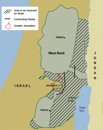 Kadima & The Alon Plan vs. HAMAS & 1967 Borders??: The Allon or 'Alon' Plan was the 1967 scheme to annex a big swath of the West Bank. The dimensions are roughly laid out in this map from IsraeliPalestinianProCon.org. Now, apparently HAMAS is advocating the full 1967 borders as a basis for a truce. We will see how horrible the U.S. media makes such an argument sound.
Ariel Sharon's basic strategy was to solidify the Allon Plan and make it palatable to the American public, or at least get Congress to swallow it.
Hamas hints at truce in return for '67 borders
By Arnon Regular, Haaretz Correspondent and Haaretz Service
A long-term truce (hudna) with Israel is possible if Israel retreats to its pre-1967 borders and releases Palestinian prisoners, Hamas leader Mahmoud Zahar told CNN on Monday.
"We can expect to establish our independent state on the area before '67 and we can give a long-term hudna," Zahar told CNN's Wolf Blitzer.
Zahar laid out a series of conditions that he said could lead to years of co-existence alongside Israel. He said that if Israel "is ready to give us the national demand to withdraw from the occupied area [in] '67; to release our detainees; to stop their aggression; to make geographic link between Gaza Strip and West Bank, at that time, with assurance from other sides, we are going to accept to establish our independent state at that time, and give us one or two, 10, 15 years time in order to see what is the real intention of Israel after that."
Asked about Hamas' call for Israel's destruction, Zahar would not say whether that remains the goal. "We are not speaking about the future, we are speaking now," he said. Zahar argued that Israel has no true intention of accepting a Palestinian state, despite international agreements including the Road Map for Middle East peace.
Until Israel says what its final borders will be, Hamas will not say whether it will ever recognize Israel, Zahar said. "If Israel is ready to tell the people what is the official border, after that we are going to answer this question." Asked whether Hamas would renounce terrorism, Zahar argued that the definition of terrorism is unfair.
Israel is "killing people and children and removing our agricultural system -- this is terrorism," he said. "When the Americans [are] attacking the Arabic and Islamic world whether in Afghanistan and Iraq and they are playing a dirty game in Lebanon, this is terrorism." He described Hamas as a "liberating movement."
.....Hamas will not oppose Palestinian Authority Chairman Mahmoud Abbas if the latter decides to negotiate with Israel, the deputy head of Hamas' political bureau, Musa Abu-Marzouk, said Sunday.
Ok then, those are promising signs from a shadowy group (a pretty good history from MidEastWeb) that is suddenly blinking in the limelight. Not sure what the hell it means, but I don't know if they do either.
Lots of things are happening. Former CIA dude Pat Lang reacts to the election with typical CIA sarcasm. Hamas leader: 'Palestinian army' possible. Haaretz: Umm Mohammed talks politics By Amira Hass, "Hamas deputy says resistance to 'occupation' will continue". "Turning from Terror / A Green Dawn is on the rise." "Hamas' next step / In search of a united force".
The Observer | Focus | The Hamas revolution:
'East Jerusalem,' he intoned dryly from the podium, 'six seats.' And with each successful candidate he named, he listed their party. 'Change and Reform,' he read out first, the banner under which Hamas, an organisation better known for its dozens of suicide attacks against Israel, was standing. And again: 'Change and Reform'. And yet again. Four times out of six.
He turned to Hebron, a clean nine-seat sweep for Hamas. So he continued through Nablus, North Gaza, Tulkarm, Jenin and Gaza City. Even the largely Christian area of Bethlehem saw two of its four seats fall to Hamas. Among the Gaza winners was Um Nidal, also called Mariam Farah, a gun-toting woman known as the 'Mother of Martyrs' who ordered three of her sons to their deaths as suicide bombers.
As Hanna Nasser spoke, mentally the crowded room coloured in a map of Gaza and the West Bank, from the flat and crowded slums of Gaza's Khan Younis to the hilly cities of the West Bank, painting it in Hamas green. Only wild and dangerous Rafah at Gaza's southern tip voted unanimously for the old order.
With each result history was gyrating more wildly about the auditorium with its stone-faced electoral commission members sitting bleakly in a row. Everything had been transformed.
Observations from Gilbert Achear on JuanCole.com:
4. The irresistible rise of Ariel Sharon to the helm of the Israeli state resulted from his September 2000 provocation that ignited the "Second Intifada" -- an uprising that because of its militarization lacked the most positive features of the popular dynamics of the first Intifada. A PA that, by its very nature, could definitely not rely on mass self-organization and chose the only way of struggle it was familiar with, fostered this militarization. Sharon's rise was also a product of the dead-end reached by the Oslo process: the clash between the Zionist interpretation of the Oslo frame -- an updated version of the 1967 "Alon Plan" by which Israel would relinquish the populated areas of the 1967 occupied territories to an Arab administration, while keeping colonized and militarized strategic chunks -- and the PA's minimal requirements of recovering all, or nearly all the territories occupied in 1967, without which it knew it would lose its remaining clout with the Palestinian population. The electoral victory of war criminal Ariel Sharon in February 2001 -- an event as much "shocking" as the electoral victory of Hamas, at the very least -- inevitably reinforced the Islamic fundamentalist movement, his counterpart in terms of radicalization of stance against the backdrop of a still-born historic compromise. All of this was greatly propelled, of course, by the (very resistible, but unresisted) accession to power of George W. Bush, and the unleashing of his wildest imperial ambitions thanks to the attacks on September 11, 2001.
5. Ariel Sharon played skillfully on the dialectics between himself and his Palestinian true opposite number, Hamas. His calculation was simple: in order to be able to carry through unilaterally his own hard-line version of the Zionist interpretation of a "settlement" with the Palestinians, he needed two conditions: a) to minimize international pressure upon him -- or rather U.S. pressure, the only one that really matters to Israel; and b) to demonstrate that there is no Palestinian leadership with which Israel could "do business." For this, he needed to emphasize the weakness and unreliability of the PA by fanning the expansion of the Islamic fundamentalist movement, knowing that the latter was anathema to the Western states. Thus every time there was some kind of truce, negotiated by the PA with the Islamic organizations, Sharon's government would resort to an "extrajudicial execution" -- in plain language, an assassination -- in order to provoke these organizations into retaliation by the means they specialized in: suicide attacks, their "F-16s" as they say. This had the double advantage of stressing the PA inability to control the Palestinian population, and enhancing Sharon's own popularity in Israel. The truth of the matter is that the electoral victory of Hamas is the outcome that Sharon's strategy was very obviously seeking, as many astute observers did not fail to point out.
Haaretz has lots to mull over. I think "hostile rabble" is a tad racist, but that's what appears to be on their minds right now. Analysis: Wave of democracy pits Israel against 'Arab street':
By Aluf Benn, Haaretz Correspondent
The Palestinian Authority election marks the beginning of a new period in the region that could be termed "the era of the masses." Henceforth Israel will have to factor into its foreign policy something it has always ignored - Arab public opinion.
Israel has always based its regional policy on arrangements and terror-balances with the Arab dictators. They understood force and Israel could do business with them. Their authority was seen as a barrier protecting Israel from the rage of the hostile rabble in the "Arab street." That was the basis of the peace agreements with Egypt and Jordan, Yasser Arafat and his heirs and the game rules vis-a-vis Syria and Lebanon.
But those days are over. The democratization process that U.S. President George Bush has triggered and the open debate promoted by Arab satellite networks are causing the old frameworks to crumble. The mass demonstrations that led to the Syrians being driven from Lebanon, the elections in Iraq and those in the territories are merely the beginning. As far as Israel is concerned, the worst stage will come when the democratic wave washes over Jordan, its strategic ally; Egypt with its modern army and F-16 squadrons, and Syria and its Scud and chemical warhead stores.
The mess continues. Shadowy times ahead.
HAMAS Charter, Article 17:
Therefore, you can see [the Zionists] making consistent efforts [in that direction] by way of publicity and movies, curricula of education and culture, using as their intermediaries their craftsmen who are part of the various Zionist Organizations which take on all sorts of names and shapes such as: the Freemasons, Rotary Clubs, gangs of spies and the like. All of them are nests of saboteurs and sabotage. Those Zionist organizations control vast material resources, which enable them to fulfill their mission amidst societies, with a view of implementing Zionist goals and sowing the concepts that can be of use to the enemy. Those organizations operate [in a situation] where Islam is absent from the arena and alienated from its people. Thus, the Muslims must fulfill their duty in confronting the schemes of those saboteurs. When Islam will retake possession of [the means to] guide the life [of the Muslims], it will wipe out those organizations which are the enemy of humanity and Islam.
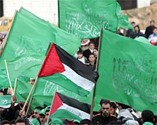 Another fine mess we're in today. Rotary Clubs are marked for death. The Palestinian militant organization HAMAS unexpectedly finds itself in command of the Palestinian Authority, whatever that means these days. Meanwhile, Ariel Sharon lies in a vegetative state, and Israel's Kadima Party is essentially a political platform without any organization behind it.
So within the space of a few weeks, the leading political formations have shifted from Likud + Labor vs. Fatah, to a likely Kadima vs. HAMAS arrangement. No one saw this coming, from the Israeli intelligence services to the high officials of the Terrorist Organizations in Damascus. Only this act of supreme petulance from the Palestinian public could make everyone else look so stupid.
HAMAS was expecting to play the minority spoiler to Fatah. Instead, it's very much like in 1977, when the Likud Party unexpectedly took Israel, even though Likud seemed like an unsavory band with a history of armed gangsterism, and a maximalist view of controlling the Holy Land, as this brilliant piece from Haaretz, "Introducing HAMAS - the New Likud" clearly explains. (In less than a year, Likud PM Menachem Begin cut a Peace Treaty with Egypt and got out of the Sinai. So hardliners can be flexible, let's please remember).
Let us also remember that Israel actually helped build up HAMAS as an anti-Marxist, anti-PLO alternative within the territories in the 1980s. Talk about your golems run amok. In 1978, Begin approved Sheik Yassin's charter that started the HAMAS seed organization Mujama. Raimondo reflects on the irony of this. Robert Dreyfuss explains in this Podcast, as well as Richard Sale in UPI:
"Israel and Hamas may currently be locked in deadly combat, but, according to several current and former U.S. intelligence officials, beginning in the late 1970s, Tel Aviv gave direct and indirect financial aid to Hamas over a period of years. Israel 'aided Hamas directly – the Israelis wanted to use it as a counterbalance to the PLO (Palestinian Liberation Organization),' said Tony Cordesman, Middle East analyst for the Center for Strategic [and International] Studies. Israel's support for Hamas 'was a direct attempt to divide and dilute support for a strong, secular PLO by using a competing religious alternative,' said a former senior CIA official."
[.....]
Israel was certainly funding the group at that time [in the 1980s]. One U.S. intelligence source who asked not to be named said that not only was Hamas being funded as a "counterweight" to the PLO, Israeli aid had another purpose: "To help identify and channel towards Israeli agents Hamas members who were dangerous terrorists."
[.....]
Violent acts of terrorism became the central tenet, and Hamas, unlike the PLO, was unwilling to compromise in any way with Israel, refusing to acquiesce in its very existence.
But even then, some in Israel saw some benefits to be had in trying to continue to give Hamas support: "The thinking on the part of some of the right-wing Israeli establishment was that Hamas and the others, if they gained control, would refuse to have any part of the peace process and would torpedo any agreements put in place," said a U.S. government official who asked not to be named.
(Does this remind anyone of the CIA-ISI-Taliban connection? Oh wait, it's immoral and paranoid to suggest that intelligence agencies set up Islamic militant organizations. Sorry.)
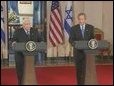 Well, thanks a lot, George W. Bush. You thought that you could ignore the substance of the Palestinians' calls for a real state in the West Bank and Gaza, you thought that when the United States officially approved of "Israeli population centers" in the West Bank, it was a really fucking shrewd move.
Here's some advice, Mr. President. Fire your advisers. They're all a bunch of fucking morons who have turned most of the world against you. I don't know how much of this is really your fault, but I know that so many of our problems come from their staggering incompetence, and fanatical, ignorant and militant racism towards so much of the world (especially Arabs).
And now, it turns out to be a huge surprise that people in the Middle East will vote for well-organized hard-core theocrats when they get the chance. That's Democracy for you. The Muslim Brotherhood, the root organization from which HAMAS sprang, is now the most powerful opposition in Egypt (with 88 of 454 Parliament seats - and the potential for many more). Hezbollah is decidedly successful in Lebanon.
Lo and behold, in Iraq, the Shiite fundamentalists turned out to be the best organized. Who would have thought that groups like SCIRI and the Dawa Party would be able to marginalize everyone else, and seize control of Iraq's security ministries? Now southern Iraq will effectively be a satellite state of Iran. It was so goddamn predictable that this would happen, and now it has.
But I respect the Israeli public right now. After the madness of the last few years, they are feeling pretty damn raw about life, but according to the polls, they actually seem a lot more sane than the Cheney Administration. Right now, it appears that Kadima would get about 44 seats in the Knesset, Labor about 21, and Netanyahu's Likud around 13. This shows that Netanyahu's dangerous fanaticism has been discredited in Israel, and that's great news. On the other hand, here in the U.S., Netanyahu gets to pimp his racial chauvinism, on, for example, MSNBC's Hardball, saying disgusting things about his future plans:
If we make additional unilateral retreats, they'll simply fire rockets into our airports and Khassam projectiles into our cities and so on. So I think we have to establish a security belt around the Palestinian areas. This doesn't annex any population [LAND?! -Dan], it doesn't do anything except provide for stability and security, which is the first foundation of peace.
...... [MATTHEWS:] And then [Sharon] said the demographic situation, whereby there's so many more Arab people living within the territory under Israeli control that Israel had to avoid becoming a colonizer by stepping back and only claiming land that it where the Jewish people were in the majority. How's your view different?
NETANYAHU: Well no, we didn't disagree on that and I don't want to go back into the Palestinian towns, I don't want to go back to Gaza and I certainly don't want to go back into the Palestinian cities in the West Bank.
I have no intention whatsoever—we won't do that. But the territories that are in dispute are largely empty of Palestinians, or anybody, for that matter. [WHAT A SON OF A BITCH -Dan] Yet they could be used as launching ground for more Hamas terrorist attacks against us.
So I say first of all, provide a security cordon of these largely empty territories. Don't annex and don't re-enter the Palestinian-populated areas. Leave that to the Palestinians.
But build, if you will, a real defensive perimeter around the Palestinians. Tell them that they will be rewarded for peace-making and they will be punished for terror-making. I think that's a pretty sound policy. I practice it as prime minister and I brought terror to its lowest level in the last decade. It wasn't because the Hamas and Arafat became Zionists, believe me, Chris. It was because this policy of strength and deterrence works to restore hope and peace.
Madness. In Israel they don't buy his bullshit anymore, but on American cable news, he's a goddamned patriot. Insane. And of course Matthews doesn't call him on it. Netanyahu has to sell it here because the rest of Israel doesn't trust his shady ass one bit.
"Strength and Deterrence" is pretty much equal to the old neoconservative advice for Netanyahu, telling America that "peace through strength" is the way to victory, as Richard Perle, Douglas Feith and David Wurmser advised Netanyahu in the famous 1996 neo-con manifesto, "A Clean Break: A New Strategy for Securing the Realm", which suddenly seems more relevant than ever. Oh, by the way, let me put what Feith wrote in June 1996, according to the "Peace through Strength" Neo-con Center for Security Policy:
Likud's position on settlements reflects the peace-through-strength principle. The diplomacy of Israel's outgoing Labor Party government confirmed a lesson with long roots in Zionist history: Israel is unlikely over time to retain control over pieces of territory unless its people actually live there. Supporters of settlements reason: If Israelis do not settle an area in the territories, Israel will eventually be forced to relinquish it. If it relinquishes the territories generally, its security will be undermined and peace will therefore not be possible.
(So that was the intellectual foundation of the key architect of the Iraq war. Feith also made lots of money as a lawyer for Israeli arms dealers with his settler/partner Marc Zell, but that's a tangent. The Occupation is profitable for some interests — a crucial point always missed)
I find it amazing that now Bush says he won't talk to the Palestinians until they swear off violence. We should say that we won't talk to the French until they ban croissants, won't talk to the Afghans until they swear off narcotics, won't talk to Wisconsin until they destroy the cheese, won't talk to the Pentagon until it swears off corrupt contracts, won't talk to the Chinese until they quit trading goods, won't talk to Iran until they stop being Iran, won't talk to the Israelis until they swear off building their FUCKING INSANE settlements. Sorry, why the fuck don't people get it?
George W. Bush, you need to actually be a Man for once in your life, and go talk to these people personally. Get everyone in a tent in the desert, lock it down and give everyone tea until there's a peace deal. Why the fuck is it considered so brave to refuse to talk to people, like some pissy teenager?
I would like to throw in an additional FUCK YOU to Bob Shrum, who bears a lot of personal responsibility for this disaster. On the same Hardball episode, Shrum, who was John Kerry's senior campaign director, offered the following enlightened bit:
Well I think we have to be realists about this. I mean, democracy has led in the Palestinian territories now to the rise of Hamas. And I thought Benjamin Netanyahu, who was on your show just a few minutes ago, did a very good job of giving his basic stump speech, which is “I told you so, I told you so, I told you so.”
I think you're going to see the Kadima party of Sharon move to the right, there's a very real prospect that Netanyahu is going to win [wrong yet again, you idiot. -Dan] because Israelis are going to say, “Why in the world should we negotiate with or make any kind of settlement with people who only want to negotiate our destruction? Why should we turn over territory to people who are going to let Hamas use it as a base from which to launch terrorist attacks?”
I will always bitterly remember the day in 2004 that Bush declared that "Israeli population centers" in the West Bank were a fabulous fucking idea. My bitterness doubled when the Kerry campaign chimed in, "Oh yeah, that's a great fucking idea," because Bob Shrum is too much of a racist to understand that the settlements are a principal source of hatred towards America in the Middle East. And too much of a coward to even dare trying to have Kerry explain this to the American people.
 And so now the flyers of the green flags have seized the territories through legitimate democratic methods.
Way to go, you geopolitical geniuses, you guys are so fucking smart. We invaded Iraq to make Iran more powerful, we paid Israel to build settlements to make apocalyptic American Christian Zionist fundamentalists and their fanatical Likud friends happy. Now we are broke, the U.S. Army is wedged between Kurds, Sunnis and Shi'a as low-level ethnic cleansing breaks out, the Iranians are happily building the Bomb, our Afghan allies are pumping out most of the world's heroin, and everyone in the world hates us.
Thanks, Washington. Obviously no one is as smart as the War Party.
See if you can pick up the historical metaphor. Around and around we go. (Thucydides, by the way, is considered 'the father of history'. --Dan)
In the winter [416-15 BC] the Athenians resolved to set sail again against Sicily with larger forces... They were for the most part ignorant of the size of the island and its inhabitants, both Hellenic and native, and they did not realize that they were taking on a war of almost the same magnitude as their war against the Peleponnesians...
Nicias had not wanted to be chosen for the command; his view was that the city was making a mistake, and on a slight pretext which looked reasonable, was in fact intending to conquer the whole of Sicily—a very considerable undertaking.
So he came forward to speak, hoping to make the Athenians change their minds: "...I think that we ought not to give such hasty consideration to so important a matter and on the credit of foreigners get drawn into a war that does not concern us... [T]his is the wrong time for such adventures and the objects of your ambition [gold, treasure and military bases] are not to be gained easily. ..."
"[E]ven if we did conquer the Sicilians, there are so many of them and they live so far off that it would be very difficult to govern them... The right thing is that we should spend our new gains at home and on ourselves instead of on these exiles who are begging for assistance and whose interest it is to tell lies and make us believe them ... who leave all the dangers to others and, if they are successful, will not be properly grateful, while if they fail in any way they will involved their friends in their own ruin. ..."
When the news reached Athens [of defeat], for a long time people would not believe it. ... And when they did recognize the facts, they turned against the public speakers who had favored the expedition ... and also became angry with the prophets and soothsayers and all who had, by various methods of divination, encouraged them to believe that they would conquer Sicily.
--Thucydides, The Peloponnesian War, Books VII and VIII
This quote was in John K. Cooley's recent book, "An Alliance Against Babylon: The U.S., Israel and Iraq
More later. I have to run around and do a lot of stuff today.
Palestinian militants say truce ends at midnight
By Arnon Regular and Nir Hasson, Haaretz Correspondents, Haaretz Service and News Agencies
Militant Palestinian factions said on Saturday that as of New Year's Day they would no longer be bound by a truce that has brought the most peaceful spell since the start of the five-year-old uprising.
Meanwhile, Israel Air Force fire killed two Palestinians in the no-go area of the northern Gaza Strip on Saturday night, according to Palestinian security sources.
Haaretz: A waiting game
By Amir Oren
According to his strategic adviser, Eival Giladi, Sharon's time frame for a permanent settlement is approximately 2025: only 19 years from Sunday. The new year, 2006, is already shaping up as a wasted one, a year of treading water, unless a different Palestinian leadership arises, replacing Mahmoud Abbas (Abu Mazen) or displacing him. Absent such a leadership, the terrorism will continue, including the launching of Qassams. And if no new leadership emerges, a generation will pass before new leaders appear.
The cruel choice that is becoming constantly clearer is between Hamas and Marwan Barghouti. Anyone who does not want to see Hamas in power will have to accept Barghouti as the prime minister of a Palestinian government until the end of the Abbas presidency, and accept him as president afterward.
........
At the beginning of the month, a senior General Staff officer was invited to represent Israel in a joint course of about 30 generals from the Western armies that are mired in Iraq and Afghanistan. The topic under discussion was urban combat against insurgents and terrorist and guerrilla elements. At the meeting in which lessons were drawn, the IDF representative agreed with the accepted view that dealt with the importance of intelligence and command-and-control systems, but in his view the true challenge facing the governments, armies and intelligence agencies of the advanced countries is more conceptual than operational or technological. The gist of the challenge involves shattering the regular format of military behavior, to the point where terrorist groups will be unable to predict the behavior of the state system they are facing.
.......
The officers and Shin Bet personnel who always aspire "to close a circle" - to see, identify and shoot before the target disappears - know that the substantive difficulty does not lie in their sphere. With the Palestinians - and with the Lebanese, too, until the Syrian and Iranian influence on them is annulled - there is no way to close a political circle of give-and-take, agreement, upholding and domestic enforcement.
Meanwhile In Iraq... the Kurds seem to be preparing to make a move in 2006.... We were told that Ambassador Negroponte would bring some of that 'Salvadoran Option' death squad tactics to Iraq. And indeed, he did with his practiced, masterful skill from the salad days in Honduras. Fortunately, many of the new Death squads / 'freedom fighters of free Iraq' were trained (and are still paid) from Iran, lending a certain Persian texture for those now chafing under the Badr Corps and other various militia.
Turning (much of) Iraq into something of an Iranian satellite state was an obvious effect of an invasion that anyone could see coming. Why the hell was that in vital American interests? Tell me, you hawks, what does that get us?
US-Shiite Struggle Could Spin out of Control
Analysis by Gareth Porter*
WASHINGTON, Dec 26 (IPS) - The George W. Bush administration has embarked on a new effort to pressure Iraq's militant Shiite party leaders to give up their control over internal security affairs that could lead the Shiites to reconsider their reliance on U.S. troops.
.....
For Shiite party leaders, U.S. pressure to share state power with secular or Sunni representatives -- especially on internal security -- touches a raw nerve. They regard control over the organs of state repression as the key to maintaining a Shiite regime in power.
If Abdul Aziz al-Hakin and other SCIRI leaders feel they have to choose between relying on U.S. military protection and the security of their regime, they are likely to choose the latter. They could counter U.S. pressures by warning they will demand a timetable for withdrawal of U.S. troops if the United States continues to interfere in such politically sensitive matters.
That would not be an entirely idle threat. Last October, Ayatollah Ali al-Sistani was reported by associates to be considering such a demand. The implication of calling for a relatively rapid U.S. withdrawal would be that the Shiite leaders would turn to Iran for overt financial and even military assistance, in line with their fundamental foreign policy orientation.
The Bush administration's strategy of pressure on Shiite leaders over the issue of control over state security organs thus has the potential to spin out of control and cause another policy disaster in Iraq and the entire Middle East.
Kurds in Iraqi army proclaim loyalty to militia
By Tom Lasseter
Knight Ridder Newspapers
KIRKUK, Iraq - Kurdish leaders have inserted more than 10,000 of their militia members into Iraqi army divisions in northern Iraq to lay the groundwork to swarm south, seize the oil-rich city of Kirkuk and possibly half of Mosul, Iraq's third-largest city, and secure the borders of an independent Kurdistan.
Five days of interviews with Kurdish leaders and troops in the region suggest that U.S. plans to bring unity to Iraq before withdrawing American troops by training and equipping a national army aren't gaining traction. Instead, some troops that are formally under U.S. and Iraqi national command are preparing to protect territory and ethnic and religious interests in the event of Iraq's fragmentation, which many of them think is inevitable.
CSM:Iraq's micro parties could play key role
Shiites and Kurds look to be big winners of this month's vote, but tiny parties could emerge as power brokers.
NY Times: G.I.'s to increase U.S. Supervision of Iraqi Police
The increase is seen as a way to exert firmer control over the commando units, which are suspected of carrying out widespread atrocities against civilians in Sunni Arab neighborhoods. Human rights groups here say the units may be guilty of murdering and torturing hundreds, and possibly thousands, of Sunni Arab men of military age.
........
American officials say it is unclear whom the units are taking orders from, the ministry or militia commanders. The minister of the interior, Bayan Jabr, is a senior member of the Badr Brigade.
Mr. Jabr is fighting the American plan to place more advisers in the Iraqi commando units, according to the senior American commander. "We'd know exactly what they are doing, and we'd have some more control," the commander said.
Momentarily, a summing of the year 2005, such as it was.
 This was an excellent holiday weekend for me, caught up with lots of people, found out who is far-flung and to where. I will not gossip about the details, but I feel like I'm properly in touch with most of my circles of friends nowadays, which makes me feel much more comfortable in my skin.
Drunk fun with the office copy machine -- who has to fix it afterwards?
NATIONAL JOURNAL: Key Bush Intelligence Briefing Kept From Hill Panel
Ten days after the September 11, 2001, terrorist attacks on the World Trade Center and the Pentagon, President Bush was told in a highly classified briefing that the U.S. intelligence community had no evidence linking the Iraqi regime of Saddam Hussein to the attacks and that there was scant credible evidence that Iraq had any significant collaborative ties with Al Qaeda, according to government records and current and former officials with firsthand knowledge of the matter.
The hit parade continues. More via Booman Tribune and DKos. The details are ugly and incriminating.
Tony Blair is going to pieces.
Smokin in the coal mine: Peter Gartrell wrote a story carried in quite a few papers about a program to get coal miners to quit smoking. Their lungs must be in terrible shape anyway...
Air Power in Iraq: Sudden talk that the US will withdraw ground forces and perhaps grant Iraqis the power to call in airstrikes, as Sy Hersh put in the New Yorker put it (as covered by the Guardian, Stygius, DailyKos - with terrifying bits from a CNN Hersh interview, and as always Juan Cole). Bush is having some messianic visions again, but hey, at least Ahmadi-Nejad is too.
More headline chunks: US says Iraq insurgents can be 'part of solution': US 're-evaluates' its position after initially expressed dissatisfaction with Cairo meeting statement 'right of people to resistance'. Juan Cole talks about what the insurgents told the CIA in Cairo.
In the broader context, Bush really did want al-Jazeera gone when he purportedly suggested bombing it. Crazed old neo-con Frank Gaffney approves of bombing al Jazeera. And Michael Jackson blames the Jews for his money woes.
Interesting site: DefenseTech. With regards to the Syria thing, UN chief: Arab leaders worried Syria could become the next Iraq. 19 different UAVs operate in Iraq, but how many can solve the situation? On the plus side, a UAV to deliver medical supplies has been invented.
Zarqawi-Goldstein, part 239: the great terrorist is a cartoon character. It was doubted last year. And Marshall puts a bit in on that. Less skeptical, the Zarqawi dilemma.
The Pentagon said that White Phosphorus was a chemical weapon, when Saddam was using it. How ironic. (this is the declassified doc) JawaReport on Iraq Gun Porn: Which Guns Suck, Which Guns Rock. The Rummy-Blitzer exchange is amazing.
This is sort of funny. The Weekly Standard is going to save the day and prove that Saddam had WMDs and was in fact, Osama's boyfriend. Good work. Daou gives us the ten major pro-war fallacies in case we forgot.
For the obsessively detail oriented, Lesser Neocons of L'Affaire Plame (featuring our man 'Clean Break' Wurmser). Fortunately I merely skimmed it. Raimondo cackles about the Feast of Scandal for Thanksgiving.
Raimondo also pokes around the waters of anti-Semitism that apparently are now getting somehow spun towards Chris Matthews -- as an excuse for Scooter leaking him Valerie Plame's name. I am not sure this makes sense. However, Raimondo adds that Wilson once said the following:
"The real agenda in all of this of course, was to redraw the political map of the Middle East. Now that is code, whether you like it or not, but it is code for putting into place the strategy memorandum that was done by Richard Perle and his study group in the mid-90's which was called, 'A Clean Break: A New Strategy for the Realm.' And what it is – cut to the quick – is if you take out some of these countries, some of these governments that are antagonistic to Israel then you provide the Israeli government with greater wherewithal to impose its terms and conditions upon the Palestinian people – whatever those terms and conditions might be. In other words, the road to peace in the Middle East goes through Baghdad and Damascus. Maybe Tehran. And maybe Cairo and maybe Tripoli if these guys actually have their way. Rather than going through Jerusalem."
So the anti-Clean Break Conspiracy was also anti-Semitic, which legitimatized leaking Plame's name?
Crazed Mercenaries and their video cameras: There is apparently some creepy video of Iraqi civilian cars getting blown up by the good folks at Aegis Defence Services, a privatized military firm set up Lt Col Tim Spicer -- the former director of Sandline International, a defunct company that used to sell arms to the guys in Sierra Leone, along the shadier side of geopolitics. AegisIraq.co.uk was the site the video was on. (CSM on the story)
There is of course pretty much no congressional oversight of the vast mercenary army in Iraq. (more on Aegis, Sandline and Executive Outcomes - here's even more!) The more one thinks about private armies, the more it seems like an amazingly self-reinforcing arrangement. Capitalism-squared, you might say.
Kurt Vonnegut said that terrorist die for their own self-respect. That is fairly insightful, but of course draws flack from much wiser keyboard commandos.
"What George Bush and his gang did not realise was that people fight back. Peace wasn't restored in Vietnam until we got kicked out. Everything's quiet there now."
There's a long pause before Vonnegut speaks again: "It is sweet and noble - sweet and honourable I guess it is - to die for what you believe in."
....I ask one more question: "But terrorists believe in twisted religious things, don't they? So surely that can't be right?"
"Well, they're dying for their own self-respect," Vonnegut fires back. "It's a terrible thing to deprive someone of their self-respect. It's [like] your culture is nothing, your race is nothing, you're nothing."
There's another long pause and Vonnegut's eyes suggest his mind has wandered off somewhere. Then, suddenly, he turns back to me and says: "It must be an amazing high."
The CIA wants Dr. Phil's tactics for Guantanamo. Well, maybe it's an improvement.
The UK Ministry of Defense complains that farmers are shining lights at their Apache helicopters around Dorset -- and they think this could could cause a crash. Huh.
Iran Spring?? (Foreign Policy) Realists Tighten Grip as Talks Open with Iran by Jim Lobe. Why bother getting into the gory details? But I will say that Lobe is really an excellent source on this stuff & the neo-cons. Basically the point is that the neo-cons have been discredited, and the 'realists' are getting the upper hand finally.
Washington's growing reliance on and support for regional diplomacy marks a serious setback to neo-conservatives who, long before the Iraq war, had championed the unilateral imposition of a Pax Americana in the Middle East that would put an end to what in their view constituted the chief threats to Israel's security -- Arab nationalism and Iranian theocracy.
Now, two and a half years after invading Iraq to put that peace into place, the administration finds itself seeking the support of both forces, just as the realists had warned.
Check out this huge statement that Iran purchased in the NY Times. In particular that they haven't started a war of aggression against their neighbors in 250 years. I think that the way that various parties have managed the ethnic groups on the periphery was not exactly polite over that time... either way the demonization will continue.
BBC: Doubts grow over US Afghan strategy.
Internet hug transmission: Scientists in Singapore are developing a way to 'transmit hugs' over the Internet through vibrating jackets.
The Drunkard's Guide to Poker. What if hackers ruled the world? New Firefox. Something in the ocean goes Boing.
Big Bang in Israel: It's very big news that Sharon has decided to quit the Likud Party and go for elections. Alongside this, there is a younger leftist in charge of the Labor Party now, so suddenly the meanest part of the Israeli right-wing -- the faction that opposed even the Gaza pullout -- will likely find itself without any power in the next Israeli government.
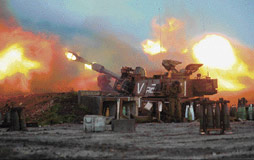 Let me press all these Haaretz headlines together into one mush. 11 Israelis injured, at least 4 Hezbollah gunmen killed in failed kidnap attempt. Hezbollah releases video footage of [last] Monday's fighting. PM to offer PA independence for security. Eyeing Likud leadership, Mofaz, Shalom lambaste Netanyahu. Israel maintains its strategic advantage, says Jaffee Center. Poll: 25% of settlers east of fence prepared to leave homes.
 Oh Sharon: graphic from excellent Haartez article. "Sharon knows the Likud was not a done deal." Palestinians hopeful after political volcano. Analysis / Where politics and security meet: A very interesting bit about when Israeli internal politics and the Hezbollah thing collide in real-time. Sharon aides: PM planning far-reaching diplomatic initiatives. Ariel Sharon's new faction is a one-term party.
Settlers throw stones at Palestinian homes in Hebron. Palestinians reported that settlers cut down 200 olive trees near Nablus. Nothing quite like olive tree-based warfare.
In Israel, it's the end of the Ashkenazi era? Peretz is a Sephardi. But this I thought most interesting:
At the same time, will the end of the era of generals arrive, as well? Will the time come when the top political rank does not originate in the security forces? If the conflict with the Palestinians were to end, the entire agenda would change, and the relative advantage of the generals would be eliminated. Generals would no longer be able to move so easily between the highest echelons of the army, Mossad and Shin Bet, to the political leadership.
This is one of the reasons why the generals are in no rush to end the conflict. They know that one of the most powerful factors influencing the voters is fear. Which is why they try to frighten, to pump up the volume on threats, to brandish the Iranian missiles, to carry out targeted assassinations and to always, but always, keep the finger close to the trigger. Conversely, a civilian leader does not view the other side through the gunsight, and his chances of resolving the conflict are therefore better.
Private prisons are coming to Israel. What could go wrong? The article notes that private prisons are second only to America's high tech sector as a growth industry. A parallel thought:
"Private prisons are not the only reason for this increase, but there is no doubt that their lobbying activity is one of the reasons for the increasing stringency of punishment and the increase in the number of prisoners," says attorney Aviv Wasserman, the head of the human rights division at the Academic College of Law in Ramat Gan, whose petition to the High Court of Justice against the decision to establish a private prison here is still pending.
The UK's Foreign Office and the EU leaked a document harshly critical of expanding Jewish settlements in the Jerusalem area. The EU heads of mission around there believe that all these settlements could radicalize local Palestinians, and indeed likely cause more terrorism to occur. Yet another logical reason that settlements are totally insane. Israel calls the Foreign Office 'unrelentingly pro-Palestinian.' The document, which reflects the views of many European diplomats, specifically bears a lot on the E1 Ma'ale Adumim settlement that I detailed here a while ago.
Russian missiles: You have to love the Russians and their missiles. They have made a new one that can change around in midflight and deploy decoys. Nice.
Wow, Cunningham really knew how to take bribes with gusto. Lots of spreading probes.
Banning foreigners that the Bush Administration doesn't like: Believe it or not, a huge proportion of America's most valuable inhabitants were not born here, nor did they march in an acceptably quiet lock-step with the Nixon, Ford or Reagan Administrations when they got here.
Indeed, a common theme of American history has been blaming foreigners for their weird and subversive politics poisoning our fair landscape, so now we must understand why it was a terrible idea to let the Jews, Italians and Irish in here in the first place.
Nowadays, the Muslims threaten to pray at weird times of day here, and lecture university students on ancient battles and esoteric organizations like the Cult of the Assassins. THIS SHALL NOT STAND. And when the Irish, Hebrews, Muslims, Italians, Chinese and the Cajun French and the Koreans and the Mexicans are all finally gone, we will look around at a desolate land and wonder where all the good restaurants went.
So I heartily approve that the US is banning academics and accusing them of supporting terrorism. If we do not maintain the purity of our precious bodily fluids, then the terrorists win.
(here's a link purporting an Assassin-Al Qaeda conspiracy link, at Rotten.com of all places! Ha! Oh wait, the Assassins were Shi'a, so it's nonsense - but the structure of the secret society is interesting. Nothing's True, everything is permitted :-) )
 I have to praise Clocky, the clock that randomly rolls away after you hit the snooze button, so you have to chase it down. I also have to praise the BRILLIANT crazy "talking bobblehead nodder Trading Spouses GOD WARRIOR!!" as sold on eBay - a small, talking statue replicating a crazed Christian fundamentalist mom from an episode. This got some major internet and media buzz and got bid up beyond $800!
Many people were shocked and disgusted with Marguerite's behavior on the show. Not me! I thought it was so hilarious and wonderful it inspired me to create a bobblehead in her likeness! She is now my favorite t.v. personality of all time. When judgement day comes, me and Marguerite will be fighting the demons and stabbing the jaws of gargoyles and the demonic "moon creatures"! Everything's unholy!
An interview with the Dude (the basis for the Big Lebowski) on bullz-eye.com. Really enjoyed this. In particular the part where he just keeps running into the Coen brothers at several parties, a coinsidence that inspires them to do the movie.
What happens when you combine Mario and Che for a T shirt? Genius.
In the interests of offending everyone, I'd like to present Al-Jazeerah.info's official list of Jews in the Media. It's quite a list, but they left off one of my new heroes, quasi-fictional Ninja Hollywood Agent Ari Gold! Its posting on the Muslim Public Affairs Committee UK site was headlined, "If Jews Can Be This Successful In The Media, Why The Hell Are Mosque Half Wits Not Teaching it!" There's plenty of room in the media for everyone...
SONY Rootkit followup: Sorry i forgot to mention that a virus - worm, rather - has already been found on the internet that exploits this horrible thing. See also Boston Globe.
The Grand Federalist Society conspiracy: David Cumming pointed out to me once that the Masons mostly just eat pancakes. A valuable insight. Meanwhile the FedSoc, as it should be called, has systematically eaten the government. More or less.
Old tidbit on Tracking Election Irregularities: Voting machines in Virginia were reported to malfunction as touchscreen votes for victorious Democrat Tim Kaine were seemingly diverted to Republican Jerry Kilgore.
Virginia televsion station WDBJ-TV reports voters in at least four different precincts "say their votes for Tim Kaine were not recorded or took several attempts to go through. They contend the electronic touch screens repeatedly indicated they were voting for Republican candidate Jerry Kilgore instead of registering their intended vote for his Democratic opponent Tim Kaine."
There were also voting machine problems in Ohio and California. Schwartzenegger himself was initially denied the vote as the system indicated he'd already voted. Wow.
A sweet old 500KB hard drive getting wheeled across a clean room. All right. Sorry I forgot where this link came from.
 ExplodingDog comic says it all. "I knew the answer in the beginning." The poor stick figure works through it now, too late -- the war was rationalized in terrible ways, turned now to mist. The righteous American stands alone, confused, as the world smolders with conflict, blood all around. The US has apparently introduced White Phosphorus chemical weapons into the arena of Iraq, apparently using them around Fallujah to kill targets and surrounding people:
White phosphorus results in painful chemical burn injuries. The resultant burn typically appears as a necrotic area with a yellowish color and characteristic garliclike odor. White phosphorus is highly lipid soluble and as such, is believed to have rapid dermal penetration once particles are embedded under the skin. Because of its enhanced lipid solubility, many have believed that these injuries result in delayed wound healing. This has not been well studied; therefore, all that can be stated is that white phosphorus burns represent a small subsegment of chemical burns, all of which typically result in delayed wound healing.
..... Phosphorus burns on the skin are deep and painful; a firm eschar is produced and is surrounded by vesiculation.
White Phosphorus shells apparently react with human flesh by sort of melting it, giving victims a carmelized, melted appearance while the clothes remain intact. There are reports that it's a developed Marine tactic, used in Fallujah.
The US Army itself admitted that it uses WP in Iraq, in their own "Field Artillery Magazine", as a DKos diarist pulled it together. The military said (PDF):
"WP [i.e., white phosphorus rounds] proved to be an effective and versatile munition. We used it for screening missions at two breeches and, later in the fight, as a potent psychological weapon against the insurgents in trench lines and spider holes when we could not get effects on them with HE. We fired 'shake and bake' missions at the insurgents, using WP to flush them out and HE to take them out."
When Paula Zahn introduced the exciting Suicide Bomber Woman Video the other day, they couldn't resist throwing in this horrible theatrical music, that kind of "Islamic Threat" theme, heavy with throbbing drums and synth strings, the stuff that keeps FOX News so jazzy and amusing. The thrill of the chase! Vicarious pursuit! Who can stop these Arabs before they come down the street!?
For some reason there are tornadoes ravaging the country today - the atmosphere is weird right now. Why are there so many Lockheed-Martin and Boeing feelgood promotional ads on CNN? What are they even selling?
"The End of News?" by Michael Massing - as rightwing dominance settles over much of the news landscape. This pretty much sums up the toxic information swamp we're in:
Through the Internet, commentators can channel criticism of the press to the general public faster and more efficiently than before. As became plain in the Swift Boat campaign against John Kerry, to cite one of many examples, an unscrupulous critic can spread exaggerated or erroneous claims instantaneously to thousands of people, who may, in turn, repeat them to millions more on talk radio programs, on cable television, or on more official "news" Web sites. This kind of recycled commentary has become all the more effective because it is aimed principally at a sector of the population that seldom if ever sees serious press coverage.
On the other hand, there's been this change in the political wind over the last month or so, with Libby's indictment, Harry Reid's recalcitrance -- forcing the long-suppressed investigation into the spoofed intelligence. It's been a treat to see Wolf Blitzer asking everyone about it, over and over, while Cafferty cackles. It seems the elite crew finally smell blood.
James Fallows runs through the basic points of the whole case. When every chattering head on TV claims "the Senate Intelligence report PROVES this intelligence manipulation never happened", and yet, that's pretty much their only firm point, it signals that a great many pillars of the pro-war case have finally been knocked away.
Another major defense of the war was the National Intelligence Estimate on October 1, 2002 that the CIA produced about Iraq - which they claim showed that the CIA and other intelligence agencies was dumb as anyone about the matter. There was a classified version that only a limited circle of politicians could read, and the unclassified version. The classified one had lots of things like "The State Dept thinks this WMD is not really certain", while the version that they deigned to permit Congress to read lacked the statements of doubt. Small catch. Lots of details on the NIE here and here.
RUMSFELD STRIKES BACK read the CNN title bar today, as he cited the Dems who'd talked about Iraq's threat in the past. He says that the decision to invade was based on the same stuff they had, they were all seeing, before 2000. He implies that the quality and quantity of information available to the Dems in 2002 and 2003 was the same as what the President saw, as 'everyone knew.' But even the Washington Post can't take that seriously anymore:
But Bush and his aides had access to much more voluminous intelligence information than did lawmakers, who were dependent on the administration to provide the material. And the commissions cited by officials, though concluding that the administration did not pressure intelligence analysts to change their conclusions, were not authorized to determine whether the administration exaggerated or distorted those conclusions.
Rummy even trotted out the Orwellian classic "Islamofascists: we just gots to kill 'em!"
Nothing quite as handy as merging political identities for a quick & lazy ethnic demonization -- see 'Judeo-bolshevik' for how these things work out.
They keep saying, "How dare we have this discussion now, when the war is still happening and the troops need moral support?" Well, three arguments:
First, the American public ought to see the difference in Iraq intelligence between what Democrats in Congress, Bush himself, the various intelligence agencies, and the shady guys around Cheney and Rumsfeld saw. The stuff from Chalabi should be on the public record, one piece at a time.
Second, because I believe that things were willfully manipulated (and aggressively defended when attacked - the Plame case a key symptom), the people who did that shit should lose their security clearances and go play golf with their devious friends. They don't have some intrinsic right to government paychecks, even if firing them would embarrass or fragment Bush's sad White House more than it has already. It has been widely said, especially in recent weeks, that people like Michael Ledeen were running around in 2002, helping move the specific Niger forgeries that scared the hell out of the American people. Some of this was dug up by Josh Marshall and Laura Rozen in "Iran Contra II?" Larry Franklin and the AIPAC scandal fold right into this stuff, as well.
Third, it is plenty patriotic to believe that the American people should pressure the government to have a realistic, honestly weighed and "not murderously insane" view of the world. The Bush Administration has no short-circuit to infallibility or the Wisdom of God. The embattled ranks of the U.S. military need to know that the pencil-pushers in DC will actually have to pay a price for their nonsense, and their evasion of disasters like the torture policy. The blame here resides near the top of the chain of command -- we have to help out the lower rungs by getting them out of the system. The armed forces have to know that we are going to protect them from being forced to commit such terrible acts as torture.
From an article in the Miami Herald, Leonard Pitts:
In the name of fighting terror, we have terrorized, and in the name of defending our values, we have betrayed them. We have imprisoned Muslims in America and refused to say if we had them, why we had them, or even to provide them attorneys. We have passed laws making it easier for government to snoop into what you read, who you talk to, where you go. We have equated dissent with lack of patriotism, disagreement with treason. And we have tortured.
Meanwhile, Lindsey Graham attempts to suspend Habeus Corpus for people detained as terrorist suspects. (If you permit yourself to believe that they're all known, proven terrorists, well, that just isn't true of any jail or shadow detention network - sorry)
Fortunately there are lots of military veteran Democrats, many from Iraq, who are getting into the elections less than 12 months from now. While I can't demand their politics align with my own perfectly, they'd be a hell of a lot better than the chickenhawks at understanding the terrible price of war and violence (as well as treating veterans decently).
The blowback against the Right is reaching far and wide.
Jordan bombing: Juan Cole reflects on the death of Moustapha Akkad, a Syrian movie producer who was involved with the Halloween movies, among others. Akkad was on track to produce a film about Saladin, but now it won't happen:
The guerrilla war in Iraq has claimed a unique cinematic voice of transnational modernity, who had explored the terror of psychopathology and the angst of alienation, as well as the history of anti-colonial movements.
The Iraq conflict has become a bad horror film. It has killed the grandfather of the "Halloween" movies. And it has snuffed out the man who wanted to bring real Muslim heroes such as the Prophet Muhammad, Omar Mukhtar and Saladin to American film-going audiences. Now, his last project will remain unachieved. Saladin was a Kurd from what is now northern Iraq, and he defeated the Crusaders with a legendary chivalry that inspired their respect.
Zarqawi's henchmen inspire only horror, not respect. They have no chivalry, only bloodthirstiness. They are Michael Myers, not Saladin.
Moustapha Akkad was an American voice as well as a Muslim one. We needed his ability to communicate one culture to the other. His death diminishes us all, and signals the nightfall of a decade-long "Halloween" of the horrific sort for Iraq and for the United States.
New Israeli Labor Party leader wants to pay settlers to leave West Bank: Condi Rice managed to cut a deal to fully open the Gaza-Egypt border for the Palestinians, a major step forward towards independent operations. This is good, but also the new leader of the Israeli Labor party, Amir Peretz, said that he wants to compensate settlers who want to leave the West Bank.
Peretz, who accuses the government of neglecting the poor and wants to restart peace talks with the Palestinians, also told Israeli television on Saturday he would back any bid "to give back parts" of the West Bank.
Wegner said Peretz agreed with Sharon that Israel should keep large Jewish settlement blocs in the occupied land. But, Wegner said, Peretz wanted the "billions" Israel spends on building those enclaves to be diverted to help the country's poor.
.....Wegner said Israel was in effect holding settlers not protected by the barrier as "political hostages".
This is true. It is unethical to force Jewish people to live in an occupied territory when they simply can't afford to move out. Perversely, market forces keep impoverished Jewish settlers trapped there, deprived of the choice to leave -- trapped by tax incentives and poverty, they're hapless pawns in the Israeli right-wing's absurd land game.
 There have been so many scandals breaking this week that I've really got Intrigue Fatigue:
Frank Luntz, who helped develop the "Contract With America" message that swept Republicans to power in 1994, was on the Hill last week warning the party faithful that they could lose both the House and the Senate in next year's congressional elections.
Har har har... Blogs for Bush darkly rambles about Democrats wishing for civil war. Fortunately, I scored a new apartment at the edge of downtown Minneapolis with Colin Kennedy. The apartment windows are just above the street signs in this photo. It's at Apartment 200, 32 Spruce Place, the "Haverhill Apartments", which is around the Laurel Village area. Basically to get there, you drive up Hennepin past the Minneapolis Community & Technical College and take a left onto Harmon Place, then go a block. It is right there on the first corner in. Not bad!
First, the Covert Propaganda. Let's put that in bold. Covert Propaganda. It is not getting much bounce on the TV news because there is too much going on. But I like it. See AFP or NY Times:
Federal auditors said on Friday that the Bush administration violated the law by buying favorable news coverage of President Bush's education policies, by making payments to the conservative commentator Armstrong Williams and by hiring a public relations company to analyze media perceptions of the Republican Party.
In a blistering report, the investigators, from the Government Accountability Office, said the administration had disseminated "covert propaganda" in the United States, in violation of a statutory ban.
Then, Valerie Plame and the War Propaganda. Meanwhile they started a war based on fabricated propaganda. I think I know which is worse. But they didn't like it when uppity ponks like Joe Wilson tried to deflate some of their more outlandish claims, so they smeared him by outing his wife as a CIA operative, which in their demented cocktail-party worldview somehow was thought to be a good idea. But who did this? Michael Ledeen? (well he quite possibly involved with the Yellowcake forgeries themselves, but...) Joe Wilson wasted no time in insinuating that Karl Rove and I. Lewis 'Scooter' Libby were involved, and I had this thing fairly well pegged back in 2003. Nearly two years ago, October 4, 2003, 'Everyone's National Disaster' I said:
The leaker went after Wilson to intimidate anyone else who might attack the Bush folks falsification of war intelligence. Let me offer a prediction about who was probably behind the leak: the Vice President's Chief of Staff, Scooter Libby. There have been insiders saying that the bad guy works in the Executive Office Building, where Cheney's people are. If I'm right about this, I definitely win a cookie.
(although on antiwar.com they had it pegged back then too - that was certainly one of my sources) I will award myself a cookie now. A fine headline from the WaPo: "Role of Rove, Libby in CIA Leak Case Clearer: Bush and Cheney Aides' Testimony Contradicts Earlier White House Statement". And so now they are saying, let's look at bringing in CONSPIRACY charges. Har har (via a happy Billmon)!
A new theory about Fitzgerald's aim has emerged in recent weeks from two lawyers who have had extensive conversations with the prosecutor while representing witnesses in the case. They surmise that Fitzgerald is considering whether he can bring charges of a criminal conspiracy perpetrated by a group of senior Bush administration officials. Under this legal tactic, Fitzgerald would attempt to establish that at least two or more officials agreed to take affirmative steps to discredit and retaliate against Wilson and leak sensitive government information about his wife. To prove a criminal conspiracy, the actions need not have been criminal, but conspirators must have had a criminal purpose.
Naturally folks are drooling over the opportunity to see who in the White House could actually be indicted. Dkos writer DC Poli Sci outlines how back in the Watergate days, the prosecutors wanted to avoid setting a precedent of indicting the President, so fortunately they had bi-partisan support for impeachment, an option not open these days. A very good place to start looking at the matter. An (actual) psychoanalyst looks at Bush's general destructive tendencies - and how he might lash out if Karl Rove et al. are threatened by Fitzgerald's CIA probe:
Why this matters now is the possible reaction of Bush to Fitzgerald's next serious move. My fear is that the inner emptiness in Bush will respond with absolute panic to the potential loss of Rove and his other pals. Panic in a sadist who believes in the apocalypse is something serious about which we all should be worried.
It would be funny if it weren't so obviously alarming. So would Fitzgerald bring charges against Libby? Froomkin in the WaPo has many bits about Miller's Big Secret.
Haaretz: U.S. officials eye possible Assad successors in Syria:
The sources added that senior American officials, in recent conversations with their Israeli counterparts, have expressed interest in Israel's assessments of Assad's possible successors, asking who Israel thought could replace him and still maintain Syria's stability. American officials said that their impression from these conversations was that Israel would prefer to have a weakened Assad, vulnerable to international pressure, remain in power, and is unenthusiastic about the possibility of a regime change in Syria.
The Israelis' impression was that America's main concern is the flow of terrorists into Iraq via Syria, rather than the threat posed by the Syrian-backed Hezbollah organization in Lebanon. But Washington, like Jerusalem, is eagerly awaiting the results of the Hariri investigation, and will not decide what to do about Syria until the findings have been published.
AIPAC Your ass, bitches!!! Funny stuff. Former Pentagon analyst (under Douglas Feith and the Office of Special Plans, part of the time) Larry Franklin is going to plead guilty to passing classified defense intelligence to AIPAC staffers, who in turn passed it along to Israeli intelligence agents at the embassy in Washington. AP story on it:
Rosen, a top lobbyist for Washington-based AIPAC for more than 20 years, and Weissman, the organization's top Iran expert, allegedly disclosed sensitive information as far back as 1999 on a variety of topics, including al-Qaida, terrorist activities in Central Asia, the bombing of Khobar Towers in Saudi Arabia and U.S. policy in Iran, according to the indictment.
Presumably this means that he could really spill some beans on how AIPAC has operated as an agent of a foreign power (and probably as an espionage channel) while lobbying in DC. Justin Raimondo makes the 'maximalist' case that the Israeli government has, to some extent, been manipulating US policy. I think that "Israel's secret war on the US" goes a ways too far, but we are certainly looking at a serious Rabbit Hole of mysterious proportions. Raimondo puts his favorite pieces together in "AIPAC and Espionage: Guilty as Hell":
The chief beneficiaries of the conquest of Iraq, and subsequent threats against both Iran and Syria, have been, in descending order, Israel, Iran, and Osama bin Laden. Al-Qaeda has used the invasion as a recruiting tool and training ground for its global jihad against the United States. Iran has extended its influence deep into southern Iraq and has penetrated the central government in Baghdad. In the long run, however, Israel benefits the most, as a major Middle Eastern Arab country fragments into at least three pieces and the U.S. military is ineluctably drawn into neighboring countries.
While the U.S. imposes an occupation eerily reminiscent of Israel's longstanding occupation of Palestinian lands and prepares to deal with Israel's enemies in the region, Prime Minister Ariel Sharon makes major incursions into the West Bank, even while supposedly "withdrawing" from Gaza. In the meantime, the political and military bonds between the U.S. and Israel are strengthened, as the two allies present an indissoluble united front against the entire Muslim world.
Except the alliance is far from indissoluble, as the AIPAC spy scandal reveals. The U.S.-Israeli relationship, often described as "special," is rather more ambiguous than is generally recognized, both by Israel's staunchest friends and its most implacable enemies. This has come out in Israel's funneling American military technology to China, and the threat of American sanctions, but was also made manifest earlier by indications that Israel was conducting extensive spying operations in the U.S. prior to 9/11 – suspicions that are considerably strengthened by the AIPAC spy brouhaha.
Israel's secret war against America has so far been conducted in the dark, but the Rosen-Weissman trial will expose these night creatures to the light of day. Blinking and cursing, they'll be confronted with their treason, and, even as they whine that "everybody does it," the story of how and why a cabal of foreign agents came to exert so much influence on the shape of U.S. foreign policy will be told.
In the course of bending American policy to the Israelis' will, they had to compromise the national security of the United States – and that's what tripped them up, in the end.
Again, this is not my basic opinion about the situation, but it ought to be considered. On the flip side, Juan Cole reacts to Raimondo by pointing out that in Washington, it is ALL interest group politics, but when there is no wealthy counter-interest group to given foreign countries (like pro-Likud groups or anti-Castro Cubans) then U.S. policy gets incredibly one-sided and stupid. With the memorable headline "A Government of War Criminals, A Press of Agents Provocateurs, A Bureaucracy of Foreign Spies:"
I wish the argument were more nuanced, and there are many things in it with which I disagree (David Satterfield is likely to have been a relatively innocent bystander in this train wreck, e.g.). But because Raimundo pulls no punches, he forces us to consider the degree to which Congressional foreign policy on the Middle East in particular has become virtually captive to the Zionist lobby (just as US policy toward Cuba is captive to the Cuban-American community and its lobby). He clearly goes too far, but how far should an analyst of this case go? Billmon is almost equally scathing.
One thing must be said, which is that there is no sinister cabal, that all this is just single-interest politics. The American system is one of checks and balances, and takes it for granted that there will be lobbies on both sides of an issue. But because there are no wealthy, organized, well-connected lobbies on the other side of AIPAC or the Cuban-American National Foundation (e.g.), US government policy ends up being unbalanced and often irrational on those issues. And, AIPAC functions as a foreign agent in the US without having to register as such, and some of its major officers clearly have been deeply involved in espionage for Israel for years. The last two points are uncontestable. Is this really a situation that serves the American people? Franklin, the "go-to" man at the Pentagon for then Deputy Secretary of Defense Paul Wolfowitz, was trying to get up a US war against Iran, and was soliciting AIPAC's help. We already know that Israeli Prime Minister Ariel Sharon has tried as hard as he could to get the US into a war against Tehran. Do the rest of us, who already have one military occupation of a Middle Eastern country we're not comfortable with, have any say at all in this? Don't we need a PAC for Middle East Peace that could begin offsetting AIPAC, the War PAC? If the pro-Israeli lobby or the Israeli prime minister want wars in the Middle East, why don't they fight them themselves? By the way, AIPAC has for several years been attempting to get Congress to pass a law that would put it in charge of the Middle East professors, like myself, and in a position to punish our universities financially if any of us criticize it or Israeli policy. The most dangerous thing about key elements of the Zionist lobby is that they really do want to gut the US First Amendment when it comes to Israeli interests.
I hope everyone who reads this will consider writing their Congressional representatives and senators and asking them to work to see that AIPAC is made to register as the agent of a foreign power, given the repeated pattern whereby it acts as such.
So yeah, Billmon has had a couple things to say about the matter. I also liked this UPI bit "Analysis: Netanyahu: US Opposes? So what?" which talks about Netanyahu's campaign to capture some more settlements as part of his bid to take over the Likud Party. I won't quote it now, but if you want evidence of how an insane racial chauvinist campaigns in favor of territorial expansion, you've got it. On the flip side, reflections about the peace movement in the broader Jewish community.
To hell with Des Moines: Finally the oh so productive 'retail politics' of Iowa and New Hampshire are finished as Dems to Add Contests to 2008 Calendar (via the Kos). So two more states will join IA and NH in the early set of primaries. I hope it's New York and California, or maybe Oregon and Montana. Or Mississippi and Kentucky. Whatever. Anything would be an improvement. Montana governor Brian Schweitzer was named the nation's 2005 "Hot Governor" by Rolling Stone but his story got axed. "'Since Hunter S. Thompson left, Rolling Stone hasn't been worth reading,' Schweitzer said," according to the article.
Able/Danger mystery continues: Newsday writes that the Pentagon had some sorts of leads on lead 9/11 hijacker Mohammed Atta before the attack, but the defense intelligence program Able/Danger was shut down and huge amounts of data got deleted. I've got an exciting conspiracy linked below about this, naturally!
Shaffer explained in a telephone interview that although Able/Danger never had knowledge of Atta's whereabouts, it had linked him and several other Al Qaeda suspects to an Egyptian terrorist, Sheik Omar Abdel-Rahman, who had been linked to the 1993 World Trade Center bombing and later was convicted for conspiring to attack the U.S. Atta arrived in the U.S. some seven years after that bombing. But Shaffer and his attorney, Mark Zaid, emphasize that Able/Danger never knew where Atta was, only that he was connected to Abdel-Rahman and Al Qaeda.
"Not to say they were physically here, but the data led us to believe there was some activity related to the original World Trade Center bombing that these guys were somehow affiliated with," Shaffer said.
...[Senator] Specter sharply criticized the Pentagon for refusing to allow Shaffer, Phillpott, Smith and others who recall seeing the chart to appear and answer the committee's questions. "It looks to me as if it could be obstruction of the committee's activities," the senator said. Specter added that he was especially "dismayed and frustrated" by the committee's inability to hear from Shaffer and Phillpott, whom he described as "two brave military officers [who] have risked their careers to come forward and tell America the truth."
Pentagon to permit testimony: Following the hearing, Specter announced that the Pentagon had agreed to allow Shaffer, Phillpott and three other witnesses to testify in public next month, though a Specter aide said Tuesday that the Pentagon now insisted the hearings be closed.
.....Able/Danger was an experiment in a new kind of warfare, known as "information warfare" or "information dominance." One of the program's missions was to see whether Al Qaeda cells around the world could be identified by sifting huge quantities of publicly available data, a relatively new technique called "data mining."
The data miners used complex software programs, with names like Spire, Parentage and Starlight, that mimic the thought patterns in the human brain while parsing countless bits of information from every available source to find relationships and patterns that otherwise would be invisible.
Weird. Anyway the article also features some classic pre-9/11 bits such as the Phoenix memo and the arrest of Zacharias Mussaoui (so on the day of 9/11, the Minneapolis FBI had Nicholas Berg's email password inside Mussaoui's laptop. Random but interesting......)
War Porn: A very disturbing site called nowthatsfuckedup.com features images sent in by U.S. soldiers of dead people, blown to bits and so forth, from overseas, and this has been characterized as "the new pornography of war" (also The Porn of War at The Nation). Like any incredibly shady site, it's hosted in the Netherlands, so it's unlikely that lawyers can really get to them. It is very disturbing.
It seems like this is part of a very disturbing glorification of violence, using the aesthetic of death to provide meaning -- in other words, a surface manifestation of the inner emotional state that drives wars and murder. In contrast are the (warning: very graphic links) other photo galleries that can be found online that are intended to illustrate the horrors of Iraq, in order to encourage an end to the conflict. And there are those photos of flag-draped coffins coming into Dover Air Force Base in the United States that Bush was always obsessed with hiding from us. (thememoryblog, by the way, is excellent for more news on censored and concealed news like this)
Zarqawi-Goldstein update: I found another story about the ghost-like, eerie quality of how the Abu Musab al Zarqawi figure continues to generate media reports, while everyday Jordanians doubt he's still alive at all. This was by Dahr Jamail, who also has the Iraq casualty photo galleries linked above.
IRAQ MESS - time to grab our marbles and book it: Reuters: "Reuters says US troops obstruct reporting of Iraq." Now they are saying there is ONE fully functional Iraqi battalion. Great. Time to produce some kind of really important strategic benefit by blowing the hell out of some town (Sadah) eight miles from the Syrian border. I'm sure this will produce the same fine effects as the fourth time that the U.S. captured Samarra. Classified documents are talking about withdrawal strategies. "US Generals Now See Virtues of a Smaller Troop Presence in Iraq." as in:
"the generals said the presence of U.S. forces was fueling the insurgency, fostering an undesirable dependency on American troops among the nascent Iraqi armed forces and energizing terrorists across the Middle East."
The WaPo says that well, Bush is under pressure because Iraq is dissolving, and the Saudis are getting more vocal about noting this in public, which is not their usual style at all:
For all the public confidence, however, the Bush administration in private is nervous about this sensitive last stage, which will establish whether Iraq’s disparate religious and ethnic factions can stay together in a single nation — and whether civil war can be avoided, according to U.S. officials and experts on Iraq.
The administration has come under growing pressure at home and abroad over the past two weeks, with dire warnings from Arab allies and a prominent international group about the looming disintegration of Iraq. In an unusual public rebuke of U.S. policy, Saudi Arabia’s foreign minister called a news conference in Washington last week to predict Iraq’s dissolution. He said there is no leadership or momentum to pull Iraq’s Shiites, Sunnis and Kurds back together and prevent a civil war. Other countries have expressed similar concerns in private, according to U.S. and Arab diplomats.
IRAQ Withdrawal Options Summary: Retired Lt. General William Odom adds that the Iraq war was "greatest strategic disaster in United States history". I mentioned Odom's analysis of What's really wrong with 'cutting and running' earlier. Michael Schwartz had a widely read reflection on why immediate withdrawal would be the better option now. Juan Cole's list of ten war demands for Congress, Billmon's sullen yet wise perspective and Robert Dreyfuss' view represent an excellent cross-section of thinking about the options for getting the U.S. away from this sorry vortex. Billmon's view of the War Porn site finally pushed him over the edge about the war, giving him the mental picture of growing, incipient Fascist tendencies in this country:
So I've been promising myself for a while now that I would break cover and at least admit that I'm not sure withdrawing from Iraq is the morally right thing to do, and have deep doubts about the arguments in favor of it.
But something happened on my way to a confession: I came across the Nation article on nonwthatsfuckedup.com, which meant I had to take a good, hard look at the psychopathic side of the American spirit, and consider its implications not just for the war on terrorism and the occupation of Iraq, but its role in the emergence of an authentically fascist movement in American politics, one which feeds on violence and the glorification of violence, and which has found an audience not just in the U.S. military (where I think -- or at least hope -- it's still a relatively small fringe) but in the culture as a whole.
I don't have time at the moment to explain fully why and how this peek at the banality of evil changed my thinking, although I'll try to cover it in a future post. Suffice it to say that my visit to nowthatsfuckedup.com was a reminder of the genocidal skeletons hanging in the American closet. It left me with the conviction -- or at least an intuitive premonition -- that an open-ended war in Iraq (or in the broader Islamic world) will bring nothing but misery and death to them, and creeping (or galloping) authoritarianism to us.
Jim Lobe had an excellent article about whether "Can the US Military Presence Avert Civil War?" This article is required reading. (Also it's worth recalling that Niall Ferguson was at my table when I had lunch with Michael Ledeen):
The growing spectre of a full-scale civil war in Iraq -- and the likelihood that such a conflict will draw in neighbouring states -- has intensified a summer-long debate here over whether and how to withdraw U.S. troops. Some analysts believe that an immediate U.S. withdrawal would make an all-out conflict less likely, while others insist that the U.S. military presence at this point is virtually all there is to prevent the current violence from blowing sky-high, destabilising the region, and sending oil prices into the stratosphere.
The Bush administration continues to insist it will "stay the course" until Iraqi security forces can by themselves contain, if not crush, the ongoing insurgency. But an increasing number of analysts, including some who favoured the 2003 invasion, believe Washington will begin drawing down its 140,000 troops beginning in the first half of next year, if for no other reason than the Republican Party needs to show voters a "light at the end of the tunnel" before the November 2006 elections.
.....In fact, some of these analysts believe that a civil war -- pitting Sunnis against the Kurdish and Shia populations -- has already begun. "A year ago, it was possible to write about the potential for civil war in Iraq," wrote Iraq-war booster Niall Ferguson in the Los Angeles Times. "Today that civil war is well underway," he asserted. While that remains a minority view, the likelihood and imminence of civil war in Iraq is no longer questioned by analysts outside the administration.
Ferguson blames the situation on Washington's failure to deploy a sufficient number of troops in Iraq to crush any insurgency. But a report released Monday by the International Crisis Group (ICG) pointed the finger at the U.S.-sponsored constitutional process, which will culminate in a national plebiscite Oct. 15, as having further alienated Sunnis from the two other major sectarian groups. Barring a major U.S. intervention to ensure that Sunni interests are addressed, according to the report, "Unmaking Iraq: A Constitutional Process Gone Awry", "Iraq is likely to slide toward full-scale civil war and the break-up of the country."
......"We created the civil war when we invaded (Iraq); we can't prevent a civil war by staying," Odom wrote last month in an essay entitled "What's Wrong with Cutting and Running?" He and Bacevich both argued that, instead of creating a vacuum in Iraq that would draw in neighbouring powers, Washington's withdrawal would force neighbours and other great powers -- who have been relegated to the sidelines by the Bush administration's high-handedness -- to form a coalition to ensure a conflict would not get out of hand.
Some of the administration's critics, however, argue that an immediate withdrawal will indeed make things far worse, particularly for Iraqis. "I just cannot understand this sort of argument," wrote University of Michigan Middle East expert Juan Cole on his much-read blog (www.juancole.com). "The U.S. military is killing a lot of Iraqis, but whether it is killing more than would die in a civil war would depend on how many died in a civil war," he wrote. "A million or two could die in a civil war, and that's if the war stays limited to Iraq, which is unlikely."
"A U.S. withdrawal would not cause the Sunnis suddenly to want to give up their major demands; indeed, they might well be emboldened to hit the Shiites harder," wrote Cole, who favours both the withdrawal of most U.S. ground troops and, in the absence of NATO or U.N. peacekeepers, the maintenance of Special Forces and U.S. airpower in the region precisely to prevent sectarian forces from escalating the conflict into a conventional civil war, as in Afghanistan.
Bing West reporting from Fallujah for Slate.com talks about the Emerging Iraqi Army and life in Fallujah in a series of articles. He was a Pentagon official, so the tone is towards "Rah-Rah!!" but it's still well-done. Ah, the Berg/Zarqawi story pops up here too. Anyway. 'C', an anonymous officer who served in Afghanistan and Iraq, related to Human Rights Watch how he couldn't get those in the chain of command to do anything about widespread torture practices. This quote says it all:
[At FOB Mercury] they said that they had pictures that were similar to what happened at Abu Ghraib, and because they were so similar to what happened at Abu Ghraib, the soldiers destroyed the pictures. They burned them. The exact quote was, “They [the soldiers at Abu Ghraib] were getting in trouble for the same things we were told to do, so we destroyed the pictures.”
....My company commander said, “I see how you can take it that way, but…” he said something like, “remember the honor of the unit is at stake” or something to that effect and “Don’t expect me to go to bat for you on this issue if you take this up,” something to that effect.
"Officials Fear Chaos if Iraqis Vote Down the Constitution". The suspicious sentiment of the moment:
"Nobody will be surprised to lose Anbar, and maybe one other province," one Pentagon official said. "We're not going to lose three."
Juan Cole reflects on the recent war protests and spineless Democrats. Fred Kaplan in Slate writes that the damned Constitution coming down the line in Iraq will be a disaster, and he hopes it's defeated:
The basic fact about Iraqi geography is that the Kurdish north and Shiite south have lots of oil, while the Sunni center does not. Read in this context, the basic fact about the Iraqi Constitution is that it strengthens the north and south, lets them form semiautonomous regions and expand them into super-regions—in short, it lets them dominate the country's politics and economics—while leaving the Sunnis with nearly nothing. It leaves the very faction that needs to be assimilated, if Iraq is to be a secure and viable nation, unassimilated.
Former Iraqi Army officers sat around and discussed why they wished that the old Army was still in existence, by Patrick Cockburn:
It was meant to be a moment of reconciliation between the old regime and the new, a gathering of nearly 1,000 former Iraqi army officers and tribal leaders in Baghdad to voice their concerns over today's Iraq. But it did not go as planned.
General after general rose to his feet and raised his voice to shout at the way Iraq was being run and to express his fear of escalating war. "They were fools to break up our great army and form an army of thieves and criminals," said one senior officer. "They are traitors," added another.
.....The meeting, in a heavily guarded hall close to the Tigris, was called by General Wafiq al-Sammarai, a former head of Iraqi military intelligence under Saddam who fled Baghdad in 1994 to join the opposition. He is now military adviser to President Jalal Talabani.
His eloquent call for support for the government in his fight against terrorism did not go down well. He sought to reassure his audience that no attack was planned on the Sunni Arab cities of central Iraq such as Baquba, Samarra and Ramadi, as the Iraqi Defence minister had threatened. He said people had been fleeing the cities but "there will be no attack on you, no use of aircraft, no bombardment by the Americans". The audience was having none of it.
......The meeting was important because the officer corps of the old Iraqi army consider themselves as keeper of the flame of Iraqi nationalism. One of them asked General Sammarai to stop using the American word "general" and use the Arabic word lewa'a instead.
In conversation, the officers made clear that they considered armed resistance to the occupation legitimate. General Sammarai told The Independent that he drew a distinction between terrorists blowing up civilians and nationalist militants fighting US troops.
One of the Senior Fuck-Ups, Joint Chiefs Chairman Richard Myers, is finally retiring to somewhere else that he can pointlessly bomb. Alex Cockburn and Jeffrey St. Clair bitterly lament the spinelessness of Democrats as they "Sink Deeper into the Ooze." A final bit about the AIPAC == War Party meme today:
For those interested in some of the reasons for this incredible abdication [of Democrats avoiding the recent war protest], we can cite former National Security Agency staffer and muckraker Wayne Madsen who reported two days after the rally that "according to Democratic insiders on Capitol Hill AIPAC put out the word that any member of Congress who appeared at the protest, where some speakers were to represent pro-Palestinian views, would face their political wrath."
Madsen wrote that three members of Congress had been scheduled to speak at the rally McKinney, Woolsey and John Conyers. "Word is that AIPAC will direct its massive campaign to Wolsey's neo-con and pro-Iraq war primary challenger, California state assemblyman Joe Nation, who has strong connections to the RAND corporation."
USS Cole-Wayne Madsen conspiracy time: Meanwhile Wayne Madsen has a new really exciting conspiracy theory involving the famous Israeli art students, John O'Neill, September 11, Douglas Feith and Marc Zell, Able/Danger, Islamic militants in Bosnia, Plame's Brewster Jennings front company, Sibel Edmonds, Michael Chertoff, the USS Cole bombing (actually an Israeli missile, according to Madsen's unnamed CIA source) and the rest. Not worth betting the lunch money on, but a very entertaining counter-narrative about the ideologies and paranoia of our times. Time for Deep Politics, Comrade. But Madsen takes heart with all the breaking scandals, as I do on his site:
After almost five years of incessant outrages by the Bush regime, I have never been more optimistic that the tide may be beginning to turn.
UK Times: "Iraq's Relentless March of Death." Via lies.com (love the banner pic) we get a bit about Statements from the Leaders (via Kevin Drum):
Asked whether the insurgency has worsened, Casey said it has not expanded geographically or numerically, “to the extent we can know that.” But he noted that current “levels of violence are above norms,” exceeding 500 attacks a week. “I’ll tell you that levels of violence are a lagging indicator of success,” he added.
So he is having trouble fully vaulting into lie territory, unlike Rummy. Lies.com also notes that surprisingly, adept liars' brains are built differently - with more white matter and less neurons in the prefrontal cortex.
Boeing and Bell Helicopter have apologized for running an advertisement for the V-22 Osprey aircraft that features soldiers invading a mosque. "It descends from the heavens. Ironically it unleashes hell... Consider it a gift from above." That's pretty fucked up. Apparently the building in the image says "Muhammed Mosque" in Arabic. Wow. Almost as ill-conceived as the boondoggle Osprey itself.
Abu Ghraib Photo Bomb: We are set for another batch of Abu Ghraib media to be released, much to the chagrin of the Pentagon leadership, who prefer to frame the issue as destabilizing and pointlessly inflammatory media. However, it is also excellent evidence for the American people that the Pentagon leadership does not deserve to keep their jobs, which is obviously the most important thing in the fucking world.
Former CIA dude Ray McGovern notes that the chain of command is constantly ducking responsibility for torturing people and all that. Stories of the 'New Boss' Iraqi security agencies are really scary, such as the story from Khalid Jarrar's detainment that I mentioned a while ago. You can almost taste the insanity and paranoia now generating inside those new Iraqi government agency buildings (actually, like Abu Ghraib, they're the same buildings as Saddam's day).
Paul Craig Roberts summarizes your basic reasons that Bush is stirring up some more wars with Iran and North Korea.
The Misc File: "India loses political credibility in anti-Iran vote" (IPS):
India, a country that aspires to be a superpower in Asia, lost its political credibility among the world's developing nations last week when it voted against Iran at a meeting of the Board of Governors of the International Atomic Energy Agency (IAEA) in Vienna. The headline in a leading Indian national newspaper said it all: "India's shameful vote against Iran." The criticism kept snowballing, as the media, academics and mainstream and left-wing politicians in New Delhi crucified the government of Prime Minister Manmohan Singh for abandoning one of its longtime political and economic allies in Asia.
Well that's enough fun for today. With a little luck, let this post stand as this website's high water mark of charting the World's Sordid Affairs, the sinister inverse point, the final crest of the high and terrible wave we've been on. The opposite of this:
And that, I think, was the handle - that sense of inevitable victory over the forces of Old and Evil. Not in any mean or military sense; we didn't need that. Our energy would simply prevail. There was no point in fighting--on our side or theirs. We had all the momentum; we were riding the crest of a high and beautiful wave.
So now, less than five years later, you can go up on a steep hill in Las Vegas and look West, and with the right sort of eyes you can almost see the high-water mark--that place where the wave finally broke and rolled back.
Time is on our side. I'm moving to Minneapolis.
Yeah, I can't bring myself to write any more about the whole arrest incident. So I won't.
Start with Machiavelli for the Twenty-First Century from New Left Review. I liked this.
It is true that Bush sounds like LBJ in 1967 with staying the course. Tom DeLay got indicted, what fun. They are screaming partisanship but the Democratic Texas prosecutor has hit a lot of Democrats in the past.
In Ohio they are trying to un-gerrymander the legislative districts. Good luck folks.
Robert George, a self described "Catholic, West Indian black Republican" asks himself "Why Am I (Still) A Republican?" Indeed. There is a good deal of gloating on the left-blogosphere these days, as conservatives seem to split in all directions and run for cover. Stygius and Laura Rozen note that such luminaries as Andy Sullivan, Dan Drezner and Robert "the ghoul" Novak are running for cover.
I might have the sniffles. I wonder if it is H5N1 KILLER FLU. Which is spreading rapidly.
Arianna is saying what I said a while ago, that John Bolton is quite likely connected to the Valerie Plame CIA case. (antiwar.com was on it a while ago as Raimondo quickly puts on the comments). For more old bits, consider "They Knew" the intel was spoofed in In These Times, Aug 2004. Oh by the way, HongPong.com has the top Google ranking for "bolton fake intelligence," for the excellent post: "More stories of the fake intelligence and John 'the Moustache' Bolton". Hey, not bad!
The US is really leaving Uzbekistan. I really enjoyed this lengthy New Left Review profile about the history and situation of Chechnya. It very astutely points out that no legitimate Chechen leader has ever agreed with the Russians to be part of Russia or the USSR. Also the article adds that the FSB and Putin were widely suspected of orchestrating the 1999 apartment bombings subsequently blamed on Chechen rebels - terror99.ru is a sweet Russian site elaborating on some "conspiracy theories" about why a beam of shining light like Putin would ever dare do such a thing as bomb some buildings to freak out the Russian public.
Check out Arms Control Wonk. It's just cool. They have good info about North Korea among other things.
Oddly, Arlen Specter accused the Pentagon of blocking an investigation in the pre-9/11 "Able Danger" Pentagon intelligence project that people are now saying somehow identified Mohammed Atta, and other weird stuff. NY Times on it as well as CNN. I will spare you the billions of weird theories that could spring from this. Sorry - use your imagination.
The NY Times Company is cutting out 500 jobs.
An American diplomat characterized the depth of Shiite fundamentalist organizations taking solid control of southern Iraq as "our dirty little secret." If you are looking for a more realistic summary of Islamic militant movements and "the far enemy" check out this review of The Far Enemy on the Agonist. Some are arguing that Iran is not a global threat. Try "Give Iranian Nukes a Chance" by Slavoj Zizek (Aug. 2005), a lot of stuff about how the state projects its threat perceptions onto foreigners, justifying ongoing 'security measures' that are in fact the real threats to Democracy & Freedom. I think the truth lies in between, but it certainly is true that MAD logic may get the Iranians peace in the end - or a large glass parking lot. I hope for peace, and I am not a paranoid racist who thinks that Iranian civilization is totally suicidal and irrational.
Slavoj Zizek also wrote this bit about how the WMDs were MacGuffins in the narrative. Old but funny.
The Afghan heroin kingpins / warlords did quite well in the elections. Juan Cole noted that the British agents captured in Basra were apparently active in trying to intercept arms coming into Iraq from Iran. Basra is wack these days (FT adds to this, and Raimondo remarks that we're on the war road to Damascus and Tehran via Basra). Cole adds:
Among the more powerful Iranian arms merchants is Manucher Ghorbanifar, this one with friends in high places in Washington, who is trying to pull the United States into a war against Iran. War is good for arms merchants.
There is also some info about how much be-Baathification has really happened.
Check out this new film, Occupation Dreamland, about how some US troops handle their situation in Fallujah. There are sweet trailers. It looks amazing. Also check out this story about Turkey and its social conflicts.
Some commentary about Katrina's economic effects. The "Fog of Katrina" is being used to obscure unrelated economic information, they say. MorganStanley economist talking about how and when the global economy will get rebalanced. Richard Cohen at the WaPo says choose, dammit, Guns or Butter.
As always, between Israel and Palestine there is plenty of violence and even more spin. The Israelis got mighty angry when Hamas fired a bunch of rockets from Gaza into southern Israel, which Hamas justified by claiming that Israel blew up a vehicle at a militant rally, killing lots of people. It seems reasonable to me that the vehicle blew up on its own, but it is certainly possible that Israel did it. So Israel attacked Gaza and arrested a bunch of people in the West Bank. The 'militants' supposedly captured in the West Bank were to some extent part of the militant organizations' "political wings" and some of the more moderate elements, including those that favor reconciliation and intend to run in the upcoming Palestinian elections. I found the following on some kind of rightwing Israeli site, unitedjerusalem.org, where the text was loaded into some kind of interactive bias-judging webpage. Weird. But here is the "political" vs "militant wing" bit, which seems to be on Haaretz's print page here but not here or here. Thanks google.
In the largest arrest sweep since Operation Defensive Shield in 2002, the IDF apprehended 207 leaders of Hamas´ political wing, along with a number of Islamic Jihad activists in the West Bank early yesterday. Most of those arrested are not on the list of wanted men from the two organizations´ military wings, but rather their accomplices or activists in the political and civilian wings.
Palestinian sources said that among those arrested were several local leaders considered key figures in the upcoming third round of municipal elections to take place Thursday in 105 local authorities in the West Bank and in the fourth round of elections scheduled to take place in December, which include the major cities.
Among key activists arrested yesterday were several expected to run on Hamas´ ticket for the Palestinian Legislative Council elections on January 25. Prominent among the detainees is Sheikh Hassan Yusuf, along with his two sons. Yusuf, who was released from prison six months ago, and Muhammad Ghazal, a senior Hamas leader in the Nablus area, is considered a leader of the moderate camp espousing Hamas´ involvement in the political process.
But such a move was probably deemed necessary by Sharon for his own sordid domestic political reasons: On the other side, Sharon narrowly won his battle with Netanyahu over the Likud premiership and primaries, managing to retain the later Likud primary date and blunting Netanyahu's ever-intrigiuing conspiracy to take over the state. In a humorous twist, Sharon couldn't give his speech to the Likud Central Committee because his microphone went dead. This sparked a huge controversy between both sides, with the Netties claiming that Sharon did it himself to posture as a victim. Akiva Eldar always has interesting things to say about "Sharon's Cheerleading Squad", that is, the Israeli Left that now finds themselves in a strange political alliance.
I would like to believe that it was Sharon's idea, but Netanyahu actually approved it, to suit their weird personalities.... Anyway, also Likud members accused each other of ballot manipulation and voting fraud (as has happened in the past).
Israel would like a seat on the UN Security Council. The director of the Shin Bet security service says he expects more attacks from the West Bank now, which seems true as far as it goes tactically, but then again I think we can expect the settlers to Amp their Land Grab up now as well. The settlers are on a mission to persuade Likud Central Committee members of how freakin great they are.
I just found informationwar.org, a UK peace project. Nice name. Did you know that Winston Churchill once praised dropping poison gas on the Kurds? Funny story.
HuffyPost:
US AMBASSADOR TO IRAQ PREDICTS US WILL GO INTO SYRIA…
Worth the huge type:
Dr. Zalmay Khalilzad, the US Ambassador to Iraq, made the off the record prediction that the US will go into Syria to combat insurgents that have been using the country as a staging ground for terrorist activity in Iraq.
Ambassador Khalilzad’s comments were made at businessman Teddy Forstmann's annual off the record gathering in Aspen, Colorado this weekend.
In attendance at the conference, among others were: Harvey Weinstein, Brad Grey, Michael Eisner, Les Moonves, Tom Freston, Tom Friedman, Bob Novak, Barry Diller, Martha Stewart, Margaret Carlson, Alan Greenspan, Andrea Mitchell, Norman Pearlstein and Walter Isaacson.
Today's Republicans believe in pork, but they don't believe in government. So we have the largest government in history but one that is weak and dysfunctional. Public spending is a cynical game of buying votes or campaign contributions, an utterly corrupt process run by lobbyists and special interests with no concern for the national interest.
Arch-conspiracy theorist Wayne Madsen has a really entertaining one up at his website: "The Demise of Global Communications Security: The Neo-Cons' Unfettered Access to America's Secrets." There is some interesting stuff about the National Security Agency, backdoors in Swiss Crypto AG machines, Jonathan Pollard, billionaire fugitive Marc Rich and his lawyer Scooter Libby, Canadian peacekeepers in the Golan Heights, Larry Franklin, Martin Indyk, John Bolton, the suspicious Israeli moving company (Urban Moving Systems) that some have alleged was linked to 9/11, and late FBI agent John O'Neill. And also the True reason Daniel Pearl was killed in Pakistan.
Not that I believe such a story. However, I would love to write a movie script that sounded like this. And I did agree with the statement at the end: "U.S. intelligence sources report that the one Israeli who is considered an extreme threat to U.S. national security is former Prime Minister and current Prime Minister hopeful Binyamin Netanyahu." A fine work, Madsen, can we get you into screenwriting?
Raimondo kicks around a little with the old Anthrax Attacks of 2001. They sure were helpful in driving the country into a frenzy of fear... A frame up? etc etc... WaPo says little progress in FBI work.
Reuters: "Psychopaths could be best financial traders." Who makes the most cash? Sure they're all sane.
Apparently White House Chief of Staff Andrew Card may end up secretary of the Treasury. Weird. As Kevin Drum says:
Has it really gotten to the point where it's impossible for Bush to find solid, conservative appointees for these positions who have actual experience in the relevant fields? Aren't there any left who are still willing to work for him? Or does he feel so besieged by life that he literally feels he can't trust anyone with a big job unless they've spent a couple of years working within a few feet of him?
Check out the AliveInTruth New Orleans oral history project. Best blog title I've heard lately: "Clusterfuck Nation" by Jim Kunstler. There's trouble a brewing... and he thinks life is on the edge in this Long Emergency of ours:
The new assumption will be that when shit happens you are on your own. In this remarkable three weeks since New Orleans was shredded, no Democrat has stepped into the vacuum of leadership, either, with a different vision of what we might do now, and who we might become. This is the kind of medium that political maniacs spawn in. Something is out there right now, feeding on the astonishment and grievance of a whipsawed middle class, and it will have a lot more nourishment in the months ahead.
As always, bagNewsNotes is excellent.
BAD TIMES: They are charging for me to read my Krugman and Dowd. No good. So we will have to turn to places like this for Krugman. Dammit!!
Polls Baby: Bush's speech didn't do anything good for his poll numbers. Speaking of poll numbers, Hot Damn, the Democrats are polling really damn well these days! w0000!!! Independents favor Donkeys right now 55 to 27!!! MyDD also says that "the progressive blogosphere is a larger source of news for younger Americans than all of the cable news networks combined". So Good news. Peter Daou reflects on "limits of blog power" in Salon. He was basically the Kerry Campaign-blog connection, which must have been dicey. Interesting. Much wisdom, but this nails it:
"Rightwing bloggers will do everything in their power to prevent another Katrina triangle, where the confluence of blogs, media, and Democratic leadership exposes the real Bush and shatters the conventional wisdom about his ability to lead. .... For the progressive netroots, the past half-decade has been a Sisyphean loop of scandal after scandal melting away as the media and party establishment remain disengaged."
There's some kind of video blog interview thing going on at something called EvolveTV. Apparently Kos will interview Juan Cole. Sounds good to me. (more on it)
How are Talking Points drilled into the heads of the pundits?
When John G. Roberts is approved as chief justice of the United States, as expected, he can thank President Bush 's "Friends & Allies" program, which went to work on him immediately after he was nominated. The project, started by the Republican National Committee in the 2004 re-election campaign, is simple and effective: Give opinion makers, media friends, and even cocktail party hosts insider info on the topic of the day. How? Through E-mailed talking points, called D.C. Talkers, and conference calls. For Roberts, it worked this way: A daily conference call to about 80 pundits, GOP-leaning radio and TV hosts, and newsmakers was made around 9 a.m. On the other end were the main Roberts gunslingers like Steve Schmidt at the White House and Ken Mehlman and Brian Jones at the RNC. D.C. Talkers would then be distributed to an even larger list filled with positive info about Roberts and lines of attack on his critics. "The idea," said one of those involved, "is to feed them information and have them invested in us." It has even created addicts, he added. "Now they come to us before going on TV."
Not really that clever. But interesting.
IRAQification: The Score. What happened to that $1 billion? Patrick Cockburn in Baghdad is on it. The part about 28-year old Soviet helicopters and phony Egyptian-made MP5 knockoffs is kind of funny. TIME has "The Secret History of How the US Misjudged the Enemy in Iraq (condensed)." (also this full article) And the WMD hunt fucked up early efforts that might have reduced the strength of the insurgency. The article indicates that once Tommy Franks moved his HQ to Florida from Qatar, the force in Iraq was basically run by colonels, with less than 30 intelligence officers left in Iraq. Amazing. And then they dissolved the Iraqi army and civil service. A great moment. Needs to be read. It ends:
"We have never taken this operation seriously enough," says a retired senior military official with experience in Iraq. "We have never provided enough troops. We have never provided enough equipment, or the right kind of equipment. We have never worked the intelligence part of the war in a serious, sustained fashion. We have failed the Iraqi people, and we have failed our troops."
On the other hand, Condi says it's about coffee. So what would an actual Civil War look like? Meanwhile in Central Asia, the Great Game Reloaded.
Juan Cole had a fine look at the Egyptian elections: "A people who figured out how to get rid of Napoleon Bonaparte within a year is hardly flummoxed by a mere Texas poseur." "Church of England offers to meet Muslim leaders to apologize for Iraq war." I was talking earlier about the Zarqawi-Goldstein symbolic connection. Well also, someone named Ritt Goldstein had a good story about anomalies in the Berg video last year from Asia Times Online.
Right Wing Echo Chamber invents missiles: Apparently for some reason the right wing blogosphere is inventing stories about missiles getting shot at a flight last Thursday. I have no special insight here, except that it shows a fertile fantasy life... Speaking of fantasies, Pandagon mocks PowerLine's PowerLies. But the more I think about people like that, the less free time I have. A funny interview about Creationism and Flying Spaghetti Monsterism, the Faith of Our Times. Haven't you heard that the leftists are trying to destroy America? That's new!
Someone is still keeping score on the Valerie Plame affair. Hopefully that will come roaring back again. Arianna had a bit on it.
 Colin Kennedy emailed me this excellent Reuters photo. Apparently Bush noted to Condi Rice at the UN World Summit, "I think I may need a bathroom break?" Not exactly decisive sounding leadership for going to the Pot. But either way I think it sets the tone.
"Nightmare is over as study says cheese doesn't cause bad dreams." A weird little Apple story.
HongPong.com enters Google Blog Search, and finds out the site is enmeshed in other people's conspiracy theories... It seems to update pretty quickly too. Oddly enough, the first "hongpong.com" hit turns up a link to a story on freedomforyou.blogspot.com... the paragraph that follows is certainly a weird enough thing to say. Oh the places that link to me...
Israel, Mossad, Iran and a Nuclear False Flag Attack...
...Since the US Army War College already acknowledges that the Mossad "has capability to target US forces and make it look like a Palestinian/Arab act," it may well be that the FBI has finally realized how dangerous the Israeli Fifth Column is, having begun to tighten the noose around the legendary Israeli spying operation in America by arresting Larry Franklin, Doug Feith's deputy in the Office of Special Plans, origin of the fraudulent Iraqi weapons of mass destruction intelligence. Not yet indicted, but identified as Co-Conspirator 1 and 2 along with Franklin are the two top AIPAC operatives to whom he passed higly classified intel: Steven Rosen, head of Policy and Keith Weissman, Iran specialist. Israeli sources expect Weissman and Rosen to be indicted for espionage in the coming weeks. [<--- that one is my link - Dan ]
Perhaps the two largest factions of the New World Order, Skull and Bones and the Zionists are now going into open warfare, as the Bush Administration attempts to clean out the neoconservatives, discipline the Israeli military and enforce the two state solution.
Uhm, for the record, I really disagree that Skull and Bones and "the Zionists" are the two major factions of anything at all... I keep looking around for this New World Order and all I seem to find are crazy people. Damn! :-) Nonetheless freedomforyou has a fairly classic conspiracy tale about Mohammed Atta, the "Able Danger" intelligence project that supposedly uncovered some of the 9/11 hijackers, and why not, a massive heroin smuggling operation being covered up by the government. Like I said, classic. Keep on going, Starfish Prime!
Katrina klusterfuck: Billmon tries to find enough Pepto-Bismol to swallow the nasty slime of spin and madness. As always Atrios is holding it down on the matter along with Josh Marshall, who is putting together a Katrina Timeline. William Rivers Pitt on "Washing Away the Conservative Movement" is very worth reading. In a nutshell his point is that the Grover Norquist "Starve the Beast" philosophy is dead because the first task of government is to look after the citizens, and it just don't work when you've starved it. Also "Wake of the Flood" is damn good. I liked this bit from Stirling Newberry:
The Days of Death and the Wings of Victory:
Every age buries the last, but the old age digs its own grave. And that is what Bush is doing, digging the grave of the 20th Century. It was a gleaming century that launched itself into space, it was a brutal century that killed millions. It was the century that fed more people, and cured more diseases than all the others. It was a century that saw more die in famines than in all the others.
The waste of that century has killed New Orleans. It is not the flooding, but the toxic wastes of decades that makes it uneconomical to rebuild the shattered streets of the Crescent City. It is not colonialism, but oil that drew us into Iraq. And we need not point out that Saddam came to power because of the Cold War realpolitick. But it is ours to bury the past, not to blame it. There are those who refuse to deal with reality, and think that simply distancing themselves from what was is enough - and there are many millions more who simply do not understand that the era of extraction, the era of oil and the era of a small closed affluent world surrounded by an ocean of dictatorships, deprivation and destitution is over.
........The coming weeks will strain the faith of those who have watched and waited so long. It will seem that so little of what needs to be done will be done. It will seem that the ponderous waith of putainous politics, and apathetic public opinion, will lumber only slowly in the direction of change. But the end is coming, and it will come with that shocking swiftness that the first wave of rain in a thunderstorm.
We should expect over the course of the next year, not a decline, but a crescendo of the corruption and cronyism that has marked this era and marred its politics. The thieves will be intent on throwing the last bags of loot before the robbery is over. Expect that the billions spent on Katrina's aftermath will leave Haliburton above the water, and hundreds of thousands below the poverty line. Piratization is the ethos of these last days of untrammelled and unchecked power.
And it is this that will overthrow them. The naked greed will shock a jaded public, one that will turn elsewhere, any where, for leadership and vision. They will recall in previous, even darker, hours, how the nation came together, and in that unity found achievement. They will ask why this time there was such a failure. They will not blame themselves - for in the minds of the public, they did what they were asked. Instead, they will blame the leadership to whom power was given.
Now, today, this instant, it is time to answer the call to arms. Some will protest, but more important is to contest. In 14 months time America will have a new revolution. Do not waste another minute, lest you be forced to admit that you were not there. The relief effort needs aid and comfort now. Candidates across the country need volunteers now. These two projects - to relieve the suffering and then to end it - must occupy every spare moment and ounce of energy. For it is the will of the people, that drives the wings to victory. And from victory to vindication of that which we have so long believed: that an America reborn, is an America redeemed.
Ah so then a few more links. Katrina, an economic tipping point. Good ideas for Principles of Reconstruction. Why is Blackwater there?! "Blackwater Mercenaries Deploy in New Orleans." The major media picks over the spin between federal and state officials about command of troops and the various chaotic snags. A million dumb things FEMA did. DomeBlog carries the news of evacuees at the Astrodome and George Brown Convention Center. Morgan Stanley on the Shoestring Economy. They seem to be starting to block the media. "The Thin Veneer of Civilization." Disturbing. As noted earlier:
Police in Suburbs Blocked Evacuees, Witnesses Report
By GARDINER HARRIS
Police agencies to the south of New Orleans were so fearful of the crowds trying to leave the city after Hurricane Katrina that they sealed a crucial bridge over the Mississippi River and turned back hundreds of desperate evacuees, two paramedics who were in the crowd said.
The paramedics and two other witnesses said officers sometimes shot guns over the heads of fleeing people, who, instead of complying immediately with orders to leave the bridge, pleaded to be let through, the paramedics and two other witnesses said. The witnesses said they had been told by the New Orleans police to cross that same bridge because buses were waiting for them there.
Instead, a suburban police officer angrily ordered about 200 people to abandon an encampment between the highways near the bridge. The officer then confiscated their food and water, the four witnesses said. The incidents took place in the first days after the storm last week, they said.
"The police kept saying, 'We don't want another Superdome,' and 'This isn't New Orleans,' " said Larry Bradshaw, a San Francisco paramedic who was among those fleeing.
What does an ethnic war in the Middle East look like? "Revenge Killings Fuel Fear of Escalation in Iraq." A relevant question these days. Anthony Shadid of the WaPo has an feature with TPMCafe about his new book on Iraq. The newspaper might tell you that the insurgents in Tal Afar are inscrutable evildoers, but a different moral frame (one where the Shiites and Kurds are not a bunch of Clark Kent do-gooders) suggests that the Tal Afar campaign is merely another episode in the splintering of Iraq. Prof. Juan Cole conceptualizes Tal Afar as Ethnic Civil War:
Much of the American press has reported the Tal Afar campaign as a strike by the new Iraqi Army, supported by US troops, against foreign infiltrators in the largely Turkmen city of 200,000.
As Jonathan Finer makes clear in the Washington Post, however, the operation looks different if we know some details. The "Iraqi Army" leading the assault turns out to be mainly the Peshmerga or Kurdish ethnic militia. Along for the ride are local Turkmen Shiites who are being used as informers and for the purpose of identifying Sunni Turkmen they think are involved in the guerrilla movement (apparently they sometimes make false charges to settle scores). Tal Afar was 70 percent Sunni Turkmen and 30 percent Shiite Turkmen. The Sunni Turkmen had thrown in with Saddam, and some more recently had turned to radical Islam. The Shiite Turkmen lived in fear of their lives.
So Kurds and Shiites are beating up on Sunni Turkmen allies of Sunni Arabs. That is what is really going on. The number of foreign fighters appears to be small, and US troops that had been guarding against infiltration on the Syrian border were actually moved to Tal Afar for this operation. It is mainly about punishing the Sunni Turkmen for allying with the Sunni Arab guerrillas. That the attack came in part in response to the pleas of local Shiite Turkmen helps explain why Prime Minister Ibrahim Jaafari (Shiite leader of the fundamentalist Dawa Party) authorized it, and went to Tal Afar on Tuesday for a photo op.
The US will never get stability in Iraq if it is merely an adjunct to a Kurdish-Shiite alliance against the Sunni Arabs and their Turkmen supporters.
As far as Iraq breaking into pieces is concerned, well the spooky new Constitution seems to have been finally tacked down, and there are key provisions that allow "super-provinces" to be organized. Probably Kurdistan and Sumer in the south would be organized to have federal-style power over many affairs, possibly including the all-important oil revenues. Again at juancole.com, guest writer Roger Myerson, a professor of economics who analyzes democratic structures interacting with economics, finds that the super-provinces would not help efficiency, but instead increase the likelihood of secession and breakup of Iraq:
Merging provinces into larger regions cannot increase the ability of local governments to adapt to local conditions. In the American federal system with its 50 states, the leaders of southern and northern states already have the ability to adapt their local administrative practices to their local variations of our southern and northern subcultures. Merging our state governments into larger regional mega-states could only decrease local adaptability. But such mergers could also seriously increase the possibility of secession. The leader of a regional mega-state that included a large fraction of America's population and resources would perceive more benefits and fewer risks in contemplating secession from the Union than any state governor would today.
In a well-designed federal system, the existence of small autonomous local governments can improve the performance of national democracy, because politicians in a federal democracy can prove their credentials for national leadership by serving successfully as leaders of autonomous local governments. Americans have regularly found strong candidates for president among our state governors. This effect of federalism on national elections may be particularly important for new democracies, where candidates with good reputations for responsible democratic service are likely to be scarce. For example, the PRI's long grip on national power in Mexico was broken by an independent state governor.
From this perspective, an ideal federal system would grant substantial autonomous power to local governments that are relatively small but are just large enough that successful management of a local government can demonstrate strong qualifications for national leadership. Given provinces that have this minimal size, the effects of merging provinces would be to decrease the number of such independent local leaders and to increase the chances of regional secession. So the principal beneficiaries of such mergers would be the politicians who expect to become leaders of the separate regions.
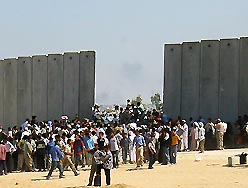
Israel business: Things are very wrapped up in Gaza and Palestinians are free to wander between Egyptian Rafah and Gazan Rafah (how did the line get down the middle of that city anyway?).
In New York where he was attending the United Nations General Assembly on Wednesday, Prime Minister Ariel Sharon said he expected Egypt to bring the Egypt-Gaza border under control. "I imagine the Egyptians will get a grip," he said. "There is heavy American pressure on Egypt and the Palestinians on this issue." Palestinian Foreign Minister Nasser al-Kidwa on Wednesday blamed Israel for chaos at the border, as the frontier remained open for the third consecutive day and hundreds of people streamed freely from one side to the other. Addressing the GA, al-Kidwa said that the situation had been of Israel's making as it had insisted on a unilateral withdrawal from the area. Gaza's future, al-Kidwa added, would be determined by Israel's actions in the West Bank. Defense Minister Shaul Mofaz said Tuesday that the government is going to make investing resources in developing the West Bank settlement blocs a top priority. Israel pulled the last of its troops from Gaza early Monday morning, marking the end of 38 years of miltiary rule in the area. Egypt initially said it was allowing free passage across the border as a humanitarian gesture, and pledged to restore order within days. On Wednesday, however, Hamas members blew a hole in the concrete fence that runs along the border, having cleared the area to prevent casualties. Palestinian police did not intervene. Egypt on Wednesday warned Palestinians crossing the frontier to return by sunset when passport controls were to be reimposed, and said it had found an arms-smuggling tunnel under the border. By nightfall, the border was still wide open.
So the Palestinians came in and whooped it up. There is even a bit of paranoia in Israel that Egypt is perhaps planning another war:
The Philadelphi route and the next war
There are quite a few policy makers in Jerusalem who believe that deploying several hundred Egyptian soldiers along the Philadelphi route is a strategic mistake, which will lead to disaster. .... Even 26 years after the signing of the peace treaty with Egypt, many believe, as does Steinitz, that the peace is temporary, and that Israel must prepare for the next war with Egypt. The strongest proof of Egypt's true intentions is its massive military armament. Why does Egypt need such a large and advanced army, they ask, if it has no intention of fighting Israel in the future? After all, Egypt has no other enemies whose military power justifies such extensive armament. And if Egypt is in fact planning war, why should Israel help it prepare, by allowing the deployment of an Egyptian military force on the border of the Gaza Strip?
......However, the reason for the military strengthening of Egypt is not the desire to wage war on Israel, but rather fear of Israel. It is hard for Israelis to believe that anyone is liable to consider their peace-loving country a military threat. But as is written in the annual report on the balance of power in the Middle East recently published by Tel Aviv University's Jaffee Center for Strategic Studies, Egypt sees Israel as a genuine threat, for several reasons.
The first is that the Israel Defense Forces is stronger than Egypt's army. The Egyptian regime sees Israel as an unstable factor, which tends to use force to resolve political problems. Egypt believes that Israel has extremist forces, whose rise to power is liable to lead to belligerence. In Cairo they have not forgotten the declaration by Avigdor Lieberman, who as minister of national infrastructure in 2001 warned that the IDF could destroy the Aswan Dam. Egypt regards the building of a modern military force as a factor that will deter Israel and ensure the stability of the peace treaty.
A third reason involves Egypt's low self-image in relation to Israel. Israeli economic, military, scientific and technological superiority intensifies Egyptian frustration, and this gap spurs Egypt to compete with Israel in the area of arming itself.
The final withdrawal after all these decade prompts some reminiscing from Haaretz about why the hell the Israeli government tried to dominate it in the first place:
The sky did not fall down
By Tom Segev, Haaretz Correspondent
The nearly 40 years of Israeli rule in the Gaza Strip that have now come to an end leave behind a terrible heritage of oppression, bereavement and hostility. The occupation destroyed a number of the fundamental values of Israeli society. The cheap laborers that came from Gaza helped to heap wealth on some of their employers; but from many aspects, they also damaged the Israeli economy.
Many Israelis warned this would happen. Here's a story that requires a psychologist more than a historian.
On the eve of the Six-Day War, Israel Defense Forces officials debated the question of whether or not to conquer the Gaza Strip. Then chief of staff Yitzhak Rabin was opposed to the idea, commenting, "We can forgo the Strip." And then, "There's no point in getting involved with the Strip." At most, Rabin believed that the Strip could be conquered as a bargaining chip, with his idea being that immediately after its occupation, the area would be returned to Egypt in the framework of an agreement that would ensure free sailing in the Tiran Straits, and other terms too perhaps.
A number of the officers who participated in the discussions tried to persuade Rabin "to take" Gaza. "Brigade 60 will not have any trouble with the Strip mission," said then GOC Southern Command Yeshayahu Gavish, while deputy chief of staff at the time, Haim Bar-Lev, promising that "the cleansing" of the Strip would take no more than four hours.
At some stage during the discussions, then newly appointed defense minister Moshe Dayan joined the fray. He opposed occupying the Strip because of the Palestinian refugees who had settled there after fleeing and being evicted from their homes in 1948 and thereafter. According to Dayan, Israel had no interest in taking responsibility for looking after them. "Let others worry about them," he said, deciding that during the first stage of the war, at least, the IDF would not move into Gaza.
However, the minutes of the discussions (kept at the IDF archives) include an argument in favor of occupying the Strip, and it is an eye-opener because of its irrational nature. "It's a shame to forgo the headline: 'Gaza is in our hands,'" was Rehavam Ze'evi's contribution, which expresses the essence of most of the decisions that led to the occupation of the territories in the Six-Day War.
As long as the alternatives facing the state ahead of the Six-Day War were considered in a level-headed manner, most of the decision-makers agreed that most of the territory that Israel was likely to occupy shouldn't be occupied. Nevertheless, the territory was occupied, because when the battles began, the decision-makers acted on gut feelings and from the heart, and not from the head.
Also there was a story about Ehud Barak and the various rumblings of an Israeli Left trying to pull itself together, figure out whether or not is worth supporting Sharon if he leaves another couple West Bank settlements or not. This is the first I've heard in a while of Ami Ayalon, the pro-peace advocate who used to be the director of Israel's Shin Bet internal security service - the only director of a security agency I've ever met, save the time I saw Porter Goss in the Ft. Myers airport.
Along the far edges of Israeli politics, in a side alley far from the central stage, the Israeli left is trying to resurrect itself, to signal that it has not fled, that it still has something to say. In the view of some, this is a heroic struggle; in the view of others, a pathetic attempt. Who's got the strength for all this talk about a permanent settlement, about a Palestinian partner, about a Geneva agreement, about "peace," when everything is focused on Ariel Sharon and his battle for survival against Bibi.
The demonstration scheduled by the left for Saturday night, September 24, the day before the Likud Central Committee convenes, was planned to be the great show of unity of all of the bodies, organizations, and individuals with good intentions. But less than two weeks before the date, first cracks are already showing in the wall. Officials from Ami Ayalon's "People's Voice" announced a few days ago that they were pulling out of the joint committee organizing the demonstration. Its message - a permanent settlement, now - seems wrong to them. Even though the whole essence of the People's Voice is a permanent settlement. People's Voice representatives had other suggestions that were rejected by the Geneva agreement and Peace Now; for instance, declared support for Sharon, a call on Sharon to continue the evacuation of isolated settlements.
There is no way we could accept that, say the Geneva folks; if Sharon evacuates another three settlements in his next term, that is something for which we should support him? Besides which, say Yossi Beilin's people, who decided that the people are against a permanent settlement? As evidence, they present a poll conducted last week by the New Wave polling institute, in which the following question was asked: Are you for or against a permanent settlement between Israel and the Palestinians that would include the evacuation of most of the settlements in Judea and Samaria? Forty-seven percent said they backed the statement, and 42 percent said they were opposed.
It was a disturbing episode to see photographs of torched synagogues in the old Gaza settlements. Historically, no positive situations have followed from torched synagogues, but on the other hand, they were generally ugly, heavy concrete structures designed to withstand mortar attacks, more aesthetically bunkers than temples. it is easy to understand why the Israelis could not bring themselves to destroy the structures, (as the chief rabbi of Moscow reflects) but they really set up the Palestinians, who would obviously want to pick apart every settlement building. And now the Israeli police fear revenge attacks by right-wing Israelis against mosques in Israel.
Severance just messaged me to say hi from London. She added "never buy batteries in shepherd's bush." Not sure why. But there you go.
Randy Kelly got whomped in the St Paul mayoral primary, shocking as it is. They were gloating at the DailyKos about how his Bush endorsement bit him on the ass in a town like this. I added what I know firsthand of Kelly's self-justification for endorsing Bush last year:
Kelly endorsing Bush == Homeland Security cash
Let me relate a funny story about Mayor Randy Kelly. Earlier this year he came to talk to students at Macalester College (where i just graduated from) and there were a lot of annoyed Mac Dems wearing signs that said something like "I support real Democrats". So finally the question came, why the hell did you endorse Bush?
Well he said basically that he did it because he believed it would be the best for St. Paul, apart from his personal preferences. How would it be best? Well, he said, it makes it easier to get things out of Washington. So when the Department of Homeland Security was abruptly going to cut St. Paul out of a whole bunch of funding (it was probably for first responders, as someone noted above), he proudly said that he was able to go to Washington DC and get the money back - in other words, endorsing Bush made it easier to get back the patronage cash that is apparently being funnelled in the most political way possible through the damned Department that is supposed to keep all Americans safe.
I was taken back by the abrupt cynicism of this - it hadn't occurred to me that DHS money was being used to reward local politicians in such a way. Kelly was very matter-of-fact about this. I guess this is what federal-city realpolitik is all about, but his glib and direct statement on it shocked me.
(it is a little reminiscent of how FEMA seems to have been used to funnel cash into Florida in 2004 to warp the election)
This post is hyper long, but why not toss in a bit about "Lost at Tora Bora", published four years after 9/11? A fine account of how we surrounded Bin Laden in the cave complex with 36 Special Forces, and tried to buy off a bunch of goofy heroin-laden warlords without realizing that Bin Laden had paid many off already. I would quote this but really you should read about this critical opening episode of the War on Terror, the whole thing. Tom Watson reflects on it. it's never The End.
BROUSSARD [of Jefferson Parish]: We have been abandoned by our own country. Hurricane Katrina will go down in history as one of the worst storms ever to hit an American coast. But the aftermath of Hurricane Katrina will go down as one of the worst abandonments of Americans on American soil ever in U.S. history. … Whoever is at the top of this totem pole, that totem pole needs to be chainsawed off and we’ve got to start with some new leadership. It’s not just Katrina that caused all these deaths in New Orleans here. Bureaucracy has committed murder here in the greater New Orleans area and bureaucracy has to stand trial before Congress now.
Yeah, I don't know if I can put the big picture of the storm together. Nonetheless here are some stories.
Someone told Cheney to go fuck himself on live television. Tomgram: Iraq in America: At the Front of Nowhere at All: The Perfect Storm and the Feral City By Tom Engelhardt really puts it into perspective, and all the nasty parallels and feedback effects from the Iraq war making things worse, the sudden and shocking evidence that the Public Sector in this country has been stripped to the bone, etc. A lot of blame is getting spun around, Brit Hume even claimed that Bush "pleaded" that the mayor of New Orleans would evacuate.
Also this White House photo of Bush in a video teleconference before it hit just illustrates how they shouldn't have dropped the damn ball. Check out the official note from FEMA's Brown (PDF), five damn hours after it hit, putting DHS and FEMA into action in the "near catastrophic event". Via TPM.
The Red Tape and bizarre bureaucratic moves included having firefighters hand out fliers apparently. The pathology of our government:
...as specific orders began arriving to the firefighters in Atlanta, a team of 50 Monday morning quickly was ushered onto a flight headed for Louisiana. The crew's first assignment: to stand beside President Bush as he tours devastated areas.
Image before life. Also Barbara Bush said that "This is working out very well for them" in their tortured refugee status because they were "underprivileged anyway." There are some horrible reports about totally staged relief events - entire sites that appeared to hand out supplies, then collapsed as soon as Bush and the less observant American media moved off. The Germans of ZDF were more observant. But wait, maybe that was not accurate at all. Here are some translations of the media in question.
It would appear that Blackwater USA - the same private military firm/mercenary org that's done such a fine job in Mesopotamia - has sent at least 150 people into the New Orleans area. They are patrolling with M-16s. Yeah. A blogger on the ground appears to have broken this story.
The practice of putting political apparatchiks into FEMA makes more sense if we consider what might have happened if it had hit a swing state in an election year, such as the 2004 hit on Florida, where FEMA rolled in and basically showered people with cash well outside the damage zone, resulting in a nice bounce of several points for Bush. Was Michael Brown basically perpetrating fraud in Florida 2004 (PDF)? Salon: The Politics of Hurricane Relief. ThinkProgress Katrina Timeline attempts to counter the spin. Billmon is doing a damn good job these days, as always.
True Blue Conspiracy Theorist Wayne Madsen said that someone, probably the government, was jamming radio transmissions around New Orleans. What the hell? I don't get it. Well, now there is an update that is is coming from some kind of pirate radio station in the Caribbean. Ok, whatever. Here is how you can defeat radio jamming signals. Apparently. Also, he has a grand conspiracy already going into place about depopulating the poor black population of the city. I liked the bit about "secret hereditary societies." So take this with many grains of salt:
September 9, 2005 -- Dallas meeting plans reconstruction of New Orleans without poor African Americans. According to well-informed New Orleans sources, New Orleans' wealthiest families, including those who are direct descendants of the French who settled New Orleans (not the Acadians [Cajuns] who were poor refugees from British tyranny in Nova Scotia) are meeting in Dallas today with Bush administration officials, New Orleans city officials, wealthy Texas oilmen, and bankers to plan for the reconstruction of New Orleans. These wealthy New Orleans residents live in the gated community of Audobon Place, a section of the city near the Garden District replete with personal helipads that still has running water and sewage and was only slightly affected by hurricane Katrina. It is now reportedly being patrolled by private Israeli security forces. Yesterday's Wall Street Journal ran a piece with more details on this story.
Rep. Richard Baker (R-LA): "We finally cleaned up public housing in New Orleans. We couldn't do it, but God did."
The Dallas meeting focused on rebuilding and re-zoning New Orleans without the "criminal element," a code word for the city's poor African American community.
These New Orleans residents have been scattered across the United States and are now under the control of FEMA. There is an understanding by the wealthy New Orleans elite that the poor will never be able to return. The Journal reported that the person who chaired the Dallas meeting was Jimmy Riess, one of the wealthy New Orleans elite who also served as Mayor Ray Nagin's Chairman of the Regional Transit Authority, which is in charge of the city's buses, trolleys, and trains. New Orleans sources report that public transportation was purposely not used to evacuate the poor New Orleans residents as a means to depopulate the poorer and more flood-prone sections of the city. [hongpong: wtf?!! let me get my tinfoil hat right away!] In fact, after the properties in New Orleans poorer communities are razed many of the deed records of the poor and middle class contained in government offices and title companies of Orleans Parish and neighboring Jefferson Parish may end up being casualties of the flood. As one New Orleans source put it, "people will not have proof they ever owned anything." As for renters and residents of public housing, they will be prevented from returning to their native city, according to New Orleans sources. Louisiana's Republican House member Richard Baker, a strong Bush ally, may have tipped his hand about the future plans for New Orleans when he told a group of lobbyists, "We finally cleaned up public housing in New Orleans. We couldn't do it, but God did."
Guess Who Is Planning the Rebuilding of New Orleans?
The French-American elite of New Orleans are among the city's "rich and famous." They run the Mardi Gras "crews" (Krews) or clubs, secret hereditary societies that sponsor the annual pre-Lenten festival. Many also run large oil companies and are long time supporters of the Bush family and their associated oil and gas cartels.
Meanwhile, the wars: There was the conference about terrorism and security called America's Purpose, which you can see video about, and some stuff on CSPAN. Washington dude Steve Clemons was involved. In terms of the war, Juan Cole offered an excellent dissection of how Christopher Hitchens is still trying to defend it.
The "sovereign" Iraqi government wants to get those private mercenary / privatized military / security firms under control somehow, including a central registry. Also this news from the Telegraph.
For more than two years such contractors have roamed with impunity. But now the interior ministry has imposed rules requiring all their firms to be registered and weapons to be carried only by guards holding an official licence.
If any of the companies is considered to be a threat or if it angers a government official its official permit could be revoked and the business ordered to depart.
About 25,000 security contractors, many of them British, American and South African ex-servicemen, lured to Iraq by wages of up to £750 a day, are estimated to be in the country providing protection for official buildings, supply convoys or visiting businessmen.
They are highly unpopular with locals. Convoys of contractors have become a common sight on a journey through Baghdad since the March 2003 US-led invasion.
Adorned in sunglasses and bullet-proof vests, they travel in white four-wheel-drive vehicles with gun barrels protruding from the windows. Many refuse to obey road signs and consider traffic jams a security risk so barge through the lines of vehicles which are often forced to pull over rapidly on to pavements.
Their lack of official status has long been a concern and those operating on US department of defence contracts are free from risk of legal penalty under the Iraqi judicial system if they killed anyone in a firefight.
But under the new rules confirmed yesterday all such firms will be brought under the authority of the Baghdad government. All companies will have to provide details of their number of employees, jobs undertaken and office addresses.
Most significantly their employees will no longer be allowed to possess a weapon without approval. Many of the firms have considerable firepower. As well as AK-47s and assault rifles some have heavy machineguns and anti-tank rocket launchers. One company, Blackwater, even has its own fleet of helicopters which criss-cross Baghdad with machine guns poking out from the side.
The surging private military industry is a fascinating subject for me. If you want a really entertaining video shot from the Blackwater guys' helicopters, check out MilitaryVideos.net. The latest video, from August, is Blackwater in Najaf 2 (BitTorrent wmv - legal). Sounds exciting. Index of some of these companies, Global Guerrillas on PMFs, the Guardian on it. Soldiers of Good Fortune by Barry Yeoman in Mother Jones is a really excellent primer. And of course Wikipedia on it.
OS X + Windows Video Tech Tip: For some horrible reason, Windows Media Player for Mac OS X is a very stubborn piece of crap that hates to play lots of WMV files. However, if you retitle the file's type from .wmv to .asf , then lots of them will work. Incredibly stupid, but it works on most of the videos from MilitaryVideos.net.
Juan Cole offers us the following tidbit about how Rummy thinks that we can do a Top Notch job in New Orleans, Iraq AND the Global War on Terror.
The US Pentagon is sending hundreds of members of the Louisiana National Guard home from Iraq. Some of them have lost homes in New Orleans. Internet gossip had earlier suggested substantial discontent in the ranks over being stuck in Iraq while Louisiana faced its biggest crisis in modern history.
The Iraqi Interior ministry said 9 Iraqis were killed, among them a high-ranking official in the ministry of the interior. Another 20, at least, were injured.
US Secretary of Defense Donald Rumsfield maintains that the US government can both take care of New Orleans and pursue the "global war on terror."
Uh, Donald, let's look at this situation. First, much of New Orleans is under water. You stole money that should have been spent on its levees for the Iraq War, and you stole state national guards from Louisiana to fight in Iraq. (The state national guards hadn't signed up to fight foreign wars and were surprised when you kidnapped them, sometimes for a whole year at a time.) So you haven't actually done a good job with the effects of Katrina in New Orleans. In fact, the job has been so bad that some wags are saying they can't believe you personally were not in charge of the recovery effort.
Then let's consider the war against al-Qaeda. You may have noticed that Ayman al-Zawahiri issued a videotape late last week. It was bundled with the farewell suicide tape of Muhammad Siddique Khan, the mastermind of the 7/7 bombers in London. It now appears that your inability to capture al-Zawahiri has allowed him to intrigue with Pakistani jihadi groups to recruit British subjects to bomb their own country. Bin Laden and Zawahiri are at large and free men, which is your failure.
Then there is the war in Iraq. I don't need to tell you that that isn't going very well. In fact, what in hell are you doing in the godforsaken Turkmen city of Tal Afar? Is it really a big threat to the United States? Is it likely to be friendly to us if you drop 500 pound bombs on its residential districts?
You left out the fourth war Bush is fighting, on the US poor. The average wage of the average American work fell last quarter, amidst rising corporate profits. Bush cut billions in taxes on the rich, and then gave $300 checks to some poor people, who didn't seem to realize that by taking it they were giving up all sorts of government services and maybe even their social security payments.
So, Donald, maybe it is true that you can save New Orleans, occupy Iraq and fight a global war on terror all at the same time. But you, at least, cannot actually do these things successfully. Which is why you should have resigned a long time ago.
Projects in Iraq are running out of cash. This would include water and power projects. Also, the US is obsessed with gaining control of the town of Tal Afar near Syria, and has been bombing the bridges over the Euphrates River in an effort to prevent militants from circulating. Of course, some people might suggest that such an action is pretty much the Direct Method for "dividing a country", but how could I suggest such a thing? Also the city of Qaim, on the edge of Syria, has been a site of dramatic violence and such... As usual it is all being blamed on Goldstein. I mean Zarqawi. A complex report about the struggle in Iraq over its economic organization. Of course, the US has been crushing the wishes of the more socialist-oriented Iraqis, who realize their country has a good chance of getting ahead with export-led industrial development and a heavily subsidized public sector backed up with oil wealth. Oh well. That is Not Suitable to our Fantasy Vision, dammit!
Israel is wrapping up the Gaza occupation, and the little slice of land between Gaza and Egypt will finally return to Arab hands. This is called the Philadelphi Corridor or Philadelphi Route, which this Fikret Ertan dude reflects on. The matter of border customs stations, overseen by an international team, has not been fully resolved yet. It seems that Bush is intervening with the Europeans, asking them not to pressure Sharon so that he's more likely to win against Netanyahu. However, as writer Gideon Samet points out, they are being lazy and unhelpful, making the wrong moves with the "Israeli hurricane" as well. Israel is sealing the Rafah crossing in Gaza to prep it. The notoriously goofy Rabbi Ovaida Yosef said that Hurricane Katrina was God's punishment for Bush's support for leaving Gaza.
"It was God's retribution. God does not shortchange anyone," Yosef said during his weekly sermon on Tuesday. His comments were broadcast on Channel 10 TV on Wednesday.
Yosef also said recent natural disasters were the result of a lack of Torah study and that Katrina's victims suffered "because they have no God," singling out black people......Yosef singled out black victims, saying "they don't study Torah." He used the word "Kushim," which in the Bible refers to an ancient African people but in vernacular Hebrew is considered derogatory.
Our last Israel tidbit comes from Amira Hass, on "Gun Envy." Life for a tiny child in the Gaza slums:
In another year or two, he will learn to distinguish between an armed Jew and an armed Palestinian. Instead of fear, maybe he will be filled with pride and excitement. In another three years, he will know how to distinguish between armed men from Hamas and armed men from the Palestinian Authority/Fatah, and will already decide which is his favorite team. Thus, without his parent's wanting it, without realizing it, without his similarly excited friends realizing it - he will be infected with the common malady whose scientific name is "gun envy."
The minor variety of this illness is sympathy (for one organization or another) and emulation (with toy guns). The serious variety is to join an organization. The most common symptom of this illness is reflected in the billboards and posters that constantly crowd one's field of vision: men armed with rifles and mortars, in every pose imaginable, and with each organization competing over whose is bigger. Another symptom is expressed in the public military ceremonies that elicit ecstatic reactions from the crowd.
She astutely points out that the Palestinians are in fact developing mirror images of the main force all around them, the IDF.
Was Israel Keeping Tabs on some of the 9/11 hijackers?
What an interesting question!! What do you say,
senior FOX News reporter Carl Cameron, in December 2001?
CARL CAMERON, FOX NEWS CORRESPONDENT: Since September 11, more than 60 Israelis have been arrested or detained, either under the new patriot anti-terrorism law, or for immigration violations. A handful of active Israeli military were among those detained, according to investigators, who say some of the detainees also failed polygraph questions when asked about alleged surveillance activities against and in the United States. There is no indication that the Israelis were involved in the 9-11 attacks, but investigators suspect that they Israelis may have gathered intelligence about the attacks in advance, and not shared it. A highly placed investigator said there are "tie-ins." But when asked for details, he flatly refused to describe them, saying, "evidence linking these Israelis to 9-11 is classified. I cannot tell you about evidence that has been gathered. It's classified information." Fox News has learned that one group of Israelis, spotted in North Carolina recently, is suspected of keeping an apartment in California to spy on a group of Arabs who the United States is also investigating for links to terrorism. Numerous classified documents obtained by Fox News indicate that even prior to September 11, as many as 140 other Israelis had been detained or arrested in a secretive and sprawling investigation into suspected espionage by Israelis in the United States. Investigators from numerous government agencies are part of a working group that's been compiling evidence since the mid '90s. These documents detail hundreds of incidents in cities and towns across the country that investigators say, "may well be an organized intelligence gathering activity." The first part of the investigation focuses on Israelis who say they are art students from the University of Jerusalem and Bazala Academy.....
And so on and so forth. An incredibly weird thing to hear from Fox News. But within weeks this story vanished down the memory hole, and only because someone managed to tape the four Fox reports and put them up on the Internet can we watch all 1 2 3 4 of them right now!
The new twist, as Justin Raimondo brought to attention, is that some corporate lawyer did a massive study (PDF) picking apart all the various weird detentions of Israelis, and he discovered a very serious overlap between where the 9/11 hijackers lived, and where the Israelis were apparently spying from. The maps are hilarious! So it would be quite a dramatic story if it all turned out to be true. Personally, I am not betting my lunch money on it, but I thought it certainly interesting enough to post on the site.
As always, Josh Marshall is holding it down on TalkingPointsMemo.com. There has been plenty of good stuff about the Katrina spinstorms there lately.
I am no fan of Allan Bloom style neoconservative browbeating of the "Liberal Academia", but this review in NYTimes about the effect of his classic "Closing of the American Mind: How Higher Education Has Failed Democracy and Stolen My Maple Syrup" was sort of interesting. I think the interesting point was that Bloom would be appalled how the rightwing is attempting to ideologically straitjacket academia in the same sorts of ways that Bloom thought the Big Scary Left did back in the day.

Misc bits: freewayblogger.com chronicles signs posted on overpasses and stuff against Bush and the War. This is very old news, but the British graffiti artist Banksy bombed the wall constructed by the Israeli government inside the Palestinian Territories. I can't believe he did something so detailed in the high-security area. Badass.
That's all for today, folks.
I have decided that this post shall look delirious. Sorry.
ACLU: Government documents on torture
http://www.angelfire.com/indie/hairtransplant/
"Up is down"ism as a graphic.
I thought this was fantastic. A nice profile of Douglas Feith and what a horrible role he has played in the health of Zionism and the United States alike, from the Village Voice's Bush Beat. More background on Doug Feith, his role in Iraq and the Office of Special Plans. A really fabulous article by Feith in 1993 in which he highlights his extreme racism and fanatical views of the West Bank settlements (this was written when they were a fraction of current size)
The weaving around the bigshot Democratic centrists regarding Iraq. Why the hell should I care what another internet pundit like Yglesias says? i don't know, this navel gazing is tiresome but at least these guys are trying to get a grip on it. (also via dailykos)
No power, no constitution in Iraq (AP)
Blackouts disrupt oil exports as Iraqi parliament cannot overcome ethnic rivalries. Bush defends war amid Texas protests.
Joe Klein always seems to piss me off, with his holier-than-thou wisdom that has turned out to be worthless time and again. And here it drips with contempt for those who dare to challenge his orthodoxy, while he spins around and admits that it's evaporated, but the 'naive' types somehow don't get it, as always:
Perhaps he feels the pain more intensely than other Presidents, knowing that the real war in Iraq, the one that began after he proclaimed that "major combat operations are over," was not anticipated by his Administration, a colossal failure of planning and execution. It is also possible that there is more than crude political calculation to the President's failure to attend funerals; his refusal to intrude upon the private grief of the families has presidential precedent. But the inability to acknowledge these terrible losses leaves an aching void in the rest of us. It isolates the general public from the suffering that is a dominant reality of life in military communities.
And that is why the awkward anguish of Cindy Sheehan has struck a chord, despite her naive politics and the ideology of some of her supporters. She represents all the tears not shed when the coffins came home without public notice. She is pain made manifest. It is only with a public acknowledgment of the unutterable agony this war has caused that we can begin a serious and long overdue conversation about Iraq, about why this war—which, unlike Vietnam, cannot be abandoned without serious consequences—is still worth fighting and why we should recommit the entire nation to the struggle. This is a failure of leadership, perhaps the signal failure of the Bush presidency.
Sheehan defends herself. Meanwhile, back at the Crazy Ranch: US Christian Broadcaster Calls for Chavez Assassination
Pat Robertson said the United States has the ability to "take out" Mr. Chavez, and said he thinks the time has come to use that ability. Mr. Robertson accused Mr. Chavez of supporting communism and Muslim extremism, and said that killing him would be a "whole lot cheaper" than starting a war.
Chavez Ally: Robertson a 'fascist.' Why Pat Robertson's Statements Help Hugo Chavez. Oh Time. You and your talk of angry neoleftists.
Chavez is no doubt a source of concern for Washington, if only because Venezuela is America's fourth-largest foreign oil supplier. Chavez's erratic and often bellicose anti-U.S. rhetoric—he publicly called Bush an "ass____" in Spanish last year—as well as his desire to sell less oil to the U.S. and more to ideological allies like China, are hardly comforting as gas nears $3 per gallon. But neither is Chavez's embrace of nations like Iran, and nor is the fact that he's leading a politically potent (and, to the Bush Administration, potentially destabilizing) wave of angry neo-leftism in Latin America, from Argentina to Mexico.
But Chavez holds cards that make remarks like Robertson's all the more incendiary on the Latin American street, where language like "U.S. imperialism" suddenly has currency again. One is the past: Latin Americans have too many vivid and bitter memories of U.S. intervention in their countries—operations that sometimes included brazen assassinations —which is why the Bush Administration got burned by accusations it backed a failed coup against Chavez in 2002. Another is democratic legitimacy: Chavez, for all his authoritarian tendencies, is a democratically elected head of state who last year won a national recall referendum approved by international observers.
Venezuela Slams Robertson Over Remarks
Libertarian griping about the War on Terror eroding freedoms. True enough. Bush vs. Benedict: Catholic neoconservatives grapple with their church’s Just War tradition. Another libertarian griping about how our constitution has been hollowed out. Was the Credit too loose?
One war theory: Iraq Was Surviving the Sanctions Why They Wouldn't Wait. A tipping point on Iraq: HAS it been reached? (Jim Lobe)
Stories from the Gaza withdrawal:
Troops, police complete forced evacuations in less than a week.
NY Daily News: Hand-to-hand fight in Gaza. Bush: Next step after pullout is working gov't. in Gaza Strip.
Fascinating tale of the former West Bank civil administrator, who basically made himself an enemy of the settlers.
Bush might just be crazy then:
Is Bush Out of Control?
By DOUG THOMPSON
Aug 15, 2005, 05:46
Email this article
Printer friendly page
Buy beleaguered, overworked White House aides enough drinks and they tell a sordid tale of an administration under siege, beset by bitter staff infighting and led by a man whose mood swings suggest paranoia bordering on schizophrenia.
They describe a President whose public persona masks an angry, obscenity-spouting man who berates staff, unleashes tirades against those who disagree with him and ends meetings in the Oval Office with “get out of here!”
In fact, George W. Bush’s mood swings have become so drastic that White House emails often contain “weather reports” to warn of the President’s demeanor. “Calm seas” means Bush is calm while “tornado alert” is a warning that he is pissed at the world.
Decreasing job approval ratings and increased criticism within his own party drives the President’s paranoia even higher. Bush, in a meeting with senior advisors, called Senator Majority Leader Bill Frist a “god-damned traitor” for opposing him on stem-cell research.
“There’s real concern in the West Wing that the President is losing it,” a high-level aide told me recently.
A year ago, this web site discovered the White House physician prescribed anti-depressants for Bush. The news came after revelations that the President’s wide mood swings led some administration staffers to doubt his sanity.
Although GOP loyalists dismissed the reports an anti-Bush propaganda, the reports were later confirmed by prominent George Washington University psychiatrist Dr. Justin Frank in his book Bush on the Couch: Inside the Mind of the President. Dr. Frank diagnosed the President as a “paranoid meglomaniac” and “untreated alcoholic” whose “lifelong streak of sadism, ranging from childhood pranks (using firecrackers to explode frogs) to insulting journalists, gloating over state executions and pumping his hand gleefully before the bombing of Baghdad” showcase Bush’s instabilities.
“I was really very unsettled by him and I started watching everything he did and reading what he wrote and watching him on videotape. I felt he was disturbed,” Dr. Frank said. “He fits the profile of a former drinker whose alcoholism has been arrested but not treated.”
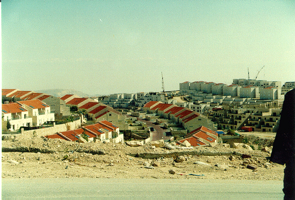 Let's Roll. The two northern West Bank settlements went down without serious violence between the IDF and settlers, though some settlers have raided Palestinian villages. But a recent announcement of Jerusalem-region settlement construction jeopardizes any peace deal. E1 is going to be enclosed by the Big Fence. Cutting off South West Bank (Bethlehem & Palestinian neighborhoods) from North West Bank (Ramallah and northern Palestinian Jerusalem villages) . This tract of land is literally an ALL IMPORTANT key to a Final Agreement. But Sharon, ever the tactician, is going to make his move, World Court be damned. What does the Israel Hasbara Committee say?
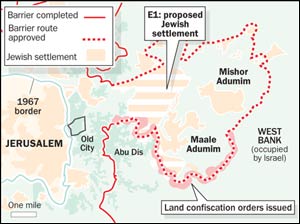
(^this graphic from The UK Times)
Peace Now, the Israeli peace group which is anti-settler (and pro-Stable Zionism I might add) What is E-1?
What is E-1? Is it the same as reported plans to expand Ma'ale Adumim?
E-1 is short for "East 1," the administrative name given to the stretch of land northeast of Jerusalem, to the west of the settlement of Ma'ale Adumim. When people talk about E-1 today, they are referring to a longstanding Israeli plan – never implemented – to build a large new Israeli neighborhood in this area.
E-1 is not the same as the expansion of Ma'ale Adumim. The ongoing expansion of Ma'ale Adumim, which the biggest settlement in the West Bank (about 30,000 people), is toward the east, in the direction of another settlement, the Mishor Adumim industrial park.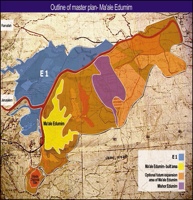
Is E-1 part of Israel or the West Bank?
E-1 is part of the West Bank. It was never annexed to Israel and since 1967 it has been under Israeli military law.
(photo source) Is Ma'ale Adumim part of Israel or the West Bank?
Due to its close proximity to Jerusalem, Ma'ale Adumim is viewed by most Israelis as a suburb or neighborhood of Jerusalem. However, Ma'ale Adumim is located in the West Bank and is therefore a settlement. The area on which it is located was never annexed to Israel and since 1967 has been under Israeli military law. Ma'ale Adumim is the largest settlement in the West Bank and is one of only four settlements in the West Bank classified by Israel as a "city." Many observers expect that under any future peace agreement Ma'ale Adumim will remain part of Israel, as was the case under the Clinton proposal and the Geneva Initiative (with a land swap to compensate the Palestinians for the territory).
Why are Israeli construction of E-1 and the expansion of Ma'ale Adumim a big deal? (AERIAL PHOTO)
Construction of E-1 would jeopardize the hopes for a two-state solution. It would, by design, block off the narrow undeveloped land corridor which runs east of Jerusalem and which is necessary for any meaningful future connection between the southern and the northern parts of the West Bank. It would thus break the West Bank into two parts – north and south. It would also sever access to East Jerusalem for Palestinians in the West Bank, and sever access to the West Bank for Palestinian residents of East Jerusalem. Both of these situations are antithetical to the achievement of any real, durable peace agreement and the establishment of a viable, contiguous Palestinian state.
The expansion of Ma'ale Adumim, as with the expansion of any other settlement, is a unilateral act which undermines and jeopardizes efforts to resume negotiations which are based on the principal of two states living side by side with peace and security.
Yes, it's got its own website: www.securityfence.mod.gov.il/Pages/ENG/operational.htm
So the latest news:
Israel plans police station on key West Bank land
Thu 25 Aug 2005 10:26 AM ET
By Cynthia Johnston
JERUSALEM, Aug 25 (Reuters) - Israel is finalising plans to build a police station on a strategic tract of land near Jerusalem in a move Palestinians fear will ultimately isolate the West Bank from the holy city and deny them a viable state.
The construction would be Israel's first on land where the Jewish state hopes to build 3,500 settler homes to link Jerusalem to the biggest West Bank settlement, Maale Adumim, despite U.S. opposition. That plan is on hold for now.
A spokesman for Israel's civil administration, Adam Avidan, said on Thursday final approval to build the station was days away and construction could begin in as little as two months.
Such a move is likely to anger Palestinians two days after Israel completed its evacuation of all 21 Gaza Strip settlements and four of 120 in the West Bank under a plan that has been touted as a springboard to renewed peacemaking.
It also comes a week after Israel issued orders to seize four tracts of Palestinian-owned land near Maale Adumim to build its West Bank barrier, whose route takes in that settlement.
By enveloping the enclave on Israel's side of the barrier, Palestinians say Israel would cut off the West Bank from Arab East Jerusalem, which they want as capital of a future state.
Israel, which says its barrier keeps suicide bombers out of Israeli cities, said the police station was needed purely for security reasons. Israeli Prime Minister Ariel Sharon has said he wants more settler homes built in the area. "I think everyone understands that Maale Adumim in any final status scenario would be part of Israel," Israeli Foreign Ministry spokesman Mark Regev said of Israel's largest settlement, which has around 30,000 inhabitants. [NOTE "Hegemonic Discourse"!! ]
"But we are not building residential housing. Although the prime minister has expressed his position that he would like to see that happen, it is not happening. And I think there is an appreciation of that."
Israel considers all of Jerusalem as its eternal capital, a claim not recognised internationally. Palestinians want the Arab eastern sector, which Israel also captured in 1967.
U.S. embassy spokesman Stewart Tuttle, asked about the plan, reiterated a call by President George W. Bush that Israel stop settlement construction, but had no comment on the fresh plans.
Israel evacuated 9,000 settlers and some 6,000 supporters from Gaza and part of the West Bank this month. More than 200,000 West Bank settlers remain, primarily in large blocs like Maale Adumim Sharon says Israel must keep for strategic reasons.
Sharon billed the pullout as "disengagement" from conflict with Palestinians in revolt but Palestinians fear the move was a ruse to cement Israeli control over much of the West Bank. They said they now fear Israel will use the police station to stake a claim to West Bank land near Jerusalem and block the creation of a territorially contiguous Palestinian state with a capital in the eastern sector of the holy city.
Without that tract of land, which Israel has labelled as E-1, Palestinians fear they will be unable to reach agreement with Israel for a two-state solution to decades of conflict.
"I think it is a rather cynical move. At a time when Israel is trying to gain brownie points for the Gaza disengagement, its real strategy is being executed in East Jerusalem," said Michael Tarazi, legal adviser to the Palestinian Authority on Jerusalem affairs.
The International Crisis Group think tank has said barrier construction and settlement growth, especially around Jerusalem, could drive Palestinians to violence and damage prospects for a comprehensive peace deal. A fragile ceasefire now prevails.
(source)
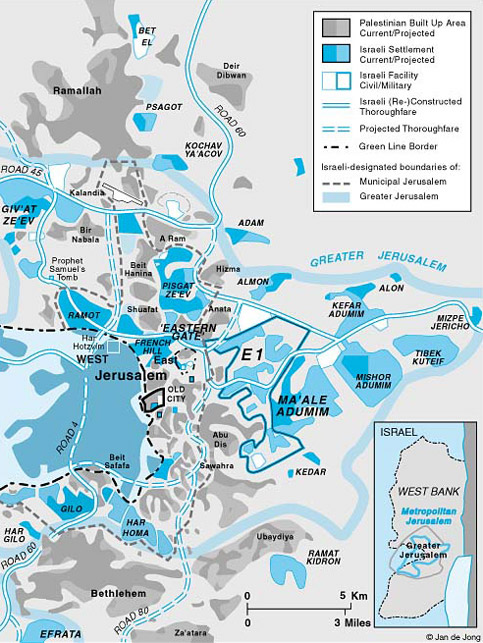
E-1: The End of a viable Palestinian state by ElectronicIntifada, a few months ago:
Still, Israel cannot “digest” the 3.6 million Palestinians living in the Occupied Territories. Giving them citizenship would nullify Israel as a Jewish state; not giving them citizenship yet keeping them forever under occupation would constitute outright apartheid.
What to do? The answer is clear: establish a tiny Palestinian state of, say, five or six cantons (Sharon's term) on 40-70% of the Occupied Territories, completely surrounded and controlled by Israel. Such a Palestinian state would cover only 10-15% of the entire country and would have no meaningful sovereignty and viability: no coherent territory, no freedom of movement, no control of borders, no capital in Jerusalem, no economic viability, no control of water, no control of airspace or communications, no military - not even the right as a sovereign state to enter into alliances without Israeli permission.
And since the Palestinians will never agree to this, Israel must “create facts on the ground” that prejudice negotiations even before they begin. Last week's announcement that Israel is constructing 3500 housing units in E-1, a corridor connecting Jerusalem to the West Bank settlement of Ma'aleh Adumim, seals the fate of the Palestinian state.
As a key element of an Israeli “Greater Jerusalem,” the E-1 plan removes any viability from a Palestinian state. It cuts the West Bank in half, allowing Israel to control Palestinian movement from one part of their country to another, while isolating East Jerusalem from the rest of Palestinian territory. Since 40% of the Palestinian economy revolves around Jerusalem and its tourist-based economy, the E-1 plan effectively cuts the economic heart out of any Palestinian state, rendering it nothing more than a set of non-viable Indian reservations.
The apparent Development pattern as Palestinians project. Note that the connection between Arab areas, between the northern and southern West Bank:
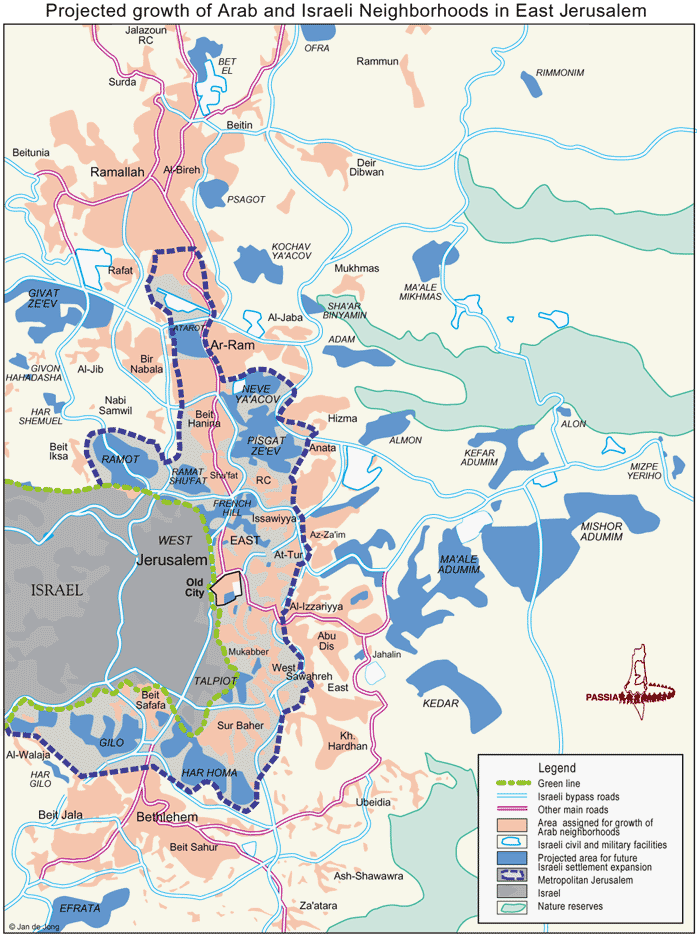
A few years ago, a group of Bedouin who had settled in the area after getting kicked out of Israel at the beginning, was chased out of their resettled spot inside the area known as Maale Adumim.
The Jahalin Bedouin, who have been living on the site of Ma'ale Adumim since the early 1950s after their forced transfer from the 'Arad area in the Negev, have enjoyed a mixed relationship with the Israeli settlement. When the first construction began in earnest in 1982, some Bedouin (who have traditionally been non-political) supplemented their income by working on the new building sites. However, the expansion of Ma'ale Adumim has gradually ensured the displacement of nearly all the Jahalin; and those of the tribe still remaining in their original homes are now protesting fervently against Israel's threatened confiscation.
The land on which the Jahalin have been living belongs to Palestinian landowners in the neighbouring village of Abu-Dies. However, since Israel declared the area to be 'State land' in 1982, the claims of these landowners, let alone the Jahalin, have been dismissed. Israel is pursuing its claim to the land even though the Jahalin's lawyers have been able to establish serious irregularities in the procedures by which the area was made State land. The fight to save the remaining Jahalin, or at least to ensure that they are properly and fully compensated for the loss of their homes, continues to date in the Israeli High Court [Requested Compensations].
So guess what? This isn't good.... The game of crazed Holy Geography continues. Which reminds me of how much clarity being an Atheist provides with these situations.
On television, the tumult in the Gaza Strip looks like nothing less than a pogrom -- soldiers dragging Jews out of their homes and synagogues for immediate, involuntary, permanent relocation. Does it matter that the soldiers are Jewish, too? Not to the Jews being hauled away. Does it matter that some of the most vociferous protesters don't even live in Gaza and are just there to make a point? Not if you remember all the Freedom Riders of the civil rights era who came from Massachusetts or Michigan, not Mississippi.
What's happening in Gaza is geopolitically and historically correct, and when seen from the proper altitude -- high enough that individuals blur into groups -- it's morally correct as well.
[.......]A friend once observed that for African Americans and Jews, the word "paranoid" has no meaning. That's because history proves that it's not our imagination: They are out to get us.
So can I recognize the necessity, the inevitability of the autopogrom in Gaza without cheering its execution? I guess I don't have a choice, since that's what I feel. I'm sorry for those people, long misguided and now betrayed. Some may be religious fanatics and others political extremists, but their sugar-plum-fairy visions of Greater Israel didn't just pop into their heads. Their political and religious leaders put them there. And now, as those leaders do what they must, they should feel the deepest sorrow and shame.
'Goodbye to all that:" IDF plans to complete evacuating Gaza by Tuesday. Not bad! Haaretz writers put disengagement in perspective. A Defining Moment. Who will rule Gaza now?
IDF digs trench to keep Palestinians out of Gush Katif
By Nir Hasson and Amos Harel, Haaretz Correspondents
Israel Defense Forces on Friday began digging eight-meter-deep trenches around the evacuated Gush Katif settlements in the Gaza Strip in a bid to prevent Palestinians from reaching the settlement bloc prior to its complete evacuation. Troops will renew operations on Sunday as activity was halted for the Sabbath. By Tuesday, the IDF intends to complete the evacuation of all settlements in the Gaza Strip. Troops will then focus their efforts on the northern West Bank settlements of Homesh and Sa-Nur. Hundreds of radical settler youths have moved into the latter settlement in recent weeks.
So we will get a bit of a Round Two from those damn Yesha teenagers.
Israel's Gaza Operation Sets Precedent (AP)
With its lightning operation in Gaza — nearly all Jewish settlers evacuated in just 55 hours — Israel has shown the world that it can dismantle such enclaves with relative ease, despite the settlers' tears, anguish and occasional violence.
Having set this precedent, Israel will likely come under increasingly intense pressure to do the same in the West Bank — though Israeli officials insist it could be years before settlements there even come up for discussion.
On the Palestinian side, leader Mahmoud Abbas' success in preventing deadly attacks by militants during the pullout has boosted his image as a peace partner and given new weight to his demand that Israel resume negotiations.
Sheehan stuff: It was a good episode for the antiwar movement, few can doubt. A spearhead of the peace movement? has it touched off some kind of national nerve? Yeah. A good roundup from Froomkin at the WaPo. Too bad she's gone. NewsFromBabylon is a sweet site, and they posted a big NY Times story about "The Other Army," namely all those private military firms, or "private security companies" as the softies wish you'd call them. "US Spy satellites under scrutiny:"
One of the systems under scrutiny by Negroponte is a classified program to build the next generation of stealth satellites, whose estimated costs have nearly doubled to $9.5 billion in recent years, according to sources.
The program has been severely criticized in closed session by members of the Senate Select Committee on Intelligence, who have objected to the rising costs and who argue that it is ineffective against modern adversaries such as terrorist networks. The Senate panel has tried to kill the program in the past, sources said, but it has been supported by House and Senate appropriations committees and the House intelligence panel.
Because of their small size, these satellites -- early generations had been code-named Misty -- would be almost invisible among existing space debris to enemy radars. But those same small dimensions would also limit some of their collection capabilities, according to John Pike, an expert in space vehicles with GlobalSecurity.org.
The other futuristic spy satellite program that Negroponte has focused on is the new generation of non-stealth space vehicles -- using optical, radar, listening and infrared-red capabilities -- known collectively as the Future Imagery Architecture (FIA). Development of these satellites, which has been going on since the late 1990s, has also had major cost increases, now estimated at more than $25 billion over the next decade. As a result, the House intelligence panel voted sharp reductions in its version of the fiscal 2006 intelligence authorization bill.
The Sign That Knows You: Look at this graphic as it looks back at you.
GAZA: Haaretz: STATUS: Disengagement - Day Five Diary. Analysis: Resistance to the disengagement has been futile.
You have to read Sharon's speech:
Sharon did not use his speech to joyfully declare that he has no intention of withdrawing from even one millimeter of Judea and Samaria. In fact, he opened the door to a continuation of the process: "The world is awaiting the Palestinian response, a hand toward peace or the fire of terrorism. We will respond to the outstretched hand with an olive leaf, but we will respond to fire with stronger fire than ever before."
Herein lies a hint that the Gaza prototype, with requisite corrections, would be applied in areas to the east. In an interview appearing in last Friday's Yedioth Ahronoth, Sharon provided a few more details about his plans for the West Bank: "Not everything will remain; the settlement blocs will remain."
Toward of the end of the speech, Sharon offered another, surprising, diagnosis: "The disengagement will give us a chance to look inside ourselves. The agenda will change. Economic policy will find the time to address closing the social gaps and a real war on poverty."
You could hardly believe your ears. For this is the exact argument of the left: that the settlements were built at the expense of the development towns, investment in infrastructures, in roads, in education and vocational training, and are therefore the major cause of social and economic gaps and poverty.
Sharon slams 'grave' Jewish terror attack on Palestinians. Man who killed 4 Palestinians: I hope someone kills Sharon:
Asher Weissgan, a 38-year-old resident of the West Bank settlement Shvut Rahel, on Wednesday shot to death four Palestinians with whom he worked and wounded two others, one of them seriously. Prime Minister Ariel Sharon condemned the attack as an "exceptionally grave Jewish act of terror," Israel Radio reported, and instructed the security establishment to deal harshly with all attempts to harm innocent people. "I'm not sorry for what I did," said Weissgan before entering a remand hearing at the Petah Tikvah Magistrate's Court. "I hope someone also kills Sharon."
Earlier Thursday, security forces prepared for possible riots in Palestinian areas in the territories in reaction to the shooting. Hamas has threatened to avenge the shooting, which was the second Jewish terror attack in two weeks. Sources in Hamas told Haaretz on Wednesday night that it was still committed to the current cease-fire, but that they would not be able to continue restraint in the face of repeated Jewish terror attacks. "We are in favor of quiet and continue to be committed to it but will not permit it to be unilateral," said Sheikh Hassan Yusef, a senior Hamas official in the West Bank. But Sami Abu Zohari, a Hamas spokesman in the Gaza Strip, warned that retaliation would follow. The victims have been identified as Mohammed Mansour, 48, and Bassam Tauase, 30, both from the Nablus region; Halil Salah, 42, from Qalqilyah; and Osama Moussa Tawafsha, 33, from the village of Sanjil, not far from the West Bank town of Ramallah.
Palestinians fire mortar shells towards Gaza settlement of Gadid. IDF says thwarted terror attack by Palestinians during pullout. Children caught in middle of settlers' struggle to make gains on TV (not to mention caught in the settlements themselves). They never had to cut off the power & water. Palestinian After Party by Amira Hass. Op: Territory for Israel. I thought this argument about how settler rabbis sanctify random objects to theologically justify their activities was fascinating. Analysis / Settler leaders: Riding the tiger: Who would have thought that people who even see the state of Israel as an enemy wouldn't obey their leaders?
Rabbi Shlomo Aviner, a leading settler rabbi, who was cursed as a heretic this week after trying to restrain a group of angry teenagers, has perhaps learned the lesson that his colleagues should have learned from countless incidents in Jewish history: He who nurtures a tiger will not always be able to control it. If you wish to retain control, your ranks must be confined to those willing to accept your authority.
It is almost ironic: Those who refused to accept the authority of the state's decisions have now discovered that they cannot impose their authority on their own forces. Except that this is no laughing matter.
AIPAC bits and PR for the West Bank settlements. I found today I have a good Google ranking for 'AIPAC intel.' So why not add a story from about a year ago, "Israel has long spied on U.S., say officials." in the LA Times via w3ar.com. Even Billmon is talking about the latest bits of the AIPAC scandal. This site also has exciting keywords like Intelligence:Espionage:Israeli Espionage. Meanwhile, we are getting some trial balloons for the coming PR offensive to help Israel retain West Bank settlements. Note the trickier rhetorical devices, which I will set in subtle HTML:
Mother Knows Best By ZEV CHAFETS
This diplomatic success was possible only because Mr. Bush won Ariel Sharon's trust. Previous administrations tried to bribe or pressure Israel into making territorial concessions. The president used different tools - common sense and credibility.
As a master politician, Mr. Bush realized that there were political limits on what Mr. Sharon could do. Neither Mr. Sharon nor any conceivable Israeli prime minister would ever evict the hundreds of thousands of Israelis who now live in East Jerusalem and the major settlement blocs of the West Bank. Asking for that would be an automatic deal-breaker. Same for the Palestinian demand that millions of Arab refugees and their descendants be "returned" to Israel. And Israel would never relinquish its option to respond militarily to armed aggression.
Mr. Bush acknowledged these Israeli truths in an official letter he sent to Mr. Sharon in April of 2004. In exchange for that recognition, however, the president asked for - and got - Mr. Sharon's agreement to do what he could do. Evacuating Gaza was one of those things.
The American vision for Middle East peace sees exit from Gaza as a first step. Next comes an Israeli withdrawal from those settlements in the West Bank that aren't already de facto parts of Israel, and then the creation of an independent Palestinian state.
You PONK ASS BITCH. LOOK AT THIS DAMN MAP AND TELL ME WHICH ONES. Ariel? Kiryat Arba? sorry folks that was crude. But I find this kind of shady language most antagonizing.
Cut and Run? That is a very good question which is hardly asked with the kind of objective rigor that it deserves. It's converse, "Staying the course," always has struck me as a weird and flimsy oxymoron, since the course has been wobbly and improvised quite badly. For example, what is the difference between "Cutting and Running" from the Kurds, and "Staying the Course" with the Kurds? "Kurdish Autonomy Moves Evoke Bloody Repression [in Iran]- Regional Crisis Growing." Fortunately a retired military theorist, William Odom, brings home the main points in a clear way:
What’s wrong with cutting and running?
If I were a journalist, I would list all the arguments that you hear against pulling U.S. troops out of Iraq, the horrible things that people say would happen, and then ask: Aren’t they happening already? Would a pullout really make things worse? Maybe it would make things better.
Here are some of the arguments against pulling out:
1) We would leave behind a civil war.
2) We would lose credibility on the world stage.
3) It would embolden the insurgency and cripple the move toward democracy.
4) Iraq would become a haven for terrorists.
5) Iranian influence in Iraq would increase.
6) Unrest might spread in the region and/or draw in Iraq's neighbors.
7) Shiite-Sunni clashes would worsen.
8) We haven’t fully trained the Iraqi military and police forces yet.
9) Talk of deadlines would undercut the morale of our troops.
But consider this:
1) On civil war. Iraqis are already fighting Iraqis. Insurgents have killed far more Iraqis than Americans. That’s civil war. We created the civil war when we invaded; we can’t prevent a civil war by staying.
[..........]
6) On Iraq’s neighbors. The civil war we leave behind may well draw in Syria, Turkey and Iran. But already today each of those states is deeply involved in support for or opposition to factions in the ongoing Iraqi civil war. The very act of invading Iraq almost insured that violence would involve the larger region. And so it has and will continue, with, or without, US forces in Iraq.
7) On Shiite-Sunni conflict. The US presence is not preventing Shiite-Sunni conflict; it merely delays it. Iran is preventing it today, and it will probably encourage it once the Shiites dominate the new government, an outcome US policy virtually ensures.
8) On training the Iraq military and police. The insurgents are fighting very effectively without US or European military advisors to train them. Why don't the soldiers and police in the present Iraqi regime's service do their duty as well? Because they are uncertain about committing their lives to this regime. They are being asked to take a political stand, just as the insurgents are. Political consolidation, not military-technical consolidation, is the issue.
The issue is not military training; it is institutional loyalty. We trained the Vietnamese military effectively. Its generals took power and proved to be lousy politicians and poor fighters in the final showdown. In many battles over a decade or more, South Vietnamese military units fought very well, defeating VC and NVA units. But South Vietnam's political leaders lost the war.
Even if we were able to successfully train an Iraqi military and police force, the likely result, after all that, would be another military dictatorship. Experience around the world teaches us that military dictatorships arise when the military’s institutional modernization gets ahead of political consolidation.
[........]
The US invasion of Iraq only serves the interest of:
1) Osama bin Laden (it made Iraq safe for al Qaeda, positioned US military personnel in places where al Qaeda operatives can kill them occasionally, helps radicalize youth throughout the Arab and Muslim world, alienates America's most important and strongest allies – the Europeans – and squanders US military resources that otherwise might be finishing off al Qaeda in Pakistan.);
2) The Iranians (who were invaded by Saddam and who suffered massive casualties in an eight year war with Iraq.);
3) And the extremists in both Palestinian and Israeli political circles (who don't really want a peace settlement without the utter destruction of the other side, and probably believe that bogging the United States down in a war in Iraq that will surely become a war between the United States and most of the rest of Arab world gives them the time and cover to wipe out the other side.)
The wisest course for journalists might be to begin sustained investigations of why leading Democrats have failed so miserably to challenge the US occupation of Iraq. The first step, of course, is to establish as conventional wisdom the fact that the war was never in the US interest and has not become so. It is such an obvious case to make that I find it difficult to believe many pundits and political leaders have not already made it repeatedly.
So in other words there is little to be salvaged. The potential negatives aren't so bad, relatively, if they are happening already. All right, that's enough. I should go have fun and act like a reasonable person now.
Someone attacked Aqaba recently. Reminds me of a tale from Lawrence of Arabia.
In a second confrontation with Sherif Ali (Ali represented by a dark profiled image on the right of the frame, Lawrence by a blonder, paler, blue-eyed image on the left of the frame), Lawrence is accused of being stark-raving mad, or at the least, arrogant for proposing a painful, arduous trek across the beautiful but waterless, sun-drenched Nefud Desert:
Sherif: You are mad. To come to Aqaba by land, you should have to cross the Nefud Desert.
Lawrence: That's right.
Sherif: The Nefud cannot be crossed.
Lawrence: I'll cross it if you will.
Sherif: You! It takes more than a compass Englishman. The Nefud is the worst place God created.
Lawrence: I can't answer for the place, only for myself. Fifty men?
Sherif: Fifty? Against Aqaba?
Lawrence: If fifty men came out of the Nefud, there would be fifty men other men might join. The Howeitat are there I hear.
Sherif: The Howeitat are brigands. They will sell themselves to anyone.
Lawrence: Good fighters, though.
Sherif: Good...yes. There are guns at Aqaba.
Lawrence: They face the sea, Sherif Ali, and cannot be turned round. From the landward side, there are no guns at Aqaba.
Sherif: With good reason. It cannot be approached from the landward side.
Lawrence: Certainly the Turks don't dream of it. (He points in the direction of Aqaba.) Aqaba is over there. It's only a matter of going.
Sherif: You are mad.
Riding "in the name of Feisal and Mecca" and without Brighton's knowledge, Lawrence is allowed to take a small force of fifty of Feisal's men to set out for Aqaba "to work your miracle." For pragmatic reasons (and as a counterpoint to the strong-willed Lawrence), Sherif Ali joins the "Englishman" to cross the blazing Nefud Desert.
So they are doubling down on Aqaba. On a closely related subject, Nick Werth is under fire at aarongleeman.com:
Werth: aaron youre far better off losing to quad threes at "call down to the river" canterbury than you are dumping your complete bankroll online to some nyu freshman sitting there 5 hours a day on party poker. that shit plays like it is rigged, i kid you not. i play live every day, and never see more instances of 99 v KK, or TT v AA on a six handed table than i do on party. it has made me start thinking. go play the fall poker classic if you want some action against some good players, online play is for those who are either very lucky or very smart, and due to your excellent writing skills, i am prone to guess you aren't quick to learn the percentages of every hand post-flop, like the best online players/math geniuses have. 90% of players lose online, i know of one player who has consistently won long-term on party, and he knows of only one other. maybe other sites are different, but i cant afford to find out. float me into a game next week, i stopped trying to make money and found myself coming out ahead more often than i did when i thought i could play
and then it gets ugly:
wow, Nick, way to insult Aaron's intelligence by saying he's not mathematically inclined. And in fact it is possible to win money at an online poker site, but if you play too many garbage hands and play them too strongly you will get your ass kicked. Admittedly it sucks when you're playing against idiots and your KK loses to a guy who called a large bet before the flop with an unsuited 3-4 and made 4's full on you, but you just have to continue to play smartly, and take advantage of those times that you have the best hand.
Werth: i didnt say pp was fixed, i said it plays as if it were. when i lose to a runner runner bad beat in a tournament, i stand up and say nice hand. online it just pisses me off when the cards go away real fast after some idiot puts you all in pre-flop for $450, you think about it, then call with QQ and the button. the cards come down ridiculously fast and he wins with a set of threes (he had 38off). many single table tournaments, however, are most certainly hubs for collusion. why wouldnt you set up multiple computers with different IP addresses and play $30 sitngos all day?
ouch:
Nick, I'm sure you're much better at this poker thing than I am, but if the dude had 3-8 offsuit, wouldn't he have ended up with "trips," not a "set?" USAFChief | 08.19.05 - 5:11 pm | #
Werth responds to this charge for me via AIM:
three of a kind is a set
its the ones before that
now this blog just needs to start talking about tennis and it is my dream site
Indeed Nick, Indeed. I would like to play poker on a balcony in Aqaba.
PS I wish Werth hadn't taken his blog down, it was just getting good...
This is a very remarkable piece of writing from Haaretz. Cognitive structure of messianic ideology and the whole bit. Deserves its own post.
Chronicle of an end foretold
By Ari Shavit
Not far from the gate, the boys are singing "Have pity, O Lord, on your people Israel." The girls are painting final posters: "Cry, the belovedcountry." And in the synagogue Rabbi Mordechai Elon promises that if no great miracle occurs this night, the loam of the destruction will be used to build a new house. But in the secretariat they are at their wits' end: There are no hotel rooms for Shabbat. Israel is discarding us like waste. Like human waste.
It's a complex story, Gush Katif. On the one hand, it is indeed Algeria. Distinctly Algeria. A baseless settlement project of a mother-state that chose to place a low-income population in occupied territory. A closed local regime that maintains a colonialist farm economy, nourished by cheap land, cheap water and cheap labor, all originating in the military occupation. Worse: this Algeria is evangelist. An Algeria imbued with faith. And this faith, which is interwoven in the singular settlement enterprise, lends a messianic cast to the feeling of supremacy. Here the lordship is not only military, political and economic. Here the lordship is also religious. It is not aimed only at the natives across the fence; it is also aimed against the mother state. And therefore it endangers the mother state, poisons its democracy, corrupts its enlightenment and thwarts its ability to function as a rational entity.
However, there is another side to this, too. The anomalous conditions, conditions lying outside present-day reality, enabled the development of an anomalous society. A strong, cohesive and principled society. A society of tenacity, decency and mutual help. A frontier society of members of the lower middle class who found meaning in the sand-swept territory and there fashioned a narrative of meaning. They turned the territory into a place where a heart-touching spectacle was played out. A spectacle of a life of worshiping God and working the land. A life of loyalty to the homeland and a life of sacrificial devotion. A life from another world.
The first containers enter through the gate in the late afternoon. This is how it was in each of the settlements. First vehement opposition to the containers, then fear of the containers, then capitulation to the containers. The containers became the icon of the disengagement. The containers as a manifestation of government endeavor and the containers as a manifestation of government incompetence; the containers as government sensitivity and the containers as government insensitivity. But, above all, the containers carried with them the information that the moment a container was placed in the yard of a house was the moment of the death of that house. The house is emptied into the container. The house disappears into the container. It is the container that will take the house from here. It will replace the house. It will return the Jew to his wandering.
So that now, when the long line of huge yellow trucks enters through the gate, bearing the blue containers and the rust-colored containers, it is obvious that the die has been cast. And as the containers are borne slowly down the ring road past the electronic fence and past the concertina fence and past the fence of concrete blocs that seal off Khan Yunis, it is clear that this particular settlement, too, has accepted its lot. Even this settlement has reached its end.
The planners designed the place for living on its paths. The houses were separated from the plots in such a way that the area of the hothouses slightly recalls a military logistics center, whereas the residential area creates a pleasant feeling of dividing paths and internal gardens and an absence of roads. Maybe because of the far-sighted planning, Gush Katif became such an impressive community success. Or maybe it is the feeling of the frontier that united the community. Maybe the simple faith. Or this revelation, suddenly, that while the mother state of Israel is becoming secular and enlightened and corrupt, here in the daughter-Israel, different values are maintained. And whereas Israel the mother is becoming a hedonistic, reveling Paris, here in little Algeria a faith-driven version of 1960s Israel is being upheld. Nearly all the families have flourishing hothouses. And all of them together, the 8,000 settlers of Gush Katif, weave a community fabric such as exists nowhere else. They have built a kind of model of Zionism in the sand. A blind, strange Zionism. A cruel and naive Zionism. A Zionism that is beyond time and place, which protects itself with reckless abandon and buries its dead with deep devotion. And maintains on the dunes of Gaza beach a form of lost Israeli soul to which Israel itself is already foreign. Israel itself no longer wants it.
So they refused to believe. Not only because of the cognitive structure of the messianic consciousness. Not only because of the potent fusion of faith and denial. And not only because of the rabbis' promises. Not only because the drowning person grasps at every straw. But because daughter Israel cannot comprehend that mother Israel will deny it like this.
The soil-bound Israelis of Gush Katif could not believe that the digital Israelis of Tel Aviv would throw them out like an object no one wants. And would send against them the army in which they believed so much; would send into their homes the people in uniform whom they so loved; would smash their faith-driven world with a short, sharp jab.
So when the moment came, they could not struggle. When they finally got it, they collapsed without a fight. Suddenly, within hours, they shifted from a state of consciousness of faith to a state of consciousness of reality. Hurrying to pack all that came to hand. Filling the yawning container with kitchen tables and bookshelves and double beds. Towels, sheets, toys.
The story of Gush Katif is the chronicle of an end foretold. The attempt to foment colonialism at the end of the 20th century was bound to lead to destruction. The attempt to realize messianism in history was bound to lead to destruction. Nevertheless, when that destruction came, it came abruptly. In a snap. The army's ultimatum. The encirclement. The buses approaching the gate.
The intention was to die like Pompeii. To make the soldiers march into cherry-tomato-red hothouses. To make the State of Israel march into animated family homes: the soup on the stove, the table set for lunch, the children playing outside.
But the other Israeliness, which suddenly inundated Gush Katif, overcame the religious intention. The impulse to pack and save what could be saved was stronger than the ceremonial discipline. So even before the IDF arrived, the story of meaning disintegrated. The strength to revolt against reality ran out. The strength to stage an alternative reality ran out.
In the house, they lit mourning candles. They wept over the children's beds. They wept in the anarchy of the boxes that were being filled. No, the image that will be burned into the memory will not be of Pompeii. It will not be one of life suddenly frozen. The image that will be burned into the memory will be of full refugee status. Bitter, irreparable refugee status.
In the pre-dawn hours, the uprooted of the other settlement remained without a shelter for the night, because the young people who served in the elite units decided to act. Instead of a farewell ceremony, they lit a fire. So that, in the end, when the State of Israel arrived in blue uniforms at the gate of the settlement, the gate was on fire. A bad fire, black, rose up above the olive tree. A bad fire, black, rose up above those who were blowing shofars. A black fire above those who were reciting the "Shema." A black fire above the sign that the girls prepared at night: "Cry, the beloved country."
Under the smoke stood a strong man with a long beard, leaning on a big hammer. Twenty-four years had passed since he settled on this sand, and 42 years since his parents thrust him aboard a ship in the port of Algiers. Does this day resemble that one? It is not the same thing, he says. Here, it is mine. In this sand lies my soul.
What will they bring with them on their return to the other state? Not self-criticism, not a faith-driven stocktaking, not a new insight. What they will bring is great rage. What they will bring is the story of Joseph. The feeling that their brothers threw then into a pit of snakes and scorpions. And the determination to climb out of the pit and become the rulers of the land. The determination to create dozens of new Gush Katifs out of the death of this one. The determination to transform the whole State of Israel into a Katif state.
Best news of the day, Christopher Walken for President. "If you want to learn how to build a house, build a house. Don't ask anybody, just build a house." There you go. Clearly the best thing ever.
New York - Early today [August 9], actor Christopher Walken, 62, held a private conference at the Waldorf Astoria Hotel in New York in which he announced his intentions to run for the Presidency of the United States in the 2008 Election.
Said the Queens native, “I have always been a follower of politics. My father was friends with the mayor of Schodack (NY) back in the 1940’s. We would walk the streets of Schodack and the people, they would wave to him. The children adored him. That is what I love to be, a man of respect and love.”
Sweet pwnage: "The Wrath of Khan's Spoiler". What happens when Captain Kirk just wants to read the new Harry Potter in peace? [spoiler warning: don't watch this if you want to read the new book] See also lindsaylohannekkid.ytmnd.com (Safe for work)
It's Gaza Time! What will the US do next with Israel?? This is full of interesting inside tidbits about how Rice is taking the leading role in presenting some kind of accomplishment, and now the Israelis & the US are eager to give Abbas some kind of goods so that he can
Stuff from Haaretz about Monday's tumultuous pullout events. Yoel Marcus reflects on Sharon's move, and his Farewell to the concept of Greater Israel (eretz Israel). Analysis: In speech of his life, Sharon looks to convey hope. "Sharon to nation: I had hoped to hold onto Netzarim forever." Two alternative scenarios of Radical Jewish or Palestinian attacks & what might happen. Most settler families in Northern Gaza agree to leave. They will not treat remaining protesters with 'kid gloves' if the residents actually get out of the way. 100 extremists attempt to march on Jerusalem's Temple Mount, as I predicted. "Still the same old Arik".
Dallas law cracks down on feeding homeless. If there's one thing we've got too much of today, it's clearly Compassion for the poor. Dammit!
Awesome bronze head of Bush!! (via Atrios)
Washington Post dramatically indicates that the U.S. is officially giving up on the high and mighty rhetoric on Iraq and just wants out: "U.S. Lowers Sights On What Can Be Achieved in Iraq" An interesting tidbit from Juan Cole on the state of affairs in Sunni country... It is very difficult to tell how things are shifting around at this level right now:
The Washington Post reports that the Sunni tribal leaders and the remnants of the Baath Party (Jaish Muhammad or Muhammad's Army) in Ramadi have decided to protect the city's small Shiite minority from a planned pogrom by the Sunni Salafis allied with Abu Musab al-Zarqawi. I suspect the issue of protecting the Shiites has crystalized a power dispute in the city between the Salafis and the old tribal/Baath elite. I would not put a lot of hope in the split becoming permanent, since both groups would still cooperate against US troops. I wonder if the rumors of the shelling of a mosque reported by al-Zaman yesterday are Salafi propaganda to cover the fact that Sunnis are fighting each other?
DailyKos had stuff about this article about Democratic change these days: "The 'Netroots' Versus The Establishment".
Murray Waas is coming up with the goods on Rove:
Justice Department officials made the crucial decision in late 2003 to appoint a special prosecutor to investigate the leak of the identity of undercover CIA officer Valerie Plame in large part because investigators had begun to specifically question the veracity of accounts provided to them by White House deputy chief of staff Karl Rove, according to senior law enforcement officials.
Several of the federal investigators were also deeply concerned that then attorney general John Ashcroft was personally briefed regarding the details of at least one FBI interview with Rove, despite Ashcroft's own longstanding personal and political ties to Rove, the Voice has also learned. The same sources said Ashcroft was also told that investigators firmly believed that Rove had withheld important information from them during that FBI interview.
Waas also had a story that the FBI cleared Felt of the watergate leaks, proving that he couldn't have done the Deep Throat stuff alone.
Air Force colonel accused of defacing cars bearing pro-Bush bumper stickers. Man airlifted out of gorse bushes. "A man has been rescued by helicopter after being trapped in prickly gorse for two days." The Blogometer: looking at Cindy Sheehan coverage...
CHINA journey: In other news, Arthur Cheng is now headed for at the Neusoft Institute of 'Infomation' Technology in Chengdu, Sichuan province of China. Look at these excellent photos of the campus.
The government officially ordered Jewish settlers to leave Gaza today, and thousands refused to budge. Within 48 hours the forcible removal of everyone who hasn't yet left will begin, and it's anybody's guess as to what will happen. The following looks at some of the intersecting tactical, religious and sociological problems for Israel, including the very real threat of rebellion within the Israeli Defense Forces. It's a long post, but damn, this situation is complicated.
Right now, a confrontation with eight distinct militant sides or command groupings is about to materialize, and I can only guess at how the complex operation will play out among these forces: the Gazan Palestinian Authority and its paramilitaries [in particular Dahlan's people]; HAMAS; smaller militant organizations; hardline settlers and the YESHA Council of Settlements [YESHA an acronym for Judea Samaria Gaza]; radical Jewish militants [Kach/Kahanists] and possibly rebel IDF units from hesder yeshivas; the national Israel Defense Forces; the Israeli police; the more passive [generally more secular] Gaza settlers. Prime spots for English updates across the spectrum include ynet (Yedioth Ahronoth), Haaretz, Arutz Sheva, Jerusalem Post, israelinsider, DEBKA, IMRA, WAFA, Palestine Post, Palestine Report (PMC), JMCC, Palestine Chronicle, Indymedia Israel (open wire).
Northern West Bank is a closed military zone. Haaretz: Gaza sealed as disengagement begins:
Israel Defense Forces troops sealed off the Gaza Strip at midnight Sunday, marking the start of the withdrawal, the first time Israel will pull out of land Palestinians want for a future state. Forty-eight hours later, soldiers will begin forcibly removing those settlers remaining in the settlements.
Israeli authorities set up roadblocks across southern Israel and cut off bus service to the Jewish settlements in the Gaza Strip on Sunday as they began final preparations to begin dismantling all 21 settlements inside Gaza.
As of Sunday, thousands of residents remained inside the settlements, vowing to resist their eviction. Other opponents of the pullout have threatened to hold massive demonstrations against the plan and to run the roadblock on the Gaza border to create chaos and torpedo the plan. Settler leaders were to lock the gates of some Gaza settlements Sunday to keep out the soldiers and police officers who are charged with handing out the eviction orders to residents.
In a parallel protest, dozens of police officers received telephone calls from people in the United States who identified themselves as members of the Chabad movement, asking the police to refuse to carry out evacuations, and to influence fellow officers to refuse, the radio reported. It said the police were outraged that their personal phone numbers were distributed to disengagement opponents abroad. [indicates rebellious forces are using key intelligence]
Harel is to command a force of more than 20,000 police and soldiers in the disengagement operation beginning this week. He turned aside media reports that soldiers at checkpoints had turned a blind eye to infiltrating protesters.
There are six tactical 'rings' of Israeli forces: "Yesha trying to foil pullout by keeping troops away from Gaza:"
Yesha Council settler leaders are instructing pullout opponents to drive in convoys to the Kissufim crossing, at the entrance to the Gaza Strip, and prevent security forces from reaching the settlements slated for evacuation.
[.....]The disengagement forces will be divided into six "rings." The first ring (combining both army and police) will deal with removing the settlers from their homes. The second ring, of Israel Defense Forces soldiers only, is charged with blocking the surrounding roads to prevent anti-withdrawal activists from reaching the settlement being evacuated. The third and fourth rings, all army, will defend both civilian and security forces from Palestinian attack. The fifth ring, mostly IDF soldiers, will patrol the Green Line to prevent activists from infiltrating the Strip from Israel. The sixth ring, consisting of police officers, will control traffic on Israeli roads in the western Negev near the Gaza border. And there is another ring, which no one wants to discuss. It is the "zero ring," which will deal with any violent standoff situations that arise. Brigadier General Amos Ben-Avraham, who is the commander of the division unit for this force, avoids the cameras. Senior officers who were willing to talk about it hope it will not be needed, but they know that is an unreasonable expectation.
Kfar Darom is packed with protesters, ready to resist. A settler with 15 supporters announced the establishment of a 'Jewish Authority' in Gaza independent of Israel and has forthcoming 'tactical secrets.' Just another ranting guy, but the rebellious/seditious political current is firmly entrenched. An excellent interactive graphic on the New York Times site indicates along one block of Neve Dekalim, which started when I did (1983), the long-term residents of its first block are mostly planning to stay put until the soldiers come around, although some have shipping containers set up. "Gush Katif settlers to lock gates to stop IDF entering"(earlier today) but more secular northern Gaza settlements are mostly empty already. Plans of resistance:
In the more hard-line settlements, people are reportedly planning to lock their doors and windows and chain themselves to heavy objects. People are being advised to continue resisting even after they have been put aboard buses, and to damage the bus and even set it on fire in order to put it out of commission.
The YESHA Council is orchestrating an outer ring of settler resistance, with settlers operating two more inner rings of defense to impede and possibly battle the IDF:
Residents have been told by leaders to store as much dry food as possible. According to plans issued by the various struggle headquarters, there will be three rings of opposition. The outer ring, under the charge of the Yesha Council of settlers, is to block the main arteries leading to the Kissufim crossing with tens of thousands of activists, who will face thousands of police and soldiers. The second group of activists intends to deploy between the settlements, and send as many people as possible to a settlement being evacuated. The headquarters of one organization, the National Home, has told members to bring wire-cutters to get through fences and move toward a settlement being evacuated, to avoid soldiers blocking the roads. "The goal is to create 20,000 fronts," a leaflet distributed in the Gush stated. Inside the settlements, illegal residents and settlers will reportedly attempt to sabotage vehicles and block roads. Detailed recommendations on how to deal with mounted police were posted at synagogues, including a suggestion to inject horses with the atropine syringe that comes in the gas-mask kit issued to Israelis, which would lead to its death.
It seems to me that the leadership of Tanzim, HAMAS, Islamic Jihad & the other militant organizations has every incentive to keep things tamped down during the process, but HAMAS will probably try to prove its potency by firing a few rockets and mortars. The police are already blaming the army for the massive infiltrations:
A combination of two main factors led to the failure: the army's overly generous policy of issuing visitor passes that allowed thousands to enter, hundreds of whom had come to stay; and soldiers manning the roadblocks who were soft on enforcement. False documents, hiding in car trunks or pestering the soldiers until they gave in all took their toll. The large number of infiltrators raises suspicions that soldiers sympathetic to settler ideology looked the other way as people illegally crossed the roadblocks.
By the middle of last week, increasing numbers of containers stood next to homes, especially in the secular settlements. Still, there are impressive numbers still there: social pressure in the Gush, honed over four and a half years of rocket fire, will not buckle to the Disengagement Administration until the last minute. [....] Hard-core resistance is expected in Kfar Darom, parts of Neveh Dekalim, Kerem Atzmona, Shirat Hayam and possibly Morag, where the largest number of infiltrators has settled in.
The army is expected to react especially harshly to resistance from this quarter, possibly as early as tomorrow, and will apparently be spearheaded by a Border Police brigade. The troops will approach the protesters unarmed, but they will be followed by trucks with clubs. [......]A particularly worrisome scenario involves possible extremist action, with security around Prime Minister Ariel Sharon particularly tight. But one settler climbing on a roof in Neveh Dekalim and shooting at Khan Yunis is enough to start a chain reaction, which will mean a withdrawal under Palestinian fire.
As long as this does not happen, the unknown in the equation is the Palestinian side. With the prize so close, the Palestinians seem to be restraining the terror organizations. The IDF hopes this will be the chance for Mahmoud Abbas' government to prove it is serious about preventing terror.
Haaretz editorializes that the settlers are preparing for war with the IDF:
Entire yeshivas have recently moved to Gush Katif, openly, with a permit, because of the weakness of the army and police. [....] The settlers are not the enemy, and the army is not preparing for war against them, said the chief of staff without understanding that that this equation is true in only one direction. The army is not preparing for war against the settlers, but the settlers are preparing and how.
This is the approach that Gush Emunim used for years, with great success: tears and pleas for mercy on one hand, adherence to the goal and willingness to cut through fences on the other, all while cultivating the belief that they are right, whereas the evacuating forces are merely doing the dirty work.
This frighteningly empathetic approach has led to repeated failures against the settlers throughout the decades since Sebastia [in Sinai], and it is liable to do so this time as well. Too many meetings between commanders and evacuees, too much coordination and too many heart-to-heart talks have weakened the army and strengthened the settlers. Thus while hundreds of permanent residents of Gush Katif are preparing to leave quietly, they are being replaced by thousands of opponents of the evacuation for whom the IDF is the avowed enemy. [.....] President Moshe Katsav's request for the evacuees' forgiveness and his statement that he has been impressed by their struggle also demonstrates that so far, the settlers have the upper hand.
Also they editorialize, "Beware the zealots," connecting the escalating internal conflict with the baseless anger that destroyed the Second Temple:
Now, less than 60 years after the land was won by the small band of people who broke into dance after the UN vote and then went off to fight a war of survival, the young country is repeating the event that long ago sealed its fate: The destruction of the Second Temple was not only the ruin of the physical Temple in Jerusalem, it was also the ruin of the national home. The actual destruction was carried out by foreigners, but it was the blind zealots, saturated with a megalomaniacal hunger for power, who presumed to lead the tiny Jewish state on their own stubborn path, turning their back on political reality and speaking in the name of a single principle: religion, according to their interpretation.
The zealotry of those who destroyed the Temple and the national home sprouted from the fundamentalist flower beds of the religious hierarchy, which cloaked itself in eternal power in the name of a jealous God, deaf to the world and refusing all compromise. In the struggle over the image and existence of that Jewish state, the zealots bested the yearners for peace. The former chose suicide, slaughter and exile, and sealed the fate of the entire Jewish people. Much to our horror, the third Jewish commonwealth now faces a challenge which draws its inspiration from similar sources.
The location is identical, and the balance of power between the state and the international community is similar. Once again, the fragile sovereignty of a state fighting for survival can be perceived. Once again, a stubborn, irresponsible, megalomaniacal group of zealous rabbis has arisen, kicking indiscriminately at the sovereignty of the state and at the chances for a normal, just life within the family of nations, and threatening to bring down the house if it does not get its way.
At first glance, Israel seems to be dealing with a problem similar to that of the Western democracies, who are deporting the religious extremists who threaten their sovereignty. But these countries, whether Christian or secular, are fighting Islam, while Israel is attempting to make its way in the world while threatened from within by the zealous leaders of Judaism - the root of the nation from which the state itself sprouted.
Tisha B'Av this year is therefore a day of deep spiritual reckoning. In light of the historical lesson that it evokes, the Jewish State must steel itself for the struggle it now faces, for the sake of its sovereignty and to prevent a third destruction of its home.
IDF chief of staff estimates 5000 thousand rightwing protesters have infiltrated the settlements, many of them young fellow settlers raised in the West Bank and indoctrinated in radical yeshivas. It is hard to say how violent the more extreme settlers may become, possibly including attacking nearby Palestinians to provoke an escalation, as they reportedly attacked Palestinian officials in January.
Israeli security organizations consider some IDF units organized from Hesder yeshivas in the West Bank as possibly seditious and likely to obey radical rabbi leadership over military orders. "Hesder yeshivas under fire":
IDF commanders are worried about the possibility of receiving hesder yeshiva soldiers because they may refuse orders,” said the head of IDF Personnel Directorate, major general Elazar Stern. Stern was addressing ultra-Orthodox soldiers who had just been drafted into the army.
Times profile on the settlers:
The Gaza settlers are made up largely of middle-class families with children, and their resistance is expected to be mostly passive. Soldiers and police may have to drag them from their homes, but clashes are considered unlikely.
But some settlers could resist more actively. And the infiltrators, many of them deeply religious teenagers or young adults from the West Bank, are seen as wild cards and could be more aggressive in confronting the security forces. In the Rafiah Yam settlement in southern Gaza, a resident torched his house, a minibus and a warehouse, Reuters reported. "I don't want to leave anything for the Palestinians," the resident, Yaakov Mazal-Tari, said. "They do not deserve it. I'm going to burn everything, and what I can't burn I will destroy."
There have been a lot of protests near the Al Aqsa/Temple Mount site lately. Also there will only be about 8,000 police available in the entire rest of Israel, down from the normal level of 28,000. This means a lot of potential mischief from thieves and everyday criminals, fanatics who might go after the Temple Mount/Al Aqsa site or other holy sites. Another confrontation at the Temple site like this one (or this little one) between young Muslims and the Israeli police, possibly egged on by Jewish or Christian fundamentalists, could easily escalate, and hardcore settlers have a strong incentive to do so.
The social/class component should be considered, as this Times update today describes how people sought better quality of life thru incentives, trapping them in a war zone:
Many of Neve Dekalim's residents came from neighboring working-class towns in southern Israel, seeing the move here as a step up the economic and social ladder. Government financial incentives meant they could buy more affordable and larger homes than inside Israel. The move also allowed them to build a community of religious Jews.
The community grew into the main commercial and municipal center for Gaza settlers. It has a gas station, a grocery store, four synagogues, health clinics, two seminaries and several schools and day care centers. The settlement borders the Palestinian town of Khan Yunis, where scores of mortar shells have been launched at Neve Dekalim.
Further betraying the sense of suburban calm, a hulking cement wall separates Khan Yunis from Neve Dekalim. The settlement is ringed by electric fencing and guarded by soldiers. At a recent prayer rally, about 2,000 people prayed and sang, asking God to intervene to help halt the government's plan to evacuate their town along with the 20 other Jewish settlements in Gaza. The mood here swings between despair and the hope that an 11th-hour miracle might yet occur.
The leadership of hesder yeshivas, an integral element of West Bank settlement strategy, have inserted whole groups of radicalized young teenagers into the Israeli military as fully organized units. Zeev Schiff in Haaretz on the danger of yeshiva unit rebellion inside the IDF:
The problem is that over the years other rabbis-civilians-have acquired a status that enables them to intervene in purely military matters. At the same time, there is a growing influence of civilian rabbis on the actions of extremist settlers. For example, when the theft of olives from Palestinian farmers became widespread, there were rabbis who gave a "religious green light" for these criminal acts. The infiltration of civilian rabbis into the IDF has been slow but steady. In the past, the settler leaders tried to influence the appointment of the head of Central Command, in whose territory most of the settlements are located. When they weren't happy with a head of Central Command, they tried to dictate to the defense minister when this commanding officer should not be invited to a joint meeting with them. Minister Moshe Arens was the one who rejected that demand.
The infiltration of the rabbis into the IDF has been carried out mainly by means of the hesder yeshivas (which combine Torah study and military service). There are 14 such yeshivas, and their students perform compulsory military service for a total of 16-18 months in all the rest of the time they study. For about two and a half years, their commanding officer is in effect the rabbi of the yeshiva. In addition, the rabbis of the hesder yeshivas established a "yeshiva committee" for themselves, which has been recognized by the IDF. The problem is that the committee is involved in making decisions such as which yeshiva should be recognized, who will be recognized as a yeshiva student, and where he will serve. This is not only intervention in the army on an organizational level it is also an attempt to determine its values.
This path has led to the phenomenon of refusal to serve. But even without the disengagement from the Gaza Strip, these rabbis are for the most part on a collision course with the military system. ..... The chief of staff and the rabbis are not in a situation where they have to conduct a dialogue. This dangerous phenomenon must be wiped out. Just as the generals should not interfere with what is happening in the rabbinical world, so the rabbis should not interfere with what is happening in the IDF. Had the opponents of the disengagement, which was approved by the Knesset, won their struggle, in the end we would have witnessed the rabbis' domination of the IDF agenda.
It's hard to say how the outcome of the withdrawal will be measured by the leadership of the eight forces above. The hardcore settlers and YESHA Council will find it a galvanizing event that will produce a more radicalized cadre of youngsters who will return to their West Bank settlements and redouble their efforts to prevent the Israeli people from withdrawing further. They will probably attack Palestinians in Hebron and near Tapuah, a hardcore settlement of neo-Kahanists outside Nablus in the northern West Bank. However, many less radical settlers would also like to 'cash out' of their entrapping West Bank mortgages like their Gaza brethren, and leaving Gaza will increase pressure to help West Bank moderate settlers finance their departure.
The Israeli Defense Forces and the Israeli Border Police will finally be relieved of the onerous task of defending pointless irregular settlement positions under constant Palestinian bombardment, a key reason that Israel's settlement policy is detrimental to its security, as a former Meretz MK Prof. Galia Golan once explained to me. However this means they could be more free to conduct scorched-earth Defensive Shield type operations, while bulldozing new swaths around West Bank settlements such as Ariel and Maale Adumim, that Sharon has promised to hang on to (in keeping with his long-term implementation of the 'Allon Plan,' nearby the Orwellian 'separation' fence line - please look at fence satellite images for cognitive dissonance between geography and morality)
The Likud party is probably going to splinter in some way, with Netanyahu challenging Sharon. Polls show that Netanyahu has the advantage in a primary over Sharon, but a "big bang" realignment, with Sharon leading a bloc combined with Josef Lapid of the secular centrist Shinui Party and Shimon Peres of Labor could take a commanding swath of the Knesset, strongly defeating a Likud led by Netanyahu.
The PA and HAMAS are competing to claim credit for the Israeli move, like any other politicians would. The people at DEBKA are claiming that Al-Qaeda style militants will move into Gaza (take them with a grain of salt) and also, if Lebanon is truly demilitarized the militants based there might shift into Gaza. HAMAS would dearly like to turn settlement sites into their own enclaves, but wealthy Gulf Arabs also want to put together large development projects.
I'd like to wish the Palestinians and Israelis with the best of luck in crushing the wills of their violent and recalcitrant internal rivals, in the hopes that this withdrawal can stabilize and eventually reverse the complex and violent process of the Israeli occupation and gradual annexation of the Palestinian occupied territories. It's one hell of a brave step, without a peace treaty. It's too important to fail.
Ok so Andrew has me doing a couple websites now - the front end of a party supply company site, and more complex sort of social services type site. So there's a lot to do for the next few days. Also Arthur Cheng is going off to China tomorrow, so we have to kick it before he returns to the Great Red Middle Kingdom. So I need to clear out these links to free the RAM for web stuff... Enjoy.
Outer Space. Real sweet M8/Lagoon Nebula photograph. From NASA. Congrats to the shuttle folks on patching their stuff and using the International Space Station. Even though the recent affair looked like a mess, they'll learn quite a bit about how to do space patching missions in the future. "How to hack yr craft in space" is something the human race will have to figure out sooner or later. It's a pity, I used to take such an interest in Out There, until this ball suddenly seemed like a much larger problem.
The Next War. "War Plans Drafted to Counter Terror Attacks in U.S." "No Sympathy for the Neocons" by Raimondo, good stuff. Again, here's that creepy report about Cheney requesting nuclear war plans to nuke Iran after a random terror attack, committed by someone, anyone. I recommend this Federation of American Scientists site with all kinds of cool docs about Iran's nuclear program, including the COOLEST BIBLIOGRAPHY EVER:
Journal of Science of the University of Tehran, 1998, Vol. 3, p21-37, A. Pazirandeh
Research Reactor Fuel Element Leak Testing Using Delayed Neutron Counting
Annals of Nuclear Energy, 1999, Vol. 26, p1601-10, H. Khalafi
Calculational Tools to Conduct Experimental Optimization in Tehran Research Reactor
Nuclear Science Journal, 1999, Vol. 36, p42-50, M.Roshan Zamir
Design of the Tehran Research Reactor Spent Fuel Storage
Annals of Nuclear Energy, 2002, Vol. 29, p1591-96, M. Zaker
Effective Delayed Neutron Fraction and Prompt Neutron Lifetime of Tehran Research Reactor
Annals of Nuclear Energy, 2002, Vol. 29, p1989-2000, M.B. Ghofrani and S.A. Damghani
Determination of the Safety Importance of Systems of the Tehran Research Reactor Using a PSA Method
Annals of Nuclear Energy, 2003, Vol. 30, p63-80, M. Boroushaki, M.B. Ghofrani, C. Lucas and M.J. Yazdanpanah
An Intelligent Reactor Core Controller for Load Following Operations, Using Recurrent Neural Networks and Fuzzy Systems
Iranian Journal of Physics Research, 2004, Vol. 4, p13-31, R.I. Najafabadi, R.K. Faegh and H. Afrideh
Measurment and Calculation of High Energy Neutron Flux in Aluminum, Graphite, Water and Paraffin Assembly
Annals of Nuclear Energy, 2005, Vol. 32, p588-605, H. Arab-Alibek and S. Setayeshi
Adaptive Control of a PWR Core Power Using Neural Networks
Scientific Bulletin of the Atomic Energy Organization of Iran, 1998, Vol. 18, p9-17, A.A. Hosseini, H. Mansuri and R. Mahmudi
Casting and Irradiation Studies of 8001 Series of Aluminum Alloys for Nuclear Research Reactor Structural Applications
Progress in Nuclear Energy, 2004, Vol. 44, p331-45, P. Parvin, B. Sajad, K. Silakhori, M. Hooshvar and Z. Zamanipour
Molecular Laser Isotope Separation vervus Atomic Vapor Laser Isotope Separation
I think we harbor the fantasy that all these people have no right to do their research, but hopefully something as prosaic as these journal articles helps illustrate that they are well integrated with the global nuclear research community and it can't be wished away. Come on, wouldn't it be Totally Badass to design neural networks to manage an Iranian nuclear power plant?
Ledeen and his uncle Izzy: A lot of neocons were Trotskyists, dontcha know?
Think Tankery: "Rich Liberals Vow to Fund Think Tanks." Also "Bear 'expert' devoured by bears." roughly the same stuff. "Britney 'oblivious' to shooting."
Iraq. I am really appalled that Bush is taking a FIVE WEEK VACATION while everything is going to hell. Fortunately, the appearance of pissed off mom of a deceased soldier Casey Sheehan threatens to turn the entire vacation into a PR disaster for Bush. She has every right to do this, she's giving out dozens of interviews and reframing the whole situation. Top Notch. A whole little tent city of angry veterans families might materialize, and wouldn't that be excellent? Spending August on Caesar's Doorstep, not bad at all.
A weird sort of coup dislodged the US-appointed mayor of Baghdad with a SCIRI guy. how many insurgents?
Going to court yesterday made this report from Raed Jarrar's brother, Khalid, about getting arrested by the New Mukhabarat (Iraqi secret police) all the more vivid. Khalid basically got picked up after surfing a couple websites at a university Internet cafe, and got tossed in the dungeons of the Interior Ministry, now of the refurbished Mean Shiite sort, and his family didn't know where he was for several days. All sorts of guys, mostly Sunnis, are sitting around, getting tortured, accused of having terrorist infrastructures, while in reality they don't know what the hell is going on. Harsh.
They started by asking me: “What’s the connection between you and the London Bombs?” !!!
And I was like: “haaaaa???!!.”. I said: “London Bombs???! Nothing!”
BANG!!
A heavy hand landed on my neck, my brain was too busy to feel the pain, I felt my neck numbing for a while.
“SPEAAAK” he shouted.
“Turn around” he yelled.
I turned, facing the room now, but not seeing anything other than my nose and the shoes of the person who was interrogating me, standing so close.
“Why do you have a beard?” he asked.
“Because the prophet...” (I was trying to tell him that prophet Mohammad had one, and that I have one because I love to look like him...)
BANG
He slapped me on the face. It made a loud noise that the room became dead-silent for some seconds….
“May the prophet curse you” he shouted.
Again, my brain didn’t respond to the pain signals, I didn’t feel it.
For the next few hours, they asked me questions like “who are the other members of our terrorist cell, where does your fund come from? What operations did you have?”
“What do you have against Shia?”
I said: “nothing, my mother is Shia!”
He said” what do you have against Kurds? Why don’t you go blow yourself up and kill Kurds?”
I said: “Because God says in Quran…” (I was trying to tell him a part of Quran where God orders us not to kill any innocent soul) he interrupted me shouting, “We know Quran better than you”.
“My best friend is Kurdish!” I said.
“Of course he is, so that you can get information about Kurds from him, right?” he answered.
Nothing I said seemed to make sense to them. And nothing they said makes sense to anyone in the world.
Then finally I understood why I was there, after few hours. Security guards at the university had printed out all the websites I was reading while I was online there. They were accusing me of “reading terrorism sites” and “having communications with foreign terrorists”.
“Do you know what these pages are?”
I looked at them and figured out they were the comment section of Raed in the Middle!!
[.......]
I was so lucky that I was taken to the Mokhabarat directly. Usually you have to go through a police station or a center of the national guards to get there, where the standard procedure of torturing is hanging people upside down and beating them with cables for hours, pinching their bodies with electrical drills, burning them with hot water, ripping out their finger nails, breaking bones, using acids on the wounds after whipping them, the dead bodies that are found in the dumpsters in Baghdad even had their eyes taken out of them, and a lot of these things happened with people that I know, or with people that were detained with the people that were with me in this jail, before they were brought here, and the list of torturing techniques is long, and you don’t want to hear them or know about them if you want to sleep at night.
In one of the floors in the same building, there is another prison, a bigger one called “The Palace of Hospitality” (doesn’t this remind you of 1984? The ministry of love and stuff?) Where recently a father and his son were arrested, and the son died at night because his rips were broken after they beat him, and then they spelled hot water on his body, he kept moaning of pain for the whole night, said Abo Ayid, who slept right beside him, and then he died. I’ll tell you more about Abu Ayid in the end.
The one thing in common between all the people that were there is that almost all of them were Sunnis. Interrogators told one of the prisoners during an interrogation session “you Sunnis are all terrorists” and during my interrogation, I heard a lot of racist remarks and questions. The Shia Iraqis who were there were mostly accused of non-terrorism crimes, like stealing, carjacking, etc…
It goes on and on, very intense. Glad he's ok, but it's hard to hear about the security apparatus shearing the state into pieces.
Also Riverbend from Baghdad hasn't had any entries since July 15. There are often big gaps in Riverbend's blog, but you always wonder if something horrible hasn't happened, as it regularly does. I would recommend spending awhile both Khalid Jarrar's 'secrets in Baghdad' and Riverbend's 'Baghdad Burning'. I don't have the words to describe the depth of the writing...
Juan Cole on the problems of the Japanese mission in Iraq, where it would appear that the Sadr supporters in their bit of the south are pissed off with the SCIRI/Badr Corps people. Also Hakim of SCIRI officially wants a 'Sumer' super-province in the south, which would negotiate as a bloc with the central government, keeping a lot of the revenue from the southern oil fields, and as a regional counterweight to 'Kurdistan.' This would appear to be a formal manifestation of the fracturing of the country. The question is, can we get a catchy title for Sunni Anbar and other bits? How about "Arabian Texas"?
The great Bush Vacation Conspiracy and the 1999 Russian Apartment building bombings: nathan x over at 911fraud.blogspot.com suggests that whenever Bush takes his August vacations, terror attacks are likely to follow. But he believes that there was a 9/11 coverup and so forth, roughly along the lines of the 9/11 conspiracy theory laid out by the Prison Planet people. I think it's more likely that Bush just doesn't feel like reading goddamn memos like "Bin Ladin Determined to Strike in U.S." because he needs to Cut the Brush!! nathan also some other tales/stories/whatever label you want about governments performing terror strikes to manipulate the political situation. One particular site, terror99.ru, chronicles the very suspicious 1999 Russian apartment building bombings and the strange investigation that followed. I think that particular case is especially weird.
However I will take a moment to clarify that I don't believe there was a Grand 9/11 coverup/'false flag' conspiracy (although 50% of New Yorkers are kinda suspicious about it), nor do I think that the London bombing was like that, despite what the conspiracy folks (let's say tinfoilhatvolken) are saying now. On the other hand, very often governments generate terrorist-paramilitary style organizations for various ends, such as the international Islamic front in late 1970s Afghanistan, Israel's bastard child, Hamas, as well as fortifying more concrete organizations like the heroin-laden Kosovo Liberation Army. Would Russia's FSB blow up some stuff to galvanize the withering Russian public to support crushing separatists at Russia's crumbling edges? (I'm still curious about the 9/11 insider trading, but who knows?)
I just don't know. (and far be it from me to risk antagonizing the New KGB, the New Mukhabarat, and the Chinese People's Liberation Army in one mere post). But I'll always enjoy a good yarn. I always try to pass things like this through by John Le Carre/'Absolute Friends' filter before I consider them as Truth. Anyway, there is far too much crazy stuff in the Mundane World to require me to dwell on the more Grand Esoteric Plots.
The 9/11 Israeli Art Student mystery: Speaking of Grand Plots, the weirdly conspiratorial journalist Wayne Madsen has a really enormous story about the strange tale of the Israelis arrested selling art around secure installations in the U.S. and Canada, possibly acting as Mossad agents and shadowing the 9/11 hijackers in several cities. I have trouble judging Madsen's credibility, considering stories like his exciting claims that secret Saudi funds and BCCI-linked offshore cash financed fixing the vote in Ohio last year. Real hard to believe. But still, at the least people like Madsen offer a different kind of prism to evaluate the world. But I was kind of surprised to see a more mainstream guy like James Wolcott announced that he added Madsen's site to his blogroll. So maybe he's a little more credible. Madsen has lots about the AIPAC thing, and definitely accuses Michael Ledeen of being involved.
AIPAC Fun! So now we may add Mossad to the list of intel agencies that should be annoyed today. Perhaps they would like to read Dreyfuss' report on the AIPAC scandal as well. Naughty, everyone's talking about it. Corn says it's Bad News for Rove.
Likud ready to split? With Netanyahu out, former Jerusalem Mayor and Sharon loyalist Ehud Olmert is relatively more important, and has said that Israel is not trying to trade Gaza in order to keep West Bank settlements. I don't know how far that will stick, but it is pretty much the opposite of what Netanyahu says all the time. "Gaza Pullout threatens to split Israel's ruling party."
Interesting stuff from Norman Solomon: War Made Easy, methods of propaganda, etc. Also a Solomon bit about a jailed soldier, Kevin Benderman, who refused to go to Iraq. Although I can't say if this sentiment is legal in such a day and age, (especially in Britannia) I also believe that it is very legitimate for a soldier to fight hard to stay home, if for no other justification than that we invaded that country because of knowingly fabricated intelligence, and those implicated in the Pentagon are still in charge of setting the disastrous policies that the military's Bendermans would have to carry out.
Random: Also check out inside Bush's weird Global Democracy movement. Coldtype.net had a lot of sweet essays about the war and such from Chomsky, Tariq Ali, Solomon, Jim Lobe and others. The Lobe one, in particular, outlines the neocon intelligence fabricating (PDF) with excellent detail.
Safari Crashed so I am dumping in the headlines I wanted to put: "Abu Mazen quietly plans a revolution: He wants to be president, too." The bus shooter case is now a lynching, says Haaretz, and a TV station showed footage of it. And so it's a nasty situation. Talk of the connections between Palestinian security forces, corrupt officials, the Israelis and militants/terrorists, in other words the Robin Hoods of Gaza. Netanyahu is plotting something. So would leaving Gaza truly equal the End of the Occupation? what does that say about efforts to make the West Bank arrangement seem "Normal"?
And that is all.
It's really only a few days until the pullout (and hell, I'm going to court on Wednesday, too) so the next few days will surely be interesting. Finance Minister Netanyahu ditched out of Sharon's cabinet, pandering to the nasty rightwing of the Likud, as he's a disturbing racist who wants to gain a great many West Bank settlements, as he's proven.
An Israeli website posted an article claiming that Israeli Arabs killed the Shfaram bus shooter, Eden Natan-Zada, after he had been handcuffed by the Israeli police, but now the Arab community wishes to conceal an impromptu mob killing. The evidence for this is apparently that Natan-Zada was handcuffed, as photos seem to indicate.
[Hadash MK Muhammad] Barakeh claimed that the soldier was hit to prevent him from killing more people and denied that he was murdered after being handcuffed. "We're speaking about self-defense. The man tried to exchange his ammunition cartridge and these were the seconds given to overpower him. People tried to neutralize him. That's it."
However, Shfaram's security officer, Jamal Aliam, told Army Radio that Zada had been attacked by dozens after he had been handcuffed and subdued by police. Photographs from the scene show the body of Natan-Zada with his hand manacled. Unless he was handcuffed after death, he could have posed no threat. The photographic evidence indicates that Barakeh was lying and demands further investigation.
Channel Two screened still photos of Natan-Zada on the bus with his hands manacled and bound by his shirt, still alive, and then several minutes later, dead, after "dozens" of local Arabs overwhelmed the few policemen on the bus assaulted the defenseless prisoners with blows and objects.
This would be the perspective from 'israelinsider,' which we could more accurately term 'israelinciter' based on the inflammatory ramblings of their far right opinion section. For example, the spokesman of the hardcore Hebron settlement has a regular slot, and he claims that Sharon is the real terrorist for trying to pull out:
Such an act [the bus shooting] definitely cannot be condoned. Shooting people is not a solution to the problems faced by Israeli society, whether they be the conflicts between Israelis and Israelis, or the conflict between Jews and Arabs, between Israel and the Arabs. In fact, despite the fact that thousands of Israelis are legally armed, (including most residents of Judea, Samaria and Gaza), the number of Jews who have taken the law into their own hands is miniscule. And this, despite the thousands of Jews attacked, wounded, maimed and murdered by Arabs, year after year.
[.....]
These events -- Natan-Zada, Gush Katif and the Northern Shomron [withdrawals], Cytrin, and other such atrocities -- are all symptoms of the sickness which has invaded our collective body, and is eating at us from the inside. Eden Natan-Zada was not a terrorist -- he was a victim of real terror -- terror initiated by Ariel Sharon and his cronies. They are responsible for the last week's attack -- they are the essence of the cancer destroying the State of Israel. They are the real terrorists.
Of course, as a leading settler he knows full well that the settler movement has been taking the law into its own hands, employing direct violence to steal chunks of land such as downtown Hebron at a regular pace. (a couple maps)
On a very opposing view, Haaretz editorializes harshly against the settlers whose radical ideologies gave rise to the bus shooter:
All these "rotten apples," whom their rabbis and leaders call "quality youth," were brought up on extreme national religious fundamentalism, which, with the support of the state, honed the Torah of Israel into an evil and vengeful sword. The attempt to describe the murderer as "newly religious," and therefore lacking understanding, reflects more than anything else the racist arrogance of the rabbis. All who are familiar with their sermons, their one- dimensional interpretation of halakha, cannot help but be infuriated by this ugly position.
For more than 30 years now, the incitement of the Yesha rabbis has been frothing from the weekly Torah portion commentaries distributed in synagogues, from public classes, yeshiva high schools and hesder yeshivas (whose students combine Torah study with army service) and in bar mitzvah and wedding sermons. They, who turned the zealous biblical murderer Phineas into a cultural hero, turned the removal and destruction of the people of conquered Canaan into a paragon and the construction of the Temple into the sanctification of the divine name in our time, cannot now wash their hands. The hatred of Arabs and their identification with the biblical arch-enemy Amalek, the aspiration to expel them "voluntarily" from the land that is sacred to the Jews, or even to destroy them, is regularly coded in their sermons and writings. The preachers are not marginal or lunatic; they are the pillars of the settlement communities, conducting an ostensibly restrained dialogue with the police and the army that is full of the "love of Israel," as if they themselves had not led the incited masses to a violent clash. The murder in Shfaram made clear, beyond any shadow of a doubt, that the final line has been crossed. The government of Israel must now start applying the law to those who have mocked it for so many years. Kach and Kahane Hai, the settlement of Tapuah and other dangerous centers are not negotiating partners; they, their rabbis and the outer circles that nourish them must be dealt with with a strong hand.
Theres another rightwing israelinsider bit about how Britain will erode because of the Muslim fifth column, and of course currents of antisemitism cause the Israeli-Palestinian conflict to be portrayed Totally Wrong in the UK. Sharon intends to lock up Jewish extremists without trial in 'administrative detentions.'
On the flip side, Electronic Intifada's Hasan Abu Nimah suggests that the whole truce is just a tool for the Israelis to legitimize further annexation/colonization plans.
Israel never wanted to be a party to any discussion leading to a truce that would tie its hands. It considered the matter a purely internal Palestinian affair, because the media had already saturated the airwaves with the notion that any violence was solely the responsibility of the Palestinians. A truce, therefore, was only required from them. The Israelis also wanted the truce to delegitimize any Palestinian opposition, not only to the deepening occupation, but also to any Israeli plans for further expansion and colonisation. The truce, which Israel never recognized and never promised to observe -- a promise which it strictly kept -- was needed to give it the time to complete its plans of annexation, the creation of new facts on the ground, and the consolidation of its war gains. In simple terms, the truce gave Israel freedom of action at no cost, and certainly at no risk.
[.....]The truce was bound to collapse sooner or later, although all efforts will now be made to save it, first because it was meant to hide the problem rather than resolve it, and second because it was superimposed on top of a minefield of atrocities, aggression and injustice. None of those powers who struggled for the truce did one meaningful thing to make it into what it should be, the prerequisite for political discussions to end the Israeli occupation in its entirety, not just the bits Israel has grown tired of.
The Presbyterian Church intends to pressure some major US corporations into ceasing their work profiting from supporting the Israeli military and the myriad processes of the occupation. (Haaretz on it)
The companies include ITT Industries and United Technologies, which supply communication equipment and helicopters to the Israeli military; Caterpillar, whose equipment is used in Palestinian home demolition and the building of settlements; and Motorola, which provides military wireless communications and invests in Israeli cellphone firms, which are alleged to be sidestepping license requirements and undermining Palestinian businesses.
Back to the weirder segment of Israeli news sources, the mysterious people at Debkafile believe that al Qaeda will sweep into the Sinai and Gaza after the withdrawal, setting the stage for a Grand Confrontation:
In the article in the opposite column, DEBKA-Net-Weekly and DEBKAfile’s terrorism experts offer new information on how al Qaeda is getting organized for action in the Middle East. The world Islamist organization is now active not only in Sinai south of Israel, but also in Jordan across from the Jewish state’s heartland, in the north in the Levant and among the Palestinians who live cheek to jowl with Israelis.
Israeli officials are so busy second-guessing Hamas and trying to decide whether the radical Muslim group will shoot or hold its fire during the pull-backs that no one thinks of asking what will happen after it is over, when Al Qaeda’s bombers move over from Iraq – and from Sinai - to join forces with the Hamas and likeminded Palestinian terror groups sworn to destroy Israel - the Jihad Islami, and the radical Palestinian fronts.
[.....]Now, in July 2005, DEBKAfile’s counter-terror analysts believe that, as soon as the last Israeli leaves the Gaza Strip towards the end of the year, and the northern West Bank in early 2006, al Qaeda’s networks will move in.
Also interesting from DEBKA: "How Much Will Sharon Fork out for a Favorable Security Council Resolution?" and "Al Qaeda's Appearance in Gaza is a Dangerous New Terrorist Manifestation." I am inclined to see this as a lot of hot air. You have to take DEBKA with a grain of salt, to be sure, such as this exciting report that "Osama bin Laden Looks Like Heading for Iraq."
Ok, a couple more things from israelinsider: Aaron Lerner describes how disengagement is so very bad. Some settler rabbi from Cleveland articulates a (metaphorical) conspiracy theory about how the Yesha Council is a puppet of the Israeli government. Crazy, as well as this odd remark from some Golan Heights mom regarding the bus shooter:
Could it also be that the highly politicized General Security Services was, once again, up to their shenanigans, and their plans either succeeded or backfired (one never really knows)?
A Gaza settler teacher/spokeswoman calls for more to join her for the Gush Katif showdown:
To my fellow Jews? Move, move towards Gush Katif. Do not let Gush Katif fall. Do not throw in the towel. If your leaders let Gush Katif fall, Yehuda and Shomron [West Bank settlements] will fall. All of Israel will fall. We need you by the thousands. Get here.
And of course "Orange Orit" says this is really another Pogrom:
I wonder what kind of peace can transpire from such cruelty and insensitivity. The expulsion is almost worse than your standard Jewish pogrom because in this case the expulsion is being carried out by people who are purported to love you, to take care of you, to protect you. Only a cynical, hateful, merciless world -- Jewish and non -- can watch and sanction such a subtle, sly yet deadening horror.
Another blast from the past came today as Peter Gartrell materialized in town, on his way to a cub reporter gig at a newspaper in Gillette, Wyoming, covering the natural gas industry. I've got to run over & say Hi in a sec...
So then, the Gaza withdrawal is less than two weeks away. A 19-year-old AWOL Israeli soldier-turned-settler got on a bus and shot four Israeli Arabs, wounded more, and was in turn killed by those he hadn't shot. He spent a while in the settlement of Tapuah, which is dominated by Kach followers or Kahanists, one of the most dangerous radical Jewish groups, which believes in the widespread ethnic cleansing of Arabs from both the West Bank and Israel.
Such groups are now pitted against the Israeli government, the courts, law enforcement and the military as the Gaza action gets underway. Of course, Sharon is wary of such radical groups, seeing as how a very similar assassin to the bus assailant killed Yitzak Rabin those years ago.
I don't have time to toss in the links now. Damn
Home Front: (not that I am fond of such terms) "Mass casualties push war sentiments back to forefront".
As I noted earlier, the Pentagon is trying to forestall releasing even more horrible Abu Ghraib photos. Military lawyers argued against harsher interrogation methods in early 2003 (NYT).
Iran has the upper hand perpetually, it seems.
China: It's never too late to gear up some more enemies. Max Neocon Max Boot has the latest paranoia about China's research into Earthquake Weapons to make us quiver...
Max Boot: China's Challenge
In 1998, an official People's Liberation Army publishing house brought out a treatise called Unrestricted Warfare, written by two senior army colonels, Qiao Liang and Wang Xiangsui. This book, which is available in English translation, is well known to the U.S. national-security establishment but remains practically unheard of among the public.
Unrestricted Warfare recognizes that it is practically impossible to challenge the U.S. on its own terms. No one else can afford to build mega-expensive weapons systems such as the F-35 Joint Strike Fighter, which will cost more than $200 billion to develop. "The way to extricate oneself from this predicament," the authors write, "is to develop a different approach."
Their different approaches include financial warfare (subverting banking systems and stock markets), drug warfare (attacking the fabric of society by flooding it with illicit drugs), psychological and media warfare (manipulating perceptions to break down enemy will), international-law warfare (blocking enemy actions using multinational organizations), resource warfare (seizing control of vital natural resources), even ecological warfare (creating man-made earthquakes or other natural disasters).
The two write approvingly of al-Qaeda, Colombian drug lords and computer hackers who operate outside the "bandwidths understood by the American military." They envision a scenario in which a "network attack against the enemy" would be carried out "so that the civilian electricity network, traffic dispatching network, financial transaction network, telephone communications network and mass media network are completely paralyzed." Only then would conventional military force be deployed "until the enemy is forced to sign a dishonorable peace treaty."
Who are these 21st Century acolytes of Sun Tzu? I'm sure they have interesting lives deep in the Chinese military. This review said "Colonel Qiao Liang, for instance, received his B.A. degree in Chinese literature, and has published several notable novels. He is employed in the Creative Writing Departament of the Air Force..." If you wish to read "CHAOXIANZHAN" or "Unrestricted Warfare" it may be found in HTML (via Cryptome) or PDF (via Terrorism.com). It's around 200 pages so get ready for fun.
Well that's all I've got time for tonight. Time to kick it with Peter, and also Will Rothschild, who is leaving town Real Soon Like.
Well, I am drastically under-employed but that didn't stop me from donating $25 to the critically important effort at the tip of the Peace Spear, the long-running site Antiwar.com direly needs to raise a total of $60,000 for operations over the next year.
With a wide variety of voices about Iraq, Israel, globalization and all the rest, a tasty blog, and the iconoclastic editorial direction of Justin Raimondo, antiwar.com has definitely played an important role keeping stories like the Plame case and the AIPAC scandal (and their exciting cross-connections) somewhere in the public eye.
It's all going down this summer, and we need Antiwar to keep up the good fight. They only need a few thousand more, so go for it!!
There was a big earthquake over in Montana, and I shot Andy an email about it. He says he's doing all right, but the big thing he's looking out for is the Yellowstone Caldera, which could really take out the whole area if it blew up. What is in Yellowstone's Future? There was an earthquake off the coast of Kamchatka just a little while later.
Couple days ago: Bloomberg Reporting That Rove, Libby May Be Subject To Perjury Charges
Arianna raises a theory that Judith Miller herself got very angry with Joe Wilson, which propelled her into telling Rove Plame was a CIA agent. In other words, good Judy was very much a fellow traveler of the neocons and Chalabi, and therefore took accusations they were spoofing the intelligence very personally. That would be a horrible twist, yes?!?! Steve Clemons on it, he thinks it tracks loosely with other things he's heard.
Social Security: Thomas Frank, a good article on the trillion dollar hustle. Frank is doing this Book Club thing online at TPMcafe and it's pretty interesting. He also linked to Pissed Off White Truck Driver Guy:
Can't you morons in the DLC see that blue-collar America clings to the Repubs. because the Repubs. WANT us. And they PROVE it by consistently addressing just 1 or 2 wedge issues that concern blue collar America. Nevermind that these issues don't even relate to our work life; it still trumps the absolute NOTHING that Democrats offer! And _traditional_ Democratic values offer the blue-collar worker nothing less than actual salvation from what ails him at work. But these working-man values - even the mere NAMING of these ailments we are plagued with - have been WITHHELD for 20 years! Not a peep. Not a sound. No one comes. No one speaks. No one gives a diagnosis. So, clearly, we have been thrown away. Disposed of. And there still are MILLIONS of us. Millions who could be voting Democratic by 2006 if the Party would actually come and talk to us, beginning with the NAMES of the Unfair Labor Practices used against us everyday. Posing for pictures with John Sweeney once every 4 years is not even in the ballpark of what is needed! Do you want us? Really? Then show us. Come down to the loading dock.
The GOP wishes to investigate Pat Fitzgerald. Josh Marshall thinks it's funny that Sen. Roberts is such a tool, but will Hastert try to can PattyPat?. Also a dude named Murray Waas on the situation. Agonist notes: For Two Aides in Leak Case, 2nd Issue Rises: NYT - At the same time in July 2003 that a C.I.A. operative's identity was exposed, two key White House officials who talked to journalists about the officer were also working closely together on a related underlying issue: whether President Bush was correct in suggesting earlier that year that Iraq had been trying to acquire nuclear materials from Africa.
Also see: Ex-CIA Officers Rip Bush Over Rove Leak and related thread: Testimony By Rove And Libby Examined
Also WaPo: "Prosecutor In CIA Leak Case Casting A Wide Net" now including all that damn fake intelligence!!!
Always worth checkin in on Juan Cole. Just found occupationwatch.org and its list of news aggregators.
CNN.com - U.S. study: Insurgents infiltrate Iraq police - Jul 25 Raimondo: Blowback in Iraq: The U.S. invasion empowered Iran: was that the agenda all along?
Maybe I put this before but its worth repeating: Government Defies an Order to Release Iraq Abuse Photos. Sad: Burns in NY Times: If It's Civil War, Do We Know It - Iraq. Patrick Cockburn: Sunday Independent - Iraq has descended into chaos way beyond West's worst-case scenario. Peter Galbraith: NY Review of Books: Iraq: Bush's Islamic Republic
The DLC is quite catty these days. (via Atrios)
If only we could hear such moral clarity from our own party's left! Instead, we heard from Daily Kos, the ur-liberal ur-blogger, whose blog included a cheer for, among others, outcast Labourite George Galloway, who blamed the attacks on Blair's Iraq policy -- and was roundly denounced by virtually all British politicians. "See, Democrats? That's how it's done," lectured the blogger ignorantly [Ed note: This item was written by "Bill in Portland Maine," a regular contributor to Daily Kos]. Likewise, Matt Yglesias, an articulate liberal voice at The American Prospect, who belittled Marshall Wittmann's call for moral clarity as a phrase never used "unironically" anymore. No wonder Democrats are perceived to have a values problem.
My liberal friends are quick to point out that the left's chief grievance is with the war in Iraq, not the war on terror. But what does it do for the image of the Democratic Party -- not to mention the thinking of rank and file Democrats -- when some of our most skilled commentators use a moment of unambiguous terror to first find fault with an American policy (unseating Saddam Hussein) rather than first condemning the terrorists? It's both morally wrong and politically dumb. These musings in the left-wing blogosphere may be read regularly by only a few thousand people, but they seep into the intellectual bloodstream of the Democratic Party. They once again place Democrats on the wrong side of the ultimate issue of our time: winning the war on terror.
Haaretz - U.S.-Israel crisis deepens over defense exports to China. Corridors of Power / Who would give the go-ahead? Peace Now: TV program funding incitement by extreme right wing. This stuff about the religious right wing wanting to take over the state, and their bizarre messianic theology, is most alarming.
The results of this poll of Israeli settlers are fascinating:
Compensation law should apply to West Bank too, settlers say
By Akiva Eldar, Haaretz Correspondent
Most settlers want the government to compensate residents of West Bank settlements - and not just those from the Gaza Strip - who move within the Green Line, according to a poll conducted by Market-West on behalf of the Peace Now movement. Fifty-three percent of settlers said the Evacuation-Compensation Law, which determines that settlers evacuated under the disengagement plan will receive compensation payment, should also apply to the West Bank. While a solid majority of religious settlers (83.6 percent) oppose the disengagement, the level of support for the pullout among the secular settler population is not much lower than the level in the overall Israeli population. Nearly 47 percent of secular settlers support the pullout from Gaza and part of the northern West Bank, while 58 percent of the overall population expressed support for the plan. The Peace Now poll, conducted on July 18, surveyed a representative sample of 503 people over the age of 18 from 57 settlements. Of the respondents, 126 described themselves as secular, 207 as religious, 111 as traditional and 60 as ultra-Orthodox. A slight majority of secular settlers oppose continued construction in the West Bank settlements, the poll found. While 51.3 percent of secular settlers say further construction must be prevented, 42.7 percent expressed support for more building in the West Bank. However, 67 percent of the overall settler populace expressed support for the construction of new West Bank settlements, an increase of 6 percent since January. A whopping 86.6 percent of religious settlers expressed support for continued construction, while just 7.5 percent oppose more building. Among settlers who described themselves as traditional, 58.1 percent support continued settlement construction and 35.2 percent oppose it. Among the ultra-Orthodox settlers, 66.7 percent said they support more construction and 25.4 percent oppose it.
Well who knows, even settlers can surprise the hell out of me.
SCOTUS and other intestinal parasite-like acronyms: WaPo: Unraveling the Twists and Turns of the Path to a Nominee. They are trying to keep Roberts docs out of the hands of Democratic lawmakers. Clash likely. He was in the cheesy Federalist Society, but claims no memory of it.
UK cops (are) killaz: Blast Inquiry hampered by shooting (UPI)
A summary of tasty Karl Rove Yellowcake news:
You can tell Frank Rich is having a lot of fun these days: Eight Days in July
Dan Froomkin in the WaPo Gets It: What Did the President Know?: My favorite:
So was the Roberts nomination moved up in an attempt to distract from the CIA leak scandal? And did it fail?
Howard Kurtz asked the National Review's Byron York for his thoughts.
"Just shows you the president's brilliance," York said with a big smile. "Roberts is not taking the heat off Rove; Rove is taking the heat off Roberts. And now we don't have the Supreme Court controversy which we thought we were going to have."
Some dude in Niagara Falls: "Karl Rove: An American Traitor."
TIME: "The Rove Problem": featuring fun at teh Home with Valerie.
Pissed off ex-CIA dudes: Larry Johnson is all right. He was Plame's classmate back in CIA training, he's been out defending her record. And best of all, he and another ex-CIA dude, Pat Lang, have a fine blog called NO QUARTER. Well done, good luck.
Whizbang weird political things: Liberty Dollar - Inflation Proof Currency - only in America. Small question: How can it be inflation proof if it's pegged to the US Dollar?
Best .gov site ever: Sen Lautenberg deconstructs the Chickenhawk. Also check out WhiteHouseTapes.org.
Torture Watch: Government Defies an Order to Release Iraq Abuse Photos.
Moustache Watch: Bolton may snag the recess appointment, McClellan says. And now that batshit neocon Frank Gaffney is lauding Bolton as our man to stop the UN's EVIL GLOBAL (BLACK HELICOPTER) TAX!!!! YAY!!!! Who'd think they needed the Idaho militia set? Via Clemons.
Collapse of Civilization Watch: Jared Diamond on Failing to Think Long Term. What was the guy cutting down the last tree on Easter Island thinking?
Global Guerrilla Watch: I feel dumb that I didn't find Global Guerrillas, a site run by some trendy buzzword defense analyst type dude, earlier. It has lots of good stuff, sort of a merger of open-source talk with security strategy: The Global Guerrilla Venture Model, THE BAZAAR OF VIOLENCE IN IRAQ, 4GW -- FOURTH GENERATION WARFARE, STIGMERGIC LEARNING AND GLOBAL GUERRILLAS, SCENARIO: CHECHEN INDEPENDENCE, THE OPTIMAL SIZE OF A TERRORIST NETWORK, Global Guerrilla Credo, THE BAZAAR'S OPEN SOURCE PLATFORM, AL QAEDA'S GRAND STRATEGY: SUPERPOWER BAITING, EXPORTING SYSTEMS DISRUPTION, URBAN TAKEDOWNS, TRANSNATIONAL GANGS. OK wasn't that a fun collection of keywords? Should get me some FBI hits for sure. I will return to this fine subject later...
Iran Contra Infiltration Watch: Confessed Iran-Contra Figure Lands Sensitive Pentagon Post
Iran Belligerency Watch: Congresscritters want to use the MEK to swipe at Tehran: Alert for proxy war potential... Iran ‘terrorist’ group finds support on Hill.
Israel Disengagement Watch: Hey the United Arab Emirates is going to build a nice new Palestinian town in Gaza on the site of an abandoned settlement, with at least $100 million for 30,000 to 40,000 Palestinians. Not bad!
Protest March: "Victory or Flop?" Haaretz asks. Opinion: Democracy needs to go on the offense:
The rule of law faced a battle of life and death last week. The determined efforts of the police and army succeeded in thwarting the desires of tens of thousands of demonstrators to reach Gush Katif and prevent implementation of the order issued by the prime minister under the Disengagement Implementation Law that limits entry into the areas to be evacuated. This determination will be put to trial day after day, and any acceptance of a "small" infringement will end up as a dangerous downward spiral.
[....]The overall conclusion is that our defensive democracy at this time must defend itself against rebels from within, and turn into an offensive democracy, with all the human suffering involved.
Knesset passes immunity reform on eve of Omri Sharon indictment. Bush nominates Richard Jones as next ambassador to Israel. Editorial about Egyptian efforts to deal with sudden terror surge.
Settlers still trying to get into Gaza & cause trouble. Going to organize out in the western Negev desert.
But somehow this mess is a civics lesson?!
The recent days have, in fact, strengthened Israeli democracy. Contrary to all the whining about the supposed damage to the rule of law, the police and the Israel Defense Forces have learned an important lesson on the subject of human dignity and freedom. [.....]
For the first time in their history, they learned to use a foreign language: non-violence. Now it is only to be hoped that the thousands of soldiers and police, the new learners, will internalize what they studied in the fields of Kfar Maimon, at the Kissufim roadblock and on the roads of Israel: It is also possible without beatings, without "means for dispersing demonstrations" and, of course, without shooting. Not only is it possible, it turns out that these methods also harvest great success. Indeed, even when a soldier is run over by demonstrators, there is no need to open fire immediately. Henceforth, every Hebrew soldier and every member of the police force will know that there is also another way, and that it is possible to think twice before beating, kicking and shooting. Someone who did not hit anyone at Kfar Maimon will not shoot at Kissufim, and perhaps will not do so elsewhere either. It is an irony of fate that it has, in fact, been the Jewish settlers in the territories, the sector that has turned breaking the law into a way of life more than any other population group, are the ones who have, unintentionally, taught this stunning lesson in civics to the police and soldiers of Israel.
And a great deal of further detail about Israeli police violence upon the residents of Israel, Arabs and Jews. Hm. Good ol dove Shimon Peres says that Hebron has to go back to Palestinians, Jerusalem has to be divided, but illegal West Bank settlement bloc of Gush Etzion is fixed to be annexed no matter what. Dammit man, that's wrong. One more final thing about the settlements: Israeli president Moshe Katsav praised the values & goals of the remaining West Bank settlers, and credited Bush for acceding to illegal settlement bloc annexation:
In an op-ed published in Yedioth Ahronoth, Katsav said that the settlers "have played a significant role in the achievements of the State of Israel," including U.S. President George W. Bush's agreement to "settlement blocs in Judea and Samaria."
Katsav said Bush also reached his conclusion thanks to the prayers of Jews in the Cave of the Patriarchs and Rachel's Tomb. The president called on settlers to restrain themselves, but expressed much sympathy for the objectives of their struggle. He advised them to stay calm ahead of the struggle over the West Bank and said, "The values for which the residents of Judea and Samaria are struggling continue to be essential for the nation and the state."
These are untenable statements. The settlements play no role in the achievements of the state. On the contrary, the more they multiplied, the smaller the chance of reaching an agreement with the Palestinians and the greater the danger to Israel as a Jewish and democratic state.
The coverage of the disengagement in Haaretz is real good. There are roughly four major forces pressuring the situation right now: the Israelis are basically divided between the hardcore religious nationalists, who oppose the withdrawal and have actually come out to protest, versus the rest of Israel. On the Palestinian side, Hamas is upping the violence in an attempt to weaken the Palestinian Authority's wobbly control of Gaza, so that Hamas can be the real winner once the settlers are gone.
"IDF: Settlers slipping into Gaza":
The Yesha Council of settlements reneged on a verbal agreement with security officials by deciding to continue the demonstration at Kfar Maimon, senior army officers said last night. The Israel Defense Forces believe that the demonstrators plan to stay there for a long time - to exhaust the security forces.
Army sources said that right-wing activists are also slipping into Gush Katif while the army's attention is focused on Kfar Maimon. They estimated that some 600 nonresidents had infiltrated Gaza in the week since it was closed, most of them in the cars of Gush residents. Since the start of the year, some 1,500 people have moved to Gush Katif.
As of last night, thousands of demonstrators remained in Kfar Maimon, surrounded by more than 20,000 policemen and soldiers. In the evening, they tried to continue their march toward Gush Katif, but were forced to give up when faced with a wall of policemen and soldiers. Settler leaders continued to vow that the march would happen.
More about the nasty Jerusalem wall they are trying to throw up from Amira Hass: "On the slope of Jewish democracy":
Prime Minister Ariel Sharon is not dividing Jerusalem. Neither is Minister Haim Ramon. They have simply found a faster and more efficient way than those tried before to get rid of tens of thousands of Palestinian residents of Jerusalem - after the process of robbing them of their lands for the benefit of the Jewish residents has been exhausted.
At the beginning of last week, the government decided to speed up the construction of the separation fence in the Jerusalem area, which will also surround and imprison the residents of three East Jerusalem neighborhoods: the Shoafat refugee camp, and the Salaam and Dar Khamis neighborhoods in Anata. For more than a year and a half from the time the route was set, the state was in no hurry to build, and it delayed replying to the petitions filed by attorney Danny Seideman on behalf of neighborhood residents. Now, when all the spotlights are on the incidents surrounding the disengagement, the state is rushing to construct a concrete wall and watchtowers, which have cut off the residents from their city and their entire way of life.
The major summary of what happened yesterday:
According to Peres, the actions of disengagement foes in recent days is the best proof that the Gaza Strip and northern West Bank settlements should be evacuated as soon as possible, and allow the thousands of police officers and officers to face the real task of fighting terror, crime and violence.
Meretz-Yahad leaders convened Thursday and called on the government to advance the pullout, saying that doing so would prevent an "unnecessary and dangerous war of attrition with those trying to prevent the disengagement by violent and undemocratic means."
Officials might discuss moving up the pullout with U.S. Secretary of State Condoleezza Rice, who arrived in the region later Thursday, according to another senior government official speaking on condition of anonymity.
Palestinian Prime Minister Ahmed Qureia said he hoped Rice's visit would trigger a "comprehensive diplomatic process," with the pullout from Gaza as the first step.
The evacuation originally was to have begun in mid-July, but was pushed back to mid-August, ostensibly out of consideration for observing a three-week mourning period - beginning Sunday - for the destruction of the biblical Jewish Temples. Critics said the pullout was delayed because the government was far behind in its preparations.
[......]
Security forces in the Negev town of Kfar Maimon on Thursday morning dismantled their temporary headquarters and most troops left the area after anti-disengagement protesters decided against continuing a banned march.
The heads of the Yesha Council of Settlements announced Wednesday night that the march to the Gush Katif settlement bloc was over, and that they would instead try to use small groups to infiltrate into the Strip, which was last week declared closed to non-resident Israelis.
According to estimates some 200 protesters are expected to remain in Kfar Maimon.
Yesha leader Benzi Lieberman told protesters Wednesday night that the attempt to reach Gush Katif with a massive march would be replaced by infiltration in small groups.
"We will get there bit by bit, and in two weeks' time we'll have another 10,000 people in Gush Katif," Lieberman said. The number of settlers set to evacuate the Strip under the disengagement is approximately 9,000.
Lieberman also asked all those who were able to remain in Kfar Maimon to do so in order to force large numbers of police to stay there as well. Military sources said settlers intend to employ this tactic in order to wear down the security forces ahead of the disengagement to hamper their operational capabilities.
More below on the disengagement, as well as Hamas causing problems for the Palestinian Authority in Gaza. At the end some creepy statements from a wild rightwinger.....
Nadav Shragai, who is the regular Haaretz settler correspondent and fairly sympathetic to them: The Opposition / Practical losers, media winners:
More than anything else, the pullout opponents are worried about the picture of police and demonstrators clashing. In their hearts they pray that if violence does break out, it will come from the police.
In this "love march," the demonstrators sing to the soldiers "we love you"; Effi Eitam is photographed embracing the commander of the Southern District of the police.
[......]
Yesterday, another 1,000 demonstrators marched toward Kfar Maimon, and additional groups were seen organizing in Sderot. The win/loss calculation of this battle has two sides: the media and the practical. On the practical level, the government is the winner so far. Masses of pullout opponents did not reach Gush Katif, and this fact probably won't change. On the media level, the protesters are the winners for the meantime. As the underdogs, they set the media and public agenda, and even managed to gain some sympathy, thanks to the harsh measures of the police and the sacrifice and devotion of the protesters over the past few days.
Visually, the pictures we saw from Kfar Maimon were reminiscent of the orange revolution in Ukraine - an army of protesters headed by determined leaders. In practical terms, the difference is huge: in Ukraine, people with a wider variety of opinions took part in the protest. In the "engagement march" only the national religious camp is taking part. The secular opponents to disengagement stayed home.
Thousands left Kfar Maimon yesterday morning either because the heat was too much for them or they were daunted by the sight of huge numbers of troops around Kfar Maimon, and convinced there was no way they would get to the Gush. In the evening, things changed - more arrived, fewer left.
Also there is an interview with Mohammed Dahlan, the Palestinian Authority Civil Affairs Minister. "Dahlan: Hamas is trying to carry out a military coup against the PA":
Palestinian Authority Civil Affairs Minister Mohammed Dahlan told Haaretz this week that Hamas is trying to carry out a military coup against the PA.
"When someone tries to take over a police station by means of a rocket-propelled grenade launcher, that is an attempted military coup," he said.
Dahlan also said that Prime Minister Ariel Sharon and Hamas have the same goal: destroying the PA.
[.....]Dahlan admits that Hamas is stronger today in Gaza than the PA. "I'm surprised that the PA hasn't collapsed yet," he says.
Kind of classic: "Neveh Dekalim / `Aren't you ashamed to be standing here?'"
But the roadblock brought [the settlers'] target audience directly into their hands. No publicist could have dreamed a better setup: The police, arms locked, and the Israel Defense Forces troops behind them are not allowed to move. They are a captive audience, an open target.
During times of calm every protester turns preacher, orator, prophet, confidant, friend. Only a few inches separate the speakers and their audience, they stand only a breath away. "Think of yourself, not of me. It will destroy your soul from within, your Jewish soul," a youth said, preaching to a policeman not to take part in the evacuation. Such monologues abound along the row of police. For the most part they remain silent, trying to avoid the protesters' gaze, but sometimes they respond, or begin a dialogue: the Holocaust, Golda, Begin, Judaism - everything is discussed. "You will have children in a few years," says a protester, with a look of pity. "What will you tell them? I uprooted thousands of Jews from their homes? How will you face them? And what about the Jewish graves, no, listen to me, this is the time to stop. Don't let them brainwash you." [......] The protester followed [the policewoman]: "You're a Jew, Etti, when your boy is eight days old you will circumcise him, right? What will you say to him?"
Here is an argument from the right-wing Israel Harel. It is fairly spooky. "When the government loses control":
There is no doubt that the delegitimization of the settlers and their supporters has in recent months created a parallel process in which the injured public - mainly because government institutions have provided it with valid justifications - has in response begun delegitimizing the government and all the institutions that have mobilized completely behind it. The most normative public in the country, which is careful to observe even the most trivial as well as the most serious precepts of both criminal and moral law, is now ready, because the inhibitions against doing so have disappeared, to respond by breaking laws in areas that could shake the foundations of those government bodies that have risen up against it - and to pay the price.
And this, in my view, is the real disengagement, far more fateful than the diplomatic one, that Sharon has caused, with backing from all those state institutions that have enlisted on his side. "Here we have an attempt by tens of thousands to undermine the foundations of the government," declared Elyakim Haetzni, the leading advocate of nonviolent civil disobedience, with satisfaction. The government, he said, is panicking and playing into our hands. The precedent of employing the army is a clear sign of loss of control that brings the end of the Sharon government near.
And one of the listeners responded: Once, I thought you were an extremist, an angry prophet who always sees only the bad. Today, you should know, I and those like me, ordinary members of the religious bourgeoisie, are beginning to agree with you. Consider the silence of the jurists and all the other defenders of human rights in the face of the unbelievable step of using the army at Kfar Maimon. Even during the Arab riots of October 2000, the government did not dare use the army against Arab citizens of Israel. Only here, since Sharon knows that the High Court of Justice will back him - even though this precedent is liable to be used against the Arabs in the future - has he dared to use the army against the settlers.
To Dr. Yitzhak Weiss, a medical doctor, historian and biographer of Herzl (in French), the use of the army against one's own citizens recalls the government's loss of control on the eve of the Russian revolution. As was beautifully described in the film "Battleship Potemkin," he noted, the beginning of the czar's end was when the army, rather than the police, was sent in to end the workers' strikes. The soldiers then switched sides, and thus began the revolt that changed history.
[.......]And, undoubtedly because of the achievement of having tens of thousands show up for a lengthy, exhausting mission, the very atmosphere tingles with the feeling that the goal - stopping the uprooting - is achievable. And there is certainly an educational message, and perhaps even something more, in the sentence printed on the orange shirts worn by many of the youth: "The eternal people is not afraid of a long road."
Ouch. When the Associated Press goes this way, you've lost that bit of spin you really need:
Vice President Dick Cheney's top aide was among the sources for a Time magazine reporter's story about the identity of a CIA officer, the reporter said Sunday.
Until last week, the White House had insisted for nearly two years that vice presidential chief of staff Lewis Libby and presidential adviser Karl Rove were not involved in the leaks of CIA officer Valerie Plame's identity.
I found this really weird and interesting: "Vladislav Surkov's Secret Speech: How Russia Should Fight International Conspiracies," complete with allegations of CIA meddling in the recent Ukraine elections, etc. There's even a jab at James Woolsey for interfering. The site also carries a story about possible Soviet WMDs hidden in the US. The government of tiny, horribly poor Russian republic of Dagestan, adjacent to Chechnya, is on the verge of collapsing, and Islamic militants are causing persistent problems.
Eurasia Daily Monitor: LEAKED MEMO SHOWS KREMLIN FEARS COLLAPSE OF DAGESTAN
On July 8, Moskovsky komsomolets published a report leaked from the office of Dmitry Kozak, Russian President Vladimir Putin's Special Envoy to the Southern Federal District. The report, from Kozak to Putin, described Dagestan as rife with interethnic, religious, and social conflicts and on the brink of collapse. Specifically, "One should recognize that, taken together, the unsolved social, economic, and political problems are now reaching a critical level. Further ignoring the problems and attempts to drive them deep down by force could lead to an uncontrolled chain of events whose logical result will be open social, interethnic, and religious conflicts in Dagestan" (Moskovsky komsomolets, July 8). The authors of the report also warned that the rising influence of religious communities, especially at the local-government level, could result in the emergence of "Sharia enclaves" in the mountain districts of the republic. The report warned that an Islamic state could potentially materialize in the Dagestan mountains.
Iraq: Billmon curses the Flypaper theory of anti-terrorism how Bush's advisor, Townsend, still seems stuck on it. Krugman on the depressing White House detachment from reality. Sunni-Shiite violence and tensions intensify. "Insurgents active again on the streets of Falluja". Tales of an Iraq veteran. Another leaked British document indicates that the Iraq war is seen to radicalize British Muslims. "Shiites bring rigid piety to Iraq's south."
A strange story about ongoing conflict between privatized military firms/forces and the US military in Iraq. There are conflicting stories about whether the US wants to build permanent bases in Iraq -- either in the desert or urban enclaves -- as Stratfor reported last year, VS. recent reports that the British want to get the hell out.
Iraqi blogger Raed "in the Middle" Jarrar's brother has been arrested by the new Iraqi security forces or new Mukhabarat / Mokhabarat. "Fortunately, it's a nice governmental gang!"
If your child or sibling vanishes for two days then calls from the secret service jail in any other place on earth, that would be considered a disaster and a violation of human rights… In Iraq, however, it’s Happy News.
Because the other options include: To be tortured, executed, and thrown in garbage by SCIRI and their Badr brigades. To be held by the Iraqi police and left to choke to death in one of their cars. To be held by the US troops then disappear and be mistreated for months in one of their many prisons. To be kidnapped by one of the countless criminal gangs and cost your family some tens of millions of Iraqi Dinars and/or your life.
So now you can see why being held at the mukhabarat jail is such happy news!
Rovification: (defined as a vortex of scandal from which not even spin can escape)
See the Video: Cooper confirms Rove told him! Ouch! Cooper's tell all TIME story (excerpts). Howard Fineman with a surprising amount of candor in Newsweek. Via CrooksAndLiars.com, sweet site. Alex Cockburn bitterly compares coverage of the Rove story with the Franklin/AIPAC scandal, and a lot of nasty things to say about the CIA. Scooter Libby may have released Miller from confidentiality agreement?
Wilson pounces, calls for Rove resignation. Krugman points out that Rove was the guy who changed our political environment post-9/11, making it clear that "we're living in a country where there is no longer such a thing as nonpolitical truth." In other words, we're in Team B country now.
it seems plenty clear that rightwing hawks band together to provide more threatening propaganda about enemies of the United States, in order to undermine other people in Washington's professional intelligence community. This has happened quite a few times, and the general moniker of "Team B" style thinking -- named after a 1976 group that produced dramatically inflated disinformation about the Soviet Union from the CIA's data -- has become associated with manipulating intelligence, to create public impressions the hawks need to support their policies. Wolfowitz was on Team B back in the 1970s, which is where he first started mucking about with the exciting political potential of WMD threat construction. (Andy Tweeten and Adam Zelmer introduced me to this interesting idea about how security discourse is manipulated. Threat construction arguments in debate are very helpful.)
As Rovegate goes down, Team B-style tricks seem to be popping up all over. The Yellowcake uranium forgeries may yet get tied to the Pentagon's Office of Special Plans, which worked quite a bit like Team B to subvert America's intelligence agencies. Scooter Libby was the OSP's liason to the CIA, which means he might be involved with the whole thing, as Wilson has alleged more than once. I earlier linked to this interview with a former top CIA officer, Vincent Cannistaro, who quite directly talks about Ledeen, the Iraqi National Congress fabricating WMD intel, the whole bit.
Keep an eye on TPM, it's damn good.
Juan Cole is yet again saying he thinks that Michael Ledeen was involved with fabricating the Niger-Yellowcake documents. Daniel Schorr on NPR talking about how the real issue is how America was misled into the war, featuring Wilson. Raimondo maps it onto the conflict between neo-cons and the CIA, before the war started:
Seen against the backdrop of the fierce intra-bureaucratic war that broke out in the administration in the run-up to the Iraq war – with the CIA and the mainline intelligence and diplomatic communities pitted against civilian neoconservatives in the upper echelons of the Pentagon and the Office of the Vice President – the outing of Plame and her colleagues amounts to an act of espionage committed out of a desire to exact revenge. The leakers meant to retaliate not just against Joe Wilson, through his wife, but against the "old guard" that was resisting the campaign to lie us into war. When the CIA wouldn't go along with the neocon program and "spice up" their analyses with Ahmed Chalabi's tall tales and the outright forgery of the Niger uranium documents, the War Party struck back at them with the sort of viciousness for which the neocons are rightly renowned.
And it goes on further into the links between Scooter Libby, John Hannah, John Bolton, AIPAC, Chalabi, the Yellowcake forgeries, etc. etc. etc. Raimondo's earlier piece about the unmitigated calls for post-London fascism from former Mossad director Ephraim Halevi is also quite interesting, as I noted earlier.
Older stories: "A Flood in Baath Country" about depressing conditions in Syria has been widely acclaimed in Lebanon. The filibuster deal has apparently harmed the Senate Republicans, causing fundraising setbacks--they are way behind the Democrats! It would seem the hard-right base is furious that Senators cut a deal, and ties have loosened between the leadership and the base. All the more pressure on Bush to appease them with some dingbat on the Supreme Court
Iran: Kissinger says don't discount military action if talks fail. (via CFR... bum bum bummm...)
Whatever: Guardian: Reporters find cocaine in EU parliament. World of Paparazzi: Photo Wars. They've got the best intel of all, it seems:
He opens a drawer, pulls out a few stacks of paper. Here, he says, are this week's scheduled movements of every famous passenger of a major limousine company in Los Angeles. He has an employee of the limo company on retainer, with bonuses "if there's results."
Here, too, are what Mr. Griffin describes as the passenger manifests of every coast-to-coast flight on American Airlines, the biggest carrier at Los Angeles International Airport. "I get the full printout," he says. "If they fly any coastal flight, I know. I can also find anybody in the world within 24 hours, I guarantee it. If they don't mask the tail number on a private plane, I'll find it." He says he has law-enforcement officers on his payroll, too, and can have a license plate checked in an hour on weekdays, 20 minutes on weekends.
I thought this set of photographs from the point of view of snipers was creepy but sort of cool.
It's going down in Israel: Fighting both Palestinian militants and hardcore Jewish protesters, the protest actions are starting up pretty much right now. It's coming: "Settlers to march on Gaza despite police ban". Keep tabs with right-wing sites Arutz Sheva (offering opinion from settlers), GAMLA, a for more on settler actions. Of course there is also the weird and disinformation-laden DEBKAfile.
Disturbing new law enforcement stuff: "Genesis of an American Gestapo," a somewhat ranting bit about the spooky new National Security Service, or as this writer dubbed it, the New SS. I don't feel like looking for new horrible news about the FBI-law enforcement shakeup, but it's damn interesting, and real important. The next COINTELPRO or whatever could spring out of this kind of stuff...
Tech: Wouldn't this keyboard be amazing? Programming on offshore boats = sweatshops at sea?
Lots of stuff going down in Israel: Haaretz editorializes that with the Gaza closure, "The evacuation has begun" in earnest.
People like Nadia Matar, Moshe Feiglin, Noam Livnat, Uri Ariel and Effi Eitam, all of whom recently moved to Gush Katif, did not come to contribute to the routine of daily life, but to stir up the residents and organize resistance activities. The prime minister correctly assessed the risks inherent in this development and did what was necessary.
The settlers cannot continue to play a double game and expect empathy. They cannot build a tent city for opponents of the disengagement near the Strip, organize a march of thousands of people to Gush Katif, incite soldiers to disobey orders, and bring thousands of new residents, whom the IDF will then have to evacuate, into Gaza and then expect the government to sit with folded hands. The army and the police must focus on the main task, not waste their strength on nuisances. The complaints of the opposition's leadership, including the comparison of the Strip's closure to the siege of Jerusalem, to ghettoes and to concentration camps, are hardly unexpected. These are exceptionally difficult days, with a high potential for violence and a constant fear of bloodshed.
I thought that this column by Akiva Eldar, "Impressions from the mid-Jerusalem roadblock," about Sharon's sudden, bizarre plan to build a huge wall through the middle of the city was really quite interesting. Also it shows Israeli polls showing wide support for peace negotiations and withdrawals from the territories. But it is an incredibly weird portrait of life in Jerusalem. This look by Meron Benvenisti how life will get messed up by a new Jerusalem fence, including the idea of a "soft transfer", strengthening the Jewish element of Jerusalem while dissolving its Arab element.
Analysis: Timing of Gaza closure was defined by Yesha leadership
The timing of the Gaza Strip's closure was determined by the chief of staff of the Yesha Council of settlements, Bentzi Lieberman, rather than the chief of staff of the Israel Defense Forces, Dan Halutz. The minute the council announced its plans for a mass march to Gush Katif, it was clear that the IDF would advance the closure of Gaza and block access to Gush Katif before the marchers reached it. The question of why the council scheduled the march for next week, rather than allowing Gush Katif residents to enjoy a normal life for as long as possible, as many residents had requested, has two answers. The first is that the march was scheduled to coincide with the Knesset debate on a bill to postpone the disengagement. The Yesha Council, unlike the militant right, believes that the battle will be won or lost in the Knesset, not in the streets. The council's hope is that a mass march will influence some MKs to vote for postponement. How? The council has no real answer, but it hopes that by creating an atmosphere of crisis, of a country on the verge of an explosion, some MKs will be persuaded that postponement is preferable.
More below the fold.....
"It is all Israel," Fragmentation of Palestinian agricultural land behind the West Bank fence by Amira Hass:
Listen to the soldier in the field. He says what his commanders were trained to cover up and embellish. Listen to the red-headed soldier, who prevented residents of Qafin from passing through the gate in the separation fence last month to get to their lands. These are 5,000 out of 8,200 dunams of agricultural land in a village in the northwestern West Bank. These are lands belonging to the families of these residents for several generations, and for so-called security reasons they were separated from the village - as has happened, and will happen, with hundreds of other Palestinian villages.
[.......]
But the red-headed soldier didn't discuss only the gate. He didn't hide the geopolitical worldview in whose name he is commanded to safeguard the gate's welfare. "There is no entry to Israel from here," he said. When he was told that the farmers don't want to enter Israel, but to walk 200 meters to get to their age-old lands, a few kilometers away from the Green Line, he responded: "To be politically correct, it is all Israel." How right the soldier is. From his standpoint, on the security road that links up with bypass roads for Jews only, which in turn link up with settlements and Israel proper, this is what he and his colleagues watch every day: The space called "Israel," from the river to the sea, containing all kinds of "crowded population concentrations" surrounded by fences and imprisoned behind locked gates.
[......]
The residents of Qafin have come to one conclusion: The goal is to bring about the neglect of their green agricultural lands until they become wilderness. Then Israel can rely on an old Ottoman law that allows neglected and abandoned land to become public property, in order to make the wilderness bloom. In Israel, as every soldier knows, the "public" is the same as the "Jews." And so will the mistake of 1948 be rectified. At that time, some 18,000 dunams from Qafin became part of Israel, became Jewish land. Now it will happen to an additional 5,000 dunams.
Noam Livnat is the brother of the Israeli education minister, and he was just arrested for violating a restraining order barring him from entering Gaza after a violent confrontation:
Noam Livnat, brother of Education Minister Limor Livnat, was arrested yesterday in the Gaza settlement of Shirat Hayam, following a violent confrontation between his supporters and police. Livnat, a resident of Yitzhar in the West Bank, had violated a restraining order barring him from entering Gaza. Livnat is a leader of the Defensive Shield and Jewish Heart movements, which encourage soldiers to refuse orders to evacuate settlements. Over the past two years, the organizations have collected more than 20,000 signatures from soldiers saying they would refuse such orders.
[......]
After his arrest yesterday, Livnat said, "The government is nervous because of the success of the Jewish Heart campaign to spread the word about refusal of orders. The arrest is an attempt to shut us up, but it won't help, and on the day of reckoning thousands will refuse orders."
Haaretz editorializes that they wish that the Israeli government won't knock down the houses in the settlements they are going to abandon in just over 30 days. "IDF chief denies link between London attack and Mike's Place [Tel Aviv] bombing". After this bombing, "Israel may renew policy of assassinations."
A leftist MK comments about how the settler movement has succeeded in blurring the Green Line in the perceptions of Israelis:
Despite the settlement project's failure to establish the territories and the settlements as a legitimate part of the State of Israel, it appears it did succeed in one thing: With the encouragement or tacit agreement of all the governments, it blurred the Green Line (pre-Six-Day War border) - which is, in fact, the one and only clear border that can be drawn, and the only border on the basis of which it is possible to arrive at an agreement that will be acceptable to the two sides and also win international recognition.
Even now it is clear that at least in certain areas of the West Bank - Ma'aleh Adumim, the neighborhoods of Jerusalem and the Etzion Bloc - the Green Line will not go back to being an agreed-upon border. It will be very difficult, if not impossible, to evacuate these areas, and Israel will have to give other territories in exchange for them. In the rest of the areas of the West Bank, the only chance for a peace agreement is based on the distinction in the consciousness of the Israeli and Palestinian publics between sovereign and legitimate Israeli territory and occupied territory, the status of which has yet to be determined. It is possible only to imagine what would happen to this mental distinction between Israel and the territories if settlements had not been erected in them. Returning from these imaginings to the reality reveals a surprising and worrisome success on the part of the settlement project - undermining the Israeli public's perception of the Green Line as an agreed-upon peace border between Israel and its Palestinian neighbor. It is no accident that at the behest of all of the education ministers, the Green Line vanished from the maps that are displayed in Israeli schools.
[........]
We are now at a historic crossroads. Never before has a single Jewish settlement been evacuated. The disengagement plan is the first test of the dismantling of imposed settlements that are stuck like a bone in the throat in the midst of a foreign Palestinian territory. Therefore, the disengagement must be carried out to the letter, completely and at the designated time, before a new generation arises that did not know 1967, and before our children and our grandchildren are condemned to live by the sword forever, without even understanding why.
Despite all the nasty business about how criticism of Israel supposedly equates to antisemitism, as Mr Ledeen has resorted to lately, I think what's really antisemitic is how the American media never bothers to air the opinions of the Israeli left at all -- they are virtually invisible here. Yoel Marcus, unfortunately, also labels Blair an antisemite:
When Tony Blair cites the conflict in the Middle East ("the Israeli occupation," of course) as one of the three reasons for Islamic terror, he is no different from your common anti-Semite.
Other than that its an interesting column. Adjustments have to be constructed with the Egyptians. It seems that Egyptian border police will guard the Gaza-Egypt border after the withdrawal, instead of the regular Egyptian police. An interesting Anti-Defamation League poll about Israel, conducted in the US and Europe, shows that
71 percent of those polled expressed support for the disengagement plan, 52 percent believed Israel was working harder for peace than the Palestinians, and 43 percent said they sympathized with Israel.
"It is apparent from the survey that Israel's bold initiatives to bring security and peace to its people resonate with the American people," said Abraham H. Foxman, the ADL's national director, at a Jerusalem press conference.
[.....]
Support for Palestinians among Americans also increased: 68 percent said they thought Palestinians were serious about peace negotiations, up from 62 percent in the previous survey.
[.....]
Foxman said yesterday that "light years" separate European and American public opinion in relation to Israel. Foxman estimated that if more terror attacks occur in Europe, the tendency to blame Israel indirectly for them will increase.
Among the 500 respondents in the 12 major states of the European Union, including Hungary and Poland, only 13 percent sympathized with the State of Israel, compared to 25 percent who sympathized with the Palestinians. Only 19 percent of the respondents said they saw Ariel Sharon as a positive figure, compared to 39 percent who saw him as a negative figure. In 2004, 8 percent saw him in a positive light, compared to 39 percent who viewed him negatively.
So much for the flypaper theory. Let's think about why the hell it was ever taken seriously in the first place.
Ok then, I am going off for the weekend real soon. So here is a bunch of links yall should check out.
Israel and Palestine: The Pullout is a real big deal, but Sharon is also trying to lock in the West Bank settlements as far as possible. There are 38 days until the pullout. I am suspicious that the recent money handed to the Palestinians may be used to build fences, checkpoints and shit in the West Bank on the premise that it "improves their quality of life" by allowing more streamlined processing around the vast chunks of stolen land. Haaretz has a furious editorial about detatching Jewish religious fundamentalism from secular Israeli politics. It is spooky:
While Gush Katif residents are trying to postpone the Gaza Strip's closure to visitors until the last possible moment, the Yesha Council of settlements has its own agenda, no longer focused on thwarting the disengagement, but on seizing the moment to arouse the entire settler camp.
It is doubtful that anyone in the settler leadership thinks protest can prevent the evacuation of Gush Katif. After all, they know Ariel Sharon better than anyone, and they know that the more spokes put in his wheels, the more determined he becomes. The settler leadership's political goal is to exploit the fire that has already been started in the youth, the yeshivas, the girls' schools, the road blockings, the prisons, the army and even the ultra-Orthodox camp to ignite a huge conflagration to prevent further evacuations. This blaze is also liable to destroy any remaining empathy that the Israeli public has for the settlers' concerns.
Given that we are dealing with brainwashed youngsters, who from their infancy have been spoon-fed the belief that it is forbidden to give up any scrap of land, grew up on memories of Sebastia and learned from their parents that breaking the law always pays, any attempt to direct and moderate the protest is doomed to failure.
[......]
The mass march to Gush Katif, like the scale of refusal by religious soldiers, will determine not only the future of the hesder yeshivas, but primarily whether religious Zionism in its current incarnation is not a Trojan horse that has infiltrated Zionism in order to destroy it from within.
The hardcore settlers and their supporters are going to have a mass march towards Gush Katif in Gaza pretty soon, and will attempt to overwhelm the Israeli military. It is interesting that the whole area is so small, that such tactics are viable.
Right-wing protesters set up new Gush Katif stronghold
Right-wing protesters have begun establishing a new stronghold in the settlement of Shirat Hayam, bringing in large amounts of equipment over the past few days and carrying on construction work, in contravention of the order issued last week by GOC Southern Command Dan Harel.
Far-right activist Moshe Feiglin, head of the Jewish Leadership faction in the Likud Party, moved there yesterday.
Israel denies the press reports about their getting intelligence (or providing it) to the British government. However we should point out the key sentence:
"After the first explosion, our finance minister received a request not to go anywhere," Foreign Minister Silvan Shalom told Army Radio.
We need to know for certain when the British actually determined they were experiencing a terror attack -- because it apparently wasn't after the first explosion. This timeline the thing that a lot of 9/11 conspiracy theorists dwell on, and if we're to parse out this whole crazy theory -- again, based on an AP story and a Stratfor report -- the timeline matter.
IDF gives Amuna outpost 48 hours to evacuate 9 homes (built illegally on Palestinian land). Sharon's London statement and more on the denials. Radical stories from Right wing: More soldiers say "I cannot expel Jews". Israel wants US Aid for Pullout Plan. New border crossing system. West Bank barrier construction accelerated.
Iraq: Now it's being claimed that the Iraq insurgency may be directly tied to the bombings, besides a whole swath of people that are just quite happy about it because the British illegally invaded their country and helps continue blowing it up.
It's too bad though--if the American military leadership had been forced to take more cues from the Brits, it surely wouldn't have gotten so bad in Iraq. For example, the British initially accepted -- as the Americans finally came to accept -- the Shiite sheiks in southern cities that threw the Baath off and took relatively calm control of their areas immediately.
So it's all gone to hell. I usually count on Juan Cole to offer finer-grained details about the disaster. His line these days, "sometimes you are just screwed." In this Salon article, he remarks on the message the bombers posted, "the time of revenge has come".
Minnesota: /bin/shutdown --stategovernment now
It pisses me off. I also feel somewhat embarrassed because I helped put together the Politics in Minnesota index for a Legislature, that for whatever else, caused the state's first shutdown. BLAH. Why do they think that evaporating the government is useful? <That zap sound you're hearing is my neurons killing themselves in despair.>
Damn Judy Miller: Why the hell does she have to be the saint of journalism, after putting out all of Chalabi's WMD disinformation for the whole damn country to swallow? The WaPo says its a bad case for the fight. Although their editorials are usually ridiculous these days. Some say she should go to jail.. No one in White House press corps questions Rove.
Misc: ok we;re shifting to Linkdump:
Scarborough is crazy. Durrr. FOX's bombing reaction is fucking scary. FUcking SCARY. Again SCARY. Do conservatives believe in revolution? Yes it was practically an attack on London Muslims... "It's Up to the Anti-War Movement to Restrain the Thirst for More Blind Revenge". Fisk: "Bush was right, but too late"
Info Clearing House is good. Watch the Antiwar blog.
For some fun, NewsBreakers awesome!
Well I am sorry, that is all the links I have time for. MUST GO NOW. Damn... as always time's a bitch.......... Have a good weekend all.
To know the ending would be pretending...
I am tired of hearing about how the Israeli government is doing this that or the other thing, and the strange press reports about how Israelis in London got tipped off by Scotland Yard just minutes before the bombing piss me off because I don't want to ponder another bizarre conspiracy-lke situation. And yet here it is...
It's a strange time in Israel right now, with the Gaza disengagement only 30 days away. The settlers are doing all sorts of crazy shit there, blocking roads, fighting with Israeli soldiers, etc.
It's pretty damn hazardous to be a pro-withdrawal Israeli leader, as Sharon seems to be for the moment. Last time around, radical religious nationalists of the right wing wanted to murder Prime Minister Rabin, applied a talmudic theological concept called 'Din Rodef', a pronouncement that murder is acceptable for someone who threatens Jewish lives. Then a student, Yigal Amir, partly educated in West Bank settlements, killed Rabin.
Israeli politicians are maneuvering between the settlers and the rest of Israeli society, and in my view one of the shadiest operators is current Finance Minister Benjamin Netanyahu, a hardcore hawk who has made many declarations about the importance of preserving West Bank settlements. Consider this pre-bombing editorial by an Israeli rightwinger about the importance of finding a secular leader to protect the settlement movement. He names Netanyahu as a leading, but tainted, contender for that spot.
So it is quite annoying that Netanyahu happened to be practically on top of one of the bombings in London, and according to an early Associated Press report, his security team was warned minutes before the bombing occurred, as I posted yesterday.
Later press reports altered this account, and now the British and the Israelis Totally Deny everything. Not surprisingly, various people are taking this weird story and running with it. Justin Raimondo at Antiwar.com is asking "What did Bibi know - and when did he know it?" with some antiwar blog entries about how the timeline of Israeli denials doesn't make any sense (because now the Foreign Minister Silvan Shalom is claiming they were warned after the first explosion, yet the Brits didn't detect it was actually a terrorist attack until around the third explosion) , and the right-wing blogosphere helping to spin the story towards oblivion. (including Powerline. Fuck those guys.)
In any case, I'm not going to level accusations. It's all quite weird and who knows what really happened. However, the private intelligence service Stratfor posted a very odd report about the London bombings, which someone put onto the Internet:
July 7, 2005
Israel Warned United Kingdom About Possible Attacks
Summary
There has been massive confusion over a denial made by the Israelis that the Scotland Yard had warned the Israeli Embassy in London of possible terrorist attacks “minutes before” the first bomb went off July 7. Israel warned London of the attacks a “couple of days ago,” but British authorities failed to respond accordingly to deter the attacks, according to an unconfirmed rumor circulating in intelligence circles. While Israel is keeping quiet for the time-being, British Prime Minister Tony Blair soon will be facing the heat for his failure to take action.
Analysis
The Associated Press reported July 7 that an anonymous source in the Israeli Foreign Ministry said Scotland Yard had warned the Israeli Embassy in London of possible terrorist attacks in the U.K. capital. The information reportedly was passed to the embassy minutes before the first bomb struck at 0851 London time. The Israeli Embassy promptly ordered Israeli Finance Minister Benjamin Netanyahu to remain in his hotel on the morning of July 7. Netanyahu was scheduled to participate in an Israeli Investment Forum Conference at the Grand Eastern Hotel, located next to the Liverpool Street Tube station -- the first target in the series of bombings that hit London on July 7.
Several hours later, Israeli Foreign Minister Silvan Shalom officially denied reports that Scotland Yard passed any information to Israel regarding the bombings, and British police denied they had any advanced warning of the attacks. The British authorities similarly denied that any information exchange had occurred.
Contrary to original claims that Israel was warned “minutes before” the first attack, unconfirmed rumors in intelligence circles indicate that the Israeli government actually warned London of the attacks “a couple of days” previous. Israel has apparently given other warnings about possible attacks that turned out to be aborted operations. The British government did not want to disrupt the G-8 summit in Gleneagles, Scotland, or call off visits by foreign dignitaries to London, hoping this would be another false alarm.
The British government sat on this information for days and failed to respond. Though the Israeli government is playing along publicly, it may not stay quiet for long. This is sure to apply pressure on Blair very soon for his failure to deter this major terrorist attack.
Also, Arutz Sheva, an extremely right wing Israeli news source affiliated with the settler movement and Arutz 7, a pirate settler radio station, posted this strange story this morning:
Report: Israel Was Warned Ahead of First Blast
10:43 Jul 08, '05 / 1 Tammuz 5765
(IsraelNN.com) Army Radio quoting unconfirmed reliable sources reported a short time ago that Scotland Yard had intelligence warnings of the attacks a short time before they occurred.
The Israeli Embassy in London was notified in advance, resulting in Finance Minister Binyamin Netanyahu remaining in his hotel room rather than make his way to the hotel adjacent to the site of the first explosion, a Liverpool Street train station, where he was to address an economic summit.
At present, train and bus service in London have been suspended following the series of attacks. No terrorist organization has claimed responsibility at this time.
Israeli officials stress the advanced Scotland Yard warning does not in any way indicate Israel was the target in the series of apparent terror attacks.
In typical style, Raimondo threw into his "When did Bibi Know" story a link to this incredibly strange FOX News story from 2001 about an Israeli espionage operation running across the United States. I'd never seen the actual FOX video until now. It has since been deleted from Fox's website.
At least the G8 is still going to hand out some aid. Huzzah.
Why not throw in some links to various reactions. Disturbingly, Fox commentators agreed that this attack was a good thing for the West. An oddball site Propaganda Matrix goes further with the Israel angle and posts a claim from the ever weirder Prison Planet site that as they say: "Cover-up in progress." The far saner Juan Cole has more to say. George Galloway said that this is the price for invading Iraq. A Dude on TomPaine.com. Tariq Ali reacted.
Last thing, I strongly recommend looking at what Efraim Halevi, the former director of the Mossad and now the head of the Center for Strategic and Policy Studies at Hebrew University, wrote about how after the bombings, a very generalized "we" have to escalate the anti-Islam war:
Ex-Mossad Chief Calls For World War After London Attack
Rules of conflict for a world war
By Efraim Halevi
07/07/05 "The Jerusalem Post"
......There will be supreme tests of leadership in this unique situation and people will have to trust the wisdom and good judgment of those chosen to govern them. The executives must be empowered to act resolutely and to take every measure necessary to protect the citizens of their country and to carry the combat into whatever territory the perpetrators and their temporal and spiritual leaders are inhabiting.
The rules of combat must be rapidly adjusted to cater to the necessities of this new and unprecedented situation, and international law must be rewritten in such a way as to permit civilization to defend itself. Anything short of this invites disaster and must not be allowed to happen.
So, you know, another ranting Israeli hawk. Big deal...
This post is a little more hodgepodgy than I intended, but I want to close by noting that I don't really support believing these accusations and innuendoes about the attacks yesterday. As the wise big guy in the film Control Room sarcastically put it, "Everything that happens in the middle east is an Israeli conspiracy, a water pipe in Damascus breaks, it's an Israeli conspiracy." I'm paraphrasing. There are some strange threads to this story, and I certainly think that Stratfor is a quite credible source. I've got no ultimate conclusions on the matter, just questions.
Yet another thing to roll my eyes about...
I'm going up north for the weekend so there might not be any more posts. I am also working on a new Hongpong.com version, and hey, you can check out how it's getting put together @ wp.hongpong.com. Go WordPress!
 It reminds me of when I went to London, only a few days after the Madrid bombings. At the time, the whole system was on a terror alert, as they feared a reprisal. However, I walked right past heavily armed police onto the Tube, and it wasn't as if they were patting everyone down. "Al-Qaeda shadow looms over London." This was very similar to the Madrid attacks:
"Like the attacks on the Spanish capital, the targets in London were key transportation nodes: underground stations which intersect with main railway stations, feeding through hundreds of thousands of passengers an hour during peak time," says Dr Eyal.
"And, like in Madrid, the purpose was to kill as many people as possible, by striking at different targets at more or less the same time."
The London stock market plunged after the attacks but the FTSE 100 index came mostly back up. US stock markets aren't hosed. And oil is at a record high but for some reason eased off after this. I wonder if the Plunge Protection Team is rolling out? (London's Evening Standard on the PPT)
The Guardian has a news blog running with updates (General summary). The photo here came from flickr.com. There is a large collection of pictures tagged "London Bomb Blasts" that has a lot of original pictures. (BBC also has pictures and a map of the bombed lines)
Wikipedia now has a picture collection as well as large set of emerging information. Wikinews covers "Four bombs rock London" with many news links, including the surprising news that Netanyahu of all people had some kind of advance warning from the Brits.
The Israelis were tipped off minutes before the explosions?! WTF?
Netanyahu Changed Plans Due to Warning
By AMY TEIBEL, Associated Press Writer Thu Jul 7, 7:14 AM ET
JERUSALEM - British police told the Israeli Embassy in London minutes before Thursday's explosions that they had received warnings of possible terror attacks in the city, a senior Israeli official said.
Israeli Finance Minister Benjamin Netanyahu had planned to attend an economic conference in a hotel over the subway stop where one of the blasts occurred, and the warning prompted him to stay in his hotel room instead, government officials said.
Foreign Minister Silvan Shalom said he wasn't aware of any Israeli casualties.
Just before the blasts, Scotland Yard called the security officer at the Israeli Embassy to say they had received warnings of possible attacks, the official said. He did not say whether British police made any link to the economic conference.
Reporter Chris Allbritton put a translation on his site back-to-iraq.com, of a statement posted on an al-Qaeda linked website, www.qal3ati.com. The site seems to be gone for now, but this was the post:
Announcement on London's Operation 7/7/2005
Jamaat al-Tandheem Al-Sierri (secret organization group)
Organization of Qaeda't al-Jihad in Europe
In the name of God the most merciful...
Rejoice the nation of Islam, rejoice nation of Arabs, the time of revenge has come for the crusaders' Zionist British government.
As retaliation for the massacres which the British commit in Iraq and Afghanistan, the mujahideen have successfully done it this time in London.
And this is Britain now burning from fear and panic from the north to the south, from the east to the west.
We have warned the brutish governments and British nation many times.
And here we are, we have done what we have promised. We have done a military operation after heavy work and planning, which the mujahideen have done, and it has taken a long time to ensure the success of this operation.
And we still warn the government of Denmark and Italy, all the crusader governments, that they will have the same punishment if they do not pull their forces out of Iraq and Afghanistan.
So beware.
Thursday 7/7/2005
Jamaat al-Tandheem Al-Sierri (secret organization group)
Organization of al Qaeda't al-Jihad in Europe.
BTW Allbritton is releasing podcasts of his journalism over in Iraq. Nice.
Speaking of Afghanistan, an interesting BBC tale about American troops battling near the Pakistan border. As their Afghan ally put it, are mostly Arabs, Waziris from Pakistan and Chechens. Also, the Iranians are going to train Iraqi troops. What could go wrong?! "Will the US be asked to leave key military bases?" in Kazakhstan, Kyrgyzstan, Tajikistan & Uzbekistan?
In the evening of the aftermath, Financial Times analysts have published a harsh rebuke to the United States and its Global War on Terror:
Bush has to review strategy, say US experts
By Guy Dinmore and Demetri Sevastopulo in Washington
Published: July 7 2005 18:16 | Last updated: July 7 2005 18:16
A constant theme of the Bush administration is that America and the world are safer because of the US invasion of Iraq and its anti-terror strategy.
That argument prevailed during the US presidential election campaign last year, despite even official US evidence to the contrary, but may have been finally buried by Thursday’s bombings in London.
Experts in Washington said following the blasts that it was time for the Bush administration to re-evaluate its strategy. Confronted by opinion polls showing his falling popularity and waning support for the war in Iraq, Mr Bush stuck to his guns in a speech to the military last week that characteristically showed no hint of change.
“There is only one course of action against them: to defeat them abroad before they attack us at home,” said Mr Bush in Fort Bragg, North Carolina.
Last September, at the peak of his re-election campaign, Mr Bush told the Republican national convention: “We are staying on the offensive striking terrorists abroad so we do not have to face them here at home. Our strategy is succeeding. We have led, many have joined, and America and the world are safer.”
John Hamre, president of the Center for Strategic and International Studies and former deputy secretary of defence, said: “Clearly [the world] is not safer. I think this highlights the complexity of the problem.
“We must defend a vast infrastructure constantly while extremists get to pick the time and place with very limited tools. Obviously we must try to intercept the terrorists. But we must also address the broader socio-political context. We can’t solve this with a relatively limited dimensional model of counterforce. Being mighty is one thing. Being effective is another. This is a much more complex problem.”
Classified studies by the CIA and State Department leaked to the media last month concluded that Iraq had replaced Afghanistan as the prime training ground for foreign terrorists who could travel across the world spreading destruction. The Bush administration has struggled even to work out whether the world is a safer place or not.
A year ago, the State Department had to withdraw a report by the Terrorist Threat Integration Centre that claimed terror attacks in 2003 had declined sharply. The revised report more than doubled the numbers of attacks and deaths.
We have to keep on going, doing whatever the hell we are doing...
The British security bureaucracy has done it again, as another exciting memo from 2002 has leaked out, this one more closely detailing how the Brits feared the consequences of an illegal invasion of Iraq. Check out Walter Pincus' story in the WaPo, vs. the rather more intense one in the London Times, as well as one from a couple days ago about how America finally learned about the memo... Juan Cole has informed comment on the memos:
It makes me deeply ashamed as an American in the tradition of Madison, Jefferson, Franklin, Lincoln, and King, that in their private communications our international allies openly admit that the United States of America routinely disregards international law. The Geneva Conventions were enacted by the United Nations and adopted into national law in order to assure that Nazi-style violations of basic human rights never again occurred without the threat of punishment after the war. We have an administration that views the Geneva Conventions as "quaint." The US has vigorously opposed the International Criminal Court.
The cabinet briefing, like Lord Goldsmith, is skeptical that any of the three legal grounds for war existed with regard to Iraq. Iraq was not an imminent threat to the US or the UK. Saddam's regime was brutal, but its major killing sprees were in the past in 2002. And, the UNSC had not authorized a war against Iraq.
[.......]
The polite diplomatic language hides the implications that there would be a global black psy-ops campaign in favor of the war, conducted from London. Since the rest of the briefing already admits that there was no legal justification for action, the proposal of an information campaign that would maintain that such a justification existed must be seen as deeply dishonest.
One press report said that the British military had planted stories in the American press aimed at getting up the Iraq war. A shadowy group called the Rockingham cell was apparently behind it. Similar disinformation campaigns have been waged by Israeli military intelligence, aiming at influencing US public opinion. (Israeli intelligence has have even planted false stories about its enemies in Arabic newspapers, in hopes that Israeli newspapers would translate them into Hebrew and English, and they would be picked up as credible from there in the West)
Also check out a couple earlier posts on British memos, the WMD spoof and etc. As well as Cole's recent piece in Salon about Iraq.
Meanwhile, in a disturbing display of anti-democratic tendencies, Wisconsin Rep. Sensenbrenner got infuriated as the House committee he chairs discussed the upcoming renewal of everyone's favorite piece of righteous legislation, the Patriot Act. They halted in the middle of the hearing, and it was an awful display of the surprisingly rapid erosion of our democracy. And then they cut the Democrats' mikes off. I can't find the damn links & video clip I had of this. Will post later.
So now we have AfterDowningStreet.org as well as DowningStreetMemo.com, both sites devoted to discussing the real meaning of these memos as well as what sorts of political action people ought to take in response. They're putting a petition together, to go along with Rep. Conyers letter to the President:
Dear Mr. President:
We the undersigned write because of our concern regarding recent disclosures of a Downing Street Memo in the London Times, comprising the minutes of a meeting of Prime Minister Tony Blair and his top advisers. These minutes indicate that the United States and Great Britain agreed, by the summer of 2002, to attack Iraq, well before the invasion and before you even sought Congressional authority to engage in military action, and that U.S. officials were deliberately manipulating intelligence to justify the war.
Among other things, the British government document quotes a high-ranking British official as stating that by July, 2002, Bush had made up his mind to take military action. Yet, a month later, you stated you were still willing to "look at all options" and that there was "no timetable" for war. Secretary of Defense, Donald Rumsfeld, flatly stated that "[t]he president has made no such determination that we should go to war with Iraq."
In addition, the origins of the false contention that Iraq had weapons of mass destruction remain a serious and lingering question about the lead up to the war. There is an ongoing debate about whether this was the result of a "massive intelligence failure," in other words a mistake, or the result of intentional and deliberate manipulation of intelligence to justify the case for war. The memo appears to resolve that debate as well, quoting the head of British intelligence as indicating that in the United States "the intelligence and facts were being fixed around the policy."
As a result of these concerns, we would ask that you respond to the following questions: 1)Do you or anyone in your administration dispute the accuracy of the leaked document? 2) Were arrangements being made, including the recruitment of allies, before you sought Congressional authorization to go to war? Did you or anyone in your Administration obtain Britain's commitment to invade prior to this time? 3) Was there an effort to create an ultimatum about weapons inspectors in order to help with the justification for the war as the minutes indicate? 4) At what point in time did you and Prime Minister Blair first agree it was necessary to invade Iraq? 5) Was there a coordinated effort with the U.S. intelligence community and/or British officials to "fix" the intelligence and facts around the policy as the leaked document states?
These are the same questions 89 Members of Congress, led by Rep. John Conyers, Jr., submitted to you on May 5, 2005. As citizens and taxpayers, we believe it is imperative that our people be able to trust our government and our commander in chief when you make representations and statements regarding our nation engaging in war. As a result, we would ask that you publicly respond to these questions as promptly as possible.
Thank you for your prompt attention to this matter.
In a not very related matter, something is going on between the Pentagon and China. Also check out the story of the trojan programs that the Israeli police found all over many different companies.
The funniest thing to come through lately came from Dan Schwartz, the "Ten Most Harmful Books of the 19th and 20th Centuries," such as the Communist Manifesto, Chairman Mao's little Red Book, the Kinsey Report, the Feminine Mystique, and why not, Nietzsche and Keynes. Those fine people at Human Events, a batty rightwing journal, have done it again with their panel of righteous judges. Darwin, Mill, Nader, Gramsci and Adorno were also noted as dangerous writers.
Lebanon: Robert Mayer on PubliusPundit.com has a good summary of the complexity of Lebanese electoral politics. I am a little sketched out by the wave of 'pro-democracy' talk purportedly coming from Lebanon, but nonetheless I like the picture at the top of their site because like mine it features riot police and people showing the victory sign. Also reported on the voting. Not sure who Mayer is or what his political orientation is. ok.
So something about the filibuster: FilibusterFrist.com hails the compromise as a victory. When discussing the vote, an anchor at FOX was caught referring to the Republican Party as "we" (see the FOX Freudian slip in a Movie!) James Dobson calls down hellfire.
Random blog: Security Awareness, angry about something in OS X.
Local Music: A friend of mine named Dave is starting up a record label called The Firm Records. He's working with his friend Jared to get an album released under the name "The Beckoning." You can hear some cuts on their site.
Media makes me cry: A Pie Fight that you can edit yourself on a site promoting "The Real Gilligan's Island." I don't understand what the hell this is.
Piss-Off-Nixon Dept. Deep Throat is out and about in his walker. It is marvelous to hear G Gordon Liddy and Patty Pat Buchanan tell us about what a bad deed it was to harm that paragon of virtue Richard Nixon. On a somewhat related topic, the intelligence analysts responsible for the aluminum tube nonsense got rewarded! Of course, people made fun of this. Who will be the deep throat for this Pentagon? Does Karen Kwiatkowski have to do everything around here?
Misc: A Republican congressman attacks Bill Maher. Shocking. "What a social security deal might look like." The left's fear of money?
Stand at the Apocalypse: Who knows what's happening with Bolton? Steve Clemons at TheWashingtonNote.com. Sen. Reid comments on it. But of course, we still got Jesse Helms: ""John Bolton is the kind of man with whom I would want to stand at Armageddon, if it should be my lot to be on hand for what is forecast to be the final battle between good and evil in this world."
Peak oil: There's a lot about the Peak Oil problem from Kevin Drum at WashingtonMonthly.com. This Matthew Simmons character is some sort of expert as featured in this Agonist post (or this one).
GWOT Part III... Oh great, the lens of the War On Terror is going to be widened, because, believe-it-or-not, Al Qaeda is not really a concrete organization and there are many other people the government would like to kill. Apparently Bush's top terrorism advisor is named Frances Fragos Townsend. Sounds like an alias. Thomas Friedman says "Just Shut it Down" as Guantanamo is rapidly corroding America's values and generating legions of people who hate us even more for our crazy policies.
...but Part II isn't over! The vaunted "Operation Lightning" that coincided with Memorial Day is not getting a lot done. Raimondo has a funny column about his confrontation with Nancy Pelosi, the winged goddess of victory. Of course she is caught up in trying to appear mega-Super Tough in the War Against Evil, and this is leading to a certain moral erosion... And don't forget her exciting speech to AIPAC!
We need whistle-blowers: It is said that Coleen Rowley, the Minneapolis FBI agent who performed some painful whistleblowing upon the FBI, may run for Congress in Minnesota against the rightwinger John Kline, most well known for being trustworthy enough to carry the nuclear launch codes at some point in his military career. Sibel Edmonds has a strange case, the translator who tried to stop craziness inside the Department of Justice at least has herself a website.
Star Wars projects into the Real World: A whole freakin lot of people commented on how Star Wars fits into the national debate. Orson Scott Card of the "Ender's Game" sci-fi series commented that Jedi-ism is not a very good religion: "in the new movie, the knights are elitist, dictatorial, and unconvinced that good is an absolute." (although he is surprisingly anti-media as well) I don't really feel like writing more on this subject now, even though I went to go see the movie a second time with Cheng Diggity last night.
Rat Race Status: This NY Times article about how people chase elusive class status symbols in America today really hit home for me. Alison sent it to me, noting its connection to what we learned about Marcuse's theories of the one-dimensional man, propelled by the false needs of a society designed to appear as if it catered to his every desire, while actually trapping him. A related very interesting "info Marxist" column by the generally senile Mr. Brooks. At the least, this proves that neo-cons are still old leftists.
The history of all hitherto existing society is the history of class struggle. Freeman and slave, lord and serf, capitalist and proletariat, in a word oppressor and oppressed, stand in opposition to each other and carry on a constant fight. In the information age, in which knowledge is power and money, the class struggle is fought between the educated elite and the undereducated masses.
The information age elite exercises artful dominion of the means of production, the education system.
[.....]
The information society is the only society in which false consciousness is at the top. For it is an iron rule of any university that the higher the tuition and more exclusive the admissions, the more loudly the denizens profess their solidarity with the oppressed. The more they objectively serve the right, the more they articulate the views of the left.
Periodically members of this oppressor class hold mock elections. The Yale-educated scion of the Bush family may face the Yale-educated scion of the Winthrop family. They divide into Republicans and Democrats and argue over everything except the source of their power: the intellectual stratification of society achieved through the means of education.
More than the Roman emperors, more than the industrial robber barons, the malefactors of the educated class seek not only to dominate the working class, but to decimate it. For 30 years they have presided over failing schools without fundamentally transforming them. They have imposed a public morality that affords maximum sexual opportunity for themselves and guarantees maximum domestic chaos for those lower down.
A few sites to look at: American Hajji is apparently the blog of a soldier who just got dumped into Mosul, fresh from the U.S. He also has posted a lot under "nameless soldier" on DailyKos.com.
Always look at the Agonist, a sort of open-source-model news aggregator that I've been looking to since the war started. They posted my submission of the AIPAC story a few days ago. A statement about Chinese currency manipulation from a Rep. Tim Ryan (D-OH), direct to their site. Also a rather overwrought bit about dirty money in the global economy by UK journalist Nick Kochan.
When to start a bombing? Congressman John Conyers has a sweet blog entry @ DailyKos (pretty good user range, ya?) about how the recent British memo that got released about the intelligence being "fixed around the policy" is helpful, but Conyers adds that the Americans were bombing Iraq in 2002 with the specific intention of antagonizing Saddam Hussein into retaliating. This early bombing, preparing the "battle space" as they called, was a particularly illegal action intended to provide a legal pretext, which ultimately failed to work. So they had to dream up the niger-uranium type stuff instead....
GoreTV: Al Gore's rumored cable news station has finally resurfaced as... drum roll... Current (not to be confused with our new MPR operation). As Business2.0 reported:
Gore took the wraps off his long-awaited foray into media moguldom, Current, a cross between video blogging and the early days of MSNBC. Starting Aug. 1, hipster hosts will introduce streams of blip-length clips, created by the viewers themselves, focused on music and other suitably hip subjects. The channel's first call for entries offered a tempting $3,000, three-segment "studio development deal" as a prize for the best submissions. The East Coast liberal elite expecting DNC-TV or endless reruns of Charlie Rose and Topic A With Tina Brown were left scratching their heads.
Meanwhile, Google's Larry Page sent reporters scurrying when he offhandedly mentioned during a panel that the company would begin accepting amateur video search submissions "in the next few days." Sure enough, Google's video service is now accepting files for upload and review, although the company is offering few details on when and how someone might ultimately be able to watch them, not to mention how much Google might someday charge viewers for the privilege. Ignoring the stated restrictions on what could be uploaded, the wits at Slashdot immediately saw right through what Page described as an "experiment in video blogging": This was Google's back door into the porn business. Amateur video indeed.
Then Google and Gore announced a deal with each other. Google's "Zeitgeist" feature, which compiles the top 10 most searched terms at any moment, will become the organizing principle of Current's news programming.
They have jobs available.
BagNewsNotes digests news imagery and the various methods of political spin contained therein. For example, the recent cover of Mother Jones, a crappy Schwartzenegger ad, a disturbing photo of a soldier writing on an Iraqi's head, or Queer Eye for the Pregnant Guy. NewsCorpse.com has an amusing name altho it seems pretentious.
Censorship: A batshit Poli Sci professor in Hawaii thinks that censoring the media is a fabulous idea. I don't feel like dragging myself through the details of the recent Amnesty report about our shiny new gulag system, but good ol' Sidney Blumenthal has something about the great international secret torture conspiracy®©.
Ukraine's New Boss is about the same as the Old Boss. They are going right back to old-school socialism under the new patronage of the United States, in Raimondo's view.
Fahd hospitalized? When this duffer of the desert finally goes, it'll be a mess fo sho.
The Avian Flu is coming!!! AUGH!! This horrible post from the DailyKos construes a future America laden with refugee camps and pandemic. Awful. More about it.
Libertarians: Check out LewRockwell.com, libertarian blogging and so forth. With interesting stuff from (non-libertarian) reporter Jim Lobe about the messy state of the US military, and another article about that disturbing Housing Bubble we've heard about.
I always say read Juan Cole (not to be confused with John Cole) and these days it's no different. In this case, thoughts about a recent suicide bombing against Iraqi Sufis. Also, uhm, some southern Iraqis want to reorganize the provinces into a super-province of Sumer, in reference to the very ancient civilization once sited there:
Al-Hayat says that its sources in Iraq describe an ongoing dispute between the Kurds, who want an Iraqi federalism that gives "states' rights" only to Kurdistan but not to other provinces, and the Shiites, who want a federalism that would apply geographically throughout the country. The Shiites want to create a southern super-province to serve as a counter weight to Kurdistan. Shiite leaders are planning a congress that can establish the instrumentalities for creating the region of "Sumer" in the south, which will consist of 3 consolidated provinces.
[....]
The plan is opposed by Iyad al-Samarra'i of the Sunni Iraqi Islamic Party, who said that the IIP is willing to recognize a Kurdistan but that otherwise the present provincial boundaries should be kept. He said that if the Kurds and Shiites did go ahead with their schemes for large federal regions, the Sunni Arabs would be forces to consider creating one for themselves, as well.
The Shiites' use of "Sumer" as the name of the southern confederation is a reference to the earliest civilization in Mesopotamia, based in the south near the Gulf, who had writing as early as 3500. It is always a bad sign when people revive ancient place names, since it points to a romantic nationalism, the most virulent, false and ugly kind. (The people of southern Iraq didn't even know about Sumer two centuries ago-- modern archeologists recovered that part of history. It was perhaps the one success of Saddam's educational system that he instilled a craze for ancient Iraqi civilization in the students, as part of his nationalist agenda).
Apparently the Brits want to hand over security in their sector within a few months — de facto security control has mostly been in the hands of various Sadrists, the Dawa Party militia and other Shiite characters for quite a while.
A subject I always find alarming: the idea that God is acting to drive the gears of miscellaneous things that happen in the war, an essential element in the messianic narrative of our days. Good old Oliver North put together a book about "A Greater Freedom: Stories of Faith from Operation Iraqi Freedom." Another book, "The Faith of the American Soldier" by Stephen Mansfield, has a seemingly more rational description of itself on Amazon:
Since men and women in battle not only face the prospect of their own deaths but also must fashion a moral rationale for killing, the battlefield is often a place of tremendous religious transformation.
Do men and women at war revert to the faith of their youth or do they gravitate to the spirituality around them? Do they lose all faith in the face of horror, or do they piece together an informal faith that simply gets them through the fight? Are they better warriors and do they experience less post-traumatic stress if they believe their war is righteous and that they are agents of good?
So I have been settling into this new apartment. It's a cool spot to be at, and everyone likes the front porch's lofty perch above Selby Avenue. However, the relaxation of summer has been disrupted by the departures of so many of my best friends from school... Peter, Tim and Chris took off over the last couple days, and it really stings to realize I won't see those guys for a long time.
On the plus side Adam Gerber and Arthur Cheng are back in town for a while... And of course there are still plenty of people around town until at least the end of the summer.
With the ridiculous charges against me still to be resolved (obstruction of legal process with force), it adds some little bit of tension to my whole situation. I have to call into my Conditional Release officer every week, or else face Something Bad Happening. Until the charges go away, getting nailed any little thing, probably even jaywalking, could send me right back to jail. That's a horrible feeling, but at least it adds... zest, I guess.
And hey, I've got a new computer now, a fine graduation gift. A G5 tower with dual processors @ 2.4 GHz should keep me occupied for quite a while. You wouldn't believe how many friggin browser windows I can have open. Top Notch.
Ok ok... so I suppose everyone would like some interesting stuff to look at. I have been piling up the links for a few days, so I think these chunks of info will have to go into a few posts.
Memorial Day: It started oddly, as I finished packing my stuff from the house at 1834 Grand Avenue, as plumes of carpet fibers and decades of dust mite feces plumed around me. My former landlord Scott, in his infinite wisdom, decided that the fetid, ancient carpets of the living room and bedrooms needed to be ripped out Right Away. I couldn't pack my stuff with all the dust, as he chopped them up with a razor blade. I left for about 45 minutes and when I returned, he had shut and locked all the windows, locking in all the trillions of particles of dust and shit. Looking back, I'm pretty sure that those old carpets (pre-1995, I learned) were responsible in part for my sniffles and nasty coughs over the last 24 months.
And I spent a while in the final embrace of Cable, sweet sweet cable. I packed all night long in the dust, and as the sun on Memorial Day rose, I watched the patriotic programming fire up. Very early, Saint Paul Network News carried a Democracy Now! special feature on "Preventive Warriors," which was really pretty damn good. Then they played ironic music to footage of American bombers cruising over Southeast Asia. The program ended with "THE EXCEPTION TO THE RULERS" on the credits, and SPNN clicked back on to bombastic music over the usual slideshow. (speaking of DN, here's a fun bit with Seymour Hersh about Israeli agents in Iran Iraq and Syria)
A few hours later the plug was pulled for good. Brit Hume is a fading memory.
So then, what about the nameless soldiers, the ones who get wiped out by an IED or friendly fire or disease or the heat or a suicide or a RPG or a helicopter crash. State Rep. Becky Lourey's son met his end only a few days ago. The war touches lots of people, it takes them away. That is the essential moral framework of the issue. The Hiawatha light rail cruises past the National Cemetery before it reaches the Mall of America. How excellent that people should be reminded of the many who left this world in the name of serving the calling for their nation, before they enter that edifice of materialism and sheer idolatry.
I curse the anti-war folks for somehow not making the connection with the rest of the country, to help them understand that we value the people of our military the most highly when we protect them from having to go to these places, before we force them to make terrible decisions and compromise their morals. To respect their sacrifice is to reduce the amount of sacrificing that the leaders deem necessary.
The argument of our time is that "he/she did what they had to do," be they the insurgent, the soldier, the settler, the terrorist, the drug smuggler, the lobbyist, the PR flack, the factory laborer. Politics and ethics these days are situational — there is no good platform to stand on anymore. To protect and respect our soldiers, we should have kept them out of the Casbah in Ramadi and Fallujah, the teeming slums that we couldn't begin to really understand. We should never have put these young folks in the irrational position of having to decide these matters of life and death, always without the adequate information, guidance and leadership from the top needed to make sane decisions.
I've met quite a few people in the active service, the reserves, veterans and the recently discharged. They're of all sorts, came in misfits and down on their luck, looking for some sort of money and some sort of structure. They got worldly whether they wanted to or not. Haiti, Somalia, parachute missions into North Korea, the base complexes of Europe. Cogs in a vast machine, leveraging its power over the whole world.
As an atheist, the tragedies that pile up, one after another, becoming all the more bitter as I realize that their souls don't get some kind of automatic nice ride to somewhere sweet — isn't that a common thread binding the true Islamic fundamentalists and their monotheistic brethren?
I want to toast those many fallen Americans and their counterparts in the living world. They are trying to do what they have to do with some kind of morality, and some kind of a goal in mind, even if it is bitterly impossible to reach. I wish their top leadership wasn't totally crazy, and I wish that they hadn't gotten snagged in Iraq, fighting ghosts. We should redouble our efforts to get them out of this mess, and rip the lunatics away from the ability to give these folks orders.
Two senior AIPAC officials to be indicted by Justice Dept. under U.S. Espionage Act
Nathan Guttman | Washington | May 30
Haaretz:
The U.S. Justice Department is expected to file indictments against two former senior American Israel Public Affairs Committee (AIPAC) staffers - Steve Rosen and Keith Weissman - and, according to sources familiar with the affair, the charges will be subsumed under the Espionage Act.
A Virginia grand jury is now examining the evidence in the case, which involved receipt of classified defense information from Larry Franklin, a Pentagon official, and its transfer to the representative of a foreign country, Naor Gilon, of the Israeli embassy in Washington. Sources involved in the case confirmed that the Espionage Act is on the agenda.
...According to the sources, the grand jury will submit indictments in the coming weeks against Rosen, the former head of foreign policy for the lobbying organization, and against Weissman, who was responsible for the Iranian brief in AIPAC. The grand jury is expected to hand down its indictment against Franklin this week. He is suspected of handing over the classified information. That indictment is expected to be similar to the criminal complaint already filed by the FBI.
The classified material is said to involve information about Iranian intentions to harm American soldiers in Iraq, and it was supposedly given to the two former AIPAC staffers during lunch in Virginia on June 26, 2003.
But suspicions against Rosen and Weissman focus on a meeting a year later, on July 12, 2004.... Franklin called Weissman and asked for a meeting to discuss an important subject. At the meeting, in a mall near the Pentagon, the Franklin told Weissman that Iranian agents were trying to capture Israeli civilians working in the Kurdish area in northern Iraq. Around the same time there had been conflicting reports in Washington about an Israeli presence in Kurdish Iraq. Journalist Seymour Hersh of The New Yorker had written that Israelis were operating there, but Israel -and the Americans -denied it.
At the meeting, Franklin told Weissman that the information was classified. This is significant in terms of the investigation, since it prevents the AIPAC men from claiming in their defense that they did not know they were dealing with state secrets.
...The fact that Rosen and Weissman, as American citizens, handed information to an official representative of a foreign power while knowing it was classified is incriminating under the 1917 Espionage Act, which defines as a crime receipt of classified information for the purpose of helping any foreign entity.
I'd like to note the unceremonious dismissal of some top AIPAC officials, due to the fact they were allegedly passing intelligence and secret government machinations about Iran to Israeli intelligence. This would apparently be fallout from the Larry Franklin scandal.
This particular case gnaws at the underpinnings of the case for war, and as more information becomes widely know about how much stuff was truly fabricated in order to start the Invasion of Iraq, it will extract a political price from the neo-cons and perhaps one day lead to their downfall.
Certainly John Bolton's role in spoofing information and intimidating honest analysts has become more prominent in recent weeks... even with all the madness in the Capitol regarding judicial nominees and the Nuclear Option, arguments about the threat they pose to "National Security" could still make a difference. Maybe the Democrats should take this and run with it for 2006?
Raimondo at Antiwar.com describes his view with characteristic bluntness:
...the FBI clearly has the goods, not only on Franklin, Rosen, and Weissman, but on AIPAC as well. They don't just start launching raids on one of the most powerful lobbies in Washington for the fun of it: this investigation has been going on for at least two years, and something has been sustaining it. Mowbray and Israel's amen corner insist it's anti-Semitism, but is AIPAC, too, part of the Vast Anti-Semitic Conspiracy? The once-powerful lobby is now running away as fast as possible from these two because they're the victims of a pogrom?
A nest of spies in the Pentagon, determined to bend policy – and the rules governing the dissemination of top secret materials – to Israel's benefit. That's what the FBI investigation has uncovered, and it's no accident that the core of this espionage cell is located in the policy department of the Pentagon, formerly overseen by Douglas J. Feith, who resigned earlier this year. Why did he resign so suddenly? Perhaps we are about to find out.
Franklin worked in the bureau for Near East and South Asian Affairs, under William J. Luti, until he was reassigned in the wake of the scandal: it was Luti who presided over the infamous Office of Special Plans, which was responsible for "stove-piping" patently false "intelligence" on Iraq prior to the invasion. According to Julian Borger of the Guardian, there was an identical unit based in Israel that was funneling phony intelligence to key decision-makers: Pentagon analyst Karen Kwiatkowski, now retired, also witnessed a strong Israeli connection, with IDF officers exempted from having to sign in on visits to agency facilities. What is under investigation by the FBI is what Robert Dreyfuss and Jason Vest, writing in Mother Jones, dubbed "the shadow agency within an agency" – Israel's fifth column in the Defense Department.
Read this: "Is John Bolton Going Down? An amazing afternoon at the Senate Foreign Relations Committee. By Fred Kaplan"
you can download the most unlikely video of the committee hearing that halted Bolton's march. NY Times reports. Reuters. Agonist.org Bolton Watch thread.
Wow, yesterday was an unexpected political victory for the "reality-based community" as somehow Republican Senator Voinovich from Ohio (something of a maverick) said he wouldn't vote to get John Bolton out of his nominating committee. This came out of the blue and apparently surprised everyone. Now there are three more weeks to accumulate nasty information about Bolton and his radical duplicitousness, and I'd say he's probably toast.
This is without a doubt the first major public setback the neoconservative clique has had since the election. Aside from the harm to Bolton's reputation, his little trial is causing all sorts of well-cemented lies about the war (and WMD lies, in particular the Niger case) to slide apart. This could go very far, and there is quite a bit of energy suddenly floating around. It seems possible that moderate Republicans see a need to push back against DeLay-Bolton-style embarassingly corrupt petulance and bullying, let alone their many crimes and pathological lying.
The long-awaited Return of the Establishment Conservatives may be at hand, and the Great Battle of RightWing ThinkTankery may yet unfold. Perhaps Lewis Libby will go to jail after an opportune leak about the Valerie Plame CIA case, perhaps Cheney will have to resign. As the Republicans seem to be agitated like a tank of hungry piranhas, and the Lame Duck air that Bush reeked of back in 2001 has returned with force.
Washington Post: "Bolton often blocked information, officials say", somewhat related "The Neocons' Unabashed Reversal" by Michael Kinsley. A tidbit about Bolton lying about Cuba.
I have bumped into some nice blogs about the subject, some new, some not. Democracy Arsenal, Washington Note is totally essential, Obsidian Wings, War and Piece, Arms Control Wonk, Stygius, Mattie Yglesias, Juan Cole, hey why not CounterPunch?
Slate on some specific allegations:
The allegations were made by at least seven officials who have been interviewed by the committee staff (and leaked or otherwise provided to the press) as well as, in a public hearing, by Carl Ford, a conservative Republican and career intelligence official who, until recently, was assistant secretary of state for intelligence and research. They boil down to these: On at least five occasions, Bolton intimidated and tried to get fired intelligence analysts at the State Department and the CIA who disagreed with his views. A former official with the U.S. Agency for International Development wrote a letter to the committee stating that during one run-in with Bolton, while she was working on projects in Kyrgyzstan, he harassed her in a Moscow hotel lobby, banged on her door, then went to Kyrgyzstan and spread lies about her—saying she was being investigated for absconding with government funds—that nearly derailed her work. Several officials have claimed, though anonymously for now, that Bolton blocked official documents about Iran from moving up the chain of command to Colin Powell.
During his hearings, Bolton was asked about some of these matters. He said that he'd asked for the reassignment of one intelligence analyst not because of a dispute over substance but because the analyst had gone behind his back. This claim has been thoroughly rebutted by several witnesses, who affirm that the dispute was over substantive intelligence analysis. A small but telling lie: When Biden asked Bolton whether he personally drove out to CIA headquarters to pressure one high-ranking official to fire the national intelligence officer for Latin American affairs, Bolton said that he'd gone there mainly to ask about intelligence procedures and that he drove there on his way home from work—it was no special trip. Biden said today that he'd since received Bolton's logs for that day. It turned out he made the trip in the morning, then came back to the State Department for a full day's work.
On a totally unrelated note, the George W. Bush conspiracy generator is awesome. It gave me "George W. Bush lowered taxes so that big corporations could oppress transgendered people."
Other stuff: More about oil-for-food, the real deal. That weird fake hostage thing shows sectarian tension growing. FT: Sunni Arabs face dilemma. Shiite bloc plans purge of Saddam-era officials. BBC: "Iraq militias 'could beat rebels'". A Hole in Bush's Exit Strategy (interesting stuff about Privatized Military Firms SAIC etc) Cockburn: "Iraqi Peace in Tatters". Is God taking sides in Iraq?
Fear and loathing with Republicans.
Israel's Military "Justice" system in occupied territories.
What the fuck are these Minutemen, really?
Haaretz: PM: Settlement blocs to stay ours in any final deal
Prime Minister Ariel Sharon, speaking at a new conference with President George W. Bush in Texas on Monday, said large West Bank settlement blocs would remain in Israeli hands in the framework of any final status agreement with the Palestinians.
"The settlement blocs will remain in Israel's hands in any final-status agreement no matter the repercussions entailed," Sharon said.
"We are very interested in having (territorial) contiguity between Ma'aleh Adumim and Jerusalem, however the matter will take many years and we will have many more opportunities to discuss it with the Americans," Sharon added.
Bush, concerned about the progress of negotiations toward peace in the Middle East, asked Sharon both publicly and privately Monday not to expand the key West Bank settlement of Ma'aleh Adumim.
PM: Atmosphere in Israel looks like eve of civil war
In an interview with NBC News on Monday, Sharon spoke of the growing threat of violence by extreme-right Jewish activists in Israel ahead of the disengagement plan.
"The tension here [in Israel], the atmosphere here looks like the eve of the civil war," Sharon said. He also said that although he had been defending Jews all his life, steps are now taken to protect his own life from attacks by Jews.
PBS Frontline "Days of Rage":
Scene III: Late February, the Jerusalem headquarters of the Council of Settlements in Judea, Samaria and Gaza
Twenty-five settler leaders gather in emergency session around a long polished boardroom table a day after the cabinet's authorization of Sharon's plan. The morning is devoted to political and PR action against the plan, the afternoon to "practical steps." The leaders emerge with a two-pronged strategy: to go on pressing for a referendum on disengagement and, failing that, to flood the areas designated for evacuation with tens or even hundreds of thousands of supporters to help settlers physically block police and army efforts to remove them. The council members set up a "general staff" to work out the details. Settler leader Pinchas Wallerstein, who a few days earlier declared that settlers and their supporters should be "ready to risk their lives" to reach the evacuation areas, dubs it the "Judgment Day" team.
These scenes demonstrate what lies ahead in the struggle over evacuation. Together they reveal the three major strategies that Israeli authorities expect opponents of disengagement to adopt: precipitating "a cata-clysmic event that changes the course of history"; using the system to beat the system; and scuttling the disengagement plan by sheer weight of numbers.
[.....]
Besides the threat to [Ariel] Sharon, the police identify two other potentially "cataclysmic" events: An attack on the mosques of the Temple Mount, sacred to Muslims the world over; or indiscriminate gunning down of Arab civilians, following the example of Kahanist Baruch Goldstein's massacre of 29 Muslim worshippers in Hebron's Tomb of the Patriarchs in February 1994. An event of either kind could inflame the Muslim world, disrupt the nascent accommodation with the new Palestinian leadership and jeopardize Sharon's disengagement plan.
In early February police reported "intelligence of a general sort" of an impending attack on the Temple Mount. On February 22, National Police Chief Moshe Karadi told the Knesset's Finance Committee that he wanted 187 more men and an additional 61 million shekels ($14 million) to beef up security at the holy site. Over the next few days, police called in the media to show the tight measures already in place to cope with what they see as an emergency situation: cameras in strategic places, stringent body checks for all visitors, ground patrols and spotter planes.
Today I heard Bush and Sharon's press conference in Texas, wherein Bush basically handed the major West Bank settlement blocs to the Likud, and "at least" managed to extract a promise from Sharon to remove the more recent outposts and freeze construction. This disturbed the morality of my worldview, and came as yet another signal reinforcing the new Israeli-American hegemon in all its ever-expanding glory. However, the engine of this spatial acquisition, the settlers themselves, will prove to be a hazardous geopolitical tool as political friction increases inside Israel...
I'm going to turn this one over to a bunch of extended blockquotes.... I want to go to bed and leave these elements for the record. See also the extended section...
Also, shame on the neoconservatives who have, by and large, supported the Likud party quite closely, since of course neo-cons have an ideological debt to the patron saint of Likud, Vladimir "Iron Wall" Jabotinsky. I have been over this all before, but now we are really going to see the nasty fallout from their militant ideas...
There are rumors that Israeli settlers will try to attack the Temple Mount/Al Aqsa complex in Old Jerusalem in July, in order to Precipitate a Regional Conflict and forestall the evacuation of settlers from Gaza and a few West Bank points. On the other hand, Hezbollah sent an unmanned drone whizzing into northern Israel. Things nearly got out of hand just the other day:
Haaretz: Vigorous law enforcement needed:
Rightists opposed to the disengagement, including MKs Aryeh Eldad, Uri Ariel, Yehiel Hazan and Michael Ratzon, wanted to go to the Temple Mount yesterday during Muslim prayers, to actualize what they called "the State of Israel's sovereignty" over the site. They apparently forgot that the decision on the content and meaning attributed to the historic cry, "The Temple Mount is in our hands," is not in the hands of MKs or the citizens of the state, but rather in the hands of the political echelon of the government.
Given the level of sensitivity at present, Public Security Minister Gideon Ezra's decision not to allow the rightist MKs to reach the mount was particularly justified. Security considerations can override the special "freedom of movement" afforded MKs. Calls by the Revava organization for a mass demonstration of Jews on the Temple Mount created the "real possibility" of violence. The relative quiet with which the Muslim prayers ended yesterday is not necessarily a harbinger of what is yet to come.
While the police were concentrating enormous forces on and around the mount yesterday to prevent violence, rightist activists managed to surprise the police by blocking a major transportation route - the Ayalon highway. The demonstrators burned tires and blocked traffic in both directions during the morning rush-hour traffic. The police gradually managed to open the route and arrested dozens of activists. This was not the first time the highway was blocked. Presumably, in the coming months there will be more scenes of refusal to obey the law on main thoroughfares.
Prevent Jewish Moves on Al-Aqsa: Cabinet
JEDDAH, 12 April 2005 — Saudi Arabia yesterday called for prompt action by the international community to prevent Jewish extremists from invading the Al-Aqsa Mosque compound in Jerusalem and warned that such moves could destabilize the region.
The Council of Ministers, chaired by Crown Prince Abdullah, said that the move by ultranationalist Jews would also derail the Middle East peace process.
“The move by Israeli extremists to storm into Al-Aqsa Mosque will endanger security and stability in the Palestinian territories as well as the region as a whole and will obstruct all efforts to establish peace in the region,” said a statement carried by the Saudi Press Agency.
IDF to disarm four West Bank settlements set for evacuation
Jewish settlers in four West Bank settlements will be disarmed about two weeks before they are to be removed from their homes this summer, military officials said Monday, reflecting growing concern that settler resistance to a West Bank pullback will be particularly intense.
Settlers, however, said they would not give up their weapons.
Israel plans to dismantle all 21 settlements in the Gaza Strip and four in the northern West Bank in July and August, removing about 9,000 Israelis from their homes. While the Gaza operation will be much larger, Israeli officials have grown increasingly worried about violence in the West Bank.
Gaza is surrounded by a barrier and access can be easily controlled, while West Bank settlements can be reached from many directions. The West Bank also holds special significance for religious Jews, raising the likelihood that Jewish ultranationalists might pour into the West Bank settlements to resist the evacuations.
Military officials, speaking on customary condition of anonymity, said troops will collect all military-issue weapons from residents of the four settlements slated for evacuation about two weeks before the pullout. Military commanders expect more settler resistance in the West Bank than in Gaza, the officials said.
Gaza settlers will also be disarmed, although the timing of the weapons collection remains unclear, they added.
The West Bank withdrawal, meanwhile, is increasingly shaping up to be a more complicated operation than the Gaza evacuation. "We are worried more about settlers coming from the outside, not necessarily the residents," said a military official, speaking on condition of anonymity.
The Yedioth Ahronoth daily quoted a senior military officer as saying "violent cells" have already been established in two of the West Bank settlements slated for evacuation, Sa-Nur and Homesh. The four settlements have a total population of about 500 people.
PBS Frontline: Israel's Next War? Against the Extremists: (interview with producer)
How many people are we talking about -- those who believe the country should be exclusively Jewish?
Latest polls show that 30 percent of the people in Israel support the idea that the land belongs exclusively to the people of Israel, to the Jews, and that the state should be exclusively Jewish.
Can you break down this 30 percent into smaller groups?
Think of it as a pyramid. At the very bottom is the foundation, the ideology. At this bottom level you get to those who believe that Israel should be inhabited by Jews only, that the Arabs should find another place to live in. Go higher and you have less people, but more determined ones, who say something should be done to reach that goal. At the very top are the people who are willing to do something about this themselves, to take some action to escalate events, to help bring about the final biblical redemption. They are a small minority, but it only takes a few to change the course of history. We saw what happened when one man assassinated Prime Minister Rabin [Yigal Amir]. It stopped the peace process, changed its course. It took a while until it was resumed again. This was a very traumatic event that is still fresh. It has not been forgotten.
Now there's a chance that we resume the process. And what the security forces and many people in Israel are concerned about is that some of these extremists will derail the fragile process again, using violent means.
Is there a sense that the security forces and the media didn't take these extremists seriously enough before Rabin's assassination in 1995?
Yes, very much so. Or else how can you explain the easy way in which it happened? No one believed this was possible. That a Jew would murder a Jew?… Even those who did not accept Rabin's views and his ways were shocked at the very fact that this was possible, that it happened. And if it happened once, it can happen again. Rabin's assassin, Yigal Amir, came from the same circles, the same ideology as the people in the film. He might be from a different background, but he shares the same values and was just as determined as they are. In essence the extremists are very much against the way Israel is run and want to change it. They want a Jewish Kingdom, a monarchy. They want a king. They want the Torah to be the law.
[....]
What did [convicted violent settler] Shlomi and the others think of the film?
The people I portray in the film, and many like them, weren't shocked by what they saw. They felt I represented what they believed in, although I'm told they didn't like the tone.
The wider Israeli audience [see press reaction in Israel] was shocked by what these guys had to say. Again, they knew about radical settlers, but suddenly, it came to them in full color along with the real "revelation" if you want, that having the Arabs leave is only their first step. What the extremists really want is a different kind of country altogether. A different way of life. They don't want a democratic state. They don't want a country with Western elements. They don't want a country with cinema and television and what have you, all the Western kind of culture, Western music, secular books and all that. They want a pure Jewish country. A Jewish theocracy with a king who rules by the law of the Torah. They want a Temple. They want to destroy the mosques on the Temple Mount and rebuild the temple that's their temple. They want to have sacrificial rituals.
Frontline excerpts "Talking with Jewish Extremists" by Jessica Stern:
...But what about the murder of [Itzak] Rabin? I ask. Do you believe it was religiously acceptable, given that there exists today no ultimate authority to sanction such a step?
"You've got a ticklish point," he says. "Contrary to popular belief, the highest value for a Jew is not the preservation of human or even of Jewish life. The highest value is doing what God wants you to do. So in an attempt to put Jewish values in a hierarchy, human life in general, Jewish life in particular, is high on the list. But it's not the top."
But how, I wonder, does a Jew know what God wants him or her to do in any given instance? Why is it that the only people who seem to know with absolute certainty are the people who become terrorists?
"There are a number of circumstances under which the individual is enjoined to take a Jewish life if necessary without consulting a court," Lerner continues. "If you see a person preparing to commit a capital crime -- rape or murder -- it is your duty to stop him. You must stop him any way you can. It's similar in some respects to the right Jewish law accords the individual to restore his own property from a thief if it is stolen. You don't have to bring him to court. If you can catch up with him, you can take your property back by force. You don't have to bother the court with stuff like that. Rabin was stealing Jewish property, proposing to give it away."
So the death of Rabin was simply "collateral damage" in an effort to recover stolen property, according to Lerner's convoluted reasoning. His murder would not even have required a ruling by the Sanhedrin, if it had existed.
"I had been convinced for some time that Rabin's death was coming, that it had to come," Lerner continues. "I understand what motivated Yigal Amir [Rabin's murderer]. I am convinced that he felt that Yitzhak Rabin was putting the survival of the Jewish people in danger by his policies. There was no other way of removing Rabin from the gun he was pointing at the Jewish people. I'm ninety-nine percent positive that that's what he thought. Honestly, I can't argue with it."
After his arrest, Amir proclaimed that the killing of Israeli prime minister Yitzhak Rabin was justified, even commanded, by the rulings of Din Mosser and Din Rodef, as described in the Jewish religious law, or halakha.
According to the halakah, the rulings of Din Mosser and Din Rodef apply to those Jews who have committed the most despicable crime imaginable -- the betrayal of their fellow Jews. The punishment of the Mosser -- a person who hands over sacred Jewish property to the gentile -- as well as that of the Rodef -- a person who murders or facilitates the murder of Jews -- shall be death. Since the execution of the Mosser or the Rodef is aimed at saving the lives of other Jews, there is no need for a trial.
[....]
Kach and Kahane Chai were declared terrorist organizations in 1994 by the Israeli cabinet. The banning of the two groups followed one of the most well-known incidents of Jewish extremism, namely the massacre of twenty-nine Muslims in Hebron by Dr. Baruch Goldstein on February 25, 1994. Goldstein, a thirty-seven-year-old doctor and father of seven at the time of the shooting, was a prominent member of Kach. The group had issued statements supporting Goldstein's attack.
Both Kach and Kahane Chai organize protests against the Israeli government and harass and threaten Palestinians in Hebron and the West Bank. Groups affiliated with them have threatened to attack Arabs, Palestinians, and Israeli government officials. They claimed responsibility for several attacks of West Bank Palestinians in which four persons were killed and two were wounded in 1993. In April 2002, the current leader of Kach, Baruch Marzel, was arrested by Israeli police in connection with a plot to leave a trailer laden with two barrels of gasoline and two gas balloons outside a Palestinian girls' school in East Jerusalem. The West Bank settlements of Tapuah and Kiryat Arba are strongholds of the Kahanist movement. According to the International Policy Institute for Counter-Terrorism, both organizations receive support from American and European sympathizers. ...
I ask Erzion to explain his feeling of urgency about rebuilding the Temple. "If you seek the kernel of meaning in the Temple," he says, "it is akin to the meeting of love between the Jewish people and God, or the attraction between men and women. The Jewish people are the female aspect, and they are missing their other, an other which can only be recovered when the Temple is rebuilt. The view of God is symbolized by the man, and the Jewish people as a woman.
"It is something so wonderful you can hardly imagine it. None of us has ever seen or touched anything like it. It is not just the stones it's built of. That's just the framework, like the peel of an orange. The Temple is the collective spirit of the people." Erzion is clever, like Lerner. But he is also poetic. Listening to him, I start to feel the loss of this mystical place. I feel the longing. For the Temple, and for this sensual union between God and man that he describes. Fundamentalism is always about longing, I remind myself, often for something that never existed.
[.....]
On May 2, 1980, Fatah threw a grenade into a group of Jews who were praying in Hebron, six of whom were killed. The Jews in Hebron wanted to take revenge. Most of them wanted to go to a market and blow up as many Arabs as they could or do the same in a mosque. But Erzion persuaded his colleagues that wounding, not killing, several Palestinian leaders was a better strategy. Erzion felt that killing them would only make them heroes. This was a clever strategy. The group managed to wound several Palestinian mayors.
In subsequent attacks, Erzion failed to prevail over his more violent colleagues. On July 17, 1983, an Israeli yeshiva student was killed in Hebron. Erzion's colleagues entered the Islamic College in Hebron, determined to kill as many Arabs as they could. They killed three and injured over thirty.
[.....]
Although Erzion appears to have given up violent struggle, at least for now, he has not given up his efforts to prepare Israelis to rebuild the Third Temple when the time is ripe. Yehuda Erzion, Yoel Lerner, and Avigdor Eskin are all members of the Temple Mount Treasury, a group that continues to raise funds to rebuild the Temple.
Gillon believes that the radical right continues to pose a grave threat to Israeli national security, perhaps even more than Hamas. "Here in Israel we don't like to say this very loudly, bur the radical-right Jewish groups have a lot in common with Hamas," he told me. Hamas and the radical-right groups have twin objectives: one religious, the other political, Gillon explains. Both use selective readings of history and of religious texts to justify violence over territory.
Etzion tells me sadly that he has learned the Jewish people are not ready for redemption. He serves as the leader of the group Chai Vekayam (Alive and Existing), which regards itself as "the catalyst for a Jewish renaissance." The group focuses on encouraging Jews to prepare themselves for the imminent redemption through prayer.
The Temple Mount is the only holy place for the Jews, Etzion explains. "The one thing I am sure of," he says, "is that the Dome of the Rock is a temporary building. It must come to an end. Exactly when and exactly how I cannot say. But as a principle, I am sure its end is near."
Other nice links: so who was this Kahane fanatic anyway? See what his fans put on the Internet.
Tonight's entry is dedicated to my favorite Roman god, Non Sequitur. We have many things to note.
The Montana House resoundingly confirmed a resolution disparaging the Patriot Act as Fascist Horse Manure. (via Eschaton)
Prince Charles is an ill tempered hemorrhoid of a heir.
Misc links: Did anyone notice that the famous The Blogging of the President bopnews.com needs to update all this '2004' crap they have written all over. HongPong.com started going in 2001 but I'm not still obsessed with high school... Taegan Goddard's PoliticalWire.com, interesting stuff... American Constitution Society has a fancy lookin blog with all sorts of ongoing legal news, and in particular some good thoughts about the Schiavo case and federalism:
...the Schiavo case reveals the true priorities of the right: they are happy to abandon the principles of federalism if the issue is related to questions of "life." But if they are willing to cast aside federalism in the Schiavo case, won't they be willing to do the same in the context of abortion? And if they are, won't that inevitably lead to attempts to pass federal legislation banning abortion?
There is a big deal going on regarding how political contributions via websites should fit into the FEC regulations. Info @ redstate.org. Behold pretentious blog of rightwing Robert Kaplan supporters. This is why Kaplan and his pagan ways make him a bastard.(Hey, they use WordPress, which probably works better than this system).
Gonna have to get me a gravatar. In here is the very best picture to come out of the Terri Schiavo circus (this one). A more moderate Republican dared asked for sanity, then they cut off his fingers. The Pope pleaded for world peace.
C-SPAN provides platform for Holocaust denier to badger author??
MOONIES! John Gorenfeld takes it upon himself to look out for the good Reverend Moon and his Unification Church's ongoing efforts to destroy America and bring that special blend of Korean Neo-Jonestown Messianism to us all... Scrap Democracy! The Evil Elliot Abrams will speak at your functions! I believe Gorenfeld was the one who found out about that crazy crowning ceremony when good ol Moon told us he was the Messiah. That's Washington for ya!
These links should have been in the last post: A little more about the White Supremacists getting ignored by the Department of Homeland Security, as I mentioned earlier. And a little More about Team B in the late 1970s using fake information to support hawkishness...
Kyrgyzstan revolution: it seems like another mess on Afghanistan's doorstep, rather than one of these glossy color coded revolutions intended to provide a jolly narrative for the Folks Back Home. Most of these are sugarcoated, like Ukraine's Yuschenko, for example, is portrayed as a Hero of Democracy rather than someone who embezzled vast sums from the IMF.
In Kyrgyzstan, a poor country that lacks even a spellcheck entry on my computer, is one of these rather authoritarian (post-Stalinist?) Central Asian republics, overrun with heroin smuggling operations and the Russian mob. This article from March 1 describes the local "managed democracy" (ie rigged systems) that the former president, Akayev, couldn't quite rig enough to Inspire Confidence. Oddly enough, some people say that Kung Fu was responsible for this turn of events:
KARA SUU, Kyrgyzstan (AFP) - Many say people power brought down the regime in Kyrgyzstan last week. But Bayaman Erkinbayev, a lawmaker, martial arts champ and one of the Central Asian nation's richest men, says it was his small army of Kung Fu-style fighters.
In southern Kyrgyzstan, where the protests that brought down the Askar Akayev's 15-year regime first flared, the name of 37-year-old Erkinbayev seems to be on everyone's lips. Erkinbayev is the wealthy playboy head of the Palvan Corporation, who led 2,000 fighters trained in Alysh, Kyrgyzstan's answer to Kung Fu, to protests launched after the first round of a parliamentary election on February 27.
A hero in his hometown Osh, he is generally considered to have financed the protests and sent his martial arts trainees to the front lines of the demonstrations, including in the capital Bishkek.
"When our old men were beaten and thrown out of the regional administration building, my fighters were on the front line. And during the siege in Bishkek, my fighters went in first," Erkinbayev told AFP in his gymnasium in Osh.
Iraq still rockin: The Fallujah brigades might be comin back again. Keep reading Juan Cole. Hey, who remembers how Ahmed Chalabi provided all that fake information about weapons of mass destruction in a successful effort to trick the American public into supporting an invasion? Ahh, the good old days... For that honed sense of outrage about the recent panel report on the WMD lies, consider Raimondo:
If and when the [Larry] Franklin [AIPAC-related] case finally comes to trial, the courtroom deliberations could shed new light on the question of how and why we were lied into war. It will prove in a court of law what I have long contended: that the only way to understand this shameful episode in the history of American wars is to look at the series of "mistakes" and "miscalculations" as a covert operation carried out by agents of a foreign power. Contra the WMD report, it wasn't "tunnel vision" that led to a monumental "intelligence failure" – it was treason.
Ray McGovern on the need for Honest Intelligence, regarding National Intelligence Estimates (such as those previously spoofed) etc., and of course our spotty intel on Iran. Scott Ritter says that Bush has a plan to get ready for war with Iran by June this year of our lord 2005.
Lebanon: something written in an unorthodox fashion by William Lind against the U.S. meddling about in Lebanon, and how it plays into al-Qaeda's interests if we go after Authoritarian Syria.
Israel: The Planned Chaos Of Illegal Settlements. This is very important.
Israel/Russia: Funny story about a corrupt financier named Vladimir Gusinsky and his Russian and Israeli schemes. Apparently he has some sympathy from characters like Benjamin Netanyahu... The Agonist is doing some serious reporting of its own now, kudos to them.
The Local Front for Fatal Hubris: Any criticisms of Tom DeLay and the cockroaches oozing from his mouth will be Taken Personally and Reinserted Rectally.
Our hazy theme today is how rhetoric and threat language are used to shift around the perceived morality of Acting Against The Evil Ones.
Sometimes we should reflect on how the government views internal enemies. The inclusion or exclusion of various groups from heightened law enforcement scrutiny tells us a lot about how that government perceives its own identity.
So I have some stuff about Natan Sharansky, whose supposed ideology about the spread of freedom has totally infatuated Bush, but is itself the slanted product of a hardcore Likud supporter, shifting the definition of Arabs to suit his own purposes, influencing both Israeli and American government identities.
First thing is a report of a leaked memo from the Department of Homeland Security which indicates DHS will institutionally become more fixated on left-wing groups, those Real Dangerous Earth Liberation Front types, apparently placing less emphasis on right-wing militia and white supremacist groups. Great:
The Department of Homeland Security (DHS) does not list right-wing domestic terrorists and terrorist groups on a document that appears to be an internal list of threats to the nation’s security.
According to the list — part of a draft planning document obtained by CQ Homeland Security — between now and 2011 DHS expects to contend primarily with adversaries such as al Qaeda and other foreign entities affiliated with the Islamic Jihad movement, as well as domestic radical Islamist groups.
It also lists left-wing domestic groups, such as the Animal Liberation Front (ALF) and the Earth Liberation Front (ELF), as terrorist threats, but it does not mention anti-government groups, white supremacists and other radical right-wing movements, which have staged numerous terrorist attacks that have killed scores of Americans. Recent attacks on cars, businesses and property in Virginia, Oregon and California have been attributed to ELF.
On the flip side is Bush's Democratic Revolution Loverboy, Israeli Minister of Jerusalem Affairs/Olde Time Soviet Dissident Natan Sharansky. Sharansky wrote some book about the global democracy movement, but this all seems to be slick packaging within which lies a typical Likud hawk. Perhaps I'm not being fair; he did truly spend the better part of a decade in the Soviet gulag. However, as a piece in the American Conservative, a paleo-con periodical put it...
The one-time Soviet prisoner, now an Israeli cabinet minister, became the personal embodiment of the link that neoconservative intellectuals had long asserted in print between the Cold War and “World War IV”—a long twilight struggle against totalitarianism morphing seamlessly into the War on Terror. Sharansky could claim authoritatively that the battles against Soviet despotism and Islamic terrorists were essentially part of the same fight, the free against the unfree. As a result of his personal struggle, Sharansky embodied, to use a favorite catchword of the administration’s ideologists, “moral clarity.”
But in real political life, moral clarity between liberty and despotism is not so easy to come by—and perhaps nowhere is that clearer than in Sharansky’s own path since he entered Israeli politics. For there his career has been marked not by moral clarity but rather by moral ambiguity and inconsistency in his advocacy of democracy and human rights, particularly in the context of the Israeli-Palestinian conflict. [....]Over the course of Sharansky’s political career, he has steadily morphed from avatar of universal human rights into a pillar of Israel’s nationalist camp.
Soon after Sharansky’s arrival on Israel’s political scene, international human rights advocates and members of the Israeli peace movement began to suspect that he adopted a double standard in dealing with the Palestinians. After a long and exasperating exchange with Sharansky in 1997, an Arab reporter for Al-Sharq al-Awsat threw up his hands and exclaimed, “What you are in effect saying is that everything that the Israeli Government does today is right, that the whole world is wrong to criticize Israel, and that there is no possibility of making any changes in Israel’s policies?” Sharansky blithely responded, “I would not put it quite so strongly.”
[....]
In a particularly cynical move, Sharansky and Sharon’s other opponents sought to twist Israel’s democratic process to hobble even this very tentative step toward peace [the Gaza withdrawal]. As a recent Ha’aretz editorial characterizes this ploy: “The referendum campaign being waged by Sharon’s ministers, his buddies in the Likud, the settlers and fanatics of every stripe, is a threat to the democratic-parliamentary structure of the state, no matter how you look at it.” In a recent cabinet vote on Sharon’s Gaza withdrawal plan, Sharansky cast one of five nays.
[...]
....the nature of Sharansky’s political constituency in Israel drove him to the nationalist extreme. His original party started out narrowly focused on advancing the ethnic interests of Russian Jews and was fairly moderate on most other issues. But Avigdor Lieberman, another Russian Jew, saw the potential for a political party based on the growing Russian Jewish community and better understood that this community was very hawkish, particularly on the issues of Islam (which for Russians was clearly identified with the Chechen War) and the Arabs. Subsequently, Sharansky and Lieberman formed the National Unity Block, which came to represent the most nationalistic edge of the Israeli political spectrum. Like their former countrymen back in the old motherland, Russian Jews in Israel are, in the words of Eduard Kuznetsov, editor of the Israeli Russian-language paper Vesti, “the descendants of an imperial attitude. Land is sacred. And though only 1 percent of them live in the occupied territories, they have an instinctive hatred of Arabs and see no reason to make any concessions.”
Well, "instinctive hatred" is more of a blanket term than I really like, but then again this is a Russian newspaper editor talking. The following interview in Mother Jones illustrates the Likud-nationalist ideology behind the flowery democracy talk:
MJ: Another criticism of you is that as Housing Minister in Ariel Sharon's first government, you participated in the expansion of Jewish settlements in the West Bank. And many people say: "Well, how can one promote a democratic Palestinian state while at the same time supporting settlements which Palestinians see as an impediment to that state?"
NS: Well, look, Palestinians see the strengthening of Jewish settlements as an impediment, and some Israelis see the strengthening of the Palestinian Authority as an impediment. But the truth is that if you really want to live in peace, with two democratic societies—Palestinian and Israeli—these must be societies where people can live without fear. And here's something that's strange. The whole world expects that Arabs should be able to live peacefully in Israeli territory—and as you know 17 percent of Israeli citizens are Arabs. At the same time, the world also expects that Jews should leave the territories controlled by the Palestinian Authority, because those Jews will be killed there. That, from the beginning, shows that the world expects very different things from these two types of societies.
I never saw the legitimate strengthening of the Jewish community in the territories under discussion as an obstacle to peace. Israel has showed many times that, as soon as there is any hope for peace, we will make all sorts of concessions. The last example of this was Ehud Barak. But if we're making these concessions, I want to make sure that we have a reliable partner first, a partner who is also ready to take those concessions, for the sake of peace.
MJ: Israel has peace treaties with Egypt and Jordan, which have held, even though neither state is a democracy, why wouldn't the same be true for an undemocratic Palestinian state?
NS: First of all, we want to have peace with everybody, whether they are a democracy or not. But the difference is that with democracy you can have peace that you can rely on. For leaders of democratic states, war is always the last option, but when you have peace with a non-democracy, you have to rely on the strength of your military to enforce it. So we have peace with Egypt backed by a treaty, but also peace with Syria without a treaty. In both cases, it's because we can rely on the strength of our army. Peace with the Palestinians, however, will not come with their state safely behind the Sinai. The new state will be in the suburbs of Tel Aviv and Jerusalem. In this case, it's much more difficult for Israel to rely on the strength of its army to enforce peace, so we need a partner we can trust and rely on, a democratic partner.
One more word about Egypt. What's interesting about our agreement with Egypt is that Egypt got a lot out of it: the territories, financial support, weapons from Americans, and so on. But it lost something very important to the government: It lost Israel as enemy. And for a dictatorial regime, an outside enemy is something that helps the regime survive. So they lost us as a political enemy, but then in the last twenty years they emerged as the new anti-Semitic center in the world. The country prints more anti-Semitic literature, like the Protocols of the Elders of Zion, than any other Arab country, and that's a direct result of the fact that Egypt is not a democracy. When they lost us as a political enemy, they still needed us as a national enemy, so now they're becoming the center of anti-Semitism.
A whole array here of Likud bits. The "rely on the strength of your military to enforce [peace]" option == Revisionist Zionism's Iron Wall philosophy. The "I never saw the legitimate strengthening of the Jewish community in the territories under discussion as an obstacle to peace" bit was pure Land Grabbery and Hegemonic Discourse, and lazy hegemonifying at that. Of course it's legitimate, that's why it wasn't an obstacle to peace! Now that is a tautology worth putting clusters of zealots on the West Bank for. And we can see the ideological continuity with the Clean Break neocon folks as well.
On the other hand, he is right that the outside enemy helps the regime survive. USSR and the Capitalist Cigar smokers, Nazi Germany and International Jewry, the New Pentagon and Shibboleth O Evil Zarqawi, these are handy things. War is a Force that Gives Us Meaning. To hate at least rhetorically delays the pressures of reform, but doubly so in a democracy where vast sections of the population have been brainwashed.
To make the American people intolerant of imaginary WMDs held by an inflated enemy image, that was the genius of Wolfowitz, and his Cold War predecessors like Wohlstetter. To run intelligence puffing-up using totally fake Empirical Evidence, like the old Team B venture, was recognized as the best political strategy to making doves look foolhardy. in those days, it was the nukes, whereas nowadays it was the Curveball-based intel, Yellowcake Uranium and Aluminum Tubes.
I have to go to bed now. More later. Augh, I always say that.
All right, Major Things have to Happen today and I've got to set about doing them real quick-like, in preparation for the trip. Have to write midterm exam all day...
Civil war stuff further down. Turns out that the Bush Administration makes up more shit than any other presidency, ever. They use fake news broadcasts with fake reporters, distributed to TV stations, to help provide the public with a fuzzy background of "a caring get-it-done Administration". The Congressional Budget Office has considered some of this stuff potentially "covert propaganda". The NY Times had a major feature on it Sunday.
"Thank you, Bush. Thank you, U.S.A.," a jubilant Iraqi-American told a camera crew in Kansas City for a segment about reaction to the fall of Baghdad. A second report told of "another success" in the Bush administration's "drive to strengthen aviation security"; the reporter called it "one of the most remarkable campaigns in aviation history." A third segment, broadcast in January, described the administration's determination to open markets for American farmers.
To a viewer, each report looked like any other 90-second segment on the local news. In fact, the federal government produced all three. The report from Kansas City was made by the State Department. The "reporter" covering airport safety was actually a public relations professional working under a false name for the Transportation Security Administration. The farming segment was done by the Agriculture Department's office of communications.
Under the Bush administration, the federal government has aggressively used a well-established tool of public relations: the prepackaged, ready-to-serve news report that major corporations have long distributed to TV stations to pitch everything from headache remedies to auto insurance. In all, at least 20 federal agencies, including the Defense Department and the Census Bureau, have made and distributed hundreds of television news segments in the past four years, records and interviews show. Many were subsequently broadcast on local stations across the country without any acknowledgement of the government's role in their production.
This winter, Washington has been roiled by revelations that a handful of columnists wrote in support of administration policies without disclosing they had accepted payments from the government. But the administration's efforts to generate positive news coverage have been considerably more pervasive than previously known. At the same time, records and interviews suggest widespread complicity or negligence by television stations, given industry ethics standards that discourage the broadcast of prepackaged news segments from any outside group without revealing the source.
Federal agencies are forthright with broadcasters about the origin of the news segments they distribute. The reports themselves, though, are designed to fit seamlessly into the typical local news broadcast. In most cases, the "reporters" are careful not to state in the segment that they work for the government. Their reports generally avoid overt ideological appeals. Instead, the government's news-making apparatus has produced a quiet drumbeat of broadcasts describing a vigilant and compassionate administration.
Some reports were produced to support the administration's most cherished policy objectives, like regime change in Iraq or Medicare reform. Others focused on less prominent matters, like the administration's efforts to offer free after-school tutoring, its campaign to curb childhood obesity, its initiatives to preserve forests and wetlands, its plans to fight computer viruses, even its attempts to fight holiday drunken driving. They often feature "interviews" with senior administration officials in which questions are scripted and answers rehearsed. Critics, though, are excluded, as are any hints of mismanagement, waste or controversy.
Some of the segments were broadcast in some of nation's largest television markets, including New York, Los Angeles, Chicago, Dallas and Atlanta.
All right other stuff, quickly. Stratfor says that John Bolton is not such a horror for the UN post, and of course I disagree because he is A) batshit crazy B) antagonizes people purely for symbolic value C) incredibly dishonest and dangerous.
In fact, there is some extremely deep diplomacy going on here. Bolton belongs to the "put-up-or-shut-up" branch of American neocons, believing that the United Nation's original charter prescribed a much more activist organization -- where resolutions would be strengthened by possible consequences if violated, often including the use of force. In Bolton's mind, the Korean War is precisely the type of military action the United Nations was designed to authorize and carry out.
This is, needless to say, very different from the circumstances surrounding the Iraq war of 2003 -- in which the Bush administration, we believe, hoped that the United Nations would not go along with U.S. requests. The whole point of the war was not to oust Saddam Hussein but to intimidate Syria, Iran and Saudi Arabia into acting against al Qaeda on Washington's behalf. Bush wanted to scare regimes that supported or enabled al Qaeda by placing uninvited, unsanctioned American armored divisions -- not a sea of polite blue helmets -- in the sands of Iraq.
[.....]
Had the administration simply wanted to destroy the United Nations, it would have appointed someone far less controversial and independent-minded who would simply rubber-veto U.N. Security Council resolutions ad nauseam. As Bush pointed out during his first term, the United Nations is relevant only if it takes steps to enforce its own dictates.
Bolton feels the same way. He believes the U.N. system is not necessarily irredeemable, but simply discredited. Rather conveniently, he has two ready-made test cases waiting: North Korea has withdrawn from the Nuclear Non-Proliferation Treaty while Iran is, at best, attempting to skirt the IAEA on technical grounds. In effect, both states have -- in the eyes of the United Nations -- placed themselves outside of the system, and are therefore squarely in what Bolton and his neocon circle feel are the United Nations' crosshairs. Bolton's task will be to get the United Nations to act against them -- not for American interests, but to prevent the United Nations from sliding into total irrelevance.
In the four years to come, the United Nations is likely to have several "legitimate" targets, from the neocons' point of view. In his second term, Bush seems committed to finishing the work not just of his first administration, but of the Reagan and Bush Sr. administrations as well. The White House has made no secret of goals that include not only tying up the final loose ends of the Cold War and completing the rollback of Russian power, but also of extending that geopolitical effort to Communist East Asia and the Middle East.
I don't buy it. Ok. Also a former US soldier, Nadim Abou Rabeh, claims that the U.S. faked the news of Saddam's capture on Dec. 13, 2003, and he was actually captured by Rabeh and others somewhere totally different on Dec. 12. Justin Raimondo speculates on whether this is true, and the upcoming demonization of Bashar Assad as the next-worst-thing-to-Hitler. He also has a bit about how the Neo-cons have been chased out of one of their periodical redoubts, National Journal.
The pro-Syrian govt in Lebanon is back in the saddle. Experts warn that the War on Terror (TM) is going to make more terrorists. Apparently the U.S. is finally ready to acknowledge that Hezbollah has a key role to play in Lebanon. We just don't have the traction to play the stupid demonization card anymore.
Speaking of liars around Bush, a bit by David Corn about the bad old days of massacres in El Salvador, and Elliot Abrams lying to Congress to cover it up. These days are going to be here again, with people like him and Negroponte running around. Dowd points out that these 'security-minded' bastards are not really that competent at security.
Oh yeah, here's some batty stuff. David Horowitz made up a site, discoverthenetwork.org, that purports to connect, say, the editors of The Nation with Zacharias Moussaui. It also shines light on the evil conspiracy that is Counterpunch.org. Nuts.
Ok finally, something about that civil war stuff. Uri Averny, an old-school Israeli peacenik, has a ton of good thoughts about what kind of mess we are getting drawn into with Lebanon and elsewhere.
Many years ago, I read a book called The Quiet American by Graham Greene. Its central character is a high-minded, naive young American operative in Vietnam. He has no idea about the complexities of that country but is determined to right its wrongs and create order. The results are disastrous.
I have the feeling that this is happening now in Lebanon. The Americans are not so high-minded and not so naive. Far from it. But they are quite prepared to go into a foreign country, disregard its complexities, and use force to impose on it order, democracy, and freedom.
[....]
Exactly 50 years ago, a secret, heated debate took place among the leaders of Israel. David Ben-Gurion (then minister of defense) and Moshe Dayan (the army chief-of-staff) had a brilliant idea: to invade Lebanon, impose on it a "Christian major" as dictator, and turn it into an Israeli protectorate. Moshe Sharett, then prime minister, attacked this idea fervently. In a lengthy, closely argued letter, which has been preserved for history, he ridiculed the total ignorance of the proponents of this idea in face of the incredibly fragile complexity of the Lebanese social structure. Any adventure, he warned, would end in disaster.
At the time, Sharett won. But 27 years later, Menachem Begin and Ariel Sharon did exactly what Ben-Gurion and Dayan had proposed. The result was exactly as foreseen by Sharett.
[....]
In Lebanon, all the diverse communities are in action. Each for its own interest, each plotting to outfox the others, perhaps to attack them at a given opportunity. Some of the leaders are connected with Syria, some with Israel, all are trying to use the Americans for their ends. The jolly pictures of young demonstrators, so prominent in the media, have no meaning if one does not know the community that stands behind them.
[...]
It took us 18 years to get out of that morass. Our only achievement was to turn the Shi'ites into a dominant force. When we entered Lebanon, the Shi'ites received us with showers of rice and candies, hoping that we would throw out the Palestinians, who had been lording it over them. A few months later, when they realized that we did not intend to leave, they started to shoot at us. Sharon is the midwife of Hezbollah.
[....]
If a civil war breaks out in Lebanon, it will not be the only one in the region. In Iraq, such a war – if almost secret – is already in full swing.
The only effective military forces in Iraq, apart from the occupation army, are the Kurdish peshmerga ("those who face death"). The Americans use them whenever they are fighting the Sunnis. They played an important role in the battle of Fallujah, a big town that was totally destroyed, its inhabitants killed or driven out.
Now the Kurdish forces are waging a war against the Sunnis and Turkmens in the north of the country, in order to take hold of the oil-rich areas and the town of Kirkuk, and also to drive out the Sunni settlers who were implanted there by Saddam Hussein.
How can such a war be practically ignored by the media? Simple: everything is swept under the carpet of the "war against terrorism."
But this small war is nothing compared to what may happen in Iraq, once the time comes for deciding the future of the country. The Kurds want complete autonomy, or independence by another name. The Sunnis would not dream of accepting the rule of the Shi'ite majority, which they despise, even if it came about in the name of "democracy." The outbreak of a full-fledged civil war may only be a question of time.
[....]
If the Americans succeed, with Israel's discreet help, in breaking the ruling Syrian dictatorship, there is no assurance at all that it will be replaced by "freedom" and "democracy."
Syria is almost as splintered as Lebanon. There is a strong Druze community in the south, a rebellious Kurdish community in the north, an Alawite community (to which the Assad family belongs) in the west. The Sunni majority is traditionally divided between Damascus in the south and Aleppo in the north. The people have resigned themselves to the Assad dictatorship out of fear of what may happen if the regime collapses.
It is not likely that a full-scale civil war will break out there. But a prolonged situation of total chaos is quite likely. Sharon would be happy, though I am not sure that it would be good for Israel.
[....]
Israel is now openly threatening to bomb the Iranian nuclear installations. Every few days we see on our TV screens the digitally blurred faces of pilots boasting of their readiness to do this at a moment's notice.
The religious fervor of the ayatollahs has been flagging lately, as happens with every victorious revolution after some time. But a military attack by the "Big Satan" (the U.S.) or the "Little Satan" (us) may set fire to the whole Shi'ite crescent: Iran, south Iraq, and south Lebanon.
[....]
And here, too. Israel, too, has recently witnessed a tiny civil war.
In the Galilean village Marrar, where a Druze and an Arab Christian community have been living side by side for generations, a bloody incident suddenly erupted. It was a full-fledged pogrom: the Druze fell upon the Christians, attacking, burning, and destroying. By a miracle, nobody was killed. The Christians say that the Israeli police (many of whose members are Druze) stood aside. The immediate reason for the outbreak: some doctored nude pictures on the Internet.
Here are a couple other writings by Averny. This one is interesting but in particular please read "Israel's coming civil war," it is scary as hell. It was written back in October but it is highly relevant.
Everybody in Israel is talking about the Next War. The most popular TV channel is running a whole series about it. Not another war with the Arabs. Not the nuclear threat from Iran. Not the ongoing bloody confrontation with the Palestinians.
The talk is about the coming civil war.
[....]
The seeds of the civil war were sown when the first settlement was put up in the occupied territories. At the time, I told the prime minister in the Knesset: "You are laying a land mine. Some day you will have to dismantle it. As a former soldier, let me warn you that the dismantling of land mines is a very unpleasant job."
[...]
Many settlers do not yet say so openly and pretend to be insulted when such attitudes are attributed to them, but in fact they are dragged along by the hard core that has already thrown off all the masks. They challenge not only the policy of the government, but Israeli democracy as such. They declare openly that their aim is to overthrow the State of Law and put in its place the State of the Halakha.
A State of Law is subject to the will of the majority, which enacts the laws and amends them as necessary. The State of the Halakha is subject to the Torah, revealed once and for all on Mount Sinai and unchangeable. Only a very small number of eminent rabbis have the authority to interpret the Halakha. That is, of course, the opposite of democracy. In any other country, these people would be called fascists. The religious coloration makes no difference.
The religious-rightist rebels are powerfully motivated. Many of them believe in the Kabbala – not Madonna's fashionable Kabbala, but the real one, which says that today's secular Jews are really Amalekites who succeeded in infiltrating the People of Israel at the time of the exodus from Egypt. God Himself has commanded, as everyone knows, the eradication of Amalek from the face of the earth. Can there be a more perfect ideological basis for civil war?
In preparation for the Great Rebellion, the settlers have unveiled their potential. The most eminent rabbis of the "Religious Zionist movement" have declared that the evacuation of a settlement is a sin against God and have called upon the soldiers to refuse orders. Hundreds of rabbis, including the rabbis of the settlements and the rabbis of the religious units in the army, have joined the call.
The voice of the few opponents is being drowned out. They quote the Talmudic saying "the law of the kingdom is law," meaning that every government has to be obeyed, much as Christians are required to render unto Caesar what is Caesar's, etc. But who listens to these "moderate rabbis" now?
The conquest of the army from the inside began long ago. The "arrangement" with the yeshivot (religious schools) that serve in the army as separate units has allowed the entry of a huge Trojan horse. In any confrontation between their rabbis and their army commanders, the soldiers of the "arrangement yeshivot" will obey the rabbis. Worse: for years now, the settlers have systematically penetrated the ranks of the officers' corps, where they now constitute an even more dangerous Trojan horse.
[....]
Altogether, the settlers, together with their close allies in Israel including the yeshivot students, may amount to something like half a million people – a mighty phalanx for rebellion.
Well that's a pretty serious blog post. I don't think I'll have time to add anything else. I didn't really even have time for this, but it is really important stuff to note. Everyone have a great spring break, and hopefully Mordred will offer something to us over that time....
Bush orders Syria out of Lebanon
United States President George W. Bush on Wednesday pointedly ordered Syria out of Lebanon, saying the free world is in agreement that Damascus' authority over the political affairs of its neighbor must end now.
He applauded the strong message sent to Syria when Secretary of State Condoleezza Rice and French Foreign Minister Michel Barnier held a joint news conference in London on Tuesday.
"Both of them stood up and said loud and clear to Syria, 'You get your troops and your secret services out of Lebanon so that good democracy has a chance to flourish," Bush said at a event on his job training programs at a community college in nearby Maryland.
Also Wednesday, Lebanon's opposition demanded the full withdrawal of Syrian military and intelligence services and the resignation of Lebanese Syrian-backed security chiefs.
I am highly suspicious of this stuff about Syria causing the assassination of this Hariri cat, and I fail to see how people can leap to such conclusions so quickly. Either way it is not a surprise that many Lebanese are tired of the Syrians, but then again Syria is perched in a quiet state of war with Israel, recently interrupted by an Israeli bombing of what they called an Islamic Jihad base, and of course the recent accusations that Devious Syrians were instrumental in the recent suicide bombing. And of course the Iraq thing. So where does Syria go? What are they really doing right now? Why is Lebanon any of our god damn business?
I'll note at this point that Hongpong.com has in fact gotten hits from the Paris of the Middle East... I forget what the ISP was called but it was kind of funny.
News links: Here I have a bunch of links mostly from Lebanon's Daily Star. I would like this set to illustrate the fact that Lebanon has quite an excellent degree of press freedom... not infinite but hey it's there.
Two weeks of turmoil summarized by the Daily Star."People power" brings down cabinet. History in the making. A good thing? Let's look at this great Lebanese model or so they say. Fragile Syria must withdraw. Electrified youth hope for new beginning. Saudis demand Syrian withdrawal. Cheers in Beirut (which you have to admit doesn't happen often).
Thoughtful second thoughts on Lebanon from Matt Yglesias. Keep reading Juan Cole, its good for you.
Some people are highly cynical: The Cedar Revolution is hollow by Justin Raimondo:
George W. Bush's journalistic sock-puppets are hailing their own hallucinations: what's sweeping the Middle East is not a wave of capital-"D" Democracy, but a tsunami of nationalistic and religious fervor that can only redound against us.
Lebanon's "Cedar Revolution" is a case in point, one that illustrates the entirely illusory nature of the media hype – which is, unsurprisingly, identical to the U.S. government's official line. The official story is that the long-suffering peoples of Lebanon have had enough, and – drunk with the mere promise of the magical elixir of Democracy – are at last rising up, seizing their liberty, and throwing off their Syrian oppressors. It's a pretty story, albeit a bit simple-minded and hackneyed, but there's just one problem: it isn't true.
The reality is that Lebanon has had democracy for quite some time: or, at least, more so than any other Middle Eastern Arab nation. But instead of being a panacea for the country's problems, this relative excess of democracy has merely exacerbated them. Divided into a bewildering array of ethno-religious and political fiefdoms, Lebanon has managed to survive the foibles of majority rule largely by avoiding centralization and devolving power back to the various clans, parties, and religious groups that constitute, in effect, a collection of mini-states.
[.....]
The sudden and quite unexpected resignation of the pro-Syrian Lebanese government – which would have won any vote of confidence in the parliament – is being portrayed as a necessary concession to a rising populist movement patterned after Ukraine's "orange revolution" – but it seems to me it was a very clever ploy. The so-called "opposition" is united by nothing but a common hatred of Syria and a willingness to act on behalf of foreign interests. Once the government is out, however, and the Syrians withdraw to the Bekaa valley, they will be left to fight among themselves – and who can doubt that the communal grudge matches that have afflicted Lebanon for most of her history will reassert themselves in the absence of a stabilizing force?
So that's a few points on the matter. I really can't say what's what about this whole thing. It reeks of manipulation, and as jolly as it might look on TV, we are set for all kinds of problems to unfold...
also of random interest: sex lies and jeff gannon by justin raimondo...
Well well well, this just sounds delicious. Lebanon's becoming free! The Iranians are... going to do whatever. And Syria is cornered. Gaza's on its way to becoming a cleared territory... Hm. Maybe things will wrap themselves up neatly. But it never goes that way.
The Kurdish areas--Kirkuk, Mosul regions--are not likely to remain stable. The Iranians are still pursuing their nukes and the U.S. and Israeli hawks are croaking at a fever pitch. Lebanon may be without a stabilizing force of any sort, and they could all turn against each other in a little while.
This writeup concerns the Israeli-Palestinian conflict. The stuff about Syria and Lebanon I'm putting in another. Here we have a collection of stories mostly from EI and Haaretz, two fairly well respected sources on opposite sides.
The U.S. government now says that there are slightly more Palestinians than Israelis living in the ol' Mandatory Palestine, Making the demographics and the claim to the West Bank all the more absurd.
Meanwhile in Israel it's on the settlers and the right-wing members of the military to make their move. They are locking a land-grab in the West Bank with a new Morally Approved fence route, designed to contain more illegal settlements--and about a quarter-million Palestinians. The airstrikes against Palestinians have not really stopped, and there is some sort of debate in their military complex about whether or not the vast housing demolitions actually accomplish anything (By Zeev Schiff below) It is a positive step for the moment, praised by this Israeli peace org.
This story also is interesting because it ties to the issue of housing construction licenses, an important bureaucratic instrument used to justify demolition and carry out the cleansing of Palestinians, even throughout the 1990s. The nasty land confrontations are still going on and it's really "Unilateral give, unilateral take" (this story from the always interesting electronicintifada.net)
Housing demolitions story by Zeev Schiff:
The family of suicide bomber Abdallah Badran, who killed five Israelis and wounded another 50, need not worry. Two weeks ago, the defense minister approved a decision by the chief of staff to halt the practice of demolishing the homes of suicide terrorists. Even if they capture the person who sent the murderer, according to the new decision, his home will not be destroyed. And if there is a decision in the future to once again demolish homes, B'Tselem will once again demand that Israel pay damages to the family of the suicide bomber.
The current decision was made in the wake of a recommendation by a committee headed by Maj. Gen. Udi Shani that doubted whether house demolitions were a factor in deterring terror. According to that logic, buildings constructed without a license by the occupied population in the territories cannot be destroyed because it won't deter others from building without licenses. There are also family members who live in those buildings who also were not involved in breaking the law. And it could be argued that the thousands of Palestinian detainees, the assassinations and the other steps in the war against terror did not deter others from joining the uprising and committing acts of violence.
The representative of the Shin Bet in the Shani committee opposed the ruling that demolishing the home of a suicide terrorist does not deter at all, and presented proof to back up his argument. When the issue was brought to the forum of the general staff, there was a debate because it was difficult to quantify the intensity of the deterrence.
It turns out that during the discussions, the committee's mandate was broadened to deal with the matter of homes demolished during combat. It distinguished between justified demolition resulting from operational needs, when a force is fighting for its life, and demolition for observation purposes (the practice known as "exposure") or for protecting the border, as in the Philadelphi corridor region. Some parts of the report have not been published.
[.....]
What will happen if terror resumes? The lawyers have the feeling that in any case, there will not be a resumption of the house demolitions only for the purpose of deterrence, a method used by the British on an enormous scale during the Arab Uprising in the Land of Israel. The committee report says that "an extreme change" would return the situation to the status quo ante. They did not define "extreme change."
The Israeli-Palestinian peace political partisan pair Yossi Beilin and Yasser Abed Rabbo write that what's going on now is still land theft, perpetuating the conflict:
A physical barrier constructed without Palestinian consent, inside Palestinian territory, leaves more than a quarter of a million Palestinians involuntarily annexed to "barrier-delineated" Israel. Tens of thousands of settlers remain on the "Palestinian side." The barrier will eventually be dismantled or moved. But for Palestinians, the fabric of daily life is further ruptured.
For Israelis, every revision and extra unnecessary kilometer of barrier takes resources away from desperately needed social budgets, while gaping holes remain in construction, as even the Sharon government hesitates to defy the Israeli Supreme Court, the Hague ruling and the U.S. government.
We are not against a physical as well as a political border, and fences may make for good neighbors. But not when the fence is in the neighbor's garden. It is an agreed border regime that will look after both peoples, the best security guarantee. In the Geneva Initiative, we reached an agreed border - the detailed maps can be viewed at www.geneva-accord.org - based on the 1967 lines with minor mutual modifications, and a land swap that addresses both Israeli and Palestinian needs.
But it is the guiding policy of this decision that is equally troubling. The unilateralism that has characterized the last few years must now become the language of the past. With one hand the Sharon government met the outstretched Palestinian hand at Sharm, but with the other hand it continues to sign unilateral edicts that shape our shared future.
The unilateral policy had two components: one side exclusively defines what happens next and then implements these decisions alone. It seems that regarding implementation, the Israeli government has understood the need for coordination and cooperation. But this is not enough. The process itself, the parameters, the substance, must again be the result of a dialogue - and a dialogue between Israelis and Palestinians, not Israelis and Israelis. We must return to comprehensive negotiations.
The Gaza disengagement and unilateral West Bank barrier construction are connected in more ways than the Israeli government vote. Our concern is that this signifies the "morning after Gaza" intentions, namely a continued avoidance of permanent status talks and the creation of more facts on the ground that undermine the very viability of a two-state solution.
The temptation to go slowly, in measured steps, nothing too far-reaching, is perhaps human and understandable. But it is mistaken, and learns nothing from the past decade. The cruel terror attack in Tel Aviv is another example of what extremists can do to sabotage and wreck. It is in the interest of both our peoples to end this conflict - and soon. That is probably why in a recent poll published in Ha'aretz, 64 percent of Israelis and 54 percent of Palestinians supported the detailed content of the Geneva Initiative.
Interim arrangements and the avoidance of defining the endgame solutions are a recipe for encouraging extremists on both sides to torpedo every step along the way. Gradualism places an unbearable burden on any attempt to stabilize the security situation. Not defining the endgame feeds unnecessary fears and unrealistic dreams in both constituencies. In many respects, it may be easier to reach a permanent status agreement than an interim arrangement.
Of course, we both support an end of the occupation in Gaza. But the "morning after Gaza" is just around the corner, and those who wish this conflict to continue, or believe that it is our fate, are already planning their next moves. So it is not too early for the coalition of sanity on both sides to declare that after Gaza, no more unilateralism, no more interim solutions, end the uncertainty, end the conflict.
We find it instructive that in more than a year since the Geneva Initiative launching, no detailed alternative plan has been proposed for resolving the Israeli-Palestinian conflict. Even our critics appear to concede that if, or when, a solution is reached, it will be along the Geneva Initiative lines.
Amira Hass says that there is a sense that old corrupt games might return, that is, the fantasies laid over the Oslo process that ducked the inevitable impact of land theft for settlements might be returning today... the occupation just may lock itself in more tightly inside the West Bank. Amira Hass is really interesting about this, asking what the Palestinian "state" as such really exists for:
The excitement that accompanied the rejection of the original composition of the Palestinian government by the Palestinian Legislative Council last week blurred the fact that there was no debate about the purpose of the new Palestinian government.
There was no challenge to the way the Palestinian governments since 1994 have perceived their function as "governments of the nascent state." It is a concept that has been accepted alongside the belief - once shared by many Israelis - that all it takes is a vaguely worded agreement to create a dynamic that will necessarily lead to a state. In other words, the belief that the liberation of the territory in which that state will exist will take place on its own.
But it is precisely the thesis of Oslo, that the process would inherently lead to a Palestinian state worthy of the name, that collapsed. The Oslo years proved that Israeli governments exploited the period of negotiations to strengthen the settlements in the West Bank and East Jerusalem. That construction, which goes on to this very day, undermines the chance to reach a peace agreement based on an independent Palestinian state beside Israel.
In the Oslo years, Yasser Arafat and the bridesmaids of the agreement were eager to behave as if there already was a state and not even one in formation. Arafat loved the title "President of the State of Palestine," and enjoyed nurturing the mechanisms of power and coercion that belong to real states. With a limited budget, he continued paying disgraceful salaries to the employees most vital for a future Palestinian state, particularly health and education professionals. Thus he gave up the necessary conditions for the process of national liberation: creating social solidarity and investment in the human potential of all social classes.
The mechanisms of charity and corrupt racketeering were able to thrive precisely because the PA's leadership gave up any attempt to create a welfare society, meaning a decent distribution of wealth, and in that way win the confidence of the public.
European countries and the U.S. also wanted to see a state in "Palestine." They dumped the dreary duty of treating Israel as an occupying power, which continues to control all the land reserves of the nascent state. Like today, at the London meeting, they invested efforts in monitoring the early failures and corruption of the Palestinian regime. Like today, in London, alongside the sloganeering about two states, they allowed Israel to continue its blatantly corrupt and anti-democratic actions: the theft of the land of the Palestinian people. With their generous contributions to the PA, they regulated and continue to regulate the levels of damage done by the occupation.
[.....]
The Palestinian people is capable of withstanding terrible trials and tribulations: physical, psychological and economic. It can certainly face those trials if they become a means within the context of planned, coordinated and deliberately led strategic action meant to break the rules of the game that faked peace and statehood, rules that were set down in the days of Oslo and are coming back to deceive us now once again.
Haaretz - Israel News - Zionist zealotry is not necessarily religious:
Most of those who object to the disengagement are religious, a fact that distorts the ability to understand their worldview.
Thus, for example, most people tend to assume that religious groups' objection to the pullout derives from their preference of the Torah laws to the laws of the state. Such circles no doubt exist, headed by the rabbis who issue halakhic rulings forbidding the evacuation of settlements in the name of the Torah. Their disciples, the students of the Orthodox-national yeshivas, are also part of these circles.
They should be reminded that the religious establishment has agreed to accept halakhic violations no less severe than evacuating settlements - first and foremost the acceptance of a non-halakhic justice system - in order to maintain and preserve the national homeland.
It is a common misconception that messianic beliefs are by their very nature more extreme than others. Those who have a messianic view of the state, to which they attribute a "redemptionist" religious status, are in fact more likely to uphold moderate positions, because of the very sacredness they attribute to the state.
This explains Rabbi Shlomo Aviner's public stand against disobeying orders to carry out the evacuation, while at the same time advocating that individuals use every means to evade actions that aid the evacuation, as suggested by Rabbi Zvi Tau, the leader of the "messianic line."
In contrast, Rabbi Avraham Shapira, who is not "messianic" but a halakhic man par excellence, rules unequivocally to refuse the evacuation, because the state in itself has no holiness. As far as he is concerned, the evacuation order should be seen as any other order to violate halakha.
However, all this rabbinic argument is restricted to a minority. Most religious people who object to the disengagement, headed by the leaders of Yesha (Council of Settlements in Judea, Samaria and the Gaza District), are not motivated by religion. Their readiness to accept the results of a referendum proves this. A religious person would not subject his religious values to a referendum, not even for manipulative purposes.
Why then are they fighting so insistently, with some of them even willing to violate orders and laws?
For one thing, they feel that the decision-making process was not democratic. Another reason is that for segments of religious Zionism, Zionist values themselves, like settlements, have acquired an "Orthodox" status stronger than any halakhic principle.
This reasoning leads to the conclusion that Zionist zealotry could be no less dangerous than religious zealotry. Another conclusion is that religious Zionism, among other groups, should launch a comprehensive public and educational debate about the proper relation between the Land of Israel and the settlements in it, and the State of Israel and Zionism.
According to the original Zionist concept, the settlements are a central means for setting up a sovereign national home. However, if settlement endangers the national home - as in areas where the settlement would endanger a Jewish majority and therefore sovereignty - it must be rejected.
A third conclusion, and perhaps the most urgent, is that most of the objectors to the disengagement share the code of values of its supporters. In other words, the state and democracy take precedence even over the Land of Israel. We may reject their demand for a referendum or even suspect their motives, but it would be wrong to lump them together with those advocating disobedience to orders and brand them as a "menace to democracy."
Moreover, portraying them, in the words of the ironic old Jewish adage, as "robbed Cossacks" might drive them into the arms of the zealots. In a society where murderers and terrorists can demand human rights, there is no place for presenting all the settlers as a sector whose complaints are unworthy of hearing. After all, their main "crime" is pressuring the government and manipulating the authorities. They are no more "robbed Cossacks" than Ariel Sharon, who is suddenly expressing dread of "the danger to democracy."
Meanwhile, this stuff just amazes me. Now there have been Halakhic (Jewish religious law) rulings from some extremists that allow non-Jewish members of the IDF to be shot at during settlement evacuations. In turn, a local sheik has issued a counter-fatwa. So this is how religious warfare is formalized between segments of Israeli society: Haaretz - Fatwa allows Bedouin soldiers to return fire in evacuation:
A Bedouin Sheikh issued Wednesday an Islamic ruling under which Beduoin soldiers who take part in the evacuation of settlements were allowed to protect themselves even at the price of hurting settlers.
The Islamic ruling, or Fatwa, issued by Sheikh Kamel Abu Nadi comes after reports appeared that rabbis had issued a halakhic ruling permitting live fire on Druze and Bedouin soldiers and police officers who take part in evacuating settlements under the disengagement plan.
"Many soldiers and officers have turned to me during the last week asking what they should do in the event that they were fired on during evacuation," Abu Nadi said.
"In reaction I issued a Fatwa that if they can not avoid taking part in the evacuation and were fired on, they should return fire in order to protect themselves," Abu Nadi said.
Bazam Nafez Abulqian, an Israel Defense Forces major in the reserve and chairman of the Bedouin soldier and officer association, turned Wednesday to Justice Minister Tzipi Livni and Attorney General Menachem Mazuz in a request to deal severely with right-wing inciters.
"After years where Bedouin soldiers served and protected settlers all over the country, they are suddenly abandoned and people distinguish their blood from blood of Jewish soldiers?" Abulqian asked angrily.
I'm feelin pretty bleary eyed. It's been a pretty weird semester, I think you'd all agree. Nonetheless I am not as angry as I might have expected to be... The feeling I get these days is "Oh, here we go for another round of the nonsense," but for some reason, at times I feel less terrified than usual. There is a large degree of uncertainty, as usual, but things could shake out in a good way, or else catastrophically fall apart.
I am still not done with Macalester this semester, and still have not had as much time as usual to follow things, but I will lay out some things about both the voting irregularity complex and the usual war madness. Then I am going to drink.
Then I will finish things tomorrow and Tuesday. Then it will be done. Don't expect more posts till late Tuesday at the earliest, more likely Wednesday.
It seems clear that the story about the Florida programmer Clint Curtis being asked by Republican Congressman Feeney actually has some legs, although it's hard to say how conspiratorial we should view this. It still sounds like a classic case of wildly unscrupulous bastards in Florida doing horrible things. Once again, Florida didn't let us down.
THE BRAD BLOG following the election mystery has returned to its former web address, now that they have gotten a better server setup. Brad Friedman just posted a whole batch of stuff about this guy Curtis, and the coverage he has gotten. Friedman says that a major news network is snooping around the story, and there was a good story in a local Florida paper (brad's comment) as well. The Raw Story is also all over some stuff in Ohio, including the Kerry campaign, who have filed a lawsuit alleging vote tampering in an Ohio county. Also some Diebold people were recently 'calibrating' a machine before the incremental recounts were to be held in Ohio, a county official testified.
From six days ago, Bob Fitrakis on what the special hearings in Ohio... heard. Brad Blog on candidate David Cobb's Judiciary Committee Testimony which was apparently pretty dramatic. WashingtonPost.com: Several Factors Contributed to 'Lost' Voters in Ohio. Thanks, guys. The Official Kerry-Edwards Position on How to Handle the Ohio Recount, Sent to the Individual Boards of Election in the State.
The NY Times reports on it, hurray: Lawmaker Seeks Inquiry Into Ohio Vote."See also the exciting "Ohio presidential vote challenged" The AP report which first cited "dissident groups" (via MSNBC). Sweet.
So where's the big picture? I don't really know, it seems like the electoral manipulation that could have very well occurred has been legitimized by the media pretty thoroughly now, yet finally we're getting some stories that are cracking the surface.
But then, back to the regularly scheduled program, i.e. the circus of idiocy known as 'the Beltway.' One thing we have working is the purge throughout the government, which might get rid of the more incompetent neo-cons, but also will likely gut the CIA and other pockets of sane people. Either way, people are getting fired, so we will get more dirt about the internal workings of the place, and some of the really bad ones might get fired.
There is a fairly good chance that things might straighten out on the international stage before February or March. If the Iraqi elections get some kind of assembly going, they aren't all killed, and the U.S. gets the hell out of the Sunni areas, then things might simmer down before the emerging civil war cracks all the way open.
Meanwhile the Israelis see an opportunity to lock in their stolen territory right now, but they also seem reluctant to attack militarily until things shake out with Arafat's successor and the Palestinian Authority. I haven't written too much about this because it is damn hard to tell where things are shifting, and everyone is in 'wait and see' mode.
I have noticed there is a major Public Relations offensive gearing up against Syria now via that instrument of doom, the U.S. cable TV network. Besides allegations on CNN about Syrians doing things in a segment about "Inside the Insurgency," we have Dore Gold. Former Israeli ambassador to the UN Mr. Gold was on the Daily Show pimping his book "Tower of Babble," critical of the United Nations. He kept arguing that the organization has a lack of moral standards etc. etc.
Jon Stewart did his best under the circumstances (Of course, Gold's statement is ironic because of the sheer number of times that his country has been singled out by the UN, and all those times that the United States has blocked Security Council resolutions against them).
Anyhow Gold insinuated that Syria was orchestrating the insurgency and Baathists were running stuff from there... He said this retroactively proved they could not be trusted to be on the UN Security Council and uphold world peace etc. His rhetorical strategy was really good here and he managed to reverse the times of cause and effect.
On the one hand, I think it is quite probable that people and arms are going from Syria to Iraq. There are plenty of Sunni tribes that span the Levant region into Syria, and these are the people that the U.S. has decided are Morally Incorrect Terrorists to Wipe Out from the Sunni Triangle.
I think it is worth noting that the Syrians used their time at the Security Council to attempt to prevent the invasion of Iraq, even while they trafficked arms up to the last minute into Iraq. That would qualify them as fairly interested in world peace, at least in this instance. As for terrorism, after 9/11 the Syrians have supplied the CIA with crucial intelligence against Al-Qaeda, which has directly saved us from terrorist attacks. We didn't lose that intel source until the Bush folks, cajoled by the neo-con crew of the Administration (probably on the basis of false intel, as usual) turned against Syria.
I've long expected a big anti-Syria thing to happen, and it seems like the time is probably at hand. The Syrian ruling clique has long opposed political groups like the Muslim Brotherhood that support elements of Al-Qaeda's ideology. If Prez. Assad gets taken out then then the fundamentalist folks will be in a very strong position. If the U.S. keeps blowing away their cousins, then the war will spread.
One tiny thing... an old BradBlog post about the weirdness of Warren County, which had the mysterious Nov. 2 lockdown and a really really high turnout for Bush. Warren County, OH anomalous count. I'll add this to the Wiki, and the other stuff, once I finish my papers.
Here is some more stuff from Dan Schwartz about the new Defense Science Board report which basically assaults what the Pentagon and White House are trying to claim about the "War on terror" etc, plus the Ukraine story and how Wal-Mart alienates the labor of Chinese people... Mr. Schwartz:
First, an unexpected bit of good sense from the Pentagon: the Defense Science Board, an advisory panel within the military, issued a report admonishing the US government for a failure to communicate effectively with the Muslim world AND warning that even if we communicate our policies and intentions clearly, there is no P.R. remedy for bad policies. (it hasn't been released to the public, so all I know is what the NYT has reported)
"In stark contrast to the cold war, the United States today is not seeking to contain a threatening state empire, but rather seeking to convert a broad movement within Islamic civilization to accept the value structure of Western Modernity - an agenda hidden within the official rubric of a 'War on Terrorism,' " the report states. "Today we reflexively compare Muslim 'masses' to those oppressed under Soviet rule," the report adds. "This is a strategic mistake. There is no yearning-to-be-liberated-by-the-U.S. groundswell among Muslim societies - except to be liberated perhaps from what they see as apostate tyrannies that the U.S. so determinedly promotes and defends."
I would add, obviously, that those yearning to be free of such tyrannies are unlikely to wish our assistance in casting of their yokes; as the report notes, we often support the dictators. "Muslims do not 'hate our freedom,' but rather they hate our policies," adding that "when American public diplomacy talks about bringing democracy to Islamic societies, this is seen as no more than self-serving hypocrisy."
Further, "The critical problem in American public diplomacy directed toward the Muslim world is not one of 'dissemination of information' or even one of crafting and delivering the 'right' message. Rather it is a fundamental problem of credibility. Simply, there is none - the United States today is without a working channel of communication to the world of Muslims and of Islam."
I'm incredulous that a government agency of any striping, let alone the DOD, would say things like this. Questioning American altruism? Denying American credibility on the world stage? Betraying the rhetoric of the War on Terror? Ladies and gentlemen, this is HERESY. let's see if anything comes of it...
"The United States is deeply disturbed by extensive and credible indications of fraud committed in the ... presidential election. We strongly support efforts to review the conduct of the election and urge ... authorities not to certify results until investigations of organized fraud are resolved. We call on the Government ... to respect the will of the ... people, and we urge all ... to resolve the situation through peaceful means. The Government bears a special responsibility not to use or incite violence, and to allow free media to report accurately on the situation without intimidation or coercion. The United States stands with the ... people in this difficult time."
So goes the White House press release concerning the recent US elections. Just kidding. Everything was FINE here, but the Ukraine, it would seem, just doesn't meet international standards for electoral legitimacy, so we'll probably need a recount or maybe even a new election. The press has been all over this one; I've seen more coverage, closer to the front page, from more sources in the last 3 days alone than there has been in the 22 since our own election.
Here's a nice roundup of some Ukraine coverage via Metafilter.
Speaking of double standards, Wal-Mart has conceded to allow store associates in its Chinese retail locations to form unions. The company has fought tooth and nail over the years to prevent such perversity among its employees here in the states, but I guess even unionized Chinese workers won't ask much in the way of decent pay or dignified working conditions. The All China Federation of Trade Unions is relatively weak—not much more than an extension of the national party bureaucracy—so hey! if that's the price we pay for expanding to this enormous new market, so be it.
Happy Turkey Day!
More news from the ongoing Israeli-American hegemon project. According to this rightwing news story, it sounds like Israel gave the U.S. some of their trusty Evil Israeli Bulldozers to git those Ayrabs... To restate the major problem with this type of thing, the U.S. military is so disadvantaged in the situation that we are dependent on the Israelis to provide operationally useful tactics (and bulldozers).
Unfortunately, traveling down this dark road will make us rise to ever worse methods of torture and suppression, while merging our perceived national identity with Israel's. The Israelis will happily provide the means (and the personnel?) as long as it takes. Operationally useful tactics probably can't rescue us from strategic disaster, and when the Arab TV networks get a good look at these bulldozers, it will make our strategic position that much worse.
I should add that I don't know much about WorldTribune.com so this article could be nonsense, but there is nothing in it too surprising. WorldTribune looks like a right-wing rag, as they have a link to the Drudge Report at the very top.
Is it really true that we have run out of armor plates so badly that we are buying the damn things from the Israelis? How much are we paying their military-industrial complex, then?
SPECIAL TO WORLD TRIBUNE.COM
Wednesday, November 10, 2004
BAGHDAD – The U.S. military has employed Israeli urban warfare tactics during the current invasion of the Iraqi city of Fallujah.
U.S. officials acknowledged that hundreds of officers have trained in Israel over the last two years in urban warfare and counter-insurgency. In September, scores of U.S. officers trained at the Adam urban warfare school northeast of Tel Aviv, a facility that contains a mock Arab village.
The U.S. officers trained in Israel relayed their expertise to the U.S. Army's Joint Readiness Training Center in Fort Polk, La. Over the last two years, the army center has increased the number of mock Arab villages from four to 18 and employed Arab speakers for urban warfare exercises.
A key Israeli lesson adopted by the U.S. military was the need to maintain surprise during an infantry advance in an Arab urban environment.
Officials said the Army and Marine Corps have employed tactics developed during the Israeli military invasion of West Bank cities in 2002.
They said the Israeli methods helped save soldiers and accelerate the advance through Fallujah.
"We have learned a lot regarding urban warfare tactics in the Middle East from our allies," an official said. "Yes, this includes Israel."
In the Fallujah operation, U.S. troops broke through walls of Iraqi homes to avoid exposure in the city's narrow alleys, believed to have been mined by insurgents.
Another Israeli lesson was the use of air platforms to target enemy combatants during street battles. In Fallujah, the United States has employed AC-130 gunships to target insurgents in downtown Fallujah. In the Gaza Strip, Israel has used the Apache AH-64A attack helicopter to strike insurgents and their vehicles.
On Wednesday, the U.S. military said it has captured 70 percent of Fallujah and killed about 80 insurgents. The military, reporting light casualties, said most of the fighting was taking place in the center of the city.
"The enemy is fighting hard but not to the death," Lt. Gen. Thomas Metz, the multinational ground force commander in Iraq, said in a Pentagon videoconference broadcast from Iraq. "There is not a sense that he is staying in particular places. He is continuing to fall back or he dies in those positions. I think we're looking at several more days of tough urban fighting."
Another Israeli tactic developed by the U.S. military in Fallujah was the use of a multi-pronged advance on insurgency strongholds in an urban area. Officials said the technique was employed in the Israeli ground offensive on the northern West Bank city of Nablus in April 2002. The U.S. force has also employed armored D-9 bulldozers to clear roads. Israel has provided the United States with 14 armored D-9 bulldozers for the war in Iraq.
Officials said Israel has also provided armor for Bradley infantry fighting vehicles, many of which have been deployed in Fallujah. They said Rafael, Israel Armament Development Authority has sold the reactive armor plates to the U.S. Army.
In Fallujah, the U.S. military also employed an Israeli method of clearing mines. The method called for a tank to fire a barrel of more than a ton of explosives and attached to a 200-meter cord.
The barrel explodes and sets off mines planted in either a field or street.
Arafat's sudden illness has prompted a flurry of activity all over. The Israeli military is of course concerned about what might happen after he dies, to the extent that rioting Palestinians might overrun settlements and military positions in the territories, or that Jordan, pressed between the West Bank and Iraq, could get violent.
Within the West Bank, occupation policy is tense (via Haaretz):
IDF commanders were instructed, should such a situation arise, to do everything in their power to prevent a flare-up and reduce friction between troops and Palestinian demonstrators in West Bank and Gaza towns. Even so, commanders were also told to make every effort to prevent demonstrations from overrunning IDF roadblocks and settlements in the territories.
In the Ramallah area, IDF troops were put on a raised level of alert, fearing that the gravity of Arafat's condition would spark a wave of Palestinian demonstrations.
Military sources believe that the causes of Arafat's deterioration would have a direct effect on the extent to which Israel is held responsible for his death, even though the IDF is not particularly active in Ramallah recently nor has it strictly maintained the siege on his headquarters.
Still, IDF sources say that should Arafat die, soldiers will be told to respect Palestinian mourning rituals, thereby avoiding a situation in which expressions of joy of Israeli soldiers cause emotions to ignite.
Early IDF discussions on the matter included the question of where Arafat would be buried. The PA chairman had in the past stated that he wished to be buried on the Temple Mount in Jerusalem, although it is unlikely that Israel would ever agree to this.
"Divvying Up Arafat's Powers." At least the Palestinians are already planning a round of elections in a couple months.
Inside Israel, we now see the emergence of a messianic, pro-settler faction within Likud led by Benjamin Netanyahu. We need to fear this man:
Netanyahu revolted against Sharon on live television. For three years he has been repeating to his people that he would not depose the prime minister because he is not willing to sit on a chair that is bleeding. This week he did, although in an embarrassing way, but there is no need to worry. He will recover. The person who managed to recover after the assassination of Yitzhak Rabin and go on to win the elections will ultimately succeed in defeating the elderly leader who is now clinging to the tattered remnants of his party.
Henceforth it will be like in the period prior to the 1996 elections. Netanyahu is now conducting a campaign for the leadership of the Likud party and in order to do this he is turning to his home camp, the Yesha (settlers' acronym for the territories: Judea, Samaria and Gaza - which also means "salvation" in Hebrew) Council, the courts of the National Religious Party rabbis and Shas leader Rabbi Ovadiah Yosef. When the moment rolls around he will run a national campaign - he once again will go back to being "moderate" and speak to Shinui voters.
The dumb Shas party is against withdrawal, says the settler news.
"Dismantling Jewish communities in Gush Katif and northern Samaria would endanger Israel," Shas party spiritual leader Rabbi Ovadia Yosef said Saturday night. "Next, they will chase Jews out of Ashkelon, [West Bank city Hebron] Hevron and Be'er Sheva; there will be no end!"
Speaking in his weekly Saturday night sermon, which drew much more press coverage than usual given its political content and ramifications, Rabbi Yosef ruled that the 11 Shas MKs - and others - must vote against Prime Minister Ariel Sharon's disengagement plan. The Rabbi's decision stonewalled Sharon’s attempt to win an impressive majority in the Knesset when the disengagement bill comes to a first reading on Tuesday.
The rightwing WorldNetDaily reported it believed that the ailing Mr. Arafat prefers that Kerry wins. This item via the settler news service Arutz Sheva. It's a one-time opportunity for progress, eh? What kinds of shakeups for the Middle East?
A writeup on CounterPunch critical of Thomas Friedman's sudden turn against the Bush Administration because it regards the Israeli-American hegemon issue as something transmitted via TV.
In some random domestic headlines,
Is Bush's website blocking international visitors?
Tom DeLay's corruption may bite him on the ass in the election, before he goes down for certain indictment. Wouldn't that be sweet if Texas voters knocked him out first?
Ralph Nader has a letter from a Minnesota highway. Fuck him and the tarmac he rides on.
This is the partial transcript of Osama Bin Laden's recent video released on Al Jazeera. I have to say the best thing about it was his podium.
DUBAI, Oct 30 - Following are excerpts from a speech by al Qaeda leader Osama bin Laden addressing the American people in a video tape, parts of which were aired by Al Jazeera television on Saturday, as translated by Reuters.
"O American people, I am speaking to tell you about the ideal way to avoid another Manhattan, about war and its causes and results.
"Security is an important foundation of human life and free people do not squander their security, contrary to Bush's claims that we hate freedom. Let him tell us why we did not attack Sweden, for example.
"It is known that those who hate freedom do not possess proud souls like those of the 19, may God rest their souls. We fought you because we are free and because we want freedom for our nation. When you squander our security we squander yours.
"I am surprised by you. Despite entering the fourth year after Sept. 11, Bush is still deceiving you and hiding the truth from you and therefore the reasons are still there to repeat what happened.
"God knows it did not cross our minds to attack the towers but after the situation became unbearable and we witnessed the injustice and tyranny of the American-Israeli alliance against our people in Palestine and Lebanon, I thought about it. And the events that affected me directly were that of 1982 and the events that followed -- when America allowed the Israelis to invade Lebanon, helped by the U.S. Sixth Fleet.
"In those difficult moments many emotions came over me which are hard to describe, but which produced an overwhelming feeling to reject injustice and a strong determination to punish the unjust.
"As I watched the destroyed towers in Lebanon, it occurred to me punish the unjust the same way [and] to destroy towers in America so it could taste some of what we are tasting and to stop killing our children and women.
"We had no difficulty in dealing with Bush and his administration because they resemble the regimes in our countries, half of which are ruled by the military and the other half by the sons of kings ... They have a lot of pride, arrogance, greed and thievery.
"He [Bush] adopted despotism and the crushing of freedoms from Arab rulers and called it the Patriot Act under the guise of combating terrorism.....
"We had agreed with the [the Sept. 11] overall commander Mohammed Atta, may God rest his soul, to carry out all operations in 20 minutes before Bush and his administration take notice.
"It never occurred to us that the commander in chief of the American forces (Bush) would leave 50,000 citizens in the two towers to face those horrors alone at a time when they most needed him because he thought listening to a child discussing her goat and its ramming was more important than the planes and their ramming of the skyscrapers. This had given us three times the time needed to carry out the operations, thanks be to God...
"Your security is not in the hands of Kerry or Bush or al Qaeda. Your security is in your own hands and each state which does not harm our security will remain safe.
The International Roundtable at Macalester is one of the biggest annual events on campus. This year, (Sir) Ahmed Samatar of the International Studies department managed to corral three leading intellectuals into speaking: super-leftie Tariq Ali, historian of the British empire Niall Ferguson and mega-neoconservative Michael Ledeen. (Right now the Mac Weekly site is not showing my story that was published on Friday. I emailed the webmaster about it, so that should be cleared up.)
As a senior, I was invited to the Roundtable lunch. Things just went from there. The following was my editorial on what happened:
With the election scorching our brains, the future has seldom looked less certain. A small network of ideologues, analysts and bureaucratic adventurers known as neoconservatives have shaped our strange generation in ways unimaginable only a few years ago. As Washington reporter Josh Marshall put it, the war in Iraq will forever be known as the war that neocons agitated for, framed, planned (poorly), and finally carried out, by persuading a trusting American public with fake intelligence, over the resistance of the vast majority of the world. Thomas Friedman stated that this war could never have happened without a couple dozen in the capital leaning on the levers of power.
At this precipitous, binary moment in our nation’s history, either we are about to reach the High Noon of an eight-year Bush presidency, or we are tripping through its final days. If Bush is finished, the psychopathology of individuals like Michael Ledeen will be digested for decades. If the smirk-in-chief is just settling in, we’d better figure out these people’s motives, and quickly.
After Tariq Ali’s Friday morning session, where Ledeen perused a book for long stretches, the speakers, and some seniors and professors retreated to the Weyerhauser Boardroom. I asked Dhruva Jaishankar to save me a seat at some table. I built a croissant sandwich, and I suddenly discovered that Dhruva had landed at Ledeen’s table. He saved me the chair on Ledeen’s left. I thought, “What the hell? Let’s do it,” and sat down with the grim scholar of war.
How do I converse with a genuinely diabolical person, especially one about to speak before the whole campus? I thought, chewing my sandwich, can I just bitch at the man holding the American Enterprise Institute’s ‘Freedom Chair?’
Parsing my words, I asked him if the Middle East was a fundamentally inscrutable “wasteland of mirrors,” a phrase I erroneously thought he’d used. No, the Middle East was pretty easy to figure out, he said.
Ledeen has staked everything on the belief that the fundamentalist Iranian leadership will nuke Israel or the U.S. once they have the bomb. Thus, for him, their downfall is among the highest of priorities. He has fought within what he deemed Washington’s “chaos” of policymaking to go after Iran. But the neocons tend to get carried away with rhetoric for its own sake: witness how State Department Undersecretary John Bolton has threatened the sensitive North Koreans right before negotiations just for the hell of it. So I asked him, if the regime in Iran is highly unpopular, how can he be sure that they aren’t exaggerating their intentions, hoping to goad the United States into overreacting and threatening them, so that they can turn around and tell the Iranian opposition that they must unite to fight the external threat?
Ledeen, a Machiavellian to the core, said that this was much too convoluted for him. He said that he was a historian of the twentieth century who’d read a great deal of fascist rhetoric, and those people were very serious about killing the Jews. Likewise, he said that former President Rafsanjani stated he would nuke Jerusalem despite the losses from a counterattack, because it would benefit Islam to take out a huge proportion of the Jews while only a small proportion of Muslims would get killed in return.
I asked why the Iranians would bomb Jerusalem if it would kill so many Muslims. He said that the Iranians murderously hate Arabs and kill them all the time. In fact, he said, the Iranians are killing “hundreds” of Arabs in Iraq today, sending in money and munitions.
His scheme to free Iran was to supply the opposition with the tools to destabilize the regime, “but not a single bullet.” I have a hard time believing he could resist arming the Iranian opposition. In fact, many say that the Pentagon, administered by Ledeen’s allies, has courted a weird, cultish anti-regime Iranian guerilla group based in eastern Iraq called the Mujahideen al-Khalq. If Bush wins, it’s quite unlikely that the neo-cons will be able to resist using forces like these to harass Tehran, but we have no idea what sort of reaction this would provoke from the highly mobilized, nationalist Iranians.
Trying to avoid provoking more mobilization, I asked Ledeen what sorts of places he got his information. “Never watch television,” he told the students at the table. He’d also given up on The New York Times. He surprised us when he said that he really likes reading online blogs, in particular Iranian and Iraqi blogs. Iranian blogging has snowballed into a serious trend, providing a sizeable young population with the means to skirt government censorship. Ledeen said that once you’d been reading a source for a while, you can get a feeling for their perspective and veracity, something I agree with.
He kept muttering little statements, preparing himself for the dramatic speech to follow. In particular, at both the lunch and his speech, he referenced sliding over the “border between manic depression and genius,” while he later admitted that writing about Iran was his therapy.
More than anything else, this explains the neoconservative agenda in a way that has eluded me during this bizarre presidency. Ledeen’s power in Washington has shaped not just their unresolved debate over Iran. More importantly, his militant myopia has fed the government’s racist, irrational and self-destructive tendencies. Yet Ledeen admits he has an anarchic streak inherited from his Russian anarchist Uncle Izzy. He also admits to a Trotskyist belief in perpetual global revolution. He said that America’s government was a “chaos,” but a better, more productive chaos than others. America is a revolutionary power, he argues, that crushes ideas before it makes a new order. Strip out Trotsky’s stuff about proletarians, swap bourgeoise for ‘terror master,’ and you’ve got a recipe for everlasting wars.
After I got away from that table, my little moral universe was bent. I hadn’t confronted the man like I would have a year ago; I hadn’t hacked the bristly defenses raised so harshly in the talk that followed. I didn’t get to the bottom of their motives. Did I, of all people, make a good impression on a man who wants to crush everything I stand for? Was that the wrong thing to do?
I'm don't have the details about this, but it sounds like an amazing movie: "The Fourth World War" is a documentary out of the various movements against wars all over the world, or rather, the 'thousand civil wars' the trailer speaks of. Suheir Hammad is narrating, and she was really impressive when she spoke at Macalester last year.
The movie is touring the U.S., and playing at the Campus Center Sunday night at 7:30. It will be screened in Minneapolis later tomorrow night, at the Soap Factory at 10 PM (2nd St. SE and 5th Ave.).
Additionally, this is an example of how our Macalester internet setups aren't working. There is nothing about a MOVIE in the CAMPUS CENTER on Macalester's event calendar website. What is the point of having a site like that? If we started doing more dynamic things online at Mac, then such events could be better publicized, as I argued in a Mac Weekly editorial a couple weeks ago.
'The Corporation' also screened on campus recently, and I'm sad I missed that, although I saw it at Lagoon a while ago.
I ♥ Huckabee's opens tonight at the Grandview. Nice. My Michael Ledeen story will be in The Mac Weekly today... "Lunch Beyond Good And Evil." Coming soon.
Some random tidbits for Friday morning:
Hans Blix on the preposterous games that Bush played with the inspections. Not as funny as Blix's role in TEAM AMERICA, which I saw last Saturday and really liked.
What is going on regarding Major Assaults Planned Right After the Elections? More of the democracy-terror nexus whipping about and killing innocent people.
Get your Armies of Compassion domain names. They're going quick. In the time I was watching this, someone bought armiesofcompassion.net. WhoooO!
As everyone knows by now, Ron Suskind's article in the NY Times Sunday magazine was staggering. I left one quote as my AIM away message for awhile:
The aide said that guys like me were ''in what we call the reality-based community,'' which he defined as people who ''believe that solutions emerge from your judicious study of discernible reality.'' I nodded and murmured something about enlightenment principles and empiricism. He cut me off. ''That's not the way the world really works anymore,'' he continued. ''We're an empire now, and when we act, we create our own reality. And while you're studying that reality -- judiciously, as you will -- we'll act again, creating other new realities, which you can study too, and that's how things will sort out. We're history's actors . . . and you, all of you, will be left to just study what we do.''
All sorts of faulty technology messed up the war for troops, besides the catastrophic planning.
"Post-war planning non-existent" by those stalwart Knight Ridder guys.
War on Terror spreads terror, says Rami G. Khouri in "Filling the Swamp."
"Allawi Presses Effort to Bring Back Baathists." Yes, that's Moral Clarity! Green Zone sabotage. Actually this proves that the "Green Zone" no longer exists, if it ever did.
On a lighter note, how about that Apple stock?
"Because something is happening here, but you don't know what it is, do you, Mr. Jones?"
Bob Dylan, Ballad of a Thin Man (Highway 61 Revisited)
Small, somewhat terrifying factoid: a poll in Israel last week revealed that about 36% of Israelis fear their country is "close" to a civil war. On the other hand, the poll also showed that strong majorities, even of Likud voters, favored withdrawing from Gaza, and most of them also favored holding national referendums to decide the matter, and others. All in all, very very interesting. But also scary.
Are you for or against carrying out a national referendum on the plan to
disengage from the Katif Bloc and Gaza Strip?
Total: For 57% Against 32% Other 11%
Likud voters: For 71% Labor voters: For 54%
And if a referendum takes place on the matter of disengagement from the
Katif Bloc and Gaza Strip how would you vote?
Total: For 62% Against 26% Other 12%
Likud voters: For 54% Against 36%
Labor voters: For 73% Against 19%
[.....]
Do you think that the Israeli public is close or far from civil war?
Total: Close 36% Far 52% Other 12%
Likud voters: Close 43% Far 50%
Labor Voters: Close 42% Far 54%
Danny Rubenstein in Haaretz says that the Israeli setters, who have already conquered the West Bank, are actually turning their sights around and trying to rule Israel. An interesting argument!
From the Palestinians' perspective, and apparently not only theirs, the real battle has recently moved entirely onto the Israeli side of the court. There, one of the sides in Israel is well-defined. These are the Jewish settlers in the territories and their allies, who are doing with the territories what they think is good for Israel - that is, doing whatever they please. They grab land and properties, for the most part in accordance with plans that are defined in advance and with government budgets. They set up settlements and outposts, mark what they think should be Israel's border, and shape the way the Arabs who live there are controlled.
The other side - the Israeli government and its mechanisms - is harder to define because at least in the West Bank, the government of Israel does not exist. If it does, it appears in the form of Jewish settlers. On the weekend, for example, Deputy Defense Minister Ze'ev Boim declared that the Israel Defense Forces will not be able at this time to demand that Jewish settlers who have illegally seized shops owned by Arabs in Hebron's wholesale market, clear out.
The IDF will also not be able to protect Arab olive-harvesters who are attacked by Jewish settlers, and the evacuation of the outposts has already become a joke. Palestinian spokesmen cite many examples of how the settlers and the Israeli government in the territories are one and the same. A significant proportion of the people in Israel's administration and security forces in the West Bank are inhabitants of the Jewish settlements there, and many of them see the rulings by the rabbis of Yesha (the settlers' acronym for Judea, Samaria and the Gaza Strip, which also means "salvation" in Hebrew) and the decisions of the Yesha Council as authoritative and legitimate.
In this context it can be said that the political battle that has moved onto the Israeli side of the field is abandoning the territories of the West Bank and is moving inside Israel proper. The state of the Jewish settlers, which has won in Yesha, is now trying to rule all of Israel.
Hard to know how to respond to that one. At least we know that the second Bush administration will continue its pattern of excellent decisionmaking.
I will have to merge my Campaign 2004 and Israel-Palestine topics: for a rather graphic example of the Republican-Likud merger, check out Republicans Abroad-Israel. Norm Coleman is smiling there, sharing a sign saying "Minnesotans in Israel for Bush."
Why have I been silent for a while here? It is not that I'm being lazy out in the Real World. Between four classes, a radio show, editing the newspaper and all the election stuff, it's really hard for me to get onto here and give you all something new to look at.
In no small part because I had a conversation with Michael Ledeen on Friday during Macalester's International Roundtable conference. I feel like my unbalanced little moral universe has totally spun off its bearings. Yet I now understand the neoconservative mindset much better than before. This is not comforting nor relaxing information to find out about. So I haven't been sure what to say about it yet. We will have something in the Mac Weekly about it later this week.
Still, the website gets hits from all over, and the nature of these global information networks still amazes me. And yet again, the government and the military are all over my shit.
I finally got around to looking at the HongPong.com access log, and I found that traffic is quite high right now, higher than my sputtering efforts here probably deserve.
So I have not looked at the site's traffic patterns for awhile. In the last week, there have been an average 356 requests for pages a day. That's not too bad. Traffic has tapered off a bit during September, but there is a lot of variability any given day, from 200 to 500 hits.
Somewhere among these visits came the Central Intelligence Agency, although apparently they were on a Google search for 'tower bridge terrorism.' I just ran this search and found an old post about my London trip up on the third results page, above MSNBC and National Review stories.
I wonder if the CIA's visit was just a spider logging information about terrorism. That wouldn't surprise me any more than CENTCOM's visit to my Iraq page this summer.
The Department of Homeland Security came by looking for "unedited iraqi prison photos and videos." I don't have those. But I feel safer already.
Someone from the State Department came in on Google via searching for "Dan Senor CPA Israel neo-con" and I didn't disappoint them! (that's the second time I've gotten a search critical of neoconservatives from the State Department!)
There also seems to be an uptick in the number of visitors from Israel, including the Tel Aviv University and Weizmann Institute of Science, as well as the mysterious barak.net.il.
A Palestinian newspaper searching for information about radio transmitters found something totally irrelevant here. This would mark the first connection to my site from the West Bank that I've detected. So the site projects some sort of minute, momentary effect on the situation. That's pretty sweet.
Other strange visitors include mail3.JohnKerry.com, a Russian dating site called your-ideal.com, a couple hits from Brandeis and Stanford. There are quite a few folks from the Netherlands and Pakistan this time, as well. I won't get into the country list now.
I got a couple hits from Army computers who came in on Google searched for "helicopter video kills" and "video of riot control," both of which connected with old stories. The Air Force and Navy have also been visiting on similar Google searches.
Another hit came over something called nipr.mil, described as
Nipr.mil is not a single domain a but a hush-hush web proxy that acts as a gateway for hundreds of U.S. military domains in order to hide their identities. It was established by the Defense Information Systems Agency (DISA) in response to a memorandum (CM-5 1099, INFOCOM) issued in March 1999 by the Chairman of the Joint Chiefs of Staff, calling for "actions to be taken to increase the readiness posture for Information Warfare." "Uncontrolled Internet connections," the document says, "pose a significant and unacceptable threat to all Department of Defense information systems and operations.
Ok, good the information warfare people are here. Nice. Another Army hit came from a Google search for 'tactical humint team team leader' where surprisingly enough, I am on the first results page due to a blockquote in a story about Army deserters. Great, now some computer thinks my site has sympathy for deserters. I wonder how many bad juju points I get for that.
The prize for funniest scary government computer name goes to:
moses.radium.ncsc.mil
More interested government agencies these days include:
I just found this list that someone made about Big Brother computers watching them. It's roughly like that around here! Hurray Tech!!
Ok, now is the run-up time for the big venture to New York City. Have to plan things...
Something has gone odd with the style sheets here. I will fix that later.
The Counter Convention. Anyone need to hitch a ride east? (I don't think there will be extra space beyond the folks I'm with, but the local anti-war folks are going)
The identity of CIA agent Anonymous has found its way into print, evidently a little while ago in the Guardian. This story talks all about where Imperial Hubris came from and the CIA anonymity rules. Anonymous is actually CIA analyst Michael Scheuer.
Among some in the intelligence community who have either obtained copies of the Imperial Hubris manuscript or heard about certain passages, the rough consensus is that a not-long-for-his-job George Tenet indicated to the [CIA Publication Review Board] that the book’s publication should be allowed, as it might blunt or contextualize some of the scathing criticism likely to assail the agency in forthcoming 9/11 Commission and Senate Select Intelligence Committee reports — and also might aid the cause of intelligence reform. According to several intelligence-community sources, the manuscript was in limbo at least three months past the Review Board’s 30-day deadline earlier this year. Says one CIA veteran: "I think it’s possible that it got the approval around the time Tenet decided for himself that he was leaving."Pat Buchanan has a new book out and Raimondo thinks its awesome. He threw a couple links in: an insane piece by Office of Special Plans conspirator David Wurmser and a rambling declaration of World War IV from Norman Podhoretz.
Meanwhile Blackwater (yes, that blackwater has an email list) sent me a link about fourth-generation warfare. Interesting.
In Israel, Akiva Eldar demands that the Labor party drop all prior restraints on joining the government. YES. Ugly, tho.
Last Wednesday, in full public view, the supreme forum of the Likud tightened the handcuffs around its leader's wrists. The masses who believed that Sharon is prepared to offer "painful concessions" in return for peace found out that his students in the academy of shackling are not allowing him to pull several hundred Jews out of the Gaza Strip.
[....]
If the disengagement plan and peace are so important to the state and to the party, the architect of Oslo should teach his colleagues a lesson in self-sacrifice; he should inform Sharon that the party is interested in fair representation in the foreign policy-security cabinet and the important ministerial committees of an ad hoc emergency government for a period of one year. The Likud must decide - there are no more excuses.
Ok, ok, ok, I have to post some things around the ideological spectrum. Starting around the right-wing anti-war libertarian pole, Antiwar.com's Justin Raimondo had three interesting pieces, but as always I take him with a grain of salt. First, the Democrats may have flipped around, and become the more militarily interventionist party. Is this too hard to believe?
[Chalmers] Johnson cuts right to the essential issue, which is not just the plethora of bases, but certain recently-established military installations:The idea of permanent military bases in Iraq is simply ghastly, as most Americans can intuit by this point. Every permanent base there, established and maintained in such a bloody fashion, would irresistably attract every militant in the middle east."At the same time, they don't say anything about 14 permanent bases being built in Iraq. Four are already built: Tallil Air Base, Baghdad, the one in the north near Mosul and the one over on the border with Syria. They don't say anything about the bases in Jabuti, in the Saharan Desert, in Mali and places like that."
Neither Kerry nor Bush wants to talk about those particular bases, or what they imply. Whatever their disagreements over particular nuances, both "major" party candidates support the concept of a semi-permanent American military presence in Iraq.
Beyond that, this mutual nonaggression pact underscores the role of the two parties as twin pillars of a foreign policy based on hubris, and rooted in the grating, militant self-righteousness of our ruling elites that has – rightly – made us the objects of worldwide opprobrium.
"Good!" they say. "Bring the Terrorists out to fight!!! Bring em on, hash it out over there, stay on offense!"
Yeah. That's working out smoothly. Such a strategy is BASED on abusing and disrespecting the occupied nation, because then the goal is to turn into a bloody wasteland, you cannot but reach disaster.
Next story: the improbable tale of Israeli counterterror expert and sexual harrassment victim Golan Cipel. Now, some might say that it's a little odd to have an Israeli citizen acting as the main counter-terror czar in a crucial place like New Jersey. But wait, there's more! Evidently Cipel—or someone else named Golan Cipel—worked at the Israeli Consulate General in New York City, handling the public relations side of government activities. Raimondo's column has all sorts of interesting links to Internet search archives, such as the Google USENET archives that include a ton of the "Israel Line" government press releases that Cipel helped write. And, according to Raimondo, he's made a few interesting statements about the Israeli-Palestinian conflict here and there.
Also, Raimondo cites one hell of an odd posting from the right-wing FreeRepublic.com news site from November 2002 that says:
Perfect accuracy nearly two years ago, filched away on this madcap right-wing site. I find that rather stunning... In any case, Cipel sounds like he was fairly close to the Israeli intelligence services. Oh well.... besides this the neo-cons are lining up to sneak into the opposition. Check the door for sweaty, militant old bureaucrats, please. In a column about the late libertarian Mike Mayakis he referred to an old piece about how Superman was anti-war...and Captain America saw Nixon hang himself? Meanwhile this cheesy piece asserts that comics suddenly got political out of nowhere. Right.
NJ has within its borders a scandal which makes the Clinton/Lewinsky matter a walk in the park. The press has danced around the real issue. It will be revealed that what has occured in the Garden State is a scandal of the greatest importance. It will lead to the resignation of its current Governor James McGreevey due to his abuse of office and the NJ tax payers to prop up Golan Cipel. The nature of their real relationship is on the verge of breaking into the spotlight. This will be earth shattering.To: deepthroatnnj
I know what it is. That Isreali friend of McGreevy's who was on the payroll is really his gay lover.
2 posted on 11/03/2002 2:26:41 PM PST by Rodney King
There are some sweet political ads that Errol Morris is making for MoveOn.org. Seemingly modeled on the Apple Switch ads, that Morris also made, these are pretty sweet, and remind me of Fog of War because of the "Interrotron," a teleprompter-based interview device that Morris put together to really extract a directness from people. See the ads on this delightful PAC donation page.
Christopher Hitchens is such an idiot, I can't believe he got suckered into defending Ahmed Chalabi. What the hell?
I will summarize a few nice bits from Billmon, who has gone fishin' for a while. On the Valerie Plame/Get Scooter front, the prosecution zeroes in, but will Libby defend himself by claiming that other reporters already knew Plame was an agent? An older story asks if it will end at the Supreme Court.
To flip to the right, we have some columns from SoldiersForTheTruth.com, a really interesting source for perspectives on the strange mush of tortured politics of today's U.S. military. John Lehman from the 9/11 Commission says, damn right we are after the Islamic fundamentalists, so where's the leadership? The editor of DefenseWatch, Ed Offley, says we need to get more alert about Muslim soldiers as "the enemy within" acting for Al-Qaeda. I liked the bit by the site's main editor, David Hackworth, about a nation, divided again:
...Kerry’s campaign push on how he Ramboed his way through the war – for four months – rubs a lot of vets the wrong way. And it does take its toll on those of us who prefer our heroes to be modest, unassuming types like Alvin York – who stayed the course until it was “Over, over there.”But politics and style aside, Kerry did serve with distinction in Vietnam when he easily could have avoided that killing field. His service to his country shouldn’t be diminished by the same despicable, politically motivated tactics visited upon Sens. John McCain in South Carolina and Max Cleland in Georgia, also Viet vets. This kind of gutter-bashing doesn’t belong in American politics, and vets shouldn’t allow themselves to be used as ammo for cheap shots at one of their own.
The stalwart Brown Water Navy warriors who fought at Kerry’s side say he was A-OK, which is good enough for me. The muckrakers such as John O’Neill and his Swiftboat snipers – who didn’t sail on his boat but served anywhere from 100 meters to 300 miles away – are now coming off like eyewitnesses when in fact not one of their testimonies would hold up in a court of law. A judge would call these men liars and disallow their biased statements.
I’ve been in a fair number of battles in my lifetime, first fighting for my country in several hot wars, then covering a dozen conflicts as a correspondent. And I’ve learned that if you can’t see the fight right up close, smell it, hear it and touch it, you can’t possibly bear witness.
[......]
[John] O’Neill and his chorus of haters are still in their get-Kerry mode. I suspect the decades-long fury is still fueled by Kerry’s high-profile anti-war stance when he returned home. That was a position that was taken by hundreds of thousands of other Viet vets, including myself in 1971 – which, according to Joe Califono's recent book, Inside: A Public Life, almost cost me my life.
Not just Ted Kennedy, but hundreds of people are being screwed by airline watch lists. Ught.
The prospects for Israel's Likud-led government to become another national unity government with the Shimon Peres and the Labor party were narrowly squashed by the Likud central committee, one of the most obnoxious and counterproductive entities in the middle east. Haaretz on this whole mess:
Likud hands Sharon a crushing rebuff: Ariel Sharon suffered a crushing rebuff at last night's Likud convention when delegates voted for a proposal blocking the Labor Party's entry into a unity government, and rejected a proposal by the prime minister which would have effectively enabled him to hold talks with Labor.However, another article described how the anti-Sharon folks are actually really tired of dealing with the settlers:Convention members were asked to vote on two resolutions - one from Sharon, authorizing him to carry out coalition negotiations with any Zionist party, and a competing one from Minister Uzi Landau rejecting a coalition with Labor. Sharon's own proposal was defeated by just 5 votes - but Landau's passed 843 to 612, a majority of 231.
[....]
Nevertheless, it would be very difficult for Likud MKs to raise a hand in favor of a decision rejected so sweepingly by the convention, since it is the convention that controls their political fate - it chooses the party's Knesset list.The defeat was all the more humiliating for Sharon because, unlike at previous Likud party gatherings, he and his people worked hard to win this vote, lobbying convention members energetically and making sure that the hall was packed with Sharon supporters so that booing from opponents could be offset by cries of "Arik, King of Israel!"
[......]
There is a faction within the Likud, Sharon charged, that "has worked against the government since its inception" and has now "announced that it intends to vote in the Knesset against the policy of our government, a Likud government. This is not appropriate behavior for members of a ruling party. It is behavior that is liable to bring the Likud to the verge of a split. We have to decide - will the Likud continue to run the country in a united, responsible and statesmanlike fashion, or is the Likud led by an extremist, rebellious and irresponsible opposition?"The Likud, he added, has suffered boycotts by other parties in the past, and precisely because of this, it should not itself boycott any Zionist party.
"I hear terrible cries of boycotts, hatred, bans, voices that threaten civil war... voices that call for violence against soldiers, policemen and even against me. We must make a different voice heard in the Likud... the voice of the late Menachem Begin, who prevented civil war before the founding of the state, who brought about a unity [government] on the eve of the Six Day War, who made peace with Egypt despite the difficulties. This is a voice that knows how to place the good of the state above any personal or party interest... If we do this, we will continue to be victorious."
[Minister] Livnat backed Sharon in her speech, declaring: "Any boycott of a Zionist party is unacceptable. It is unacceptable morally, and it will hurt us electorally... Every time the national camp has failed to line up behind its leader, we have lost."
But Minister without Portfolio Landau, one of the leading opponents of both disengagement and Labor's entry into the coalition, rejected both the allegation of boycott and the allegation that he and his fellows were a rebellious faction. It is Sharon, he charged, who has repeatedly "scorned" the Likud and its historic path - by terming Israel's presence in the territories an "occupation," by calling for a Palestinian state, and by ignoring the decision of Likud members, who rejected his disengagement plan in the May referendum.
Sharon's desire to bring in Labor is merely one more example of the prime minister's utter contempt for his own party, Landau said. As for Labor, "we aren't rejecting a party - we're rejecting a path," he said.
Labor's presence in the government, he said, would mean a return to the 1967 borders, the division of Jerusalem, an end to the army's determined war on terror, and the return of both Palestinian Authority Chairman Yasser Arafat and Labor Party Chairman Shimon Peres to the center of the political stage.
One of the Likud leaders said, "It's hard for me to admit but the Likud must take the power away from the committee members, one way or another. You can't run a ruling party with more than 3,000 members, each thinking he can grab the prime minister by the balls. It's undignified, both for the party and the state."For other minutia from Israel, a non-Jewish woman's name on a memorial plaque to a suicide bombing was written differently than the Ultra-Orthodox victims of the bombing. People hate living next to the Central Bus Station in Tel Aviv because it's noisy, smelly and has ruined their apartments. A Labor MK writes about how horrible economic conditions have become there, in essence due to the cutbacks needed to support the settlements and the war in Netanyahu's sandbox world. A rightwinger argues against considering a deal on the Golan Heights with Syria:
That is the interesting thing about Israel: people aren't sure if it's a nation or a narrative, no one likes smelly bus stops, and the enormously powerful ruling party is completely set against itself. Perhaps the only advantage of their coalition-parliamentary system is that it has some flexibility in theory, that better parties might go in and shift it leftward without another election. However, you can't do this if the overpowered Central Committee is stubborn, corrupt and worthless. Yet again this indicates that the problem with Israel might be that the executive actually isn't powerful enough against its internal rivals.
"Narrative" is a post-modern term that stresses relativity and subjectivity. In the history of the nations there is no absolute truth - except, of course, the Palestinian truth. It is important to reiterate and state that the life story of the Israeli nation in the land of Israel, the exile from the land and the people's cleaving to the land that developed in the Diaspora in order to return to the land, are neither myth nor relative truth. They, according to every historical and sociological parameter, are absolute truth, not narrative.There is no "clash between two narratives" here. Although a large group of Arabs who today call themselves Palestinians have formulated a national identity - and their success, due partly to Jewish failures, is quite convincing - and deny any Jewish connection to the land of Israel, no one, apart from Israel's enemies from within and without, relates seriously to this denial.
This was well put by the historian Prof. Ben-Zion Dinur, a Mapai (Land of Israel Workers Party) member and Israel's second education minister: The Arabs who arrived here in recent centuries have all the rights in the State of Israel, but no rights to the land of Israel.
While listening to MPR this afternoon I learned that they are in the process of purchasing St. Olaf College's non-profit radio station WCAL, another classical station on 89.3 FM, for $10.5 million. They don't have the cash on hand, so they are borrowing it. Gary Eichten just asked, "Is Minnesota Public Radio out to conquer the world?" in his classic way. Hahahahaaa....
I would say this will probably work out very nicely, but I'm not sure if such a nerdy thing as a St. Olaf classical station could ever become cool.
The press release has some helpful info:
WHAT WILL YOU DO WITH WCAL?On a tangent there's kind of a funny story in Haaretz about Ultra-Orthodox pirate radio stations in Israel.
We do not yet have specific plans as we did not expect this opportunity to be on the horizon this year. Over the years, we have explored several formats that we think would be valuable services for the Twin Cities. Now we will have the opportunity to work with the community to develop the best one.We will maintain the current classical music format until we are able to determine the best use for the frequency. We acted quickly because it was most important for us to save the frequency for public radio. For the long term, we will review other options, such as programming not currently available to the 2.6 million people within the range of the WCAL signal.
The future of signature WCAL national programs such as Sing for Joy and annual broadcast of the St Olaf Christmas Festival, which are St. Olaf's programs, is still under consideration.
[......]
WHY DID ST. OLAF DECIDE TO SELL THEIR STATION TO MINNESOTA PUBLIC RADIO?
St. Olaf said in its press release that it wanted to sell WCAL to an entity that would reflect the college's values and that would appreciate the 80 years of dedication and hard work that went into building the station's programming and broad listenership. President Christopher M. Thomforde noted Minnesota Public Radio's mission "to enrich the mind and nourish the spirit" and its 37-year history of operating public radio stations, and called it a "perfect partner" to carry on WCAL's legacy. St. Olaf said it would use the assets of the sale to strengthen the college's endowment and support programs that strengthen the college's mission.HOW MANY LISTENERS DOES WCAL REACH? HOW MANY MEMBERS? WHAT IS ITS HISTORY?
WCAL reaches more than 80,000 listeners each week in the Twin Cities and Rochester areas, with broadcast transmitters in Rosemount and Rochester. It began as a student physics experiment in 1918. It was licensed as an AM broadcast station in 1922 and received its FM license in 1968. WCAL has 8,000 members.
Ok then kids, my dad will be here in like 20 minutes. I have all these browser windows to clean out before I go to Utah, so this will be a little funky. But interesting stuff.
josh Marshall points out a new washington blog. this guy wrote a sweet article about think tanks.
low numbers for bush. checkpoints.
Robert Fisk says Iraq imploding. Durrr.
mccain and the swift boat veterans thing.
israel says to hell with road map, more suburbs in west bank!! interesting letters.
Alan Keyes is the Quintessential American
The internal press squabbles about WMD lameness
particles information holes etc.
After the convention, Democrats are reclaiming the center says Dionne. Right wing son of a bitch liked Obama. Explosions of applause etc. krugman on the Script. go to hell Brooks.
So then are the Dems shifting to the right on foreign policy?!
Dissection of Iraq lies from before. So then why did they go to the desert? the uprising is a test!
American prisons are horrible too.
i saw this sweet video called Spin that was made from unedited network TV satellite transitions, and people come across as racist or just batshit crazy, in Larry King's case. About Spin [1 2 3 4 5 6]
I liked Manchurian Candidate. Read Ebert's review of the classic original and the new one.
Keep reading TPM. Duhhh.
Iraq reconstruction funding has spawned 27 criminal inquiries. what the hell?!
Most important: does M. Night Shammaaaala (no time to type) suck as director?
OK I am the hell out of here!!!! Peace to y'all!!!!! Be back Sunday!
I have to work on stuff all day today but I had to post this amazing bit. Israeli anarchists broke through the West Bank barrier, a brilliant application of anarchy:
Activists, Palestinians break through fence near Tul Karm
By Yoav Stern, Haaretz CorrespondentPalestinian residents of the West Bank village of Kafr Zeita and anti-separation fence activists on Monday burst through a gate in the barrier separating the village from its agricultural lands.
Activists from the pro-Palestinian International Solidarity Movement and the Israeli group Anarchists Against the Fence said this was the first time demonstrators have managed to break through the barrier.
Activists and residents of the village, located north of Tul Karm, began breaking through the gate when there were no Israel Defense Forces soldiers present. When the first patrol jeep arrived on the scene, the gate had already been opened.
"Nothing will dissuade us from breaking this fence," Yonatan Pollack, of Anarchists Against the Fence, said.
The organization's activity in Kafr Zeita was part of its protest march from Jenin to Jerusalem along the route of the separation fence. The march is slated to end in another two weeks.
In 2003, Anarchists activist Gil Na'amati was wounded by IDF gunfire during an attempt by the group to break through the fence.
[Book of] Revelation is must reading nowadays, especially for the nonbeliever. I have returned to it, many years after abandoning the above-mentioned childhood faith, not because I think it is inspired prophecy, there being in my opinion no such thing, but because many other people (including many I'd grant are "good" people) think that it is. And because some of them think this piece of Holy Scripture somehow justifies ongoing imperialist war, which they (with their commander-in-chief) conceptualize religiously as a war of Good versus Evil. And because that conviction causes believers to support, on faith, Bush's efforts to remold the Middle East in the way the neocons (who are overwhelmingly not fundamentalist Christians, but who assiduously court them) want to do it. One should read Revelation to see how it can be used, and to see what sort of worldview the book encourages.I thought this was a striking article "Apocalypse Now: Why the Book of Revelations is Must Reading," reflecting on Bush's pandering to the apocalyptic fanatics and such. Also it linked to this insane prophetic/war type page. Also the PBS page "frontline: apocalypse!" has a number of serious scholarly perspectives. I also ended up at Frederick Engels' "On the History of Early Christianity," which had some weird excerpts:It is truly a godsend to those in the administration who want to transform the Muslim world, acquiring strategic control over Southwest Asia while enhancing Israel's security situation, that a considerable portion of the U.S. population consists of persons who take the book seriously. The neocons and patrons manipulate the Christian devout who adulate Ariel Sharon like a rock star, believe Israel (miraculously reconstituted half a century ago, in fulfillment of Ezekiel 37:12-14) can do no wrong, have little concern about Arabs' rights, and think Islam is a teaching of the Devil. Rev. Jerry Falwell calls the Prophet Muhammed a "terrorist." Rev. Franklin Graham calls Islam "a wicked, evil religion" and says its God is not the Christians' God. These reverends' followers are very useful supporters of the war on the human mind that is the "war on terrorism," the focus of which shifted so swiftly from al-Qaeda to Iraq (alike in little save their Muslimness), and could shift to Syria or Iran or Pakistan suddenly tomorrow. When you mix the anti-Islam pronouncements with Bush policy decisions and millenarian faith, you have an explosive combination.
We therefore see that the Christianity of that time, which was still unaware of itself, was as different as heaven from earth from the later dogmatically fixed universal religion of the Nicene Council; one cannot be recognized in the other. Here we have neither the dogma nor the morals of later Christianity but instead a feeling that one is struggling against the whole world and that the struggle will be a victorious one; an eagerness for the struggle and a certainty of victory which are totally lacking in Christians of today and which are to be found in our time only at the other pole of society, among the Socialists.In fact, the struggle against a world that at the beginning was superior in force, and at the same time against the novators themselves, is common to the early Christians and the Socialists. Neither of these two great movements were made by leaders or prophets -- although there are prophets enough among both of them -- they are mass movements. And mass movements are bound to be confused at the beginning; confused because the thinking of the masses at first moves among contradictions, lack of clarity and lack of cohesion, and also because of the role that prophets still play in them at the beginning. This confusion is to be seen in the formation of numerous sects which right against one another with at least the same zeal as against the common external enemy. So it was with early Christianity, so it was in the beginning of the socialist movement, no matter how much that worried the well-meaning worthies who preached unity where no unity was possible.
[.....]
So here it is not yet a question of a "religion of love," of "Love your enemies, bless them that curse you," etc. Here undiluted revenge is preached, sound, honest revenge on the persecutors of the Christians. So it is in the whole of the book. The nearer the crisis comes, the heavier the plagues and punishments rain from the heavens and with all the more satisfaction John announces that the mass of humanity will not atone for their sins, that new scourges of God must lash them, that Christ must rule them with a rod of iron and tread the wine-press of the fierceness and wrath of Almighty God, but that the impious still remain obdurate in their hearts. It is the natural feeling, free of all hypocrisy, that a fight is going on and that -- à la guerre comme à la guerre.
A peculiar antithesis to this was the religious risings in the Mohammedan world, particularly in Africa. Islam is a religion adapted to Orientals, especially Arabs, i.e., on one hand to townsmen engaged in trade and industry, on the other to nomadic Bedouins. Therein lies, however, the embryo of a periodically recurring collision. The townspeople grow rich, luxurious and lax in the observation of the "law." The Bedouins, poor and bence of strict morals, contemplate with envy and covetousness these riches and pleasures. Then they unite under a prophet, a Mahdi, to chastise the apostates and restore the observation of the ritual and the true faith and to appropriate in recompense the treasures of the renegades. In a hundred years they are naturally in the same position as the renegades were: a new purge of the faith is required, a new Mahdi arises and the game starts again from the beginning. That is what happened from the conquest campaigns of the African Almoravids and Almohads in Spain to the last Mahdi of Khartoum who so successfully thwarted the English. It happened in the same way or similarly with the risings in Persia and other Mohammedan countries. All these movements are clothed in religion but they have their source in economic causes; and yet, even when they are victorious, they allow the old economic conditions to persist untouched. So the old situation remains unchanged and the collision recurs periodically. In the popular risings of the Christian West, on the contrary, the religious disguise is only a flag and a mask for attacks on an economic order which is becoming antiquated. This is finally overthrown, a new one arises and the world progresses.
Dramatic CounterPunch stuff tonight: "The Rise of Global Resistance" by Omar Barghouti. Rather top-to-bottom leftie roundup of this that and the other thing, etc, etc....
If the fall of the Berlin Wall signaled the decisive beginning of the end of the East-West opposition, the illegal, immoral and criminal war on Iraq, waged by the new Rome of our time, might well announce the baptism of a new world community opposed to empire, any empire, and based on the precepts of evolving international law, human rights and the common principles of universal morality that are emerging.Almost everyone with conscience fears and resents the megalomaniac cult sitting on the throne in Washington. It is the product of a strategic alliance between the omnipotent military-industrial complex (with a lion's share for the oil industry), the fundamentalist-Christian and the Zionist ideologies. It is a cult that has amassed colossal financial, political and media power, enough to rekindle its deep-rooted disposition and ambition to become the master of the universe. A century and a half after officially abolishing slavery in the U.S., the new-old masters have a diabolic agenda to resurrect it, except this time on a worldwide scale.
Being able to detect this phenomenon, a great majority of nations, including an impressively increasing number of conscientious and mentally-liberated Americans, wish to see this cult of "neo-conservatives" and its agenda humbled, at the very least, if not altogether defeated.
[....]
At the very heart of this strategy is control over oil supplies. Robert E. Ebel, director of the energy program at the Center for Strategic and International Studies (CSIS), a Washington think tank whose advisers include Kissinger and Brzezinski, among other dignitaries, explains: "Oil fuels military power, national treasuries, and international politics. It is no longer a commodity to be bought and sold within the confines of traditional energy supply and demand balances. Rather, it has been transformed into a determinant of well-being, of national security, and of international power."
[...]
The rest of the world truly hopes that Americans may themselves rise up to the occasion and renounce the empire from within; that they may opt for the status of relatively less privileged citizens of a more just and peaceful world, rather than the loathed masters of a bludgeoned, bullied, and oppressed world; that they may shed their role as uncritical, even submissive, subjects of a reviled, racist and morally bankrupt empire. With conscientious Americans on board, the world has a chance to defeat the mad beast with nuclear fangs, before it takes us all under. With concerted mobilization and global activism, we may well celebrate one day the withering away of empire.
"Iraq, According to Edgar Allen Poe: Now it's coffin bombs in Baghdad," a column from Iraq by Robert Fisk. "The Dogma of Richard Perle" is an interesting piece because I have absolutely no idea why this was written, a free-floating polemic, if you will.
This article in CounterPunch poses the idea that there is no neutral position available in the Israeli-Palestinian conflict. I'm not sure if that's really an honest thing to say, but I can certainly see where the "neutral" media fuzzes things out and legitimizes them.
[Rabbi Michael Lerner of Tikkun] also has a puzzling tendency puzzling for someone clinging to the middle to refer to the Palestinians as "the Other". Although he uses the term in a friendly context of having respect for "the Other" for instance the terminology actually gives away the true nature of his neutrality. No matter how conciliatory, Lerner clearly deep down thinks of himself and Israel as residing on "this" side of that imaginary middle path between "us" and "them", and therefore his first interest is Israel.I blame the media more than the activists, really. It is hard to keep perspective in such a dizzying topic, but then again, isn't this article rather dogmatically claiming that a spectrum of acceptable positions doesn't even exist, and yet again the writer is the only one who can pick out the Safe Spot?? Sounds like a copout to me.
[.....]
The immorality of the center is that this middle path has helped create a deathly silence about the destruction of lives and property that goes on every day in the occupied territories. Because they refuse to see realities on the ground, centrists cannot even imagine the scale of the oppression that Palestinians face at Israel's hands. They cannot imagine the grotesque miscarriage of justice represented by taking a middle position between the oppressor and the oppressed. The checkpoints, the roadblocks, the sniper shootings, the aerial bombardments, the assassinations, the settlements and Israeli-only bypass roads, the land confiscations, the bulldozing of olive groves, the demolition of homes and entire residential neighborhoods, the foul labyrinth of walls and fences that have imprisoned entire Palestinian villages, halted all movement, separated farmers from farmland, children from schools, the sick from hospitals, brothers from brothers: all of these separate aspects of Israel's oppressive system, and the magnitude of their totality, have escaped the rosy view of those who only follow a middle way. Their silence and averted gaze grease the wheels of oppression and are in no way balanced by the occasional suicide bombing.Their silence clears the way for ever greater Israeli violence, making it easier for Israel to swallow more of Palestine while the world looks elsewhere. Certainly the centrists are not alone responsible for enabling continued Israeli oppression; they are themselves fighting a valiant uphill struggle against vocal mainstream pro-Israeli sentiment on the near right and the far right, among Jewish organizations, Christian fundamentalists, the media, and politicians of both major parties. But the peace movement represents a substantial minority voice that could have a major place in public discourse if only it would speak out against oppression. Its determination merely to be a voice of sweetness and light, rarely criticizing, always accentuating the positive, severely diminishes its own impact and allows Israel to be wanton while the rest of the world is silent.
[....]
Public discourse in general, and many in the vocal pro-Israel community in particular, are tuning in to the public relations benefits of appearing balanced and open to the Palestinians. The rightwing pro-Israel advocacy group The Israel Project, led by Republican consultants Frank Luntz and Jennifer Lazlo Mizrahi, has recently been holding seminars to train activists in how to get the Israeli message across most effectively and is emphasizing the importance of being optimistic and not demonizing the Palestinians. It's hard to distinguish this kind of false, deliberately deceptive appearance of "balance" from the balance advocated by the centrists of the peace movement, and in terms of how the situation on the ground plays out, there is no difference. As it works out in actuality, neutrality is an endorsement, at least implicit and often explicit, of all Israel's policies; it results in a virtually total obliviousness to how those policies affect Palestinians, their daily lives, and their national prospects. Centrist peace activists have helped make this possible.
First a correction to the CENTCOM story: Kat's sister wrote the program WeatherPop start to finish. Can't stomp on a programmer's rep here. Seriously.
Categorize this under both "Groupthink" and "Israeli-American Hegemony theory." This is not exactly a small matter: Senate Report on Iraq Intel Points to Role of Jerusalem, as reported in the Jewish New York weekly journal Forward:
Cooperation between Israel and the United States helped produce a series of intelligence failures in the lead up to the Iraq war, according to separate reports issued by members of the Senate and the Knesset.The Senate Intelligence Committee, in its report issued last week, blasted the Central Intelligence Agency for poor intelligence gathering and analysis, and concluded that the U.S. "intelligence community depended too heavily on defectors and foreign government services" to make up for America's lack of human intelligence in Iraq. The credibility of these outside sources was difficult to ascertain and, as a result, the United States was left open to manipulation by foreign governments, the Senate report concluded.
In particular, the Senate report claimed, America had become completely dependent on foreign sources to evaluate Saddam Hussein's ties to Hamas, Hezbollah and other Palestinian terrorist organizations. On this front, the Senate committee concluded that the foreign intelligence was "credible." On the issue of weapons of mass destruction, however, the Senate report concluded that the United States relied on incorrect intelligence to argue that Iraq possessed weapons of mass destruction.
Any direct references to Israel were blacked out of the published version of the Senate report, but an earlier report issued in March by a Knesset committee made it clear that U.S. and Israeli intelligence agencies were working together and exchanging information.
"In this particular case, nobody had hard, on-the-ground intelligence information," said Gerald Steinberg, a professor at Israel's Bar Ilan University and an expert on American-Israeli security relations.
Intelligence agencies, Steinberg said, were relying on a combination of data collected from Iraqi defectors, as well as radio monitoring or signal intelligence. The intelligence community, Steinberg said, "looked for the signal intelligence to verify what they got from the defectors. When you're doing that, and you don't have ground truth, you can usually find enough information to apparently verify what you're looking to verify."
Along similar lines, the Senate report criticized what it described as the creation of an "assumption train" — a chain of false assumptions based on faulty, unscrutinized intelligence. Judging from the Knesset report, issued in March by an investigative committee appointed by the Israeli parliament's Foreign Affairs and Defense Committee, several of the assumption train's cars were made in Israel.
[...]
In turn, the Knesset report stated, foreign intelligence services relied on intelligence passed on by Israel that actually originated from operatives working for other governments. The result, according to the Israeli report, was "a vicious cycle of sorts in the form of a reciprocal feedback, which at times was more damaging than beneficial. It very well may be that the assessments given by an Israeli intelligence organization, or any other organization, to a fellow organization, were passed from hand to hand, played a central role in making up the assessments of that foreign organization, and then eventually returned to the original organization as an assessment of a different intelligence organization. That assessment, in turn, was immediately perceived as a reinforcement and validation by a reliable source, of the original Israeli assessment."
Meanwhile, Israel has completed its rehearsals to bomb the Iranian nuclear facilities.
Is it that the U.S. is losing its grip on the Shiites altogether? Of course, that's the scratch. We never had a handle on what Iran was doing. Initially, after 9/11, I heard about Al-Qaeda problems in Iran, which seemed obvious enough, as people would have been circulating around Afghanistan. However, Iran was invested against the Taliban by supporting the Tajik (heroin-funded) warlord Ismail Khan of Herat.
Iran has a decentralized power structure, with competing blocs protecting Byzantine budgets and managing giant state-owned foundations, the ancient bazaar projected on a modern scale. So some people that we would list as Al-Qaeda would obviously have slipped through such a huge and discombobulated state, with sympathetic help from the Revolutionary Guards or other random cats. The Iranian frontier with Afghanistan is part of one of the world's largest heroin routes, so all kinds of weird people are around...
Juan Cole is all over the Sunni-Shiite questions, the whole bit:
For all we know, there is an Iranian Chalabi who is behind these reports, hoping to get the US to overthrow the regime in Iran so that he can take over. As for the al-Qaeda detainees or those under electronic surveillance, the letter of Abu Musab al-Zarqawi has already made it clear that some radical Sunni elements that fought in Afghanistan dream of provoking a Shiite-American struggle. Al-Qaeda detainees are notorious for providing the US with disinformation aimed at furthering their plots. Iran is a notorious enemy of Wahhabism and al-Qaeda and the Taliban. How sweet it would be to provoke a war between the US and Iran by hanging 9/11 on Tehran! (It should be remembered that NSA intercepts also showed that Saddam had biological and chemical weapons, presumably because Saddam ordered his officers to talk them up in the vain hope of deterring a US attack).
[....]
Another problem is that Iran does not have a tight, unified government. The Iranian state consists of a number of competing power centers. In recent years the president, Mohammad Khatami, has supported more civil liberties and an opening to the West. The Supreme Jurisprudent, Ali Khamenei, is an old-style Khomeinist who revels in puritanical theocracy and hates the US. Even Khamenei, however, is not implicated in ever having planned direct action against US soil. Then there are the Basij and Revolutionary Guards and Quds Brigade paramilitaries, and it is unclear how much central control the state has over them. So even if some official in the Revolutionary Guards did let al-Qaeda operatives in (and this is by no means proven), it would not necessarily say much about the stance of the Iranian government(s).
[.....]
Iran has admitted to having taken some al-Qaeda operatives captive after September 11, but it is holding them for some quid pro quos from the United States. In particular, Iran wants to ensure that the US does not allow the Mojahedin-e Khalq (MEK) terrorist organization to continue to hit Iran from its bases in Iraq, and the al-Qaeda detainees are among its only bits of leverage over Washington in this regard. (Amazingly enough, there are political forces in Washington, including the Neocon-dominated, pro-Israeli "Washington Institute for Near East Policy," that support the MEK terrorist organization and want the Bush administration to, as well. Even scarier, WINEP, this supporter of a notorious terrorist group, is highly influential in Washington and US military and State Department personnel are actually detailed there to learn about the Middle East!).
[.......]
Here is the Common Sense test: Usama Bin Laden is a fanatical Sunni Muslim surrounded by other fanatical Sunni Muslims and was nested in the Taliban, who are fanatical Sunni Muslims. Iran is Shiite, a branch of Islam that fanatical Sunni Muslims absolutely hate. In Afghan politics, 1996-2002, at the time it was dominated by the Taliban and al-Qaeda, Iran was allied with the Northern Alliance against the Taliban and al-Qaeda. Iran was trying to overthrow the Taliban and crush them and al-Qaeda.Iran's allies in Afghanistan were the Tajiks, the Uzbeks and especially the Hazaras. The Hazaras are Afghan Shiites. They form about 15% of the Afghan population. The Hazaras' main political vehicle was the Hizb-i Vahdat or Unity Party, which was and is closely allied with Iran. Tajik warlords in the Northern Alliance like Ismail Khan, who are Sunnis, also have strong ties of language and patronage to Iran. Basically, Persian speakers in Afghanistan tended to side with Iran, especially Shiite Persian speakers. Whereas Pushtu speakers and immigrant Arabs tended to side instead with Pakistan.
[.....]
Pakistan's Sunni fundamentalist-dominated military, especially its Inter-Services Intelligence or military intelligence, had more or less created the Taliban and heavily supported them with equipment, training, fuel and other goods.Iran and Pakistan were engaged in a regional struggle for influence in Afghanistan and Central Asia, in which Iran's Shiism and Pakistan's Sunnism were ideological tools. This struggle spilled over into Pakistan itself. The radical Sunni Sipah-i Sahabah or Companions of the Prophet, originating in Jhang Siyal in northern Punjab, has conducted a terrorist campaign of assassination against Shiites in Pakistan. Sipah-i Sahabah was one of the jihadi groups that got training in al-Qaeda camps in Afghanistan and was allied with al-Qaeda and the Taliban.
[......]
The second test is Who is Helped by these Crazy Allegations?- The Likud lobby in Washington, especially Michael Ledeen, Michael Rubin and other warmongers. They want the Tehran regime overthrown in part because it stands in the way of an Israeli annexation of southern Lebanon, with the Litani river as the long-sought prize. Iran is allied with Hizbullah in southern Lebanon, which forced the Israelis back out of Lebanon with a nearly 20-year long guerrilla struggle. They also want to force Hizbullah to pull back its support of the Palestinian uprising. Since Iran has substantially cut back on its support for Hizbullah, however, overthrowing Tehran would have little effect on such local political dynamics. (The Likud's Ariel Sharon should never have invaded Lebanon in 1982, which is what created Hizbullah, suicide bombings as a tactic, and radicalized Lebanese like 9/11 hijacker Ziad Jarrah).
- Old-time US intelligence and diplomatic officials who have a grudge with Iran over the Hostage Crisis and other Iranian actions against the US in the 1980s
- The US military-industrial complex, which is frustrated at not being able to extract money from the potentially wealthy Iranian market
- Iranian expatriates from families formerly allied with the deposed Shah of Iran, who are enormously wealthy and influential and are eager to play Chalabi in Tehran. Watch them as key sources of disinformation.
- Al-Qaeda, which is seeking to "sharpen contradictions" by provoking serial fights between the US and Muslim powers. It would especially like to see a US- Shiite struggle, so that its two major enemies would both be weakened and pre-occupied with each other rather than Bin Laden.
The hawks are marshalling their forces to start justifying the bombing of Iranian nuclear sites, whether by the U.S., Israel, or why not, Kurdish guerillas? A new Committee on the Present Danger has slithered from the dankest cubicles of Washington. There have been two of these propaganda beasts before. The last CPD harassed Jimmy Carter, issuing a more alternative, hawkish foreign policy stream of exaggerations and paranoia, suggesting the need for ever-more military spending at all times. Many of the same people got involved with the very similar Project for the New American Century scheme.
Fortunately the chairman of the new blob has been forced to resign because he had been working with Austrian quasi-Nazi Joerg Haider. Justin Raimondo is all over this one.
As a random side link I picked up somewhere, let's step back and look at NSC 68, a national security directive issued in April 1950 that really sent us off into the cold war. What kinds of NSC 68s have been drafted by geniuses like Douglas Feith and thrown into our system, and what would a new CPD try to put in? In other words, what operational doctrines would cause the issues above to completely flare out of control?
There was a burst of rather jarring news recently about Israel's involvement with the Kurds and Israeli interrogators in secret U.S. prisons from the BBC and Sy Hersh. Hersh has an extended New Yorker piece, revealing among other things that Israeli commandoes are cruising with Kurds into Iran!!
Via BBC the thoroughly worthless Gen. Janis Karpinski now says that she saw an Israeli who claimed to help interrogate Iraqis, the first time a senior American has admitted the Israelis had security access:
The US journalist who broke the Abu Ghraib scandal told the programme his sources confirm the presence of Israeli intelligence agents in Iraq. Seymour Hersh said that one of the Israeli aims was to gain access to detained members of the Iraqi secret intelligence unit, who reportedly specialise in Israeli affairs.Wow, now the respected pubisher Jane's Security News reports exclusively on Shin Bet interrogators in Iraq. Argh!!
Some Kurdish guys justified a new sort of alliance with Israel against Syria and Iran in Haaretz:
I have mentioned before that (because the U.S. handed security in the Kurdish areas to local militia) Kurdish armed groups are purging Arabs from places like Kirkuk and the outlying cities. Kirkuk could be the next Saravejo. Really.
"The Kurdish public is not ready to take any more humiliation. As long as we thought we could persuade the Americans to support our positions, our leaders were supported by the public," he said. "The Kurdish public is disappointed and angry, it wants results. You in Israel talk of the greater Eretz Yisrael and here we talk of greater Kurdistan. Today our political war begins."The Kurd's struggle has two main objectives - to regain Kirkuk and its suburbs, and to gain a share of the power in the central Iraqi government. Both are uphill struggles.
[....]
Fridon Abed Alkadar, who was Kurdish interior minister, said: "The situation is now very strange. The U.S. told us they do not want to divide Iraq like Lebanon, for fear that what happened there would happen here. But if they don't accept the idea of a federated Iraq, the situation may be like the one that triggered off the civil war in Lebanon."
Already there are reports of Kurdish militants fighting Iran, which we had to expect at some point, I suppose. Nor is it that surprising that the Israelis would reach out yet again to the non-Arabs of the middle east, in an attempt to improve their position with the Arab regimes. I don't have a moral problem with this occurring, but it certainly illustrates a central flaw in the idea that Israel is America's unwavering ally in the Mideast. Simply put, Israel has its own interests and those don't always coincide with ours. If they want to use the Kurds now that we've nearly shattered Iraq, what use is it to get offended? It's all political expediency, the Great Game anew.
In other Israel news I would like to say "Blahhhhh" to Richard Cohen for getting so damned delighted that Israel shifted its wall slightly back, via a Supreme Court ruling. Ok, fine, then show me how that whole West Bank approach actually builds a stable democracy. Or two.
You see, it turns out that in the first days of the Intifada, Israel fired more than a million bullets into the West Bank and Gaza, without any sort of strategic doctrine that framed a peaceful resolution, in part because as I said before, the head of their military intelligence, Amos Gilad, originally set a self-fulfilling prophecy by laying out a policy that Arafat and all of Palestine was not interested in negotiation. This is groupthink, systemic insanity, folks. A nice editorial illustrating why the fence is so toxic to the Arab residents of greater Jerusalem.
Speaking of insanity, more about the talk of Palestinian ethnic cleansing emanating from the settler leaders. This piece neatly refutes the view that Israel 'won' the Intifada, because, hell, Israel is still tied down in a hot, exhausting war. Duhhh?
This is very alarming. A top rabbi went off talking about 'rodef,' the supposed religious justification for a Jew to kill another Jew. Such things appeared shortly before a religious fanatic killed Rabin, in other words pretty much direct incitement that is now being threatened against Sharon if he dares pull back from land.
More about Sharon's wedged situation, attempting to retreat from Gaza among domestic political turmoil.
Wow, confusion inside and out. But in a sense the U.S. put them in the position of having to connect with the Kurds by destabilizing Iraq. And now the effort to secure their own gambit will probably cause more tumult inside Iraq, while the symbolic implications of Israeli interrogators are just terrible. Middle East is like that.
I strongly recommend to everyone this article in the Christian Science Monitor on "Mixing Prophecy and Politics," which lays out the concrete connections between the end-of-the-world Christian fundamentalists that support Israel's colonization of the West Bank as a gateway stage to the battle of Armageddon, and their political hooks in the United States.
This whole political-religious framework is also known as 'premillennial dispensationalism,' which means that A) we live with the End Times and 'millennium' in our future and B) God dispenses goodies to good people, that is, he blesses those who bless Israel and curse those who curse Israel, in part. In other words, an interventionalist God, the type who would, as Jerry Falwell described it, punish the U.S. directly via Sept. 11. The problem with this kind of thinking, as the article makes clear, is that people who are thinking 'eschatologically' sometimes act to make their prophecies self-fulfilling, by financially supporting West Bank settlements, for example. In turn, this kind of garbage could easily incite World War III if clear-thinking politicians don't intercede. But of course this is Bush we are talking about, and he implies all the time that God intended Sept. 11 as some kind of avenging task generator. As an atheist, all this stuff scares the hell out of me, for reasons I hope are obvious. I think about it a great deal.
If you ever wanted to hear what a right-wing peacenik does when he collides with flashy left-wingers reading poetry, read the very amusing latest from Justin Raimondo. He also addressed the Hersh and BBC reports about the Israelis, leading round to his usual thesis that Israel was the only country that really stood to benefit from the war on Iraq.
I will say again that I always take Raimondo with more than a grain of salt, but has he been proven wrong thus far?
In an effort at damage control, the Israel lobby is making a concerted effort to smear whomever states the obvious: a great deal of the "intelligence" used to lie us into war came directly from Tel Aviv and was "stovepiped" into the White House by neocon White House advisors, and that, in retrospect, this war has been to the strategic advantage of one and only one nation on earth: Israel.If "Israel was never near the top of the list" when it comes to motives for this war, then how is it that Tel Aviv turns out to be the chief beneficiary in so many ways? As the Mossad infiltrates Kurdistan, demands recognition from the Iraqi "government," and even sends its skilled torturers to help the American occupiers subjugate and degrade their Arab charges more effectively, the demonstrable evidence that Israel's most loyal supporters led the way to war is not so easily brushed aside.
I will throw out this blob of links before getting later to more prosaic things later Fri. And lots more light rail stuff.
Rumsfeld reminded his folks coercing Arabs to stand in the hot Cuban sun, he can do it for eight hours, so why can't they do four? This man is next for the Nobel prize and its no wonder the chicks still dig him. Look at all these hot interrogation docs they put out but Billmon adds that they are from far too early, before the torture scandals in question.
Resistance grows to the 'imported government' that the IGC foisted on everyone. "Pressure at Iraqi prison detailed" in USA Today:
The officer who oversaw interrogations at Abu Ghraib prison near Baghdad testified that he was under intense "pressure" from the White House, Pentagon and CIA last fall to get better information from detainees, pressure that he said included a visit to the prison by an aide to national security adviser Condoleezza Rice.In the area of treacherous Washington lobbyists, it seems that little pseudo-Dem fattycats have been giving away strategy to the Republicans so that they can calibrate how hard to squeeze their own party. Yes.Army Lt. Col. Steven Jordan, in a sworn statement to Army investigators obtained by USA TODAY, said he was told last September that White House staffers wanted to "pull the intelligence out" of the interrogations being conducted at Abu Ghraib.
[......]
Jordan, the top military intelligence officer at Abu Ghraib, described "instances where I feel that there was additional pressure" to get information from detainees, including a visit to the prison last fall by an aide to Rice that was "purely on detainee operations and reporting." And he said he was reminded of the need to improve the intelligence output of the prison "many, many, many times."
[....]
Rumsfeld told reporters at the Pentagon on Thursday that he recalled imploring, " 'Help, intelligence community and CIA. Give us more information.' Certainly that's a fairly typical thing in a conflict." He said he could not recall "any specific conversations" about improving intelligence results at Abu Ghraib.The Defense secretary also acknowledged that, at CIA Director George Tenet's request, he ordered an Iraqi terror suspect held for seven months without registering him on prison rolls or notifying the Red Cross, as is customary. The move delayed access by Red Cross inspectors to the detainee, a suspected member of the terror group Ansar al-Islam. But Rumsfeld said "there is no question at all" that the suspect was treated humanely. The terror suspect was never held at Abu Ghraib, but the incident illustrates the involvement by high-level administration officials in prisoner handling.
The twerps at New Republic wade into self-pity for supporting the war (David Corn says YOU SUCKAZ):
Finally the fate of Iraq is in the hands of Iraqis. If Iraq becomes a theocracy, or succumbs to a strongman, or collapses as a state, all this, too, will be the work of a free Iraq. For this reason, it is important to remember also that democratization is essentially a policy of destabilization. It demands the overthrow of one political culture so that another political culture may take its place. (That is why the outrages at Abu Ghraib and elsewhere are not only repugnant but also disastrous: "Hearts and minds" are precisely the field upon which democratizers make their stand. In this regard, nothing could be more damaging to the future of Iraq than Iraqi anti-Americanism.) It is absolutely astonishing that the planners of this war expected only happiness in its wake. Their postwar planning seems to have consisted in a kind of reverse Augustinianism: goodness is the absence of evil, Saddam is evil, Saddam's absence is good. They failed to intuit all the other evils that would emerge in the absence of this evil. They did not recognize the multiplicity of Iraq's demons; which is to say, they did not recognize Iraq.It's upside down as hell, the Iraq = 9/11 spinstorm. They claim that believing in Mohammed Atta in Prague is actually a major matter of faithful credence, a matter of your political compass rather than factual veracity. What tasty quotes from the Bush administration:
[.....]
It is no wonder that this administration has presided over a new flourishing of anti-Americanism. It accepts anti-Americanism as a compliment. It holds that all anti-Americanism is like all other anti-Americanism, and is in no way to be imputed to American behavior. In this way, the Bush administration has transformed anti-Americanism into one of the most urgent, and least addressed, problems facing American foreign policy. In a time when the safety of the United States depends more and more upon the cooperation of other states and other societies--the struggle against terrorism is a struggle against stateless villains organized in far-flung networks--the foreign policy of the United States surrendered to Gary Cooperism. Our leaders are all such legends in their own eyes. But after Will Kane shot Frank Miller dead, you will recall, he left town. The unilateralist became an isolationalist. The transition was easy. He would rely forevermore upon his sanctimony and his hauteur.
MR. RUSSERT: The Washington Post asked the American people about Saddam Hussein, and this is what they said: 69 percent said he was involved in the September 11 attacks. Are you surprised by that?I would point out the growing evidence of ethnic cleansing of Arabs in northern Iraq. This is to a great extent the backlash from the cleansing that Saddam carried out. I also find it disturbing that the former Kurd-Arab barrier is called the Green Line... what does this sound like? In fact, refugee camps of Arabs are forming, a perfectly logical outcome of stumbling into an ethnically troubled county without a plan or enough troops to maintain political order. What on earth will happen next?? Where will the newly sovereign refugees go?VICE PRES. CHENEY: No. I think it's not surprising that people make that connection.
MR. RUSSERT: But is there a connection?
VICE PRES. CHENEY: We don't know. You and I talked about this two years ago. I can remember you asking me this question just a few days after the original attack. At the time I said no, we didn't have any evidence of that. Subsequent to that, we've learned a couple of things. We learned more and more that there was a relationship between Iraq and al-Qaeda that stretched back through most of the decade of the '90s, that it involved training, for example, on BW and CW, that al-Qaeda sent personnel to Baghdad to get trained on the systems that are involved. The Iraqis providing bomb-making expertise and advice to the al-Qaeda organization.
[.....]
We know that many of the attackers were Saudi. There was also an Egyptian in the bunch. It doesn't mean those governments had anything to do with that attack. That's a different proposition than saying the Iraqi government and the Iraqi intelligent service has a relationship with al-Qaeda that developed throughout the decade of the '90s. That was clearly official policy.
Q: Mr. President, do you believe that Saddam Hussein is a bigger threat to the United States than al Qaeda?PRESIDENT BUSH: That's a--that is an interesting question. I'm trying to think of something humorous to say. (Laughter.) But I can't when I think about al Qaeda and Saddam Hussein. They're both risks, they're both dangerous. The difference, of course, is that al Qaeda likes to hijack governments. Saddam Hussein is a dictator of a government. Al Qaeda hides, Saddam doesn't, but the danger is, is that they work in concert. The danger is, is that al Qaeda becomes an extension of Saddam's madness and his hatred and his capacity to extend weapons of mass destruction around the world.
Both of them need to be dealt with. The war on terror, you can't distinguish between al Qaeda and Saddam when you talk about the war on terror. And so it's a comparison that is--I can't make because I can't distinguish between the two, because they're both equally as bad, and equally as evil, and equally as destructive.
Thousands of ethnic Kurds are pushing into lands formerly held by Iraqi Arabs, forcing tens of thousands of them to flee to ramshackle refugee camps and transforming the demographic and political map of northern Iraq.Some more of that stuff from the chatty anonymous CIA agent (via Washington Monthly). This dude was on CNN Wednesday, and his voice wasn't disguised. As most have noted, he had a strange combination of honest sentiment towards our evolving catastrophe in the so-called GWOT, but Anonymous suggested we might just have to go with the high body count.....some 10,000 Kurds have gathered in a sprawling camp outside Kirkuk, where they are pressing the American authorities to let them enter the city. American military officers who control Kirkuk say they are blocking attempts to expel more Arabs from the town, for fear of igniting ethnic unrest.
Peter W. Galbraith, a former United States ambassador, who has advised the Kurdish leadership, said he recommended a claim system for Kurds and Arabs to Pentagon officials in late 2002. Nothing was put in place on the ground until last month, he said, long after the Kurds began to move south of the Green Line.
"The C.P.A. adopted a sensible idea, but it required rapid implementation," Mr. Galbraith said. "They dropped the ball, and facts were created on the ground. Of course people are going to start moving. If the political parties are encouraging this, that, too, is understandable." [?!?!? -Dan]
[....]
But in the villages and camps where the Kurds have returned, Kurdish leaders are more boastful. They say they pushed the Arab settlers out as part of a plan to expand Kurdish control over the territory.
[....]
Before the war began in 2003, Arab settlers worked the fields in the areas surrounding Makhmur. Most of the settlers were brought north by successive waves of Mr. Hussein's campaign to populate the north with Arabs, killing or expelling tens of thousands of Kurds.Exactly what happened when Mr. Hussein's army collapsed is disputed. Kurdish officials say the Arab settlers fled with the army. No expulsions were necessary, they said.
Meanwhile in the Holy Land, you got Hebron headaches.
Hurray for Krauthammer and his West Bank wall:
The more Shaul sifts through his memories, the plainer it seems that there was no particular single moment in which his view of the world changed. A year and two months of serving in Hebron, first as a soldier and then as a commander, became a nightmarish collage of sights, sounds and feelings, which gradually led him to conclude that "It's a situation that screws up everyone. Everyone goes through the same process there of the erosion of red lines and a sinking into numbness. People start out at different points and end up at different points, but everyone goes through this process. No one returns from the territories without it leaving a deep imprint, messing up his head."
[.....]
Shaul could not bear the moral erosion he noticed in himself and his comrades: "It starts with little things. At first, you only blindfold real suspects, and in the end you have some teenager who left his house during the curfew sitting next to you blindfolded for 10 hours, and it seems normal to you. A lot of things are done just to demonstrate a presence, to show that the IDF is everywhere at all times. On each patrol, they enter a few houses, put the women and children in one room and the men in another, check documents, turn the house upside down and then leave. There are no terrorists there, no special alerts. It's just done. And then there's the shooting, of course. Hours upon hours of shooting from a heavy machine gun or a grenade launcher, on a residential neighborhood, like Abu Sneina. Do you know what it means to fire grenades into a crowded neighborhood where people live? And for four hours in a row? It's a situation that brings out the insanity in people."At a fairly early stage of his army service, he considered refusing orders, and for a time, he asked his displeased commanders to assign him guard duty only within the base. After a little while, he decided that he had to change things from the inside and started a course to become a squad commander. "It was a disheartening experience. The kind of people I encountered there made me realize that there was no chance of influencing this system from the inside."
How so?
"There were a lot of people there, the next generation of IDF commanders, who weren't open at all to questions of ethics. For them, the slogan `In war as in war' was a satisfying answer to everything."
[....]
Since the outbreak of the intifada, the public has heard many reports about exchanges of gunfire between Palestinians in the Abu Sneina neighborhood and the IDF posts in the area of the Jewish neighborhood. Shaul explains that in most cases, the soldiers have no idea where the shooting is coming from, and so they developed the concept of iturim - picking out certain buildings that for one reason or another came to be marked as preferred targets for shooting. For example - abandoned buildings, buildings under construction, or buildings that just stuck out, "that we shoot at when they shoot at us."They shot at you from the buildings?
"From the neighborhood. Most of the time, there's no connection to the buildings. You don't know where they're shooting at you from, but the idea is that there shouldn't be an event without a response, so you respond with a big spray of gunfire. Sometimes they shoot something like four bullets and the IDF, in response, goes at it for four hours."
Always in response to Palestinian gunfire?
"A lot of times, we told ourselves, they'll surely start shooting when it gets dark, at six, so why shouldn't we start shooting at 5:30, to deter them? Or they go up with the armored personnel carriers into Abu Sneina and start to spray the iturim, the selected buildings, from close up. To make a show of presence."
Oddly enough Israel is still sinking under the same demographic problems it had before: you can't overlay a minority of Jews over a space that holds more Arabs; that is, with the settlements Israel is still entering a minority situation that defies stable democracy, and hence, Hebron.
Even more important, [Palestinians] have lost their place at the table. Israel is now defining a new equilibrium that will reign for years to come -- the separation fence is unilaterally drawing the line that separates Israelis and Palestinians. The Palestinians were offered the chance to negotiate that frontier at Camp David and chose war instead. Now they are paying the price.It stands to reason. It is the height of absurdity to launch a terrorist war against Israel, then demand the right to determine the nature and route of the barrier built to prevent that very terrorism.
These new strategic realities are not just creating a new equilibrium, they are creating the first hope for peace since Arafat officially tore up the Oslo accords four years ago. Once Israel has withdrawn from Gaza and has completed the fence, terrorism as a strategic option will be effectively dead. The only way for the Palestinians to achieve statehood and dignity, and to determine the contours of their own state, will be to negotiate a final peace based on genuine coexistence with a Jewish state.
A couple tidbits about the rearranging of U.S. military forces: it really says something when we are actually pulling people from South Korea to stuff into the war effort. Altogether there are a lot of changes planned in the global military system (make what you will of that Orwellian statement). Base-wise, things are moving around now.
Draft rumors flyin: anything to it? All I know is that we have the notice filling up the draft board with "Oh shit!" written on it in the living room.
The mad Reverend Moon got some attention from the mainstream media for his bizarre peace crowning ceremony where he declared himself the Messiah. I swear, if someone manages to immanetize the eschaton, Moonies will be involved.
PR flacks of the former Clark-Gore schools prepare to defend Mr Moore. (more about flackery) At least Kerry is polling well in the independents.
Why I loathe David Brooks: he is an irritating "scruffy little mascot" of the neo-cons, but I forget who said that.
So let these be the links to chew on. I have more things to figure out Friday. Can't wait for the movie.
The truth comes to Time magazine. Q.E.D., as they say:
But the intelligence community's shaky performance also made the [CIA] agency vulnerable to another kind of attack: the one mounted by a group of hard-line neoconservatives who took over at the Pentagon and in the Vice President's office when Bush became President. Long suspicious of the CIA if not openly hostile to it, the neocons came into power asserting internally that the agency couldn't shoot straight and therefore its judgments couldn't be trusted.(via an insight from Billmon, as well as this one)The Bush hard-liners had long believed that stability could come to the Middle East and Israel — only if Saddam Hussein was overthrown and Iraq converted into a stable democracy. Led by Deputy Defense Secretary Paul Wolfowitz, they were installed at various national-security choke points in the government, and nothing moved without their O.K. Bamford comes very close to stating that the hard-liners were wittingly or unwittingly acting as agents of Israel's hard-line Likud Party, which believed Israel should operate with impunity in the region and dictate terms to its neighbors. Such a world view, Bamford argues, was simply repotted by the hard-liners into U.S. foreign policy in the early Bush years, with the war in Iraq as its ultimate goal. Bamford asserts that the backgrounds, political philosophies and experiences of many of the hard-liners helped to hardwire the pro-Israel mind-set in the Bush inner circle and suggests that Washington mistook Israel's interests for its own when it pre-emptively invaded Iraq last year.
This is what I was saying all along... doesn't it feel sour?
Well well then, I've got two classes at the university tomorrow... this is going to be a good time. On Sunday, for my dad's birthday, as a family we rode around the Mississippi waterfront area on Segways. 'Twas excellent. The company, Human on a Stick, has a website, and hopefully soon a few pictures they took of us will appear in the photo gallery. They took us into the base of the Mill City Museum and gave us cookies halfway through the trip. I won't share more because I have to get to bed soon.
However, here is some of the stuff which has been backing up in my browser windows in this June of Suspense.
First area: in Israel there is confrontation over the stability of Sharon's government, as the hard-rightwing pro-settler parties dropped out. Housing Minister Effi Eitam and Tourism Minister Benny Elon (a favorite of evangelical Christians) couldn't handle supporting the withdrawal from Gaza and parts of the West Bank, so they quit the government. (more on the arguing inside the NRP) Now Sharon's government has only 59 of the 120 Knesset members' complete support, and some members of the Likud party are now voting against the government in no-confidence motions, while some of Sharon's Likud ministers are failing to show up for key votes altogether. As usual it is so complicated that the parentheses are nested:
Prime Minister Ariel Sharon told Likud members on Monday night that the 12 party dissidents were forcing him to invite Labor Party to join the coalition, a move he was not happy to take.
He explained that the current coalition was unable to function with only 49 MKs (59 coalition members, together MKs David Tal (One Nation) and Michael Nudelman (National Union), but excluding the 12 "rebels").Sharon decided Monday night that "at this stage" he will not fire Likud Minister Uzi Landau or Likud Deputy Minister Michael Ratzon for skipping a no-confidence vote on the disengagement plan. The motion, filed by the National Union party, was defeated in the Knesset on Monday.
[....]
Likud "rebels" Landau and Ratzon preferred to risk Sharon's wrath by skipping the vote than support the government's position on evacuating from the Gaza Strip and parts of the West Bank. Sharon told his cabinet members Sunday that they must attend all votes and support his disengagement plan.
[....]
Meanwhile, half the National Religious Party faction - party chairman Effi Eitam and MKs Yitzhak Levy and Nissan Slomiansky - voted against the government on the anti-disengagement motion. The other three NRP faction members - Minister Zevulun Orlev and MKs Shaul Yahalom and Gila Finkelstein - refrained from voting.
[........]
National Union MK Binyamin Elon, who was fired as housing minister prior to last week's cabinet vote on disengagement, blamed Sharon for betraying the Likud movement, its constitution and its members, who voted to defeat the pullout plan in a May 2 party referendum.Elon quoted from a section of the Likud constitution saying that the Jewish people have an eternal right to the Land of Israel, and said Sharon was threatening his ministers so they wouldn't oppose his disengagement plan.
Quite a few people are skeptical about Sharon's disengagement plan. On another TV talk show, "Hot Mishal," Netanyahu remarked that the government had not actually decided on evacuating settlements - "In nine months, we'll have to sit down and see what's what." This is Bibi's way of saying that for the time being, it's all talk. The left and the media commentators don't really believe that Sharon will do what he says either. They think that when the time comes, he'll find an excuse to get out of the whole thing.Meanwhile, the real deal is that they are building a horrible fence around the grand mega-settlement of Ariel, in the center of the northern West Bank (near the area that they talk about "evacuating"). The last link, a Haaretz editorial, also describes the pain caused by the huge fence cutting through Arab towns that sit snugly against whatever might be called 'official' Jerusalem. And cash money, 300 million shekels to be dumped into the 'security' of the other unfenced settlements. They are considering building another neighborhood to fill the gap between Jerusalem and a huge bloc of settlements south of there. Very inflammatory.
[.....]
In practice, the plan to withdraw unilaterally from Gaza is an attempt to retain our hold on most of the West Bank. Sharon rejects Arafat as a partner for dialogue not because army intelligence whispered in his ear that the guy is a bastard. It's because he knows the conditions for an agreement with Arafat (or any other Palestinian leader) are the same as those insisted on by Sadat - withdrawal to the `67 borders and saying goodbye to the settlements. And that is not on Sharon's agenda, even in his worst nightmares.Hence from Arafat's perspective, Sharon is not a peace partner either. Sharon is focused on Gaza, and he is not preparing the Israelis for the great exodus that will enable the two peoples to live side by side in peace. Unilateral withdrawal from the Gaza Strip, which has rattled the windowsills in these parts, is peanuts compared to the quake that is on its way. The epicenter - and the solution - are inside Gaza.
The threats of the organizational chiefs in the territories should be taken seriously. This is not the time to pooh-pooh the warnings of the world's leaders, who say that terror has assumed World War III proportions and will not stop unless Israel takes steps to leave the Gaza Strip and a Palestinian state is on the map.
Earlier in the month (reported June 9), a senior U.S. official demanded the withdrawal of settler outposts. This editorial pointed out the lurching, undemocratic nature of Sharon's moves, going from stupid ministers to a stupid Likud referendum to a worthless phone poll to "prove" that the public supported the withdrawal/annexation plan (yes we are mapping out oxymorons this evening). (See also "Four comments on the situation.") On the plus side, the evacuation planning committee announced that they would envision leaving by September 2005, a terribly long time, but at least it is a sort of planning timetable... and we all know how well those work in the middle east.
On the military planning side, it's been unearthed that the military establishment sees that the situation with the Arab world is, operationally speaking, a zero-sum game. But this is also interesting: the head of Israel's military intelligence research division, a very weird man named Amos Gilad, apparently gave false reports about what Arafat's intentions and actions were in the dawning days of this whole phase of the conflict. The difference between military intelligence and politics here is pretty much nil, but basically he argued that Arafat was determined to level Israel and hence there was no 'partner for peace' worth talking to. (this was the original report by veteran journalist Akiva Eldar)
Then, on the flip side, the Haaretz settlement reporter Nadav Shragai reports on "when rabbis and politicians clash" over the settlements (in this case National Religious Party rabbis, who have a degree of organizational authority). On the pro settler side "Religious Zionists cannot retreat"!!! A call to arms, nearly.
This whole crazy thing has dwelled on the inward machinations of Israeli politics, never a healthy hobby. In Palestine, a good chunk of the Jenin refugee camp that got leveled (and many innocent people killed) in the "Defensive Shield" phase, has been rebuilt with extra big gaps between buildings for Israeli tanks to go zooming through. About 100 of the 530 "housing units" obliterated more than two years ago have been replaced. That rounds it out for this batch of info... sorry its mostly from Haaretz, what can I say, they're pretty good.
Voice of America: 32 Percent of Iraqi Respondents Strongly Support Moqtada al-Sadr:
An Iraqi public opinion poll to be released later this week indicates a growing number of people in the country say they support a radical Shiite Muslim cleric whose militia is fighting coalition forces.Meanwhile in Israel, teenagers believe in refuseniks, and conscientious objectors of all kinds, but around 60% had "strong anti-democratic tendencies."In the survey, conducted by the year-old Iraq Center for Research and Strategic Studies, 32 percent of the respondents said they strongly support the fiercely anti-coalition Shiite cleric Moqtada Al-Sadr. Another 36 percent said they somewhat support the cleric, even though he is being sought by the coalition for his alleged involvement in the murder of a Shiite rival, who was killed last year.
The poll numbers place the radical cleric among the three most admired figures in the country, behind the top religious authority for the majority Shiites, Grand Ayatollah Ali Sistani and the political head of one of the largest Shiite parties, Ibrahim Al-Jaafari.
....
The head of the research center, Mr. Duleimi, said that the poll also shows that Iraqis want an interim government that has the power to make sweeping changes after the sovereignty handover on June 30.In listing their priorities, nearly 82 percent said that they want a government that could implement economic reforms. More than 75 percent said the interim government should have the power to replace current governors and ministers. Finally, 74 percent said [the] government should have the power to order coalition forces to leave Iraq.
A relatively large proportion of Israeli teens - 43 percent - support refusal to serve in the territories or refusal to eject settlers, compared with 25 percent of those aged 18 and older, according to a survey conducted by the Israel Democracy Institute two months ago.Israel would be a confusing place to grow up, worsened by the blanket drafting of 18-year-olds.
....
While 75 percent of adults said a soldier must not refuse an order to evacuate settlers, only 57 percent of teens agreed with that statement. A slightly smaller gap was found regarding the refusal to serve in the territories: 71 percent of adults compared to 57 percent of teens said soldiers cannot refuse on grounds that they object to Israel's policy toward Palestinians.[....]teens of all political stripes assented to the refusal to evacuate settlers at similar rates - around 40 percent. In general, the survey found that teens are largely tolerant of ideological refusal motivated by reasons that are contrary to their own views.
The survey's authors found another cause for concern in teenagers' longing for "a strong leader" to head the country "instead of all the debates and laws." A high degree of support for this statement indicates strong anti-democratic tendencies among teens, whose response rate was 60 percent, compared to 58 percent among adults.
....
It is possible that the reason for these positions is that teens are substantially less interested in political matters. Only 29 percent of teens demonstrated a reasonable level of political knowledge (i.e., were able to answer correctly two out of three relatively simple questions, such as who is the Knesset speaker), compared to 61 percent of adults. Only half of the teens surveyed expressed any interest in politics, compared with two-thirds of the adults.
....
Among teens, 27 percent do not think they will remain in Israel, compared to 13 percent of adults. The situation is even more problematic when it comes to a sense of belonging: nearly half of the teens do not feel they are "part of the country and its problems," compared to a quarter of adults.
What is the point of all this? Numbers reflect reality. One-third of Iraqis like Sadr strongly, and another third somewhat like him. There's your silent majority, Mr Friedman.

I was thinking about going to a camp near International Falls today, but I said I wouldn't if the weather looked terrible. Well, it does. There are tornadoes and crazy warnings all south of us, while the atmosphere has less energy and more slow moisture here.
These summer storms come zooming over us, and their power comes from the intensity of the summer heat--and how it picks up moisture. It's quite fitting that there's a movie about global warming and climate shifts, as the west dries up and the sun makes storms and tornadoes.
What is a pressure point of this global warming? Where are its effects felt the most heavily? Places in the desert that lack air conditioning. So global warming impacts Bush's policy in Iraq too.
Alison gets a lot of flack from people for the gas prices at SA. She is the last domino in a global chain of violence, market anxiety and schemery that stretches all the way to the top of the White House. Energy waves come right to the corner.
Bush is talking again tonight. Will he declare anything about Chalabi? Will he say anything about oil? Or is it just another one of those pop out of the shell for a moment, vanish, kind of things. There was a report in the NY Times today about how furious congressional Republicans are that they can't get the man's attention. If that's how their people in Congress are treated, who the hell is running this operation?
Yeah, it's the failure of a presidency before our very eyes, the rolling energy of all the horrible things he's done—all the failures to handle reality—jeopardizes the whole world. Yet that administration has christened itself. Literally, they map the situation onto theocratic ideas. Rick Perlstein reveals that they are synchronized with apocalyptic Christians in their mideast policy, in a sense. In the Village Voice:
The e-mailed meeting summary reveals NSC Near East and North African Affairs director Elliott Abrams sitting down with the Apostolic Congress and massaging their theological concerns. Claiming to be "the Christian Voice in the Nation's Capital," the members vociferously oppose the idea of a Palestinian state. They fear an Israeli withdrawal from Gaza might enable just that, and they object on the grounds that all of Old Testament Israel belongs to the Jews. Until Israel is intact and Solomon's temple rebuilt, they believe, Christ won't come back to earth.Abrams attempted to assuage their concerns by stating that "the Gaza Strip had no significant Biblical influence such as Joseph's tomb or Rachel's tomb and therefore is a piece of land that can be sacrificed for the cause of peace."
Three weeks after the confab, President George W. Bush reversed long-standing U.S. policy, endorsing Israeli sovereignty over parts of the West Bank in exchange for Israel's disengagement from the Gaza Strip.
......(snip).....
When Pastor Upton was asked to explain why the group's website describes the Apostolic Congress as "the Christian Voice in the nation's capital," instead of simply a Christian voice in the nation's capital, he responded, "There has been a real lack of leadership in having someone emerge as a Christian voice, someone who doesn't speak for the right, someone who doesn't speak for the left, but someone who speaks for the people, and someone who speaks from a theocratical perspective."When his words were repeated back to him to make sure he had said a "theocratical" perspective, not a "theological" perspective, he said, "Exactly. Exactly. We want to know what God would have us say or what God would have us do in every issue."
I don't know if the real world is reaching these people, or what. I don't know if they even perceive those who are dying, on all sides. What's the purpose?
Maybe Bush will announce the resignations of Douglas Feith and Rummy!!! I think he'll have to lay someone out tonight. These guys have stacked up their self-important authority so high, any fired political appointees would bring about the collapse of their whole legitimacy.
Yet they are whole, and their legitimacy has already collapsed rapidly. Where are the cracks going to come out? And what gets poured into all the policy? Religious fanaticism? Talk of "the enemy" and "terrorist clerics"? When does it end?
They've all got guns, Mr Secretary. Thanks for giving Chalabi and Iranian intelligence all of Saddam's secret files. Nice move in the war on Evil.
Its a horrible place to be for those young soldiers, and its going to get hot as the burned oil has become carbon dioxide trapping more thermal energy, where it joins the hot dust and burned substances, all heating the place, with no plan...
The former commanding general of Centcom, Mr Zinni, called it Niagara Falls. The energy waves rise and fall, dollars, gallons, bombs...
What do you do now? What can you do? Tell us, oh great secreted President, shaky and irritable.
Unexpectedly I went to the Timberwolves playoff game on Friday. It was fun as hell. They were winning in much of the first half, but it is hard as hell to get rebounds with Shaq around the basket.
I've been lying low this week, trying not to get too psyched out about the news of new photographs, war around the holy Shiite shrines, the wretched border cases in Rafah and along the Syrian border. What does it mean if Chalabi's intelligence was mainly a front for Iranian schemers?
Was the Pentagon that foolish? The answer seems to be that some agencies, such as the Pentagon's Defense Intelligence Agency, knew that the guy who talked about mobile bio-weapons labs was a liar, but somehow that sanity check got blocked by someone else in the Pentagon. The State Department and CIA certainly were never big into the Chalabi fantasy.
Chalabi's people were the ones who provided the lurid wallpaper of fear that surrounded us in the leadup to war. The hawks bought the silly garbage because they needed it to justify the unreal, hellish nightmare that has unfolded. They needed the false intelligence to fabricate fear in the public mind.
Finally, David's artwork for our wall came in. It is about damn time and maybe I will put up a couple photos of the drawings, which are made of chalk, ink, colored pens and pencils, all around some good stuff.
I will try to put together some of the new information, but my God it is hard to figure out which way things are spinning right now. One of the key questions is how fanatics like Jerry Falwell and Pat Robertson view this stuff. I found an interesting story in the Village Voice about 'theocratic' advice in Washington....
Also I haven't forgotten to explain the story of the lawn chair from hell, as an example of weird patterns, rather than a conspiracy. More later, ever later...... The story continues, whether I like it or not. I will have to go back into trying to deal with it, before it deals with me.
The funny thing is that Ariel Sharon's withdrawal proposal was voted on by about 50,000 Israelis out of several million, but it is heralded as a definitive, withering loss for the old bastard. I think the plan is horrible because it is based on abrogating fundamental Palestinian claims before negotiations, and it reinforces systemic distortions in Israeli society that lead to expansion of the settlements and racist policies of land confiscation. However the withdrawal from Gaza was a good thing that even the IDF would like to do.
Here are some various things about how happy the settlers are now (and dreaming of political domination of all Israel) as well as how horrible it is for Bush to be in this situation where a bunch of rightwing lunatics have basically sawed off the limb he'd climbed out on.
Serge Schmemann in the NY Times, cautiously balanced:
The symmetry of these [peace] proposals was highly delicate — knocking out any element collapsed the whole.WaPo editorializes the Poor Wager:Americans have known this ever since they became the principal mediators in the conflict. Though the United States has been an unwavering supporter of Israel since the 1967 war, American presidents and secretaries of state have recognized that a credible mediating role also requires assuring Palestinians that the United States hears their grievances and will not give Israel a free hand to decide their fate unilaterally.
Tough love has often been needed. In the first Bush administration, Secretary of State James Baker III held up loan guarantees to Israel over the issue of settlements; President Bill Clinton compelled Prime Minister Benjamin Netanyahu to withdraw from Hebron. No administration accepted Mrs. Meir's definition of evenhandedness.
Until last month, that is, when President Bush signed off on Israeli West Bank settlements and the abrogation of the Palestinians' right of return. He said he was merely recognizing the facts on the ground, and there is an element of truth to that, even if he missed the larger point. Anybody who's been to Ariel or Maale Adumim knows these "settlements" are real cities, just as everyone knows that a skyscraper in Tel Aviv will not revert into a Palestinian's olive grove.
But knowing how things should end has never been the problem in the Middle East. It's always been about how to get there, as the vote in Ariel Sharon's Likud Party, rejecting his initiative for Israel to withdraw unilaterally from Gaza, has made so abundantly clear.
It's hard to believe that Mr. Bush failed to realize that by denying critical elements of the Palestinians' national narrative, he was stripping them of negotiating leverage and undermining whatever faith they still had in American mediation. His father could have explained it to him; so could a close reading of his own road map, which held that refugees and borders were issues to be resolved at the negotiating table.
PRESIDENT BUSH's ill-considered bet on Israel's Ariel Sharon is looking shaky barely two weeks after it was made. Mr. Sharon's decisive loss of the referendum Sunday within the right-wing Likud Party on his plan to withdraw Jewish settlements from the Gaza Strip may have crippled the initiative -- or, at least, Mr. Sharon's ability to implement it. It's not yet clear what the political consequences will be in Israel, but the prospective damage to the Bush administration is already obvious.Christian Science Monitor says Bush Out on a Limb with Sharon, but at least the vote clarifies how worthless the Likud party is:The president delivered to Mr. Sharon, in writing, historic changes in the official U.S. position on a final Israeli-Palestinian settlement, thereby enraging Arab opinion and alienating European allies at a moment of crisis in Iraq. By staking out positions on Israel's annexation of parts of the West Bank and the non-return of Palestinian refugees, Mr. Bush compromised the ability of the United States to serve as a mediator for a future final settlement. In return, Mr. Sharon has now allowed 50,000 members of his hard-line party, or less than 1 percent of Israel's population, to reject the withdrawal the administration portrayed as justifying its concessions. Mr. Bush won't take back his commitments; unless the pullout is somehow revived, the result will be another blow to U.S. standing in the Middle East -- one the administration can hardly afford.
That plan, which cut the Palestinians out of the loop on their future, was strongly endorsed by President Bush in order to help Mr. Sharon win the vote. But both men have now suffered a big loss. And Mr. Bush only ended up undercutting the war on terrorism in ignoring the Palestinians and thus angering even more Arabs.Now to Haaretz which carries a fine analysis of how Sharon's two 'revolutions,' the Likud party and the settlement movement, might combine to bring him crashing down:Yet despite failures in both these approaches, the extremes - Arafat on one side, and the Jewish settlers and most of Likud on the other - have unwittingly exposed their active opposition to a two-state solution. They both defied an idea that most Israelis and Palestinians want. They can more easily be isolated as obstacles to peace.
Likud, like Arafat, can no longer be counted on to make the necessary concessions. And as the US has decided it can't trust Arafat anymore, it must also think twice about endorsing any peace plan from an Israeli government.
Now, it appears that two movements - both fathered by a revolutionary named Ariel Sharon, the Likud and the settlement enterprise - may come together in a new synthesis, in effect a new revolution, spurred by a joint offensive that may ultimately spell the end of Sharon's career.John Kerry tries some Israel love at a speech before the ADL, talking about how he once toured the country and decided to proclaim things on a ridge at the end:
.....
The mother-model of Zionist revolutions, David Ben-Gurion's Labor movement, has spawned no end of rivals and parallel revolutions, none more energetic and influential than the settlement movement in the West Bank, Gaza and East Jerusalem.The movement combined religious-Messianic zeal with two principles of early Labor ideologues: territorial maximalism and land conquest through the creation of new settlements by small collective groups.
There is indeed a weird echo in this, as Democratic presidential candidates and Iraqis alike take the ancient dead seriously.
The last stop on the tour Kerry told to the audience was Massada, where, after a lengthy discussion of the suicide by the survivors on the desert plateau-palace rather than be captured by the Romans, Kerry and the other members of the delegation found themselves, he said, on the ledge where air force cadets are sworn in."And we stood on the edge and we yelled `Am Yisrael chai!' And boom, across came the echo, the most eerie and unbelievable sound. And we sort of looked at each other and we felt as if we were hearing the souls of those who had died there, speaking to us."
The settlers are punch drunk happy! Their day has come!
Thousands of young people from the Jewish settlements of Gush Katif in the Gaza Strip yesterday stood at dawn in the amphitheater next to the Neveh Dekalim Local Council building and sang Hatikvah, and the hymn "I believe."Aw shucks. Nobody asked the IDF what they wanted:It's exactly the way Independence Day prayers end in National Religious communities - the national anthem along with a kind of religious anthem, the Maimonidean principle of faith that begins "I believe with perfect faith in the coming of the Messiah."
Before they began singing, the young people had been listening to Rabbi Rafi Peretz, head of the pre-army study program at Atzmona and a reserve IAF pilot who is greatly admired by the young people of Gush Katif. He spoke of "the war we won - a war for the love of this people. Something new was born today. Now, bring on the general referendum, and we'll win that as well."
The settlers of Gush Katif sense a time of grace is upon them. Rabbis, local council heads, and especially young people speak frequently of the need to expand their door-to-door campaign.
"Anyone who was part of this operation saw what spiritual energy is," said Rabbbi Yigal Kaminsky, Gush Katif's regional rabbi. "Everyone gave his spirit, his soul, his body to the struggle. When you begin to peel open the hearts, the bond between us and all of Israel is revealed in a big way."
IDF leaders believe a bilateral arrangement and agreement are preferable to a unilateral move. Ya'alon said during internal discussions that he supports the idea of leaving the Gaza Strip, but in the context of an agreement. In other words, the idea is correct, but not the method and the plan. The claim that he is opposed to leaving Gaza is therefore incorrect. On the other hand, like Prime Minister Sharon, the chief of staff and others on the general staff say Israel has no partner today for negotiations. Their stance is contradictory: If there is no partner, how is it possible to achieve a bilateral agreement?I like that: war as peace. Now that they are disengaging it's really all out.The disengagement plan concept of "minimizing the damage" originated in the IDF in recent months. It has taken on various forms, and has become an operational plan of sorts. The military responses to the attacks on Israeli targets are becoming harsher. This can be measured in the number of Palestinians killed in each attack of the ground forces. They no longer try to spare Palestinian arms-bearers, whoever they may be. Not only is Hamas in their sights. It is also no coincidence that Hamas leaders Ahmed Yassin and Abdel Aziz Rantisi were assassinated after the disengagement plan was born.
More than once in the past, the IDF has taken a restrained approach, as opposed to the proposals of the political echelon, and especially the prime minister. No longer.
I am alarmed about the increasing waves of ... I don't know what to call it, angry energy ... oscillating between Fallujah, Fox News, Jerusalem and Najaf. On Fox they are all angry retired colonels all the time who've reached the firm consensus that the jihadis must be slaughtered in Fallujah wholesale, while the rest of the Arab world shimmers and buckles under the immense political pressure that Bush and Sharon generated by officially refuting the refugees and gaining the "Israeli population centers."
I'll cite a couple stories that I found interesting this evening. Firstly a piece on Tech Central Station positing the theory of a world-historical shift emerging through Islamic militancy in the middle east, conceived not as 'terrorism' or 'radicals vs moderates' but rather the new Islamist project or 'renovatio' of bringing down all the corrupt regimes and angling towards a new pan-Islamic caliphate. This kind of thing seemed a lot more far-fetched, what, a year ago?
WaPo says that a lot of soldiers are surviving injuries that would have been lethal, so of course it's a lot more living wreckage.
The Fallujah folks (of today's fallen minarets, no less) have sprouted a political arm affiliated with the Muslim Brotherhood. (could this be linked to Islamist disgruntlement in Syria??)
This feature from the journal Foreign Policy deflates a lot of myths about Al Qaeda, helping to illustrate that it's a sort of 'venture capital' kind of outfit rather than a coherent organization.
Suicide bombings have less to do with fundie indoctrination than sociological conditions: witness the Tamil Tigers, according to a political scientist. (not that this field doesn't attracts more than its share of preposterous poli sci fiends)
A writer in the Lebanese Daily Star is really just trying to get our attention, how could he have ever reached such silly conclusions:
Without being unduly alarmist, it is safe to predict that the coming weeks and months are likely to be exceedingly dangerous. It feels as if the whole planet is threatened by an imminent volcanic eruption. Such is the thirst for revenge and the level of frustration in the Arab and Muslim world that explosions of violence are to be expected in widely scattered locations....And don't forget: Bush didn't really plan for the impact Iraq might have on the domestic economy, either!! (reg. req'd) Sweetness.Recent actions and statements by US President George W. Bush and Israeli Prime Minister Ariel Sharon, as well as by British Prime Minister Tony Blair, have been so grossly offensive to a large segment of Arab and Muslim opinion that they seem bound to trigger a violent response. By resorting to force and by ruling out a peaceful settlement of regional disputes, whether in Iraq or Palestine, these leaders have legitimized terror. Consciously or not, they have in fact provoked it....
Israel lies at the heart of the present international disorder. Its supporters in Washington conceived the war against Iraq and pressed for it to be waged, in the mistaken belief that it would help Israel defeat the Palestinians. Differences over how to resolve the Arab-Israeli conflict have become the main subject of discord between Europe and the United States. Europe has been powerless to make itself heard, largely because of the large-scale, high-level penetration of the American government by "friends of Israel." This is a striking feature of contemporary politics.
Meanwhile, Israel's daily slaughter of Palestinians continues to outrage the conscience of the civilized world, yet no one knows how to stop it. Memories of the Holocaust, together with an unmatched worldwide propaganda machine, have given the Jewish state a wide measure of immunity. Yet Sharon's cynical strategy is crystal clear. To seize more land on the West Bank, he is exploiting to the full the support of a weak American president, anxious for the votes of American Jews and fundamentalist "Christian Zionists" in an election year.
These links have been shamelessly pilfered from the superb WarInContext.org so please direct accolades and cash money to them; they work hard.
I guess all these articles really caught me as alarm bells that we are staring down a major sea change across the political system of the Mideast, like it or not. The question is which batshit apocalyptic militarists are going to call the shots on each side. (crossposted on DKos)
A whole bunch of British government diplomats have released a letter criticizing Tony Blair's strategies on Iraq and Israel/Palestine, saying that he has been heedless of civilian casualties in Iraq while undermining and unbalancing the British approach to the Arab world by abandoning the Road Map plan. Reuters summarizes the 'unprecedented letter' while Juan Cole reprints it in full. I would characterize this as pretty much the whole British Arabist establishment flaming Blair. Reuters:
The diplomats criticised the toll of the war and apparent lack of a plan for life in the country post-Saddam. "The Iraqis killed by coalition forces probably total between 10,000 and 15,000," they said, estimating the number killed in the last month in Falluja alone at several hundred.Or rather, as Iraqi-Palestinian Raed in the Middle put it about a week ago:"There was no effective plan for the post-Saddam settlement...To describe the resistance as led by terrorists, fanatics and foreigners is neither convincing nor helpful."
On the Middle East, the diplomats said big powers had waited for U.S. leadership to advance a "road map" for peace that had raised expectations of a lasting Israeli-Palestinian settlement. "The hopes were ill-founded. Nothing effective has been done either to move the negotiations forward or to curb the violence. Britain and the other sponsors of the road map merely waited on American leadership, but waited in vain," it said.
"Worse was to come," they continued, attacking Bush's decision this month to endorse an Israeli plan to retain some settlements in the West Bank as an illegal and one-sided step. "Our dismay at this backward step is heightened by the fact that you yourself seem to have endorsed it, abandoning the principles which for nearly four decades have guided international efforts to restore peace in the Holy Land."
I am ANGRY!!! VERY ANGRY!!! I am a secular leftist! But I am angry!!!!And earlier:
Can you imagine what do other millions of right winged religious people feel????
I can’t even concentrate and don't know if my words will make any sense!!The hate and anger of the Arab people today is unbelievable!!!, Palestinians Iraqis Jordanians Egyptians Syrians … the hate against Bush and his administration is huge now… enormous … ENORMOUS!!!!!!
Everyone believes that Bush is giving the green light for Sharon to kill their leaders, and everyone thinks that Iraq, Falluja, Najaf and every other city would face the same Palestinian destiny if they didn’t fight Against the American army now …. They would be put under siege and assassinated one by one by the American helicopters!!!
Everyone thinks that it is better to start fighting from now!!! Everyone is full of HATE!!! EVEN ME!!!When the Iraqi fighter kills more American soldiers now… he has the images of Ahmad Yasin and Ranteesi in his mind
Can you imagine a community that is boiling?! Like a volcano?!
....
I am losing faith that words can solve anything when Bush and Sharon are ruling the world, and I can feel that explosion that will destroy everything is coming; it will destroy us and destroy you.The explosion is coming.
The volcano of the Middle East is not going to sleep forever.
So, after the huge defeat and failure, Bush decided to make a move today… he announced the neo-Balfour Declaration, and gave the house of my grandfather as a gift to Sharon. Please! UN resolutions? Road map? anyone? hello?I mean… where is the point? How can someone donate something that he doesn’t own? It’s like me announcing that I give the house of Bush as a gift to my father!
There's been a hella lotta news over the past couple days. However, Saturday is Springfest, and I fully intend to immerse myself in the music, because I haven't been keeping tabs on pop culture as well as I should be. I don't want to think about all the damn news for a little while. So let this summary suffice for Saturday; there's plenty of interesting things to look at, radical and more conservative.
Remind us why the war happened. This animation has some rather jarring imagery but nonetheless it's worth looking at. A tacky style or propaganda of the 21st century?
UN Iraq man Lakhdar Brahimi condemns Israel's policies, generating conflict with the Israelis and surely making the Pentagon a happy bunch of fellas, reports BBC.
CS Monitor reporter on the deterioration in Iraq and how it has made journalists increasingly unable to wander about the country:
The United Nations envoy to Iraq has sparked a row after describing Israeli policy towards the Palestinians as "the big poison in the region". Lakhdar Brahimi told French radio there was a link between Israeli actions and the recent upsurge of violence in Iraq. He said that the handover of power in Iraq was being complicated by Israel's policies in the West Bank and Gaza.UN Secretary General Kofi Annan's spokesman has reportedly described the comments as "unacceptable".
....
Mr Brahimi said his job was made more difficult by Israel's "violent and repressive security policy" and its "determination to occupy more and more Palestinian territory". He added that people's perception in the region was of the "injustice" of Israeli policy compounded by the "thoughtless support" of the US.The UN secretary general's spokesman, Fred Eckhard, told Israeli radio it was not acceptable for senior UN officials to make such comments about a member nation.
In essence, I feel we've become boiled frogs. Toss the frog into boiling water, and he jumps right out again, or at least tries. But put him in lukewarm water and slowly turns up the heat and he barely notices until he's cooked. Rather than overestimate the problems (a common journalistic temptation), I've begun to wonder if we're not understating them, notwithstanding the letters from readers who accuse our paper, and many others, of being Chicken Littles.Phil Carter of Intel Dump has an insightful article on Slate about how the Iraq invasion has basically paralyzed the ability of the US military to respond to things elsewhere, crunching logistics and all that. He's a more conservative guy but he knows his stuff really well.To be sure, in a wartime environment like Iraq's there is rarely a constant arc of progress, or descent into chaos. Violence ebbs and flows, incidents flare and then almost inexplicably, vanish. This froggy is leaving on a reporting trip outside Baghdad today - the first trip out of the city in more than a week. It feels safer again.
I wanted to throw in some things from CounterPunch: this April 10 piece by Robert Fisk describing how the Bush administration attacks its critics on Iraq, this jolly rambling report on 'Pseudoconservatives' by an anonymous defense analyst. Rahul Mahajan is a very intrepid journalist that I've mentioned recently, having written this piece on a visit to Fallujah and also writing the very interesting Empire Notes from Baghdad. Also Tariq Ali weighs in with his New Leftist sort of thing on "The Iraqi Resistance: a new phase." What seems to be his key point:
Its no use for Westerners to shed hypocritical tears for Iraq or to complain that the Iraqi resistance does not meet the high stands of Western liberalism. Which resistance ever does?Then there is Fisk again on the Bush-Sharon plan, "Bush Legitimizes Terrorism." The piece is a tad overwrought, but I can only imagine how bitter someone like him would be having seen the middle east burn itself to bits for decades, never even thinking that it would come to this today. On the front page today is a humorous "Glossary of the Iraqi Occupation" by Paul de Rooij.When an Occupation is ugly, the resistance cannot be beautiful, except in a Hollywood movie or an Italian comedy.
Here are the now-famous photos of deceased American soldiers returning to Dover Air Force Base (on a fast mirror). These pictures are the rather explicit negation of a finely tuned, decade long Cheney policy to remove critical images of the reality of American warfare from the array of visual images that the public can actually see. In other words, their strategy was to prevent you from seeing these pictures. Now you can and should look at them to understand more fully the situation.
Mr Marshall is following a couple interesting developments. Firstly he says that plans to invade the southern Iraqi oilfields were ordered at the same time in the same document as the plans to invade Afghanistan in late 2001. Hot damn, cause and effect! He is also following the upcoming changes in the Iraqi government, and the apparent distancing of Ahmed Chalabi from the reins of power, both within Iraq and the ludicrous perks accorded to him by the U.S., such as his enormous personal stash of incriminating Baathist documents that by all rights should belong to the Iraqi people, not a lying, intel spoofing embezzler.
The topic is the new Iraqi government now being planned and organized jointly by the US and the UN and the fact that the decision has been made to toss overboard most if not all of the folks we put on the Interim Governing Council. At the top of the list of those to get the heave-ho is Ahmed Chalabi.According to the article, the administration is seriously considering cutting off the amazingly ill-conceived $340,000 a month subsidy we still give Chalabi. Meanwhile, his role as head of the de-Baathification committee has just been publicly criticized by Paul Bremer.
David Corn has some reactions on the administration shifting Afghanistan money getting to possibly illegal Iraq war preparations.
The Hawkington Times says that "US sees Syria 'facilitating' insurgents." Oh well.
One conservative columnist in the Chicago Tribune flames Bush to a crisp over the war. I strongly think this is worth checking out, as it is not the new leftist claptrap of Counterpunch! :) Since no one wants to register for the Tribune, why not read it on the Agonist message boards?
They repeatedly tell us, in only slightly different ways, that this leadership group--or, better said, "court"--is one of "irregulars." At every opportunity, they went around our official government, around our institutions, and likely enough around the law. Across their history from the 1970s until today, this Bush neo-conservative group, backed by elements of the radical right and American supporters of Israeli Prime Minister Ariel Sharon, created alternate power centers to bypass traditional American ones. In short, they are true radicals. Think "Robespierre."Bob Woodward writes in "Plan of Attack," for instance, how Douglas Feith, one of the most radical of the Bush-Rumsfeld courtiers, lobbied for the special intelligence planning board within the Pentagon to bypass traditional intelligence that warned against going to war in Iraq. This fact is widely known, but Woodward importantly explains: "It was a different way of doing things, first because the planners would be the implementers"--they would become the "expeditionary force" within Iraq after the war. Definitely not kosher!
There is a huge feature on the public radio series Marketplace about the Spoils of War, the reconstruction cash money millionaires and all that. You can listen online, and it will certainly go in the Mercenary File as well. Speaking of mercenaries here is a feature on them from earlier in the month.
A while ago I stumbled on a large booklet describing the funding and operational organization of Al Qaeda and its Southeast Asia affiliate Jamaat Islamiya. (spellings vary :) The book featured a good deal of interesting evidence about how Al Qaeda operates through charities, front companies, the hawala money networks and so forth. But it also had charts laying out the structures of contemporary JI and Al Qaeda, as well as the more theoretical designs of how terror networks are laid out.
Later that day I found a couple stories about Hamas and its workings, which are quite a bit more complex than the suicide bomb factories and occasional welfare handouts that the media caricatures lead us to believe. I oppose Hamas' goals and methods as ghastly and counterproductive to the Palestinian people, but I am intrigued by how the organization has numerous branches and an all-pervasive social structure in Palestinian society that replaces the fading and highly dysfunctional Palestinian Authority. I'm also alarmed by the burgeoning operation of Hamas-related schools for the youngsters, because by teaching intolerance you get into more feedback loops of violence.
This feature about the late Sheik Yassin on the Palestine Chronicle delineates the development of Hamas over several decades. Sources like this certainly have their biases, and this particular article has a rather passive view of suicide bombings, but nonetheless sheds light on a very shadowy organization:
The Brotherhood's strategy was to create a decentralized yet hierarchical system of operations. Hamas is composed of administrative, charitable, political, and military elements, which have subdivisions. The administrative wing coordinates the movement's actions. Charity work is conducted in cooperation with other centers sympathetic to Hamas. The political activity that takes place within the territories is confined to Hamas sympathizers participating in union and university elections. Externally, Hamas has information and political offices in a number of neighboring states. The "military" wing, known as the Izzedin Qassam Brigades, is responsible for combating the occupation.I would say that it is accurate that Israel in fact encouraged increased militancy in Hamas by going after the more moderate factional leaders. Israel has done this all the time, and then claims no moral difference between killing any and all leaders of whatever stripe. It works to the Likud's favor to eliminate the more moderate leaders. When they are gone, the movement is further radicalized (and deemed to have had its true nature finally revealed) and the peace process gets nowhere. Were the 'pragmatic elements' ever potentially helpful? We will never know, since we were only left with the remnants.Since the founders were Brethren, Hamas' structure borrows from the movement. For example, each region is comprised of "families" and branches, answerable to an administrative center. Hamas members, however, are not singular in capacity. There are four general categories in which they fall—intelligentsia, sheikhs (religious leaders), professionals, and activists. Contrary to media reports claiming that zealots from poverty-stricken areas lead the movement, "among [its leaders] are intellectuals, bourgeoisie and educated people far from the bottom rungs of the social ladder".
.....
Yassin was among the first leading moderates in Hamas jailed by Israel; but not the last. Israel’s arm also reached across the Atlantic, encouraging America’s incarceration of Musa Abu Marzuq, former chief of Hamas’ political wing and a key component of the movement’s pragmatic elements.Although Israel may have assumed such moves would hamper, or possibly end, Hamas activities, the opposite occurred. Israel altered the political rather than military direction Hamas was moving in; and inadvertently helped hard-liners. In recent years, it has been increasingly difficult to convince, or be convinced, that restraint is the right strategy. And leaders who had previously held convincing arguments against mass violence, are have become less able to dissuade Hamas’ unregimented military arm, the Izzedin Qassam Brigades, to temper their activities.
The Qassam Brigades are divided into independent cells of five to ten combatants. The total number of hard core fighters is estimated at around 100, although many more sympathizers claim to be part of these cells. Following repeated Israeli crackdowns, these cells have distanced themselves from the political leadership. They give Hamas their allegiance and are bound to its general long-term goals; yet do not report their plans or activities to the political hierarchy, thus avoiding detection by Israeli and Palestinian Authority security services.
Also it is very important to note how the cells absorb a certain array of operating principles but then operate independently. To an extent this also seems to be the Al Qaeda-linked pattern of activity. As people say, Osama bin Laden was really trying to franchise the operation, and 3/11 perhaps proved the success of the business model.
In any case, if and when the Israelis withdraw from Gaza, the Palestinians are considering holding elections, where Hamas supporters could quite possibly take a plurality of the vote. Wouldn't that be funny?
Bush's spokesman had reservations about the list of settlements that Sharon announced in Israel as safe from evacuation and hinted that in a final peace agreement that included a territorial exchange with the Palestinians, not all would remain under Israeli control. The settlement blocs will compete - Ariel against Kiryat Arba, Gush Etzion against Ma'aleh Adumim against the Binyamin district - and some will be evacuated and others will go through to the Final Four.Haaretz' Amir Oren reporting on the machinations unleashed inside Israeli politics by Bush's declaration.Bush also shackled Sharon to a timetable for evacuating the outposts, under the supervision of Ambassador Dan Kurtzer, whose job will be to do to Sharon what Sam Lewis did to Menachem Begin and Yitzhak Shamir in the 1970s and 1980s, while Sharon mocked them for it. Sharon is the D-9 bulldozer driver, a "Dubi" in IDF slang, who can with the same machine and effort either lay the groundwork for a new settlement or demolish one; and Kurtzer will be the foreman for the demolitions.
Netanyahu's announcement of support for the evacuation is very bad news for Sharon. The message to Mazuz and Bush is simple: An indictment against the prime minister will not obstruct the political process because the next in line is committed to it. The horse can be changed, because the fresh one, waiting for the change, will continue the work of the predecessor. To implement Sharon's plan, there's no need for Sharon.
I got up early this morning to watch the Sunday talk shows, starting with Kerry on Meet the Press and Rice on several shows. Turned out to just be a lot of talk. McLaughlin Group was all right, they played a little clip of Prof. Khalidi. However, as usual hours of network TV teach us little or nothing. Wolf Blitzer somehow forgot to ask Ehud Olmert about the settlements.
60 Minutes featuring Bob Woodward's critical new book on the drive for war is going to be published this week, and already the stuff in there about Powell is quite stunning.
This weekend I saw the new phase of the Israeli-American hegemon begin to coalesce in all its oily glory. Rita Cosby on FoxNews says that "we" took out Hamas' operational leader Rantissi, and MSNBC's Abrams' Report editorialized about how unfair it is when people say that U.S. troops--and Israeli troops--are intentionally harming civilians when they are merely going after The Terrorists.
They are trying to merge the Terror Threat into one unitary force, with us and the settlers as one spunky crew of do-gooders. It seems that Richard Perle still has some persuasive influence.
All these God damned retired military officers appearing constantly on TV scare the hell out of me... the body count is all they care about. It's appalling.
I have to run now, but please enjoy this roundup on the no-strategy strategy on Iraq, Woodward's new book and the continuing fallout from Washington's merger with Jerusalem. Also some shocking quotes on Iraq... from Timothy McVeigh?
If the invasion was an integral part of the war that began Sept. 11, then Bush will generate public support for it. The problem that Bush has -- and it showed itself vividly in his press conference -- is that he and the rest of his administration are simply unable to embed Iraq in the general strategy of the broader war. Bush asserts that it is part of that war, but then uses the specific justification of bringing democracy to Iraq as his rationale. Unless you want to argue that democratizing Iraq -- assuming that is possible -- has strategic implications more significant than democratizing other countries, the explanation doesn't work. The explanation that does work -- that the invasion of Iraq was a stepping-stone toward changes in behavior in other countries of the region -- is never given.--Stratfor (this URL will cease to work soon)We therefore wind up with an explanation that is only superficially plausible, and a price that appears to be excessive, given the stated goal. The president and his administration do not seem willing to provide a coherent explanation of the strategy behind the Iraq campaign. What was the United States hoping to achieve when it invaded Iraq, and what is it defending now? There are good answers to these questions, but Bush stays with platitudes.
This is not only odd, but also it has substantial political implications for Bush and the United States. First, by providing no coherent answer, he leaves himself open to critics who are ascribing motives to his policy -- everything from controlling the world's oil supply, to the familial passion to destroy Saddam Hussein, to a Jewish world conspiracy. The Bush administration, having created an intellectual vacuum, can't complain when others, trying to understand what the administration is doing, gin up these theories. The administration has asked for it.
...
The problem that Bush has created is that there is no conceptual framework in which to understand these maneuvers. Building democracy in Iraq is not really compatible with the deals that are going to have to be cut. It is not that cutting deals is a bad idea. It is not that the current crisis cannot be overcome with a combination of political and military action. The problem is that no one will know how the United States is doing, because it has not defined a conceptual framework for what it is trying to accomplish in Iraq -- or how Iraq fits into the war on the jihadists.
...
Obviously, the administration has a strategy in Iraq and the Islamic world. It is a strategy that is discussed inside the administration and is clearly visible outside. Obviously, there will be military and political reversals. The strategy and the reversals are far more understandable than the decisions the Bush administration has made in presenting them. It has adopted a two-tier policy: a complex and nearly hidden strategic plan and a superficial public presentation.
A report on the Agonist about how the new American stance on Israel and the occupation will harm efforts to stabilize Iraq: "Optional Pain: Into the abyss." According to this piece, the ceasefire in Najaf will not hold, and this week finally generated for Arabs the "linkage" between the U.S. and Israel.
Prof Juan Cole has a new piece on Salon.com, "Turning into Israel?" which everyone should read. Just sit through the Salon ad like a good child.
Neoconservatives, many of them ardent defenders of Israel with strong ties to the Likud, were among the chief intellectual architects of the war on Iraq. The American neoconservative linkage between Iraq and the Likud was first revealed in a position paper, "A Clean Break: A New Strategy for Securing the Realm," written by Richard Perle, Douglas Feith, David Wurmser and other neoconservatives for incoming Israeli Prime Minister Benjamin Netanyahu in 1996. They advocated an Iraq war, the destruction of the Oslo peace process, the refusal ever to return territories occupied by Israel in 1967, and using a conquered Iraq as a means of pacifying the Lebanese Hezbollah.Thank you, sir.At the time, such positions were regarded as wildly radical: Today they have become U.S. policy. ....
The siege of Fallujah made the American military look to many Iraqis and Arabs as though it were imitating the tactics of the Israeli military, which had long launched punitive raids into Gaza (and before that Beirut) and targeted places like civilian apartment buildings and crowded streets with bombs and missiles from jets and helicopter gunships..... The upshot: In many minds, there are now two major occupations of Arab land by outside powers, the West Bank and Iraq. This perception is a very dangerous development for Americans seeking legitimacy in Iraq and the Muslim world.The massive U.S. assault on Fallujah created a situation in which political forces not on very good terms with one another put aside their differences to unite against the U.S. Palestinians and Iraqis tend to differ about whether the U.S. removal of Saddam Hussein from power was a good thing. Almost all Iraqis agree that it was. But both concur that Israeli occupation and punitive measures toward Palestinians in Gaza and the West Bank are wrong.
Likewise, radical Sunnis and radical Shiites do not for the most part like each other very much. But they were capable of joining together to send tens of relief trucks in a convoy to aid Fallujah. This forging of new bonds among forces that reject both the now-formalized process of annexation by Israel of Palestinian territory and the continued U.S. occupation of Iraq signals that the U.S. is losing the battle for hearts and minds. Once such attitudes harden, they are extremely difficult to overturn. Fallujah may be one of those historical turning points, where the stronger power wins militarily but loses all legitimacy in the eyes of those for whom it is supposedly fighting.
It's rough in Husaybah, the last Iraqi city on the Euphrates before the Syrian border. Apparently several marines were just killed this weekend there.
Rumor has it that a Kurdish splinter group is going off to fight the Turks. Watch out for KONGRA-GEL... acronym of doom.
Spain is getting the hell out now that Aznar is gone. Bad things going to happen with the Brits in Basra? An Army think tank condemns 'war on the cheap.' Nice to know that the institutional gears are grinding.
Here is a real weird shocker: there's a new book out about Timothy McVeigh, including a number of statements from our most well-known domestic terrorist. It seems that during his service in the first Gulf War, he was deeply troubled by having killed an Iraqi from 19 football fields away:
McVeigh received a medal for his deed, but "the would-be Rambo was emotionally torn about what he had done ... as he reflected on his actions, McVeigh found that his first taste of killing left him angry and uncomfortable. The carnage and sadness he saw in the hundred-hour war left him with a feeling of sorrow for the Iraqis." It was too easy: McVeigh, who according to the authors always hated bullies, felt like one himself. In an extraordinary quote, he says, "'What made me feel bad was, number one, I didn't kill them in self-defense. When I took a human life, it taught me these were human beings, even though they speak a different language and have different customs. The truth is, we all have the same dreams, the same desires, the same care for our children and our family. These people were humans, like me, at the core.'"This is a textbook example of FOXNewspeak, "Palestinian Homicide Attack Wounds Four" at "an industrial zone between Israel and Gaza," whatever limbo space that might be. (Erez is in fact located inside Gaza; my point is that their terminology is warped)It's not easy to know what to make of this quote, which sounds like it could have been uttered by "All Quiet on the Western Front" author Erich Maria Remarque. How could the man who claims to feel no remorse after killing 168 people, including many children, suffer such conscience pangs over the killing of two enemy soldiers? But his feelings become more comprehensible when we consider that McVeigh had grave doubts about the war in the first place, because Iraq was not directly threatening the U.S. and because he was serving as part of a U.N. force "that, he feared, was eventually planning to take over the world." In any case, if we assume his statement is sincere, it becomes more difficult to picture him as an unfeeling sociopath.
EJ Dionne in the WaPo attacks the administration for multiplying radical theories atop each other in the invasion of Iraq, citing a new book Rick Atkinson's "In the Company of Soldiers" on the 101st Airborne:
...Our troops and Iraq confronted looting and chaos. Pulitzer Prize-winning author Rick Atkinson's fine new book about the 101st Airborne Division in Iraq, "In the Company of Soldiers," picks up the story. Atkinson contrasts Maj. Gen. David H. Petraeus surveying "a great river of loot" with Rumsfeld's denial of the reality on the ground. The television images, Rumsfeld said, were of "the same picture of some person walking out of some building with a vase."Bob Woodward is releasing a new book wherein he basically acts as an anguished Colin Powell's mouthpiece, adding further to the tumult in Washington. Woodward says that "Top administration officials barely speak to each other" now that the acrimony has reached this level, further evidence that Washington is a house divided against itself, bucking and swaying wildly... The WaPo broke some nice quotes from it yesterday although it was this exclusive AP story that broke it open.Atkinson writes: "The Pentagon press corps laughed, but Rumsfeld's remark was inane. . . . Too little thought had been given, by the Army or anyone else in the Defense Department, to securing Iraq, except for oil fields and the WMD depots, which would prove nonexistent. . . . The military had barely enough troops to wage war, much less to simultaneously put a country bigger than Montana into protective custody."
So Bush pursued one radical theory about planting democracy in Iraq and doubled our nation's bet by pursuing another radical theory that underestimated the number of troops we needed to create the order essential for democracy.
Maureen Dowd remarks on what Powell actually told Bush about taking over Iraq, 'the house of broken toys.'David Brooks finally admits that he was wrong, but he'll be proven right in 20 years. Ok then...
Marines abandon cultural sensitivity training in Fallujah. I thought the bit about "Sniper Bob" at the end was interesting.
The full text of Brahimi's plan for Iraq, and Prof Cole's view on it.
The shockwaves of Bush's declaration for the settlements continues to radiate. Egypt's president claims to be "shocked," as if he didn't see this one coming. Not surprisingly, a writer in Lebanon's Daily Star sees it as election-year pandering to fundamentalists.
"This statement secures for Bush the support of both Jewish electors and of hard core evangelical Christians," he said. But the real winner in the matter, according to him, is Israeli Prime Minister Ariel Sharon because he will be able to make use of that position in his own favor by both appealing to the Likud Party and continuing in the construction of the controversial separation fence.Australians grumbling about the whole damn thing, as is Marwan Bishara, who if memory serves used to be in the Israeli Knesset."This position is the first American position of its kind in decades and its first beneficiary is Sharon," he said. He added that international observers were linking the developments in Palestine to those in Iraq, in that both were seen as an example of US-Israeli hegemony over the region.
Josh Marshall says in for a dime, in for a dollar with the Likud:
I think it's clear that Israel will never allow a right of return for the descendents of anyone who lived within Israel's current border before 1948, having the US rule it out altogether simply makes us the enforcer of the policies not just of Israel but of this particular Israeli government.And that brings us one step closer to the complete identity of viewpoints, interests and policies between the United States and Israel, which is really not a good thing for either Israel or the United States -- particularly not when this Israeli government is in power.
I'm not doing that, but some of my favorite web writers seem to be: Billmon and Salam Pax, both of them needing some time to collect themselves after things have gotten so shaken up this week. Billmon closes this episode by saying:
A friend of mine likes to call the Israeli-Palestinian issue the "Death Valley" of American progressives -- a hellish, blasted wasteland that sucks the life out of anyone who tries to cross it. Better not to go there, and instead work the land that can be watered and tilled: health care, the environment, econoimc policy, etc. And for a long time I thought that was good advice.I also strongly recommend Billmon's second-to-last writing 'End of the road:'But since 9/11, I've come to think that the desert has to be crossed, otherwise the gradual descent into an endless war in the Middle East is going to doom whatever slim hopes there may be for a revival of progressive domestic policies in this country -- much as the coming of the Cold War did after World War II
.....
It doesn't look like this crash can stopped, either. I guess that's one of the essential elements of tragedy -- the disaster can be seen but not avoided. Maybe it's the same feeling that John O'Neill had as he ran back into the South Tower that day, knowing what he had feared most had come to pass. I don't know. When the next major attack hits America, and the pressure to retaliate with genocidal force becomes impossible for our rotten political system to resist, maybe then I'll know.I'm left at a bit of a loss here. What is to be done? The Popular Front isn't looking like a very viable proposition at the moment. Maybe it's just time to sit back and see whether the metaphorical truck breaks through the Middle Eastern telephone poll -- or wraps itself around it, turning the passengers into jelly. "Oh well."
I'm feeling pretty beat right now -- in several senses of the word. So I'm going to shut down the bar for awhile and think things over. I mean, if the leader of the free world can take a week off in the middle of an intifada, I figure I'm entitled to kick back for a few days, too.
Bush's statement marks the effective end of any realistic chance that the United States will play a constructive role in resolving the Israeli-Palestinian conflict. Washington truly is Likud-occupied territory now, and resistance is almost certainly futile. For all intents and purposes, the world's only superpower has been bound and gagged.I looked at Ayatollah Sistani's website today, including the Fiqh--questions and answers from the religious authoritay. They are entertaining, especially the oral sex questions. He also knows what's what with the lottery.
"While Bush vacationed, warnings went unheard." It seems that George Tenet is ducking responsibility for informing the president about terror threats at the ranch in August 2001, but then whose responsibility was it?? Aw snap–they must have forgotten to bring some brains to the Crawford picnic.
Sidney Blumenthal, Clintonista Extraordinamente, talks about how the military is increasingly pissed with Bush, and of course how ignorant he was in that press conference. This Slate digestion of the press conference is about as brave an interpretation as any sane person could tolerare.
Bin Laden offered a truce to Europe. How bizarre, I thought as it came over on the CNN breaking news early this morning.
They are trying to discredit the 9/11 commission, surprise surprise.
Updates from riverbend in Iraq as well as Iraq at a Glance.
Muslim WakeUp is a nifty very pro-modernization of Islam sort of site.
TurningTables is printing interesting things that he couldn't publish when he was still in the military. A proud army parent speaks out about how bad the leaders are.
Wednesday was a very strange one. I am not sure what to make of all that's happened.
What does it mean to have a man at the helm who knows he's made mistakes, but can't recall what they are?
Where do we go from here? How will the world react to Bush and Sharon's joint declaration?
If it's now US policy to support these things, are the settlers and the White House coordinating? How is Washington-- the Pentagon and the White House, I suppose-- gauging the 'realities on the ground?' Who gets free reign to manipulate the realities?
"Bush rips up the road map" reports the Guardian today. On Tuesday, "Sharon vows to keep control of major West Bank settlements" they reported.
The rumors are getting around now that the horrible John Negroponte will be appointed to succeed Paul Bremer in the Sovereign Iraq. That man's hands are bloody from Central America, the horror of this man ruling American policy in Iraq with all these mercenaries around is too much...
Haaretz analysis on Bush's statements.
I respect Rabbi Michael Lerner writing in the Nation (and online) about the terrible synchronicities of both occupations. Lerner is among the Jewish peace movement struggling to challenge the occupation of Palestinian land. This piece is a little more radical dissention from Zionism, also the Nation.
"Saravejo on the Euphrates." Another Nation article about the wreckage of Fallujah.
I think everyone should read what Billmon wrote on the Bush-Sharon agreement today. It is a dead on expression on what we've thrown away, and what terrible risks are being gained by the moment.
Cheney's paycheck from Halliburton in 2003 was only $20,000 less than his White House paycheck.
Rep. Waxman watching the reconstruction contracts in Iraq. Good info here...
Fareed Zakaria in Newsweek: "Our Last Real Chance" featuring "The Politics of Rage: Why do They Hate Us?"
More about the devious Ahmed Chalabi from the Agonist.
What weakness, what confusion...
'Corpses lying in streets of Fallujah'
THE OTHER WAR by SEYMOUR M. HERSH: Why Bush’s Afghanistan problem won’t go away.
U.S. Workers, Lured by Money and Idealism, Face Iraqi Reality
Mr. Bush's Press Conference: The New York Times Op Ed page:
The United States has experienced so many crises since Mr. Bush took office that it sometimes feels as if the nation has embarked on one very long and painful learning curve in which every accepted truism becomes a doubt, every expectation a question mark. Only Mr. Bush somehow seems to have avoided any doubt, any change.
It has come.
Bush May Accept West Bank Plan
Sharon to ask Bush to reject any right of return
Obligatory (via Billmon)
George Orwell, "Politics and the English Language," 1946
Can't keep my eyes from the circling sky / tongue tied and twisted / an earthbound misfit
--Pink Floyd "Learning to Fly" on "A Momentary Lapse of Reason"
Drawing later on a line he often slips into his campaign speeches, he reminded a global audience that "freedom is the Almighty's gift to every man and woman in this world. And as the greatest power on the face of the Earth, we have an obligation to help the spread of freedom."
New York Times -- April 14, 2003
He said to them, "Not yours is it to know times or eras which the Father placed in His own jurisdiction.
But you shall be obtaining power at the coming of the holy spirit on you, and you shall be My witnesses both in Jerusalem and in entire Judea and Samaria, as far as the limits of the earth."
--So Spake The Jesus, Acts 1:7-8 (Concordant Bible).
Bush is set to meet with Ariel Sharon at the White House tomorrow during a very climactic moment. It is encouraging, I suppose, that he's offering to withdraw from the Gaza Strip, much to the fury of the settlers and Israeli right-wing parties within the government. It's nice to actually see settlers forced to protest. (The Guardian adds the context so ominously lacking in American media)
We can't underestimate the importance of the effect of Sharon's Gaza gambit on the West Bank's future. Sharon seeks nothing less than leveraging America's power to permanently secure the vast majority of the settlements, along with the seized and fenced land around them, representing somewhere between 40 to 60% of the West Bank.
On this topic, President Bush's motives have always seemed very shadowy. In his time, Poppa Bush strongly believed in checking Israel's land grab, leading to quite a bit of friction between him and the Israelis. No doubt this stemmed from his realpolitik outlook, as well as an oil-man's firm goal of maintaining decent relations with the Arab world.
So is Bush just another Christian fundamentalist, blithely unconcerned, or even pleased, that Jewish settlers are displacing Arabs and slicing up the land? I tend not to think so. In his addled life, Bush has been treated to a spectacular spiritual education from Billy Graham and the other southern Christians, but I think that Graham does not teach the sons of rulers the same sort of pap his media empire propagates. To control fundamentalists and secure their loyalty, you can't think along the same lines they do. All along Graham whispers to Bush the key slogans needed to bring them into line while the outward operation levels their minds.
I saw Graham's creepy daughter Anne Graham Lotz pimping her new fundie book, "Why?" on Hannity & Colmes and other Fox outlets for the Easter season. Besides her disturbing wrenched-facelift appearance, I was struck by her final statement that the Sept. 11 hijacking plot was essentially birthed in hell, and furthermore that those causing all the trouble in the streets of Iraq that day didn't worship the same God "as us." Both of these statements strike me as heretical and dangerous to the Christian faith, because they elevate Sept. 11 from the mundane to the spiritual or eschatological plane of existence. They reinforce Bush's false and anti-Christian notions of ultimate good, accessible at the Pentagon, pitted against ultimate evil lurking in the Arab shadows. These ideas are designed to compel Christians to throw everything away and march mindlessly to the end of the world and the All-Consuming Battle of Good and Evil.
Ultimately Lotz's declarations are heretical for the very reason that Jesus laid out: Not yours is it to know times or eras which the Father placed in His own jurisdiction. Planes flying into buildings are not the ultimate harbingers of spiritual collapse, unless we permit them to be.
If Bush has been huddled this whole Easter vacation praying at the ranch as Iraq goes up in flames, that would concern me more. And I suspect he probably has.
What kind of God resides in the infinite space between his two temples? What loosed fears and imagined demons nip at his eye sockets when he stumbles through another unnerving press conference?
The wild theories about how Leo Strauss encouraged his followers to strike a pose of prophetic piety while cynically claiming divine inspiration come to mind when consider the attitude taken by the Moralizing Mega Leaders around him. The idea that the nihilistic real leaders would lead along the naïve religious "gentlemen" of society fits over today's situation too well. But it's paranoid. Is Bush the top gentleman or the nihilist leading the other gentlemen?
Why have Israel and the West Bank become so crucial? Why does Bush go through all these hoops to protect, extend and underwrite Israel's policies? It still doesn't add up, and it probably won't until the dust settles. And the dust won't settle until the "final status agreement," so in the meantime young and confused people like me speculate endlessly.
I will add the obvious facts: support for the Israeli settlement project is close to a political freebie for right-wingers scooping up fundamentalist Christians. It's also highly profitable for the military-industrial engine, once the unchallengable priority of continuous annexation is locked into place. These are some of the prime movers, but it fails to explain why Bush thinks as he does.
In what seems like a thousand years ago, I reached the conclusion that the morality of Palestinian violence could only be judged alongside the fact that Israel's multi-party government incorporates several parties that openly advocate the ethnic cleansing of Arabs. I felt that those parties' Jewish supporters in the West Bank enjoyed a political shield and even encouragement of their aggressive activities. The Likud, as the umbrella right-wing party, is hardly innocent of prodding Israeli Jews to invest in seizing more land.
I first ran across the little Scripture quote above in some fundie literature that was of course devoted to helping the Jews settle Judea and Samaria, to ultimately bring about the end of the world and the collapse of the Jewish people, a suppressed logik bomb in the Likud-fundamentalist alliance. I've heard other fundies talk about how we should witness Judea and Samaria, and pay attention to what the (white) Christians who've been there report.
But unfortunately, I am all too aware that it in great part it is the Palestinian Christian population that bears the crushing pressure of this horrible, profitable war. Especially in Bethlehem, they are the ones squeezed between Fatah and Hamas on one side, and the expanding "suburbs" of Jerusalem upon their farmland. Hence, with what means they still have, many have chosen to leave the Holy Land for Jordan and points elsewhere.
So, in my cheeky atheist way, I took that verse of the Bible to signify that Jesus would want good people to witness all transpiring in the ancient land. Seeing past the unpredictable violence of Islamic militants, Jesus would be more than a little upset that those ancient communities are getting rolled aside for another bypass highway, another self-defeating expanse of red-roofed homes. Jesus would want us to understand that a sturdy peace, not annexing a bloc of settlements on Holy land, is the only goal that a good Christian would work towards.
If in fact the U.S. acts to secure these settlements, who can predict what the reaction will be across the Arab world? Who knows what the Iraqis will do, now that they've determined how to kill and injure the U.S. military at an unprecedented rate?
Hear Ye! The time is nigh to visit Armageddon Books. :)
The ongoing news and some opinions: As always, some of the most clear and incisive views come from within Israel. "Caving in to terror, back to 242" by Amir Oren:
It took a mere eight companies - paratroopers, Golani and Border Police. They secured the open, fragile borders of Israel in Gaza and Sinai, in the Arava and along the length of the West Bank, in the Galilee and in the Amakim region, right up to the May 1967 alert and the subsequent Six-Day War. That was the entire ground force the Israel Defense Forces was asked to commit to maintaining security along the confrontation lines with Jordan, Egypt, Syria and Lebanon. There was no fenced, electronic obstacle line covered by air power.
....
Ninety-two is more than eleven times eight - and 92 companies is the force the army needed after the Six-Day War to guard the new lines and patrol the territories. That was before the number of commands was inflated, and the numbers increased even further with the intifada of the 1980s and then again with the fighting under way since September 2000.
.....
In a new study of the IDF from 1967-1973, recently completed by Maj. Gen. (res.) Haim Nadel, Sharon is quoted at telling a general staff meeting around the time Eshkol and Johnson were meeting: "We generals have all the full right not only to express ourselves, but to influence matters. A lot will be dictated to Israel by the IDF's position. These borders are not only borders for peace, they are borders to prevent war, borders to prevent the danger of eradication ... We are now in an ideal situation; there won't be normalcy for decades to come ... the borders to keep are the current ones, without any retreats, without any arrangement that doesn't guarantee absolutely our military control over the territory. And that means maintaining the current situation."
It would be interesting to know how Tourism Minister Binyamin Elon felt this morning. I mean, there hasn't been a Pesach like this one in years: More than a million people thronged to the countryside, hiking, picking cultivated buttercups, visiting the parks, touring archaeological sites and filling every possible hotel and guest house. Even the Negev knew joy.Here is an article from Salon about Tourism Minister Elon and his connections with American fundamentalists.
...
But from the perspective of the tourism minister, who wakes up in the morning in [West Bank settlement] Beit El, the rush to nature is somewhat one-sided. The vast majority of the hiking and traveling takes place inside the Green Line. There are a few specific sites in Yesha (the Hebrew acronym of Judea and Samaria) that are blessed with physical beauty and historical significance (national significance, too, in the eyes of many)...
....
In the Negev, Galilee and center of the country, in the parks and forests, everyone holidayed - religious and secular, hawks and doves. With their feet and tires, they marked out the Green Line.That was the strongest proof of the Israeli aspiration for normalcy. If the settlers' claim that the terrorism wiped out the Green Line were correct, and that there is no difference between Afula and Ofra, why did most families prefer to spread their blankets out in Horshat Tal, barbecue on the banks of the Yarkon River, pick cotton on a kibbutz, suntan along the shores of Lake Kinneret and put up tents in Eilat? Maybe because it's that small, old, crowded Israel, blossoming in a cornucopia of colors and the fragrances of flowers is in the hearts, and the land of messianic salvation is the one that failed?
The Palestinian Prime Minister Qureia is infuriated that this plan will help clear the way for annexation, and naturally it's Finance Minister Benjamin Netanyahu leading the charge to demand that the Likud Party annex:
Sharon expects guarantees from Bush in support for the disengagement plan, assurances that no other plan will replace the road map, backing in the fight against terror emanating from territories from which Israel has withdrawn, and a declaration that Israel will not be required to return to the 1967 borders.On the other hand Yoel Marcus is more optimistic that the Gaza move will finally bring about an end to the occupation. Keep in mind that Benjamin Netanyahu is leading the efforts to build as much fence around settlements as possible:Meanwhile, Palestinian Prime Minister Ahmed Qureia said Tuesday that Sharon's plan to retain and expand five large West Bank settlement blocs destroys any chance for peace. Qureia said the plan "may destroy the whole peace process."
"These tactics destroy any hope for peace," he said. "We will not accept any settlement blocs. And we will not accept any decisions unless the Palestinian Authority is a part of the decision-making process."
....
Hours before leaving the country at around 2 A.M. Tuesday, Sharon said the West Bank settlement of Ma'aleh Adumim would be included in the "Jerusalem envelope" section of the West Bank separation fence. The prime minister also specified five other West Bank settlement areas that would remain under Israeli rule.
....
Sharon wants the American letter to contain declarations regarding the future permanent status, which can be taken as support for the annexation of large blocs of settlement in the West Bank and the elimination of the Palestinian refugees' right of return to Israel. Sources said a final agreement may not be reached until Wednesday's meeting with Bush.Sources in Jerusalem also said the exchange of letters will not be public, but that the Americans will not be averse to Israel's publication of the letters.
PM names settlements to remain under Israeli rule: Speaking at the start of the traditional Moroccan post-Passover Mimouna festivities in Ma'aleh Adumim, Sharon said the settlement - which is adjacent to Jerusalem - was one of six areas in the West Bank that would remain under Israeli control.
"Ma'aleh Adumim will remain part of the state of Israel forever and ever," Sharon said about the largest settlement in the West Bank. "It will be included in the envelope fence around Jerusalem in order to avoid terror atacks on it and in its environs."
The prime minister also said the Gush Etzion settlement bloc, Givat Ze'ev, Ariel, Kiryat Arba, and enclaves in the West Bank city of Hebron would all remain under Israeli sovereignty. This was the first time Sharon has detailed the settlements Israel wants to keep.
"Ariel, the Etzion Bloc, Giv'at Zeev will remain in Israeli hands and will continue to develop," Sharon said. "Hebron and Kiryat Arba will be strong. Only an Israeli initiative will keep us from being dragged into dangerous initiatives like the Geneva and Saudi initiatives."
Netanyahu has no intention of supporting the disengagement plan until Sharon builds a fence around the Ariel, Gush Etzion, Maale Adumim and other enclaves.... “At the moment”, Netanyahu told his followers, “not a meter of that security barrier is being built in the direction of those enclaves. Sharon is building the fence on the Green Line, or next to it, without anybody noticing. I suggest he start taking me seriously. Only when the barrier is built, and I mean by that the route approved by the government, only after that will I get behind him. I will force him to fulfill that condition. And I’m not just saying that, not threatening. This is for real”.Tonight comes the long-belated press conference. I wonder what demons will peer out from his eye sockets this time.
I watched a little bit of the Fox News Sunday roundup, featuring Bill O'Reilly and two retired military officers rambling on about cracking the brownshirt thugs etc. etc.. I wonder if people are starting to realize that retired military officers are not the fount of all mideast wisdom in this world. Of course the former assistant chief of the air force would understand the intricacies of civil management in the Arab world. "We'll need some more SEAL guys, more tanks and some of your boys' F-22s too!" says the other one. Brilliant! With advisors like this we are sure to prevail. As Bill says, crush them now, hearts and minds come later! Your wisdom, Bill, is something to behold. No spin both now and before the war, as long as we never crosscheck anything you say.
The ghastly hypocrisy among all these shrill folks is pretty alarming. They are sort of spinning off into an exciting new plane of existence where Iraqi neighborhoods must be leveled to hypothetically save the life of a single marine, though by what strategy isn't specified. It's a rhetorical device to make murder sound inevitable, for the coming of the (fourth?) gulf war is upon us.
I think this is almost more disturbing than the dissolving situation in Iraq:
Senior Israeli officials met with top Bush administration officials on Sunday in a bid to complete details of Israel's unilateral withdrawal of settlements in the Gaza Strip, a diplomatic official said.What will Sharon tell the fine zealots of Ma'aleh Adumim? "The plan's rock solid," no doubt. Also, Stephen Hadley and Elliott "PNAC" Abrams are two completely corrupt neo-con bozos, Abrams of Iran-Contra fame.
The official, who spoke on condition of anonymity, said Prime Minister Ariel Sharon's chief of staff, Dov Weisglass, and other Israeli officials met at the White House with deputy U.S. national security adviser Stephen Hadley and Elliot Abrams, a top National Security Council aide.
....
Shortly before Sharon leaves the country, he will visit the largest West Bank settlement - Ma'aleh Adumim, on the outskirts of Jerusalem - in an effort to win support for the withdrawal plan, the prime minister's bureau said.
....
Israel will not be asked in the future to withdraw to the 1949 cease-fire lines (the Green Line) on the West Bank, according to a letter Bush is to present to Sharon during his U.S. visit.According to the letter, the determination of borders in a final status accord will take into consideration "demographic realities" on the ground.
Sharon's letter to Bush will state that the prime minister intends to bring the separation plan to his cabinet and to the Knesset for approval. The letter says the plan includes the withdrawal of all Jewish settlements and Israel Defense Forces from the entire Gaza Strip, apart from the Philadelphi Road on the Egyptian border, and that it also calls for the evacuation of four Jewish settlements in the northern Samaria section of the West Bank.
Bush's letter to Sharon will also contain the following:
* Reiteration of America's commitment to Israel's security and to the preservation of its strategic qualitative edge.
* A statement of commitment to the road map, and to the prevention of other diplomatic initiatives.
* Recognition of Israel's right to self defense and its right, as need arises, to carry out anti-terror operations in areas from which its forces are to be withdrawn.
* A declaration that Palestinian refugees can be absorbed in the future in the Palestinian state, just as Jewish refugees from Arab states were absorbed in Israel.
Israeli officials believe the section of this letter from Bush referring to final status borders is highly significant. They believe it constitutes U.S. recognition of Israel's future annexation of West Bank settlement blocs and the negation of a right of Palestinian refugee return to Israel.
Israel has been pushing for a clearer wording to the letter, but the Americans have made it clear that it is difficult for them to include an outward statement against the right of return due to their relations with Europe and the Arab states.
Israel also expects that the Bush administration will support the planned route of the separation fence. In exchange for such support, Israel has promised that no "enclaves" will be created that trap hundreds of thousands of Palestinians, and that the West Bank town of Ariel will not be connected to the main separation fence.
I am more than a little angry that this seems like it will come to pass like every other folly, and what will unfold is what the lunatics wanted all along... I don't believe for a minute that the fence won't create "enclaves" because the whole idea is to create "enclaves." Hurray for Ariel not being within the fence, but instead everything else will be? Ahhh, thank you great 21st century Christian warriors..
Just as a reminder, here's how Bush may view the religious overtones of the War On Terra. (this is from an arch-conservative site)
Wow, a heavily indebted dairy farmer in Mississippi went to work for driving fuel trucks for Kellog Brown & Root in Iraq, and got kidnapped on a fuel convoy between Fallujah and Baghdad. Others have said that the easy-pickins target of the convoy was hardly guarded at all. Now he has been taken hostage by Iraqi insurgents threatening to kill and mutilate him. He's the guy on the video clips in front of the Iraqi flag. That's about as horrible as it gets.
Describing conditions in Fallujah, EmpireNotes relates the political allegiances of (Fallujans?):
Among the more laughable assertions of the Bush administration is that the mujaheddin are a small group of isolated "extremists" repudiated by the majority of Fallujah's population. Nothing could be further from the truth. Of course, the mujaheddin don't include women or very young children (we saw an 11-year-old boy with a Kalashnikov), old men, and are not necessarily even a majority of fighting-age men. But they are of the community and fully supported by it. Many of the wounded were brought in by the muj and they stood around openly conversing with doctors and others. One of the muj was wearing an Iraqi police flak jacket; on questioning others who knew him, we learned that he was in fact a member of the Iraqi police.An Iraqi dentist at Healing Iraq takes stock of a year of occupation. It's one of the most fatalistic things I've seen, but that is simply the road he sees it going down, and what has America done to keep it from the path of civil war?One of our translators, Rana al-Aiouby told me, "these are simple people." It is true that they are agricultural tribesmen with very strong religious beliefs. They are not so far different from the Pashtun of Afghanistan -- good friends and terrible enemies. They are insular and don't easily trust strangers. We were safe because of the friends we had with us and because we came to help them.
The muj are of the people in the same way that the stone-throwing shabab in the Palestinian intifada were. A young man who is not one today may the next day wind his aqal around his face and pick up a Kalashnikov. I spoke to a young man, Ali, who was among the wounded we transported to Baghdad. He said he was not a muj but, when asked his opinion of them, he smiled and stuck his thumb up.
A whole year has passed now and I can't help but feel that we are back at the starting point again. The sense of an impending disaster, the ominous silence, the breakdown of most governmental facilities, the absence of any police or security forces, contradicting news reports, rumours everywhere, and a complete disruption in the flow of everyday life chores.There is a problem with Abu Ghraib, a notoriously chaotic prison west of Baghdad, full of common criminals, foreign elements and the local revolutionaries, a steaming, barbaric mess of a place. The whole place is surrounded with Saddam's mass graves. But better still, the families and acquaintances of those prisoners are floating around the surrounding city, which generates a great deal of violence, and the prison is itself attacked from time to time. If there was a jailbreak, who knows what kind of militancy would come out?
All signs indicate that it's all spiralling out of control, and any statements by CPA and US officials suggesting otherwise are blatantly absurd.The chaos and unrest have rapidly spread to several other cities in Iraq such as Mosul, Ba'quba, and Kirkuk. The situation in Fallujah looks terrible and bleak enough from what Al-Jazeera is showing every hour. Ahmad Mansour reported that they keep changing their location for fear of being targetted by Americans. The town stadium has turned into one large graveyard, and the death toll is 500 Iraqis until now with over a thousand injured, a huge price to pay for 'pacification'. The insurgents in Fallujah who are using mosques and house roofs to wage their war against the Marines are equally to blame for the blood of the civilians who have been caught in the crossfire. A ceasefire has been announced by the Americans and is supposed to be in effect but Al-Jazeera reports that fighting continues. What kills me is the absence of any serious effort by Iraqi parties, organisations, tribal leaders, or clerics to intermediate or try to put an end to the cycle of violence. All we hear is denunciation and fiery speeches as if those were going to achieve anything on the ground.
.....
It is becoming increasingly evident from all the violence we have witnessed over the last year, that a proxy war is being waged against the US on Iraqi soil by several countries and powers with Iraqis as the fuel and the fire, just like Lebanon was during the late seventies and eighties. The majority of Arab regimes have a huge interest in this situation continuing, not to mention Iran, and Al-Qaeda. I am not trying, of course, to lift the blame from Iraqis, because if Iraqis were not so divided the way they are, these powers would have never succeeded. I never thought that Iraqis would be so self-destructive, I thought that they had enough of that. But with each new day I am more and more convinced that we need our own civil war to sort it all out. It might take another 5, 10, or even 20 years, and hundreds of thousands more dead Iraqis but I believe it would be inevitable. Yugoslavia, South Africa, Lebanon, Algiers, and Sudan did not achieve the relative peace and stability they now enjoy if it weren't for their long years of civil war. If the 'resistance' succeeded and 'liberated' Iraq, the country would immediately be torn into 3, 4, 5 or more parts with each faction, militia, or army struggling to control Baghdad, Kirkuk, Najaf, Karbala, and the oil fields. It will not be a sectarian war as many would imagine, it would be a war between militias. We already have up to 5 official militias, not to mention the various religious groups and armies.
Reports from Iraq now show that it has become a chaotic detention center and under investigation by Amnesty International. Salon.com called it Gitmo on Steroids. Near the international airport, it has become the City of Fear where the local residents are possibly suffering from Uranium poisoning. the black hole where midnight arrests go. Conditions have improved, from concentration camp-like quality, to mere Spartan prison level, but this is small comfort to those inside and outside.At least someone has proposed a useful plan to bring peace to Iraq.That the rebels are operating outside of a notorious prison should be of note, and that they have control of the highway there, and apparently can at least strike at US helicopters, is of note. Tensions have been building there for weeks as Iraqi's have complained about the treatment there.
....
The fighters have been attacking the prison with mortar fire. And still have control of the main highway to Fallujah.This area then is a focal point for anti-US sentiment, because it is now the site of a makeshift town filled with people who have one thing in common - relatives in US custody. There are, according to reports, hundreds of "third party" nationals in custody here. One would presume that these are the suspected cadres or terrorists who have come to Iraq.
That the rebels are operating with impunity here means that the native intifada has joined up with the elements of the resistance trained or backed by the outside - that Abu Ghraib has become an antiversity of terror and resistance.
Ok, I'm about to go have Easter dinner with the fam, but here are a couple updates.
Empire Notes reports the damage in Fallujah.
I am extremely alarmed about this report in Haaretz that states Bush is going to make a declaration in favor of annexing West Bank settlements this week. This is what you might call a harbinger of a new sort of holy war, or just another day at the ranch.
Anti-U.S. Outrage Unites a Growing Iraqi Resistance (NY Times, April 11) BAGHDAD, Iraq, April 10 — Moneer Munthir is ready to kill Americans.Fighting barefoot strikes me as the ultimate signature of life and death in the Global South. This is everything we could ever fear, replicated across the country.For months, he has been struggling to control an explosion of miserable feelings: humiliation, fear, anger, depression.
"But in the last two weeks, these feelings blow up inside me," said Mr. Munthir, a 35-year-old laborer. "The Americans are attacking Shiite and Sunni at the same time. They have crossed a line. I had to get a gun."
Ahmed, a 29-year-old man with elegant fingers and honey-colored eyes, has been planting bombs inside dead dogs and leaving them on the highway. He and a team of helpers have been especially busy recently.
"We start work after 11 p.m.," Ahmed said. "Our group is small, just friends, and we don't even have a name."
.....
The other day, when trouble broke out in the predominantly Shiite neighborhood of Khadamiya, he dashed home from work, grabbed a clip for his Kalashnikov and took it out front."If the Americans come this way, we will fight them," Mr. Muhammad said. "I'm going to defend my house, my street, my land, my religion."
He stood on the sidewalk in sweat pants, without shoes.
"I like to fight barefoot," he said.
Mr. Muhammad said he recently joined the Mahdi Army. And while some of his neighbors watched him admiringly as he strapped on an ammunition belt and gulped down a glass of water before a battle started, others scowled.
......
A few days after the contractors were killed, United States marines invaded Falluja, 35 miles west of Baghdad, in a major offensive to wipe out the insurgents behind the attack. So far, more than 300 people have been killed.Before the fall of Saddam Hussein a year ago, young men in this city were told they were the vanguard, the elite, top prospects for top jobs because of their tribal connections and Sunni alliances. Now, they are adrift, subject to the most aggressive American tactics and the full brunt of occupation.
Like the angry youth of the West Bank and Gaza, Iraqi children are increasingly surrounded by music, images, leaflets and praise for fighters. "The men of Falluja are men for hard tasks," sings Sabah al-Jenabi, a popular Iraqi performer, in a song that made the rounds even before the killing of the contractors. "They paralyzed America with rocket-propelled grenades. The men of Islam will fight the Americans like leaderless soldiers. We'll drag Bush's corpse through the dirt."
Abdul Razak al-Muaimy, a 32-year-old laborer, said: "I train my son to kill Americans. That is one reason I am grateful to Saddam Hussein. All Iraqis know how to use weapons."
It goes without saying that such groups are literally impossible for the U.S. to infiltrate, so the only strategy available is collective punishment, which merely reflects the West Bank. Our leaders believe that this "Mahdi" thing is a concrete object with membership lists and annual tea parties. Is it so hard to believe that they're just plain pissed?
Already, "We think we have taken away a significant capability," Brig. Gen. Mark Kimmitt, deputy director for operations of the military's task force in Iraq, said in a telephone interview. "It no longer is an offensive threat; but it still remains a threat." General Kimmitt said the order had gone out "to destroy the Sadr militia — deliberately, precisely and powerfully."Enter Evil Galactic Emperor Palpatine:But now the militiamen who took control, to varying degrees, in Kut, Kufa, Najaf and a section of Baghdad called Sadr City have broken into small groups, with some already seeming ready to melt away to fight another day. "We believe that many who were wearing the Mahdi Army uniform last Saturday have tucked it under the bed and put their AK's back in the closet," one senior military officer said.
That means detailed intelligence will be required to identify the militia's leadership and important fighters, a factor noted by Mr. Bush in his radio address, which carried a warning of the "struggle and testing" that lay ahead. In Falluja, he said, the Americans "are taking control of the city, block by block." In the south, he said, "they have taken the initiative from al-Sadr's militia."
"Prisoners are being taken, and intelligence is being gathered," Mr. Bush said. "Our decisive actions will continue until these enemies of democracy are dealt with."
The Iraqi army refuses to fight other Iraqis, and of course they have been dissolving all over the place.
British officers in their sector of southern Iraq believe that U.S. troops are just plain brutal. This is further disturbing evidence of the impact that the hi-ranking Pentagon planners have had on America's policy towards Iraqis.
Speaking from his base in southern Iraq, the officer said: "My view and the view of the British chain of command is that the Americans' use of violence is not proportionate and is over-responsive to the threat they are facing. They don't see the Iraqi people the way we see them. They view them as untermenschen. They are not concerned about the Iraqi loss of life in the way the British are. Their attitude towards the Iraqis is tragic, it's awful.I can't believe they just use the computers to fire back into the general area of mortars--that's appalling and may be a war crime. "Expect Snipers on All Minarets.""The US troops view things in very simplistic terms. It seems hard for them to reconcile subtleties between who supports what and who doesn't in Iraq. It's easier for their soldiers to group all Iraqis as the bad guys. As far as they are concerned Iraq is bandit country and everybody is out to kill them."
......
The officer explained that, under British military rules of war, British troops would never be given clearance to carry out attacks similar to those being conducted by the US military, in which helicopter gunships have been used to fire on targets in urban areas.British rules of engagement only allow troops to open fire when attacked, using the minimum force necessary and only at identified targets. The American approach was markedly different: "When US troops are attacked with mortars in Baghdad, they use mortar-locating radar to find the firing point and then attack the general area with artillery, even though the area they are attacking may be in the middle of a densely populated residential area.
"They may well kill the terrorists in the barrage but they will also kill and maim innocent civilians. That has been their response on a number of occasions. It is trite, but American troops do shoot first and ask questions later. They are very concerned about taking casualties and have even trained their guns on British troops, which has led to some confrontations between soldiers.
Exiles are coming back to fight. This story is reported by Hannah Allam, who as a young female American Muslim, has put herself at great personal risk to report from Iraq, including a daring story I remember from months ago where she went deep into the Sunni Triangle to interview insurgents. This particular story was reported from the dusty back alleys of Amman, Jordan.
These via TPM: Even CIA arch-enemy Novak is taking shots at Bush?! "the generals are silent -- in public. Many confide that they will not cast their normal Republican votes on Nov. 2." Wowza... This Aug. 6 memo zap comes from a disenchanted former Republican bigshot. Disorder up and down their ranks!!!
Judge the Pundits! (via Agonist) Support Erodes. Anger throughout the mideast, as always.
Billmon makes the case that Iraq is now FUBAR to end all Rs. In that thread magurakurin said that
These people in Fallujah are fighting for their homes, they have nowhere to go. It all reminds of a scence in Casablanca When Colonel Strausser asks Rick how he will feel when the Germans march into New York and Bogart replies with something to the effect of "Well, there are some parts of New York that I would advise you not to invade."The troop shortage is a great deal of the problem now. The U.S. literally can't allocate many more marines to crush Fallujah, it's just too big. The whole country is too big.
How is Iraq any different? Do you think three battalions of any Marines would be able to control Jersey City? How about the Bronx? South Central LA? It's over, we lost.
Patrick Cockburn reports on Apocalypse now? Part 1 in The Independent.
the disasters of the past week, the worst in political terms since President Bush decided to invade Iraq, are in large measure self-inflicted. The US suddenly found itself fighting a two-front war because it over-reacted to pressure, political and military, from important minority groups in the Sunni and Shia communities.The Sharonizing of America: you have to read this, because only an Israeli can understand the synchronicity:In Vietnam a US commander once said of a village: "We had to destroy it in order to save it." In Iraq the same might apply to Fallujah. It is true that since the war Fallujah has been the most militant and anti-American city in Iraq, but it is not entirely typical. Sunni by religion and highly tribal, it has a well-earned reputation among Iraqis as being a bastion for bandits. Iraqis in Baghdad, even those sympathetic to the resistance, spoke of people in Fallujah pursuing their own private feud with the US.
Yet the US responded to the killing of the four US contractors in Fallujah by sending in 1,200 Marines to launch a medieval siege, one in which they initially refused to allow ambulances in or out. If the Americans really believed they were being attacked by a tiny minority, Iraqis asked, why were they attacking a city of 300,000 people? The result has been to turn Fallujah into a nationalist and religious symbol for all Iraqis.
......
[Sadr]'s black-clad militiamen, known as the Army of the Mahdi, number perhaps 5,000 men. But as soon as they went on the offensive, they exposed the fragility of US support among the Iraqi police and US-trained paramilitary units, such as the Iraqi Civil Defence Corps, which were expected to assume an increasing share of security duties.About 200,000 Iraqis belong to these forces. However, confronted by the Army of the Mahdi the police faded away, often handing over their weapons to Mr Sadr's men. As soon as the Army of the Mahdi moved on the city of Kut, on the Tigris south of Baghdad, the police disappeared and the Ukrainian soldiers in the city withdrew.
......
By dissolving the Iraqi state and dealing only with Iraqis long in exile, the US began to alienate Iraqis as a whole. Mr Bremer and the CPA confined themselves to Saddam's old palaces, and when they visited other cities they were cocooned from the reality of Iraqi life around them, most notably the growing anger at the lack of economic opportunities.Even now there are only limited signs that Washington and the CPA understand the extent of the political defeat that they have suffered. If they are not prepared to hold Iraq with a large military garrison, they need Iraqi Arab allies - and of these today they have almost none.
the Americans have supplanted us in the headlines. Their air force carried out targeted assassinations, letting the chips of civilian casualties fly where they may as they lop off the arm of terror. In a confusion of historic images, the Iraqi quagmire was dipped into the Lebanese quicksand with a touch of Vietnam jungle.Daily sites to check (yes, Gerber, this is my belated note to you) would mainly include the Agonist, Juan Cole, Billmon, WarInContext, Dkos, BackToIraq and Josh Marshall's TPM, with a side of TomPaine, Alternet, ZNet, Counterpunch and CommonDreams.
......
The jubilee of Dien Bien Phu: The struggle between the occupation forces and powerful national currents hasn't changed - not in Nablus and not in Baghdad.
....
However, the peak of the coordination between the two countries is the current situation, in which for the last few years we have been witnessing a kind of Israelization - or Sharonization - of America: in its attitude toward the threats of terrorism, America is talking and behaving in Iraq like the last of the hawks on the Israeli General Staff. Instead of giving Jerusalem an example of political daring, Washington has become a huge version of the Israeli army's "we'll show them" approach. Sharon's visit there next week will look almost like the hosting of the aged mentor by his slightly maladroit disciple.
Jesus' General featuring Republican Jesus, is just damn great. RealClearPolitics got a good mention as a well-done conservative blog on Dkos yesterday. Steve Gillard is on point yet again about their "CEO accountability avoidance." Blogging of the President is a nice liberal blog by Jay Rosen (including something about Kurds). INTEL DUMP isn't bad, but fairly aggressive/conservative (to engage in pigeonholing). Mark Kleiman also is a top notch blogger. Tapped is another nice weblog from The American Prospect Online. Counterspin mm mm good. OpenSourcePolitics is kewl.
Empire Notes is posting straight from Baghdad. This is excellent: Turning Tables, a soldier who blogged when he was in Iraq, and has just started up again after returning to civilian life, but of course things have taken their turn:
i'm so torn now...it's hard for me to make an unbiased decision...how do i feel...Not to be confused with e-rocky-confidential and Iraq Now, other soldiers writing in Iraq.
revolution is coming...i hope it's averted...but i know it won't be...how do you quench the fire of fanaticism...there is no central command capable of surrender...a million militants/freedom fighters/insurgents...a million roque groups who don't agree with each other...A million places to hide in and fight from...one giant can of shit worms...
In the Military-Industrial Feedbag department, consider whereisthemoney.org, charting how many trillions of Pentagon dollars fly out of the Treasury somewhere into CorporateSpace. Compare with CostOfWar.com or its scholarship page.
Some paranoid things I'm throwing in, as long as we are talking about those who were Determined to Strike Inside U.S.: Emperor's Clothes Articles on 9-11. Something paranoid about Kerry and the DLC.
My God, David Brooks is still the most wretched thing to see. Strained cognitive dissonance and silly sources (Lieberman AND a Yale lecturer?! Huzzah!) of the worst sort:
Most important, leadership in the U.S. is for once cool and resolved. This week I spoke with leading Democrats and Republicans and found a virtual consensus. We're going to keep the June 30 handover deadline. We're going to raise troop levels if necessary. We're going to wait for the holy period to end and crush Sadr. As Joe Lieberman put it, a military offensive will alienate Iraqis, but "the greater risk is [Sadr] will grow into something malevolent." As Charles Hill, the legendary foreign service officer who now teaches at Yale, observed, "I've been pleasantly surprised by the boldness and resolve."Under the mercenary file we should add this NY Times story about how Blackwater was lured into the now-legendary Fallujah ambush. Also consider that the MilCorps are grouping together now: "Each private firm amounts to an individual battalion," said one U.S. government official familiar with the developments. "Now they are all coming together to build the largest security organization in the world." Sounds like SkyNet. A further comment on the condotierri. Of course without sufficient troops they saved the day in Najf before. Hired Guns by Tucker Carlson. Is it Crossfire Tucky Tuck? I can't imagine he'd muss his bowtie.Nonetheless, yesterday's defections from the Iraqi Governing Council show that populist pressure on the good guys is getting intense. Maybe it is time to pause, to let passions cool, to let the democrats marshal their forces. If people like Sistani are forced to declare war on the U.S., the gates of hell will open up.
Over the long run, though, the task is unavoidable. Sadr is an enemy of civilization. The terrorists are enemies of civilization. They must be defeated.
Texans pray for oil in Israel. Why the hell not?
For the moment, Juan Cole is suggesting that the Neocons pounced on al-Sadr when he announced his support for Hamas, and if the leader of the Shiite Marsh Arabs, who has suspended his role in the Governing Council, turns against the U.S., it could be a whole new ballgame. Neocon schemeries? Never!:
Abdul Karim al-Muhammadawi, legendary leader of the Iraqi Hizbullah, which organized the Shiite Marsh Arabs to fight Saddam, has suspended his membership in the Interim Governing Council (IGC) in order to protest American actions in attacking the Sadrist movement. Al-Muhammadawi met Friday with Muqtada al-Sadr, whom the Americans say they will arrest (according to AP). Were Muhammadawi and the Marsh Arabs to turn against the Americans, they would be formidable foes.later he suggests that the killing of Yassin and this turn in the situation are deeply connected, and I tend to agree:Although Neoconservative circles in the US continued to attempt to blame Iran for the Shiite insurgency, it is obvious that it is homegrown and that it was deliberately provoked by the Americans, perhaps by the Neocons themselves. With their typical arrogance, they vastly underestimated the support for Muqtada in the country, and underestimated the degree to which even Iraqis who do not like him would violently resist the US moving against him. The Neoconservatives, egged on by Israeli PM Ariel Sharon, want to widen the war to Iran so as to overthrow the government in Tehran, and apparently don't give a rat's ass about the American lives that would be lost attempting to occupy Iran, a country 3 times larger than Iraq.
....
American troops, which had faced heavy fighting and harassment in the Shiite slums of East Baghdad or Sadr City, gave up and withdrew from the civilian areas on Friday, according to wire service reports and the Arabic press. The US does retain control of the police stations in East Baghdad, but these are apparently isolated garrisons and the writ of US rule runs no farther than the fences around them.
This looks to me like an incipient collapse of the US government of Iraq. Beyond the IGC, the bureaucracy is protesting. Many government workers in the ministries are on strike and refusing to show up for work, according to ash-Sharq al-Awsat. Without Iraqis willing to serve in the Iraqi government, the US would be forced to rule the country militarily and by main force. Its legitimacy appears to be dwindling fast. The "handover of sovereignty" scheduled for June 30 was always nothing more than a publicity stunt for the benefit of Bush's election campaign, but it now seems likely to be even more empty. Since its main rationale was to provide more legitimacy to the US enterprise in Iraq, and since any legitimacy the US had is fading fast, and since a government appointed by Bremer will be hated by virtue of that very appointment, the Bush administration may as well just not bother.
.....
Part of what caused this incipient collapse of the US-appointed Iraqi government is that the US military decided to besiege the entire city of Fallujah to get at insurgents who killed 4 US Blackwater mercenaries last week, even though reports indicated that the guerrillas left the city after the killings. Those guerrillas, supported by civilian demonstrations and desecration of the mercenaries' bodies, announced that they were taking revenge for the Israeli murder of Hamas clerical leader Sheikh Ahmed Yassin. Just as the Israelis and their American amen corner helped drag the US into the Iraq war, so they also have inflamed Iraqi sentiment against the US by spectacular uses of state terror against Palestinians. Both the Sunni and the Shiite uprisings in Iraq in the past week in a very real sense were set off by Sharon's whacking of Yassin, a paraplegic who could easily have been arrested. (Only once Muqtada al-Sadr announced his support for Hamas was he targeted by the Neocon-dominated Coalition Provisional Authority for arrest, convincing him that he had nothing to lose and had better launch an insurgency).
The late news on the Jerusalem Post is that there were specific warnings of Palestinians rioting after Friday prayers at the Temple Mount/Al Aqsa Mosque in the Old City.
Police: Riots may break out after Friday prayersMassive police forces were stationed Friday morning in east Jerusalem and especially in the Old City, after police received specific warning that young Palestinians intend to riot following the Muslim prayers on Temple Mount, which are to resume at 1 p.m.
Last Friday, Palestinian youth rioted on the holy site in what was considered the most serious security incident on Temple Mount since the riots of October 2000, which sparked the second Intifada, known also as the al-Aqsa Intifada.
Police said that entrance to the mosques was restricted to men above the age of 45 carrying Israeli IDs. Muslim women of all ages are allowed to enter the compound.
Meanwhile, the high terror alert continues across the country. Security forces are stationed in city centers, shopping malls and synagogues.
Meanwhile the Post's editorial board says "unless the US wipes out Mahdi's army and the Sunni resisters quickly and decisively, it will have a real intifada on its hands:"
Now it's a fair question whether the US will have to face down a popular uprising – a real Iraqi intifada – or be defeated by it.Our sense is that what America faces now is similar to what Israel faced in the early days of the present conflict. Fallujah, as American military commanders have pointed out, is a city apart, a place that uniquely benefited from Saddam's largesse and now finds itself a loser in the new dispensation. Sheikh Sadr is a young upstart, supported mainly by Iran and opposed by the mainstream Shiite Ayatollah Ali al-Sistani. As for "Mahdi's Army," Sadr's ragtag militia, it does not represent a serious military threat to the Coalition.
Yet what starts small can end large. A population that wishes to remain aloof from a conflict can gradually be drawn into it as orchestrated provocations engulf everyone in violence. Sadr's calculation is that as violence spreads – and as the Coalition resorts to increasingly aggressive measures, with all the "collateral damage" that entails – Iraqis will cast their lot with him, not the occupiers or their designated successors.
As of this writing, the Coalition has obliged the sheikh. The US has promised a "deliberate and precise" reaction; in Fallujah, Marines fired rockets at a mosque, killing more than two dozen Iraqis.
That does not mean that any military action taken against Sadr is counterproductive and will only strengthen him. What it does mean is that the Coalition cannot afford half-measures. The great mistake made by Israel in the early days of the intifada – and that, frankly, is what it has become, even if it didn't start out that way – was to ratchet up the violence slowly. Too much Israeli precision served too embolden the Palestinians rather than deter them. Too much American precision will accomplish the same.
We do not mean to suggest that the US employ indiscriminate force. But unless the US wipes out Mahdi's army and the Sunni resisters quickly and decisively, it will have a real intifada on its hands, and the temptation to retreat will ultimately prove overpowering. Just look at Israel.
Who would have ever thought they might want that to happen?
I am extremely concerned that there will be another incident around the Mount/Al Aqsa area, perhaps rounded out with something else in Karbala and Najf, a synchronicity between Arabs, Israel and the United States, having stumbled up to this point, having finally exhausted all plans...
Also, word is that all Sunnis in Baghdad are supposed to go to the central mosque. Raed in the Middle:
The next couple of days are going to be really red.
The Red Weekend…
Tomorrow is the first anniversary of the “fall” of Baghdad.Tomorrow is Friday, the Muslims sabbath, and the mosques of Baghdad will NOT be available for the noon prayer. The mosques announced that the Friday prayer of tomorrow is going to be in the central mosque, for all Sunnis. Um AlMaarek mosque, thousands and thousands are going to be there.
Thousands of Iraqis from all Iraq joined the Falluja blood donation campaign, Falluja is still under siege, more than 300 people killed there and more than 500 injured in the because of the collective punishment Bremer has ordered.
Iraqi police officers joined AlMahdi Army in Najaf and Kufa, where the coalition forces lost control over the city. The same thing in AlKut city too.
The GC is falling apart, some members resigned, others are on their way.
People are making jokes about the “hand over of authorities”, who is going to hand over what?This Saturday is a sacred religious anniversary for Shia, the (Arbaeen) of AlHusien. This anniversary witnessed millions of Iraqi Shia marching to Karbala from all the Iraqi cities, and if this thing happens this year… ohhh…
......
This bloody cycle of violence is not going to stop in the next couple of days, but next week I think a political solution will be acceptable.I feel sad and frustrated.
The sound of aggression and violence is louder than my voice.
I can't believe that Bush is yet again hanging out at the GOD DAMNED RANCH. Because God knows he did such a good job managing threats from there last time.
I have found a huge array of information today, so let me summarize:
Mesopotamia Aflame: DEBKA is not my idea of a serious source, but their Iraqi battle map is what you have to look at. Don't necessarily believe their report about Sadr, (nor Hamas) but it's interesting.
There is emerging information that a U.S. translator says that the government had all kinds of 9/11 evidence in its possession. And lo and behold the U.S. media won't pick it up.
There are Sunnis and Shiites marching from baghdad to Fallujah with humanitarian supplies, and they have been overrunning American checkpoints. Could go badly.
In the Irony Department Richard Perle says there wasn't enough planning. WHAT THE HELL MAN?!
Justin Raimondo on Sadr, "The New Saddam." Because the U.S. always needs someone to hate? Hmm...
More of Asia Times: One year on, from liberation to jihad by Pepe Escobar. Meanwhile it's time to reconstruct Islam!!! The Shiite voice that will be heard. Baathists on the bandwagon! But wait, its not a second war?!?!? Ahh hell...
The very paranoid site WHATREALLYHAPPENED.COM is having a field day! (a paranoid report on whether or not a plane actually hit the Pentagon). I don't really need any more conspiracy theories, so regard these as questionable but entertaining. Pepe Escobar at Asia Times online is going off about 9/11. A mellow theological scholar publishes a book asserting that the 9/11 story was faked.
Command Post has continuing updates. More hawkish places are asserting that Iran is propelling matters. This piece does have a lot of nice background, though.
These are extremely graphic pictures of dead Iraqis in Fallujah from Al Jazeera. Asia Times on the uprising: When fear turns to anger.
Iraq Anarchy by Robert Fisk, a man whose early pessimism about the war turned out all too correct
Anarchy has been a condition of our occupation from the very first days when we let the looters and arsonists destroy Iraq's infrastructure and history. But that lawlessness is now coming back to haunt us. Anarchy is what we are now being plunged into in Iraq, among a people with whom we share no common language, no common religion and no common culture.Here is something of significance: In the former capital of the Islamic Caliphate, Samarra, the uprising has arrived, according to AFP. I have said before that Samarra is a sort of 'magic' place in the logic of Al Qaeda, in the sense that they are trying to rebuild the caliphate, which would hold a special logic within this ancient city.
...
Dan Senor, the occupying power's spokesman, wouldn't tell anyone exactly what the evidence against Sadr was - even though it has supposedly existed since an Iraqi judge issued the warrant some months ago.The US military response to the atrocities committed against four American mercenaries in Fallujah last week has been to surround the entire city and to announce the cutting off of the neighbouring international highway link between Baghdad, Amman and Damascus - thus bringing to a halt almost all economic trade between Iraq and its two western neighbours.
What good this will do "new" Iraq is anyone's guess. Vast concrete walls have been lowered across the road and military vehicles have been used to chase away civilians trying to by-pass them. A prolonged series of Israeli-style house raids are now apparently planned for the people of Fallujah to seek out the gunmen who first attacked the four Americans - whose corpses were later stripped, mutilated and hanged.
.....
And all this, remember, began because Mr Bremer decided to ban Sadr's trashy 10,000-circulation weekly newspaper for "inciting violence."
"I believe, first of all, that we underestimate that this war on terrorism is really a war against radical Islam. Terrorism is a tactic. It's not a war itself. Secondly, let me say that I don't think we understand how the Muslim world views us, and I'm terribly worried that the military tactics in Iraq are going to do a number of things, and they're all bad. ... I think we're going to end up with civil war if we continue down the military operation strategies that we have in place. I say that sincerely as someone that supported the war in the first place."More on this from salon.com."Let me say, secondly, that I don't know how it could be otherwise, given the way that we're able to see these military operations, even the restrictions that are imposed upon the press, that this doesn't provide an opportunity for Al Qaida to have increasing success at recruiting people to attack the United States. It worries me. And I wanted to make that declaration. You needn't comment on it, but as I said, I'm not going to have an opportunity to talk to you this closely. And I wanted to tell you that I think the military operations are dangerously off track. And it's largely a U.S. Army -- 125,000 out of 145,000 -- largely a Christian army in a Muslim nation. So I take that on board for what it's worth."
The rightwing Tacitus says something insightful, but also portentious of doom, as those hawks are wont to do:
Consider that if you are American, there is no open road to Baghdad from any of Iraq's neighboring countries. For the moment, CPA resupply is a triumph of airlift. Something to chew on. It's not the result of any one tragically wrong decision or miscalculation; rather, it's the end result of a year of accumulating bad calls and wishful thinking: disbanding the army plus not confronting Sadr plus giving the Shi'a a veto plus the premature policy of withdrawal from urban centers plus the undermanning of the occupation force (and the concurrent kneecapping of Shinseki) plus the setting of a ludicrously early "sovereignty" date plus the early tolerance of lawlessness and looting plus illusory reconstruction accomplishments plus etc., etc., etc. In short, the failure of the occupation to be an occupation in any sense that history and Arab peoples would recognize. Bad calls of such consistency are the product of a fundamentally bad system.
......
As you read this in the cold, comforting, wan glow of your screen, United States Marines are adding Fallujah to the roll call of honor that stretches from our young nation's first defeat of jihad in North African sands, to the beaches of Tarawa and Saipan, to Hue, and beyond. And soon, the men and women of the United States Army will emerge from their embattled base camps to conquer the ancient valleys of the Tigris and the Euphrates for the second time in a year. What they are doing is right and just; the enemy they fight is manifestly base and tyrannical. There is no question on this count, and there is no doubt of their battlefield victory. What is in doubt is whether their victory will last, and whether the price paid for it will be worthwhile. These magnificent instruments of our national will, soldier and Marine alike, are unstoppable by any insurgent, any jihadist, any fanatic, or any guerrilla.
Juan Cole on point as always. Also he illustrates the truth about the role the U.S. has played in influencing the growth of post-Saddam Iraqi militias:
Coalition Provisional Authority spokesman Dan Senor, who has often attempted to peddle frankly false stories, was at it again on Wednesday. He said Muqtada al-Sadr was targeted because he maintained a militia. Let's see: In April of 2003, the US Department of Defense flew Ahmad Chalabi into Iraq with over a thousand of his militiamen, actually transporting them in US troop carriers. They brought a militia to Iraq.
Just published, Robert Reich asks us to visualize what a second Bush administration might feel like.
A book review about The Rise of the Vulcans, a book I got but haven't read much of yet about the personal histories of Bush officials. It is not very polemical; the section about Wolfowitz's path from math to Wohlstetter's political science is quite good.
I already posted this before, but once again a book review from the Times about Bush's psychopathology:
the Schweizers quote one unnamed relative as saying that George W. Bush sees the war on terrorism "as a religious war": "He doesn't have a p.c. view of this war. His view of this is that they are trying to kill the Christians. And we the Christians will strike back with more force and more ferocity than they will ever know."
Someone advised me today to keep an eye on CounterPunch. Not a bad idea.
Riverbend in Iraq is still going. Another Iraqi blog, Iraq-Iraqis.
...A united militia with the same uniform should be created grouping all the guards and armed people from the parties’ members and the followers of the GC members to enforce order in streets. It’s their duty and our duty would be to defend our democracy and freedom against terrorists and trouble makers and kayos lovers.
Lawrence of Cyberia, another nice blog. Reading A1 is another blog that criticizes the New York Times.
I just mentioned it below, but again Billmon's Death of a Dream is worth reading for its insight on neo-cons, Israel and anti-Semitism in the Middle East. This is the Arabic blog which the original mujahideen conversation apparently comes from.
Compare this press release with what actually transpired in that poor nation.
The casualties are piling up rapidly. This site is authoritative.
NY Times reporter John Burns was briefly captured by a Shiite militia.
Michael Lind wrote this last year about "The Weird Men Behind George W Bush's War," and I might be more skeptical of it if Lind wasn't a former neocon, and editor of the National Interest, himself. (Good info about PNAC in here) I ran into some old paranoid pieces about the war running beyond control. Another old piece by a Palestinian professor about how the war is supposedly ultimately to Israel's benefit. Ah, for those heady and speculative days.
Via Atrios a stunning little letter from a contractor working in Iraq:
Discipline is slipping in the forces and it reminds one of the Viet-Nam pictures of old. Instead of a professional military outfit here we have a bunch of cowboys and vigilantes running wild in the streets. The ugly American has never been so evident. Someone in charge needs to drop the hammer on this lack of discipline, especially that which is being hown by the Special Forces, security contractors, and "other government agencies". We won the war but that doesn't mean we can treat the people of this couotry with contempt and disregard with no thought to the consequences. Those contractors, just like the last ones who were killed, were out running free with no military escort. Armed or not, that is a breach of protocol and a severe security risk. While I grieve for the families of those persons I would like to see the person who decided that it was alright for them to convoy out there without the military brought up on charges, unless of course that person was in the convoy, in which case at least he won't be getting anyone else killed.I'm angry about how we're treating peope here. I know it's not the entire military, in fact it is a very small, select group that believes they are somehow above the law of not ony this land but also the law of the military and those laws we hold dear in ouor own country. If someone were to try to treat our fellow Americans the way some of these people are treating the Iraquis the courts would certainly lock them away. I would phrase that last line harsher, but in light of recent events that would be cruel. Discipline is needed here, and I'm not certain that our current administration is prepared to take the steps necessary to crack down on all of this. In order for discipline to be restored I do believe Donald Rumsfield would have to admit that perhaps Powell's rules of war were in fact valid.
Inside the personal bubbles that the long-suffering Israeli populace inhabits:
Suicide bombings create small, self-enclosed worlds consisting of family, a few friends, and a tiny geography. You go to this supermarket which is not in a busy mall, this cafe which has an armed guard, drive your kids to school along this side road which isn't a bus route - and to hell with anyone you don't know or trust. This is your own personal bu'ah, your bubble, and no one who is not in it is above suspicion. What is happening in Gaza or Nablus - the curfews, the checkpoints, the terrifying incursions of troops, the targeted assassinations, the collapse of the social infrastructure, the malnutrition, the cages in which Palestinians are fenced off like zoo animals - could be happening in Bosnia instead of a 25-minute drive away, because no one goes there except your son the soldier or your husband the reservist, and he doesn't talk about what he's seen because he can't. He doesn't have the emotional language to express it, who among us does? He comes home and gratefully re-enters his bu'ah. If I were an Israeli businessman, I'd invest in escapism, the bu'ah's wallpaper...If you ever wanted to understand what anesthitized language about cracking down on Palestinians looks like, read this from an Israeli terror institute.
Joe Conason observed in February that the president was oblivious.
Rummy admits it's serious! "Iraq's stability crumbling at a rapid rate."
This news report from Knight-Ridder looks grim:
Marine engineers patrolling near Ramadi on Wednesday reported coming across a mass grave containing up to 350 bodies of Iraqis who appeared to have been killed in the fighting. It wasn't clear whether the bodies belonged to combatants, civilians or both.
.....
Rumors, unconfirmed and unconfirmable, heightened the tension: Those involved in the insurgency said Sunnis, Shiites and even Palestinians would gather in a war summit in Sadr City on Thursday."The Sunni people, the Shiite people, we share the same God, the same suffering under the Americans and the same goal, to end the occupation of Iraq," said Said Ammer al Husainie, the Mahdi Army leader in Sadr City. "We have been working together, and will continue to work together, to see that our aims are met.
.....
-The BBC reported that Shiite fighters had entered a Sunni mosque Monday, recruiting volunteers to donate blood for the resistance. Once recruited, the volunteers "together agreed on a wide-range attack in the neighborhood on the Americans," the BBC reported.-In Ramadi, a traditional Sunni stronghold, witnesses said Marines were fighting soldiers who were dressed like members of Mahdi Army.
-In southern and central Baghdad, traditional Sunni neighborhoods, pro-Sadr posters and literature were widely circulated.
Too funny to leave out: the dictator of Turkmenistan's dogmatic guide to better living: The Rukhnama. Radio Free Europe is a new news source. EurasiaNet has a lot of good news collecting going on. Don't forget the Argus.
If this whole post doesn't make any sense to you, it doesn't make sense to me, either.
Mac Weekly interview, October 10, 2003:
Dan Feidt: There have been a lot of violent incidents of in Sadr City recently, because the Americans have detained some clerics that follow Sadr. Is that a sign that the peace between the Shia religious groups and the United States is fraying?
Prof. Rashid Khalidi: It is not clear whether in fact what the United States is doing with Muqtada al-Sadr—in this place called Sadr City which is named for a relative of his who was killed by the Baathists—is going to lead to alienation of the Shia from the United States. Sadr doesn’t represent all the Shia. He is one factional leader. He is charismatic, he is popular but there are a lot of other people there.
The big question is A: how alienated are people in Iraq going to be, Shia, by American actions and policies, and B: to what extent will the United States try to repair its relations with the Shia by making up to Iran. There is an important faction in our government which is trying to do that, just as there’s an important faction in the government trying to sabotage any such possibility. So stay tuned for where the arm wrestling in Washington will end up. That in turn will determine a lot of these things. If The United States totally alienates Iran then one of the few possible means of positively affecting the attitudes of Shia in Iraq will disappear.
I have been playing Johnny Cash's cover of U2's One over and over the last few days. The burning away of any cohesion, any plan, any progression in Iraq has forced me to step back and do some soul searching. What was the point, anyway? I really tried to find out, in my own half-assed roundabout kind of way.
I talked for a while with a Macalester geography professor before lunch. Everyone was expecting Sadr to make a move at some point, he said, but it seems the U.S. never had a plan to handle him, and no one thought that it would go this far.
Before the war he tried hard to find out from his connections in Washington if there was, in fact, a postwar plan. There was none, of course, and no one ever told him who was ultimately in charge of making that plan.
So was it a sin of omission? Was the plan to bring it all crashing down? Why would people that had agitated against Saddam for years finally wipe him out without a playbook?
Since this stretch of HongPong.com started in March 2003, I can't say exactly what my point was; I just wanted to highlight what I saw was wrong in the war that was just getting underway.
On the fifth post, I pointed out that they weren't planning, and it alarmed professional policymakers. I tried to highlight the importance of these weird and disturbing documents like the Clean Break.
Now it's all coming down; can I say that I was surprised? Did I do enough to prevent this? Could I have influenced a damn thing?
If I feel upset that it might be flying to bits, I can only imagine how the many knowledgeable and concerned people I've met over the past few years feel about the grand failure to prevent what awaits us tomorrow. I was just one damn student.
I tried to conduct some journalism, but even after this interview, I didn't have a damnfool idea of what action I ought to take. At least I asked a question about Sadr.
As Radiohead says, "We tried but there was nothing we could do."
I found the following in a thread on Billmon.org, attached to a very insightful piece illustrating that anger towards Israel is not something we can surgically rip out of the Middle East.
This was posted by the German magazin der Spiegel and was taken from an the islamic weblog qoqaz.com they translated from the arabic and I have translated from the German. It regards the resistance in falludja.Al-Anbari: God is Great!
Al-Ramadi: Peace!
Al-Anbari: Peace upon you!
Al-Ramadi: Peace and the Mercy of God upon You!
Al-Ramadi: Are you still alive? (...) Send us news!
Al-Anbari: Wie have smashed the Americans, battles are raging in all the streets.
Al-Ramadi: By God!
Al-Anbari: By God! And we have taken their weapons and equipment.
Al-Ramadi: Were some of them killed as well?
Al-Anbari: Yes the whole troop that was on street 20, was completely destroyed and one of the cars, that was close to mariams house, was burned.
Al-Ramadi: Which Mariam?
Al-Anbari: Remember Mahmud al-Mariam, that lives close to the house of Ibrahim al-Khaschiban? The house behind his.
Al-Ramadi: Ah. Have they gotten in the houses or arrested anyone?
Al-Anbari: No they have not succeeded in getting to this place yet. Perhaps they will come in the night. At the moment they are collecting themselves in the street on which the playground is located close to the house of Safi al-Battah.
Al-Ramadi: Was kind of weapons are the resistance fighters using?
Al-Anbari: Light weapons and grenades.
Al-Ramadi: I have heard that their base in Ramadi was hit hard with mortar fire yesterday..
Al-Anbari: yes, their night was black. (...) The eintire region has risen against them without exception! Interesting is also that most of the Mudschahidin are made up of police and the new army.
Al-Ramadi: God is great! (...)
Al-Anbari: Truly, when you see their weapons you feel that the angels are fighting on our side!
Al-Ramadi: There is no victory except on Gods side!
Al-Anbari: They called me from the school and told me not to come, for the situation didn't allow it. They killed 6 Americans. I felt something pull me there, and I found the battle in the vicinity of our house. And the heroes ran after the Americans (...). When I saw them again, they were carrying the Americans weapons and equipment stained with their blood, they were screaming God is Great!
Al-Ramadi: By God, Arabs and Muslims here are truly very eager, to hear more such news, that cools the breast. I will copy this dialog and show all!
Al-Anbari: God is Great!
Al-Ramadi: And what now? (...)
Al-Anbari: We are at greatest readiness. (...) I will give you the details if I stay alive.
Kamal: I plead God for your safety and victory.
Al-Anbari: The American Armee, that the world fears, has turned out to be a horde of sheep(...).
Kamal: How are Mohammed and the other Mudschahidin?
Al-Anbari: They are well. thank God we had no dead and only two wounded, and their wounds are slight.
Kamal: Who are these two?
Al-Anbari: To be honest, I don't know them, for people in the entire region mobilized, men and women. I didnt think people from this region had so much heroism and courage in them. Mothers even pushed their children to fight.
Kamal: As God wills it! Blessed be the Allmighty!
Al-Anbari: Imagine: I encountered a boy, he was not even 15, and he carried a weapon,but without ammunition (...). When I saw him in his heroism, I ripped out my magazin and gave it to him.
Kamal: Oh God!!! God is Great!!!
Al-Anbari: I also saw a young man, that heroically stood his ground against the Americans and threw after them, and they didnt react to it, even though they were many.
Kamal: Such news calms and strengthens the pride. (...) I would like to ask you a favor.
Al-Anbari: Sure.
Kamal: I wish to make as many copies of this story, as I can and distribute them to all Mudschahidin , that wish to have it, as a small effort on my part, to help strenghen their moral.
Al-Anbari: As God wills!"This conversation with a messenger out of Ramadi appeared today, on wednesday afternoon. As god is my witness, I know this brother, who finds himself at the gulf, for I have worked with him. He with whom he speaks, is his brother in Ramadi. In this conversation is contained news of the Mudschahidin on the battlefield"
There's been a lot of things on the news today. Why did the CPA suddenly choose to shut down Sadr's newspaper? Perhaps it had something to do with this AP report that Sadr was declaring allegiance with Hamas and Hezbollah last Friday. Did this provide an opportunity for the Middle Eastern altruists in the Pentagon to, say, merge the threats between Israel and the U.S.? That's wild speculation!! Can't be true!
Prof. Juan Cole continues to describe things with the most clarity. He actually sounds almost as paranoid as I do sometimes:
The civilians in the Department of Defense only know how to blow things up. Rumsfeld, Wolfowitz and Feith staffed the CPA with Neoconservatives, most of whom had no administrative experience, no Arabic, and no respect for Muslim culture (or knowledge about it). They actively excluded State Department Iraq hands like Tom Warrick. (Only recently have a few experienced State Department Arabists been allowed in to try to begin mopping up the mess.) The Neocons in the CPA have all sorts of ulterior motives and social experiments they want to impose on the Iraqi people, including Polish-style economic shock therapy, some sort of sweetheart deal for Israel, and maybe even breaking the country up into three parts.He informed me of people called "Palestinian-Salvadorans," quite a shock. Polls:
An opinion poll taken in late February showed that 10 % of Iraq's Shiites say attacks on US troops are "acceptable." But 30% of Sunni Arabs say such attacks are acceptable, and fully 70% of Anbar province approves of attacking Americans. (Anbar is where Ramadi, Fallujah, Hadithah and Habbaniyah are, with a population of 1.25 million or 5% of Iraq--those who approve of attacks are 875,000).But simple statistics don't tell the story. If there are 25 million Iraqis and Shiites comprise 65%, that is about 16 million persons. Ten percent of them is 1.6 million, which is a lot of people who hate Americans enough to approve of attacks on them. If Sunni Arabs comprise about 16% of the population, there are 4 million of them. If 30% approve of attacks, that is 1.2 million. That is, the poll actually shows that in absolute numbers, there are more Shiites who approve of attacks on Americans than there are Sunni Arabs. The numbers bring into question the official line that there are no problems in the South, only in the Sunni Arab heartland.
Sadr's volatile movement has seized control of the Holy Shrine of Imam Ali, one of Shiism's holiest sites. (All we need now is a(nother) Temple Mount incident)
Will the US attack the Kurds? What? This latent Kurdish nationalism seems to be emerging. It is, as they say, troublesome.
As well as an interesting report about crime and disorder thriving in Baghdad, Al Jazeera has some late breaking news, in their own unique style, from Falluja. (this city has somewhere called the "Golan District?!" Hell) Also there is a lack of food.
"We also visited the Golan district where clashes took place earlier today between fighters from Falluja and US forces," Ali said. "We saw signs of fierce confrontation. US forces have bombed the district. We saw several destroyed houses."Golan inhabitants say US forces used cluster bombs and missiles against them," he said. "Citizens of the city are completely enraged - but not afraid - waiting for the coming events," the correspondent said.
.....
The leaflets outlaw demonstrations and the possession of firearms and impose a 7pm to 6am daily curfew. Residents are advised that in the event of a raid by US forces, all family members should gather in a single room in the house. "This indicates that door-to-door operations will be launched by US forces," the correspondent said.Aljazeera has also received a statement issued by a group in al-Anbar province calling itself the Jihad Brigades, urging followers of the Shia leader al-Sadr to continue resisting.
"Even Falluja's main hospital is inaccessible because it is located out of the city across the Euphrates river, and the bridge is closed. Today I saw an ambulance driver negotiating with US soldiers to let him cross the bridge. They let him through after a long and tiresome argument.""Shops are closed and life in the town is paralysed. I am standing among dozens of angry Falluja people. They say they are not afraid of the US forces, they are ready to fight. The crowd was chanting 'There is no God but Allah'."
THE PREZ: No, the intention is to make sure the deadline remains the same. I believe we can transfer authority by June 30th. We're working toward that day. We're, obviously, constantly in touch with Jerry Bremer on the transfer of sovereignty. The United Nations is over there now. The United Nations representative is there now to work on the -- on a -- on to whom we transfer sovereignty. I mean, in other words, it's one thing to decide to transfer. We're now in the process of deciding what the entity will look like to whom we will transfer sovereignty. But, no, the date remains firm.
Gloom...has been building over Iraq. Increasingly, the Wise Heads are forecasting disaster. Wise Heads say they see no realistic plan, hear no serious concept to get ahead of the situation. Money, training, jobs...all lagging, all reinforce downward spiral highlighted by sickening violence. There seems to be no real "if", just when, and how badly it will hurt U.S. interests. Define "disaster"? Consensus prediction: if Bush insists on June 30/July 1 turnover, a rapid descent into civil war. May happen anyway, if the young al-Sadr faction really breaks off from its parents. CSIS Anthony Cordesman's latest blast at Administration ineptitude says in public what Senior Observers say in private...the situation may still be salvaged, but then you have to factor in Sharon's increasing desperation, and the regional impact.
WaPo says it "Marks a New Front in War." Also "Spread of Bin Laden Ideology Cited." Al Qaeda == "The Base," don't we get it yet?
I liked the NY Times story about the life of the mercenary. Google News searches for mercenaries are fruitful right now.
Here's a fun article about how religious people are turning away from the Enlightenment from the Secular Humanists.
Guardian writer grumbles about America's emerging cultural war. Is it really that polarized? I don't know if I buy it.
More paranoid things about the energy markets. I'm certainly not buying all of this one.
A few bits about Israel: Increasing anti-Semitism really concerns me, as it will likely cause the social fabric in a lot of already marginal places to fray, as well as scare the hell out of many people. Haaretz investigates something well worth reflecting on. Sharon says his hands are clean of bribes, yet no matter how much he washes, the spots, damn spots, won't come out, he says. " Less than a man of his word, Sharon's Passover Legends." Not surprisingly the Palestinian peace movement is having trouble getting traction right now. Why aren't settlers protesting more?
Christian Science Monitor says that Iraqis and Palestinians see their sufferings as a form of globalization (via Prof. Cole):
The focus on Jews and Israel reflects a wider belief among Arab Iraqis, Sunni and Shiite alike, that the US and Israeli occupations are twin Golems of a globalization that they can not resist or control, one that is causing the disintegration of the very fabric of their cultures and economies even as it offers prosperity and freedom to a fortunate few.It may be hard for Americans to understand the occupation of Iraq in the context of globalization. But Iraq today is clearly the epicenter of that trend. Here, military force was used to seize control of the world's most important commodity - oil. And corporations allied with the occupying power literally scrounge the country for profits, privatizing everything from health care to prisons, while Iraqi engineers, contractors, doctors, and educators are shunted aside.
Like economic globalization in so many other countries of the developing world, this model in Iraq is an unmitigated disaster. My visits to hospitals, schools, think tanks, political party headquarters, art galleries, and refugee camps reveal conditions clearly as bad, and often worse, than on the eve of the US invasion.
....
Iraq is sliding toward chaos; a state that many Iraqis increasingly believe is exactly where the US wants them to be. A prominent Iraqi psychiatrist who has worked with the CPA and the US military explained to me that "there is no way the United States can be this incompetent. The chaos here has to be at least partly deliberate." The main question on most people's minds is not if his assertion is true, but why?For example, many here see last week's carnage of Americans in Fallujah as suspicious. To send foreign contractors into Fallujah in late-model SUVs with armed escorts - down a traffic-clogged street on which they'd be literal sitting ducks - can be interpreted as a deliberate US instigation of violence to be used as a pretext for "punishment" by the US military.
I like last December's special Washington Monthly report on the glorious synchronicity between powerful Republican families in the U.S. and those who are somehow plucked to serve in Iraq.
When the history of the occupation of Iraq is written, there will be many factors to point to when explaining the post-conquest descent into chaos and disorder, from the melting away of Saddam's army to the Pentagon's failure to make adequate plans for the occupation. But historians will also consider the lack of experience and abundant political connections of the hundreds of American bureaucrats sent to Baghdad to run Iraq through the Coalition Provisional Authority.
Wandering around I found a piece by Manuel Valenzuela on a rather far-left site, featuring things by the "Worker's World" and others... (they are reprinting the as-yet-unconfirmed Zelikow-Israel thing, again via Cole) More than a little bloated with cliches but interesting nonetheless: "The War of Error:"
It is in the MIC’s interest to prolong this most ambiguous and marketable war for as long as possible. When the citizenry has been successfully turned to submissive sheep, ignorant as to its role as a massive pawn, primordial emotions dictating logic and common sense, the MIC is assured of ever-increasing power, control and wealth. From cradle to the grave, we are but slaves to the military-industrial complex, nothing more than puppets whose strings are attached to the massive claws of the omnipotent masters tearing us to shreds as they amuse themselves with the games of disquieting existence and rapacious divisiveness they thrust upon our oblivious selves.Greed-mongers, fear-mongers, warmongers and profiteers, the Bush administration, the Corporate Leviathan and the MIC together are annihilating our future. When greed intermingles with the almighty dollar, profit is placed above people, we become statistics in cost-benefit analysis, we are shamelessly exploited and we all become open wounds waiting to become collateral damage.
Let me just ask how Bush felt about Israel and Palestine back in those days.
Please, someone, tell me that the last three years weren't all about generating Israeli-American hegemony over the Middle East, that this whole cataclysm wasn't designed to torch the whole of Mesopotamia and issue waves of wreckage and fear among the Arab people, to the benefit of Israel's Samsonite leadership.
People find it very hard to believe that the Pentagon neo-cons really thought Israel's security policies--i.e. the West Bank occupation/settlement project-- had much to do with the need to invade Iraq. It is a radical idea.
(I posted this quick one on a DKos thread)
How many people know that Pentagon Undersecretary for Policy Douglas Feith's former law partner Marc Zell IS IN FACT a settler, and a leader of that movement?? Is this fact somehow devoid of any significance whatsoever?
Perhaps, just perhaps, it has to do with Kissinger's theory of the Revolutionary Power that seeks to flip over the whole poker table in order to get what it wants. Can the glittering prize be something as pathetic as the tiny wedge of hilly desert between Jerusalem and Jordan? Is the goal to shake the Mideast to the point that all those nations are reduced to fighting and killing among themselves?
Can their imagined key to the prize be the radicalization of relations between Sunnis, Shiites and Kurds? Was the opportunity to toy with Iraq's complex inter-group plumbing the REAL PLAN? And encouraging the destruction of Iraqi ministries and illuminating government records THE METHOD?
How do you explain this in enormous gap of time between when they convinced Bush to do it--late Sept 2001--and the invasion itself, they somehow forgot to plan what would have to be done in Iraq after the invasion? That somehow they forgot to equip the army with nonlethal peacekeeping gear and, hell, any kind of civil defense plan at all??
Maybe after all this time I am still stubborn and extraordinarily paranoid. Yes, I am both of these. But WHY doesn't Bush understand that Israeli settlement construction and Arab and Palestinian democratic process are a ZERO SUM GAME? Does he not understand that his support of Sharon makes the Arabs paranoid as hell?
Furthermore, I believe that Ahmed Chalabi and his paramilitaries, who have been permitted by Feith and the gang to seize control of all of Saddam's dirty secret police files, have been running around the country killing Sunni leaders and blackmailing everyone. This has exacerbated sectarian tensions. (Was partitioning Iraq, also known as the theory of "re-Ottomanization," related to this?) Where does Chalabi stand in relation to today's magnitudinal jump in chaos? I have not a damn clue.
I wish I was not driven to make such radical statements as these above. I wish that Iraq + Israel + Palestine had some kind of easy, honorable logic that would work itself out. Yet I have searched for a long time, and I have not yet found it. So I am forced to postulate the more paranoid theories. *I WANT them to be disproved. I DO.* Yet I cannot see the way out of this dumb tunnel.
What was I supposed to think after reading The Clean Break and Crumbling States documents by the current Pentagon/Special Plans staff?
What do we do now? I am cursed to be an atheist. If I weren't, I would pray.
I ran into this weird info via Cosmic Iguana and had to dig into it further. A professional metals trader named Jim Sinclair now sees strange actions in the U.S. dollar, which he can't pin down on anything normal. He thinks there may be a pattern marking it as similar to the mysterious stock market manipulations just prior to 9/11.
This guy clearly seems pretty eccentric, but if my job was to track the most notoriously silly market in the world, the gold market, I would probably be batty too.
Sinclair believes this pattern immediately emerged after the assassination of HAMAS spiritual leader Sheik Yassin. Gold community heads up, March 26:
In conversation with Kenny this morning, we both noted that gold is in what I call "the technician’s nightmare" which is not that infrequent once a long trend is underway.All internals are now full-bore positive, well overbought and therefore screaming for a correction. A failure to see a relatively short-lived, but possibly sharp correction is what concerns me as I look at new market trading relationships and fish for the cause.
Al Qaeda is both a financial and military organization. My question is simple: Are we looking at the al Qaeda footprint in the market?
........
You know that there was significant, unexplained -either fundamentally or technically- buying of Puts and selling calls in the airlines' stocks just before 9/11. This has never been defined or investigated.Here is what bothers me. I see a footprint in the US dollar that is not the Exchange Stabilization Fund. It is not the German Blitz-Market. It is not the Swiss Stair Ladder. It is not Pinky Green and his pal. It is the footprint I showed you last night and one that I have never seen before.
If I were Interpol, the CIA or the NSA, I would reacquisition the chart of the options on airline trading for 90 days before 9/11 and see if the footprint now in the dollar, which is unique, matched the footprint on the buy of the airline Puts and the sell of the airline Calls just before those exact airlines hit the WTC.
There is a scary combination taking place which is a skewing of relationships caused by a huge interest in the market muscling new market trading relationships between items by their execution. Please consider the following:
1. Asian currencies are strong on balance.
2. The US dollar has been accumulated over the past 7 days in a unique footprint.
3. The euro is weak on balance
4. Gold is strong, period.
5. The stock market, although it should be near a technical bounce, lost its bull appearance and has gone to neutral.
6. Commodities are quite strong, most certainly traditional war commodities.
7. We have a price crisis but not a supply crisis in energy.What fundamentally would make the relationship above come into the markets? If my little friend in Kenya, the Seer, Mahendra Sharma, gets it right, what would be the reason? Well, it is an unthinkable event in the Middle East that causes concern that Euroland is the next target because its security is lax compared to the USA which has become a thinly veiled police state. Would that not do the following?:
1. Launch gold into the stratosphere?
2. Strengthen the US dollar by default because the short side is simply ENORMOUS.
3. Cause mixed events in equity markets.
4. Put the price of oil to at least $60 if not higher.
5. If it was serious enough in light of this scenario, could it possibly postpone the November US elections?The evidence that such an event is possible is in the marketplace. This need not happen but should be thought about. If it occurs, the motivating factor that could go down in history as the modern version of the killing of Arch Duke Ferdinand is the recent elimination of the Hamas martial cleric.
Interest rates will rise this year and my wager is that the rise will occur before the election, most likely in late spring or early summer. That event will injur gold slightly for a very short time after which the price will appreciate into the election.I will refine the timing as we approach that event so broadly discussed but so meaningless. Just remember this: Once inflation bites, which it’s doing now as evidenced by the commodity price rise, inflation, the shark-like predator that it is, locks its jaws. Remember this well!
Assuming that gas prices climb to the $3 per gallon level, the American public will go BALLISTIC. After that happens, any claims by the Federal Reserve that inflation does not exist will fall on deaf ears AND PERMANENTLY DISCREDIT THE FED INTERNATIONALLY. I suspect that a significant amount of the participants at our recent Florida G7conferrence stopped by Salim Gillani’s Chevron station prior to the meeting.
Turkey knows the significance of this incident even if most Westerners don’t fully appreciate the danger. Turkey is maneuvering to get out of harm’s way. This is serious and when a government moves in such a significant way it has to tell you that the elimination of the leader of Hamas has widespread implications. The following is from my intelligence service Stratfor.com.
Turkish-Israeli Relations: An Axial Shift?
Summary
Turkey has condemned Israel's assassination of Hamas founder Sheikh Ahmed Yassin as an act of "terrorism." This is the first time a Turkish government has criticized Israel for a position since the two states enhanced their military relationship in the mid-1990s. The mildly Islamist Justice and Development Party (AKP) in Ankara could not afford to remain neutral on this issue, especially because many Turkish citizens have been arrested on suspicion of ties to al Qaeda. The development could signal an initial AKP bid to realign with the Arab and Muslim world; Turkey and Israel have had diplomatic relations since 1949.Analysis
Turkey has condemned Israel's targeted assassination of Hamas founder Sheikh Ahmed Yassin as an act of terrorism. In an interview with Turkish daily Hurriyet on March 25, Prime Minister Recep Tayyip Erdogan stressed that the international community must examine this kind of act, adding that there can be no peace in the Middle East unless Israel gives up its strong-arm tactics. Erdogan said Israel's actions have seriously derailed any role Turkey could have played in mediations between Israelis and Palestinians, and he hinted that he might cancel a visit to Israel in April if the current atmosphere does not change.
This is an unprecedented criticism of Israel from Ankara. The mildly Islamist Adalet ve Kalkinma Partisi (Justice and Development Party), or AKP, is taking advantage of international outrage over the killing of Yassin to try to undo Turkey's image as a pro-Israeli state. Ankara hopes this will stave off criticism from certain parts of the populace and the Muslim world. We should note that Hamas and the AKP trace their roots back to the Muslim Brotherhood organization of Egypt.
It’s a dangerous world out there that is getting even worse. That’s good for gold but for unfortunate reasons. The US simply doesn’t have any more properly trained troops to engage in Afghanistan in the manner required to meet the challenge. With this happening and the war for the minds and hearts of Iraqi citizens a disaster, where is plan B?
......
Increasingly, Alan Greenspan's reign as Chairman of the Federal Reserve is being reviewed more critically in the media. With over-the-counter derivatives out of control, householders being encouraged to borrow on their homes to finance consumer purchases, gas prices at record highs, and no indications of inflation anywhere, what can I say other than pass the Malox please.
The water of hatred is boiling all over the world but press reports are muted and seek reasons always to maintain social order.This is the most dangerous time we have faced in our lifetime. I have lived a good part of my 63 years in areas with high Islamic populations and frankly you have no idea of the hatred that is building out there every day. Nor do you appreciate the dedication that is associated with that hatred.
You do not appreciate that many more people than you can imagine are willing to die and pass along to their families the mission that this hated engenders. We do not appreciate or respect the beliefs of other cultures and that will be what history points to as the underlining cause of World War III which started long before 9/11.
Finally on April Fool's Day he posts "Rumor Control" and a bunch of Al-Qaeda news clippings when he feels that things are still afoot.
There is a high probability that what we are experiencing this morning is a very temporary blowout in the gold price from its march to the upside.Shorts are gunning for $423 on the close. Any close under $428 will encourage the short sellers. The long funds - or about 45,000 new long contracts purchased at an apparent average of $413.50 - have likely not participated in this morning's selling and will in all probability have mental stops at $423.
All this adds up to one hell of a bear trap being set up next week. The only thing I believe can prevent a temporary and healthy decline here is a significant geopolitical event. No sane person would wish for that.
There are still strange footprints in the dollar that have yet to be defined. However, the hunt is on and they will be identified. The supply of gold between $430 and $435 will be overcome but that might take some consolidation first. Markets get stretched out when they have one way runs.Gold is up over $40 since we called the bottom. That is a stretch that can only continue if the driver is a geopolitical event in the making. The crisis in energy prices continues as the falsification of economic indicators reaches a point of total absurdity.
.....
Should gold persist under $428 into tomorrow’s opening, that would call for a push to $423. At $423, the bulls will make their stand so be prepared for another shoot out at the Comex corral tomorrow.The rub is that every day the world is moving towards some sort of military/terrorist catharsis and the solutions being applied do not seems to be easing that progression.
I am supposed to write a proposal for my final paper in International Security class tonight. But given what's been happening the last few weeks, what can I address that isn't tearing apart like wet toilet paper? Where can I stand when the sands are shifting so? Is it possible to research and write on security in this snake pit? I'm hoping you guys might have suggestions!
This deserves to go first: a report from Haaretz that America plans to make 'implied' recognition of the illegal Israeli settlements. Holy land, gotta gotta get it!
U.S. assures Israel no retreat to 1967 lineBelow is my round-up on the Iraq and the Fallujah-mercenary issue, Pakistan, military-industrial corruption, the Uzbekistan aftermath, Clarkestorm 2004 and further Israel-Palestine tidbits. (crossposted on DKOS diary)
The U.S. will assure Israel that it will not have to withdraw to the Green Line in a future permanent settlement with the Palestinians.The promise appears in a letter of guarantees drafted by the American administration in exchange for Sharon's disengagement plan.
The U.S. rejected Israel's request to recognize the future annexation of the large settlement blocs in Ma'ale Adumim, Ariel and Etzion. Instead of referring explicitly to the settlements, the Americans propose a vaguely worded letter, which Israel would be able to present as implied recognition of the settlement blocs.
My special thanks go to those following the best of mainstream and alternative media every day at WarInContext. The Agonist is a news blitz all day long--they are making a full-time go at it. New frontiers of journalism or just obsessed people?
That's Robert Fisk reporting "Things are getting much worse in Iraq" today, a brutally honest British reporter who has given a totally different slant to the war, but then again he said it would be a quagmire from the very beginning. Juan Cole is an expert who just plain gets it:
Our hands were numb, recording all this, so swiftly did General Kimmitt take us through the little uptick [in violence].
A marine vehicle blown off the road near Fallujah, a marine killed, a second attack with small-arms fire on the same troops, an attack on an Iraqi paramilitary recruiting station on the 14th July Road, a soldier killed near Ramadi, two Britons hurt in Basra violence, a suicide bombing against the home of the Hillah police chief, an Iraqi shot at a checkpoint, US soldiers wounded in Mosul ... All this was just 17 hours before Fallujah civilians dragged the cremated remains of a Westerner through the streets of their city.
.....
But there was an interesting twist - horribly ironic in the face of yesterday's butchery - in General Kimmitt's narrative. Why, I asked him, did he refer sometimes to "terrorists" and at other times to "insurgents"? Surely if you could leap from being a terrorist to being an insurgent, then with the next little hop, skip and jump, you become a "freedom-fighter". Mr Senor gave the general one of his fearful looks. He needn't have bothered. General Kimmitt is a much smoother operator than his civilian counterpart. There were, the general explained, the Fallujah version who were insurgents, and then the al-Qa'ida version who attack mosques, hotels, religious festivals and who were terrorists.
So, it seems, there are now in Iraq good terrorists and bad terrorists, there are common-or-garden insurgents and supremely awful terrorists, the kind against which President George Bush took us to war in Iraq when there weren't any terrorists actually here, though there are now. And therein lies the problem. From inside the Green Zone on the banks of the Tigris, you can believe anything. How far can the occupying powers take war-spin before the world stops believing anything they say?
What would drive the crowd to this barbaric behavior? It is not that they are pro-Saddam any more, or that they hate "freedom." They are using a theater of the macabre to protest their occupation and humiliation by foreign armies. They were engaging in a role reversal, with the American cadavers in the position of the "helpless" and the "humiliated," and with themselves playing the role of the powerful monster that inscribes its will on these bodies.I was disturbed by the 'frenzy of violence' in Iraq, as the Star Tribune headline put it, although perhaps I see the frenzy occurring over a longer timeframe. The images they printed had a distinct Mogadishu overtone, it's hard to deny.This degree of hatred for the new order among ordinary people is very bad news. It helps explain why so few of the Sunni Arab guerrillas have been caught, since the locals hide and help them. It also seems a little unlikely that further US military action can do anything practical to put down this insurgency; most actions it could take would simply inflame the public against them all the more.
As recounted by Clarke in his book, and confirmed by documents provided to NEWSWEEK, Emerson and his former associate Rita Katz regularly provided the White House with a stream of information about possible Al Qaeda activity inside the United States that appears to have been largely unknown to the FBI prior to the September 11 terror attacks.In confidential memos and briefings that were sometimes conducted on a near weekly basis, Emerson and Katz furnished Clarke and his staff with the names of Islamic radical Web sites, the identities of possible terrorist front groups and the phone numbers and addresses of possible terror suspects—data they were unable to get from elsewhere in the government.
Experts say the bloodshed could signal the resurgence of the regional Islamic Movement of Uzbekistan (IMU), which has revitalized itself in the lawless Pakistan-Afghan border area, under the leadership of Tohir Yuldashev. Or it could point to a violent offshoot of the local, moderate Hizb-ut-Tahrir, fed up with years of brutal crackdowns by Uzbek President Islam Karimov on Islamic believers of all types.This Yuldashev character is being called the new "Al Qaeda leader" of the moment. Is he really internationally evil??
Well, that's about the most comprehensive war mosaic I can put together today.
So what the hell do I do about my final paper?
I will have some information about the Falluja incident in the next post. In the meantime, a couple stories about pre-destination in foreign policy.
Yes, the no-fly zones captured Georgie's imagination right away. Thanks, CNN:
BARBARA STARR, CNN PENTAGON CORRESPONDENT (voice-over): Frustrated that Iraqi gunners were shooting at American planes, within weeks of coming into office, President Bush approved war plans for a massive retaliatory attack on Iraq if a U.S. pilot had been shot down.CNN has learned that the secret plan Operation Desert Badger called for escalating air strikes within four to eight hours of a shootdown. Pentagon sources say a long list of targets across the country would be hit, crippling Iraqi air defenses and command and control. The plan went far beyond the Clinton administration's 1998 Operation Desert Fox, which hit 100 targets in four days.
President Bush revealed Desert Badger's existence in January, responding to criticism he planned to invade Iraq from the beginning.
GEORGE W. BUSH, PRESIDENT OF THE UNITED STATES: Like the previous administration, we were for regime change. And in the initial stages of the administration, you might remember, we were dealing with Desert Badger or flyovers, and fly-betweens and looks.
And so we were fashioning policy along those lines.
This says that the guy chairing the 9/11 commission, Zelikow, said that Israel's security was a prime motive in the decision to invade Iraq. Come again!?!?War Launched to Protect Israel - Bush Adviser::
Iraq under Saddam Hussein did not pose a threat to the United States but it did to Israel, which is one reason why Washington invaded the Arab country, according to a speech made by a member of a top-level White House intelligence group.WASHINGTON, Mar 29 (IPS) - IPS uncovered the remarks by Philip Zelikow, who is now the executive director of the body set up to investigate the terrorist attacks on the United States in September 2001 -- the 9/11 commission -- in which he suggests a prime motive for the invasion just over one year ago was to eliminate a threat to Israel, a staunch U.S. ally in the Middle East.
Zelikow's casting of the attack on Iraq as one launched to protect Israel appears at odds with the public position of President George W. Bush and his administration, which has never overtly drawn the link between its war on the regime of former president Hussein and its concern for Israel's security.
.....
Zelikow made his statements about ”the unstated threat” during his tenure on a highly knowledgeable and well-connected body known as the President's Foreign Intelligence Advisory Board (PFIAB), which reports directly to the president.He served on the board between 2001 and 2003.
”Why would Iraq attack America or use nuclear weapons against us? I'll tell you what I think the real threat (is) and actually has been since 1990 -- it's the threat against Israel,” Zelikow told a crowd at the University of Virginia on Sep. 10, 2002, speaking on a panel of foreign policy experts assessing the impact of 9/11 and the future of the war on the al-Qaeda terrorist organisation.
”And this is the threat that dare not speak its name, because the Europeans don't care deeply about that threat, I will tell you frankly. And the American government doesn't want to lean too hard on it rhetorically, because it is not a popular sell,” said Zelikow.
The statements are the first to surface from a source closely linked to the Bush administration acknowledging that the war, which has so far cost the lives of nearly 600 U.S. troops and thousands of Iraqis, was motivated by Washington's desire to defend the Jewish state.
The administration, which is surrounded by staunch pro-Israel, neo-conservative hawks, is currently fighting an extensive campaign to ward off accusations that it derailed the ”war on terrorism” it launched after 9/11 by taking a detour to Iraq, which appears to have posed no direct threat to the United States.
There was a big news story today about a very young Palestinian boy who apparently was strapped to a suicide bomb, and the Israelis had to get it off him, a tragic example of the conflict consuming the young, for sure. There are some rumors the whole thing was staged but I don't really believe it yet. Looking around the threads at agonist.org, I happened upon one talking about child soldiers and children thrown into conflicts, where one poster found info critical of Palestinian society for putting its kids on the 'front lines' of the fighting and having kids near militants. That, and an article I read in an academic journal today, got me thinking about how the conflict harms Jewish kids forced to grow up in the West Bank (and how hypocritical it is to blame the occupied for their occupation). I responded:
(crossposted to DKos diary)
Firstly, I'd like to respond to Marquis de Sod's post about Palestinian children perched next to armed militants. Where that site imperiously claims that "the Palestinian leadership... accuses Israel of committing human rights violations... while evading its own responsibility for the orchestrated appearance of children at the front lines of the conflict," we have a classic example of blaming those darn Palestinians for being foolish enough to exist under occupation.
The front lines are everywhere, the tanks and snipers are outside the door, down the street, at the checkpoints between the city and the villages. If only the Palestinians would somehow make themselves vanish, they wouldn't shamelessly dare to place their children there.
Of course it's terrible when kids are pawned into the conflict. They are innocent, they didn't choose to be there. They should not have to throw the stones and get shot at.
But everyone forgets civilian life on the flip side of the West Bank, the hundreds of thousands of Jews living there, raising families. Many of them are actually trapped, by Israel's shaky economy and a sort of tax-incentive honeypot that ensnares lower-middle class families in War Zone Mortgages.
It is here that the fertility rate is pushed ever higher, higher even than within Israel proper. The settlements are filled with children; many hold more children than adults. It is held up as a spiritual duty for mothers to be fruitful and multiply in Judea and Samaria.
I would argue that it is grossly immoral to force Jewish children to grow up in the warped, apocalyptic atmosphere of the West Bank settlements (although I'm sure seaside Gaza is really a peach). I am appalled that my country is plunging deeply into debt to offer Israel economic assistance which eventually finds its way into reinforcing this domesticity of madness.
These Jewish kids do not have any choice about where they grow up. The Likud deliberately sets policies to paralyze their parents in Judea and Samaria. Many of them ride armored school buses back across the Green Line to school, and of course many, many have been killed, wounded and traumatized while their moral framework is bent around into a pretzel to serve messianic right-wing power fantasies.
Are the Hebrew children of Judea and Samaria destined to lead disrupted lives, never fully able to tease out the darkness they gasped in? Are they the next ones to give up on the future and turn to violence? Marquis de Sod, have you heard of the "Hilltop Youth"?
Many of the young ones raised around Hebron and Kiryat Arba are truly dangerous. They attack Arabs--actually fighting to occupy portions of Hebron's downtown city blocks--and all too frequently the Israeli police and armed forces. I can't blame them for failing to see who they are and where they are--their whole government has orchestrated an all-consuming, fictional mythos of Jewish redemption and supremacy. It's a terrible thing to do. It's murderous to steal childhood.
Today I found a stunning story in the Journal of Palestine Studies by a researcher named Tamara Neuman, who went to live in Kiryat Arba for several months, and learned how maternity becomes co-opted and absorbed into the politics of the Israeli settlement process. Maternity assumes a pre-dialectal, almost automatic position of fundamental moral authority in discourse. In particular, one woman in the 1970s snuck into the Tomb of the Patriarchs to have a circumcision performed on her son, the first to be born in the settlement. The child later died young, and upon returning from Jerusalem she marched down to where they surmised the old Hebrew cemetary in Hebron was. Using her dead baby as a political flag, she managed to inter the child. More recently, another infant being raised--through no choice of her own--in the settlement was apparently shot by a Palestinian sniper. The child, Shalhevet Pas, was not buried by her father immediately, in order to successfully expedite the political goal of reoccupying the Arab hill neighborhood of Hebron where the shots were supposedly fired from. Eventally, Shalhevet's unhinged father was exposed as a member of a Jewish terror cell.
I'm 20 years old. So many of the Palestinian militants--terrorists--suicide bombers--are my age. So are the draftees manning checkpoints in the IDF. So are the American soldiers sent to find Weapons of Mass Destruction that our president now mockingly looks under his couch for. ALWAYS, it is my age group forced to die for these absurd totems of militarism and blind power.
When you roll your eyes at the wounded Palestinian children foolish enough to throw rocks at the troop carriers, where the Israelis return with live fire, you should remember that they have known nothing but life under the occupation.
They are on the front lines of the war because Israeli settlement blocs exert "pressure" on Palestinian urban areas. Ever looked at a map of Gush Katif and Rafah in the South Gaza Strip? The "front line" where Rachel Corrie lost her life to a bulldozer is an expanding no-mans land facing the Katif bloc.
I should add that Israelis happily apply an old Ottoman land law which declares that land unused for 5 years reverts to the "sovereign" i.e. occupying power. Hence, to gain control of agricultural land in the West Bank and reallocate to settlements, build a fence and interfere with farmer access. This wipes out the future of those impudent Palestinian children before their very eyes. And then they hire Palestinian teenage laborers to pour concrete in the hilltops. That's where the children are, dumping their own futures into the ground.
There are some days when you wish that they would just put out the real damn story for a change. But now, let's go to the Laci Petersen case. You can always tell when the narrative is dissolving, because somehow Scott Petersen's symbolic crucifixion becomes the hottest thing in American cable news. *CLICK*
While the Bush administration visibly flakes into a dozen pieces on TV under fire from the Clarke Battleship, we have a whole menu of items from the post-9/11 bloodsphere. From the furthest 'Bled al-Siba' (Lands of Insolence), we learn that the wicked Governor of Herat in western Afghanistan has regained control of his city, after someone killed the Aviation Minister and everyone ran a little amuck. Roughly 50 to 100 factional warlord fighters were killed fighting each other over this historic (formerly besieged) gateway to Persia. See it fall again next Thursday on live satellite!!
The problem with Afghanistan is that it's more an aggregate of ethnically jarred city-states than a coherently governed nation. The U.S. plan pretty much hyper-Balkanized it by installing worthless factional warlords with no oversight in every major city, kind of a government glued together like toothpicks. Wildly xenophobic, tribal toothpicks.
Meanwhile the hi-value baddies got away and Pakistan's military took quite a toll (roundup) in the mountain campaign. Strong counterattacks from guerillas, and it seems Muslim leaders there are quite angry, reports the Asia Times:
Flames of war loom large The present offensive in South Waziristan is not merely a hunt for a few fugitive guerrilla fighters (including Osama bin Laden and his number two, Ayman al-Zawahri). It is a fight to control their bases in the whole eastern tribal belt that borders Afghanistan. Any ceasefire, therefore, assuming even that it holds, will be temporary at best, and a prelude to the next battle.On Sunday, 70 of the country's most popular religious clerics, in a religious ruling issued from the federal capital Islamabad, called the Wana operation (Wana is the headquarters of South Waziristan agency) an "unjustified war" by the Pakistan army on their Muslim brothers. The clerics said that since the war had been unleashed on the mujahideen in support of the US cause in the region, anyone who died resisting the Pakistani forces would be a martyr, and any Pakistani soldiers killed would die "Motul Haram" - in other words, they would go to hell. The ruling also prohibits funeral prayers for soldiers killed in the conflict.
The ruling is a major setback for the Pakistani ruling class, and even information minister Sheikh Rasheed, who is famous for his outspoken nature, has refused to comment.
What began, therefore, as an operation to force al-Qaeda and the Afghan resistance from their base in Shawal - a no man's land .... is rapidly escalating into a major crisis for the whole country.
Meanwhile in Iraq, it is interesting that despite all the professed technocratic skill of the new administration, somehow they cannot supply the military and police equipment necessary to police and defend Iraq from hostile forces and secure the Syrian border. Among the missing items include "Life Saving Body Armor" of talking points fame, guns, radios, etc.
I find it incomprehensible that in today's titanic military-industrial complex, with its many satellites and airplanes and assorted schemers, it cannot fill in a few thousand police stations and medium-level military divisions with some kind of expediency. If this were the Roman days, you would just shoot a few pokey arms traffickers and things would move along.
14 British soldiers in Basra, Iraq were injured when 'petrol bombs,' as they call them, were launched during a protest over jobs, although some protesters supported the late Sheik Yassin or Saddam Hussein, as well. The Guardian says, "One soldier was seen with his head and shoulders covered in flames." The British forces, having a modicum of rigour about their techniques, claim to have fired only baton rounds but not live ammo or tear gas.
Among the wake of the Madrid bombings, the 9/11 commission's tidbits, the Afghans riding every which-way, and an expanding inquiry into Ariel Sharon's shady finances, Israel somehow saw the time was right to wipe out HAMAS' Sheik Yassin. Why not round out this curious March with a good heap of civil disorder moving into an April of profound anarchy in the Holy Land?
The latest spot reports from a constantly updating page at the Israeli paper Haaretz, which unlike other Israeli media tends not to become totally anesthetized when Israel launches major operations. It is 11 AM there now, but today will surely hold more news.
Five Palestinians, including a 13-year-old boy, were killed and dozens injured, Palestinian sources said, in riots that broke out in the West Bank and the Gaza Strip...Also Monday, Palestinians fired a series of mortar shells and rockets at Gaza Strip settlements and the Negev. Four Qassam rockets fell in the Negev Monday evening. Palestinians also fired several home-made rockets at an IDF checkpoint in Gaza, two mortar shells at a settlement in the Gush Katif settlement bloc, and an anti-tank rocket at an IDF outpost near Rafah in the south of the Strip, close to the Egyptian border. Two apartments in the Gaza settlement of Neveh Dekalim were damaged due to rocket attacks earlier in the day.
IDF tanks moved into northern Gaza late Monday, Israeli security officials said. Palestinian security officials said the tanks were moving toward the northern Gaza town of Beit Hanoun.
In the Khan Yunis refugee camp in southern Gaza, IDF soldiers shot and killed three Palestinians, including a 13-year-old boy, during clashes with hundreds of angry protesters. The demonstrators flocked to a roadblock west of the refugee camp, near [Jewish settlement] Neveh Dekalim, and threw stones at the soldiers guarding it. Witnesses said the soldiers fired live ammunition at the crowd, which consisted mostly of schoolchildren.
In the West Bank refugee camp of Balata in Nablus, hospital officials said soldiers shot dead a Palestinian journalist. They said Mohammed Abu Khalimi, a 22-year-old reporter for Al Najah University radio, had just broadcast a report about the army entering the camp when he was shot. They said he was standing near a group of stone-throwing youths.
Some 15,000 people, including more than 40 armed men, gathered in the center of Nablus. About 15 armed men, wearing masks and Hamas headbands, fired shots into the air.
"Dozens of people came to us this morning volunteering to be suicide bombers," said one masked militant. "We will send them in the right time."
A Palestinian man was shot and wounded in the West Bank city of Bethlehem after throwing firebombs at IDF troops, Army Radio reported.
In Jenin, another militant stronghold in the West Bank, more than 10,000 people demonstrated. Several dozen armed men from the Al Aqsa Martyrs' Brigades joined the crowd.
"Dozens of people came to us this morning volunteering to be suicide bombers," said one masked militant. "We will send them in the right time."
Ten Palestinians were injured in the West Bank city of Hebron in clashes with IDF troops. Soldiers fired tear gas and rubber bullets at protesters. Twelve demonstrators were injured in Bethlehem during clashes with IDF forces near the Tomb of Rachel near the city.
Calls for revenge emanated from mosque loudspeakers. One Hamas activist said that a new phase in the Israeli-Palestinian fighting had begun.
Shopkeepers called a one-day strike throughout the West Bank, closing virtually all stores. Palestinian schools were closed.
Jerusalem Post analyst simply says "Assassination will increase anarchy."
The settlers have an ethical code. Yay. Thanks, guys.
Hezbollah attacked Israeli positions from Lebanon.
Now Hamas could align with Al-Qaida.
Israel is barring journalists with Israeli citizenship from the Gaza Strip.
I am on a few odd Israeli e-mail lists, but one of the most interesting is surely GAMLA, a settler newswire featuring the insights of DEBKAfile. There's a certain direct style in today's analysis:
Israeli prime minister Ariel Sharon has fired the Israel-Palestinian war up to a new plane. The targeted assassination of Hamas founder, leader and moving spirit, Sheikh Ahmed Yassin, Monday, March 22, was the prime minister's thunderous reply to the critics who argue that his disengagement strategy would hand the Gaza Strip over to Hamas control. It signals his determination to purge Gaza of Islamic fundamentalist terrorists ahead its evacuation. Yassin's death is but the precursor to liquidating the violent movement he founded in 1987 to "cleanse" Middle East of Jewish sovereignty and replace it with an Islamic republic.This cleanout of Hamas strength will take time. Until it is done, Israel cannot pull out of the Gaza Strip or even begin the process of disengagement.
Nothing else is quite as wretched today as David Brooks: "Understanding what the phrase 'one nation under God' might mean -- that's the important thing. That's not proselytizing; it's citizenship."
You wanted a Global War on Terror, Mr President.
You got one.
Everything got pretty risky there for a little while, and many bits of the system were fouled up, including important Perl files. I decided to install OS X fresh on the machine, and in turn rebuild all the site's MySQL hookups, Perl modules and everything. Fortunately it somehow only took about 90 minutes to do all this. Is it flawless? I'm not sure, but it should work.
On Friday I am flying off to England. How sweet.
There has been a ton of news lately about the spoofed Iraq intelligence I love so dearly. Finally, Lt Col Karen Kwiatkowski (Ret) has written her definitive expose on what she witnessed in the Pentagon and around the Office of Special Plans. Everything here reinforced what I have been saying all along. I am really happy that the Kwiatkowski is living up to the exacting standards of personal integrity that all armed services people should strive for, and not enough have in this time of lies.
I have heard about her story for quite some time, and she has been referred to in a few stories I've linked to. A key passage from "The Lie Factory" which Senator Kennedy recently repeated on the Senate floor:
"It wasn't intelligence-it was propaganda," Kwiatkowski says. "They'd take a little bit of intelligence, cherry-pick it, make it sound much more exciting, usually by taking it out of context, often by juxtaposition of two pieces of information that don't belong together." It was by turning such bogus intelligence into talking points for U.S. officials-including ominous lines in speeches by President Bush and Vice President Cheney, along with Secretary of State Colin Powell's testimony at the U.N. Security Council last February-that the administration pushed American public opinion into supporting an unnecessary war.
I am eagerly looking forward to spring break this year. For the first time, I'll fly over the big pond to Europe and hang out with Nick Petersen in London for a week. That's this Friday.
During that time I'll leave the site turned on, and I'll probably find some time to post back to here, but it can't be frequent.
This week, I have several mid-term exams and a giant group paper to contend with, so I can't spend a great deal of time writing here.
On the plus side, I realized that the Apache server which comes with OS X has a built-in Perl module (mod_perl), but deactivated. The Perl module runs the site's Perl code much more quickly than a server without the module. To turn it on I just had to enable it in the configuration files and restart the server. *Bingo*, just like that my site's dynamic stuff runs about 3x-4x faster. It was really necessary, and I only put it off because I was too busy and I thought I would have to go through the mess of recompiling Apache. So far I am using Apple's default Apache server with no problems.
This week I am experimenting with a slick program called ecto which allows me to write entries without using a web browser.
As far as the news is concerned, those new Bush ads are just so marvellous I don't really need to add anything. But imagine if Lincoln or FDR had tried to exploit similar images. This site is run by a legal professor with a spectacular sense of humor. (via the DKos)
The NY Times is running a huge Kerry op-ed blitz today. Maureen Dowd is clearly sugar-coating a nice image of a candidate with rich interests. A DLC totem suggests that "reform" should be Kerry's word of the campaign. A Clinton-Gore poll guru says that Kerry can take Bush on all kinds of issues.
For now, however, only 40 percent of voters think the country is headed in the right direction. According to nearly all public polls, Mr. Kerry is the preferred choice for president, and that prospect may well keep Mr. Kerry from focusing on the larger choice before America. That would be a shame, because voters would respond to such a challenge.The choice is between an America inspired by John F. Kennedy and one shaped by Ronald Reagan. When the alternatives are framed this way, Americans choose the Kennedy vision by a striking 53 percent to 41 percent. It brings increased support for Democrats among voters from across the political spectrum — in small towns and rural areas, in older blue-collar communities, among low-wage and unmarried women as well as young voters and women with a college degree.
Rather than simply criticizing specific policies of the Bush administration, Mr. Kerry should emphasize the worldview it represents. Mr. Bush favors tax cuts for business and the wealthy as the best way to bring about prosperity. He heralds individualism as the key to a healthy community. In his tenure America has retreated at home before our shared problems, but advanced alone abroad. If Mr. Kerry challenges this worldview, Mr. Bush will be forced to defend it.
For more election news, Electablog is pretty darn good.
There is some weird stuff going on in Afghanistan, as the long-awaited Spring Offensive between the allies and the Taliboid forces (al-Qaeda types, probably ISI people, who knows?) springs into action. Bin Laden may have narrowly avoided a Pakistani raid. US snipers killed a bunch of "suspected Taliban."
I never thought the Republicans were 31337 hax0rs, but apparently they can steal filez and r00t a judicial computer system better than anyone thought. Their head judicial aide apparently helped steal around 4,670 secret Democratic documents. As the trolls on Fox News have been commanded to point out, many memos indicated the D's were working with outside groups to keep conservatives off judicial panels for specific cases, a hoorrrible, oh so hoorrible, infringement of judicial power. Or something like that.
I don't quite understand what D's were legitimately doing, except considering impact the judges will have on cases!!! Bad Democrats! Thinking about the effect of judges!! Bad!
Kerry beats Bush by a few points, 49-43, in Florida!!! Time to purge the voter rolls again!
Many Palestinians killed, including 4 children, in massive Gaza raids supposedly designed to draw militants out. What the hell is the point? Apparently Sharon's credibility with the abused Israeli public is at a new low, so this, like many Sharon initiatives, probably has a wag-the-dog logic to it. There is also word that the Israelis may have been asked by the Bush administration to avoid withdrawing from Gaza before the elections because of the potential instability. Uhm, Israeli occupation ==Bush political power? What? This is worth following.
Finally, at long, long last, the pervasive sense of the everlasting nightmare has softened. Yet now we have VP speculations. Bill Richardson or John Edwards seem good right now. Alison caught the McLaughlin Group this morning and McLaughlin predicted that the search for VP would go for ethnic, not regional, balance. We could do worse than Richardson, a popular southwestern Hispanic governor with tons of executive and international experience. Or on SNL, the skilled Darrell Hammond as Clinton put forth his own VP candidacy. He asked how awesome it would be to have him around again with even less responsibility. He said could put the Vice back in Vice President, although Cheney's done pretty well by that measure.
Ok, so now I will say it. My optimism about the outcome of the election and the future of the country has finally shot above 50%.
The glass is indeed half full.
There have been a lot of stories flying today about the situation in Afghanistan and Pakistan. Seymour Hersh released a major article stating that the U.S. is going into the remote Hindu Kush areas with possibly thousands of troops to seek out Bin Laden. This article is worth reading in its entirety.
Hindu Kush means "Hindu Killer," and as Hersh pointed out today, Alexander the Great lost a division up here to the harsh conditions. These are highly tribal areas, and most people are well-armed.
The problem is that for a lot of the hard-core Islamists in the Pakistani security services--mainly the ISI--the entry of US troops into Pakistan is the real red line, the breaking point. Musharraf has already narrowly avoided death several times.
Should it be a red line for us? As Andy put it, this is massive intervention into a nuclear power we are talking about. Does this kind of thing have to be voted on somewhere? What can this lead to? (What might the North Koreans do?)
Stop.
Ok, alternatively, none of this madness is going on. It's all fiction and spy yarns. Sometimes I worry I am over-reacting, but then I think about how scary nuclear weapons seemed to me back in the day. Back then, we had huge states looking out for their crown jewels, but now its more of an virtual Persian bazaar of clandestine WMD trafficking and shady deals.
Besides that, Reuters reports NATO is planning to sweep through Afghanistan, taking security control of continuous areas in a grand sweep. Yet the Taliban has control of Zabul province now, according to one Pakistani article. The NGOs have been brutally driven off in these parts and the central government, corrupt in many places, is out of reach.
The Pakistani military killed some people a little ways inside Pakistan, in an area they are searching through.
There is an interesting story in the WaPo that the Palestinian Authority might crumble, too.
Something less terrifying about other fuzzy borders in Central Asia. Seems Uzbekistan, kind of a troll state, has been laying landmines well beyond its boundaries. Meanwhile Tajiks have been wandering into Kyrgyzstan and taking resources. It's a very nomadic place, which is part of the reason the land mines are such a problem.
Interesting campaign blog with the Columbia School of Journalism.
I TOLD you that Ahmed Chalabi was dirty dirty stuff, selling bad intel via the neo-cons. The investigations are piling up. Hurrah!
The ancient West Bank town of Hebron has been a site of religious violence for quite a while, stretching back well before Israel's creation. But now the chief of an international peacekeeping force, who is now leaving his post, has said that Jewish settlers have systematically been driving Palestinians out of the section of Hebron around where the settlers live. The town has several hundred settlers in the old downtown area and around the holy Tomb of the Patriarchs. Security control in the town was divided between Israelis and Palestinians during the Oslo period. The TIPH--Temporary International Presence in Hebron-- force mainly observes what is going on, but can't intervene. It is a very strange gap in coexistence here--the antithesis of any sort of democracy.
The TIPH chief acknowledged the huge number of suicide bombers from here, but he also observed that the settlers had attacked the international observers hundreds of times. Expect this story to turn up on FOX News right away. This story jumped out at me for its sheer horror...
"The activity of the settlers and the army in the H-2 area of Hebron is creating an irreversible situation. In a sense, cleansing is being carried out. In other words, if the situation continues for another few years, the result will be that no Palestinians will remain there. It is a miracle they have managed to remain there until now."This view of the situation in the Israeli-controlled area of Hebron comes from Jan Kristensen, the former head of the Temporary International Presence in Hebron (TIPH), who completed his one-year term of office last week. Kristensen, 58, is a former lieutenant colonel in the Norwegian army and has also held various positions in UNIFIL (the United Nations Interim Force in Lebanon).
H-2, the 4.3 square kilometers of Hebron assigned to Israeli control by the Hebron Agreement, contains all of the city's Jewish settlers. When the intifada began, it had 35,000 Palestinian residents. Kristensen had no exact figures for how many Palestinians have since left but he said, "more and more people are leaving the area and it is effectively being emptied. The settlers' activities, which are aimed at causing the Palestinians to leave, and the army's activities, which impose severe restrictions, create an irreversible reality. Anyone whose economic situation permits him to do so, leaves.
"There are roadblocks in the area all the time. Once there were more than 100 days of continuous curfew, with only brief interruptions. The markets are closed, the roads are closed, and if you're a Palestinian who does not appear on the lists, you can't enter. The settlers go out almost every night and attack those who live near them. They break windows, cause damage and effectively force the Palestinians to leave the area.
"I don't see how this situation can change, and I see no possibility that the IDF will once again open the area and enable the Palestinians in it to lead normal lives. Personally, I don't believe it is possible for normal life to exist in Hebron between the communities, even if there are agreements between the leaders."
TIPH, originally established after Baruch Goldstein murdered 29 Muslim worshipers in Hebron in 1994, is comprised of volunteer observers from six countries - Norway, which runs the operation, Italy, Denmark, Turkey, Sweden and Switzerland. Its annual budget is about $2 million, not including the observers' salaries, which are paid directly by their governments.
The 71 unarmed observers patrol the city under an agreement between Israel, the Palestinians and the other six nations concerned - the UN is not involved. Almost no one in Hebron - not Israelis, Palestinians nor international agencies - believe TIPH has done much good, yet inertia has caused its mandate to be renewed every three months. For its European sponsors, its main value lies in creating a precedent for international observers in the territories. It was fear of such a precedent that made Israel insist that neither the UN nor any other international agency be involved.
Over the last year, TIPH has branched out into humanitarian activity, such as transporting students and teachers to schools during curfews. This has infuriated the settlers, and Kristensen said that settler attacks on TIPH personnel rose 60 percent in July-December 2003 compared to the first half of the year. There have been "many hundreds of incidents," he said, ranging from spitting and cursing through blocked cars to being pelted with eggs and stones.
Right now I am working on a paper about international security, an exploration of various theories such as neo-realism and critical theory critiques of international relations. Here I'm dumping some stories I found which are tied to the issues:
Ariel Sharon's new proposal to "unilaterally" withdraw from much of Gaza with a good chomp of the West Bank in exchange gets a lot of news. The Egyptian Al-Ahram Weekly features Jonathan Cook, saying its another Dead End:
A [PLO] statement issued on Friday ... rejected the "unilateral disengagement" plan. "The plan is a recipe for a takeover of most of the territories of the West Bank," the statement read.Such fears are not an over-reaction. On the heels of Sharon's announcement, the prime minister's office revealed that the plan involved transferring the Gaza evacuees to the West Bank to "consolidate" settlement blocs such as Maale Adumim, east of Jerusalem, Ariel near Nablus, and Gush Etzion south of Bethlehem. Israeli media soon became rife with rumour that Sharon would suggest to the White House that the price of evacuation would be the annexation of several large settlement blocs in the West Bank.
One source in the prime minister's office was quoted in Ma'ariv as saying, "We are putting out feelers, to see what the Americans will agree to."
The damaging effects of Israel withdrawing from Gaza unilaterally -- without a final peace deal establishing a sovereign Palestinian state -- are not hard to predict. Even if the army does pull back, it will simply be withdrawing to a new line around Gaza. The Strip would be effectively besieged, with no Palestinian control over entry or exit... It would be a settler-less occupation, but a continuing occupation nonetheless. That is hardly likely to dampen the flames of anger sweeping through Gaza's refugee camps.
Counter-intuitively, here perhaps lies some of the appeal of a Gaza evacuation for Sharon. The plan is soaking up headlines that should be reminding readers of the corruption scandal ensnaring Sharon. It ... turns the hostile gaze of the world away from the apartheid wall under construction in the West Bank. But watching from the sidelines as Palestinian political factions, along with the population of Gaza, descend into civil war may be the biggest prize of all.
The first signs of where Gaza is heading may have appeared last Thursday when a half-hour gun battle raged outside the headquarters of Razi Jabali, supreme commander of the police in Gaza. Amid rumours of treachery, betrayal and assassination attempts by the Preventive Security Organisation, one policeman was killed and 11 others wounded. Hatem Abdul-Qader, a senior Fatah member of the Palestinian Legislative Council, warned, "A withdrawal based on bad intentions and without coordination with the PA will transform Gaza into a living hell."
South Lebanon became the Hezbollah state, and a similar situation is liable to develop in the Gaza Strip. The point is that Israel is in the process of creating two Palestinian states, one in Gaza and the other in the West Bank. In Gaza, it is conducting its major military campaign against one organization, Hamas; it is proposing to withdraw from that organization's territory, evacuate settlements and demarcate a perfect boundary line with an enemy state. At the end of the process, Gaza is liable to become an entity cut off from the main Palestinian system, the autonomous province of an organization and not a separate section of the Palestinian state.The signs that this is happening are already discernible on the ground. Hamas is presenting Israel's declaration of withdrawal from Gaza as its military and political victory, and not that of the Palestinian Authority or of the organizations associated with Fatah. Islamic Jihad has been shunted aside by Hamas, which is unwilling, for the time being, to incorporate it into one organizational framework... At the moment, Hamas does not consider a hudna (cease-fire) to be a Palestinian interest - meaning a Hamas interest - and its representatives are explaining that the organization is in a state of momentum that must not be broken off by a cease-fire.
The formulations being used by Hamas leaders to describe their "victory" are amazingly like the ones we heard from the heads of Hezbollah after the IDF withdrawal from Lebanon. But that is as far as the resemblance extends. Because even if there is a full Israeli withdrawal from Gaza, its 1.25 million inhabitants will continue to be under Israeli responsibility. In contrast to South Lebanon, Gaza will have no economic hinterland... The result is liable to be another huge Palestinian diaspora, like the one in Lebanon, but without its civilian infrastructure.
There is no dispute that Israel needs to withdraw from Gaza, and fast; but it also has to find a new landlord for Gaza, just as fast. That can only be the Palestinian Authority, which in the meantime is not enthusiastic about the idea of the unilateral withdrawal. "Gaza and Jericho first" was a good proposal for another period, when an economic infrastructure still existed in the Gaza Strip and Hamas was a limited organization, fighting for its status. For the PA to be able to accept control of Gaza now, it will have to wage a tremendous struggle with Hamas. However, Israel's continued war against Hamas, and the showcase manner in which it is being waged, with the large number of Palestinian casualties it is exacting, is only enhancing the organization's status and will make it even more difficult for the PA to rehabilitate its status in the Gaza Strip.
You, the people of Yesha [Judea, Samaria, Gaza], are leading ... You are responsible for your lives and you must prepare. The government is handing over the settlers to the armed Palestinian gangs ... They have already betrayed Jews to others in the past ... To be a betrayer and an `informer' is part of the spiritual way of life of the left ... This pathological government is collaborating twice: once with a terrorist organization, a second time against Jews ... What haven't we done - we explained, we voted no-confidence numberless times. Nothing helped, they are determined. So the time has come to stop talking, the time has come to act.
Reversing a trend that predicated the fall of the Soviet Union, the U.S. has increased its military budget to more than $400 billion and its intelligence budget to more than $40 billion. Current projections point to a defense budget of more than $500 billion before the end of the decade, with another $50 billion for the intelligence community. Led by Defense Secretary Donald Rumsfeld, the Department of Defense has moved aggressively to eclipse the State Department as the major locus of U.S. foreign policy, arrogating management of the intelligence community, and abandoning bipartisan policies of arms control and disarmament crafted over the past four decades. Funding cuts have prompted the Department of State to close consulates around the world and assign personnel of the well-funded CIA to diplomatic and consular posts. Though current defense costs represent nearly 20% of Washington?s expenses, less than 1% of the federal budget is devoted to the needs of the State Department.
...
The militarization of the intelligence community has been particularly profound. Nearly 90 % of the $40 billion budget for intelligence activity is allocated to and monitored by the Pentagon, and more than 90 % of all intelligence personnel report to the Pentagon. The Pentagon controls the tasking, collection, and analysis of all satellite photography. Moreover, such key intelligence bodies as the National Security Agency, the National Geospatial-Intelligence Agency (formerly the National Imagery and Mapping Agency), and the National Reconnaissance Office are designated as ?combat support? agencies. This is exactly what President Harry S. Truman was trying to avoid in 1947 when he created the Central Intelligence Agency separate from the Pentagon, and made the CIA director of central intelligence as well.Defense Secretary Rumsfeld has gone further than any other defense secretary to control intelligence collection and analysis. He created the position of undersecretary of defense for intelligence without vetting this move with the Senate intelligence committee. In preparing the case against Iraq, he created the Office of Special Plans, which collected specious intelligence and misused intelligence community collection to justify the war and to create a congressional consensus in favor of war. Rumsfeld?s moves received rubber stamp approval from the Senate Armed Forces Committee, undermining the oversight roles of the Senate and House intelligence committees.
......
The doctrinal policies of the Bush administration have helped to make the international arena a more dangerous place. In his commencement address at West Point in June 2002, President Bush endorsed preemptive attacks, and several months later, the White House issued its National Security Strategy, which discarded the policy of détente and containment and endorsed preemptive or preventive military actions against states with which the U.S. is at peace. Ominously, the strategy report warned that the U.S. would ?make no distinction between terrorists and those who knowingly harbor or provide aid to them.? The Pentagon?s Defense Planning Guidance and the Quadrennial Defense Review projected an indefinite future of continuous and worldwide war, endorsed the policy of regime change, and championed preemptive attack as the means for securing peace through international acceptance of U.S. hegemony. The Nuclear Posture Review of 2002 lowered the threshold for using nuclear weapons, and the 2003 defense bill eliminated restrictions on researching low-yield nuclear weapons...
A confidential report prepared by the US-led administration in Iraq says that the attacks by insurgents in the country have escalated sharply, prompting fears of what it terms Iraq's "Balkanisation". The findings emerged after a rocket-propelled grenade attack on the top US general in Iraq, John Abizaid, on Thursday."January has the highest rate of violence since September 2003," the report said. "The violence continues despite the expansion of the Iraqi security services and increased arrests by coalition forces in December and January."
The report makes clear how dependent Iraq's stability is on investment in the country's economy. "A fear of some is the 'Balkanisation' of Iraq if security, economic and infrastructure situations do not improve," it says.
It attributed much of the civilian violence to rising ethnic tensions between Kurds, Shias and Sunnis, noting that several bodies were found in the south "with hands bound and bullet wounds to the head".
Lewis Libby, Cheney's chief of staff and a serious neo-con, has been named as the target of agents investigating the leak of CIA agent Valerie Plame's identity. Crucial. I did hypothesize a while ago that he might have been one of them, because he seems foul, corrupt and powerful. Hooray that I guessed right. But were they channeling the spoofed intel??
There will be nice blockquotes, because you know how I like blockquotes. Blockquotes are the HTML which surrounds a big chunk of text, usually indented. I like to make it smaller, with a simpler font. Why not throw in nice little lines above and below. FOR EXAMPLE:
The New York Times reports today that Ariel Sharon perhaps shouldn't have taken all those bribes. I just can't believe it, a sleazy Greek resort hotel deal, it will crush him!?!
2 Ministers Say Sharon Will Have to Resign if Indicted: Two Israeli cabinet ministers said today that Prime Minister Ariel Sharon would have to resign if an influence-buying investigation eventually led to his indictment.Mr. Sharon continued to swat that possibility aside, declaring that he would serve "at least until 2007," when elections are scheduled.
As the conflict with the Palestinians abruptly slipped to the sidelines of Israeli political debate, Israeli soldiers shot and killed a 12-year-old Palestinian boy playing near the boundary fence between the Gaza Strip and Israel...
An Israeli court on Wednesday indicted a real estate developer on charges of paying roughly $700,000 to Mr. Sharon's son, Gilad, in hopes of bribing the prime minister.
The indictment said the developer, David Appel, told Ariel Sharon that his son was expected to make a lot of money, but it did not lay out evidence that the prime minister knowingly took a bribe.
I am making some progress on this new website idea but it has been slow going with finals. Fortunately that ends Wednesday. Unfortunately I have a TERM PAPER about THE WAR that has been rather disrupted. And it's also due Wednesday.
Here is a screenshot chunk of what I've put together for HongPong.com so far. This information will be strung together and turned into nice chunks of HTML information. I just found out how to import the WHOLE old HongPong.com right into it, but it will be tricky. These notes haven't been filled in for the most part, but pieces are getting added as I come across them. Think of it as sort of a topical filing cabinet with links and groups. Or something... It hasn't totally come together, that's for sure. And hurray, the Neo-cons will all be bright red!

So yesterday was the burning of books. First came the looters, then the arsonists. It was the final chapter in the sacking of Baghdad. The National Library and Archives – a priceless treasure of Ottoman historical documents, including the old royal archives of Iraq – were turned to ashes in 3,000 degrees of heat. Then the library of Korans at the Ministry of Religious Endowment were set ablaze.Amid the ashes of Iraqi history, I found a file blowing in the wind outside: pages of handwritten letters between the court of Sharif Hussein of Mecca, who started the Arab revolt against the Turks for Lawrence of Arabia, and the Ottoman rulers of Baghdad. And the Americans did nothing.... I was holding in my hands the last Baghdad vestiges of Iraq's written history.
But for Iraq, this is Year Zero; with the destruction of the antiquities in the Museum of Archaeology on Saturday and the burning of the National Archives and then the Koranic library, the cultural identity of Iraq is being erased. Why? Who set these fires? For what insane purpose is this heritage being destroyed?
When I caught sight of the Koranic library burning – there were flames 100 feet high bursting from the windows – I raced to the offices of the occupying power, the US Marines' Civil Affairs Bureau. An officer shouted to a colleague that "this guy says some biblical [sic] library is on fire". I gave the map location, the precise name – in Arabic and English – I said the smoke could be seen from three miles away and it would take only five minutes to drive there. Half an hour later, there wasn't an American at the scene – and the flames were shooting 200 feet into the air.
But what is the next move for Saddam? Even in a cell the man still has a power, in no small part the ability, and the will, to tell all about how the Reagan administration helped him with all those well-demonized episodes of genocide and mayhem. There is that. But there is also Osama bin Laden about, and he's no bit player right now. As they cheered everywhere from FOX News to the foxholes to the streets of Iraq, I posted this comment about everyone's favorite evildoer. Yes, Saddam's capture helps things come together, perhaps. But who else benefits?
(Fri. Dec. 12)
In the last week, right in the middle of finals, I submitted an opinion about the Middle East (Who? Me?!) to this year's final Mac Weekly.
The United States finds itself at an ultimate nadir. We occupy hundreds of thousands of square miles of central Asia?s most historically fractious territory. The nearly-forgotten Taliban has sprung back from Pakistani strongholds, and Saddam is finally free to join the audiotape-jihadist club.Mesopotamia, the valley where the party started, is a smoldering, fourth-world ruin, flooded with a mixture of suspicious military-industrial corporations and mujahideen. The army?s mass arrests, its deployment of armor in urban areas, the razing of homes, and encircling towns with razor wire echo the terrible confrontation around Jerusalem that Bush has defiantly refused to confront. America grows inured to the daily violence and tragedies facing both Iraqis and American troops as young as first-years.
Nothing can shake this eerie sense that it is not just that Bush has failed us; rather, it is the whole underpinning of civilization itself, past and present, which has been shaken from its foundations.
It is not merely the museums of early history plundered, but the sites of our very genesis that lie destroyed. In those looted ruins, what was once knowable about our original nature has been smashed into darkness. We can never recover this loss.
The anarchy that transpired was not just an obscenity to today?s Iraqis; it was an attack on every ancient people there, and all their descendants. It destroyed our link with history, a knife in our collective soul more damaging than any crime humanity has yet witnessed. America still struggles to control a land it barely understands.
A stunning report by Seymour Hersh in this week?s New Yorker spells out the path America now seeks. The Pentagon will escalate their operations against Iraqi militants, using Special Forces hit squads to assassinate those whom our new reconstituted Baathist security forces point fingers at, Vietnam?s Phoenix Program for the 21st century.
Who better to train U.S. troops than their Israeli counterparts? Happy to build their occupation assassins into our expanding War on Terror, Israeli ?consultants? have already visited Baghdad. But which American general is putting the project together? None other than William Boykin, who publicly equates the Muslim world with the devil. According to reports, speaking before fundamentalist church audiences that ?Satan wants to destroy this nation, he wants to destroy us as a nation, and he wants to destroy us as a Christian army.?
Bush, insensitive to Boykin?s hate, is a special kind of leader. He is afraid of newspapers. He told Fox a little while ago, ?I glance at the headlines. I rarely read the stories. I understand that a lot of times there?s opinions mixed in with news. And I appreciate people?s opinions, but I?m more interested in news. And the best way to get the news is from objective sources. And the most objective sources I have are people on my staff who tell me what?s happening in the world.?
Yet his objective sources keep ducking the important questions. They didn?t send enough troops to Iraq. Why? Why was there no peacekeeping plan for the Iraqi cities? Why didn?t the Pentagon plan to defend the Iraqi government ministries? Why do they forbid Iraqis from unionizing? Why can?t they control the enormous caches of captured arms around the country?
Is their goal chaos in the name of order? Pain and death in the service of defending our freedoms? Democracy, or Michael Ledeen?s ?creative destruction??
Their special plans have unfolded. Now the abyss between America and the Arabs has busted wide open. It is well past time to get rid of Rumsfeld and the incompetents who have botched the occupation. We must go hat in hand to the UN and ask the world to repair the political catastrophe we?ve sown at its root. If we quietly accept this path, we will never know peace again.
Also I am already putting together a sort of node-type database with some software that I just got. It has a ton of potential for online information, but I'm not sure what will come of it.
One of the more famous blogs, DailyKos, switched from regular blog software to Scoop, the program which ran my site. In this way I was sort of a pioneer for adapting Scoop to bloggery, though of course little came of it.
Besides the technical stuff, things are pretty good at school. It is very different living off campus now. On the one hand, moving out of the tiny Dupre Hall single, only about 7 feet wide, into a nice duplex-apartment with The Norman feels marvelous. But this has to be balanced with all the extra cold between classes and home. Perhaps its a symptom of getting older but this year we focus on classes a lot more. Eh.. Tis worth it...
Also there are several people who I've failed to catch up with on e-mail. Rest assured it is not because I hate you, I've just been too busy to keep up with things.
This semester the most useful thing I've done (for the Mac Weekly) is interview Rashid Khalidi, a professor at Columbia and director of their Middle East Institute. Yet the interview itself is just the thing which rags on me, because he laid out all too clearly how bad things are becoming. These excerpts below are interesting, but be sure to read the whole thing:
That lays out where we are at today in this grand unpredictable flame of ours. It's just as well, in the sense that we are all learning plenty about human nature, answering otherwise hypothetical questions. To an atheist, religious warfare makes a hell of a problem to understand. Atheists in the foxhole? Even one of the godless can recognize when things have truly gone to Hell.
They just shot down a Chinook outsite Fallujah, fully loaded with soldiers about to cycle home for a break. Unbelievable how the principal lie of the war unfolds into all this tragedy.
There is an Atmosphere lyric I go by these days (from "The Wind").
"It is not certain. Proceed with caution. Fear is no longer an option."
There is the thing we are all counting on: that it's going to improve. Yes, yes it will, I have a feeling that around a year from now there will be a burden lifted from our tired shoulders. Its still a democracy, even if a wild one. Thumbs up, kiddos!
Right now I've just sat down to write this major midterm paper for International Politics class, but I thought I ought to update the site quickly before I dive in. Fall break is coming right up, fortunately, and we are going to see Atmosphere at First Ave. this Friday, which should be excellent.
A significant event: Atmosphere makes a music video! You can see it here on Quicktime or via links on their site.
The big deal for me this week has been my Mac Weekly interview with Middle East expert, Columbia history professor and occasional Palestinian diplomat Rashid Khalidi, who presented his paper "The Past and Future of Democracy in the Middle East" at this year's Macalester Roundtable. I thought that he was an excellent and informed speaker, and it rather made my day when he spoke at length about the significance of that neo-con document, "A Clean Break: A New Strategy for Securing the Realm," and how for him, it described a "template" for American-Israeli hegemony over the Middle East. This is decidedly a minority viewpoint today but I strongly believe it. When the history of the neo-con parlor game which produced the Iraq war is written, Khalidi's angle will be profoundly valuable. He also told me that Ahmed Chalabi is trying to purge Sunnis in Iraq and provoke a civil war. Also he told me that the Revisionist Zionist leader Vladimir Jabotinsky provides much of the philosophical basis of neoconservatism. Want more?
Please look at my interview with Khalidi and the Roundtable story, which due to space had to be too short to provide details on his talk.
Also look at this collection of Iraqi children's drawings, which I found profoundly moving. (link Schwartz :)
Additionally there is Josh Marshall's review of "America Unbound," with an extensive critique of the neoconservative foreign policy experience, online now.
Soo now it's back to work. Damn midterms.
The big news this week, now almost forgotten under this Calidiocy, was Israel's attack on an abandoned Palestinian camp in Syria. I wrote a lengthy analysis of the situation on Everything2.com.
It's a pretty good piece with plenty of depth of background detail. It also asks about the morality of Hezbollah, an interesting question. The piece concludes that the whole bombing incident was a symbolic act to solidify the neoconservative Israeli-American hegemon. What am I talking about? Go see: e2: Israel attacks Syria.
I am satisfied that waaay back in April I predicted the neocons would Attack Syria by a variety of means. It's weird how things can unfold like that. I really didn't think that Sharon would straight-up bomb the place.
For the Jewish new year, the Israeli paper Haaretz is publishing a lengthy and complex feature on the phenomenon of Israeli settlements in the West Bank and Gaza: funding, the outpost arrangements, the many activities of Ariel Sharon, international law, Palestinian reaction, the settlers' internet activites, taxes, settlement tourism, the Russian settler population, and so forth.
For the first time, an Israeli media outlet has tried to compile and expose the amount Israel has spent maintaining and constructing the settlements. How much has the boondoggle cost since 1967? What has been the result of this thirty year misadventure? The lead article:
The extra civilian price tag: at least NIS 2.5 billion a yearOne of the most closely guarded secrets in Israel is the amount of funding that is channeled to the settlements. Budget items were built to conceal this information and no government report has ever been published on the subject. Now, for the first time, Haaretz is presenting a nearly complete picture of the additional cost of the settlements, which totals more than NIS 45 billion since 1967
The investments include: NIS 400 million for those willing to live in settlements in the Jordan Valley; the prime minister's approval for paving three roads in the West Bank at a cost of over NIS 150 million (the Keidar-Ma'aleh Adumim road, the Nili-Ofarim road, and the Yabed bypass road); a Housing Ministry decision to provide generous benefits (totaling some NIS 200 million) to those (mostly settlers) purchasing homes in areas designated as National Priority Areas A and B; and income tax breaks of 13 percent for 60 settlements (to be selected by the Defense Ministry).
...There is still no clear answer to the question of how many extra billions the State of Israel spends in the territories each year. Is it NIS 1 billion? NIS 2 billion? NIS 5 billion? More? In other words, the question is how much less the state would spend if the 231,000 settlers resided within the Green Line. And how much money has Israel allocated for Jewish settlement in the territories since they were conquered over 36 years ago: NIS 20 billion? NIS 30 billion? NIS 50 billion - or more? The Haaretz investigation, conducted during the past three months, attempts to answer these questions for the first time.
...No prime minister or finance minister, from either the Likud or Labor parties, has ever answered these questions. Most, or all, of them do not know the answers. There is a story at the treasury about a new finance minister, a friend of the settlements, who received the portfolio not that many years ago and invited the head of the Budgets Division for a confidential talk. When the door was closed, the minister implored, "Now tell me, finally, how many billions is the government spending in the territories each year?" The head of the division responded by giving the minister a two-hour lecture on government spending in the territories. During the entire lecture, he did not mention even a single number.
am putting this up on my site because it is fun to have information that is about to disappear down the memory hole. What am I talking about? An article which now only exists via the Google cache, reporting that a bunch of Israelis were arrested posing as art students in Ottowa, and are suspected of spying. The article has been deleted from the newspaper's site. i just found this in today's report from Justin Raimondo, which details further the Israeli-art student-spy ring possibilities. Please look at this copy on Google before it disappears.
Nine Israelis face deportation
Spy agency suspects they may be foreign agentsBy JOHN STEINBACHS and ANDREW SEYMOUR, Ottawa Sun
NINE ISRAELI NATIONALS --- who CSIS suspects are possible foreign agents -- were arrested by Immigration and Ottawa police tactical officers last Friday, blocks from Parliament Hill.
The nine have all been charged by Immigration for working in Canada illegally. All are in their 20s and were apparently selling art in Ottawa. The arrests follow similar takedowns of Israelis in Toronto and Calgary over the past few weeks.
An Ottawa police source said police were told members of the group were possible agents from Mossad, Israel's spy agency, but given no further information by CSIS.CSIS declined to comment yesterday.
All nine have since been released and are staying in several rooms at a Lisgar St. apartment-hotel.
Citizenship and Immigration spokesman Rejean Cantlon confirmed that nine Israelis were arrested last Friday for working in Canada without a permit. Immigration hearings were held Wednesday and nine exclusion orders were issued.
NO WEAPONS
Ienav Sofer, Amit Yedudai, Rani Rahuhim Katsov, Roy Laniado, Shulamit Gorelik and Anatoly Belnik received exclusion orders for two years for working without authorization and misrepresentation. Koby Cole, Sharon Moskovitz and Yafit Avram were issued exclusion orders for one year.
All will be deported as soon as paperwork is ready, likely within the next few weeks, Cantlon said.
They were arrested with the help of tactical and patrol officers Friday between 5 p.m. and 6 p.m.
No weapons were found in their rooms.
Yesterday, eight were found walking down Lisgar St., but offered no comment when asked if they were Israeli art students.
This is not the first time students selling art in Ottawa have caused concern with law enforcement. In 2001, Centrepointe residents complained of foreign students selling paintings in their neighourhood that turned out to be fakes.
'WE'RE OUTRAGED'
The story of Israeli art students peddling paintings in foreign countries has been reported in the media and on the Internet in the past.
U.S. reports have alleged that groups of students had been trying to sell art in federal government buildings, prompting concerns about intelligence gathering, but no proof has ever been found linking the art peddlers with espionage.
"I keep seeing these things and looking into them, I really don't know how credible they are," said former CSIS chief of strategic planning David Harris. "Certainly it would be extremely surprising if such an outfit would repeat a (technique) in that sort of way."
Israeli Embassy spokesman Ben Forer said the matter is being treated very seriously.
"These are illegal workers ... we're outraged by this," he said. "We expect Israeli citizens that would like to work in Canada to equip themselves with the appropriate work permits before they come to Canada."
Forer laughed when asked if the arrests had anything to do with terrorism or if the nine are agents of Mossad -- whose operatives have been known in the past to favour using bogus Canadian passports.
"We don't know full details about what the paintings were but it was a completely commercial matter," Forer said.
The first week at Macalester has been going off pretty well. I am in a couple very good politics classes, a computer hardware class and urban geography. It should be challenging this year but enlightening. One of my politics classes focuses on the field known as 'critical theory' as put forth by the Frankfurt School, Herbert Marcuse, etc. Kind of psycho-social neo-Marxism, it could be described as. That's interesting... Besides that everything is excellent here at the house on Grand, despite the occasional weird incidents like the raving drunk who came up to us on the porch at 3 AM last night.
The word of the weekend I say goes to Maureen Dowd who sugggested that
Does Mr. Bush ever wonder if the neocons duped him and hijacked his foreign policy? Some Middle East experts think some of the neocons painted a rosy picture for the president of Arab states blossoming with democracy when they really knew this could not be accomplished so easily; they may have cynically suspected that it was far more likely that the Middle East would fall into chaos and end up back in its pre-Ottoman Empire state, Balkanized into a tapestry of rival fiefs -- based on tribal and ethnic identities, with no central government -- so busy fighting each other that they would be no threat to us, or Israel.Also check out a disturbing report in the Observer UK about how Iraqis randomly killed by the US are barely noted officially.The administration is worried now about Jordan and Saudi Arabia in the face of roiling radicalism.
Some veterans of Bush 41 think that the neocons packaged their "inverted Trotskyism," as the writer John Judis dubbed their rabid desire to export their "idealistic concept of internationalism," so that it appealed to Bush 43's born-again sense of divine mission and to the desire of Mr. Bush, Rummy and Mr. Cheney to achieve immortality by transforming the Middle East and the military.
What is perhaps most shocking about their deaths is that the coalition troops who killed them did not even bother to record details of the raid with the coalition military press office. The killings were that unremarkable. What happened in Mahmudiya last week should not be forgotten, for the story of this raid is also the story of the dark side of the US-led occupation of Iraq, of the violent and sometimes lethal raids carried out apparently beyond any accountability.Everyone should look at this really amazing interview with Jason Burke, someone who has examined Islamic militancy closely. (Link via Altercation) For those of you who believe that al-Qaeda is a self-contained, concrete organization rather than a loose network of militants, consider:
There?s an understanding among the Western public that Al-Qaeda is a coherent, organized terrorist network with a hierarchy, a command and control structure, a degree of commission and execution of terrorist acts by a few individuals.There was a pretty wild story in the Washington Post on Sunday about al-Qaeda setting up a front in Iraq (which of course it didn't have before) to cause havoc etc. The article also has a lot of speculations about Al-Qaeda leaders hiding in Iran after the Afghanistan war, and plotting the recent Riyadh bombings. This article in turn sparked a lot of disagreement in part because it was written by somewhat discredited WaPo reporter Sue Schmidt, who might be more ready to jump on Iran with unproven allegations drawn from the Iranian exiles who hate their government. That site, Talking Points Memo, points to a good blog kept by a middle east studies professor who also debunks aspects of the story.That simply isn?t the case. The biggest myth is that all the various incidents that we are seeing are linked to some kind of central organization. One of the reasons the myth is so prevalent is that it?s a very comforting one.
Because if you clearly get rid of that central organization, if you get rid off, particularly bin Laden?and a few score, a few hundred people around him?then the problem would apparently be solved. Unfortunately, that idea is indeed a myth and bears very little resemblance to what?s happening on the ground.
Talking Points Memo is written by Josh Micah Marshall, who writes on Salon, the Washington Monthly and a Washington newsletter The Hill. I really like his writings on various topics around Washington, such as this new piece detailing how the Bush administration hates experts who they see as controlled by a 'namby-pamby' liberal ideology, and hence disregards real facts:
By disregarding the advice of experts, by shunting aside the cadres of career professionals with on-the-ground experience in these various countries, the administration's hawks cut themselves off from the practical know-how which would have given them some chance of implementing their plans successfully. In a real sense, they cut themselves off from reality. When they went into Iraq they were essentially flying blind, having disengaged from almost everyone who had real-world experience in how effective occupation, reconstruction and nation-building was done. And much the same can be said of the administration's take on economic policy, environmental policy, and in almost every sort of policy question involving science. Muzzling the experts helped the White House muscle its revisionist plans through.In August 2002, Marshall wrote a fascinating piece in Salon about how a schism exists in the Rumsfeld Pentagon between the brass and the top civilians (i.e. the Neocons):
The Bush administration's most right-leaning political appointees are concentrated at the Pentagon. And nowhere is that tilt more evident than in its Middle East policies. The Bush appointees have not just ignored recommendations from military advisors and civil servants but have often ousted or sidelined those who have had the temerity to offer any policy advice. Over the last 18 months, there has been an exodus of career civil servants leaving the Pentagon policy shop for stints on Capitol Hill or with other Defense Department-affiliated institutions, according to a half-dozen such departees who spoke to Salon -- far more than is normally the case when administrations change from one party to the other. Many of those slots have been filled by ideologues and think-tank denizens who can be relied on to serve up the right kind of advice to their superiors.He also wrote a great article in the January Washington Monthly about how terrible Dick Cheney is at making decisions.When most people think of neo-conservatives at the Pentagon, they think of men like Wolfowitz, the deputy secretary, and Richard Perle, the chairman of the Defense Policy Board. But the second tier of civilian appointees at the Pentagon is stacked with Wolfowitz and Perle proteges who are in many ways even more conservative in their views than their mentors and -- as the Rhode incident shows -- a good deal more hotheaded...
In the minds of these second-tier appointees, taking out Saddam Hussein is only part of a larger puzzle. Their grand vision of the Middle East goes something like this: Stage 1: Iraq becomes democratic. Stage 2: Reformers take over in Iran. That would leave the three powerhouses of the Middle East -- Turkey, Iraq and Iran -- democratic and pro-Western. Suddenly the Saudis wouldn't be just one more corrupt, authoritarian Arab regime slouching toward bin Ladenism. They'd be surrounded by democratic states that would undermine Saudi rule both militarily and ideologically.
As a plan to pursue in the real world, most of the career military and the civilian employees at the Pentagon -- indeed most establishment foreign policy experts -- see this vision as little short of insane. But to Bush's hawkish Pentagon appointees the real prize isn't Baghdad, it's Riyadh. And the Saudis know it.
As far as the resignation of the Palestinian Prime Minister is concerned, that was unfortunate but really it was the poor man's only card to play. What, precisely, was he supposed to do? Buy off a few armed gangs and make them sit tight as Israel failed to relax the occupation (as well as cease constructing settlements as the Road Map demanded)? It should be remembered that he only could have moved against that 'terrorist infrastructure' in the cities where he controlled Palestinian security forces (he only controlled a few of these groups anyway). It was a pointless venture because Israel and the U.S. never gave him any slack. Israel didn't even stop trying to kill Hamas members. Well, that's one way to do a cease-fire. Finally, Ariel Sharon is safe from peace, as one Israeli put it. Israel, by the way, did bomb Lebanon a little bit this week, but that's how it goes these days. And a panel found that the Israeli police treated Israeli Arabs as 'the enemy' in a riot just after the beginning of this Intifada.
Naturally Bush didn't address the dramatic Palestinian peace plan failure, or the economy, in his barrage of platitudes this evening. His polls are falling and this whole conflagration is such a marvelous. $87 billion, money well spent. Mr Marshall says this evening:
We went into Iraq to eliminate Saddam's stock of weapons of mass destruction, to depose a reckless strongman at the heart of a vital region, and to overawe unfriendly regimes on the country's borders. Agree or not, those were the prime stated reasons. Now we've got a deteriorating security situation and a palpably botched plan for reconstruction. And our effort to recover from our ill-conceived and poorly-executed policy is now the 'central front' in the war on terror, which is among other things extremely convenient.The president has turned 9/11 into a sort of foreign policy perpetual motion machine in which the problems ginned up by policy failures become the rationale for intensifying those policies. The consequences of screw-ups become examples of the power of 'the terrorists'.
We're not on the offensive. We're on the defensive. A bunch of mumbo-jumbo and flim-flam doesn't change that.
There are two big issues on the table right now between Israel and the Palestinians. Firstly, Israel has agreed to release some Palestinian prisoners, many of whom have been detained without trial indefinitely, received 'moderate physical pressure' from Israeli security, and generally locked up, as a way to remove agitators and other 'hazardous' people, along with armed fighters, from Palestinian society. The question is how many will be released, and Israel doesn't want to let those go who have harmed Israelis, including soldiers. The Palestinian militant groups are demanding a pretty broad collection of people be released, and it seems unlikely that Sharon will let many of those go. The second big issue is the settlements, where construction continues in defiance of the 'road map.' Even while road closures may hypothetically be eased, such steps can't ease the trauma of the settlement project:
Does anyone in Israel expect the Palestinians to be so grateful for having been permitted to leave their confined quarters that they won't see what is happening before their very eyes?Nothing as dangerous as an Israeli like Amira Hass who sympathizes with Palestinians. The venerable Edward Said reflected on the road map, and saw a document floating far from reality:What is happening before their very eyes is the non-stop expansion of the settlements. Settlements are the unlawful transfer of an occupying population to occupied territory; they are the cynical theft of land reserves vital for the Palestinian cities and villages; they are the denial of territorial contiguity and the potential to develop; they are the wresting of control of irreplaceable water resources; they are control of roads. They are all that, and more.
The settlements embody all of the perceptions of Israeli lordliness that have developed over the years on both sides of the Green Line. It is an axiom now that "state lands" are only for Jews; that Palestinians need less land and water per head than Jews; that they do not deserve or require the same infrastructure or conveniences as Jews (see East Jerusalem and Galilee villages); that Palestinians live here because we allow them, not because it is their right.
The roadmap, in other words, is not about a plan for peace so much as a plan for pacification: it is about putting an end to Palestine as a problem. Hence the repetition of the term "performance" in the document's wooden prose, -- in other words, how the Palestinians are expected to behave, almost in the social sense of the word. No violence, no protest, more democracy, better leaders and institutions, all based on the notion that the underlying problem has been the ferocity of Palestinian resistance, rather than the occupation that has given rise to it. Nothing comparable is expected of Israel except that the small settlements I spoke of earlier, known as "illegal outposts" (an entirely new classification which suggests that some Israeli implantations on Palestinian land are legal) must be given up and, yes, the major settlements "frozen" but certainly not removed or dismantled. Not a word is said about what since 1948, and then again since 1967, Palestinians have endured at the hands of Israel and the US. Nothing about the de-development of the Palestinian economy as described by the American researcher Sara Roy in a forthcoming book. House demolitions, the uprooting of trees, the 5000 prisoners or more, the policy of targeted assassinations, the closures since 1993, the wholesale ruin of the infrastructure, the incredible number of deaths and maimings -- all that and more, passes without a word.There is also some very interesting stuff in this piece about an initiative called the National Political Initiative, which would help mobilize Palestinian society for elections seek peace, and take control of the adrift Intifada. There's an extremely interesting piece in Haaretz about how Marwan Barghouti, the arrested West Bank director of Fatah, helped orchestrate the cease-fire from within an Israeli prison. Barghouti has been linked to dozens of fatal Palestinian attacks and is on trial now. However, It's extremely likely that Barghouti will become the president or PM of Palestine someday.
"The hudna came about on three planes: There were negotiations between Abu Mazen [Palestinian Prime Minister Mahmoud Abbas] and the Palestinian organizations; there were negotiations between Barghouti and these organizations; and there were talks between groups of prisoners in the jails," says Haaretz Arab Affairs Editor Danny Rubinstein. "The prisoners are considered the avant-garde of the various Palestinian movements, and without their imprimatur, nothing can go forward. Thus it is that one of the central conditions of the hudna is the release of prisoners."...Certainly Barghouti is no pacifist, nor a Ghandian proponent of passive resistance and non-violent struggle. Writing in the Washington Post in January last year, Barghouti declared that "Israel will have security only after the end of occupation, not before." He was widely seen as the West Bank leader of the Tanzim, the Fatah young guard that has functioned as the primary militia during the uprising. But Barghouti has consistently pressed for a two-state solution, in which Israel and an independent Palestine in the West Bank and Gaza Strip co-exist with fully normalized relations.
"For six years I languished as a political prisoner in an Israeli jail, where I was tortured, where I hung blindfolded as an Israeli beat my genitals with a stick," Barghouti wrote of his imprisonment, which ended only with his deportation to Jordan. "But since 1994, when I believed Israel was serious about ending its occupation, I have been a tireless advocate of a peace based on fairness and equality."
As you've probably heard now, Israel is finally backing out some forces from Gaza as the "Road Map" catches some wind. This positive turn has been a long time in coming, but similar plans have failed before. The cease-fire itself contains numerous demands on Israel, such as the release of all Palestinian prisoners. Errrr...It nearly collapsed before it started when Israel attacked militants all over. It could be attributed to a systemic problem in Israel's government, in which it's dependent on the military for intelligence, as columnist Aluf Benn points out in Haaretz:
The political echelon in Israel is held captive by the Israel Defense Forces and the intelligence community, because it lacks an independent unit that is exposed to sensitive material and can ask questions before decisions are made. Prime ministers usually depend on their own military experience and judgment. It is true that tedious staff work is not always the recipe for successful decisions... The Israeli "system," in which decisions are improvised and shot from the hip, is an almost guaranteed recipe for failures. That is the way it is now in day to day decision-making about military operations and assassinations, and that is the way it has been for decades in entanglements like the settlements, ultra-Orthodox draft deferments, the occupation of Lebanon and various failed defense projects.Another Israeli angrily rejects the Jewish outpost 'pseudo-evacuation,' in the West Bank, which in reality are mostly uninhabited, 'decoy' outposts which are suitable to make a show of the government doing something, while the large settlements continue to grow 'naturally.' Of course, Ariel Sharon went on to declare a few days ago that construction would continue in settlements like Ariel, but 'without fanfare.' An article in Al-Ahram claims that it's just going to be the same game with the settlers, over and over. If this continues, it's unlikely for a firm peace to hold.
One nice thing going on today is the profusion of internet weblogs in places like Baghdad and Tehran. During the war Salam Pax got to be pretty well-known as 'the Baghdad Blogger.' I'd suggest looking at his look at the return of the Hashemite prince or the story of depressing Baghdad madness:
Actually we have been having pretty bad days. If you would have talked to me a week ago and I would have told you that I am very optimistic; maybe not optimistic but at least had hope. Now I can only think of two things. One of them was something my mother said while watching the news. She was watching something about the latest attacks on the "coalition forces" and their retaliation. She said that she has always wondered how people in Beirut and Jerusalem could have led any sort of lives, when their cities were practically military zones, she said she now knows how it feels to live in a city were the sight of a tank and military checkpoints asking you to get out your car and look thru your bag becomes "normal". When you turn on the TV and just hope that you don?t see more pictures of people shooting at each other.Salam has started a photo-log too. Other Iraqi bloggers include 'G in Baghdad,' who describes an encounter with a captured Syrian teenager in an American-run hospital, or the dual reality of the Iraqi mind:The other thing was something a foreign acquaintance has said after spending some time in the city on a really hot day. He went in threw his hat on the floor and said loudly: "I want to inform my Iraqi friends that their country is doomed". I have no idea what that was about but the sentence just stuck to my mind.
Here in Iraq every citizen was provided -since the early days of the regime- with a whole set of lies that gradually became the foundation on which you would build your perceptions of the world outside. Consequently you end up with two channels, a "channel reality" that is off the air most of the times and "channel rhetoric" a mixture of self-denial, conspiracy theory [apologia] and propaganda.G also has a photolog going now. There's an Iraqi female blogger named Zainab writing now too.Of course we shouldn?t blame Saddam and his lies based tyrannical regime only, this phenomenon has its roots deep in our cultural/religious history. Nowadays the main question every Iraqi is trying to answer, since the removal of our beloved leader is: (how should I feel towards the Americans?) and (is the American "liberation / occupation" a good or bad thing?). Don?t expect an answer from me here, until we have our first Gallup poll in Iraq all what you will get is mere speculations-observations gibberish...
I think one of the main issues we have to face, is how to stop using the rhetoric channel, how could we stop this cog mire of stupid conspiracy theories going on and on and on how to liberate our selves from the secret police mechanisms nesting in our brains, this liberation will not be achieved by American tanks, nor by a self-denial flagellation process.
Iran has experienced an upsurge in blogging as well, as View from Iran and Blue Bird Escape look at Iran from inside. Persian Blogger Chronicles is grad student Alireza Doostar's attempt to chart this new form of information as it emerges from Iran.
While on the topic of blogs, notorious uber-blonde right-winger Ann Coulter supposedly has a weblog now, but it hasn't really started. She must be building up steam and bleaching those locks...
There are a whole lot of other blogs out there to check out. Here's a few:
ut This War Had a Much Deeper Significance than Reported! according to a marvelous book I received on Friday. Beyond Iraq: The Next Move, is selling well on Amazon and Barnes and Noble, where it is listed under the 'non-fiction' and 'biblical prophecy' categories. I got my copy the only honest way, through Armageddon Books (order form: "Thanks again for selecting Armageddon Books as your supplier of end-time materials"). Evans' key points:
As I stood and shook Mayor Giuliani's hand, all I could see in my mind's eye were the two 189-ton bombs in the form of fully fueled Boeing 767s hitting the World Trade Towers just as my friend [Mossad director] had foretold. No one could have known that on that Tuesday, the 11th of September 2001, the first war of the 21st century would begin--a war against terror that may well draw the line in the sand, , forever dividing light from darkness, proclaiming like a trumpet a spiritual battle of monumental proportions. Who would have wondered at the time, that the epicenters of this battle would center on ancient Babylon (biblical Iraq) -- the spiritual center of darkness -- and Jerusalem -- the spiritual center of Light... Iraq will become the US base from which the war on terrorism is fought. From there it will only be a short reach to the throat of Syria and Iran and the terrorist networks.Ahh, sweet sweet Christian evangelistic eschatology. It's the end of time and we have front row seats for the showdown of good and evil. What actually egged me to put down $11 on this book is how much it's getting promoted, at least on MSNBC. On Hardball the other day, the host (a sub for Mathews) introduced Evans without putting him into the context of his evangelical beliefs. He just rambled on (the host asked him if he was drunk, after blurting "Sugarcoating Sinai") about the "t" word, terror, being the issue. The issue of the end of the world never entered the discussion, and suddenly the discourse in the book becomes normal. Who is reading up on stuff this way, who sees the world through this lens? What do they believe about Palestinians?
There's quite a lot of complex madness going on, as sustained riots go on in Tehran; Israel vows to obliterate HAMAS; the US Army, more than a month after 'hostilities subsided,' kills nearly a hundred mysterious guerillas and loses a helicopter. Meanwhile the WMD/lying gov't scandal continues. This is quite a long post summing up the week. If you're in the mood to get really really frightened about the political situation in Iraq, you should check out a couple writings about the problems confronting Paul Bremer, the US administrator in Iraq, and Gen. David McKiernan, the U.S. military leader in Iraq. That website, DailyKos.com, has provided really excellent coverage of Iraq, the Democratic race, and Bush's numerous failings. Check that site frequently.
It turns out that those "mobile bio-weapons lab" things were actually used to produce hydrogen. Dang, another suspected WMD site struck off.
The conclusion of the investigation ordered by the British Government - and revealed by The Observer last week - is hugely embarrassing for Blair, who had used the discovery of the alleged mobile labs as part of his efforts to silence criticism over the failure of Britain and the US to find any weapons of mass destruction since the invasion of Iraq.
Surprisingly, 82 mysterious and shadowy 'Saddam supporters' were killed at a camp this week, although they managed to shoot down an Apache helicopter in the fight. The mysterious forces seem to have quickly retaliated against American forces nearby, as another supply convoy was ambushed.
Wow. That's both frightening and suggestive of escalating problems this summer. What we've seen this past week in Israel and Palestine was hardly encouraging, as Israel attacked Hamas leaders (mostly of the so-called 'political wing') and a suicide bombing killed about 17 in Jerusalem. The situation on the ground has deteriorated this week, which might compel Israel to withdraw from areas in the northern Gaza Strip and Hamas to take a cease fire. Amos Harel in Haaretz has a lot of up to the minute insight on what's under discussion.The BBC's Jim Muir, in Baghdad, says the attackers apparently caught the convoy unawares, with soldiers being carried unprotected and vulnerable in the back of an open truck. He adds that it is a considerable embarrassment for the Americans, coming soon after the end of a much publicised offensive in the riverside country around the nearby town of Balad.
Thousands of US troops took part in the operation around Balad, part of a series of raids codenamed Peninsula Strike. It was launched after a series of attacks on US forces in the area.
Our correspondent says the fact that the Americans should then take another hit so soon and so close by is a clear sign that the coalition's enemies are determined not to be intimidated by such shows of force. It also shows just how vulnerable the American troops may be to the kind of hit-and-run guerrilla tactics that this attack exemplified.
Israel believes Egypt has a key role to play in the latest efforts aimed at calming the violence of the last few days. While Jerusalem was rocked by a suicide bombing last Wednesday, Egyptian intelligence chief Omar Suleiman was meeting with Palestinian Authority Chairman Yasser Arafat in Ramallah. Suleiman threatened Arafat with a public Egyptian condemnation if he did not stop interfering with Palestinian Prime Minster Mahmoud Abbas.All this Hamas talk could be related to the rather shocking proclamation of Senator Lugar, who now is suggesting that US troops will be used against HAMAS?!?! There is an excellent in-depth look at HAMAS in the Monday NY Times.At the same time, an Israeli security source says the U.S. is fully aware of the fact that the situation is on the verge of exploding. American reservations over Israel's recent measures in the territories have been replaced by renewed pressure on Abbas and Dahlan to accept security control in the northern Gaza Strip. The source claims that the U.S. promised the Palestinians that if they "present us with a serious plan, the Israelis will oblige."
...The decision to target Hamas leaders was not an emotional response that got out of control, sources in the IDF General Staff claimed. They insist that the new policy is the result of calculated considerations, and came after a host of in-depth discussions among top defense establishment officials.
"Abbas' government was sworn in a month ago, and has done nothing," said one high-ranking officer. He added that Hamas has taken advantage of the vacuum, and has encouraged and directed Islamic Jihad and Tanzim in the carrying out of terror attacks. Israel opted for "shock therapy": it placed Hamas leaders in the crosshairs and generated a crisis that will force Abbas and his people to act. For Abbas, said a senior officer, "this is a 'to be, or not to be' moment."
The group's popularity stemmed in part from the absence of the P.L.O., whose leaders were exiled in 1982. Some experts contend that Israel encouraged the development of Hamas indirectly as a way to weaken Mr. Arafat's Fatah party."The intention at the time was to try to stop the increasing power of Fatah," said Yohanan Tzoref of the International Policy Institute for Counter-Terrorism in Israel.
... Dr. Ranstorp said that the group believed that history would eventually reward it with a Palestinian, Islamic state on all the land that is now Israel.
"When I interviewed over 100 Hamas activists and all leadership, I was quite astonished because everyone told me that an Islamic state would begin about the years 2022 or 2023," he said. "I asked them, 'What are the conditions?' They said: 'Life after Yasir Arafat. Islamic revolution in Jordan and Egypt. Time and demography are on our side.' "
Attacking the Bush administration artfully, Paul Krugman continues to make me a happy person. He is taking the crucial task of labelling Republican political maneuvers such as the attempted redistricting of Texas as dangerously radical.
Normally states redraw Congressional districts once a decade: Texas redistricted after the 2000 census. But under Mr. DeLay's leadership, Texas Republicans are trying to increase their advantage in seats with a second redistricting. This in itself is an unprecedented power grab.Times columnist Nicholas Kristof looks at the whole WMD mystery, and manages to draw new connections about the VP's duplicity and other extreme derelictions of intelligence gathering.But it gets worse. Texas Democrats responded with a parliamentary maneuver, walking out to deprive the state Legislature of a quorum. In response, hundreds of state law enforcement officers were diverted from crime-fighting to search for the missing Democrats ? assisted, yes, by the Department of Homeland Security...
Above all, expect to see the wall between church and state come tumbling down. Mr. DeLay has said that he went into politics to promote a "biblical worldview," and that he pursued President Clinton because he didn't share that view. Where would this worldview be put into effect? How about the schools: after the Columbine school shootings, Mr. DeLay called a press conference in which he attributed the tragedy to the fact that students are taught the theory of evolution.
...I do, however, get angry at moderates, liberals and traditional conservatives who avert their eyes, pretending that current disputes are just politics as usual. They aren't ? what we're looking at here is a radical power play, which if it succeeds will transform our country.
Condoleezza Rice was asked on "Meet the Press" on Sunday about a column of mine from May 6 regarding President Bush's reliance on forged documents to claim that Iraq had sought uranium in Africa. That was not just a case of hyping intelligence, but of asserting something that had already been flatly discredited by an envoy investigating at the behest of the office of Vice President Dick Cheney.One of my favorite characters to emerge as an unexpected leader in this whole muck has to be that slightly tarnished southern gentleman Robert Byrd, who articulates on the Senate floor the rotten depths of what the United States government is doing. He gave this great speech on the Senate floor May 21.Ms. Rice acknowledged that the president's information turned out to be "not credible," but insisted that the White House hadn't realized this until after Mr. Bush had cited it in his State of the Union address.
And now an administration official tells The Washington Post that Mr. Cheney's office first learned of its role in the episode by reading that column of mine. Hmm...
"It was a foregone conclusion that every photo of a trailer truck would be a 'mobile bioweapons lab' and every tanker truck would be 'filled with weaponized anthrax,' " a former military intelligence officer said. "None of the analysts in military uniform had the option to debate the vice president, secretary of defense and the secretary of state."
I don't believe that the president deliberately lied to the public in an attempt to scare Americans into supporting his war. But it does look as if ideologues in the administration deceived themselves about Iraq's nuclear programs - and then deceived the American public as well.
Five days of protesting have gone by in Iran, as students agitated against the conservative Islamic government. Hard-line religious militants attacked students in dorms and elsewhere. I'm wondering about the substance of accusations of American meddling. Is satellite TV meddling? This Washington Post report, filed from Turkey, clearly has an agenda, but I'm wondering how it seems from over there.[T]he danger is that at some point [the truth] may no longer matter. The danger is that damage is done before the truth is widely realized. The reality is that, sometimes, it is easier to ignore uncomfortable facts and go along with whatever distortion is currently in vogue. We see a lot of this today in politics. I see a lot of it -- more than I would ever have believed -- right on this Senate Floor.
Regarding the situation in Iraq, it appears to this Senator that the American people may have been lured into accepting the unprovoked invasion of a sovereign nation, in violation of long-standing International law, under false premises. There is ample evidence that the horrific events of September 11 have been carefully manipulated to switch public focus from Osama Bin Laden and Al Queda who masterminded the September 11th attacks, to Saddam Hussein who did not. The run up to our invasion of Iraq featured the President and members of his cabinet invoking every frightening image they could conjure, from mushroom clouds, to buried caches of germ warfare, to drones poised to deliver germ laden death in our major cities. We were treated to a heavy dose of overstatement concerning Saddam Hussein's direct threat to our freedoms. The tactic was guaranteed to provoke a sure reaction from a nation still suffering from a combination of post traumatic stress and justifiable anger after the attacks of 911. It was the exploitation of fear....
The Administration assured the U.S. public and the world, over and over again, that an attack was necessary to protect our people and the world from terrorism. It assiduously worked to alarm the public and blur the faces of Saddam Hussein and Osama Bin Laden until they virtually became one...
I contend that, through it all, the people know. The American people unfortunately are used to political shading, spin, and the usual chicanery they hear from public officials. They patiently tolerate it up to a point. But there is a line. It may seem to be drawn in invisible ink for a time, but eventually it will appear in dark colors, tinged with anger. When it comes to shedding American blood - - when it comes to wreaking havoc on civilians, on innocent men, women, and children, callous dissembling is not acceptable. Nothing is worth that kind of lie - - not oil, not revenge, not reelection, not somebody's grand pipedream of a democratic domino theory.
And mark my words, the calculated intimidation which we see so often of late by the "powers that be" will only keep the loyal opposition quiet for just so long. Because eventually, like it always does, the truth will emerge. And when it does, this house of cards, built of deceit, will fall.
President Bush lauded the student protests that sparked five nights of rioting in the center of Tehran. "This is the beginning of people expressing themselves toward a free Iran, which I think is positive," Bush told reporters today in Kennebunkport, Maine, where he was vacationing with his family.The BBC report on the protests has a different spin, as the BBC tends to do. I have a lot of sympathy for those poor Iranian students, who are trapped in an iron triangle between the loathesome governments of Israel, the US and the mullahs. (Not to mention the US army now occupies two adjacent countries, which could cause some unrest.)In Tehran, demonstrators condemned both the hard-line Islamic clerics who hold most power in Iran and the elected reformers who in six years have failed to reduce the conservatives' control over daily life. Chants of "Death to Khamenei!" were directed at the country's supreme religious leader, Ayatollah Ali Khamenei. But crowds also called for the resignation of President Mohammad Khatami, a reform leader twice elected by landslide margins, who is a moderate cleric.
The unrest apparently peaked early Saturday, when militiamen wielding knives and iron bars attacked students in their rooms at two dormitories, reportedly injuring 50. Government officials singled out -- and by some accounts, attempted to jam -- Persian-language satellite television broadcasts operated by Iranian exiles in the United States. The broadcasts have urged Iranians into the streets, a position also championed by some in the Bush administration.
The complaints of ordinary Iranians, however, center on an authoritarian religious government that has failed to respond to demands for greater personal freedoms and at least the of a better economic future. More than 70 percent of Iran's 67 million people are under the age of 30 and too young to recall the 1979 Islamic revolution that deposed the U.S.-installed monarchy of Shah Mohammad Reza Pahlavi and brought the clerics to power.
UN Secretary-General Kofi Annan stated in an interview with Haaretz that he would prefer to see an armed international force placed as a buffer between Israelis and Palestinians.
"The monitoring mechanism that will be put in place next week is a beginning and it may be enough if the parties are able to break the cycle of violence. In the interim period, I would like to see an armed peacekeeping force act as a buffer between the Israelis and Palestinians," Annan said in an interview with Haaretz...Essentially, Annan supports the approach that was adopted by Yitzhak Rabin, and later rejected by Ariel Sharon, namely, "to fight terror as if there are no negotiations and to conduct negotiations as if there is no terror." He deems it a "mistake" not to talk as long as violence continues. He is "encouraged" by Sharon's recent statements about his commitment to the peace process and says, "I have to give him the benefit of the doubt. And I expect that he will deliver and that he will engage in the peace process."
The UN secretary general, who can take credit for establishing the Quartet, also does not agree with Sharon's determination to isolate Yasser Arafat. He believes the Palestinian Authority chairman still has wide influence and that it would be better "to encourage him to work for the peace process and to work to support Mr. Abbas. They need to work together for the effort to succeed." Annan asks, "Do you influence him by not talking to him? Or do you have to talk to everyone in order to have a positive influence? The developments that led to the appointment of a prime minister who is compatible with Prime Minister Sharon and President [George] Bush came out of dealing with Chairman Arafat and getting him to take positive steps. So I think he has not been entirely negative."
Annan believes that calm will not come to the Middle East without a solution to the Israeli-Palestinian conflict. "It is a crisis that inflames the masses in other countries. It is a crisis that inhibits some of the other leaders in the region from being more forthcoming in trying to achieve peace. It is a crisis that is exploited by the extremists and therefore it is absolutely essential that we resolve this conflict."
Ahmed Chalabi, the chairman of the Iraqi National Congress, is claiming that Saddam is hiding out, paying bounties for killing American soldiers, and with him are the answers about weapons.
Chalabi, 58, the leader of the Pentagon-backed Iraqi National Congress, insisted that U.S. authorities would find the former Iraqi government's hidden weapons once they locate Hussein. Chalabi maintained that Hussein is still alive and directing attacks against U.S. soldiers...So who is this marvellous Chalabi? He is derided as a "hapless strutting tool of US imperialism", as Edward Said put it. An old friend of Wolfowitz and generally someone who has taken their paychecks from the CIA. Consider this article "Tinker, Banker, NeoCon, Spy" from last November:The role of Chalabi and other former Iraqi exiles in helping to build the U.S. case for war has been scrutinized recently in Washington, particularly since U.S. inspectors have not provided substantial evidence of Iraqi chemical, biological and nuclear weapons....
Chalabi is a longtime favorite of Pentagon hawks, and he traveled on a U.S. military transport plane with the U.S.-trained 700-member Iraqi Free Forces to southern Iraq during the war. But he has criticized the U.S. military for not anticipating the extent of chaos after the fall of Hussein's government. He said he had repeatedly pleaded with U.S. officials to train a force of Iraqi military police to "go in with the American force" and halt the "looting" and the "acts of disorder."
Chalabi said that the capture of Hussein and his younger son, Qusay, could still hold the key to discovering Iraq's banned weapons: "The weapons and Saddam are one and the same thing."
If T.E. Lawrence ("of Arabia") had been a 21st-century neoconservative operative instead of a British imperial spy, he'd be Ahmed Chalabi's best friend. Chalabi, the London-based leader of the Iraqi National Congress (INC), is front man for the latest incarnation of a long-time neoconservative strategy to redraw the map of the oil-rich Middle East, put American troops -- and American oil companies -- in full control of the Persian Gulf's reserves and use the Gulf as a fulcrum for enhancing America's global strategic hegemony. Just as Lawrence's escapades in World War I-era Arabia helped Britain remake the disintegrating Ottoman Empire, the U.S. sponsors of Chalabi's INC hope to do their own nation building....There is absolutely no food for thought whatsoever in that article. None.In Washington, Team Chalabi is led by Deputy Secretary of Defense Paul Wolfowitz and Richard Perle, the neoconservative strategist who heads the Pentagon's Defense Policy Board. Chalabi's partisans run the gamut from far right to extremely far right, with key supporters in most of the Pentagon's Middle-East policy offices -- such as Peter Rodman, Douglas Feith, David Wurmser and Michael Rubin. Also included are key staffers in Vice President Dick Cheney's office, not to mention Defense Secretary Donald Rumsfeld and former CIA Director Jim Woolsey.
The Washington partisans who want to install Chalabi in Arab Iraq are also those associated with the staunchest backers of Israel, particularly those aligned with the hard-right faction of Prime Minister Ariel Sharon and former Prime Minister Benjamin Netanyahu. Chalabi's cheerleaders include the Washington Institute for Near East Policy (WINEP) and the Jewish Institute for National Security Affairs (JINSA). "Chalabi is the one that we know the best," says Shoshana Bryen, director of special projects for JINSA, where Chalabi has been a frequent guest at board meetings, symposia and other events since 1997. "He could be Iraq's national leader," says Patrick Clawson, deputy director of WINEP, whose board of advisers includes pro-Israeli luminaries such as Perle, Wolfowitz and Martin Peretz of The New Republic.
There is a frightening level of general violence in many central Iraqi cities, as skilled guerillas probe coalition defenses. In Fallujah, there have been frequent attacks.
The hostility to U.S. forces appears to be most intense in a region west and north of Baghdad dominated by Sunni Muslims who were at the core of the Baath Party and Hussein's government. Cities such as Baqubah, Samarra, Habaniyah, Khaldiya, Fallujah and Tikrit, Saddam Hussein's home town, have been particularly dangerous for U.S. troops.So here's the question: is this going to get better or worse? Easier or more dangerous? Will a pattern emerge in these guerilla attacks, or would the Bush administration prefer for now that you believe this is random flak from an unstable nation? The Times also reports on this tale of terror, "G.I.'s in Iraqi City Are Stalked by Faceless Enemies at Night":"These are military-type attacks," said Capt. John Ives, of the 3rd Infantry Division's 2nd Brigade in Fallujah, 35 miles west of Baghdad. "It could get worse before it gets better. It's a matter that some people want us dead. We're just going to have to take them out." The division was recently dispatched from Baghdad to reinforce the 3rd Armored Cavalry Regiment in west central Iraq.
In Fallujah, there are also signs of increasing organization and tactical efficiency of resisters, U.S. officers said. Some groups have begun to give themselves names -- things as simple as "The Fighters," according to graffiti on the walls in the town. Gunmen are using spotters placed along the roads or in mosques to signal the arrival of U.S. troops, Capt. Ives said. Once, someone cut electricity to a neighborhood as U.S. forces were approaching....
In Fallujah early today, a convoy of seven U.S. Humvees was attacked as the vehicles moved down Old Cinema Street, a main commercial thoroughfare. The vehicles were ambushed by rifle fire from four sides. The Americans fired at buildings on both sides of the street, chipping concrete off the facades. No one on either side was injured.
There have been attacks on U.S. forces every night in Fallujah since Wednesday, when Iraqis fired a rocket-propelled grenade at a group of soldiers positioned at a ruined police station, killing one. The assailants escaped. Fallujah has been embittered since U.S. forces killed 17 Iraqis during two separate protests in April. U.S. authorities said the soldiers fired in self-defense.
"We've got to be on our toes all the time. Eyes open, scanning the buildings. It's not tanks and infantry we're fighting anymore. It's something more hidden," said Staff Sgt. Fred Frisbie, a military policeman.
Since the American command quadrupled its military presence here last week, not a day has gone by without troops weathering an ambush, a rocket-propelled grenade attack, an assault with automatic weapons or a mine blast.American forces seem to be battling a small but determined foe who has a primitive but effective command-and-control system that uses red, blue and white flares to signal the advance of American troops. The risk does not come from random potshots. The American forces are facing organized resistance that comes alive at night...
Specialist William Fernandez experienced the enemy tactics firsthand while on patrol on Sunday night. Fernandez, a computer engineer in civilian life, was operating the radio.
When he saw a red flare he sensed his patrol was about to be attacked. Suddenly, a grenade exploded directly behind the column of six Humvees, a move he believed was intended to encourage the Americans to drive forward into the kill zone.
Automatic-weapons fire erupted from several rooftops. The Americans fired at the muzzle flashes and left the scene after several minutes. Most of the Humvees had bullet holes, but the soldiers somehow escaped injury.
"It is a miniwar," Specialist Fernandez said.
I hit the road with the troops the next day. The Spartan Brigade was like a band of nomads. They took the furniture, light fixtures, anything to make their stay in Falluja more bearable. Some soldiers even took the toilets and sinks from a bombed-out palace. They figured that the palace was a total loss and that the items could be put to better use in their new quarters, which seemed to me an eminently sensible calculation.Can we say 'freedom fighters'? Can we call this crew those magic words: a P-R-O-X-Y F-O-R-C-E against Iran? A press release of the Iranian government news agency is quite annoyed with the Bush administration for threatening to interfere with Iranian politics. These are useful to look at because they indicate Iran's basic public claims. (link: Agonist)But what were the new quarters? As the brigade arrived, it turned out that it would be setting up camp in a compound built by the Mujahadeen Khalq, an Iranian resistance group that the Clinton administration put on its terrorist list but that asserts it does not support terror attacks against the United States and wants to make common cause against the Iranian government...
The resistance movement assumed that it could stay on the sidelines during the American-led attack on Iraq and had sent a letter to Secretary of State Colin L. Powell indicating that it had no intention of opposing the American invasion. The United States bombed their bases anyway.
After the war, the United States concluded an agreement with the group, which resulted in the handing over of its tanks, artillery and other weapons. They are stored at a camp under American supervision. Thousands of the group's fighters and supporters live at a camp at Ashraf, north of Baghdad.
But at the sprawling compound here, where the Spartan Brigade was setting up Camp, the American military presence was their immediate concern. The compound was the resistance movement's rear logistics base and includes a 100-bed hospital for women, including female fighters, that had been stripped bare by looters after the war. It also has an underground bunker system that is outfitted with a filtration system, a precaution that they say is against an Iranian missile attack.
The movement says it spent $15 million building the complex, using funds donated by Iranian businesspeople within Iran and in exile. The compound was abandoned after the Americans bombed part of it during the war to topple Mr. Hussein, but now the Iranians want to move hundreds of its women here.
"If the United States desires friendship with Iran, it would naturally be expected not to interfere in Iranian domestic affairs and show respect for the decisions of the Iranian people and their values," Kharrazi said in response to Powell's statement that the US is not an enemy of Iran.So is the United States after Iran? That's the question in the Senate right now. The Senate Foreign Relations Committee is addressing this, and there seems to be great confusion and 'no debate' according to Condi, simultaneously. There hasn't been that much debate lately... (Link: Agonist)He said that Washington should be familiarized with Iranian history which proves that the people become even more united whenever the country is exposed to foreign interference. Kharrazi noted that the US secretary of state was aware as gathered from his message that the Iranians will not accept foreign interference in the affairs of their country.
The Iranian foreign minister blasted Powell for calling on Iranians to stand up against their government officials and interact freely with the outside world. Powell's latest statement hints at a desire on the part of Washington to resume friendship with Iran, but ironically not a single day passes without a new conspiracy emerging to tarnish the image of the Islamic Republic before the international community.
Moreover, since the victory of the Islamic Revolution in Iran the United States has spared no effort at blocking Iran's economic progress on various pretexts.
Judging by several interviews of committee members from both parties, a consensus seems to have emerged that President Bush has yet to formulate a clear-cut policy toward Iran, which has been seen as a hostile power since the 1979 takeover of the U.S. Embassy compound in Tehran....Thousands of students protested in Tehran yesterday, getting angry about their government. The demonstrators were dispersed by riot police. (Link: Agonist)"I don't think they have a policy," said Sen. Joe Biden (D-Del.), ranking member of the foreign-relations panel, last week. Biden was reacting to unconfirmed intelligence reports that suggested al Qaeda operatives in the Islamic republic had helped plan the May 12 suicide bombings in Riyadh, Saudi Arabia.
"I think it's kind of loose talk to be talking about fomenting a revolution in Iran because I think it undercuts the very people in Iran that we should be giving support to ? that is the moderates, who are not necessarily pro-Western, pro-American, but they are democrats with a small d," Biden said...
White House spokesman Ari Fleischer described Iran?s efforts [to stop developing nuclear tech] so far as insufficient, while one administration official questioned why a country with state-owned oil would need nuclear energy. "Why would they need to develop nuclear fuel for a reactor?" he asked.
Meanwhile, National Security Adviser Condoleezza Rice has said that the administration has no intention of debating the future of U.S. policy in Iran. "There really isn?t a debate on this issue," she told Reuters.
To round out a lot of good news, Bush is going to cause the biggest budget deficit in the history of the United States. A liberal complaint is all I have, a criticism, if you will, of the 'conservative' party and their proven fiscal agility. Do they really always have to run the tab up so much every time they get into the White House? This red ink is not just an abstraction, it's a burden of debt that my generation will have to manage. When will they start to tack it down? 2008?
The speaker of the Knesset announced yesterday that Prime Minister Sharon intends to evacuate 17 settlements in the West Bank, including one inhabited by a government minister, Avigdor Lieberman of the National Union party bloc. Said Speaker Reuvin Rivlin (Likud),
"When Sharon talks of painful concessions, he is referring to a concrete plan that he has already discussed with some of the settlers. Sharon has accepted the fact that if we want to live within borders that enable the Palestinians passage that does not go through our territory, a number of settlements will have to be evacuated," Rivlin said.So, on the face the settlement pullback seems positive (and you will see it as such on NBC News) and indeed, it represents a nudge towards reasonable peace, but, as the man says, the point of this is acheiving a semblance of territorial contiguity, not addressing one of the central Palestinian concerns (and justifications for armed action): the continuing process of annexing the West Bank, and legitimizing those annexations. "Temporary borders" could be a euphemism for "legitimizing annexation." Yes? Graham Usher suspects it's possible, because Sharon is still Sharon:Rivlin said that when Sharon became prime minister, and earlier, in talks he had with former prime minister Ehud Barak, he had earmarked 17 settlements for evacuation. "Arik made it clear a number of times that their evacuation is necessary if we are to reach some agreement. Today there are small territorial divisions. They will be united and joined. Joining them will require the evacuation of about 17 settlements," Rivlin said.
Rivlin said that after hearing of Sharon's plans, he decided he could not serve as a minister in his cabinet. "When he offered me a minister's portfolio, I preferred to be Knesset speaker. I told him openly: Arik, we are now on a course of inevitable collision. I cannot release myself from my faith. I will not convert my religion," Rivlin said.
Strategically, Sharon's acceptance of the roadmap marks another stage in his protracted efforts to shift the destination of the conflict away from "an end to the occupation that began in 1967" (in Bush's words) to the establishment of a "provisional Palestinian state with certain aspects of sovereignty" (in Sharon's). According to the roadmap the provisional state is due to come into being in 2004 but more likely at the end of Sharon's watch in 2006. Nor is Sharon's commitment to Palestinian statehood rhetorical; it is practical and being built.The big question, of course, is what Bush, a Christian, will do about the West Bank and its particular religious/social/security structure. Are we looking at a return to the 1948/67 border, or the attempted annexation of large swaths? Time will tell...In early March -- when the world was distracted by Iraq -- Sharon quietly announced that the security barrier currently carving out chunks of Palestinian farmland near the northern West Bank border will go east, severing the central West Bank region from its Jordan Valley hinterland. In April he mused that mammoth Jewish settlements like Ariel that lie 20 kilometres within the West Bank would eventually be "on our side of the fence".
If so, these walls would cage the emerging "Palestinian entity" into three disconnected cantons in the north, centre and south of the West Bank, covering about 42 percent of its territory but hosting most of its two million or so denizens. This is the "occupation" Sharon wants to end: Israel's occupation of the Palestinian "people", not the occupation of the land and resources that is their patrimony.
"The provisional Palestinian state is a new term for Sharon's old strategy for achieving a long-term interim agreement," says PA Labour Minister Ghassan Khatib. "We know that if we get trapped in this phase we won't be able to move to the final status phase -- there is no chance Sharon will allow this. We also know that the provisional state will be autonomy in effect but occupation in practice. Only it won't be called autonomy -- it will be called statehood and Israel would be let off the hook."
Of the many reservations Palestinians have about the roadmap, the provisional Palestinian state idea is perhaps the gravest. They are aware from bitter experience that Israel's provisional arrangements have a habit of becoming permanent borders.