Dan Feidt's log on Minnesota, Information Operations, spinstorms and latent contradictions.
We are not posting much until the new drupal site is rolled out. There has been a setback in the last couple days, as the image uploader mysteriously stopped working. Frustrating to have feature collapse!
Neoconservative intelligence spoofing alert (via wotisitgood4.blogspot.com):
Laura Rozen:
"Interesting Warren Strobel/John Wolcott piece on an eerie echo of phony pre-war Iraq intelligence from discredited exile groups and figures being injected into the system via unconventional US government offices, this time on Iran
[......]
And they nod to a piece I reported in the LAT a couple months back -- that a new "Iranian directorate" has been set up inside the same Pentagon policy shop that oversaw the Office of Special Plans.
[....]
It's hard to imagine that this office would wittingly use Ghorbanifar directly for Iran intelligence; but you don't have to go far to find the model that is more likely to being employed. Check out how Ghorbanifar worked with Congressman Curt Weldon -- using a cut-out, "Ali," Ghorbanifar's longtime business partner. And read the Chalabi section of the new Senate Intel committee Phase II report to see the pattern writ large -- the system by which almost a dozen fabricators were pushed forward by the INC to ply their wares on the US government, echoing and providing "confirmation" for the fabrications put forward by an earlier one; some of them have now totally disappeared. Some were pushed forward by the likes of Jim Woolsey through the DOD. I would think that responsible parties in the US government, say at the National Security Council where Stephen Hadley should by now know about Ghorbanifar because he approved the origial Pentagon meetings with him in 2001, would want to be very careful with what they're getting this time on Iran from places like DIA and DoD, and be pressing back hard to question the validity and chain of custody of the original sources."
So they are fabricating another war in the usual ways. Fuck it.
Chavez pledges to support Iran in invasion: Sep. 14, 2006. 09:20 PM
ASSOCIATED PRESS
HAVANA — Venezuela's president pledged Thursday his country would support Iran if it was invaded as a result of its nuclear standoff with the UN Security Council.
The UN has demanded Iran suspend uranium enrichment amid concerns by some nations that it could be used for nuclear weapons. Iran insists the enrichment is aimed solely at producing electricity.
"Iran is under threat; there are plans to invade Iran, hopefully it won't happen, but we are with you," Hugo Chavez told Iranian President Mahmoud Ahmadinejad at a meeting of the Group of 15 developing nations on the sidelines of a Nonaligned Movement summit in Cuba.
Anti-U.S. states try to cement accord Sat Sep 16, 2006 5:00 PM By Anthony Boadle
HAVANA (Reuters) - Iran, North Korea, Venezuela and Cuba moved to cement an anti-U.S. alliance and support Tehran's right to nuclear technology at a summit of Non-Aligned nations on Saturday.
More than 40 heads of state and leaders from over 100 developing countries were debating a document supporting Iran's right to nuclear technology for peaceful ends and another sharply critical of Israel's recent war in Lebanon. But governments with friendly ties to Washington, among them India, Pakistan, Chile, Peru and Colombia, sought to steer the summit way from confrontation and finger-pointing at the United States.
North Korea blasted the United States for unilateral actions against individual countries and called for a revitalised NAM to raise a united voice. "The United States is attempting to deprive other countries of even their legitimate right to peaceful nuclear activities," North Korea's second-ranking leader, Kim Yong-nam, said.
A batch of info mostly from JuanCole.com, the indispensable guide to all things Middle Eastern. For example, dissecting a Republican report on Iran packed with disinformation (more here). Cole's recap of 9/11 myths is a good one. Also Steve Clemons' TheWashingtonNote.com is doing good things, such as predicting ahead of time that John Bolton's recent re-nomination was sunk.
Indian guys observe that some World Trade Center scrap found its way to India, since of course there was no reason to keep evidence around.
Valerie Plame scandal flips upside down? CNN.com - Outed CIA agent Plame adds Armitage to lawsuit. The Armitage thing is a strange angle since Armitage was definitely not part of the neo-con camp in the run-up to the war - he was more of a Powell loyalist. It seems like in reality he was burned by his co-Deputy at State at the time, Marc Grossman, who is a shady neoconservative connected with drug trafficking since the good old days of Pakistan in the 1980s. According to some sources, Grossman sent Armitage a memo with Plame's name that did not flag her status as a covert agent.
In a tiny tidbit, Sibel Edmonds has noted that on the morning of September 11, Marc Grossman was meeting with then-Rep. Porter Goss, Senator Bob Graham, and Mahmoud Ahmed, the director of Pakistan's ISI intelligence agency, the guys that created the Taliban! Ahmed apparently wired $100,000 to Mohammed Atta before September 11. If you want some mind-blowingly weird shit about Sibel Edmonds, Douglas Feith, Richard Perle, financing around 9/11 and other intrigues, check this post, this and this one on wotisitgood4.blogspot.com. Nice.
In the recently released Bin Laden tape, there were odd discrepancies in how global media like chinese Xinhua and Al Jazeera described the hijackers. Either media errors or Vast Conspiracy, I guess.
BAE profit rises 28% on US orders for Iraq:
Thursday, September 14, 2006
LONDON, SEPT 13: BAE Systems Plc, Europe’s biggest weapons maker, said first-half profit rose 28%, more than analysts estimated, on US orders for Bradley fighting vehicles used in Iraq.
Net income increased to 405 million pounds ($759 million), or 12.4 pence a share, from 317 million pounds a year earlier, BAE said on Wednesday in a statement. Profit beat the 354 million-pound estimate of six analysts surveyed by Bloomberg. BAE purchased United Defense Industries Inc, the maker of the Bradley, in June 2005 to become the Pentagon’s seventh-biggest contractor. London-based BAE on September 6 recommended shareholders approve the sale of its 20% stake in Airbus SAS to concentrate on US defence acquisitions.
The sale ‘‘will allow BAE to focus on the defense sector and not be distracted by some serious problems that Airbus is facing,’’ David Hart, an analyst at Fat Prophets in London, said in an interview. ‘‘Refitting Bradleys will be a strong market for them for years to come.’’
The spooky new pope, in his infinite wisdom, decided to quote some fossilized Byzantine emperor named Manuel II Palaiologos, who hated Muslims and was therefore worth quoting.
The U.S. military is starting to fray in a lot of ways, with gang members and white supremacists now getting recruited.
Sen. Tom Harkin down in Iowa talking about the situation. John Bolton's gonna fuck everything up. Great Britain's role in the war in Lebanon - many details of nitty gritty that Blair is going to pay for. Your Iraq statistic reference.
A little humor: Top ten dumbest secret identities. Bert Blyleven drops the F-BOMB twice during a Twins game broadcast!! Awesome. Five great comedians that have totally lost it. Excellent.
Colbert scores a Hungarian bridge, or does he? Watch the video!
Most middle eastern leaders tell Kofi the war has been a disaster for them. Al Qaeda in Iraq - or not: check out the reasonable overview from a UPI analysis of the Iraq Sunni fundie situation:
Eye on Iraq: The al-Qaida myth, By MARTIN SIEFF UPI Senior News Analyst
Why did the tactical U.S. successes against al-Qaida within Iraq fail to have any positive impact on quelling the insurgency? Part of the answer is that al-Qaida and its allies had already succeeded in pulverizing the credibility of Iraq's three democratically elected governments by the time U.S. forces could make real inroads against them.
Also, U.S. planners failed disastrously to bring in enough American troops right after the fall of Saddam Hussein in April 2003 to ensure stability and the rapid restoration of basic government services in Iraq.
The U.S. obsession with ambitious, cumbersome constitutional processes distracted American planners and military from being able to focus on the primary issues of restoring power, running water and having enough reliable U.S. and allied troops to ensure law and order in Iraq's cities and towns. As a result, every one of the three civilian governments Iraq has so far had no grassroots credibility or been able to deliver basic protection or reliable services to a significant element of the population by itself.
Even in supposedly peaceful Shiite majority provinces across southern Iraq, the government forces only operate in alliance with, or at the sufferance of, a patch-quilt of Shiite militias that they do not control.
However, the real reason is that al-Qaida was never the only, or even the main, part of the Sunni resistance against U.S. forces in Iraq. By the time Zarqawi was killed, he was only the first among equals in a shifting coalition of anti-American Sunni militia groups. And when Zarqawi succeeded in provoking an overwhelming Shiite violent reaction after the Al-Askariya bombing, he achieved his ultimate strategic goal of making Iraq ungovernable through the U.S.-guided democratic political process that had been set up.
U.S. grand strategy in Iraq, in its obsession with Zarqawi and al-Qaida, never confronted the messy religious and ethnic political and paramilitary realities of the country. President George W. Bush, Vice President Dick Cheney and Defense Secretary Donald Rumsfeld remained convinced through June that once Zarqawi was hunted down and killed and al-Qaida's operational command structure was smashed, then the Sunni insurgency would evaporate and peaceful, democratic political processes would at last triumph in Iraq.
But it has not happened that way and there is no real sign that it will. The condition we have described in these columns as "Belfast rules" or "Beirut rules" -- the condition of ongoing, many-sided sectarian war between different militias after a central governing authority has collapsed -- continues to be the case in Iraq. Conditions in that unhappy country will only start to improve when U.S. policymakers finally confront this unpleasant fact.
Doomed Palestinians trapped in Iraq: Talk about double jeopardy: Palestinians that resettled after the Nakba (catastrophe of Israel's creation) in Iraq are now pretty much screwed, in particular since Shiites don't like them. This is yet another material reason that West Bank settlements are extremely bad for the world, Arabs and the United States.
Reuters: IRAQ: Palestinian refugees targeted by militants receive no help
13 Sep 2006 13:29:12 GMT
BAGHDAD, 13 September (IRIN) - The deteriorating conditions of Palestinians in Iraq have been highlighted in a report by US-based NGO Human Rights Watch (HRW).
The report, released on 10 September, said that Palestinian refugees living in Iraq are being targeted by mostly Shi'ite militant groups and are also being harassed by the government.
"Since the fall of [former president] Saddam Hussein's government, Palestinian refugees in Iraq have increasingly become targets of violence and persecution," said Sarah Leah Whitson, HRW's Middle East director.
"Shi'ite militant groups have murdered dozens of Palestinian refugees, and the Iraqi government has made it difficult for these refugees to stay legally in Iraq by imposing onerous registration requirements," she added.
Since we are posting Prof. Juan Cole-derived goodies today, I'm going to have to pilfer his post on 9/11 and Al Qaeda because it makes 1000% more sense than any other bullshit in the media in the last week. I hope he understands!
September 11, 2006: The War with al-Qaeda
The war with al-Qaeda has many dimensions. There is the war with the organization itself. There is the struggle against its offshoots and copycats. There is cooperation with Muslim governments and communities in derailing the threat. There is the question of the strength of Sunni fundamentalist parties that might support al-Qaeda. And there is winning hearts and minds in the Muslim world.
The war with the organization itself largely succeeded by 2003 and no further progress seems to have been made since that time. Some 600 al-Qaeda operatives were captured in Pakistan, many of them through a sting arranged inside the Karachi Western Union office, according to Ron Susskind. The original al-Qaeda has been badly disrupted as to command and control.
It is not, however, dead. Every evidence is that the London subway bombings of a little over a year ago had a strong connection to Ayman al-Zawahiri. He appears to have worked with a Pakistani terrorist group such as Jaish-i Muhammad or Lashkar-i Tayyibah or whatever they are calling themselves these days to recruit the young Britons that carried out the attack. Al-Zawahiri had in his possession their suicide tapes, and broadcast them on Aljazeera. It is urgent that Usamah Bin Laden and Ayman al-Zawahiri be captured. Declan Walsh explains why this is is difficult.
It may well be that the Egyptian Islamic Jihad offshoot operating in the Sinai, which conducted the Sharm El Shaikh and Taba bombings of tourist hotels, has a link to Zawahiri.
Al-Qaeda's popularity is declining in some quarters. A Pew poll in 2005 found that significantly fewer numbers of Moroccans, Turks and Indonesians were confident in Bin Laden that year than the two previous years. On the other hand, a majority of Jordanians and Pakistanis continued to have a high regard for his competency.
The Madrid train bombings show the severe challenge posed by local copycat groups that do not have a direct connection to al-Qaeda, but take up one of its calls to action and learn techniques from the internet. If a group has at least some email connections to a known terror group or individual already under surveillance, at least there is a chance of cracking the plot. If they are all "newskins," that makes them invisible.
US cooperation with Middle Eastern governments is at a high level, from all accounts. The operation against Abu Musab al-Zarqawi appears to have been very significantly a Jordanian operation. Egypt and the US conduct joint military exercises. I have a sense that the relationship with Morocco has deepened. Algeria's government fought a decade-long civil war against Islamist political forces, some of them very violent, and has reason to cooperate.
On the negative side, the Sunni Arabs of Iraq appear ever increasingly to be organized by radical Muslim fundamentalist forces of various sorts. This population of some 5 million had been among the bulwarks of secular Arab nationalism in the past, but those days are long gone.
The Islamic Action Council in Pakistan, some members of which sympathize with al-Qaeda and the Taliban, continues to rule the Northwest Frontier Province. The central government, however, which is more secular, has stopped it from implementing Islamic law and hisbah (measures that give anyone standing in enforcing morality on others). Parliament has even moved to rewrite Pakistan's flawed rape law, which is based on Gen. Zia ul-Haq's Islamization measures and is so poorly framed that it often ends up allowing the victims to be punished!
Four MPs from the Muslim Brotherhood in Jordan went to mourn Zarqawi's death with his family, triggering sanctions against them. The incident raised questions about how much distance there is between the Salafi Jihadis, the violent revivalists, and the conservative religious parties that seem to eschew violence and pursue ordinary politics.
The US pressured Egypt to open up its parliamentary elections last fall, and the Mubarak regime took revenge by letting 88 Muslim Brother delegates be seated in a chanber with a little over 400 members. These supported Hizbullah in the recent Israel-Lebanon War and have demanded that the Camp David Accords be revoked.
Hamas won the elections in the Palestine Authority. The Israelis have taken many of the elected Hamas representatives and officials into custody, however, and have repeatedly bombed the Interior Ministry in Gaza. These developments have added to the popularity of Hamas and radical fundamentalism while making a mockery of the Bush administration's stated commitment to democratization.
Hizbullah itself achieved enormous popularity, and enhanced the prestige of radical Muslim fundamentalism, by its ability to make a stand before the Israeli military machine. This development will ripple through the region, to the disadvantage of more secular, moderate forces.
The evidence with regard to hearts and minds is mixed. The Pew Global Attitudes Project reports on Indonesia, the world's largest Muslim country, with a population of 224 mn. In 2000, 70 percent of Indonesians viewed the United States favorably. (Such numbers were typical for US Muslim allies in areas not consumed by the Arab-Israeli conflict). In 2002 as a result of the Afghanistan war, the number fell to 60 percent. Then in 2003 after Bush invaded Iraq, it fell to 15 percent. After Bush sent the US Navy to help Indonesia in the aftermath of the tsunami, the numbers rebounded in 2005 to 38 percent. In 2006 they have fallen again, down to 30 percent.
So since 2000, we have fallen from 70 percent approval in Indonesia to only 30 percent, and at some points we were way down. This story contains a caution and also some encouraging news. The caution is that we are losing the Indonesia public because of this Iraq occupation. It is true in Turkey, as well, and lots of other places. The good news is that it is not irreversible. Do some nice things for someone, and the numbers go up. (The numbers also went up in Pakistan after we diverted some military helicopters to help the victims of the Kashmir earthquake). If we ended our Iraq presence, there is a chance we could repair these relationships with some munificent gestures.
In Turkey, the favorability rating of the US in 2002 was 52 percent. It is now 15 percent. That is a scary plummet! I suspect it is all about Iraq, and particularly the feeling that the US is letting the Iraqi Kurds harbor the PKK terrorists, who are blowing things up in Turkey.
The only really good news in the Pew findings is that the US has grown in popularity in Morocco, to nearly 50%, and is especially popular with youth and women. Moroccans have said they are worried about terrorism and about too much influence of religion in politics. I don't entirely understand what is driving the Morocco numbers, since they were pretty upset about Iraq, but the change should be studied for what it can tell us about doing things right. One thing that helps is that Morocco is a long way from the Arab-Israeli conflict, and, in fact, has good behind the scenes relations with Israel.
The Arab world mostly just dislikes US policy, mainly because of kneejerk support for Israeli depredations against Palestinians. The dislike doesn't change that much, though we reached a nadir in 2003-2004. In 2002 76 percent of the Egyptian public disapproved of us. In 2004 that rose to 98 percent. It has fallen down to 86 percent in 2006. Very few Egyptians approve of US foreign policy. They don't even like US intervention to open up the Egyptian political system.
To the extent that small terrorist groups benefit in their recruitment and in motivating recruits from deeply negative attitudes to the United States, these polling numbers are extremely disturbing. The main things driving a polarization between Muslim publics and the US are not al-Qaeda or terrorism, however. They are Iraq, Palestine and Lebanon. It is the policy. The policy can provoke anger and engender threat, and that is why it had better be a damn good policy. It can also make for friendships, which is what we should be aiming at.
It wouldn't take much now to settle the Israel-Palestine thing, and the time is ripe to have Israel give back the Golan to Syria and the Shebaa Farms to Lebanon in return for a genuine peace process. The Israelis are not made more secure by crowding into the West Bank or bombing Gaza daily. South Lebanon has demonstrated the dangers of ever more sophisticated microwars over rugged territory. It is time for Israel, and for the United States, to do the right thing and rescue the Palestinians from the curse of statelessness, the slavery of the 21st century. Ending this debilitating struggle would also be the very best thing for the Israelis themselves. In one fell swoop, the US would have solved 80 percent of its problems with the Muslim world and vastly reduced the threat of terrorism.
But of all the things this administration has done badly, it has been worst of all at making friends in the region. That could end up hurting us most of all, and playing into Bin Laden's increasingly ghostly hands.
Well that does it for now. Have a nice weekend.
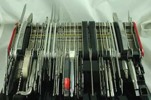
Above all, they are making a $1200 Swiss Army knife with every single tool. Yes. 85 tools including screwdrivers, a laser and a flashlight. And a "fine fork for watch spring bars."
Dig the Bush BeatBox video. Diabolical orange cat Jeff has a blog of what things he's killed.

 Check out AllPeers: A new plugin for Firefox on Linux, Windows and OS X that combines buddy lists and BitTorrent, allowing people to share files at high speed with their friends. It's in beta now, and there could be security holes, but I really want to try it. I am registered at feidt@macalester.edu so shoot me a message if you want to try it. It has just been released to Public Beta. A review notes it has 'performance issues:'
As I write this, the beta is just a day old, and the company is still ironing out some server issues. Initially, I had a problem actually downloading the tool, and once I did get it installed, performance was spotty. I had trouble signing up to the service, and the service itself went down several times while I was testing it. When it did work, the speed was acceptable.
In theory, performance should eventually be quite good. AllPeers uses a customized version of BitTorrent to swap files. So if you're sending the same file with multiple people, once others receive the file—or just parts of the file—they can help you send it to everyone else. Let's say I decide to share a file to my colleagues Sean Carroll and Lance Ulanoff. Once Sean downloads the file from my machine, AllPeers can use both his copy and mine to send it quickly to Lance. Some of the bits will come from my machine even as other bits are coming from Sean.
Despite current performance I like the basic design. It's simple—and that's what you want from a tool like this. It integrates completely with Firefox, adding a toolbar and various browser "panes" that open and close as need be. Simply by keying in e-mail addresses or AllPeers user names, you add friends and family to a contacts list, and once you've chosen a name from the list, you can start sending files via drag-and-drop (or good old-fashioned dialog boxes).
Russia and Central Asian countries nervous about US military action, conducting training exercises. Michel Chossudovsky writes that Russia and Central Asian Allies Conduct War Games in Response to US Threats, including Taijikistan, Kyrgyzstan, Russia, Kazakhstan and Uzbekistan. Things are also moving with China and India. Quoted:
"The growing militarisation is connected with mutual mistrust among countries in the region, say analysts. Iranian media have speculated that the United States is using Azerbaijan to create a military counterweight to Iran on the Caspian. It is possible that the exercise conducted by the CSTO – in which Russia is dominant – represents a response to concerns about United States involvement in developing Kazakstan’s navy. Observers say Russia is leaning more and more towards the Iranian view that countries from outside should be banned from having armed forces in the Caspian Sea."
Experts say the US is trying to step up the pressure on Iran, as well as to defend its own investments in Azerbaijan and Kazakstan. It is also trying to guarantee the security of the strategically vital Baku-Tbilisi-Ceyhan pipeline.
A military presence on the Caspian would give the United States an opportunity to at least partially offset its weakening influence in Central Asia, as seen in the closure of its airbase in Uzbekistan, the increased rent it is having to pay for the Manas base in Kyrgyzstan, and the diplomatic scandal that resulted in the expulsion of two Americans from Kyrgyzstan.
According to analysts, genuine security in the region can be achieved only if the military interests of all five Caspian countries are coordinated. At an international conference in Astrakhan in July 2005, Russia proposed the formation of a Caspian naval coordination group, but to date the initiative has not had much of a response.
And this is alarming:
The entire region seems to be on a war footing. These CSTO war games should be seen in relation to those launched barely a week earlier by Iran, in response to continued US military threats. These war games coincide with the showdown at the UN Security Council and the negotiations between permanent members regarding a Security Council resolution pertaining to Iran's nuclear program. "They are taking place within the window of time that has been predicted by analysts for the initiation of an American or an American-led attack against Iran" (see Mahdi Darius Nazemroaya, Global Research, 21 August 2006):
"War games and military exercises are now well underway within Iran and its territory. The Iranian Armed Forces—the Regular Armed Forces and the Revolutionary Guards Corps—began the first stage of massive nationwide war games along border areas of the province of Sistan and Baluchistan1 in the southeast of Iran bordering the Gulf of Oman, Pakistan, and NATO garrisoned Afghanistan to the east on Saturday, August 19, 2006. These war games that are underway are to unfold and intensify over a five week period and possibly even last longer, meaning they will continue till the end of September and possibly overlap into October, 2006".
Neo-cons are trying to hype up an Iran war, of course. Neo-cons looked foolish when the apocalypse didn't happen August 22nd like they predicted. Old Israeli spymaster Rafi Eitan said Israel should be prepared for an attack by Iran.
Raw Story: Less than half of Americans satisfied with 9/11 investigations. The NIST is going to probe if WTC 7 was brought down by bombs.
Is Cartoon Network making light of the Illuminati? A little bit...

Moral quagmire and moral clarity, based on this good bit by James Dobbins on Moral clarity in the mideast. More on this.
From the Daily Show, Bush's desperate soundbites:
According to WWTDD.com, Saddam Hussein got a personal screening of the South Park movie.
A Lockheed Martin engineer used YouTube to put his whistleblower message out, covered by the Washington Post. Check the video:
The Israel Lobby matter churns on: with the AIPAC espionage trial around the corner and a disastrous war between Israel and Lebanon, the underpinnings of the 'special relationship' between Israel and the United States seem to be front and center.
On Antiwar.com, Justin Raimondo looks at "Two Elephants in the room: Israel and its amen corner", looking at how the Washington Post's high-handed reporter Dana Milbank attacked top international politics professors John Mearsheimer and Stephen Walt for speaking at the Council on American-Islamic Relations. Mearsheimer and Walt have sparked big controversy by writing on the influence of what they termed "the Israel Lobby" on America's foreign policy. I would call it "the right-wing Israel Lobby" since there are Jewish groups like Peace Now and Tikkun who are silenced, gagged and marginalized in Washington by AIPAC and its neoconservative allies. One purpose of what they call the "Israel lobby" is to silence the more liberal Jewish lobby. (Antiwar is messed up so try this printable version)
Reporters like Milbank generally speak in favor of the corrupt neo-con foreign policy establishment, denigrating anyone looking critically at the fake Iraq war intelligence, and the role of AIPAC in influencing America's middle east policy. Milbank's mockery of Democratic hearings on the Downing Street Memo is a truly disgusting piece of reporting. For a background on AIPAC, look at AIPAC's Overt and Covert Ops by Juan Cole from 2004.
Other randomness: Israeli-style air security may head west.
Godwin's Law strikes again: Islamo-fascism: It is suddenly trendy to call America's opponents "Islamic fascists" that we can't "appease". Right now on MSNBC one of Bush's toadies is telling the Hardball host that they are basically the same as Nazis. It reminds me that political identities are shaped by words, and merging ethnic or religious words with menacing political formations is an effective way to demonize enemies. Terms like "Islamofascist" cut off critical thinking and processing actual reality, hoping to replace thought with emotional cues. This is why the real Nazis called the Jews "Judeo-Bolsheviks" – "one of the central themes of fascist ideology" as a paper on the official site of Israel's Holocaust museum puts it. "Islamofascist" is just the Judeobolshevik of the 21st century, and it serves pretty much the same purpose: to rationalize annihilation.
Local trickle-down: This is becoming a more-than-latent issue in local political campaigns, especially Keith Ellison's primary contest in Minnesota's Fifth Congressional District. Ellison is a Black Muslim, and the strongly Jewish St. Louis Park composes a large chunk of the Fifth District. While Jewish folks, like any other identified voting 'bloc', have a variety of views on the race, there were a lot of awkward stories about Ellison and the Nation of Islam, tying Ellison to the rather anti-semitic organization. I don't really know if these stories have stuck, but it certainly was a story that the anti-Ellison parts of the establishment latched onto.
Today, Ellison has been markedly more sympathetic to Lebanon than his primary opponents, which seems reasonable to me, but this promises to bring out the wrath of the hard core of the Israeli government's supporters. Stand by for what that's going to add up to by the September 12 primary...
Well that's all for now. Catch ya on the flip side. I'm going to the fair tomorrow.
Now that the dust is settling, we are hearing reports from the field about what exactly Hezbollah was doing down in South Lebanon. For more military analyses look at this excellent thread on Agonist.org Lessons Learned. Guys like William Lind have good stuff too.
For the moment, we are going to post a big chunk of Anthony Cordesman's summary of the whole damn thing. The press conference is here (PDF), the actual doc is here.
Center for Strategic and International Studies
1800 K Street, N.W. • Suite 400 • Washington, DC 20006
Phone: 1 (202) 775-3270 • Fax: 1 (202) 457-8746
Web: http://www.csis.org/burke/
Preliminary “Lessons” of the Israeli-Hezbollah War (PDF)
Anthony H. Cordesman, Arleigh A. Burke Chair in Strategy acordesman@aol.com
Working Draft for Outside Comment, Revised: August 17, 2006
[Page 16]....
Lessons and Insights into Various Tactical,
Technological, and Other Military Aspects of the War
Once again, it is important to stress that many key details of the tactics, technology, and
other aspects of the fighting are not yet clear. There are, however, several additional
lessons that do seem to emerge from the conflict.
High Technology Asymmetric Warfare
There is virtually no controversy over whether the fighting with the Hezbollah shows just
how well a non-State actor can do when it achieves advanced arms, and has strong
outside support from state actors like Iran and Syria. Top-level Israeli intelligence
personnel and officers stated that most aspects of the Hezbollah build-up did not surprise
them in the six years following Israel’s withdrawal in Lebanon.
Mosad officials stated that they had tracked the deployment of some 13,000 Katyushas,
far more sophisticated Iranian medium and long-range artillery rockets and guided
missiles (Zelzal 3), better surface-to-air missiles like the SA-14, SA-16, and possibly SA-
8 and SA-18, the CS-801 anti-ship missile, and several more capable anti-tank weapons
like the AT-3 Sagger Two and Kornet. They also identified the armed UAV the
Hezbollah used as either the Iranian Mirsad-1 or Ababil-3 Swallow.
Israeli intelligence officials also stated that they knew some 100 Iranian advisors were
working with the Hezbollah, and that they knew Iran not only maintained high volumes
of deliveries, but also had created a Hezbollah command center for targeting and
controlling missile fire with advanced C2 assets and links to UAVs. They noted that they
had warnings of better sniper rifles, night vision devices, and communications as well as
of technical improvements to the IEDs, bombs, and booby traps that the Hezbollah had
used before the Israeli withdrawal.
Israeli officials and officers were not consistent about the scale or nature of the
technology transfer to the Hezbollah or of how many weapons they had. In broad terms,
however, they agreed on several points.
Hezbollah Rocket and Missile Forces
Israel faced a serious local threat from some 10,000-16,000 shorter-range regular and
extended range versions of the Kaytusha. These are small artillery rockets with individual
manportable launchers. The rockets have small warheads and ranges of 19-28 kilometers
(12-18 miles) that can only strike about 11-19 kilometers (7-12 miles) into Israel unless
launched right at the border. They can easily be fired in large numbers from virtually any
position or building, and the Hezbollah had a limited capacity for ripple fire that partly
made up for the fact that such weapons were so inaccurate that they hit at random, could
only be aimed at town-sized targets, and had very small warheads. They were, however,
more than adequate to force substantial evacuations, paralyze local economic activity,
and drive the Israelis that remained to shelters.
Israeli officers and officials made it clear that Israel’s real reason for going to war,
however, was the steady deployment of medium and longer range systems, and the
potential creation of a major Iranian and Syrian proxy missile force that could hit targets
throughout Israel.
This force included Syrian 220mm rockets and systems like the Fajr 3, with ranges of 45-
75 kilometers, capable of striking targets as far south as Haifa and Naharia. The IAF was
able to destroy most of the Iranian Fajr 3 launchers the first night of the war, but the IDF
did not know the Syrian rockets were present.
The Fajr 3, or Ra’ad, has a range of 45 kilometers, a 45-kilogram warhead, a 240-mm
diameter, a 5.2-meter length, and a weight of 408 kilograms.
A total of some 24-30 launchers and launch vehicles, carrying up to 14 rockets each, seem to have been present.
The IAF feels it destroyed virtually all launchers that fired after the first few days, but
Israeli officers did not provide an estimate of how many actually survived.
They also included the Syrian 302-mm artillery rockets and Fajr 5, with ranges of 75 and
higher kilometers. The IAF again feels that it was able to destroy most of the Iranian Fajr
5 launchers the first night of the war, but the IDF again did not know the Syrian 302-mm
rockets were present.
The Fajr 5 is launched from a mobile platform with up to four rockets per launcher, and
has a maximum range of 75 kilometers, a 45-kilogram warhead, a 333-mm diameter, a
6.48-meter length, and a weight of 915 kilograms.
A total of some 24-30 launchers and launch vehicles seem to have been present. Again, the IAF feels it destroyed virtually all
launchers that fired after the first few days, but Israeli officers did not provide an estimate
of how many actually survived.
The level of Hezbollah capabilities with the Zelzal 1, 2, and 3 and other possible systems
has been described earlier. These missiles have ranges of 115-220 kilometers. The Zelzal
2 is known to be in Hezbollah hands and illustrates the level of technology involved. It is
a derivative of the Russian FROG 7, and has a range in excess of 115 kilometers. It has a
610-mm diameter, a 8.46-meter length, and a weight of 3,545 kilograms.
It requires a large TEL vehicle with a large target signature.
Anti-Ship Missiles
The Hezbollah C-802 missile that damaged an Israeli Sa’ar 5, one of Israel’s latest and
most capable ships, struck the ship when it was not using active countermeasures. It may
or may not have had support from the coastal radar operated by Lebanese military fires
destroyed by IAF forces the following day.
According to Global Security, the Yingji YJ-2 (C-802) is powered by a turbojet with
paraffin-based fuel. It is subsonic (0.9 Mach), weighs 715 kilograms, has a range 120
kilometers, and a 165 kilogram (363 lb.). It has a small radar cross section and skims
about five to seven meters above the sea surface when it attacks the target. It has good
anti-jamming capability.
Anti-Armor Systems
The IDF faced both older anti-tank guided missile (ATGM) threats like the AT-3 Sagger,
AT-4 Spigot, and AT-5 Spandrel—each of which is a wire-guided system but which
become progressively more effective and easier to operate as the model number
increases.
The IDF also faced far more advanced weapons like the Russian AT-13 Metis-
M which only requires the operator to track the target, and the AT-14 Kornet-E, a third
generation system, that can be used to attack tanks fitted with explosive reactive armor,
and bunkers, buildings, and entrenched troops. Many of these systems bore serial
numbers that showed they came directly from Syria, but others may have come from Iran.
The AT-14 is a particularly good example of the kind of high technology weapon the US
may face in future asymmetric wars. It can be fitted to vehicles or used as a crew-portable
system.
It has thermal sights for night warfare and tracking heat signatures, and the
missile has semi-automatic command-to-line-of-sight laser beam-riding guidance. It flies
along the line of sight to engage the target head-on in a direct attack profile. It has a
nominal maximum range of 5 kilometers. It can be fitted with tandem shaped charge
HEAT warheads to defeat tanks fitted with reactive armor, or with high
explosive/incendiary warheads, for use against bunkers and fortifications. Maximum
penetration is claimed to be up to 1,200mm.
Other systems include a greatly improved version of the 105.2-mm rocket-propelled
grenade called the RPG-29 or Vampire. This is a much heavier system than most
previous designs. It is a two-man crew weapon with a 450-meter range, and with an
advanced 4.5-kilogram grenade that can be used to attack both armor and bunkers and
buildings. Some versions are equipped with night sights.
The IDF saw such weapons used with great tactical skill, and few technical errors,
reflecting the ease with which third generation ATGMs can be operated. They did serious
damage to buildings as well as armor. The Hezbollah also showed that it could use the
same “swarm” techniques to fire multiple rounds at the same target at the same time often
used in similar ambushes in Iraq. As of August 11th, however, a total of 60 armored
vehicles of all types (reports these were all tanks are wrong) had been hit. Most continued
to operate or were rapidly repaired in the field and restored to service. Only 5-6 of all
types represented a lasting vehicle kill.
Anti-Aircraft
The IDF estimates that the Hezbollah at least have the SA-7 and SA-14 manportable
surface-to-air missile system, probably have the SA-16, and may have the SA-18. The
SA-14 and SA-16 are much more advanced than the SA-7, but still possible to counter
with considerable success. The SA-18 Grouse (Igla 9K38) is more problematic.
According to the Federation of American Scientists, it is an improved variant of the SA-
14 that uses a similar thermal battery/gas bottle, and the same 2 kilogram high-explosive
warhead fitted with a contact and grazing fuse. The missile, however, is a totally new
design and has much greater operational range and speed. It has a maximum range of
5200 meters and a maximum altitude of 3500 meters, and uses an IR guidance system
with proportional convergence logic, and much better protection against electro-optical
jammers.
It is possible that it may have been given a few SA-8 Gecko (Russian 9K33 Osa) SAM
systems that are vehicle mounted, radar-guided systems with up to a 10-kilomter range,
and six missiles per vehicle.
The IDF is concerned that these systems would allow the Hezbollah to set up “ambushes”
of a few IAF aircraft without clear warning—a tactic where only a few SA-8s could
achieve a major propaganda victory. This concern, coupled to the risk of SA-16 and SA-
18 attacks, forced the IAF to actively use countermeasures to an unprecedented degree
during the fighting.
Low Signature; Asymmetric Stealth
One key aspect of the above list is that all of the systems that are not vehicle-mounted
are low signature weapons that very difficult to characterize and target and easy to bury
or conceal in civilian facilities. Stealth is normally thought of as high technology. It is
not. Conventional forces still have sensors geared largely to major military platforms and
operating in environments when any possible target becomes a real target. None of these
conditions applied to most Hezbollah weapons, and the problem was compounded by the
fact that a light weapon is often easier to move and place without detection in a built-up
area than a heavy one.
This signature issue applies to small rockets like the Qassam and Kaytusha that require
only a vestigial launcher that can be place in a house or covert area in seconds, and fired
with a timer. Israeli video showed numerous examples of Hezbollah rushing into a home,
setting up a system, and firing or leaving in a time in less than a minute.
It also applies to UAVs. Israel’s normal surveillance radars could not detect the Iranian
UAVs, and the IDF was forced to rush experiments to find one that could detect such a
small, low-flying platform. (This may be an artillery counterbattery radar but Israeli
sources would not confirm this.)
Technological Surprise
Israeli officers and experts did indicate that the IDF faced technological surprise and
uncertainty in some areas.
Syria evidently supplied nearly as many medium range artillery rockets—220 mm and
302 mm—as Iran, and a major portion of the Katyushas. The RPG-29 anti-tank weapon
and possible deployment of more advanced anti-tank guided weapons was not
anticipated. It was not possible to determine how advanced the surface-to-air missiles
going to Hezbollah forces were. It was not possible to determine the exact types and level
of capability for Iran’s long-range missile transfers because the three types of Zelzal are
so different in performance, and other Iranian systems (including ones with much better
guidance) are similar to what Israel calls the Zelzal 2 and 3.
The fact Israel faced some degree of technological surprise should not, however, be a
source of criticism unless there is evidence of negligence. If there is a lesson to be drawn
from such surprise, it is that it is almost unavoidable when deliveries are high and many
weapons are small and/or are delivered in trucks or containers and never seen used in
practice.
It is even more unavoidable when rapid transfer can occur in wartime, or new facilities
are created, such as the joint Iranian-Syrian-Hezbollah intelligence (and advisory?) center
set up during the fighting in Damascus to give the Hezbollah technical and tactical
intelligence support. The lesson is rather that the war demonstrates a new level of
capability for non-state actors to use such weapons.
Cost
The US and Israel quote figures for the cost of these arms transfers that can reach the
billions, and talk about $100-$250 million in Iranian aid per year. The fact is that some
six years of build-up and arms transfers may have cost closer to $50-$100 million in all.
The bulk of the weapons involved were cheap, disposable or surplus, and transfers put no
strain of any kind on either Syria or Iran.
This is a critical point, not a quibble. Playing the spoiler role in arming non-state actors
even with relatively advanced weapons is cheap by comparison with other military
options. The US must be prepared for a sharp increase in such efforts as its enemies
realize just how cheap and easy this option can be.
Reevaluating the Level of Tactical and Technological Risk in the Forces of
Asymmetric and Non-State Actors
Experts like Sir Rupert Smith have already highlighted the risk posed to modern military
forces and states by opponents that fight below the threshold in which conventional
armies are most effective. Iraq has shown that even comparatively small transfers of
technology like motion sensors, crude shaped charges, and better triggering devices can
have a major impact in increasing the ability of insurgents and terrorists.
The Hezbollah have raised this to a whole new level, operating with effective sanctuary
in a state and with major outside suppliers—which Al Qa’ida has largely lacked. It is also
only the tip of the iceberg. It does not seem to have used the advanced SAMs listed
above, but the very threat forces IAF fighters and helicopters to constantly use
countermeasures. The use of ATGMs and RPG-29 not only inhibits the use of armor, but
sharply reduces the ability to enter buildings and requires dispersal and shelter.
The simple risk of long-range rocket attacks requires constant air and sensor coverage in
detail over the entire Hezbollah launch front to be sure of hitting launchers immediately.
The IDF’s task also could grow sharply if Iran/Syria sent the Hezbollah longer-range
rockets or missiles with precision guidance—allowing one missile to do serious damage
to a power plant, desalination plant, refinery/fuel storage facility with little or no warning.
The lesson here is not simply Hezbollah tactics to date. It is the need to survey all of the
weapons systems and technology that insurgents and terrorists could use in future strikes
and wars with the thesis that technology constraints are sharply weakening, and the US
and its allies face proliferation of a very different kind. It is to explore potential areas of
vulnerability in US forces and tactics non-state or asymmetric attackers can exploit,
carefully examine the holdings of state sponsors of such movements, and reexamine web
sites, training manuals, etc, to track the sharing or exploration of such technology.
Like Israel, the US and its other allies face long wars against enemies that have already
shown they are highly adaptive, and will constantly seek out weaknesses and the ability
to exploit the limits to conventional warfighting capabilities. The US must anticipate and
preempt when it can, and share countermeasure tactics and technologies with its allies.
Informal Networks and Asymmetric "Netcentric Warfare"
Like insurgent and terrorist groups in Iraq and Afghanistan—and in Arab states like
Algeria, Egypt, Saudi Arabia, and other states threatened by such groups—the Hezbollah
showed the ability of non-state actors to fight their own form of netcentric warfare. The
Hezbollah acted as a "distributed network" of small cells and units acting with
considerable independence, and capable of rapidly adapting to local conditions using
media reports on the, verbal communication, etc.
Rather than have to react faster than the IDF's decision cycle, they could largely ignore it,
waiting out Israeli attacks, staying in positions, reinfiltrating or reemerging from cover,
and choosing the time to attack or ambush. Forward fighters could be left behind or
sacrificed, and "self-attrition" became a tactic substituting for speed of maneuver and the
ability to anticipated IDF movements.
Skilled cadres and leadership cadres could be hidden, sheltered, or dispersed. Rear areas
became partial sanctuaries in spite of the IDF. Aside from Nasrallah, who survived, no
given element of the leadership cadre was critical.
A strategy of attrition and slow response substituted for speed and efficiency in command
and control. The lack of a formal and hierarchical supply system meant that disperse
weapons and supplies—the equivalent of "feed forward logistics"—accumulated over six
years ensured the ability to keep operating in spite of IDF attacks on supply facilities and
resupply.
The ability to fight on local religious, ideological, and sectarian grounds the IDF could
not match provided extensive cover and the equivalent of both depth and protection. As
noted earlier, civilians became a defensive weapon, the ability to exploit civilian
casualties and collateral damage became a weapon in political warfare, and the ability to
exploit virtually any built up area and familiar terrain as fortresses or ambush sites at
least partially compensated for IDF armor, air mobility, superior firepower, and sensors.
The value and capability of such asymmetric "netcentric" warfare, and comparatively
slow moving wars of attrition, should not be exaggerated. The IDF could win any clash,
and might have won decisively with different ground tactics. It also should not be
ignored. The kind of Western netcentric warfare that is so effective against conventional
forces has met a major challenge and one it must recognize.
Well that sounds like some badass shit. More later, but for now, dig the asymmetrical networkality of the low apogee swarm missile strategy. It delivers the goods!
The next three paragraphs are horror incarnate. It's like we wrapped everything wrong about the whole last six years into one little ball and fucking nuked the world. Seymour Hersh's latest:
Cheney’s office supported the Israeli plan, as did Elliott Abrams, a deputy national-security adviser, according to several former and current officials. (A spokesman for the N.S.C. denied that Abrams had done so.) They believed that Israel should move quickly in its air war against Hezbollah. A former intelligence officer said, “We told Israel, ‘Look, if you guys have to go, we’re behind you all the way. But we think it should be sooner rather than later—the longer you wait, the less time we have to evaluate and plan for Iran before Bush gets out of office.’ ”
Cheney’s point, the former senior intelligence official said, was “What if the Israelis execute their part of this first, and it’s really successful? It’d be great. We can learn what to do in Iran by watching what the Israelis do in Lebanon.”
The Pentagon consultant told me that intelligence about Hezbollah and Iran is being mishandled by the White House the same way intelligence had been when, in 2002 and early 2003, the Administration was making the case that Iraq had weapons of mass destruction. “The big complaint now in the intelligence community is that all of the important stuff is being sent directly to the top—at the insistence of the White House—and not being analyzed at all, or scarcely,” he said. “It’s an awful policy and violates all of the N.S.A.’s strictures, and if you complain about it you’re out,” he said. “Cheney had a strong hand in this.”
Securing the Northern Border:
Syria challenges Israel on Lebanese soil. An effective approach, and one with which American can sympathize, would be if Israel seized the strategic initiative along its northern borders by engaging Hizballah, Syria, and Iran, as the principal agents of aggression in Lebanon, including by:
• striking Syria’s drug-money and counterfeiting infrastructure in Lebanon, all of which focuses on Razi Qanan.
• paralleling Syria’s behavior by establishing the precedent that Syrian territory is not immune to attacks emanating from Lebanon by Israeli proxy forces.
• striking Syrian military targets in Lebanon, and should that prove insufficient, striking at select targets in Syria proper.
"A Clean Break: A New Strategy for Securing the Realm" by Richard Perle, Douglas Feith & other neo-cons (1996).
Emphasis mine on 'precedent,' or 'demo', as it was called in Washington during the Lebanon planning stage earlier this year.
Ten years on, the clean break has run its course:
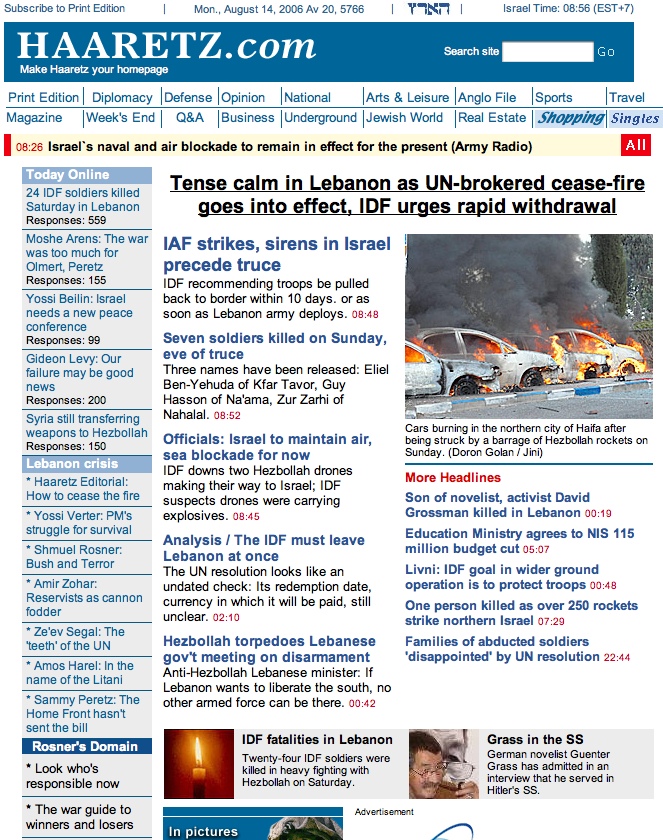
The clock just ran out. And now we find out that they were winding it up weeks before Hezbollah captured the Israeli soldiers. The captures were just a pretext: Israel and the United States wanted to smack Hezbollah around to demonstrate how weak the Iranian proxy was, and also to prepare American military planners for an Iranian attack with a "demo" of bombing (Shiite) missiles, bunkers and tunnels.
Of course, the demo failed. Failed Big Time. Thousands of dead all around, an inhuman consequence of the war Israel launched with American backing, but it's quite possible that Hezbollah's performance in the war has blown all the Pentagon's Iran fantasies to smithereens. In Washington, Bush and Cheney planned to kill lots of Lebanese in order to weaken Hezbollah and prepare the Iran war. That alone should chill you for a while.
It should chill you almost as much as witnessing the complete failure of the Western military style's beloved "full spectrum dominance", which we pretty much just did. Strategy, intelligence, tactics, training, logistics: all were complete failures. The Bush Administration misread Lebanon in a way that Ariel Sharon never would have. Now Israel's vaunted military "posture" has been crushed, revealed to all the world as incapable of defeating a well-armed modern infantry playing defense.
Israel's weak, almost meaningless military performance was one of the 21st century's signature moments – and the cruel ideologies endorsing the carpet bombing of Lebanon – this is the face of the Neoconservative world to come, if we do nothing.
The sense that Israel's military power would create order in the Middle East, forcing the Arabs to accept a peace deal on Israel's dictated terms, was one of the major principles of the Neoconservative philosophy, and the Revisionist flavor of Zionism before it. In the 1920s, Vladimir Jabotnisky wrote in the Iron Wall that only force would or could bring the Arabs to moderation – and today the Neoconservatives refuse, in principle, to negotiate with Evil Ones. Their fantasy that Israel and America could create a new, hard hegemonic (imperial?) alliance over the Middle East, on a foundation of splintered ethnic groups and military force, would never work. (Partly because those pesky subjects of the alliance tend to unite when they get bombed). Today, a core element of the Neoconservative philosophy has just evaporated as the UN saves the day. Its gears are gone.
Part of the Bush administration's plan here, according to Hersh, was to set Lebanon's other minorities against Hezbollah by bombing the common infrastructure of the country. This appears to me a pretty good example of the Iron Wall intended to divide Arabs so they cut a nicer deal with Israel. And yet again, it failed because it's a stupid fucking idea that has ruined Israel's fortunes with illusory violence at every turn. Hersh:
The long-term Administration goal was to help set up a Sunni Arab coalition—including countries like Saudi Arabia, Jordan, and Egypt—that would join the United States and Europe to pressure the ruling Shiite mullahs in Iran. “But the thought behind that plan was that Israel would defeat Hezbollah, not lose to it,” the consultant with close ties to Israel said.
Maybe Ariel Sharon learned this one the hard way in Beirut. He never wanted to try for the Litani River again, I think we can guess.
The information operation to justify the war was cynical and employed a "family == nation" metaphor designed to help the American audience psychologically project support for the war agenda, in a way that the ordinary spats between Israel and Arabs don't. The Israeli soldiers captured were just the 'morality' window dressing of the war makers. They were nothing but symbolic pawns, deliberately used to inspire the Israeli and American populations to support their leaders. They were just an opening bracket, a façade fronting a sinister "demonstration war" blasted through Lebanon, intended to enhance Israel and America's strategic might – and the Republican Party's dark political prospects in November.
Sy Hersh is giving us the goods again. He will probably be the one man who holds back the Iran war from happening. What he reports here is the hardest version of what I suspected: in DC they egged this war on, they planned it, they wanted to blow the shit out of Lebanon, and then Iran. They've wanted to run the Clean Break program since 1996. It is clear today that it's a failure at every level, but soon they'll hand out medals to make themselves feel better.
You need to read this whole article right away. This is another disastrous execution of an ideology that has critically damaged Israel, the United States, Lebanon and Iraq. The big winners are Al Qaeda and Iran. Tell me again why it's such a fucking good idea.
WATCHING LEBANON: Washington’s interests in Israel’s war.
by SEYMOUR M. HERSH
Issue of 2006-08-21, Posted 2006-08-14
In the days after Hezbollah crossed from Lebanon into Israel, on July 12th, to kidnap two soldiers, triggering an Israeli air attack on Lebanon and a full-scale war, the Bush Administration seemed strangely passive. “It’s a moment of clarification,” President George W. Bush said at the G-8 summit, in St. Petersburg, on July 16th. “It’s now become clear why we don’t have peace in the Middle East.” He described the relationship between Hezbollah and its supporters in Iran and Syria as one of the “root causes of instability,” and subsequently said that it was up to those countries to end the crisis. Two days later, despite calls from several governments for the United States to take the lead in negotiations to end the fighting, Secretary of State Condoleezza Rice said that a ceasefire should be put off until “the conditions are conducive.”
The Bush Administration, however, was closely involved in the planning of Israel’s retaliatory attacks. President Bush and Vice-President Dick Cheney were convinced, current and former intelligence and diplomatic officials told me, that a successful Israeli Air Force bombing campaign against Hezbollah’s heavily fortified underground-missile and command-and-control complexes in Lebanon could ease Israel’s security concerns and also serve as a prelude to a potential American preëmptive attack to destroy Iran’s nuclear installations, some of which are also buried deep underground.
[snip.........]
The U.S. government consultant with close ties to Israel told me, however, that, from Israel’s perspective, the decision to take strong action had become inevitable weeks earlier [than the kidnapping], after the Israeli Army’s signals intelligence group, known as Unit 8200, picked up bellicose intercepts in late spring and early summer, involving Hamas, Hezbollah, and Khaled Meshal, the Hamas leader now living in Damascus.
One intercept was of a meeting in late May of the Hamas political and military leadership, with Meshal participating by telephone. “Hamas believed the call from Damascus was scrambled, but Israel had broken the code,” the consultant said. For almost a year before its victory in the Palestinian elections in January, Hamas had curtailed its terrorist activities. In the late May intercepted conversation, the consultant told me, the Hamas leadership said that “they got no benefit from it, and were losing standing among the Palestinian population.” The conclusion, he said, was “ ‘Let’s go back into the terror business and then try and wrestle concessions from the Israeli government.’ ” The consultant told me that the U.S. and Israel agreed that if the Hamas leadership did so, and if Nasrallah backed them up, there should be “a full-scale response.” In the next several weeks, when Hamas began digging the tunnel into Israel, the consultant said, Unit 8200 “picked up signals intelligence involving Hamas, Syria, and Hezbollah, saying, in essence, that they wanted Hezbollah to ‘warm up’ the north.” In one intercept, the consultant said, Nasrallah referred to Olmert and Defense Minister Amir Peretz “as seeming to be weak,” in comparison with the former Prime Ministers Ariel Sharon and Ehud Barak, who had extensive military experience, and said “he thought Israel would respond in a small-scale, local way, as they had in the past.”
Earlier this summer, before the Hezbollah kidnappings, the U.S. government consultant said, several Israeli officials visited Washington, separately, “to get a green light for the bombing operation and to find out how much the United States would bear.” The consultant added, “Israel began with Cheney. It wanted to be sure that it had his support and the support of his office and the Middle East desk of the National Security Council.” After that, “persuading Bush was never a problem, and Condi Rice was on board,” the consultant said.
The initial plan, as outlined by the Israelis, called for a major bombing campaign in response to the next Hezbollah provocation, according to the Middle East expert with knowledge of U.S. and Israeli thinking. Israel believed that, by targeting Lebanon’s infrastructure, including highways, fuel depots, and even the civilian runways at the main Beirut airport, it could persuade Lebanon’s large Christian and Sunni populations to turn against Hezbollah, according to the former senior intelligence official. The airport, highways, and bridges, among other things, have been hit in the bombing campaign. The Israeli Air Force had flown almost nine thousand missions as of last week. (David Siegel, the Israeli spokesman, said that Israel had targeted only sites connected to Hezbollah; the bombing of bridges and roads was meant to prevent the transport of weapons.)
The Israeli plan, according to the former senior intelligence official, was “the mirror image of what the United States has been planning for Iran.” (The initial U.S. Air Force proposals for an air attack to destroy Iran’s nuclear capacity, which included the option of intense bombing of civilian infrastructure targets inside Iran, have been resisted by the top leadership of the Army, the Navy, and the Marine Corps, according to current and former officials. They argue that the Air Force plan will not work and will inevitably lead, as in the Israeli war with Hezbollah, to the insertion of troops on the ground.)
[.......]In the early discussions with American officials, I was told by the Middle East expert and the government consultant, the Israelis repeatedly pointed to the war in Kosovo as an example of what Israel would try to achieve. The NATO forces commanded by U.S. Army General Wesley Clark methodically bombed and strafed not only military targets but tunnels, bridges, and roads, in Kosovo and elsewhere in Serbia, for seventy-eight days before forcing Serbian forces to withdraw from Kosovo. “Israel studied the Kosovo war as its role model,” the government consultant said. “The Israelis told Condi Rice, ‘You did it in about seventy days, but we need half of that—thirty-five days.’ ”
.....Get ready for the New October Surprise. Michael Ledeen is pissed right now. He's gonna pull some shit to stage an Iran conflict, as James Bamford warned you in Rolling Stone.

Who, me?
It's just another disaster for the Jews and the Arabs, and certainly a disaster for America. When will these folks realize that their leaders are the real enemies, paralyzing their nations with fear to secure their own power?
And what about War Crimes charges? Billions of people want to know...
The test of the Zionist left. By Yossi Beilin (Haaretz)
There are those who expect the Zionist left to join in the revelry of war, in the pathetic slogans such as "We will win" and in the fiery comments such as "Nasrallah will remember who Amir Peretz is."
There are those who expect us to join the non-Zionist left, which is calling for a unilateral cease-fire, accuses Israel of war crimes, demands that Hamas and Hezbollah be given what they want, and opposes all use of force. Both sides say this is the test of the Zionist left - and they are right.
We have a deep belief in the right of the Jewish people to a democratic and secure state, which has a stable Jewish majority: the state of the Jewish people and all of its citizens. We are convinced our national interest is in completing the moves toward peace with the Palestinians, Syria and Lebanon, and that there is no alternative to an agreement.
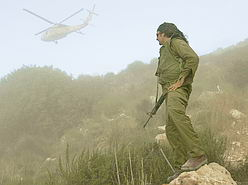 I am not gonna feel like writing tomorrow, so it's either now or the weekend. Here are a lot of bits from the past couple weeks in the Lebanon-Israel conflict. The window after the first two weeks was Israel's chance to capture the initiative against Hezbollah and attempt to achieve their hazily articulated goals in this vicious little war. It's a big war, but the space is very small.
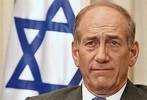 Escalations for the weekend: Haaretz: Security cabinet okays decision to expand ground operation in Lebanon:
.......PM wavered on expansion decision
Olmert was hesitant prior to the meeting on whether to approve the proposed expansion of the IDF ground operation in south Lebanon.
Olmert was concerned that the plan presented by the defense establishment would result in hundreds of casualties, and therefore, wanted to subject it to a careful cost-benefit analysis. In Tuesday's fighting in Lebanon five soldiers were killed and 23 others wounded, two of them seriously. According to a government source, Olmert had also asked the army to present him with several different options for a ground operation.
A decision to send troops deeper into Lebanon is fraught with considerable risk. In doing so, Israel could set itself up for new criticism that it is sabotaging diplomatic efforts. Also, a wider ground offensive might do little to stop Hezbollah rocket fire on Israel, while sharply increasing the number of casualties among Israeli troops.
While most of the cabinet was expected earlier to back whatever Olmert decides, sources in the Prime Minister's Office said that three to four ministers were likely to oppose a large-scale ground operation regardless of Olmert's position. The IDF's proposal was for a two-week ground operation that would involve conquering the entire area south of the Litani River, and even a few areas north of it, in order to reduce Hezbollah's short-range rocket launching capabilities.
IDF Chief of Staff Dan Halutz said Tuesday that such an operation was necessary "in order to end this war differently." People who participated in discussions of the plan with him said they had never heard him speak as forcefully in favor of anything as he did in favor of the proposed ground operation. Peretz fully supports the army's plan, which he considers essential for Israel to achieve its diplomatic goals.
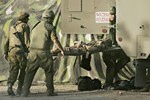 Nine paratroopers killed in attack on home in Dibel; 15 soldiers killed Wednesday in south Lebanon
By Amos Harel and Eli Ashkenazi, Haaretz Correspondents, and Agencies Last update - 01:59 10/08/2006
Fifteen Israel Defense Forces troops were killed on Wednesday, the IDF announced late Wednesday night, as fierce fighting with Hezbollah guerillas raged in the southern Lebanon villages of Ayta al-Shaab and Debel.
The 15 IDF soldiers were killed in a series of firefights across the front. In the most serious incident, nine reserve paratroopers were killed and 11 wounded by antitank missiles fired on a house in the village of Debel, in the central sector. Four reservists from an armored brigade were killed in a tank explosion, apparently caused by antitank missiles, in the town of Ayta al-Shaab. An infantryman was killed late Wednesday when he was hit by a mortar in Marjayoun.
DEBKAFile: Israeli official spokesman say deep ground push into Lebanon approved Wednesday to reduce rocket attacks is put on hold for 48 hours to give more time for diplomacy August 10, 2006, 9:26 AM (GMT+02:00)
DEBKAfile adds: On the ground, the first troop and tank elements of the advance began moving Wednesday overnight and are continuing Thursday, Aug. 10.
The decision Wednesday, Aug. 9, by 9 votes, none against and 3 abstentions, includes areas up to the Nabatea plateau and Arnoun beyond the Litani River. The objectof the extension is to reach and eliminate Hizballah's rocket-launch centers. It deepens Israel's thrust to some 45 km from the border and calls for a further large influx of army reserves.
DEBKAfile’s military sources add the extended operation does not promise the total stoppage of all rocket fire against Israel, but could potentially bring about a sizeable reduction from up to 200 a day to some 30 or 50.
Also: The stakes of the Lebanon War have shot up with the expansion of the Israeli offensive up to the Litani and Nasrallah’s rejection of diplomacy in favor of battle
Israel's military of old was specialized in quick, mechanized warfare. As they settled into the occupied territories, despite all the heavy weapons, the IDF reoriented itself to battling Palestinians, typically armed with rifles, handguns or machine guns. The Palestinians have some rocket-propelled grenades, as well, but they lack advanced infantry weapons. So the IDF has phased away from preparing for war with real infantries, and instead play supercop on the hapless residents of the West Bank.
They really thought that Hezbollah was only as "thick" as HAMAS, I guess. The Israelis went storming in without realizing that Hezbollah had lots of anti-tank missiles - on rocky terrain that doesn't give a lot of space for tanks. The IDF doctrine failed in the face of a new kind of conflict.
Right now we are watching a turning point in the nature of warfare. Everything from pack mules to to hacking to encrypted satellite feeds fits into fourth-generation warfare (pdf). Sub-state actors will basically be able to fight a top-notch modern army.
ANALYSIS: IDF still not in control of strip along Lebanon's border By Ze'ev Schiff, Haaretz Correspondent 08:57 10/08/2006
The large number and the location of the casualties that the Israel Defense Forces sustained Wednesday indicate that the army does not yet control the narrow strip along the border, although this stage of the ground operation was supposed to have been completed already.
The two battles also reveal a great deal about Hezbollah's method of fighting. They took place in two relatively small communities, Ayta al-Shab and Debel, close to the international border, on territory that until May 2000 was in Israel's Security Zone.
The ground operation, dubbed "Change of Direction 8," was intended to conquer this border strip. First it was to be a two- to three-kilometer strip. Then it was expanded to five to six kilometers, including numerous Lebanese villages and towns. The mission was to blow up all Hezbollah's outposts in this strip and drive its forces out.
What happened in Bint Jbail recurred in Ayta al-Shab. Although it seemed that the town had been conquered, it transpired again and again that there were still Hezbollah men in it. Once again, clashes and battles took place, and again, the IDF suffered dead and wounded. Although the army had conquered the town, Hezbollah men were hiding in underground bunkers well camouflaged from the outside. The bunkers had been stocked with large quantities of food, enough to last for weeks, and ammunition, including antitank missiles and, in several cases, short-range rockets.
The bunkers are connected to electricity and, according to one report, are air conditioned. When the fighting dies down, Hezbollah fighters emerge from the bunkers and set up ambushes for IDF soldiers and armored vehicles. That is why soldiers are hit repeatedly in the same places.
On several occasions, there have been difficulties evacuating wounded soldiers under fire. At times, Hezbollah fighters have fired rockets at Israel from areas close to the border that the IDF had supposedly conquered already. The means available to flush the guerrillas out of their underground shelters are not always employed.
Senior officers have suggested, inter alia, that the army bombard these towns heavily and even destroy them. But in any case, a decision has been made not to reenter them at this stage. The IDF could forge ahead, as it has done in the last two days in the Marjayoun area. But even after such an incursion, Hezbollah fighters who remain in the bunkers could continue launching rockets. In other words, they could fire toward Israel from behind the lines of IDF forces that have progressed deep into Lebanon. It is clear that the Hezbollah men who stayed behind are equipped with two-way radios and receive information from scouts hiding near the border. This explains the difficulties in managing the fighting in south Lebanon, which the IDF has not encountered before.
Even if Hezbollah "loses", the writing is on the wall. In the 21st century "the State" itself is weakening. Sub-national organizations like Hezbollah, with economic, military, political, social, educational, medical (and often spiritual) branches are displacing the State.
One should remember that the Middle East's artificial European-drawn boundaries have left many overlapping ethnic groups. The Pashtuns now at the core of the Taliban straddle Afghanistan/Pakistan. The Kurds are organized a bit like Hezbollah, and the ruthless pursuit of the Kurds' interests has rewarded them well since the US toppled Saddam. But they too are divided between parties that ruthlessly fight each other.
In Syria, only a few dozen miles east of Israel's bombing campaign lie many major Arab Sunni tribes like the Dulaimis, who especially live in cities along the river into Iraq, where their cousins' tribes live, sparring with Kurds and Shiites.
In this kind of region, everyday people are going to direct their primary loyalties towards sub-national groups that they believe represent their interests. By the early 1990s, Hezbollah, which the Iranians helped create by binding together different Lebanese Shiites, was seen as something of a successful model – social, political, military: robustly structured to resist political pressure, infiltration and military assaults from the Israelis and others.
Before Saddam fell, The Iranians used the Lebanese sub-state model inside Iraq, to lay the framework for the Shiite rise to power. Very quickly, SCIRI, Muqtada Sadr's people, and the Dawa Party all had organized cadres of armed guys, but more importantly, social services and methods for trying to restore any sense of law and order shattered with the US invasion. If the guys on the block with guns keep the thieves away, then they are pretty much your state, even if they don't report to Baghdad.
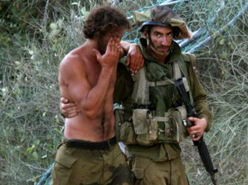 The news in Israel right now is that 15 reservists got killed in Lebanon, with heavy fighting around Bint Jbail, a site the IDF captured and subsequently evacuated. As the maps made clear, Bint Jbail is not more than a few kilometers from the border, yet the Israeli forces, despite all the bombing and everything, have not been able to hold that area, once they reached it and tried to occupy.
Reports in the Israeli media indicate that Hezbollah is able to keep attacking in areas the Israelis have already 'captured.' I think it's pretty likely that Hezbollah has drilled tunnels hundreds, if not thousands of meters long, attached to deeply hidden bunkers with all the necessary weapons and supplies. It is an amazing intelligence failure that the Israelis didn't anticipate this, and still, within a very small space the IDF has not been able to block out Hezbollah. The tempo of rocket attacks has not been curtailed in any serious way, and Israeli military analysts don't really think it can be shut down without a wide invasion. Hezbollah is winning the tactical situation by playing very hard-core defense with lots of anti-tank missiles. So far, it's mostly been a successful military strategy.
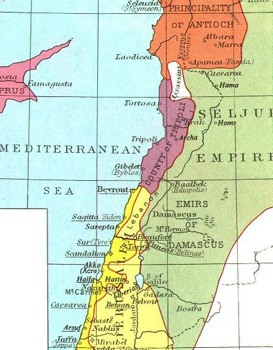 This is in keeping with the local style: in the good old days of the Seljuk Empire (c. 1100), the Hashshashin, or Assassins, would hang out somewhere between Damascus and Antioch - the home of the Holy Hand Grenade. The map's white spot shows a patch of mountainous land where the Assassins held sway. Mountainous redoubts are easier to defend, and such clever methods have migrated about 200 miles south, where nearly a millennia later, some pretty insane shit is going down.
Well then, thats enough rambling background. Here's some damn links.
The rockets keep coming: Hizbollah rockets kill 15 in northern Israel. Hapless reservists. An ugly scene. IDF Raids near Tyre.
Emotional reaction in Israel propels poor policy:
`Peace' is a term not used in the public space in Israel anymore...No one expects any dialogue on a real practical level. The military always offers a shortsighted immediate way out. The wish to identify with the power of the gun and the uniform is still alive in Israeli tribal DNA. Revenge is a word not used in the open; it is there in the undercurrent of the emotions expressed by the public, our bombardment of Gaza had the same motive behind it.
UK Guardian: Israeli pilots 'deliberately miss' targets: Fliers admit aborting raids on civilian targets as concern grows over the reliability of intelligence
You need to give money to AntiWar.com. Their work is important and kinda spooky. Rumors that apocalyptic Christian writers are visiting the White House. Stratfor has free podcasts. Updates on the Tikkun Olam blog (תקון עולם: Make the World a Better Place).
Iranian dimensions:
Haaretz: Nasrallah's dilemma By Amos Harel and Avi Issacharoff
As the war progresses, the depth of Iranian involvement in Hezbollah activity is increasingly being revealed. Hezbollah has established a Tehran-sponsored forward outpost here, under the noses of the Israelis. When the war ends, Iranian soul-searching will include the question as to whether the activity here was not premature: whether the strategic card of the rocket battery was not revealed too early, for the sake of a negligible goal like the release of the four prisoners, instead of saving it for the day of judgment, for the eruption surrounding its nuclear program.
The Iranians are involved up to their necks in Hezbollah activity: Their advisers participated in the firing of the missiles at Israeli ships and in the firing of Strela (SA-7) antiaircraft missiles at Israeli planes and helicopters. During Israel Defense Forces operations in the south, sophisticated listening rooms were discovered, via which the Iranians eavesdropped on Israeli communications and telephone networks, both civilian and military.
Guardian: Bloody night in Beirut as Israel intensifies aerial bombardment: IDF warns UN troops will be attacked if they repair bridges (aug 8)
 Information warfare sector: Olmert meets with spokespeople to sharpen PR message. PrisonPlanet says: Another Israeli Myth Exposed: There Were No Hezbollah Rockets In Qana but Israeli media alleges Qana killing was staged, dubbing this pattern Hezbollywood. With a certain sense of weird horror, Haaretz features "Where there's smoke, there's liars": "1. The Muslim Lie Mode, or The Dead as Visual Aid (When Arabs report what Israel has done) 2. The Israeli Lie Mode, or The Dead as Enemy Weapon (When Israelis report what Israel has done). 3. The American Lie Mode, or The Dead as Nonexistent." Anyway, Half of U.S. Still Believes Iraq Had WMD.
The US-Israeli link: this looks at Condi and an IDF spokesperson as two flipsides: Between two friends by Tom Segev:
During the past 39 years since the Six-Day War, the United States did not force Israel to pull out of the West Bank, but more than once acted to block Israeli military actions. Over time, we have grown accustomed to the Americans saving us, not only from the Arabs, but from ourselves too. Not in this war. It is still unclear whether this war was coordinated with the United States; only the release of government records of the past three weeks will shed light on this. Whatever the case may be, the impression is that the Americans are linking the events in Lebanon to their failing adventure in Iraq.
Israel's elites, in all fields, are made up of people who spent a number of years in the United States and returned with not only professional skills but also an appreciation for the value of the individual and basic freedoms. For the most part, this was a useful process, even though it did contribute to a fading of social compassion. This process of Americanization has led Israel in recent years to covet a role in what Bush has described as a war on the "axis of evil."
As such, Israel has adopted the moral values of Hezbollah: Whatever they are doing to the residents of northern Israel, we can also do to the citizens of Lebanon, and even more. Many Israelis tended to look at the Qana incident primarily as a media disaster and not as something that imposed on them any ethical responsibility. After all, the restrictions of humanitarian warfare are not applicable to the "axis of evil." Just like in Iraq, the lessons of Vietnam have been forgotten. It is hard to avoid the impression that the routine brutality of oppression in the Gaza Strip and the West Bank is also reflected in the unbearable ease with which Israel has forced out of their homes hundreds of thousands of Lebanese and bombed civilians.
Tense situation with Israel's own Arab population (20%): Border Police search Israeli Arab homes without warrants.
Loss of Momentum by Amir Oren (Haaretz):
The IDF's greatest loss was momentum. The first week of the campaign went reasonably well, borne on the wave of the stunning success of the attack of Hezbollah's long-range rockets. Between the middle of the second week and the middle of the third week the IDF lost a week, not least because of its reaction to the eight Golani Brigade soldiers who were killed in Bint Jbail. That lost week, as the rain of Katyusha rockets continued to fall from on high, undermined the army's self-confidence and thrust it into a posture of public self-defense. It shifted into recovery mode only because of the time it was granted by Washington. Fear of a large number of casualties was the major factor in the government's hesitations, for almost a week, about whether to send more divisions into the fray, entailing a call-up of reserve units.
The General Staff admitted the IDF did not work fast enough. They did not grasp the fact that the context had changed and that this was not just one day of battle or a routine-security incident, but a war, which has its own laws. Commanders who were used to operations in the territories did not internalize the need for speed, persistence and continuity.....
The sweeping criticism did an injustice to Division 91 and to the "hunt" concept in the air force. A colonel in the division said this week that for months the division's senior command "drove officers crazy with alerts to prevent abductions, turned over every stone and laid down new stones in order to turn them over, too." The abduction, the colonel noted, was comparable to a special operation by an IDF commando unit, which, in the absence of precise intelligence, is difficult to thwart even after all the preparations across the sector.
Various people yelling at each other: ADL: Hugo Chavez comparison of IDF and Hitler is Outrageous. Yesha (settler) Rabbinical Council objects to ridicule of Chief IDF Rabbi.
Hawks crow: Win that war! (Haaretz). Peace Index: July 2006 / Support for the war and the IDF holds up.
A final batch: I got nothing left after these Haaretz bits: ANALYSIS: There appears to be a command problem in the north. From war, an opportunity. Snatch a possible victory. Down but not out. Little Satan has big teeth. ANALYSIS: Deployment of Lebanese army may be good for both sides.
Well, that's all for a while. Enjoy.
Be advised there are graphic images of violence in this post, partly because the American TV networks have suppressed such imagery. Nothing is quite as elusive as Arab blood on American eyeballs. Now that's information warfare.
When God looks down on a "proportionate response," what does S/He see (via the agonist)? Beirut satellite image:
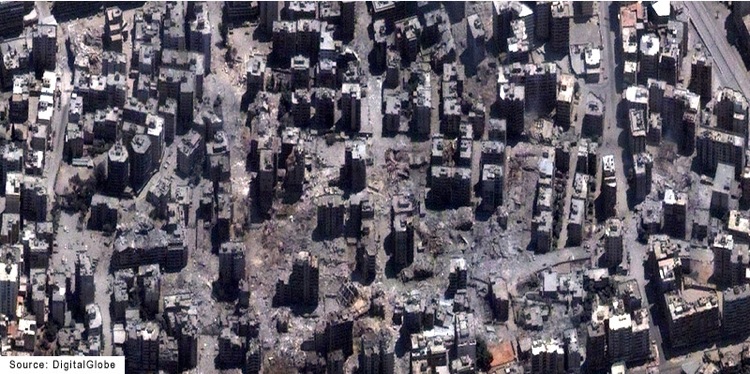
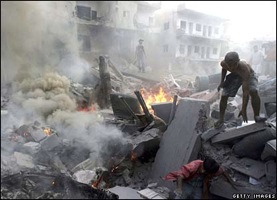
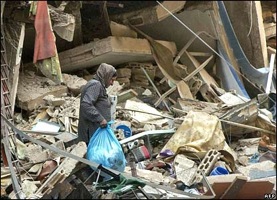
I won't go into details, but always look at Juan Cole's site. Some of the links come from there today. The Agonist is also essential reading, and Antiwar.com's blog. Good points about Western hypocrisy, and said today:
This whole thing was about Olmert proving he had stones as big as Sharon. (Shades of Fallujah in 2004 if you ask me.)
Pat Lang, formerly a top dog at the Defense Intelligence Agency, observes of the IDF withdrawal from Bint Jbeil:
Sounds Like They Couldn't Stand The Heat.
The IDF pulled its ground forces out of Bint Jbeil Saturday all the way back into Galilee. They fought there for days to take the town, lost some men and then started house demolitions. According to my Israeli sources, Hizbullah counter-attacked in strength starting Friday night. The next day Israel withdrew from the town.
It sounds like the politicians couldn't stand the prospect of real war. Or, more fancifully the IAF has laid an elaborate trap for HA. Some of the members of our seminar will prefer that idea.
A week ago the Jerusalem Post said that a "civil administration" (i.e. occupation) government for South Lebanon was being prepared, but it looks like it won't be needed at all.
 Essential reading (and not just because I interviewed the guy!) in the Nation:
Anger in the Arab World by Rashid I. Khalidi - posted July 27
In what passes for analysis of the war involving Israel, Lebanon and Palestine in US and Israeli government circles, in the well-oiled PR machine that shills for them, and in much of the US media, we are told about a struggle against terrorism by a state under siege. The basic argument is that Israel is "responding to terrorist violence," and that the only real question is, How soon will Israeli force, backed by American determination, prevail? But this scenario has little to do with reality in the Middle East.
There will be no "destruction" of Hezbollah, and no "uprooting" of its infrastructure or that of Hamas, whatever the results of Israel's siege of Gaza and its merciless attacks against Lebanon. The rhetoric about "terrorism" has mesmerized those who parrot it, blinding them to the fact that Hezbollah and Hamas are deeply rooted popular movements that have developed as a response to occupation--of the West Bank and Gaza for nearly forty years, and of southern Lebanon from 1978 to 2000. Whatever one might say about the two movements' callousness in targeting civilians (a subject on which Israel's defenders are hardly in a position to preach), both have won impressive victories in elections and have provided social services and protection to their people.......
.....Much depends on whether an Israeli, American or Israeli-American war with Syria and, much more serious, Iran can be avoided. If escalation of what is already a major war in Gaza and Lebanon can be prevented, the conflict's regional effects will be mitigated. Much depends on how fast European public opinion, turning rapidly, expresses its revulsion at what is happening in Lebanon. Tales of the massive destruction and civilian casualties are being carried home by tens of thousands of French, British, Italian and German evacuees, many of them dual nationals, appearing on French and British TV talking about the atrocities they have seen. Much also depends on how adventurous Iran and Syria choose to be, how much punishment Hezbollah can take and still keep fighting, and how wise the Palestinians are in dealing with their difficult internal situation. And much depends on how far the man in the White House will go with his instincts. If he reins in his darker impulses and those of the Israeli general staff, which is running the show on that end of the alliance, the current slide into the abyss can yet be halted. If not, the Middle East and the United States are headed for catastrophe.
Sidney Blumenthal in The Guardian: The neocon resurgence: The delusional US mindset that made the Iraq war a disaster has resurfaced in Lebanon. Lebanon Daily Star: "America's credibility will be a casualty of Israel's war: Whatever reasons arabs ever had to trust washington are going up in smoke".
Osama Bin Laden wins BIG: July 21: "Doing bin Laden's Work for Him" by Michael Scheuer, the CIA guy that ran the Bin Laden unit for years. Gotta read this one:
Most damaging for G-8 leaders will be this week's validation for Muslims of bin Laden's assertion that the West considers Muslim lives cheap and expendable. They will see that three kidnapped Israeli soldiers and several dozen dead Israelis are worth infinitely more to the West than the thousands of Muslims held for years in Israel's prisons, the hundreds already killed in Lebanon, and the eradication of Lebanon's modern infrastructure.
So bin Laden wins without lifting a finger........The impact of this Israel-Hezbollah round will not stop with the inevitable truce that will be declared after Israel ruins Lebanon. While temporary order may return to the Levant, America, Britain, and the West should not fool themselves. They have again gratuitously picked sides in a fight between two inconsequential nations; the survival of neither is a genuine national security interest for any G-8 state. Led by Washington's absurd, 30-year obsession with the minimal Shia threat to America, and blind to the hatred generated among Muslims by their foreign policies, the G-8 have mightily strengthened the enmity, durability, and resolve of the Sunni extremist movement that bin Laden leads and personifies.
Egyptian Al-Ahram Weekly On-Line: First Iraq, now Lebanon: Mainstream media is making the same excuses furnished in Iraq for the destruction of infrastructure and the mass killing of civilians in Lebanon, writes Firas Al-Atraqchi.
Where were those Israeli soldiers captured? Obviously the moral foundation of the war is that Hezbollah captured those Israeli soldiers over the 'Blue Line', inside Israel. But there are stories burbling up that they were actually captured inside Lebanon on some kind of Israeli commando raid. It seems implausible, but the story is out there.
 Neo-cons ginning up Iran war NOW: This is a MUST-read: Iran: The Next War:
Even before the bombs fell on Baghdad, a group of senior Pentagon officials were plotting to invade another country. Their covert campaign once again relied on false intelligence and shady allies. But this time, the target was Iran. BY JAMES BAMFORD
This story HAS to be read. It explains the AIPAC spy scandal, how Ahmed Chalabi told the Iranians that the U.S. was reading their encrypted messages, how Michael Ledeen is gearing up the Iranian opposition to stir up more trouble in Iran. This is a very big deal. I won't quote a lot from here, but this story tracks with a lot of the stuff we've tried to cover here on HongPong in the past. And now it is really getting put into motion. Some jackass on National Review denies everything.
Lebanon Daily Star reports yesterday that Israeli military casualties has forced a change in Israel's military strategy, abandoning a large expansion of ground warfare.

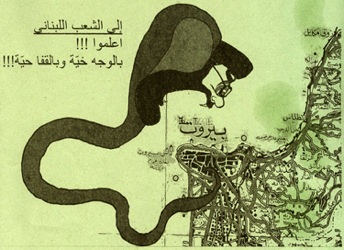 Middle East Report: Israel's War Against Lebanon's Shiites by Jim Quilty in Beirut - July 25. Features copies of Israeli propaganda leaflets (pictured here). Lots of details about those tricky complexities of Lebanese politics.
 CSM: UN deaths prompt 'diplomatic firestorm': Annan calls attack on observers in Lebanon 'apparently deliberate,' but Israel angrily denies charge. July 28: "Israeli strikes may boost Hizbullah base: Hizbullah support tops 80 percent among Lebanese factions." July 26: Asia Times Online: Hezbollah banks on home-ground advantage By Sami Moubayed.
 Antiwar.com: Be sure to read Fourth Generation War in Lebanon by Ehsan Ahrari. Justin Raimondo: Lebanon: Are the Yanks Coming? Let's hope not…. and Lebanon: Winners and Losers: Bin Laden wins, and we lose. Also, Israel is winning the battle, but not the war on July 25. However, it appears they have lost the battle too. The Fire Next Time by Osamah Khalil about the impact on the rest of the Arab world. Lawless by Nebojsa Malic. Israeli Offensive Targeting Relief Efforts? by Aaron Glantz. Five Myths that sanction Israel's war crimes by Jonathan Cook. (This article was too long though)
On Iraq check out the review of Unembedded, about freelance photo-journalists in Iraq. The photo below was in the book.
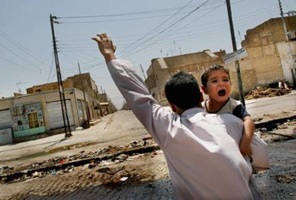
Voice of America News conveys Lebanese refugee stories:
'Tehfa says the bombs are not the only danger. Yaroun is all but cut off from the outside world. "Plus, the people die without food. There is no water, no electricity, no gas. Nothing!" she added. Tehfa literally walked to safety, wearing a pair of black flip-flop sandals and carrying nothing but her shiny black handbag. After nearly two weeks under siege, she and a group of about 70 townspeople - waving a large white flag - walked six kilometers to the nearest village, a place called Rmeich. Another Australian, Fatima Salim, managed to find a car to take her to Rmeich, and then slept in a cramped apartment with 80 other people for three days. "I lost my mother, my brother, my sister-in-law. I do not know where they are gone," she said. "Because I go out from one door, they go out from another door. And for one minute, I cannot see my parents. I do not know where they are." '
Some angry Lebanese post photos of wounded Lebanese children, and photos of Israeli children writing messages on bombs. Graphic. They also posted images of the "Marwaheen Massacre" where Israeli jets pounded and killed a fleeing Lebanese familiy earlier in fighting. The family had previously been turned away from a UN post, which is why the Blue Helmets had to pick up the pieces, literally:
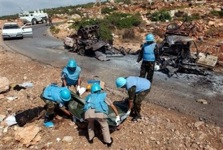
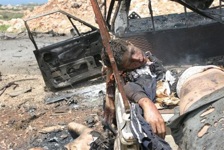
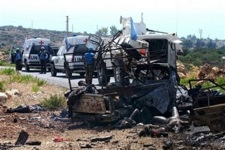
Washington Post editorial from Tuesday: "Air Power Won't Do It" as I said earlier. Interview from a week ago with a former Bush hand on Lebanon in Harpers.
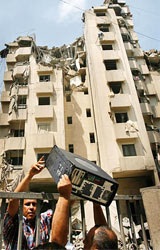 News updates from Wednesday, noted because the Dell this fleeing Beirut guy is heaving over the fence looks just like the old HongPong server. Civilians killed as Israelis target ambulances. From nearly a week ago, the AP was reporting the tenacity of Hezbollah fighters against Israel. Hezbollah fighters popped up in Beirut shortly after Israeli bombings without delay. On the 26th, UK Times said Ferocity of Hezbollah comes as a surprise as Israeli intelligence turns out to be incredibly shitty:
[Israeli] domestic support remains strong, but the first cracks have appeared, with media commentators accusing the army of providing an “insulting level of intelligence” about Hezbollah’s defences. As they munched watermelon yesterday, sweating Israeli soldiers were visibly shocked by the stiff opposition they had encountered, describing their Hezbollah opponents as a “guerrilla army” with landmines and anti-tank missiles capable of crippling a Merkavah battle tank.
“It was really scary. Most of our armoured personnel carriers have holes,” a paramedic told The Times after recovering three wounded tank soldiers. “It’s a very hard situation. We were in Lebanon before but it wasn’t like this for a long time.” A tank commander said: “It’s a real war.” In the Galilee town of Safed, Brigadier-General Shuki Shachar, deputy commander of the northern forces, conceded that the foe was not an easy one. “Hezbollah is a fanatical organisation. It is highly motivated to fight. I don’t want to give grades to the enemy, but they are fighting. They are not escaping,” he said. He insisted, however, that Israel was “changing the balance” after a belated recognition that the Shia group was dug in deeper than expected.
“After a few days we realised that Hezbollah prepared itself over the last six years with thousands of rockets, with hundreds of shelters, bunkers, with hundreds of rockets hid in houses of civilians inside south Lebanon,” he said. [this is one of those small things you figure out BEFORE you launch a war --Dan]
His forces had never intended to “conquer every square inch” of Bint Jbeil but had now achieved their objectives of taking the high ground. Wherever the Israel Defence Forces decided to act, the general said, “we have no problem to do so, no restrictions”.
Which is why they have already departed Bint Jbeil. Because they launched a war unaware of the honeycombs of bunkers and rockets. Hmm.
Things are definitely getting worse in Iraq but at least we got Lasers now?!! under the radar, it seems. News analysis: U.S. could face a showdown with al-Sadr, even more so as the U.S. eggs Israel on to kill more Shiites. In a shrewd move, the U.S. Army fired a gay Arab linguist. War Crimes trials for abusing and torturing detainees are a possibility. Time magazine: How the Lebanon Crisis Complicates U.S. Prospects in Iraq. Democracy Now reports: Star Wars in Iraq: Is the U.S. Using New Experimental Tactical High Energy Laser Weapons in Iraq? It doesn't quite sound like a laser. My money is on directed microwave radiation... I won't make a joke, because this is too creepy:
MAJID AL GHEZALI: Just the head was burnt, and the other parts of the bodies wasn’t anything happened on it.
NARRATOR: Al Ghezali reported that he had seen three passengers in a car, all dead, with their faces and teeth burnt, the body intact, and no sign of projectiles.
MAJID AL GHEZALI: There wasn’t any bullet. I saw the teeth, just the teeth and no eyes, all of them. With the body, nothing for the bodies. Just the teeth, and all the -- I mean, the heads were burnt.
NARRATOR: There were other inexplicable aspects. The terrain where the battle took place was dug up by the American military and replaced with other fresh earth. The bodies that were not hit by projectiles had shrunk to just slightly more than one meter in height.
......DOCTOR NO. 2: It seems to be a new weapon.
SAAD AL FALLUJI: Yes, a new weapon.
DOCTOR NO. 2: They are trying to do experiments on our civilians. Nobody can identify what the type of this weapon.
Ohohoho those crazy Iraqis and their stories. "How could such a thing be true?" says the skeptic. One possibility: half a billion dollars in spending may have produced something larger than a pen laser to fuck around with occupied Muslim populations. The last bit of the article:
WILLIAM ARKIN: So, right now you have about $50 million a year being spent on non-lethal weapons. You have about another $200 million or so being spent on high power microwaves, active denial-type systems. You’ve got probably another $100 to 200 million being spent on secret black laser programs. And then you’ve got the big lasers, the high energy laser of the Air Force and the other tactical lasers. So probably, when you add all of that up, you know, the United States is probably spending a half of a billion dollars a year right now on directed-energy weapons, you know, probably somewhere in the order of 300-400 million euros. So this is a significant amount of money. This is the size of the defense budgets of some countries in Europe.
On a lighter note, Joe Klein on Lieberman's Last Stand and another one of his friends ditches him. Polls are showing Lamont doing real, real well. Oddly, we discover that John Ashcroft was against torture, which is part of the reason they got rid of him.
Blog bits: The Guns of August on DailyKos.com was an interesting roundup of everything. William Arkin tries pretty hard at the WaPo to keep tabs on this stuff. Al Qaeda says it ought to fight alongside Hezbollah and Hamas, a surprising twist. Some general remarks from Obsidian Wings. Neo-con blather about Arab governments supporting Israel turns out to be false. Arab-American Abu Aardvark notes that the Rome conference was a failure.
Idiot on Fox talks about how great it is that Israel attacked UN peacekeeping posts. Greek antiwar protesters toppled a statue of Harry Truman (bet you didn't see that one coming). Kind of a funny video of these cute (Iranian?) girls talking about how much they like Hezbollah.
More Haaretz of course: Haaretz has an interesting feature on how Israeli intelligence agencies have attempted to wrap their heads around Hezbollah's tactical reality. Opening a window on intelligence. "No Time to Lose" by Amir Oren is about the peculiarity of the blaring American "green light" to bomb the shit out of Lebanon. The plan was 2 kilometers "cleared", but it ain't happening. Hezbollah, an empire of millions. Big questions, great frustration indeed. Moral Muddle - interesting questions at an IDF base about the morality of killing Lebanese civilians. A kind of funny article about Arab journalists. Check out The turnabout will come quickly By Meron Benvenisti, a peace guy explaining why the war will be abandoned in Israel. From Wednesday, The war so far / No goals attained By Ze'ev Schiff. Was there a proper decision process? By Aluf Benn. Has the army failed? By Amos Harel Finally,
Morality is not on our side By Ze'ev Maoz
There's practically a holy consensus right now that the war in the North is a just war and that morality is on our side. The bitter truth must be said: this holy consensus is based on short-range selective memory, an introverted worldview, and double standards.
This war is not a just war. Israel is using excessive force without distinguishing between civilian population and enemy, whose sole purpose is extortion. That is not to say that morality and justice are on Hezbollah's side. Most certainly not. But the fact that Hezbollah "started it" when it kidnapped soldiers from across an international border does not even begin to tilt the scales of justice toward our side.
German paper Der Spiegel has INTERVIEW WITH LEBANESE PRESIDENT EMILE LAHOUD: 'Hezbollah Freed Our Country'.
Mitch Prothero in Salon.com on the bullshit about Hezbollah hiding among civilians:
Throughout this now 16-day-old war, Israeli planes high above civilian areas make decisions on what to bomb. They send huge bombs capable of killing things for hundreds of meters around their targets, and then blame the inevitable civilian deaths -- the Lebanese government says 600 civilians have been killed so far -- on "terrorists" who callously use the civilian infrastructure for protection.
But this claim is almost always false. My own reporting and that of other journalists reveals that in fact Hezbollah fighters -- as opposed to the much more numerous Hezbollah political members, and the vastly more numerous Hezbollah sympathizers -- avoid civilians. Much smarter and better trained than the PLO and Hamas fighters, they know that if they mingle with civilians, they will sooner or later be betrayed by collaborators -- as so many Palestinian militants have been.
For their part, the Israelis seem to think that if they keep pounding civilians, they'll get some fighters, too.
The Anglican Christian Bishop in Jerusalem gets blown off by American Christians. Pretty scathing letter from the Bishop:
.....Movement of residents of the West Bank is difficult or impossible as “security measures” are heightened to break the backs of the Palestinian people and cut them off from their place of work, schools, hospitals, and families. It is family and community that has sustained these people during these hopeless times. For some, it is all that they had, but that too has been taken away with the continued building of the wall and check points. The strategy of ethnic cleansing on the part of the State of Israel continues.
This week, war broke out on the Lebanon-Israeli border (near Banyas where Jesus gave St. Peter the keys to heaven and earth). The Israeli government’s disproportionate reaction to provocation was consistent with their opportunistic responses in which they destroy their perceived enemy.
In her recent article, “The Insane Brutality of the State of Israel,” American, Kathleen Christison, a former CIA analyst says, “The state lashes out in a crazed effort, lacking any sense of proportion, to reassure itself of its strength.” She continues, “A society that can brush off as unimportant an army officer’s brutal murder of a thirteen year old girl on the claim that she threatened soldiers at a military post (one of nearly seven hundred Palestinian children murdered by Israelis since the Intifada began) is not a society with a conscience.” The “situation” as it has come to be called, has deteriorated into a war without boundaries or limitations. It is a war with deadly potential beyond the imaginations of most civilized people.
As I write to you, I am preparing to leave with other bishops for Nablus with medical and other emergency supplies for five hundred families, and a pledge for one thousand families more. On Saturday we will attempt to enter Gaza with medical aid for doctors and nurses in our hospital there who struggle to serve the injured, the sick, and the dying.
My plan is that I will be able to go to Lebanon next week - where we are presently without a resident priest - to bury the dead, and comfort the victims of war. Perhaps as others have you will ask, “What can I do?” Certainly we encourage and appreciate your prayers. That is important, but it is not enough. If you find that you can no longer look away, take up your cross. It takes courage as we were promised.
Write every elected official you know. Write to your news media. Speak to your congregation, friends, and colleagues about injustice and the threat of global war. If Syria, Iran, the United States, Great Britain, China and others enter into this war - the consequence is incalculable. Participate in rallies and forums. Find ways that you and your churches can participate in humanitarian relief efforts for the region. Contact us and let us know if you stand with us. I urge you not to be like a disciple watching from afar.
2 Corinthians 6.11:
“We have spoken frankly to you Corinthians, our heart is wide open to you. There is no restriction in our affections, but only in yours. In return - I speak as to children - open wide your hearts also.”
Blackwater blowback: As I just mentioned, the incident with the Blackwater guys in Fallujah was a big deal – so big, it may have crashed the American war effort altogether.
Well that took a long time. I am done blogging for a while, at least a few days. Things are too horrible to leave my mind in this frame. It's the last Saturday in July, and here I am, presenting all this death and doom. I don't want to spend precious days doing stuff like this any more.
Armies are criticized because the excess of power that they accumulate enables them to dictate steps of political significance during a time of crisis. In these situations, military contingency plans become the principal alternative available to the politicians, which is why they tend to accept the army's viewpoint. But this time we have before us a particularly extreme case. Not only was the military plan the only one, but the political leadership voluntarily relinquished its duty to discuss it thoroughly. This places political thinking, to which military thinking is supposed to be subordinate, in a particularly inferior situation.
A voluntary 'putsch' By Yagil Levy - Haaretz
"The enemy is deceiving its own people and the world by presenting the occupation of Maroun al-Ras as a great military achievement," a Hizbullah statement said. "An army using its elite forces and tanks backed by its air force that can enter a frontier village only after days of fighting ... is a defeated and useless army."
Lebanon Daily Star, July 24, 2006
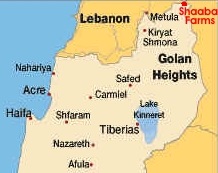 Major diplomatic movement on all fronts as Israel finds itself in the middle of a sputtering yet shockingly ugly military campaign. However, Hezbollah has apparently said they will become an entirely defensive force if Israel vacates the small Shebaa Farms area, which is considered either part of Lebanon or Syria, depending on whose map you go with. (that link was pro-Israel, here's a Wikipedia one and one from Joshua Landis at SyriaComment.com) Blame this particular line in the sand on the French. Anyway... It's all up in the air, but it's clear that Israel's more fanciful goals have fallen flat, yet they may still get some sort of international armed force involved, but probably only if Hezbollah permits it.
Phosphorus chemical weapons used by Israel, alleges Lebanese Prime Minister, doctor on CNN: Story on RawStory, a segment on CNN placed on YouTube: Very graphic - actually showing injured, severely burned Arabs, which I thought had been banned on American television:
Reuters: Lebanon president says Israel uses phosphorous arms 24 July 14:16:57 GMT
There have been previous reports of white phosphorus chemical weapons use in Fallujah... The irony of these methods is not subtle. Naturally, when the regular weapons aren't getting it done, the dirty stuff becomes appealing...
Anti-Iranian war propaganda: The same shady Iranian neo-con guy, Amir Taheri, who made up the fake "yellow stars for Jews in Iran" story is now visiting the White House. It's guys like him that are grooming Bush, telling him what he wants to hear, playing the new Chalabis, expecting to stir up trouble, TPMmuckrakers report. It's Taheri's little cronies that are going to spoon-feed the damn corporate media with stories about WMD or whatever else to scare the shit out of America again, likely right before the election. This guy Taheri is in with Ledeen and the rest of them. Taheri proclaims:
"The mini war that is taking place between Israel and Hezbollah is, in fact, a proxy war in which Iran’s vision for the Middle East clashes with the administration in Washington."
And who's gonna play the proxy? Ahmed Chalabi Amir Taheri. The Iran propaganda spigot is on full until election day. Meanwhile...
How the Israeli military manipulated policy to start the war: As the kidnapping's fallout unfolded inside Israel, the top military echelon's off-the-shelf plans to bomb the shit out of Lebanon were quickly approved and put into execution, superseding any grand political process to evaluate the consequences and prepare alternative choices. Prime Minister Olmert and Defense Minister Peretz, lacking a certain respect because they aren't generals but "civilians," deferred to the IDF's plans. This is not a portrait of a rational decision-making process:
Haaretz: A voluntary 'putsch' By Yagil Levy:
In Israeli historical memory, two incidents have been metaphorically defined as a military "putsch": the pressure applied by Israel Defense Forces generals on then prime minister Levi Eshkol to embark on the Six-Day War in 1967, and the "quiet putsch" as journalist Ofer Shelach termed the behavior of the army at the outbreak of the Al-Aqsa Intifada. Nevertheless, neither of these resembles the move that led to the start of "Lebanon War II."
On July 12, 2006, the Israeli government decided to bring about "a new order in Lebanon" by means of a massive military attack, which would cause the Lebanese government to disarm Hezbollah, or at least to remove it from the border with Israel and to deploy the Lebanese Army in its place. Like the expanded goals of "Lebanon War I," an attempt is being made here to reshape Lebanon's fragile political order by means of force.
In the history of the relationship between the political and military leaderships of Israel, the government has never made such a significant decision so quickly, operating in crisis mode just a few hours after the kidnapping of the soldiers. Under these circumstances, the military contingency plan was the main plan presented to the ministers, if not the only one. As absurd as it may sound, the government decision to embark on the Lebanon War I in 1982 was the result of a longer and more orderly decision-making process.
An expedited discussion in the cabinet does not enable an examination of non-military options - or, alternatively, a discussion of the full significance of a military operation and a positing of realistic political goals. The accelerated process did not enable the ministers to discuss the practicality of the demand to deploy the Lebanese Army, part of which is Shiite, along the border, as a force that is capable of imposing its authority on the independent Shiite militias that will remain after the dismantling of Hezbollah, if it is in fact dismantled.
It is doubtful whether the significance of the two possible results of the Israeli military blow - a change in the fragile inter-ethnic balance of power in Lebanon as a result of the disintegration of Hezbollah as the center of power that will not be replaced by another, or, alternatively, its success in surviving the attack - could be discussed in such a pressured time framework.
.......Armies are criticized because the excess of power that they accumulate enables them to dictate steps of political significance during a time of crisis. In these situations, military contingency plans become the principal alternative available to the politicians, which is why they tend to accept the army's viewpoint. But this time we have before us a particularly extreme case. Not only was the military plan the only one, but the political leadership voluntarily relinquished its duty to discuss it thoroughly. This places political thinking, to which military thinking is supposed to be subordinate, in a particularly inferior situation.
This inferiority stems, paradoxically, from the "civilian" label of the present leadership. The term "civilian" does not relate in this case only to the biography of the leaders, but to their political agenda as well - i.e., the convergence plan. A civilian leadership often tends to increase the army's freedom of operation, particularly when it operates in a cultural-political environment in which half of the voters favor the use of force to solve political problems. Under these circumstances, the civilian leadership needs the army as a political instrument for the purpose of implementing the civil agenda. After all, the "disengagement" plan was implemented thanks to the support of the army, and the same will be true of the convergence plan in the future.
This dependence makes it difficult for the political leadership to hold the army back in times of crisis - not to mention the fear of losing legitimacy by demonstrating "hesitancy" as compared to the determination of the army. Political leaders with a military past, or "hawkish" civilian leaders, have a greater ability to restrain the army in similar circumstances, as seen in the difference between former prime ministers Yitzhak Shamir (the Gulf War) and Benjamin Netanyahu (the Western Wall tunnel episode), on the one hand, and Moshe Sharett (the retaliatory operations), Levi Eshkol (the Six-Day War) and Shimon Peres (Operation Grapes of Wrath), on the other. Prime Minister Olmert now joins the second group.
Haaretz opinion: Stop now, immediately By Gideon Levy:
This war must be stopped now and immediately. From the start it was unnecessary, even if its excuse was justified, and now is the time to end it. Every day raises its price for no reason, taking a toll in blood that gives Israel nothing tangible in return. This is a good time to stop the war because both sides can claim they won: Israel harmed Hezbollah and Hezbollah harmed Israel. History shows that no situation is better for reaching an arrangement. Remember the lessons of the Yom Kippur War.
Israel went into the campaign on justified grounds and with foul means. It claims it has declared war on Hezbollah but, in practice, it is destroying Lebanon. It has gotten most of what it could have out of this war. The aerial "target bank" has mostly been covered. The air force could continue to sow destruction in the residential neighborhoods and empty offices and could also continue dropping dozens of tons of bombs on real or imagined bunkers and kill innocent Lebanese, but nothing good will come of it.
Those who want to restore Israel's deterrent capabilities have succeeded. Hezbollah and the rest of its enemies know that Israel reacts with enormous force to any provocation. South Lebanon is cleaner now of a Hezbollah presence. In any case, the organization is likely to return there, just as it is likely to rearm. An international agreement could be achieved now, and it won't be possible to achieve a better deal at a reasonable price in the future.
.......Now Israel is hoping for the elimination of Nasrallah. That's an atavistic impulse, even if understandable, which seeks the head of the enemy in order to prove our victory over him. There's no wisdom or practicality in it. Once again it is worth reminding ourselves of the dozens of people Israel assassinated in Lebanon and the territories, from Sheikh Abbas Mussawi to Sheikh Ahmed Yassin, each replaced by someone new, usually more talented and dangerous than the predecessor. The goals of the war should not be dictated by dark impulses, even if they come in response to the wishes and demands of the mob. The only advantage that would benefit Israel from the elimination of Nasrallah would be that maybe it would bring about an end to the warring. But it can be halted even without that. The other desired goal, the return of the prisoners, will anyway only be achieved through negotiations to release prisoners. Israel could have done that before the war.
It is still too early to weigh out the balance of achievements and failures of this war. The day will come when it will become clear that it was purposeless, as are all wars of choice. Ceasing it now guarantees a limited achievement at a limited price. Continuing it guarantees a heavy price without any guarantee of a suitable reward. Therefore, Israel must cease and desist. The president of the United States can push us to continue the war all he wants, the prime minister of Britain can cheer us in parliament, but in Israel and Lebanon, the blood is being spilled, the horror is intensifying, the price is rising and it is all for naught.
Billmon is top notch these days, observing plates shifting throughout the Mideast in, as always, unlikely yet ugly ways: The All Against the All:
I've been waiting to see whether the Turks are going to flatter the Israelis by imitating their invasion of neighboring country -- Kurdistan, in this case. So far, there've been no official cross-border troop movements (although Turkish special forces have been operating inside Iraq since just after our cross-border troop movement, if not before.)
But today the Kurds accused the Iranians of intervening in their internal affairs, with a cross-border movement of artillery shells:
"A senior Iraqi-Kurdish official accused Iranian forces on Thursday of shelling Kurdish guerrillas in northern Iraq.
"Othman Mahmoud, interior minister of the Kurdish regional government in the north, said shelling was going on along the border about 170 km (105 miles) north of the city of Sulaimaniya....."
......So many hatreds, so little time!
Let's see. We've got: Israeli Jews fighting Lebanese Shi'a and Palestinian Sunnis; Palestinian Fatah militants who've stopped fighting Hamas militants, but only because they're both fighting the Israelis; Saudi Sunni fundamentalists issuing fatwas against Hezbollah Shi'a fundamentalists; Egyptian Sunni fundamentalists backing those same Hezbollah Shi'a fundamentalists; Iraqi Sunnis killing Iraqi Shi'a and vice versa; Iraqi Shi'a (the Mahdi Army) jousting with Iraqi Shi'a (the Badr Brigade); Iraqi Kurds trying to push Sunni Arabs and both Sunni and Shi'a Turkomen out of Kirkuk; Turks threatening to invade Kurdistan; Iranians allegedly shelling Kurdistan, Syrian Kurds rebelling against Syrian Allawites who are despised by Syria's Sunni majority but allied with the Lebanese Shi'a who are hated and feared by the House of Saud and its Sunni fundamentalist minions. Oh, and American and Israeli neocons threatening to bomb both Syria and Iran......
......There is a passage in Kanan Makiya's book Republic of Fear that has haunted me ever since I read it. I've quoted it before to explain why I expected nothing but horror from the "liberation" of Iraq. It describes what happened in the summer of 1959 in the city of Mosul (a patchwork of ethnic, religious, tribal and class distinctions, then and now):
"For four days and four nights Kurds and Yezdis stood against Arabs; Assyrian and Aramean Christians against Arab Moslems; the Arab tribe of Albu Mutaiwat against the Arab tribe of Shammar; the Kurdish tribe of al-Gargariyyah against Arab Albu Mutaiwat; the peasants of the Mosul country against their landlords; the soldiers of the Fifth Brigade against their officers; the periphery of the city of Mosul against the center; the plebians of the Arab quarters of Al-Makkawi and Wadi Hajar against the aristocrats of the Arab quarter of ad-Dawwash; and within the quarter of Bab al-Baid, the family of al-Rajabu aggainst its traditional rivals, the Aghawat. It seemed as if all social cement dissolved and all political authority vanished."
Did you get that?? You better...
You also might be interested on Antiwar.com: July 25: Syria Emerges Front and Center by Pat Buchanan and Israel Is Winning the Battle, but Not the War by Ivan Eland.
July 25: Haaretz: ANALYSIS: The road to peace runs through Shaba Farms By Zvi Bar'el
The Lebanese government is pleased with itself, and Syria, too, has reasons to smile. As the fighting continues, Lebanese government officials are coming up with new definitions for what is known as "the complete arrangement," the one that is supposed to replace the arrangement that existed before July 12.
And so July 12 is joining the long line of historical dates that mark the stages of Lebanon's "new" independence just like February 14, the date of Rafik Hariri's assassination in 2005; or May 25, the date of the Israel Defense Forces withdrawal from Lebanon.
Saturday saw another development in the status of Fuad Siniora's government versus the strength of Hezbollah. After the government received "a franchise" to enter into negotiations on a prisoner-exchange deal, Energy Minister Mohammed Fneish, a Hezbollah representative, announced that once the IDF withdrew from the Shaba Farms area, Hezbollah's role as a "liberating" army would be over, and it would stick to a purely a defensive role.
This is a very significant statement, because it begins to define the conditions for Hezbollah's disarmament.
The government of Lebanon, Hezbollah, the United States, France and the United Nations have all realized now that the key to achieving a long-term and sustainable cease-fire by means of the deployment of the Lebanese Army in the south lies in a resolution to the Shaba Farms dispute.
At this stage, however, it is not enough for only Hezbollah and the Lebanese government to agree that the return of the Shaba Farms area would spell an end to the movement's "liberating" role. Syria is no less an important player in this regard. In keeping with maps approved by the UN, the Shaba Farms area lies in Syrian territory, so an official document in which Damascus relinquishes the area would be required too. For years now, Damascus has refused to provide such a document.
Will Syria agree to grant one now? An agreement to this end may be reached later in the week, when Syria learns both that it is the only one standing in the way of a settlement, and more importantly, according to Lebanese sources, that Washington is likely to offer Damascus a generous benefits package and a warm return to the "family of nations."
The next stage would have to be securing Israel's consent to withdraw from the Shaba Farms area, as this would then be a withdrawal from Lebanese territory; and only then could the Lebanese Army take up positions in the south, perhaps with the assistance of a multinational force if Hezbollah gives its okay.
The Lebanon Daily Star is a badass paper, no doubt.
Hizbullah gives government negotiation power
Daily Star staff: By Nada Bakri and Mohammed Zaatari
Monday, July 24, 2006
BEIRUT/SIDON: Israeli warplanes continued their bombardment of Lebanon on Sunday, killing at least eight and wounding 45, as Hizbullah gave the Lebanese government the green light to negotiate on its behalf for a prisoner swap with Israel. Any swap would include the two Israeli soldiers captured by Hizbullah in a cross-border raid on July 12, and Lebanese and Arab prisoners in Israeli jails.
"The Lebanese government will lead the exchange through the intermediary of a third party. This has been accepted by Hizbullah," Speaker Nabih Berri said Sunday.
It was not immediately known who the third party would be. Foreign Minister Fawzi Salloukh said Sunday that the two Israeli soldiers were "in good health" and called on "the United Nations or any third friendly party to engage in discussions of a prisoners' exchange."
"Germany has played an important and prominent role between Lebanon and Israel in the past, and it can play a similar role now," Salloukh said after a meeting with Peter Witteg, the head of international affairs at Germany's Foreign Ministry.
Meanwhile the Israeli offensive continued for the 12th straight day, bringing the overall death toll to at least 380 with over 1,000 wounded, according to Lebanese authorities.
A Lebanese press photographer, Layal Najib, 23, was also killed when an Israeli missile struck near her car on the road between the villages of Qana and Siddiqine. Najib worked at Al-Jaras (The Bell) magazine and was also a freelance photographer for AFP and several other news outlets.
Israel on Saturday attacked telecommunications installations in the North of Lebanon, killing a technician with the Lebanese Broadcasting Corporation, Suleiman Chidiac, and wounding two others. The station's signal was cut in several areas across the country. The destroyed relay stations were used by TeleLiban, LBCI and Future TV, and several radio stations.
Israeli air strikes also hit a mini-bus carrying 16 people fleeing the village of Tairi as it worked its way through the mountains from the Southern port city of Tyre.
A missile hit the bus near the village of Yaatar, killing three and wounding the rest of the passengers, who were taken to hospitals in Tyre. The Israeli military had told residents of Tairi and 12 other nearby villages Saturday to evacuate by 7 p.m. The villages form a corridor about 6 kilometers wide and 18 kilometers deep, believed to be the "buffer zone" desired by Israel.
At least four other people were killed by Israeli strikes in the South, Lebanese television reported, but the deaths could not be confirmed. Some 45 people were wounded in Israeli air raids that targeted villages and towns around Tyre on Sunday, security and hospital officials said.
Israeli warplanes also targeted Hizbullah strongholds in the southern suburbs of Beirut.
On Sunday, Israel hit the Southern port city of Sidon for the first time, destroying a religious complex linked to Hizbullah and wounding four people. More than 5,000 people have sought refuge in the city from other Southern villages. Four people were wounded in the strike. Israel also targeted Hizbullah's power base in the Bekaa Valley, hitting three factories, a house and bridges and roads. The air strikes ignited large fires, killed at least one civilian and wounded two others.
Three rescuers from the Civil Defense personnel of the Islamic Scout Mission, an association affiliated with the Amal Movement, were wounded after Israeli air raids struck their ambulance as it transported wounded civilians to nearby hospitals, according to Hassan Hamdan, the association's official in the South. "After the rescuers succeeded in crossing the fields and arrived in Bourj Rahal, Israeli warplanes launched missiles, leaving three of them wounded," he added.
Israeli troops continued to hold a Lebanese border village that they battled their way into the day before, but did not appear to be advancing, Lebanese security officials said. But warplanes and artillery were battering areas across the South. Hizbullah confirmed on Sunday that Israeli forces had occupied a key Lebanese frontier village and said three of its fighters had been killed there.
"The enemy is deceiving its own people and the world by presenting the occupation of Maroun al-Ras as a great military achievement," a Hizbullah statement said. "An army using its elite forces and tanks backed by its air force that can enter a frontier village only after days of fighting ... is a defeated and useless army."
"Our steadfast fighters have presented through the Maroun al-Ras confrontations and the losses of the enemy - in troops, tanks and helicopters - an example of what the confrontations will be in every town, village and position," it said. A spokesman for UN peacekeepers stationed along the Blue Line between Lebanon and Israel confirmed for AFP the Israeli advance. "Israeli troops and tanks are now inside Maroun al-Ras," said UNIFIL adviser Milos Strugar.
In the latest salvo into Israel, Hizbullah launched rocket attacks across northern Israel, including Haifa. Some of the rockets slammed into a house, an apartment building and a major road, killing at least two people, Israeli police said.
With the attacks Sunday, a total of 17 civilians have been killed by Hizbullah rockets over the past 12 days and 19 Israeli soldiers in fighting in Lebanon. - With agencies
Meanwhile, in Gaza a prisoner deal may be afoot as well. Perhaps the realists around the world's governments are actually motivated to help put something together before the neo-cons start armageddon.
Haaretz: IDF artillery shelling kills 2 children, 4 others in northern Gaza Strip
Gaza groups ready to deal on cease-fire, release of Shalit
Last update - 05:36 25/07/2006 By Avi Issacharoff, Haaretz Correspondent
All groups in Gaza, including Hamas, would now accept a cease-fire deal with Israel which would include releasing Gilad Shalit, according to the Palestinian Agriculture Minister, who also heads the coordinating committee of Palestinian organizations there.
Ibrahim Al-Naja said the factions were ready to stop the Qassam rocket fire if Israel's ceased all military moves against the Palestinian factions in Gaza. They are also ready to release Shalit in exchange for guaranteeing the future release of Palestinian prisoners. Hamas leaders did not confirm this report on Monday, but if it is true, then this is the first time that Hamas has indicated its acceptance of the Egyptian proposal to solve the crisis.
Egypt's proposal did not include an Israeli commitment to the immediate release of Palestinian prisoners, only guarantees for their future release. Al-Naja said the Palestinian faction's conditions were that the cease-fire would be mutual and Israel would stop all its actions against the Palestinians.
He also said Israel must provide clear guarantees to free veteran prisoners, minors and female prisoners incarcerated in Israel. "This initiative was presented in an attempt to alleviate Palestinian suffering, but now it depends on Israel, which is showing no indication yet of its willingness for a cease-fire," he said.
PA chairman Mahmoud Abbas will present the understandings among the Palestinian factions to U.S. Secretary of State Condoleezza Rice at their meeting on Tuesday, Palestinian sources said.
It looks like, well, everyone is refactoring... Tuesday's gonna be interesting.
Pre-1982 war ethnic layout of Lebanon: What could go wrong?
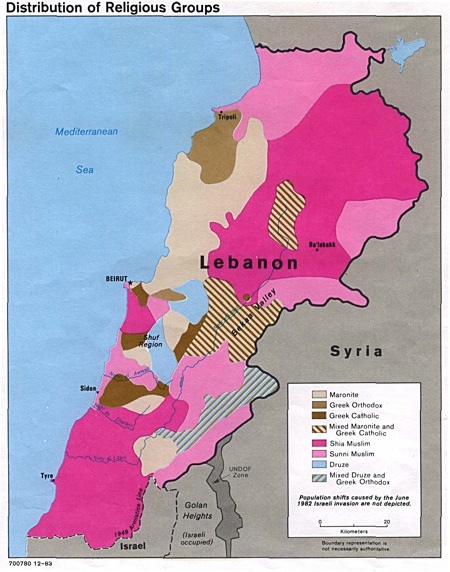
(Via the sweet UTexas map collection)
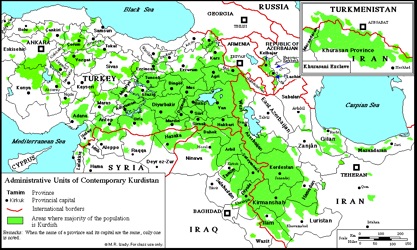 There is a sense that this is finally the Clean Break scenario happening, but there is one more problem yet to be un-tethered from order into chaos. What happens when the chaos spills into Syria? As Stratfor notes, the Israelis are 'terrified' of any regime after Bashar Assad, since it would be made of A) rebellious Kurds - who are somewhat friendly, if not allied, to Israel. B) Sunni tribes branching down into Iraq, into Anbar province and beyond, deep into the Iraqi insurgency. C) Small religious minorities like Alawites, Christians, Druze and Armenians D) A pretty good number of Palestinians. That is not a good situation for Israel, and they probably won't try to topple Assad's government. But someone else might. (Kurdish map from here, the Vladimir-Kurdistan blog)
A couple bits from Stratfor to post. They don't want people reposting their special report alerts, so I will make do with excerpts. They have a pretty close view of what the thinking is inside the Israeli military.
Basically, Stratfor makes it clear that their view is that Hezbollah's strategy is to fight until the bitter end, trapping Israel in a very high-intensity occupation and 'counter insurgency' situation, but Hezbollah has the kind of advanced anti-ship, surface-to-surface, anti-tank and anti-personnel missiles (from Iran, who knows where else? China? Russians?) to make the Israeli mission an impossible weight, far beyond what the Palestinian militant groups could achieve on their own.
So Stratfor has a pretty intricate description of what the Israelis think they can accomplish. However, if I were playing this situation in a video game like, say "Command and Conquer: Generals", the Bekaa Valley with hundreds, if not thousands, of hidden Hezbollah rockets is the last place anyone sane would want to go.
The neo-cons often harbor fantasies about breaking up ethnically diverse states like Iran and Syria, then attempting to create dominating power relationships with the US and Israel at the top, and the various bickering ethnic groups below, set against each other in high British colonial style. The Baluchis and Azeris are two that neocons are known to court in Iran, and look what has happened in Iraq. Anyone who tries to stop them is another 'terrorist,' usually a 'fascist' to boot.
This is like what Ariel Sharon thought he could engineer in Lebanon in 1982, putting the Christian Phalangists on top in a bloody civil war, crushing the Shia and other sects supported by Syria and Iran, as well as the PLO. While occupying Lebanon, Israel managed to kick the PLO out to Tunisia, which bought more time to throw settlement colonies into the West Bank. As the occupation dragged on, the Iranians helped band the Shia in southern Lebanon together under Hezbollah, and they organized a guerrilla war of attrition to force Israel to withdraw in 2000. This was a prime example of 'fourth-generation warfare,' and it now appears that the 'warfare' part of that equation is back in full force again.
Yet absorbing more of the West Bank is clearly where Israel's real interests lie: (wikipedia)
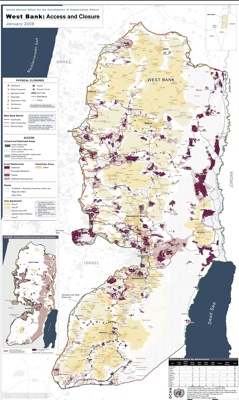
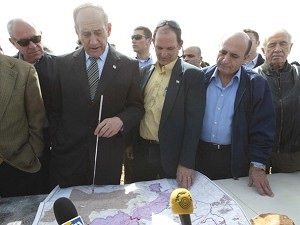
Epoch Times: Israeli acting Prime Minister Ehud Olmert (Center-L), his Defence Minister Shaul Mofaz (2nd-R) and former Israeli Prime Minister Shimon Peres (R) gather together in front of a map as they visit March 14, 2006 the Israeli west bank town of Ariel. (Pavel Wolberg-Pool/Getty Images)
Apart from the sheer bloodiness and hellish horror of such an 'ethnic re-engineering', which disgusts me deeply, setting that aside, the strategy doesn't fucking work. The basic concept in Revisionist Zionism – and now, obviously the Bush doctrine – that more bombs will inspire surrender and obedience has failed every time. Hezbollah is well-prepped for the current Israeli strategy – they know how the airstrikes work, they know from experience how Israeli intelligence has tried to catch them in this area. Most of all, they know they won straight up last time, and this time, the Israelis have better technology, but Hezbollah sure does too. They can keep falling back farther north, while still tossing long-range rockets into Haifa, and resisting all the Israelis' brutal methods by folding the organization into thousands of unstoppable, independent, rocket-bearing cells, or teams of about three, surrounded by a radicalized populace. Far better terrain for the guerrilla than the occupier, in 4GW terms.
Another point is that Israel and the United States (who obviously planned this all in tandem - hence, more U.S.-manufactured bombs on their way today to Israeli planes, Lebanese craters and Arab blood generally) have grossly underestimated the quality of Hezbollah's arsenal. This was a classic, grievous mistake on the order of Israel's foolish idea in 1973 that the Arabs were far too weak to attack – then came the Yom Kippur war.
Believing your enemies too weak and too strong, simultaneously, is a key marker of Fascist thinking.
Listen carefully to what Stratfor is saying: you can sense a waning confidence that Hezbollah could be 'eliminated' tactically, no matter how many bombs are dropped. Also, note the lack of brakes on the situation: Israel doesn't want Syria's government to fall, even while attacking the nearby Bekaa Valley. However, if, say, Al Qaeda or the Muslim Brotherhood happened to have a little luck with assassinations, anarchy across the Levant, all the way to Iran, Afghanistan, would be certain. That would not be in the interests of Israel, the United States, Iran, the EU, Turkey (especially!) or any other states.
It would be just another winning round for Al Qaeda, whose record so far in 'sharpening contradictions,' erasing stability to create 'the base', seems to be on a winning tack. The vast numbers of refugees generated in the last few days (hours!) will also help Al Qaeda style militants find converts among South Lebanon's "New Palestinians" of the 21st century. Another well thought out strategy from Washington.
Also note in particular the loss of Israeli initiative. From Sun Tzu to Clausewitz, a key aspect of warfare, especially 4GW, is retaining the initiative (PDF) – staying on the move, massing up & picking battles – but Hezbollah's dispersed, long-range nature has taken Israel's initiative apart. Israel will fight where and when Hezbollah wants them to, in a sense. Yesterday at noon from Stratfor I got:
Red Alert: The Battle Joined
The ground war has begun. Several Israeli brigades now appear to be operating between the Lebanese border and the Litani River. According to reports, Hezbollah forces are dispersed in multiple bunker complexes and are launching rockets from these and other locations.
Hezbollah's strategy appears to be threefold. First, force Israel into costly attacks against prepared fortifications. Second, draw Israeli troops as deeply into Lebanon as possible, forcing them to fight on extended supply lines. Third, move into an Iraqi-style insurgency from which Israel -- out of fear of a resumption of rocket attacks -- cannot withdraw, but which the Israelis also cannot endure because of extended long-term casualties. This appears to have been a carefully planned strategy, built around a threat to Israeli cities that Israel can't afford. The war has begun at Hezbollah's time and choosing.
Israel is caught between three strategic imperatives. First, it must end the threat to Israeli cities, which must involve the destruction of Hezbollah's launch capabilities south of the Litani River. Second, it must try to destroy Hezbollah's infrastructure, which means it must move into the Bekaa Valley and as far as the southern suburbs of Beirut. Third, it must do so in such a way that it is not dragged into a long-term, unsustainable occupation against a capable insurgency.
Hezbollah has implemented its strategy by turning southern Lebanon into a military stronghold, consisting of well-designed bunkers that serve both as fire bases and launch facilities for rockets. The militants appear to be armed with anti-tank weapons and probably anti-aircraft weapons, some of which appear to be of American origin, raising the question of how they were acquired. Hezbollah wants to draw Israel into protracted fighting in this area in order to inflict maximum casualties and to change the psychological equation for both military and political reasons.
Israelis historically do not like to fight positional warfare. Their tendency has been to bypass fortified areas, pushing the fight to the rear in order to disrupt logistics, isolate fortifications and wait for capitulation. This has worked in the past. It is not clear that it will work here. The great unknown is the resilience of Hezbollah's fighters. To this point, there is no reason to doubt it. Israel could be fighting the most resilient and well-motivated opposition force in its history. But the truth is that neither Israel nor Hezbollah really knows what performance will be like under pressure.
Simply occupying the border-Litani area will not achieve any of Israel's strategic goals. Hezbollah still would be able to use rockets against Israel. And even if, for Hezbollah, this area is lost, its capabilities in the Bekaa Valley and southern Beirut will remain intact. Therefore, a battle that focuses solely on the south is not an option for Israel, unless the Israelis feel a defeat here will sap Hezbollah's will to resist. We doubt this to be the case.
The key to the campaign is to understand that Hezbollah has made its strategic decisions. It will not be fighting a mobile war. Israel has lost the strategic initiative: It must fight when Hezbollah has chosen and deal with Hezbollah's challenge. However, given this, Israel does have an operational choice. It can move in a sequential fashion, dealing first with southern Lebanon and then with other issues. It can bypass southern Lebanon and move into the rear areas, returning to southern Lebanon when it is ready. It can attempt to deal with southern Lebanon in detail, while mounting mobile operations in the Bekaa Valley, in the coastal regions and toward south Beirut, or both at the same time.
There are resource and logistical issues involved. Moving simultaneously on all three fronts will put substantial strains on Israel's logistical capability. An encirclement westward on the north side of the Litani, followed by a move toward Beirut while the southern side of the Litani is not secured, poses a serious challenge in re-supply. Moving into the Bekaa means leaving a flank open to the Syrians. We doubt Syria will hit that flank, but then, we don't have to live with the consequences of an intelligence failure. Israel will be sending a lot of force on that line if it chooses that method. Again, since many roads in south Lebanon will not be secure, that limits logistics. [Get ready for this one, it's been key in Iraq -Dan]
Israel is caught on the horns of a dilemma. Hezbollah has created a situation in which Israel must fight the kind of war it likes the least -- attritional, tactical operations against prepared forces -- or go to the war it prefers, mobile operations, with logistical constraints that make these operations more difficult and dangerous. Moreover, if it does this, it increases the time during which Israeli cities remain under threat. Given clear failures in appreciating Hezbollah's capabilities, Israel must take seriously the possibility that Hezbollah has longer-ranged, anti-personnel rockets that it will use while under attack.
Israel has been trying to break the back of Hezbollah resistance in the south through air attack, special operations and probing attacks. This clearly hasn't worked thus far. That does not mean it won't work, as Israel applies more force to the problem and starts to master the architecture of Hezbollah's tactical and operational structure; however, Israel can't count on a rapid resolution of that problem.
........
An extended engagement in southern Lebanon is the least likely path, in our opinion. More likely -- and this is a guess -- is a five-part strategy:
1. Insert airmobile and airborne forces north of the Litani to seal the rear of Hezbollah forces in southern Lebanon. Apply air power and engineering forces to reduce the fortifications, and infantry to attack forces not in fortified positions. Bottle them up, and systematically reduce the force with limited exposure to the attackers.
2. Secure roads along the eastern flank for an armored thrust deep into the Bekaa Valley to engage the main Hezbollah force and infrastructure there. This would involve a move from Qiryat Shimona north into the Bekaa, bypassing the Litani to the west, and would probably require sending airmobile and special forces to secure the high ground. It also would leave the right flank exposed to Syria.
3. Use air power and special forces to undermine Hezbollah capabilities in the southern Beirut area. The Israelis would consider a move into this area after roads through southern Lebanon are cleared and Bekaa relatively secured, moving into the area, only if absolutely necessary, on two axes of attack.
4. Having defeated Hezbollah in detail, withdraw under a political settlement shifting defense responsibility to the Lebanese government.
5. Do all of this while the United States is still able to provide top cover against diplomatic initiatives that will create an increasingly difficult international environment.
In my view, this is the part where Israel is "proper fucked." Maybe only one of these will actually work, at best:
There can be many variations on this theme, but these elements are inevitable:
1. Hezbollah cannot be defeated without entering the Bekaa Valley, at the very least.
2. At some point, resistance in southern Lebanon must be dealt with, regardless of the cost.
3. Rocket attacks against northern Israel and even Tel Aviv must be accepted while the campaign unfolds.
4. The real challenge will come when Israel tries to withdraw.
No. 4 is the real challenge. Destruction of Hezbollah's infrastructure does not mean annihilation of the force. If Israel withdraws, Hezbollah or a successor organization will regroup. If Israel remains, it can wind up in the position the United States is in Iraq. This is exactly what Hezbollah wants. So, Israel can buy time, or Israel can occupy and pay the cost. One or the other.
[..........]
Hezbollah has dealt Israel a difficult hand. It has thought through the battle problem as well as the political dimension carefully. Somewhere in this, there has been either an Israeli intelligence failure or a political failure to listen to intelligence. Hezbollah's capabilities have posed a problem for Israel that allowed Hezbollah to start a war at a time and in a way of its choosing. The inquest will come later in Israel. And Hezbollah will likely be shattered regardless of its planning. The correlation of forces does not favor it. But if it forces Israel not only to defeat its main force but also to occupy, Hezbollah will have achieved its goals.
Sounds like Israel has blundered into a pretty ugly situation, if not an outright trap. Apart from the moral horror of injecting Israel into a giant war, killing hundreds of civilians, there is the more cold horror that it's not even going to fulfill the outwardly proclaimed goals.
Unless the goal is simply to escalate the region into a huge war, causing panicked Americans to rally round the flag again.
The problem is that once Israel has a really bad stalemate on its hands, the neo-cons will 'flight forward' from the crisis, escalating like Nazis going into Russia. And that means a war with Iran. In all likelihood, we will soon see all the theatrical staged shit like WMDs in Iran, and perhaps some false flag terror attacks will drive things into a frenzy, apart from the brinkmanship of guys like Iran's Ahmedinejad. I can't believe I'm saying this kind of shit these days, but hey, look where we are.
Unless, of course, more sane elements in the U.S. and elsewhere can intervene.
This, by the way, is the basic shape of your "October Surprise" intended to get people to vote Republican this fall. There will be plenty of well-packaged sequels until November, but we can basically see now that Clean Break is the 2006 Congressional Campaign Roadmap, and the Democrats ought to fucking act to put the brakes on and articulate an alternative, NOW.
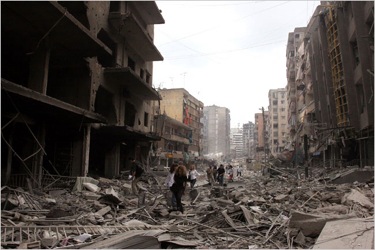
Fadi Ghalioum/Reuters. NY Times:
Journalists inspected damaged buildings Thursday after Israeli air raids in southern Beirut. (photo feature)
I would like to examine the many layers of what is going on in the mideast right now, a tricky proposition. I haven't posted a ton of stuff on the 9 days of heavy fighting so far, as the various blog commentaries and disturbing hawkish proclamations have the air of armchair morons who know nothing about the region, yet still are convinced that lots of people have to die, and then it will all make sense.
When Newt Gingrich calls it World War III, that's really... uh, something.
First I have to subtract the particular aura of doom that has settled over events, an aura deliberately fostered by all sides' political leaders that I call 'Apocalypse Chic.' In the next post I'll start into the concrete tactical reality of the situation - but first we need a little better metaphysical footing.
Last week I shared a certain moment with my former roommate on the stoop of my new building on Grand Avenue. "Shit! It's the Apocalypse!" I lamented. It seemed a juncture with eerie precedents in years past, hanging around Macalester bitching about the war and the latest lurch towards Armageddon. Later my caretaker said, "You know, it's always some damn thing - one crisis after another." Yet somehow the world keeps turning.
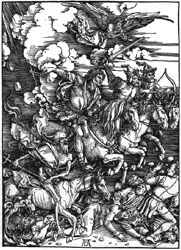 After Iraq started, I used to fear that total destabilization - the Eschaton or the Apocalypse - the point of no return, the end of predicting the future, since chaos renders it opaque. I thought that our leaders had embraced a creepy kind of foreshadowing, a sidewinding dance towards a destiny of doom. Yeah, they still do. But I don't really believe in the Eschaton anymore. It just gets more complicated each time. (image filched from Wikipedia)
The concept of "Judgment Day," (in my view a fiction since I don't believe in organized religion) first came about with the Zoroastrians in Persia, and from there integrated into Judaism (during the Babylonian captivity), Christianity and Islam. (That's definitely part of why the Book of Daniel is so kooky). Its purpose, in part, is to structure social and political authority, as decisions of the leadership can be represented as actions designed to face their societies for the imminent (and immanent) Rapture.
To fundamentalists in America, this is definitely compounded by Iraq's history as the site of wicked Babylon, and a fealty towards a highly militarized Israel, preparing to settle all the Promised Land - especially the West Bank - as a preparation for the End.
Many times in history, from the Nazis to Khmer Rouge, the American apocalypse brigades, Israel's messianic ultra-Orthodox West Bank settler organizations like Gush Emunim, and of course various Islamic movements, all of these have a foundation of belief that God dispensed order and disorder into the world, and free will counts for a limited time only, until S/He cancels the lease. Therefore, the leaders claim to be positioning their societies before this 'ultimate judgment,' and anyone who challenges their decisions is fucking up the preparations for the End of Days.
At this late date in the Middle East, "propaganda by deed" and demonstrations of lethal force are intended to both create new norms of behavior and solidify the obedience of the followers behind the leaders. The latest violence is like a kind of inverted Calvinism, where instead of Good Works demonstrating how you are a blessed one, the latest violence is represented as an act on the "cosmic plane," a kind of formal complaint or argument to the Metaphysical Other, to be scored on the approaching Last Day.
The aura of doom is a very disabling one - it tells you that everyday people are incapable of intervening in some blessed, fated order of events. It tells you that there is a veil of the supernatural behind which the government acts. It's a toxic fog sitting on your mind, cutting off all the alternative options and frames of reference before you've even had a cup of coffee. It's death in life. And it's the devil's greatest lie, told by all the totems of the highest morality in our societies.
It's very trendy these days, and it certainly brings out the worst in all the players. Bin Laden's style of bringing in a certain tone of eschatology has been incorporated into the tactics, strategy and Public Relations moves of Israel, the United States, Hezbollah, Iran, and the other actors in the region. That's why all the sides make their tactical moves for relatively simple reasons, while each vesting themselves in Apocalypse Chic. You just can't avert your eyes from the spectacle. You Have To Watch.
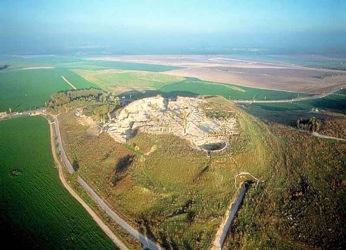
Jezreel Plain, the site of Megiddo, (Biblical Armageddon).
Karl Rove scheduled the Ultimate Battle for October 2012, just before the Presidential Election
I am going up to Hibbing to see my aunt's Dylan documentary until Saturday afternoon and probably won't have time to post until Sunday.
A tantalizing nugget: my friend's dad stumbled across a massive embezzlement scheme in the Chicago branch of the Head Start education program. This is only now coming into public view and I will try to get something real on it later.
So the Administration wants to eat reporters who spill classified information. This lends itself to a new strategy: classify everything embarrassing and evil. Now that's your tax dollars at work!
Wednesday night I was hanging out with some folks soon parting ways with Minnesota, and it was a good time. In exchange for a nice old hat, various objects were offered for barter, including a Krazy Kat book. Krazy Kat was a weird old comic from the 1920s that has reached a kind of Major Art status, while really it's just pretty weird. I noticed that Itchy & Scratchy seems to be kind of based on it, including the cat's androgynous quality. Anyway.

Finally a Democrat in the House is getting busted for a scandal. Poor Jefferson was caught taking major cash in a pretty blunt kind of way and they're saying indictments next month, yet there is a big ruckus from Republicans after the FBI searched his Congressional office and took boxes of documents. Due to the bipartisan uproar, Bush has sealed the docs from the FBI, at least temporarily.
It's an interesting case. I feel that Republicans are a bit terrified that a potential future Democratic president could find evidence of all kinds of illegal stuff in their offices. For the whole history of this country, the executive hasn't been able to storm these places (or had the guts to). I tend to think that this is appropriate, that there ought to be a sphere of immunity of some sort to protect Congress from the executive. On the other hand, I would like to see Hastert, DeLay and all the other homies get nailed for all their Abramoff corruption. Just because you're in Congress doesn't mean you're above the law. Laura Rozen asks, is it panic?
But, what if (and certainly this has happened), member X has lots of evidence proving that Gonzales is a lawbreaker himself, that Rummy is a psychopath who permits war crimes, that Cheney helped channel Halliburton contracts and Porter Goss partied with hookers at the Watergate for a decade? In other words, what if I had Sen. Carl Levin's file cabinet? Well, that file cabinet would serve as a crucial check in the pretty corrupt system we've got now, and it seems clear that the founders intended to privilege stuff like that file cabinet. I also think that it should be impossible to charge Rep. Cynthia McKinney for slapping that Capitol police officer (in particular since it's been said that the Capitol police corps have been taken over by southern GOP good-ol-boy sheriff types).
We should note that the great Joseph McCarthy could not be sued for all the crazy slanderous and libelous garbage he puked onto the floor of the Senate during the 1950s, because, well, it was his constitutional right as a Senator to say plainly false and libelous things there. If the legislative branch gets under that kind of pressure, well, they will be 'chilled' in the legal speech sense, and it's curtains for that supposedly equal branch of the government. Never forget that people with their hands on executive power don't necessarily care about the truth, but they'll try to silence those who get in their way. McKinney has been a pretty vocal anti-imperialist (not to mention 9/11 skeptic), despite her silly style, and that whole thing reeks of an effort to kill the messenger. Movin' on.
Al Gore stares into the distance: From New York magazine, via the Brad Blog:
Does he, like many Democrats, think the election was stolen?
Gore pauses a long time and stares into the middle distance. "There may come a time when I speak on that,” Gore says, "but it’s not now; I need more time to frame it carefully if I do.” Gore sighs. "In our system, there’s no intermediate step between a definitive Supreme Court decision and violent revolution."
Later, I put the question of Gore’s views on the matter to David Boies, his lawyer in the Florida-recount battle. "He thought the court’s ruling was wrong and obviously political," Boies says. So he considers the election stolen? "I think he does—and he’s right."
Brad Blog was a leading place for tracking the election fraud in Ohio, and while I don't read regularly, it's well done.
Check out Wot is it Good 4 by Lukery, which has especially followed the case of former FBI translator Sibel Edmonds - with its bizarre stories of drug money laundering, 9/11 links, FBI corruption, the whole bit. Sibel herself (official site), under many federal gag orders, has said that Lukery has been able to digest the known facts of the case better than anyone else. There's fresh stuff on a daily basis. For example, if you want to get waist-deep in some weird defense contractor shit, connected laterally with Manucher Ghorbanifar, Rep. Curt Weldon (of Able Danger fame), plus Edmonds' belief that Weldon has been kind of duped about some of the fake Iraq intelligence, well this story is what you need, and this one about some kind of corrupt link between neoconservatives, Turkey and military-industrial defense contractors, which Edmonds is also tied up in, another good one. Read this and trip out: Bing Bang Boom Shazam. The Edmonds case is way under the radar, extremely weird, but it seems to connect to the AIPAC scandal, Chalabi and the fake Iraq intelligence, some kind of secret 9/11 financing arrangements, drug money laundering, Turkish spies, and perhaps illegal money in the campaign coffers of people like Rep. Dennis Hastert. Or maybe not (Hastert is getting sucked into the Abramoff scandal, either way). I think at some point, Sibel Edmonds will finally break out into a major scandal and I'd like to say that we got a bit of the early word out here. SourceWatch on Sibel Edmonds too. (tiny side note: Lukery suggests this woman's skillful negotiation sites)
But who are Sibel Edmonds, Curt Weldon, Able Danger and what do these have to do with 9/11?? Fortunately in the expanding field of 9/11 conspiracy videos, a new one introduces these issues in an accessible way. Check out Everybody's Gotta Learn Sometime. I thought it was better than Loose Change, in terms of consisting of actual information and loose ends. However it doesn't have as many fun video clips. It has a pretty good introduction to the Able Danger, the pre-9/11 military intelligence project that apparently pinpointed some of the hijackers, and then was abruptly shut down with its terabytes of records vaporized. But ironically the problem perhaps might have been that it was based on illegal data mining?
Chinese spy update: Pretty cool stuff on the next hurrah about Katrina Leung, a pro-Republican Chinese spy who is basically getting let off by the Justice Department. She admitted tipping off the Chinese to the identities of FBI agents investigating nuclear sales to China (which mighta been tied to Iran-contra - whew). Evidently, she fed disinformation to the FBI to go after the unfortunate scientist Wen Ho Lee.
OS X operating system design: Check out this Flash animation if you want to know how OS X is structured internally. This guy's book will kick ass if you are into kernel hacking.
Israel claims Iran gets nukes in "months": My Ass. Antiwar.com's Raimondo, in a column bitching about the Iran badge story, the peripheral Israeli connections to the fake Iraq intelligence, and new and shiny paranoia from Israel about Iran, notes that well, Israel is definitely going to jerk the U.S. down this path.
AIPAC notes: I thought this was a good writeup about the power of the Israel lobby from Stephen Zunes: FPIF Special Report: The Israel Lobby: How Powerful is it Really? He points out an interesting example of a Congressman, who, when challenged about his heavily anti-Palestinian votes, basically says that the Jews made him do it for fear of losing fundraising, but even after he announces he won't run again, he still votes against Palestinians. The Jews are just - wait for it - a scapegoat for his actual anti-Arab bias. And of course there's the basic fact that Bush depends a lot more on the hardcore rightwing (and often apocalyptic) Christian Zionists that Jewish ones.
Misc notes: Watch Lazy Ramadi, a video from some troops with a video camera. You won't regret it.

Sidney Blumenthal notes Iraq is doomed. Of course, it has literally the most corrupt government ever created (although maybe DC actually wins that right now). Duly noted by the brave Patrick Cockburn:
Iraq is disintegrating as ethnic cleansing takes hold:
Across central Iraq, there is an exodus of people fleeing for their lives as sectarian assassins and death squads hunt them down. At ground level, Iraq is disintegrating as ethnic cleansing takes hold on a massive scale.
By Patrick Cockburn in Khanaqin, North-East Iraq (20 May)
The state of Iraq now resembles Bosnia at the height of the fighting in the 1990s when each community fled to places where its members were a majority and were able to defend themselves. "Be gone by evening prayers or we will kill you," warned one of four men who called at the house of Leila Mohammed, a pregnant mother of three children in the city of Baquba, in Diyala province north-east of Baghdad. He offered chocolate to one of her children to try to find out the names of the men in the family.
Mrs Mohammed is a Kurd and a Shia in Baquba, which has a majority of Sunni Arabs. Her husband, Ahmed, who traded fruit in the local market, said: " They threatened the Kurds and the Shia and told them to get out. Later I went back to try to get our furniture but there was too much shooting and I was trapped in our house. I came away with nothing." He and his wife now live with nine other relatives in a three-room hovel in Khanaqin.
The same pattern of intimidation, flight and death is being repeated in mixed provinces all over Iraq. By now Iraqis do not have to be reminded of the consequences of ignoring threats.
I liked this list from Juan Cole:
There are now four distinct wars going on in Iraq simultaneously
1) The Sunni Arab guerrilla war to expel US troops from the Sunni heartland
2) The militant Shiite guerrilla war to expel the British from the south
3) The Sunni-Shiite civil war
4) The Kurdish war against Arabs and Turkmen in Kirkuk province, and the Arab and Turkmen guerrilla struggle against the encroaching Peshmerga (the Kurdish militia).
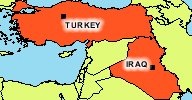 The struggle of the Turkmen is starting to branch out into Turkey. Note how Turkey is now red on the lovely Reuters map, seems ominous:
Kurds say Turkish shells land in Iraq, Turkey denies: By Sherko Raouf
SULAIMANIYA, Iraq, May 17 (Reuters) - The government of Iraq's autonomous Kurdistan region accused Turkish forces of shelling an area inside northern Iraq on Wednesday.
A Turkish government official dismissed the accusation as "total fabrication."
Ankara traditionally launches a spring offensive against Kurdistan Workers Party (PKK) guerrillas in southeastern Turkey, an area which borders Iraq.
Earlier this month, villagers in Iraq's Kurdistan accused neighbouring Iran of hitting targets inside Iraq, a charge Tehran denied.
Khaled Salih, a senior official of the Kurdish regional government in Arbil, said by telephone that no one was hurt when three shells slammed into a mountainous area close to the town of Kani Masi a few km (miles) inside Iraq.
"A village ... has been bombarded from the Turkish side. There were no casualties, but there was material damage," Salih told Reuters. "This is the second time in a week villages have been bombarded in the north."
"We will report this to the government in Baghdad so that they can contact the Turkish government and ask for an explanation," he said.
Salih said there were no PKK fighters in the area where the shells landed. NATO member Turkey has stationed some 1,500 troops stationed inside northern Iraq since the late 1990s when it launched regular raids into the region to hunt PKK fighters.
In Turkey, a government official told Reuters: "This is not true ... All the measures are on our side of the border." Turkey has sent 40,000 troops to its own Kurdish areas to reinforce the 220,000 already there, the biggest build-up in years after an increase in PKK attacks.
The PKK, seeking a Kurdish homeland including southeastern Turkey, accuses Ankara and Tehran of mounting coordinated operations against the group and its Iranian wing, PJAK.
NSA Total My Phone Bill Awareness: Crusty CIA veteran Ray McGovern rails against NSA monitoring of Americans. Sy Hersh with a few bits and pieces on the NSA situation. Congressional Quarterly reports on mysterious data links between Homeland Security and the NSA. TPMM observes how DOJ sends out TONS of subpoenas for data daily, apparently outside of judicial oversight. National Security Letters. Someday, the Letter will come for you (or more likely, me). TPMM also looks at how there is a cottage industry of companies that handle all our phone records, passing them from the telcos to the government, allowing AT&T to claim that they aren't giving Big Brother the records directly. Check this: Fuck NeuStar, the "scapegoat" for hire.
Billmon hung out in Egypt for some conference. Egypt is autocratic, the Teflon pharaoh. I like that phrase.
As always, Prof. Cole is the go-to man for direct analysis of the situation and Arab media. He also follows up further on the fake Iran Jew Badge story. Firedoglake traces back the root of the fake Badge story. The National Post had to retract the story:
Last Friday, the National Post ran a story prominently on the front page alleging that the Iranian parliament had passed a law that, if enacted, would require Jews and other religious minorities in Iran to wear badges that would identify them as such in public. It is now clear the story is not true. Given the seriousness of the error, I felt it necessary to explain to our readers how this happened.
Then, of course, the bastards require you to register to read the rest. Fuck! (this early, erroneous bit on the badge story struck me for its interesting historical content, but also classic pompous ignorati*-style writing)[ * "Ignorati" has been trademarked by Mordred]
We noted earlier a report about 200,000 AK-47s from Bosnia, that were purchased by the US for the Iraqi security forces, but now there are more reports that the AKs basically vanished and are now in the hands of insurgents because of - you guessed it - private defense contractors!! BBC reports on how the guns that ruined Yugoslavia are getting dumped straight into the Iraqi civil war.
Ah, the irony of how shitty neoconservatism worked out to be.
Murray Waas reports that Rove and Novak may have hatched a conspiracy to cover up the Valerie Plame leak (via TPMM):
On September 29, 2003, three days after it became known that the CIA had asked the Justice Department to investigate who leaked the name of covert CIA officer Valerie Plame, columnist Robert Novak telephoned White House senior adviser Karl Rove to assure Rove that he would protect him from being harmed by the investigation, according to people with firsthand knowledge of the federal grand jury testimony of both men. . . .
Rove and Novak, investigators suspect, might have devised a cover story to protect Rove because the grand jury testimony of both men appears to support Rove's contentions about how he learned about Plame.
Chinese PCs feared to be bugged: There's always time for Sinophobia.
Blockquotes are plagarism?! Plagarism Today (what a name for a site) talks about how the practice of blockquoting from other sources is really the new plagarism. I think that's a bit retarded since if you're naming your source, it's not plagarism at all. However, there are sites that exclusively skim off content and pass it as their own for spamming purposes. There are actually Hongpong.com fragments on spam sites out there. We blockquote a lot here, but damn, no one can read the whole damn Internet themselves! It seems like a silly argument, but on the other hand, the game ought to be about original content. However, I like to put lots of sources in here, since, well, you gotta at least weigh their credibility apart from mine in order for my arguments to sink in. Anyway, slashdot reacts.
Long ass random post. However more than enough stuff to keep anyone busy for a while. True?
This is the second time,
we will not fall in line,
No you can’t stop this exodus
No you won’t stop this exodus.
--Anti-Flag, Emigre (For Blood and Empire, 2006)

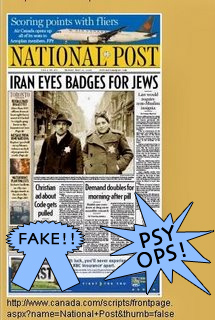 Canada's National Post newspaper published a story last Friday, A colour code for Iran's 'infidels', by Amir Taheri, which described a law passed by the Iranian Majlis (Parliament) requiring religious minorities such as Christians, Jews and Zoroastrians to wear colored clothing to signify them in public:
That sector [not headed for recession] is the garment industry and the reason for hopefulness is a law passed by the Islamic Majlis (parliament) on Monday.
The law mandates the government to make sure that all Iranians wear "standard Islamic garments" designed to remove ethnic and class distinctions reflected in clothing, and to eliminate "the influence of the infidel" on the way Iranians, especially, the young dress. It also envisages separate dress codes for religious minorities, Christians, Jews and Zoroastrians, who will have to adopt distinct colour schemes to make them identifiable in public. The new codes would enable Muslims to easily recognize non-Muslims so that they can avoid shaking hands with them by mistake, and thus becoming najis (unclean).
The new law, drafted during the presidency of Muhammad Khatami in 2004, had been blocked within the Majlis. That blockage, however, has been removed under pressure from Khatami's successor, President Mahmoud Ahmadinejad.
This, of course, echoes the Nazi policy of marking Jews and others, part of the psychological preparation to cleave them from German society, and subsequently exterminate them. The story resonates with the emerging storyline that "Ahmedinejad == Hitler!!", because as we all know, everyone from Daniel Ortega to Vladimir Putin to Hugo Chavez is in fact the reincarnation of that weird fey Austrian guy.
(The National Post is the Fox News of Canadian papers: as Wikipedia notes, discredited corrupt media mogul Conrad Black started it to counteract "over-liberalizing" Canadian papers)
The problem with Taheri's story is that it's fucking fake, a fabrication. For example, this quote appears to have materialized from nowhere, as its speaker does not exist:
"Iranians have always worn trousers," says Mostafa Pourhardani, Minister of Islamic Orientation. "Even when the ancient Greeks wore woman-style dresses with skirts, the Persians had trousers. We are not going to force Iranian men to do away with trousers although they predate Islam."
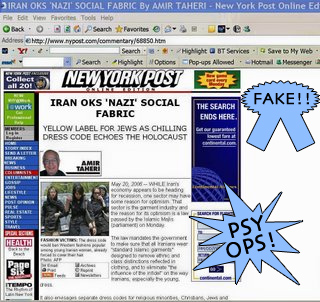 The story was quickly propagated in the right-wing media. I first heard of it from my roommate, who said there was a headline on Drudge when he was at work on Friday, yet when he tried to find it around 6 PM, it was already gone. To my credit, I immediately suggested it sounded cartoonishly evil and too good to be true. And of course, it bounced through the right wing blogosphere quite thoroughly.
The story was in turn picked up by that bastion of accuracy, the Murdoch-owned New York Post. So in keeping with our mission to comment on "information operations," and with a touch of dark irony, I have developed badges that will be attached to news stories determined to be fabrications designed to manipulate the public's perceptions of foreign devils and others. Henceforth a blue PSY OPS starburst will be affixed to such things so no one's brains are contaminated by lies!
How do we know that this is a fabrication? Wikipedia already has a major page for the event: 2006 Iranian sumptuary law controversy with many details and links. A blog called Lenin's Tomb summarized the situation and Taheri's spot in the neo-con media heirarchy quite effectively:
Amir Taheri, of course, is a dubious figure. He is a sublunary of the Benador Associates, a right-wing PR firm that supplies conservative speakers for all sorts of occasions. He specialises in producing bilge about Iran, interpreting Ahmadinejad's letter to Bush as an attempt to provoke a clash of civilizations so that the Hidden Imam will return, while asserting not only that Iran wants a nuclear bomb, but that it wants one to - well, hasten a clash of civilizations so that the Hidden Imam will return. He has claimed that attacks on London and New York were inspired by a desire by some Muslims to exert total dictatorial control over what you eat for breakfast (which is cartoonish nonsense), referred to Tariq Ramadan as a Muslim Brotherhood militant (which is flatly false), smeared antiwar protesters as defenders of the Taliban and Saddam Hussein, and asserted that Israel must claim victory over Palestine. As an "Iranian-born analyst" (they never forget to mention this), he is the neoconservative's favourite 'native informant' about Islam, the Middle East and how well various imperialist adventures are going. Commentary Magazine loves him, the Wall Street Journal loves him, the Telegraph loves him, the National Review loves him - to put it mildly, his brand of 'insight' is very popular with that baroque sodality of reactionary imperialists. Noteworthy that, after the story has already been rebutted, Amir Tehari has gone and retold the story to the New York Post with the headline 'Iran OKs "Nazi" Social Fabric'.
But what is more interesting than Tehari's corroborative role is that this utterly false and utterly implausible story was first published by the National Post and then taken up by newspapers and television stations across America and the West, and even a supposedly leftish site called Truthdig. The report cited no solid sources, merely adducing unnamed "human rights groups" were were "raising alarms" and unnamed "Iranian expatriates" who "confirmed reports". Well, I say 'unnamed' - one Iranian expatriate is named, some geezer called 'Ali Behroozian'. Quite how he was able to 'confirm' this claim, what qualified him in other words, is a mystery. Googling yields nothing about him, so either he's a private citizen, in which case the question about his qualifications to confirm anything for the National Post is repeated, or the name is all made up, in which case other questions come to mind. Possibly, these human rights groups and expatriates are of the same character as the Iraqi exiles who obligingly told Bush what he wanted to hear - or what he wanted others to hear - so that he could invade Iraq. Or one could equally suspect the hand of such PR groups as Hill & Knowlton, who famously manufactured a story about Iraqi soldiers ripping babies from incubators and leaving them to die on the floor. But what is clear, abundantly clear, is that any news reporter worth his or her salt would have spotted that this set of claims had fuck all to it. Hardly any sources, obtuse style, vagueness of details, nothing but colourful, arresting and emotionally involving claims and expostulations that divert one from analysis. As Alexandra Kitty explains in her useful book on lies becoming news, those are the absolutely standard tell-tale signs of a hoax. CBS boasts that it did not publish the story because "there were too many red flags" and not enough concrete information. Yet Fox News, MSNBC the New York Post, the New York Sun, the Washington Times, the American Jewish Congress, the Jerusalem Post and any number of wingnut sites and of course our progressive friend Truthdig all repeated these outrageous, obvious lies as if they were fact. Most, including our progressive friend Truthdig, followed the National Post's lead by illustrating their coverage with artefacts or photos from Nazi Germany.
I'll also note Juan Cole's thorough debunking of the matter: Another Fraud on Iran: No Legislation on Dress of Religious Minorities:
The National Post was founded by Conrad Black and has been owned by CanWest since 2003,* is not a repository of expertise about Iran. It is typical of black psychological operations campaigns that they begin with a plant in an out of the way* newspaper that is then picked up by the mainstream press. Once the Jerusalem Post picks it up, then reporters can source it there, even though the Post has done no original reporting and has just depended on the National Post article, which is extremely vague in its own sourcing (to "human rights groups").
The actual legislation passed by the Iranian parliament regulates women's fashion, and urges the establishment of a national fashion house that would make Islamically appropriate clothing. There is a vogue for "Islamic chic" among many middle class Iranian women that involves, for instance, wearing expensive boots that cover the legs and so, it is argued, are permitted under Iranian law. The scruffy, puritanical Ahmadinejad and his backers among the hardliners in parliament are waging a new and probably doomed struggle against the young Iranian fashionistas. (The Khomeinists give the phrase "fashion police" a whole new meaning).
There is nothing in this legislation that prescribes a dress code or badges for Iranian religious minorities, and Maurice Motamed was present during its drafting and says nothing like that was even discussed.
The whole thing is a steaming crock.
In fact, Iranian Jewish expatriates themselves have come out against a bombing campaign by the US or Israel against Iran. There are still tens of thousands of Jews in Iran, and expatriate Iranian Jews most often identify as Iranians and express Iranian patriotism. I was in Los Angeles when tens of thousands of Iranians immigrated, fleeing the Khomeini regime. I still remember Jewish Iranian families who suffered a year or two in what they thought of as the sterile social atmosphere of LA, and who shrugged and moved right back to Iran, where they said they felt more comfortable.
This affair is similar to the attribution to Iranian President Mahmoud Ahmadinejad of the statement that "Israel must be wiped off the map." No such idiom exists in Persian, and Ahmadinejad actually just quoted an old speech of Khomeini in which he said "The occupation regime over Jerusalem must vanish from the page of time." Of course Ahamdinejad does wish Israel would disappear, but he is not commander of the armed forces and could not attack it even if he wanted to, which he denies.
The Palestinian advocacy website Electronic Intifada notes that an editor of a CanWest paper said "We do not run in our newspaper Op Ed pieces that express criticism of Israel".
Here is background from SourceWatch on Benador Associates - basically a PR firm for neo-con hawks. And a Kos writer adds:
Meet Eleana Benador, the Peruvian-born publicist for Perle, Woolsey, Michael Ledeen, Frank Gaffney and a dozen other prominent neoconservatives whose hawkish opinions proved very hard to avoid for anyone who watched news talk shows or read the op-ed pages of major newspapers over the past 20 months. Also found among her client list are other major war-boosters, including former New York Times executive editor and now New York Daily News columnist, A. M. Rosenthal; Washington Post columnist Charles Krauthammer; the Council on Foreign Relations' resident imperialist Max Boot; and Victor Davis Hanson, a blood-and-guts classicist and one of Vice President Dick Cheney's favorite dinner guests.
In other words, practically the whole gang! There's plenty of commentary around this flap, such as this columnist in the Toronto Star, Canadian Cynic, Taylor Marsh, Unqualified Offerings, and plenty more if you care to search.
Besides all that, um, check out Thomas Lippman and Juan Cole's basic explanation of why Iran is not really a military threat to Israel.
Get ready for more of these. They are definitely coming, but it would appear that lots of people are already wary of the Persian version of Aluminum Tubes©®.
Technorati Tags: PSYOPS
Iran shady business: This is an encouraging chart:
 It comes via Steve Soto at TheLeftCoaster, who writes on The Economy and Iran that retired Colonel Sam Gardiner has offered an outline of the opening moves of an Iran war. Gardiner thinks its a terrible idea, and recently said on CNN that a covert war is already underway. His latest:
I. Period of Building Pressure: This could be 60 days or even six months in which the US and European leaders continue to talk to their publics on the failure of the Iranians to comply with "the wishes of the international community." There will be talk and work on sanctions but those, will be for the purpose of building US and international support; they will not be done with any hope of changing Iranian behavior. We should see the US surface a smoking gun during this phase. (Note: this has already happened with the recent “revelation” about Iran’s uranium possession in excess of what was anticipated) Some military deployments might take place. Most visible would be three aircraft carriers in the vicinity.
II. Initial Strike: This would last 36 to 48 hours. It would only be moderately visible to the global publics. Most of the attacks would take place at night. To prevent retaliation, most targets would be other than nuclear facilities.
III. Pause: The strikes would stop. Iran would be warned that if it were to retaliate the strikes would resume. The pause would probably not be long, maybe 72 hours. Either Iran would conduct an operation against US or Israeli targets, or there would be an event that is blamed on Iran. (Note: Gardiner says that it is very likely, especially in the wake of last week’s announcement from Iran that any strike by Bush against Iran would be considered as an attack from Israel also, that Iran will hit Israel in response to any attack from America)
IV. Regime Change Targeting: The attacks from this point would shift to targets that could cause the regime to fall. It would include direct attacks on the leadership of Iran.
Gardiner adds that the pressure is being increased:
In the phase of building pressure, I see two indicators. I called one of them the "smoking gun." By that I mean the Administration will reveal that Iran is farther along in its nuclear program than we originally thought. This will most likely be some evidence that AQ Kahn, the Pakistani, sold more to Iran than we knew.
Late Friday we read a leak from a diplomat with the International Atomic Energy Agency that new enriched uranium evidence has been found. This could be the emergence of the smoking gun.
The second indicator in the pressure-building phase was the position of aircraft carriers. The Reagan is in the Gulf Region. The Enterprise left Norfolk for the ME (Middle East) on May 2. The Lincoln did a port call in Singapore on April 30, apparently moving in the direction of the ME.
In October 2004, I had the bizarre experience of having lunch with that leading neoconservative Michael Ledeen, who is continually obsessed with Iran, and I wrote the following in "Lunch Beyond Good and Evil: Around a Table with Michael Ledeen":
His scheme to free Iran was to supply the opposition with the tools to destabilize the regime, “but not a single bullet.” I have a hard time believing he could resist arming the Iranian opposition. In fact, many say that the Pentagon, administered by Ledeen’s allies, has courted a weird, cultish anti-regime Iranian guerilla group based in eastern Iraq called the Mujahideen al-Khalq. If Bush wins, it’s quite unlikely that the neo-cons will be able to resist using forces like these to harass Tehran, but we have no idea what sort of reaction this would provoke from the highly mobilized, nationalist Iranians.
This appears to be exactly what is going on now, by some reports, as I noted earlier. On my birthday, Raw Story's Larisa Alexandrovna published a pretty disturbing report about how the situation is getting geared up:
US military, intelligence officials raise concern about possible preparations for Iran strike
Concern is building among the military and the intelligence community that the US may be preparing for a military strike on Iran, as military assets in key positions are approaching readiness, RAW STORY has learned.... Retired Air Force Colonel and former faculty member at the National War College Sam Gardiner has heard some military suggestions of a possible air campaign in the near future, and although he has no intimate knowledge of such plans, he says recent aircraft carrier activity and current operations on the ground in Iran have raised red flags.....
Advance teams under way; Congress ‘bypassed’
As previously reported by Raw Story, a terrorist organization known as Mujahedeen-e Khalq (MEK) is being used on the ground in Iran by the Pentegon, bypassing US intelligence channels. The report was subsequently covered by the Asia Times (Article). Military and intelligence sources now say no Presidential finding exists on MEK ops. Without a presidential finding, the operation circumvents the oversight of the House and Senate Intelligence committees.
Congressional aides for the relevant oversight committees would not confirm or deny allegations that no Presidential finding had been done. One Democratic aide, however, wishing to remain anonymous for this article, did say that any use of the MEK would be illegal. In addition, sources say that a March attack that killed 22 Iranian officials in the province of Sistan va Baluchistan was carried out by the MEK.
According to a report by Iran Focus filed Mar. 23, the twenty-two people killed in the ambush included high ranking officials, including the governor of Zahedan. "Hours after the attack took place, Ahmadi-Moqaddam announced there was evidence the assailants had held meetings with British intelligence officers," the Iranian news service reported. "Radical Shiite cleric Mostafa Pour-Mohammadi also claimed the people behind the attack were the same as those behind a spate of bombings in Iran’s south-western province of Khuzestan earlier this year and in 2005," it added.
Military and intelligence sources say that MEK assets were responsible for this attack, but did not know if the US military was involved or if US military assets were part of the ambush. One former high ranking US intelligence official described the use of MEK as more of a "Cambone" operation than a "Department of Defense operation." Undersecretary of Defense Intelligence Stephen Cambone, a stalwart neo-conservative, is considered by many to be Secretary of Defense Donald Rumsfeld’s right-hand man.
During a White House briefing in early May, outgoing press secretary Scott McClellan denied that the administration was using MEK, among several other terrorist organizations named, for ground activity in Iran....
Here is a lot of background on the shady, shady Mr Cambone. More on this at WotIsItGood4. You need to read Iran Freedom and Regime Change Politics by Tom Barry at the International Relations Center's Right Web site for more on how AIPAC and other nasty foreign policy lobbies are ginning up the Iran war:
While AIPAC is the most powerful group advocating a tougher U.S. policy toward Iran, numerous other pressure groups calling for regime change in Iran have emerged over the past several years. One of the earliest, the Coalition for Democracy in Iran (CDI), formed in late 2002, ceased functioning in mid-2005. Operating out of the office of Morris Amitay, the former director of AIPAC, CDI worked closely with AIPAC to encourage Congress to pass resolutions condemning Iran. The CDI principals continue their efforts to promote regime change in Iran through other organizations, including the Foundation for Democracy in Iran, Foundation for the Defense of Democracies, Committee on the Present Danger, and the American Enterprise Institute.
Raymond Tanter, one of the original members of the Coalition for Democracy in Iran, founded the Iran Policy Committee (IPC) in January 2005. Tanter, who was a senior staff member of the National Security Council during the Reagan administration, is also associated with several other right-wing policy organizations, including the Washington Institute for Near East Policy, Middle East Institute, and the Committee on the Present Danger. Since its founding the Iran Policy Committee has sponsored conferences and policy briefings on the Hill, and has also published four policy papers—a common theme being that the U.S. government should declassify the People's Mojahedin Organization of Iran (PMOI/MEK) as an international terrorist organization and recognize it as being the “indisputably largest and most organized Iranian opposition group.”
Tangent: Using soccer to kick Iran.
For real, I am digging around very seriously for a job today. It's my birthday tomorrow, but I really need to make sure that the coming year has the kind of stability and confidence that the last year just really hasn't had at all. And by that, I mean full time work that will get me away from wasting my time with such really productive hobbies as this site. But hey that ain't yet, so lets waste some time:
Without BAGNewsNotes, where would we get such photos? Since politics is all images these days, its nice such a site specifically checks out the visual side: Psychology Watch: The Obvious Boy For Next Secretary Of Defense:

Nuclear gas release in Prairie Island containment vessel: A story from that new Twin Cities Daily Planet site, which sort of left ambiguous the nature of a recent nuclear leak down in Red Wing:
Prairie Island accident raises questions: A nuclear industry watchdog group Tuesday called the May 5 accident at the Prairie Island nuclear plant in which 100 workers were contaminated with radioactive iodine the most serious release of radiation there in 20 years and raised questions about the federal reporting process.
My understanding from the article is that the gas never got outside the containment vessel... The wording is a bit hazy, but the Daily Planet just started up, so they've got a couple kinks to get out. I admire the clever structure of the new Twin Cities news aggregating / indie features site, though, and I wish 'em the best.
Macalester alumni mag faces Scrotum-gate: I had declined to speak of this on the Internet but then they covered it in the Mac Weekly. Basically one of the Bad Comedy boys got his balls into a group photo that was submitted to Mac's fawning glossy alumni magazine. This was a brilliant maneuver in every sense, and a good (wait for it) extension of Bad Comedy's nudity-tinged oeuvre. I'd heard some rumors of this conspiracy in advance and I'm glad it went off well.
Obnoxious 'faux liberal' Washington Post columnist complains about angry bloggers: complaining about the 'anger' factor is just another way to deflect from the substance. In this case, it was Cohen's whining about how Colbert shouldn't have dared ruffle those mega-eagle feathers, which set off some pissed off emails. Digby: "In case Cohen hasn't noticed nobody on the fucking planet likes squishy faux liberal courtiers." And Salon's Daou Report on that and on the DailyKos.
Random as hell: (but seemed interesting enough): Old Afghan warlord Gulbuddin Hekmatyar "vows allegiance to bin Laden". Actually I thought this was old news, but it's interesting he's still kicking around since the old days when Reagan helped him fight the commies and pretty much everyone else. Tariq Ali on Iran. Muqtada al-Sadr wants to model the Mahdi Army on Hezbollah, which is a logical progression from boisterous militia to political party with lotsa guns and social services. AlJazeera.com (not affiliated with the TV network): Handicapped U.S. intel. on Iran challenges new CIA man.
This interview with the frontman of Godsmack about why the hell they sold songs into military recruiting commercials is pretty funny, if sad. (via Firedoglake)
"America's Geopolitical Nightmare and Eurasian Strategic Energy Arrangements" by F. William Engdahl from the idiosyncratic Centre for Research on Globalization, which always has interesting things. "The Next World War" from Antiwar.com's Justin Raimondo.
Suddenly all these guys, Joe Biden among them, are saying "let's just break Iraq in three" and feeling clever about themselves. I think that's a bit insane, but hardly surprising. George Packer, a skilled journalist, says in the New Yorker:
The choice in Iraq should not be between the Administration’s failed eschatology and the growing eagerness of most politicians to be rid of the problem.
Nobody likes Joe Lieberman, not even his supporters. Bizarre.
Jews Jeer Mehlman: JTA: Republican chairman booed at AJCommittee event:
The room burst into applause, however, when AJCommittee board member Edith Everett asked Mehlman to “take a message” to President Bush to stop linking Israel and Iran. “It does not help Israel and it does not help American Jews to appear to be stimulators of any action against Iran,” Everett said.
Something about Hitchens and Juan Cole: Noted rightwing drunkard Christopher Hitchens broke into a private email server where one of my favorite academics on the internet, Juan Cole, was explaining that the term "wipe Israel off the map" is an idiom that doesn't actually exist in Farsi, therefore every time you hear it, it's actually a distortion of meaning that serves war propaganda. Basically Hitchens published all these chunks of Cole's reasoning out of context in Slate, and this was a dick thing to do, since no one likes Hitchens, so he does this kind of B.S. hit piece. Anyway here is a bit about it. More here. As always, Cole's site is absolutely key.
Kos calls my boss a "wingnut": Teh sweet. Duly noted on the dailykos:
Last week I opened up in Minneapolis, where I got a ridiculously good reception. I started with a book signing at Arise Books, which is a small indy bookstore run by volunteers. I hadn't ever heard of anything like that before. The place was packed, and in the crowd was Fighting Dem Tim Walz in MN-01, who got a chance to update me on his race (which really is looking good). Also present was CW Wisconsin, who drove three hours for the event and left some great beer behind for me.
I did some radio, including wingnut radio on a show following Hannity. It was the first wingnut radio I'd done, since quite frankly, I'd rather not waste my time talking to people who won't buy my book anyway. But I had a blast batting around callers like a cat toying with a mouse. Seriously, what a bunch of morons.
Counter-AIPAC academics strike back: The Mearsheimer/Walt paper about the Israel Lobby and AIPAC has generated a predictable round of finger-pointing and scurrilous charges of anti-semitism, because they dared to directly dissect with blunt academic Neo-Realist style the way that A) Israel's right-wing policies are fully supported by the United States B) for totally irrational reasons that undermine our real national interests and C) no one is ever ever ever supposed to talk about this. Obviously it is a controversial topic to ramble on about, but not now. Anyway Mearsheimer and Walt wrote a big letter reacting to the reactions. These guys will have to sacrifice a lot in order to take on such a dicey topic, and we owe it to them to look at the matter carefully. But not now, damnit. Also there is an academic Freedom of Speech petition Juan Cole started against the charges of anti-semitism directed towards M&W.
Bits on CIA chief candidate Hayden: For some bizarre reason, Dennis Hastert is lashing out at John Negroponte for trying to do a "power play" by getting his deputy Hayden into running the CIA. I would recommend Steve Clemons' Washington Note stories on this matter, and the counter-intuitive "Misreading Michael Hayden's Role in the Intelligence Bureaucracy Wars: Negroponte Wants Hayden to Battle with -- Not Help -- Rumsfeld" (also noted here). The TPM muckies managed to link Hayden to Wilkes' corrupt MZM contractor. Check out Rozen following the case as well as Marshall. Tuesday, WaPo reports FBI probing Foggo's CIA contracts. The Sun reports Pentagon Is Winner Over CIA. Today, NY Times says Clash Foreseen Between C.I.A. and Pentagon.
Wayne Madsen - a peculiar journalist who used to be in the NSA, (read caveats about him in Wikipedia), well he doesn't like Michael Hayden one bit, and he has a lot of weird goods on the guy and the NSA generally. Check this this this this this and this for quite a trip down the rabbit hole. Madsen was the guy who stirred up that story that John Bolton was improperly reading NSA intercepts of Bill Richardson. Never got disproven.

Big Ol love letter from Ahmadinejad: It is a very interesting thing to read, and it seems to be targeted more at a Middle Eastern audience than the White House as such. NY Times on it here and Le Monde has the full letter here. By the way Steve Clemons also talks about this funny letter gambit. I would include more, but this is interesting by itself:
Mr President,
September Eleven was a horrendous incident. The killing of innocents is deplorable and appalling in any part of the world. Our government immediately declared its disgust with the perpetrators and offered its condolences to the bereaved and expressed its sympathies.
All governments have a duty to protect the lives, property and good standing of their citizens. Reportedly your government employs extensive security, protection and intelligence systems – and even hunts its opponents abroad. September eleven was not a simple operation. Could it be planned and executed without coordination with intelligence and security services – or their extensive infiltration? Of course this is just an educated guess. Why have the various aspects of the attacks been kept secret? Why are we not told who botched their responsibilities? And, why aren't those responsible and the guilty parties identified and put on trial?
All governments have a duty to provide security and peace of mind for their citizens. For some years now, the people of your country and neighbours of world trouble spots do not have peace of mind. After 9.11, instead of healing and tending to the emotional wounds of the survivors and the American people – who had been immensely traumatised by the attacks – some Western media only intensified the climates of fear and insecurity – some constantly talked about the possibility of new terror attacks and kept the people in fear. Is that service to the American people? Is it possible to calculate the damages incurred from fear and panic?
American citizen lived in constant fear of fresh attacks that could come at any moment and in any place. They felt insecure in the streets, in their place of work and at home. Who would be happy with this situation? Why was the media, instead of conveying a feeling of security and providing peace of mind, giving rise to a feeling of insecurity?
Some believe that the hype paved the way – and was the justification – for an attack on Afghanistan. Again I need to refer to the role of media. In media charters, correct dissemination of information and honest reporting of a story are established tenets. I express my deep regret about the disregard shown by certain Western media for these principles. The main pretext for an attack on Iraq was the existence of WMDs. This was repeated incessantly – for the public to, finally, believe – and the ground set for an attack on Iraq.
Will the truth not be lost in a contrive and deceptive climate? Again, if the truth is allowed to be lost, how can that be reconciled with the earlier mentioned values? Is the truth known to the Almighty lost as well?
[snip]........What has been said, are some of the grievances of the people around the world, in our region and in your country. But my main contention – which I am hoping you will agree to some of it – is : Those in power have specific time in office, and do not rule indefinitely, but their names will be recorded in history and will be constantly judged in the immediate and distant futures.
The people will scrutinize our presidencies.
Did we manage to bring peace, security and prosperity for the people or insecurity and unemployment? Did we intend to establish justice, or just supported especial interest groups, and by forcing many people to live in poverty and hardship, made a few people rich and powerful – thus trading the approval of the people and the Almighty with theirs'? Did we defend the rights of the underprivileged or ignore them? Did we defend the rights of all people around the world or imposed wars on them, interfered illegally in their affairs, established hellish prisons and incarcerated some of them? Did we bring the world peace and security or raised the specter of intimidation and threats? Did we tell the truth to our nation and others around the world or presented an inverted version of it? Were we on the side of people or the occupiers and oppressors? Did our administration set out to promote rational behaviour, logic, ethics, peace, fulfilling obligations, justice, service to the people, prosperity, progress and respect for human dignity or the force of guns. Intimidation, insecurity, disregard for the people, delaying the progress and excellence of other nations, and trample on people's rights? And finally, they will judge us on whether we remained true to our oath of office – to serve the people, which is our main task, and the traditions of the prophets – or not?
Well fine, then, Ahmadinejad better damn well figure a way out of this one now, if he is going to talk all altruistic and shit...
Very bad video games: Islamists using US video games in youth appeal (May 4)
WASHINGTON (Reuters) - The makers of combat video games have unwittingly become part of a global propaganda campaign by Islamic militants to exhort Muslim youths to take up arms against the United States, officials said on Thursday.
Tech-savvy militants from al Qaeda and other groups have modified video war games so that U.S. troops play the role of bad guys in running gunfights against heavily armed Islamic radical heroes, Defense Department official and contractors told Congress.
....Devlin spoke before the House Permanent Select Committee on Intelligence, at which contractors from San Diego-based Science Applications International Corp., or SAIC, gave lawmakers a presentation that focused on Iraq as an engine for Islamic militant propaganda from Indonesia to Turkey and Chechnya.
....One of the latest video games modified by militants is the popular "Battlefield 2" from leading video game publisher, Electronic Arts Inc of Redwood City, California. Jeff Brown, a spokesman for Electronic Arts, said enthusiasts often write software modifications, known as "mods," to video games.
"Battlefield 2" ordinarily shows U.S. troops engaging forces from China or a united Middle East coalition. But in a modified video trailer posted on Islamic Web sites and shown to lawmakers, the game depicts a man in Arab headdress carrying an automatic weapon into combat with U.S. invaders.
"I was just a boy when the infidels came to my village in Blackhawk helicopters," a narrator's voice said as the screen flashed between images of street-level gunfights, explosions and helicopter assaults.
Then came a recording of President George W. Bush's September 16, 2001, statement: "This crusade, this war on terrorism, is going to take a while." It was edited to repeat the word "crusade," which Muslims often define as an attack on Islam by Christianity.
I think we all want to know which mods they are running. Are Islamic militants closing the American game-modding gap? Here in America, video games serve Freedom: "America's Army", literally a first-person shooter designed to indoctrinate the youth into joining the military. Better to spend that defense cash on manipulating teen pop culture and upping polygon counts, rather than body armor, I suppose. SAIC is shady, too, but I will let that go for now.

 Robert Smigel had this awesome cartoon on a March 1998 SNL called "Conspiracy Theory Rock" which was really quite amazing (QuickTime link), as noted in this Times story. It only aired once, and has subsequently been deleted from reruns – instead they run the second Backstreet Boys performance. Basically it conveys, in typical Smigel style, the conflicts of interest and shady military money flows of the major corporate media – and the NBC peacock does embarrassing stuff. More on it here.

 Who was Zoroaster? A Persian prophet around 1700 BC who gave us the concepts of cosmological good versus evil, the afterlife and the Judgment Day. The Persian king found this to be a handy way to generate a more coherent and submissive population, so Zoroastrianism became the state religion of Persia. Even though there are fire temples around Asia today, it is still very obscure. The fire temples all have continuously burning fires that are the representations, though not considered supernatural, of Ahura Mazda, the Light. The fires have been burning for centuries. (images from Wikipedia)
Zoroaster's influence went east, where it infused the foundations of Buddhism, and west, where it got into post-Babylonian Judaism, Christianity and Islam. Zoroastrianism is an interesting and under-appreciated pillar of monotheism, and in a sense today you could say we are dealing with a kind of Zoroastrian manichaeism run amok. At least that was the point of this DailyKos entry about the Prisoners of Zarathustra. Also, Zoroastrianism has really freakin' cool Babylon-style art.
 War Profiteering ain't that profitable? Slate: War profiteering—harder than it looks. By Daniel Gross. A lot of interesting points about the structure of how KBR works. Also check out this thing from PBS Frontline, it was quite detailed and long, but a fascinating interview about how in the military-industrial complex, contractors beget subcontractors up to six levels deep. Even more interesting, those psychopathic guys from CACI and Titan Corporation who were working as private quasi-CIA interrogators at Abu Ghraib had no government oversight officers inside Iraq at all. In other words, there is some kind of mercenary hydra beast with absolutely no checks on it. And it's stealing your money: Frontline: Outsourcing military services is in vogue. Why? An interview with Steven Schooner. Just a few things to kick around.... Try PrivateForces.com for more on the privatized / mercenary military companies.
TomMahm, Copperfield Loses Not a Cent, Lots More Stadiums Seats to Put Butts In, I Have a Cat!

The above is an untouched photograph of the view West towards the Tucson mountains from my front yard on a weekday evening. The bar on the left was frequented by Jack Kerouac, I am told.
Introducing: Strega Nona

Abby and I have adopted Strega here, which is to say, Strega's owner forfeited his right to own her through gross negligence and she chose to reside with us instead. She is currently in heat, which has been a treat, as she begins yowling at five in the morning and gets louder until ten or so. Come Friday morning, entering into estrus will forever be a thing of the past for Strega, which is win-win for everyone. Mating screams and the demented rubbing exercises that accompany them notwithstanding, this is a very cool cat- gentle and loving without being needy, small, athletic and quite beautiful, she's ["Smitten Kitten" joke redacted- ed.]
I'm an illusionist!
 David Copperfield was robbed at gunpoint in West Palm Beach Sunday night, and managed to convince the three teenage thieves holding a gun six inches from his face that he did not have any on him by performing his "reverse pickpocket" trick and pulling out his pant pockets in from of them without relinquishing possession of his scrilla and celly. He called the cops and the kids were busted "within minutes," and then magically transformed into a scale model of the Gateway Arch in a cloud of smoke. I kid, Mr. Kotkin (his real name), smoke machines are for hacks, of course! In related news, David Blaine is going to perform his next stunt, where he will be dangled from his toes while wearing the Shroud of Turin over a vat of warm marmalade, in New York City. The reason for the change of venue (he spent 44 days in a box starving himself in London two years ago) was the inhospitality of the British, who went so far as to dangle cheeseburgers from RC helicopters to torture him. So, in summary, David Blaine is a baby and David Copperfield belongs in her Majesty's Secret Service. Remember, not only did he fool the thieves and keep the cash, but we still don't know the trick, preserving his Alliance certification.
I don't even know what my point is here, other than that these guys is crazy...
Stadiums for Everyone!
 Well, the VIkings' stadium deal is still in its infancy, but the Gophers and Twins are crowning as we speak. Though the Senate shifted around the Gopher stadium plans a bit, (removing the student fee and nixing TCF Bank's $35 naming rights contribution) it is still on track at the very same moment that a Twins stadium bill's passing is looking all but inevitable. I think we can probably call all three of these projects likely, which is exciting news. The Cities had to spruce up their sports infrastructure a bit both for the purposes of major events like the NCAA tournament and the Super Bowl and to, y'know, retain their teams in an era of bazillion dollar excesses on major sports venues. The price tag? $790 million for the Vikes, $522 million for the Twinkies (half a bill and no retractable roof?) and $248 million for Goldie to go toe-to-toe with the newer stadii of the Big 10; silly money, to be sure, but the resulting facilities, and the possibility of Hennepin County pursuing its imagined urban village in the footprint of the Huhuhu Metrodome, make the deal(s) too good to pass up. FYI- The Representative sleeping through the meeting on the allocation of a half a billion dollars is Representive David Dill (DFL-Crane Lake).
 Foreign Policy magazine has a blog, with an interesting bit about the Maoist threat...to India, part of their Top 10 Stories You Missed in 2005:
Consistently outwitting and overwhelming Indian police forces, Indian Maoists, also known as Naxalites, have taken control of large chunks of territory in several eastern and southern Indian states, such as Orissa and Andhra Pradesh.
They add:
Many Indian analysts have long been distressed by the central government's indifference to the problem, leaving it to the ill-armed and corrupt state police forces. But New Delhi, now led by Manmohan Singh's government can no longer ignore the insurgency that is growing in strength. Combined with Kashmir and sporadic sectarian violence between Hindus and Muslims, the internal security problem is really serious.
This is interesting because it shows how less-than-unitary such a huge place as India can be – and it shows that a more complex model than traditional International Relations unitary state "Realism" is necessary to look at these things. It also reminds me of a certain stubborn Tamil nationalist who would remind us all where things really stood between Indian ethnicities... Photo from the Wikipedia entry on Naxalites.
The IMF is supposed to fix major trade imbalances now.
AIPAC case: Condi Rice denies that she leaked the same variety of classified information to AIPAC lobbyists as Larry Franklin. They are trying to get people to believe that "everyone does it", trading secret government deliberations among the right-wing foreign lobbies in DC. I wish I was a powerful rightwing foreign lobby, then everyone would kiss my ass!!
 Not international but fun! Joementum evaporating: more and more people are pissed at Joe Lieberman for fucking over the Democrats constantly. His indicators are falling among independents, as well. It is entirely possible that Lamont will steal the Democratic primary nomination from him, which is basically unheard of. Hit up the Lamont Blog for more on the insurgency against this p0nk.
William Arkin at the Washington Post blog Early Warning is coming up with a lot of goods on upcoming Iran madness, but he thinks its kinda funny how he has personally been pegged as a conspirator for Global Zionism, the left, right, neocons, who knows what. He's got some cool stuff about how some damn defense contractor is going to be paid to cough up terror warnings because the government is pathologically retarded:
The database is produced by IntelCenter, one of a cottage industry that has sprung up since the early 1990's to feed at the counter-terrorism trough. According to the group's website, the IntelCenter's "primary client base is comprised of military, law enforcement and intelligence agencies in the US and other allied countries around the world."
Space Command wants to obtain 20 licenses to the IntelCenter's U.S. Government Terrorism Threat Intelligence Package ($1650.00 per license according to the IntelCenter website).
This database, according to Space Command, includes "weekly and or real time email notifications of all significant terrorist, rebel group and other related activity, including bombings, assassinations, kidnappings, significant dates, threats and organizational changes within groups." IntelCenter will also provide warnings relating to "developments concerning intelligence agencies around the world including operational issues, organizational developments, new initiatives, espionage trials, new technologies and other related issues." And finally, IntelCenter will receive "real-time dissemination of raw statements, fatwas, announcements, and other messages directly from terrorist, rebel, extremist, and other organizations themselves."
The immediate question is: isn't this what all of these new "long war" commands and reorganized and beefed-up intelligence agencies with all of their new databases and data mining and authorities supposed to do? Okay, by government standards, $32,000 annually is petty cash. But there must be dozens of additional agencies and commands buying the IntelCenter product and hundreds if not thousands of licenses paid for with your and my tax dollars.
Everyone senses that we have a contractor crisis in our national security community, too many contractors acting like wild west prospectors in Iraq and the Middle East, contractors doing what we used to think of as "mission essential" jobs in headquarters and agencies.
Right on dude, right on.
 Special Operations command, SOCOM, is apparently the new heart of the "war on terror" and there are all kinds of plans getting put together to shift intelligence and shadowy combat type stuff into SOCOM - and also, a decisive shift to allow military operations without an ambassador's approval. Are they also coordinating Psychological Operations such as Zarqawi "letters?" (More on that in a bit, we do have a couple goodies...)
WaPo: New Plans Foresee Fighting Terrorism Beyond War Zones
Pentagon to Rely on Special Operations By Ann Scott Tyson Sunday, April 23, 2006; Page A01
Details of the plans are secret, but in general they envision a significantly expanded role for the military -- and, in particular, a growing force of elite Special Operations troops -- in continuous operations to combat terrorism outside of war zones such as Iraq and Afghanistan. Developed over about three years by the Special Operations Command (SOCOM) in Tampa, the plans reflect a beefing up of the Pentagon's involvement in domains traditionally handled by the Central Intelligence Agency and the State Department.
For example, SOCOM has dispatched small teams of Army Green Berets and other Special Operations troops to U.S. embassies in about 20 countries in the Middle East, Asia, Africa and Latin America, where they do operational planning and intelligence gathering to enhance the ability to conduct military operations where the United States is not at war. [orwellian phrase of the day]
And in a subtle but important shift contained in a classified order last year, the Pentagon gained the leeway to inform -- rather than gain the approval of -- the U.S. ambassador before conducting military operations in a foreign country, according to several administration officials. "We do not need ambassador-level approval," said one defense official familiar with the order.
This plan details "what terrorists or bad guys we would hit if the gloves came off. The gloves are not off," said one official, who asked not to be identified because of the sensitivity of the subject..... Special Operations Command, led by Gen. Doug Brown, has been building up its headquarters and writing the plans since 2003, when Rumsfeld first designated it as the lead command for the war on terrorism. Its budget has grown 60 percent since 2003 to $8 billion in fiscal 2007. President Bush empowered the 53,000-strong command with coordinating the entire military's efforts in counterterrorism in 2004.
"SOCOM is, in fact, in charge of the global war on terror," Brown said in testimony before the House last month. In this role, SOCOM directs and coordinates actions by the military's regional combatant commands. SOCOM, if directed, can also command its own counterterrorist operations -- such as when a threat spans regional boundaries or the mission is highly sensitive -- but it has not done so yet...
Stratfor: US is planning post-Musharraf Pakistan: Arkin has some goods on a planned spring offensive against Taliban-style guys in Pakistan, but alarmingly, The Pakistan Daily Times reports:
April 21, 2006: US now viewing Pakistan without Musharraf: Stratfor | By Khalid Hasan
There are indications that the Bush administration is now imagining a Pakistan without Gen Pervez Musharraf, according to Stratfor, an American news and analysis service.
In two commentaries in the wake of Richard Boucher’s April 5 statement in Islamabad about America wishing to see the ascendancy of civilian rule in Pakistan, Stratfor says this shift in Washington’s thinking will create further domestic problems for the Pakistani leader, since his political opponents view the US statements as a signal to intensify their efforts to oust him. The analysis also noted US National Security Advisor Stephen Hadley’s comment that the Bush administration will work with Musharraf to ensure that Pakistan’s 2007 elections are “ free and fair,” as well as Condoleezza Rice’s congressional testimony earlier this month.
“These statements from the highest echelons of the Bush administration illustrate that the United States is no longer fixated on supporting Musharraf,” says Stratfor. “This is probably because Musharraf’s usefulness to the United States is fast becoming negligible. The principal reason the Bush administration supported the Musharraf regime was due to Pakistan’s critical role in the US-jihadist war. It would appear Washington believes it does not need Musharraf at the helm for the United States to continue to prosecute its struggle against militant Islamism, and no longer believes the Pakistani state would collapse without Musharraf. Moreover, the Bush administration likely feels Musharraf is no longer able to keep domestic affairs in order, and sees pinning Washington’s entire Pakistan policy on one individual as a liability. Thus, Washington has decided to put some distance between itself and the Pakistani president.”
The analysis cautioned that this does not mean that Washington would like to see Musharraf ousted. Instead, it reflects a decision to initiate a contingency plan to avoid being caught off guard in light of political instability in Pakistan in the months ahead. Not supporting Musharraf the way it has before will allow Washington to ascertain potential alternative political players capable of stepping in and filling the void in the event Musharraf is no longer able to maintain his position.
On the other hand, if they bomb Iran, well Pakistan will probably get all fucked up, and we better rationalize that chaos now, hadn't we?
 Want to see what Iranians are saying about the whole situation? Check out the Iran Defence Forum. With such speculation as will the usa use ground forces in war against iran? Check out, if you will, the thread about "the true iran and its people," a collection of snapshots of what looks like a frickin sweet civilization with lots of beautiful women.

Note that they wear funny hats in their legislature. The "hat problem" has been the secret root of a great many conflicts.




Alright, I think we can all pretty much agree that Tehran is the Central Asian version of Manhattan + Paris. That's all for now.......
Big Poppa Doom informed everyone that, in a handy and expedient combination of Apocalyptic middle eastern wars and invisible men with booming voices, God is determining our foreign policy. What could go wrong? Catch the video. Editor&Publisher and the WaPo on it.
Bush: I base a lot of my foreign policy decisions on some things that I think are true. One, I believe there's an Almighty. And, secondly, I believe one of the great gifts of the Almighty is the desire in everybody's soul, regardless of what you look like or where you live, to be free.
Also the following statement:
One decision he questions: After the successful invasion, "preparing an Iraqi army for an external threat. Well, it turns out there may have been an external threat but it's nothing compared to the internal threat." He did not explain what external threat the Iraqis were being trained for.
FDA 420 political diktat: Last week the FDA published a fancy condemnation of marijuana medical studies -- and in an odd example of a federal bureaucracy trying to dictate rules to state legislatures, condemned efforts at the state level to reform marijuana laws. It's kind of improper for federal agencies to order state legislatures to Jump. Scientific American on it, and here's the FDA statement.
As more than a few people are noticing these days, this is another example of fake politicized science, like ordering NASA scientists to shut up about global warming (read the damn NASA memo). (don't forget that national parks are falling apart and of course the government doesn't care about global warming) Go hang out at smokedot to compensate, and don't forget all those tax dollars flushed down the toilet for the war on drugs.
 Net Neutrality: Couple more articles about the impending cancellation of the internet's egalitarian structure. Fortunately, Nancy Pelosi is supporting an amendment that would save Net Neutrality. You can become a "citizen co-sponsor" about it here. The attempt to fix it is called the Markey Amendment. Despite having a serious uphill battle, the word seems to be spreading:
We now have over 75 coalition partners, everyone from the Parents Television Council to the Texas Internet Service Provider’s Association to Consumer Action, and the blogosphere is on fire. We launched yesterday, and net neutrality is just blowing up.
Comic book collectors, video gamers, librarians, hip hop sites, music fans, more video gamers, designers, small business owners, and nonprofits have heard of the issue and are very angry at the telecom cartel’s move.
And now the tech companies have chimed in with Don’t Mess with the Net.
Iraq for Sale: The liberal documentary filmmaker Robert Greenwald (Outfoxed and others) is working on a new film, Iraq for Sale, about corrupt defense contractors, in time for the election this fall. However, they are trying to get $50 donations to finance production. I advised them that the trailer on their website doesn't seem to work on Mac.
Air Force censors liberal websites: According to someone at the DailyKos, the Air Force is blocking the DailyKos, Atrios Eschaton and TalkingPointsMemo. The roughly equivalent (although more hateful, I would say) rightwing sites FreeRepublic and LittleGreenFootballs are not blocked. More on this. If you are in the military and are trying to circumvent ideologically tainted censorship, try these tips on Peacefire. You can see if a program called SmartFilter is blocking URLs here (we are classed as "personal pages"). There is something odd about how the Air Force seems to be the most fundamentalist branch of the military.
It is also interesting that Armed Forces Radio is extremely tilted towards rightwing commentary that is rebroadcast from civilian sources. It's like 90% conservative. More on Armed Forces Radio bias here and here. This has bad effects, wherein for example, Rush Limbaugh tells soldiers through Armed Forces Radio that the Abu Ghraib torture was basically acceptable to "blow some steam off".
This website is clearly not blocked at many military installations, including the Air Force. However, I have also been sent screenshots of this site being blocked on military internet at a particular place that I won't elaborate on.
MZM meta-scandal: Corrupt defense contractor trying to start a war in Iran, and pretty much everything else too:
Disgraced defense contractor planned to promote democracy in Iran: March 24
By Warren P. Strobel - Knight Ridder
WASHINGTON - In a new example of disgraced defense contractor Mitchell Wade's attempts to exert influence in Washington and beyond, Wade and two business partners formed a nonprofit group in 2004 to promote democracy in Iran, according to documents and interviews.
Wade and the two partners, who have been large contributors to Republican political campaigns, formed the Iranian Democratization Foundation in April 2004, according to incorporation papers filed in Washington.
....In November 2004, Congress approved spending $3 million to promote democracy in Iran. Secretary of State Condoleezza Rice last month asked Congress for a large boost in funding, to $75 million. Behrooz Behbudi, who helped incorporate the foundation, said in a telephone interview that Wade "was supposed to get funds from the Congress" for the project. The two later fell out over business dealings in Iraq, Behbudi said.
Wade, who headed contractor MZM Inc., pleaded guilty last month to bribery-related charges and making illegal campaign contributions. His chief congressional patron, former Rep. Randy "Duke" Cunningham, pleaded guilty in November to taking bribes. Wade's dealings, which include contracts MZM received from Pentagon intelligence agencies, are under investigation.
 MZM is a fun one. It is interesting how there are so many scandals around Washington, they sort of blend into and overlap each other. MZM was one of Duke Cunningham's corrupt companies, but in the Jack-Abramoff-of-all-trades go-get-em style of DC operators, MZM shadiness has also been a major cause of Katherine Harris' Senate campaign disintegration in Florida, and MZM contractors helped cover up the fake Iraq intelligence in one of the Congressional investigations, by working for the Silberman-Robb Commission for WMD Whitewashing, as TPMmuckrakers have dug up. Isn't DC great? The muckies also said that MZM helped select bombing targets early in the Iraq war:
In addition to its work at CENTCOM, MZM is known to have had contracts to support CIFA, the Pentagon's domestic spying operation; the FBI's Foreign Terrorist Tracking Task Force; the Department of Energy's Counterintelligence Office; the White House's Robb-Silberman Commission to study WMD intelligence; the Homeland Security Department's watch center; and the Army's National Ground Intelligence Center.
Check out PrivateForces.com for more on privatized military firms, the sector of the economy that's gonna eat all the others.
Gas Temperature Map: You gotta check this out. It's getting hot out there.