
Dan Feidt's log on Minnesota, Information Operations, spinstorms and latent contradictions.
 "We're going to stay united, and that's what makes the strength of Lebanon. And we want ourselves to solve our problems, not to force these problems on us. Because when you force these problems, believe me, when we are united nobody can do it. And the proof is that when in 2000 nobody believed we could liberate our land, but we could do it because the Lebanese were united and the national army was with the united Lebanon and with the resistance."...
..."Yes, but we're not going to let them [divide the Lebanese]. Because the Lebanese have learned the lesson. Because when they fight between themselves it's much worse than having someone come from outside. Because we've seen what happened in '75 because we paid a very high price. Now, being united, whatever Israel can do we stay strong, because this makes the morale of the Lebanese stronger when they are united and no one can beat them."...
..."All I can say is now two soldiers have been taken and in response they are doing massive destruction in Lebanon. Is that right? I don't think so because it is very disproportionate. Two soldiers have been taken, and in the past soldiers have been taken and they exchange. So now, why they are doing that? Because they have a previous plan and they are executing that plan, in that way thinking they will do what they did in '82. But things have changed since '82."
ROBERTSON: How?
LAHOUD: "Because it's not like '82 that they can come in Lebanon and make a promenade until they reach Beirut. These people, underground Lebanese, are ready to die for their land."
ROBERTSON: "Hezbollah?"
LAHOUD: "Not only Hezbollah, many people are ready to die for their land. Wouldn't you do that if they go inside your country? You'd do the same. And the Lebanese army as well. We're not going to let anyone take our land. We've done it in the past, we liberated our land. We're not going to let them come back and take it from us."
Lebanese Prime Minister Emile Lahoud
That is one badass Prime Minister
It is a great unknown what will happen in Lebanon's sectarian divides, and the Israelis will probably be as wrong as they were in 1982. In any case, will the other sects see supporting Hezbollah as the only way to forestall civil war? How will the United States, in its infinite wisdom, come down on the Druze, Sunnis, Christians and others?
Lebanon president: We will fight invaders
'Violence brings violence ... everybody will lose,' Lahoud says
Saturday, July 22, 2006; Posted: 7:56 p.m. EDT (23:56 GMT)
(CNN) -- President Emile Lahoud has urged the Lebanese to remain united in the face of an Israeli offensive against Hezbollah and logistical targets in Lebanon that was in its tenth day Saturday.
In an interview with CNN's Nic Robertson, Lahoud again called for a cessation of the violence and said that if a cease-fire can't be brokered, the Lebanese army is prepared to defend the country -- and Lebanese solidarity ultimately will save the nation.
ROBERTSON: Mr. Lahoud, it's now 10 days into this war. Is your country any closer to a cease-fire?
LAHOUD: I'm afraid to say it is not. And really all the time, massacres are happening in Lebanon. All the infrastructure is being hit and we are paying very high price. We have women, children, all are being hit by planes. And they never stop, people think that they will stop for a few hours. They go out to get their food or anything and suddenly they are hit again. This is a real massacre.
ROBERTSON: Do you think that the war is spiraling out of control and getting worse?
LAHOUD: It is getting much worse, and day after day more targets are getting hit. As you know the airport has been hit, all bridges, big bridges, small bridges, and now the roads. Only yesterday, only 200 meters from here, at 11 at night, they hit the road. Just like this, they are creating fear and, really, it is cycling to the point of no return. That is why that as soon as possible we are asking that there be a cease-fire.
ROBERTSON: Is there enough diplomacy under way, international diplomacy, to bring that cease-fire?
LAHOUD: Yes, we've had lots of visitors coming from abroad. But unfortunately they are talking, going, and coming and talking all the time but with no result. And this makes us think, is there anything behind that? Do they want to give more time to Israel to hit more?
ROBERTSON: Do they?
LAHOUD: Well, I think they are giving more time to Israel to hit, thinking that maybe Hezbollah will give up. Hezbollah will not give up. And because of that there will be more casualties, more destruction.
ROBERTSON: But as commander in chief of the army, why don't you tell the Lebanese army to stop Hezbollah and then bring an end to this?
LAHOUD: Well, if you knew the interior politics of Lebanon, you will understand that in 2000 Hezbollah was the main liberator of our land. And at the time, the Lebanese army was and still is with what is happening on the frontier. Because, you see, what was happening was Israel with airplanes ... but having the resistance, they think twice. And because of that there is no animosity between the army and the resistance. ... The resistance are Lebanese.
ROBERTSON: Do you mean the army supports Hezbollah at this time in their fight against Israel?
LAHOUD: Believe me, what we get from our side is nothing compared to if there is an internal conflict in Lebanon. So out thanks comes when we are united, and we are really united, and the national army is doing its work according to the government, and the resistance is respected in the whole Arab world from the population point of view. And very highly respected in Lebanon as well.
ROBERTSON: If you were to call on the army now to stop Hezbollah from attacking Israel, to stop Israel therefore attacking Lebanon. Would that divide the army along sectarian lines? Would the Shiites in the army go with Hezbollah?
LAHOUD: In the first place, I wouldn't give such an order. Believe me, Hezbollah has done a lot for Lebanon in liberating this land. ... Hezbollah is part of the government.
ROBERTSON: Would you call upon the Lebanese army to join the fight if Israel invades on a land invasion in large numbers across the border? (Watch how mismatched the Lebanese army would be against Israel -- 1:45)
LAHOUD: Of course, the army is going to defend its land, and inside Lebanon they can do a lot. They cannot be strong enough to be against Israel on the frontier, because they have much more stronger materiel and weaponry. Inside [Lebanon] they know the land and, of course, they will fight the invading folks of Israel if it tries to come inside.
ROBERTSON: You will give them an order to go fight along the border?
LAHOUD: It's not Lahoud who gives them the order, it's the government. And I'm sure the government will give the order not to allow Israelis to invade Lebanon, for sure.
ROBERTSON: How close is this country to moving its army into the fight now?
LAHOUD: Well, I can't tell you now. What we're thinking is to have a cease-fire. That's what we're thinking because things that have been happening have not been happening before. I'll give you an example: Only yesterday, 23 tons of ammunition explosives came on one building, one mosque that is being built. That is more than is a tactical nuclear bomb. That means that they are using like a tactical nuclear [bomb]. But because [it is] conventional weaponry, no one is saying anything. But the result is really havoc, and we can not accept it. So before thinking about anything else and telling the army what to do and all that, the international community must really, as soon as possible, stop this killing, stop this fire. And then after that we can talk about what to do.
ROBERTSON: What are the terms of a deal that have to be worked out, and who is going to tell Hezbollah to stop fighting?
LAHOUD: If there is a cease-fire then they will start talking about everything. ... And they were discussing it, and they postponed the meeting for the end of this month to talk about the same subject. So why not let the Lebanese between themselves solve this thing?
ROBERTSON: Can the Lebanese government accept a buffer zone, an international buffer zone, with the strength of U.N. force between Lebanon and Israel?
LAHOUD: All of these subjects can be talked about after the cease-fire, because if you talk about it now it's up to the decision of the Lebanese to decide that and the government. Now, if we start talking about this, this is between the Lebanese, and probably that is what Israel is trying to do because by hitting all the time it makes maybe some Lebanese have conflict with other Lebanese. And it has been trying six years to do that. ... And now that the Lebanese are united they are trying to find a way to divide them.
We're going to stay united, and that's what makes the strength of Lebanon. And we want ourselves to solve our problems, not to force these problems on us. Because when you force these problems, believe me, when we are united nobody can do it. And the proof is that when in 2000 nobody believed we could liberate our land but we could do it because the Lebanese were united and the national army was with the united Lebanon and with the resistance.
ROBERTSON: Not everyone supports Hezbollah, and there are divisions in this community. And this country fought a 15-year civil war over those divisions. Those divisions are re-emerging below the surface of support of the attacks that are going on. Those figures could realistically grow bigger.
LAHOUD: Yes, but we're not going to let them. Because the Lebanese have learned the lesson. Because when they fight between themselves it's much worse than having someone come from outside. Because we've seen what happened in '75 because we paid a very high price. Now, being united, whatever Israel can do we stay strong, because this makes the morale of the Lebanese stronger when they are united and no one can beat them.
ROBERTSON: Having so many displaced people moving around the country, half a million according to the U.N., raising tensions. We saw a situation yesterday where displaced people told us they were being turned away from collection centers along sectarian, religious and ethnic lines.
LAHOUD: Believe me, this is not true because they are welcome in all our homes. And all Lebanese are saying whoever wants to come is very welcome, and they have made centers all over Lebanon to welcome them. ... So let's live together and, like the late Pope John Paul said, let Lebanon, who has 17 different religious sects, is a message to the world that we can live together. So, if we can live together under stress like now, and after this finishes we can become even stronger. And it will be a strong message to the world that religious sectarians and people in the world can live together in peace and harmony.
ROBERTSON: Are there any behind-the-scenes diplomatic talks under way that are going to de-escalate the situation right now?
LAHOUD: Well, we hope so. Talks are being made and many are trying to find ways how to solve things but they are slow.
ROBERTSON: Is there anything concrete on the table? Any concrete plans?
LAHOUD: Until now, no. We have just heard secretary-general of the U.N. He proposed the plan and said we'll talk about it. But children are being killed, massacred. And we don't see these pictures of these children in the international media because of political reasons. If you see them, well you can't wait to talk about it and wait for these children and women with nowhere to go and live under bombs and shells. They just live outside. They don't have a shelter. We can't wait for the talks to go on. Meanwhile the aircrafts are bombing whatever they want in Lebanon. It never happened. ... I don't see anything in history that has happened like what is happening now. Airplanes are hitting civilians all over the country and [there is no] retaliation on these airplanes because they are civilians. Now, they want to solve this, they must stop the fire and sit around the table and talk about this.
ROBERTSON: But if there is nothing on the table right now, the implication is that this is going to spiral out of control, get worse, and spread throughout the region.
LAHOUD: Exactly, and that's why we're saying we don't want to reach the point of no return.
ROBERTSON: Are you at the point of no return yet?
LAHOUD: Not yet.
ROBERTSON: How close?
LAHOUD: We are close, but not yet. We can do a lot if we can stop the fighting now.
ROBERTSON: Days or weeks?
LAHOUD: I hope ... that we solve this problem before it escalates and then we can't stop it. Believe me, violence brings violence, and it will be a cycle that no one will be able to get out of and everybody will lose. If Israel thinks it's going to win, it's very mistaken. You cannot solve things and have peace in the region with violence. It might be now they have all this weaponry. But what about the children and the people who have brothers and sisters now dying? Well, they're pushing them to, really, well, they don't have anything to lose. For them, their life is nothing, so whatever will do to them. In the future they will seek revenge. So the only way [is] to stop the firing right now for the good of everybody.
ROBERTSON: There's no timeframe yet for Secretary Rice to visit the region, how much does that concern you?
LAHOUD: Well, I can tell you it was said two days ago that she was coming and she didn't come. ... But it's not coming and going that counts, it's the solution that counts. We hope they have a solution for the cease-fire.
ROBERTSON: What's the solution that's going to work here?
LAHOUD: Cease-fire and then we talk.
ROBERTSON: How do you get the cease-fire? The Israelis want their soldiers back.
LAHOUD: There were three in Lebanon that have been in prison since 30 years. And there were many, and there was an exchange. So why now, suddenly, after taking two soldiers they have done such a retaliation? Because I believe all was planned from before and, unfortunately, they were waiting for the moment. And when the moment came and these two soldiers were taken, they had the plan of attack. It's not for the reason that the soldiers were taken, it's for other reasons. Because since 2000 they have wanted to take their revenge because they had to leave Lebanon. They have other things in mind as well.
ROBERTSON: Why didn't the government keep Hezbollah under control if the situation is so potentially divisive?
LAHOUD: All I can say is now two soldiers have been taken and in response they are doing massive destruction in Lebanon. Is that right? I don't think so because it is very disproportionate. Two soldiers have been taken, and in the past soldiers have been taken and they exchange. So now, why they are doing that? Because they have a previous plan and they are executing that plan in that way thinking they will do what they did in '82. But things have changed since '82.
ROBERTSON: How?
LAHOUD: Because it's not like '82 that they can come in Lebanon and make a promenade until they reach Beirut. These people, underground Lebanese, are ready to die for their land.
ROBERTSON: Hezbollah?
LAHOUD: Not only Hezbollah, many people are ready to die for their land. Wouldn't you do that if they go inside your country? You'd do the same. And the Lebanese army as well. We're not going to let anyone take our land. We've done it in the past, we liberated our land. We're not going to let them come back and take it from us.
ROBERTSON: How bad is the humanitarian situation right now?
LAHOUD: It's a catastrophe. If I told you there's nothing to eat, nothing to put fuel in their cars, electricity is nearly always stopped. You can't go on the road because you don't know when an aircraft hits you. ... And we know very well, by the satellite you can see the number of the part. So how can they make that mistake? They're using these ways to make people afraid and leave the country and then bring down the morale of the people. And then at the end they come and occupy and do what they did at the end of '82, or change everything in Lebanon and have it the way they want it like they did in '82. We're not going to let them.
ROBERTSON: How bad is the destruction? How long will it take the country to rebuild? How much will it cost the country?
LAHOUD: Only today I [was] told that everything is going up quickly. Now it's $3 billion, only two days ago it was $2 billion. ... Well, some bridges take five years to build, so it will take the same. But even then we don't want to reach the point of no return. Because once you reach the point of return, it becomes desperate, and he's ready to die for his country and this becomes a big problem for everybody.
Yet again movabletype is bitching out over posting a major, long update on Lebanon-Israel situation. Damn it.
Fortunately this past week i put together a Plan for the New Site, finally, with all the layout details really needed to get rolling. i have decided that we are going with structure first, filling in content as its ready, rather than waiting for all the content i want to put up to actually come together (meaning the batches of photos, especially).
What does this mean? Pretty much that more about the war is going to have to wait until I get the damn Drupal site done. It's going to take a sacrifice of some hours that I would rather spend in any other way during the summer. But now, obviously, it's gotta happen.
However I don't think it will take an inordinately long time to get the major parts together. I have promised various parties that their new areas were going to gear up a while ago. Since the damn old scripts this site runs on are finally just shitting out too much, it's back on the front burner for this week. Maybe I'll do it tomorrow night – I just can't bring myself to code like that during the day. Shit!
Pre-1982 war ethnic layout of Lebanon: What could go wrong?
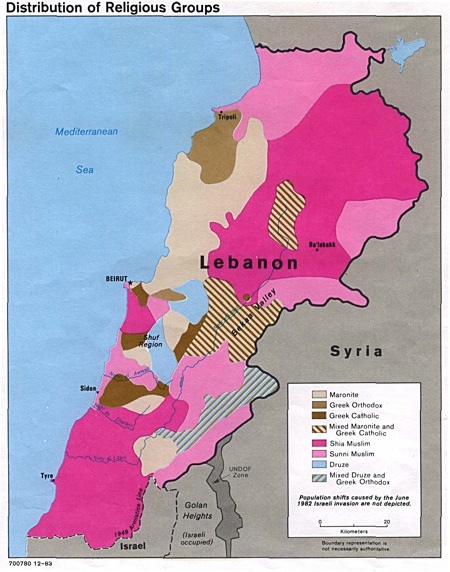
(Via the sweet UTexas map collection)
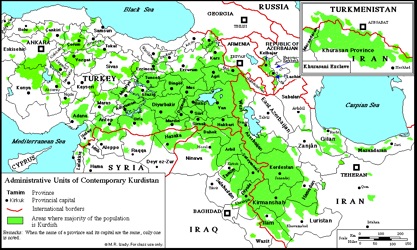 There is a sense that this is finally the Clean Break scenario happening, but there is one more problem yet to be un-tethered from order into chaos. What happens when the chaos spills into Syria? As Stratfor notes, the Israelis are 'terrified' of any regime after Bashar Assad, since it would be made of A) rebellious Kurds - who are somewhat friendly, if not allied, to Israel. B) Sunni tribes branching down into Iraq, into Anbar province and beyond, deep into the Iraqi insurgency. C) Small religious minorities like Alawites, Christians, Druze and Armenians D) A pretty good number of Palestinians. That is not a good situation for Israel, and they probably won't try to topple Assad's government. But someone else might. (Kurdish map from here, the Vladimir-Kurdistan blog)
A couple bits from Stratfor to post. They don't want people reposting their special report alerts, so I will make do with excerpts. They have a pretty close view of what the thinking is inside the Israeli military.
Basically, Stratfor makes it clear that their view is that Hezbollah's strategy is to fight until the bitter end, trapping Israel in a very high-intensity occupation and 'counter insurgency' situation, but Hezbollah has the kind of advanced anti-ship, surface-to-surface, anti-tank and anti-personnel missiles (from Iran, who knows where else? China? Russians?) to make the Israeli mission an impossible weight, far beyond what the Palestinian militant groups could achieve on their own.
So Stratfor has a pretty intricate description of what the Israelis think they can accomplish. However, if I were playing this situation in a video game like, say "Command and Conquer: Generals", the Bekaa Valley with hundreds, if not thousands, of hidden Hezbollah rockets is the last place anyone sane would want to go.
The neo-cons often harbor fantasies about breaking up ethnically diverse states like Iran and Syria, then attempting to create dominating power relationships with the US and Israel at the top, and the various bickering ethnic groups below, set against each other in high British colonial style. The Baluchis and Azeris are two that neocons are known to court in Iran, and look what has happened in Iraq. Anyone who tries to stop them is another 'terrorist,' usually a 'fascist' to boot.
This is like what Ariel Sharon thought he could engineer in Lebanon in 1982, putting the Christian Phalangists on top in a bloody civil war, crushing the Shia and other sects supported by Syria and Iran, as well as the PLO. While occupying Lebanon, Israel managed to kick the PLO out to Tunisia, which bought more time to throw settlement colonies into the West Bank. As the occupation dragged on, the Iranians helped band the Shia in southern Lebanon together under Hezbollah, and they organized a guerrilla war of attrition to force Israel to withdraw in 2000. This was a prime example of 'fourth-generation warfare,' and it now appears that the 'warfare' part of that equation is back in full force again.
Yet absorbing more of the West Bank is clearly where Israel's real interests lie: (wikipedia)
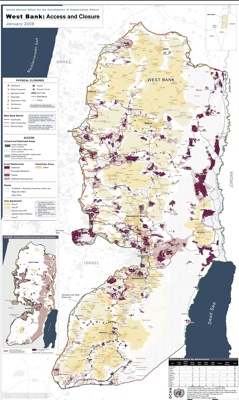
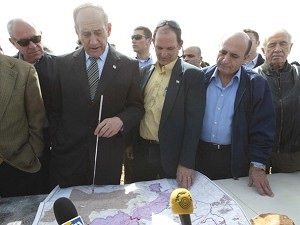
Epoch Times: Israeli acting Prime Minister Ehud Olmert (Center-L), his Defence Minister Shaul Mofaz (2nd-R) and former Israeli Prime Minister Shimon Peres (R) gather together in front of a map as they visit March 14, 2006 the Israeli west bank town of Ariel. (Pavel Wolberg-Pool/Getty Images)
Apart from the sheer bloodiness and hellish horror of such an 'ethnic re-engineering', which disgusts me deeply, setting that aside, the strategy doesn't fucking work. The basic concept in Revisionist Zionism – and now, obviously the Bush doctrine – that more bombs will inspire surrender and obedience has failed every time. Hezbollah is well-prepped for the current Israeli strategy – they know how the airstrikes work, they know from experience how Israeli intelligence has tried to catch them in this area. Most of all, they know they won straight up last time, and this time, the Israelis have better technology, but Hezbollah sure does too. They can keep falling back farther north, while still tossing long-range rockets into Haifa, and resisting all the Israelis' brutal methods by folding the organization into thousands of unstoppable, independent, rocket-bearing cells, or teams of about three, surrounded by a radicalized populace. Far better terrain for the guerrilla than the occupier, in 4GW terms.
Another point is that Israel and the United States (who obviously planned this all in tandem - hence, more U.S.-manufactured bombs on their way today to Israeli planes, Lebanese craters and Arab blood generally) have grossly underestimated the quality of Hezbollah's arsenal. This was a classic, grievous mistake on the order of Israel's foolish idea in 1973 that the Arabs were far too weak to attack – then came the Yom Kippur war.
Believing your enemies too weak and too strong, simultaneously, is a key marker of Fascist thinking.
Listen carefully to what Stratfor is saying: you can sense a waning confidence that Hezbollah could be 'eliminated' tactically, no matter how many bombs are dropped. Also, note the lack of brakes on the situation: Israel doesn't want Syria's government to fall, even while attacking the nearby Bekaa Valley. However, if, say, Al Qaeda or the Muslim Brotherhood happened to have a little luck with assassinations, anarchy across the Levant, all the way to Iran, Afghanistan, would be certain. That would not be in the interests of Israel, the United States, Iran, the EU, Turkey (especially!) or any other states.
It would be just another winning round for Al Qaeda, whose record so far in 'sharpening contradictions,' erasing stability to create 'the base', seems to be on a winning tack. The vast numbers of refugees generated in the last few days (hours!) will also help Al Qaeda style militants find converts among South Lebanon's "New Palestinians" of the 21st century. Another well thought out strategy from Washington.
Also note in particular the loss of Israeli initiative. From Sun Tzu to Clausewitz, a key aspect of warfare, especially 4GW, is retaining the initiative (PDF) – staying on the move, massing up & picking battles – but Hezbollah's dispersed, long-range nature has taken Israel's initiative apart. Israel will fight where and when Hezbollah wants them to, in a sense. Yesterday at noon from Stratfor I got:
Red Alert: The Battle Joined
The ground war has begun. Several Israeli brigades now appear to be operating between the Lebanese border and the Litani River. According to reports, Hezbollah forces are dispersed in multiple bunker complexes and are launching rockets from these and other locations.
Hezbollah's strategy appears to be threefold. First, force Israel into costly attacks against prepared fortifications. Second, draw Israeli troops as deeply into Lebanon as possible, forcing them to fight on extended supply lines. Third, move into an Iraqi-style insurgency from which Israel -- out of fear of a resumption of rocket attacks -- cannot withdraw, but which the Israelis also cannot endure because of extended long-term casualties. This appears to have been a carefully planned strategy, built around a threat to Israeli cities that Israel can't afford. The war has begun at Hezbollah's time and choosing.
Israel is caught between three strategic imperatives. First, it must end the threat to Israeli cities, which must involve the destruction of Hezbollah's launch capabilities south of the Litani River. Second, it must try to destroy Hezbollah's infrastructure, which means it must move into the Bekaa Valley and as far as the southern suburbs of Beirut. Third, it must do so in such a way that it is not dragged into a long-term, unsustainable occupation against a capable insurgency.
Hezbollah has implemented its strategy by turning southern Lebanon into a military stronghold, consisting of well-designed bunkers that serve both as fire bases and launch facilities for rockets. The militants appear to be armed with anti-tank weapons and probably anti-aircraft weapons, some of which appear to be of American origin, raising the question of how they were acquired. Hezbollah wants to draw Israel into protracted fighting in this area in order to inflict maximum casualties and to change the psychological equation for both military and political reasons.
Israelis historically do not like to fight positional warfare. Their tendency has been to bypass fortified areas, pushing the fight to the rear in order to disrupt logistics, isolate fortifications and wait for capitulation. This has worked in the past. It is not clear that it will work here. The great unknown is the resilience of Hezbollah's fighters. To this point, there is no reason to doubt it. Israel could be fighting the most resilient and well-motivated opposition force in its history. But the truth is that neither Israel nor Hezbollah really knows what performance will be like under pressure.
Simply occupying the border-Litani area will not achieve any of Israel's strategic goals. Hezbollah still would be able to use rockets against Israel. And even if, for Hezbollah, this area is lost, its capabilities in the Bekaa Valley and southern Beirut will remain intact. Therefore, a battle that focuses solely on the south is not an option for Israel, unless the Israelis feel a defeat here will sap Hezbollah's will to resist. We doubt this to be the case.
The key to the campaign is to understand that Hezbollah has made its strategic decisions. It will not be fighting a mobile war. Israel has lost the strategic initiative: It must fight when Hezbollah has chosen and deal with Hezbollah's challenge. However, given this, Israel does have an operational choice. It can move in a sequential fashion, dealing first with southern Lebanon and then with other issues. It can bypass southern Lebanon and move into the rear areas, returning to southern Lebanon when it is ready. It can attempt to deal with southern Lebanon in detail, while mounting mobile operations in the Bekaa Valley, in the coastal regions and toward south Beirut, or both at the same time.
There are resource and logistical issues involved. Moving simultaneously on all three fronts will put substantial strains on Israel's logistical capability. An encirclement westward on the north side of the Litani, followed by a move toward Beirut while the southern side of the Litani is not secured, poses a serious challenge in re-supply. Moving into the Bekaa means leaving a flank open to the Syrians. We doubt Syria will hit that flank, but then, we don't have to live with the consequences of an intelligence failure. Israel will be sending a lot of force on that line if it chooses that method. Again, since many roads in south Lebanon will not be secure, that limits logistics. [Get ready for this one, it's been key in Iraq -Dan]
Israel is caught on the horns of a dilemma. Hezbollah has created a situation in which Israel must fight the kind of war it likes the least -- attritional, tactical operations against prepared forces -- or go to the war it prefers, mobile operations, with logistical constraints that make these operations more difficult and dangerous. Moreover, if it does this, it increases the time during which Israeli cities remain under threat. Given clear failures in appreciating Hezbollah's capabilities, Israel must take seriously the possibility that Hezbollah has longer-ranged, anti-personnel rockets that it will use while under attack.
Israel has been trying to break the back of Hezbollah resistance in the south through air attack, special operations and probing attacks. This clearly hasn't worked thus far. That does not mean it won't work, as Israel applies more force to the problem and starts to master the architecture of Hezbollah's tactical and operational structure; however, Israel can't count on a rapid resolution of that problem.
........
An extended engagement in southern Lebanon is the least likely path, in our opinion. More likely -- and this is a guess -- is a five-part strategy:
1. Insert airmobile and airborne forces north of the Litani to seal the rear of Hezbollah forces in southern Lebanon. Apply air power and engineering forces to reduce the fortifications, and infantry to attack forces not in fortified positions. Bottle them up, and systematically reduce the force with limited exposure to the attackers.
2. Secure roads along the eastern flank for an armored thrust deep into the Bekaa Valley to engage the main Hezbollah force and infrastructure there. This would involve a move from Qiryat Shimona north into the Bekaa, bypassing the Litani to the west, and would probably require sending airmobile and special forces to secure the high ground. It also would leave the right flank exposed to Syria.
3. Use air power and special forces to undermine Hezbollah capabilities in the southern Beirut area. The Israelis would consider a move into this area after roads through southern Lebanon are cleared and Bekaa relatively secured, moving into the area, only if absolutely necessary, on two axes of attack.
4. Having defeated Hezbollah in detail, withdraw under a political settlement shifting defense responsibility to the Lebanese government.
5. Do all of this while the United States is still able to provide top cover against diplomatic initiatives that will create an increasingly difficult international environment.
In my view, this is the part where Israel is "proper fucked." Maybe only one of these will actually work, at best:
There can be many variations on this theme, but these elements are inevitable:
1. Hezbollah cannot be defeated without entering the Bekaa Valley, at the very least.
2. At some point, resistance in southern Lebanon must be dealt with, regardless of the cost.
3. Rocket attacks against northern Israel and even Tel Aviv must be accepted while the campaign unfolds.
4. The real challenge will come when Israel tries to withdraw.
No. 4 is the real challenge. Destruction of Hezbollah's infrastructure does not mean annihilation of the force. If Israel withdraws, Hezbollah or a successor organization will regroup. If Israel remains, it can wind up in the position the United States is in Iraq. This is exactly what Hezbollah wants. So, Israel can buy time, or Israel can occupy and pay the cost. One or the other.
[..........]
Hezbollah has dealt Israel a difficult hand. It has thought through the battle problem as well as the political dimension carefully. Somewhere in this, there has been either an Israeli intelligence failure or a political failure to listen to intelligence. Hezbollah's capabilities have posed a problem for Israel that allowed Hezbollah to start a war at a time and in a way of its choosing. The inquest will come later in Israel. And Hezbollah will likely be shattered regardless of its planning. The correlation of forces does not favor it. But if it forces Israel not only to defeat its main force but also to occupy, Hezbollah will have achieved its goals.
Sounds like Israel has blundered into a pretty ugly situation, if not an outright trap. Apart from the moral horror of injecting Israel into a giant war, killing hundreds of civilians, there is the more cold horror that it's not even going to fulfill the outwardly proclaimed goals.
Unless the goal is simply to escalate the region into a huge war, causing panicked Americans to rally round the flag again.
The problem is that once Israel has a really bad stalemate on its hands, the neo-cons will 'flight forward' from the crisis, escalating like Nazis going into Russia. And that means a war with Iran. In all likelihood, we will soon see all the theatrical staged shit like WMDs in Iran, and perhaps some false flag terror attacks will drive things into a frenzy, apart from the brinkmanship of guys like Iran's Ahmedinejad. I can't believe I'm saying this kind of shit these days, but hey, look where we are.
Unless, of course, more sane elements in the U.S. and elsewhere can intervene.
This, by the way, is the basic shape of your "October Surprise" intended to get people to vote Republican this fall. There will be plenty of well-packaged sequels until November, but we can basically see now that Clean Break is the 2006 Congressional Campaign Roadmap, and the Democrats ought to fucking act to put the brakes on and articulate an alternative, NOW.
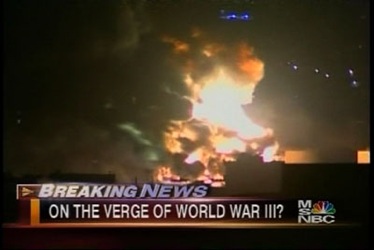
I just noted how the neoconservative Clean Break strategy appears to have been put into action. It offered a plan for Israel to "roll back" Syria with a massive war in Lebanon, theoretically giving the Israelis hegemony and an ability to dictate terms to the Arabs. The problem is that it's a dumb plan that won't fucking work, but they are going to kill hundreds (thousands?) more to keep trying it. Also word comes that Michael Ledeen is prepping the Iran war in a hardcore kind of way right now while trumpeting "World War IV."
Now that arch "conspiracy theorist" Wayne Madsen is saying that Ledeen is preparing to help Iranian dissidents plant WMDs inside Iran, to provide a staged "discovery" soon, thus providing a pretext for the U.S. to attack Iran. Once upon a time, of course, I met the man, and I wrote in the Mac Weekly:
I asked why the Iranians would bomb Jerusalem if it would kill so many Muslims. He said that the Iranians murderously hate Arabs and kill them all the time. In fact, he said, the Iranians are killing “hundreds” of Arabs in Iraq today, sending in money and munitions.
His scheme to free Iran was to supply the opposition with the tools to destabilize the regime, “but not a single bullet.” I have a hard time believing he could resist arming the Iranian opposition. In fact, many say that the Pentagon, administered by Ledeen’s allies, has courted a weird, cultish anti-regime Iranian guerilla group based in eastern Iraq called the Mujahideen al-Khalq. If Bush wins, it’s quite unlikely that the neo-cons will be able to resist using forces like these to harass Tehran, but we have no idea what sort of reaction this would provoke from the highly mobilized, nationalist Iranians.
And this appears to be exactly what is happening now. The odd thing about the following clips from Madsen's site is that these are exactly what we would have expected to hear a few years ago - that is, the old-school Neo-con conspiracy for middle eastern war is still unfolding, exactly like we feared it would. Antiwar.com's Justin Raimondo now pretty much proved to be accurate in this school of thinking.
So consider the following - and as always, take Madsen with a grain of salt. But consider how closely this follows what you expected the neo-cons to be doing:
July 21, 2006 -- Informed sources have told WMR that arch-neocon Michael Ledeen, who acts as an unofficial foreign policy adviser to Karl Rove, was at the White House yesterday with a group of Iranian opposition figures. Among the topics discussed was a promised $25 million grant by the Bush administration to the Iranian insurgents. The money is to be used to plant Desert Storm-vintage biological and chemical weapons shells, confiscated by U.S. forces in Iraq, on the Iranian side of the Iraqi border. The weapons will be used as "proof" of Iran's plan to "attack" U.S. troops in Iraq. That will be used to justify, ex post facto, the coming U.S. attack on Iran. Our sources report that George W. Bush dropped by the White House meeting to offer his support to the Iranian opposition operatives.
Pretext for war with Iran: White House plans to move chem-bio weapons from Iraq into Iranian side of this desolate border.
*********
July 21, 2006 -- The current Israeli assault on Lebanon was stage-managed between the government of Israeli Prime Minister Ehud Olmert and neocons in the Bush administration, according to well-connected sources in the nation's capital. The Bush administration had prior knowledge of and supported Israel's planned attacks on Gaza and Lebanon, the sources have revealed. In addition, there was no move by the Bush administration to warn Americans in the Occupied Palestinian Territories or Lebanon to leave the areas before the Israeli invasions. No travel warnings were issued to U.S. citizens in an attempt to mask Israeli attack plans, an action that resulted in last-minute Dunkirk-like sea evacuations of foreigners from Lebanon.
The first indication that Israel pre-planned its assault on the Palestinians came early this month when the Israelis began denying entry to the West Bank to Palestinians holding U.S. passports. The U.S. Embassy in Tel Aviv and the U.S. Consulate in Jerusalem refused to intervene with Israel, claiming it was the decision of a sovereign nation. The denial of entry to Palestinian-Americans was a violation of the Oslo Accords and the Geneva Conventions. The United States does not officially recognize Israeli sovereignty over the Occupied Palestinian Territories.
Washington insiders report that the Bush administration's coordination with Israel in the attacks on Hamas and Hezbollah involve the official adoption of the white paper, "A Clean Break: New Strategies for Securing the Realm," as U.S. policy. The "Clean Break" document, authored in 1996 by Israeli Prime Minister Binyamin Netanyahu, Richard Perle, Douglas Feith, and other neocon operatives, was written at the same time the program for the invasion and occupation of Iraq was drawn up by the same neocon players.
The current U.S.-Israeli strategy of bombing and invading Lebanon is a follow-up to four years of covert activities by the Pentagon, White House, and Mossad in Lebanon that involved the car bombing assassinations of top Lebanese officials in order to clear out Syrian forces from Lebanon. The assassinations of Elie Hobeika, George Hawi, and Rafik Hariri were all carried out to destabilize Lebanon and force the withdrawal of Syria from Lebanon. Syria was blamed by the Bush administration for all the car bombing assassinations in Lebanon.
Israel's border exercise that saw the capture by Hezbollah of two Israeli soldiers on the Lebanese side of the border and the contingency plans involving the kidnapping of an Israeli soldier by Hamas in Israel, near the Israeli-Gazan border, provided a pre-text for the Israeli attack on Gaza and Lebanon. Similar plans have been drawn up to respond to a Syrian "capture" of Israeli troops in Lebanon near the Syrian border or from the Golan Heights. That will be used to justify a joint Israeli and American attack on Syria, with Israel entering from Lebanon and the U.S. entering from Iraq.
The carrying out of the joint Israeli-U.S. attack plan for Lebanon, Syria (and eventually, Iran) is the reason why the United States has stymied UN attempts to seek an immediate cease-fire. The intent of the Bush administration is to see a widening of the conflict. Unconfirmed UN ambassador to the UN John Bolton, appearing on Fox News, laid out the future blueprint for the joint U.S.-Israeli regionalization of the war in the Middle East when he stated, "I think that if you look at the support that Iran and Syria have given groups like Hamas, Hezbollah, Palestinian Islamic Jihad that really the reckoning we need here is a reckoning, not just with the terrorist groups, but with the states that finance them."
WMR has also learned that top Israeli and U.S. military officers are adamantly opposed to the Clean Break policy. Many Israeli generals, remembering Israel's bloody occupation of Lebanon in the 1980s, favored negotiating a prisoner swap with Hezbollah. The Olmert government is purging the last remnants of the Yitzhak Rabin elements who favored negotiations from the Israeli military and intelligence agencies much in the same way that opponents of the Bush regime have been purged from the U.S. military, CIA, and State Department.
********
July 21, 2006 -- The son of David Gribben, Vice President Dick Cheney's boyhood friend and his chief of staff at the Pentagon and Vice President for Corporate Affairs at Halliburton, has reportedly joined Cheney's White House staff as an assistant. The elder Gribben is an active player in the corporate-religious tax dodge known as The Fellowship, an Arlington, Virginia-based contrivance that uses religious tax-exempt status to lobby the U.S. and foreign governments on behalf of the military-industrial complex. With the carrying out of the Clean Break by Israel and the United States, profits for companies like Halliburton are bound to skyrocket. The Israeli attack on Lebanon is already estimated to have resulted in $2 billion in damage to Lebanon's infrastructure. WMR previously reported that Jacobs/Sverdrup has been promised a lucrative Pentagon contract to build a large U.S. airbase in northern Lebanon.
************
July 20, 2006 -- WMR reported that the Israeli military was using poison gas on villages in south Lebanon. According to a former U.S. weapons expert who served in Iraq, the artillery shell in a photo taken in Lebanon (below) is a chemical weapon delivery device. It is being handled by an Israeli Defense Force soldier and Hebrew lettering can be clearly seen on the armored vehicle. Another chemical weapons shell of the same type can be seen lying on the ground to the right. It is not known what type of chemical is in the chemical canister, however, gas dropped by the Israelis in villages in southern Lebanon has resulted in severe vomiting among the civilian population.
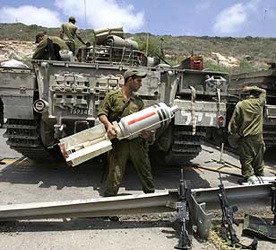
Media commentators have scoffed that Israel, with its relatively unique history, would ever use chemical weapons or poison gas in any war. It is precisely because of that perception that they are using such weapons. The deniability factor prevents the media from taking seriously the credible reports of banned weapons being used by the Israelis.
Alright, that's the maximum neo-con conspiracy theory case. But go back and read the Clean Break again, and maybe you'll finally fucking get it, if you don't already.