
Dan Feidt's log on Minnesota, Information Operations, spinstorms and latent contradictions.
In any event, the present IDF effort to "cleanse" the south of guerrillas by fire will fail. The IAF and its associated heavy artillery simply lacks the weight of fire needed to drive this enemy from its prepared positions in the stony ground of South Lebanon.
Col. Pat Lang (retired) - former top Middle East guy at the U.S. Defense Intelligence Agency
 We'll have a little more later from Haaretz about how, from the start of this war, the Israeli military establishment, led by Dan Halutz (pictured, thanks Wikipedia), basically cut off Israel's political options, dumped the blitzkreig plan on the heads of Olmert and Defense Minister Peretz, who, in turn, needed to 'look tough' to them... but first, the problem with Air Power.
Bombing the shit out of people can produce a good tactical situation sometimes, but as a military strategy it only makes sense if it's backed up with appropriate ground forces, and since war is an extension of politics by other means, a political strategy. The problem is that the U.S. Air Force strategic thinking that produced the carpet bombing of Vietnam is at work again in the halls of the Israeli Defense Force headquarters.
This way of thinking believes that dropping enough bombs is enough to evaporate enemy will. There is supposed to be a folding of the enemy's hand, since booms from the sky are sort of perceived like God's unavoidable vengeance, or something.
Donald Rumsfeld suffers from this badly – he was an Air Force boy, he never had to get neck deep in the Vietnamese mud. After Vietnam the U.S. Army had to rebuild its whole doctrine to never get bogged down on land like that again. The Air Force, on the other hand, thought it kicked a lot of ass in Vietnam, since you can make a metric out of identified targets destroyed. This, of course, leaves out the part where the surviving people on the ground are still willing to die fighting you, and they will still be able to get guns from somewhere and mess up your political agenda.
It is also plainly obvious that "shock and awe" was supposed to cause Iraqi will to evaporate from the beginning, and it didn't. Now, sadly, the chief of staff of the Israeli Defense Force is an Israeli Air Force propeller-head who never had to slog around and get sniped at around Ramallah, Nablus or Gaza.
Instead, like Rummy, he thinks he can bomb his way through. And this never really takes care of the problem. Now, the Israeli ground forces are flailing around in far too small of numbers, barely able to get a few hundred yards into Lebanon, and shitloads of airstrikes all over the hapless Lebanese North are supposed to prove the brilliance of this strategy?
Mark my words, the people of this world will have some kind of reckoning with the use of air forces once the dust settles on this round of shit. Killing civilians by the dozen from planes is equal in morality to killing them with suicide bombers. You can say the policy is better or worse in its goals, but in death, the morality of the act has the same balance. Innocent blood remains so, even when spilled from a flying object.
So we will add these words from an old hand in America's intelligence community, Pat Lang.
Now, I "get it."
Dan Halutz is the first IDF chief of staff who is not a soldier. He is a military aviator. I had missed that, but a statement attributed to a "senior officer" of the IDF in a New York Times story today caused me to look at IDF leadership. The "scales" have fallen from my eyes. "I believe in AIR POWER," the officer told the Times and Halutz is likely to be the officer who was interviewed
He has no ground forces experience at all. He reminds me a bit of Rumsfeld, the one time naval aviator and opponent of the use of sizable ground forces. Like Rumsfeld he is a proponent of "modern" warfare, gee-whiz techno- equipment and disdainful of big, heavy armored forces. He has re-organized the armed forces so that the ground forces no longer report directly to him.
Someone will say that Chaim Laskov had been head of the Israel Air Force (IAF) before becoming chief of staff in the early '50s. This is essentially irrelevant as a comparative situation. Laskov was not a pilot and was a ground force commander and a founder of the IDF Armored Corps before he became head of the air force.
Halutz is an ally of right wing political forces in Israel and an extreme proponent of the "Air Power" ideology that has been an active force in military affairs ever since it was enunciated by the Italian fascist Giulio Douhet in the '20s. The doctrine was taken up by Hugh Trenchard in Britain, Mitchell in the U.S., and the pre-war 2 German Luftwaffe. It persists in many air forces today.
The "Air Power" ideology in its purest form holds that ground forces have largely been made obsolete and useless by the invention and development of aircraft and other air delivered weapons, missiles, etc. "Air Power" theorists believe that this is true at the tactical, operational and strategic levels.
In Lebanon the IDF appears to be following a strategy at all levels that is entirely dictated by "Air Power" theory.
At the tactical and operational levels of war, Israel seems to be intent on destroying Hizballah south of the Litani River and north of Metulla to some unknown depth. Thus far, just about all the attacks against Hizballah have been made by air weapons and artillery. These weapons are inherently indiscriminate in their application, especially in the hands of "Air Power" theorists who typically want to "make the rubble bounce." This is especially true if the aforesaid airplane enthusiasts see that their theories are not yielding the desired result. If you still believe in "surgical strikes," look at the pictures from Lebanon. The IAF is "leafleting" all of south Lebanon urging citizens to leave their homes and flee northward. They appear to be intent on "herding the cats" away from their border through the use of aerial firepower. They know that Hizballah is a LEBANESE Shia guerrilla army with its roots in the Shia portion of the Lebanese population. Most of the people of the south are Shia, and the IDF knows that if they remain where they are they will support the Hizballah guerrillas both now and in the future. Indeed, the guerrillas, are, in many cases, villagers from this area. In any event, the present IDF effort to "cleanse" the south of guerrillas by fire will fail. The IAF and its associated heavy artillery simply lacks the weight of fire needed to drive this enemy from its prepared positions in the stony ground of South Lebanon. The actual ground maneuver attempted thus far is a joke and typical of the role imagined by "Air Power" advocates for ground forces. "Maroun al-Ras" is a tiny village less than a mile from the Israeli border, and no amount of fancy graphics on TV "gushed" over by retired generals can alter the fact that its capture is an insignificant achievement that has had and will have no effect on the amount of fire going into northern Israel.
At the strategic level, the IDF under Halutz is following classic "Air Power" theory which holds that crushing the "Will of the People" is the correct objective in compelling the acceptance of one's own "will" by an adversary or neutral. With that objective in mind, all of the target country is considered to be one, giant target set. Industry, ports, bridges, hospitals, roads, you name it. It is all "fair game." In this case the notion is to force the Lebanese government and army to accept a role as the northern jaw in a vise that will crush Hizballah and subsequently to hold south Lebanon against Hizballah. Since Lebanon is a melange of ethnic and religious communities of which Shia LEBANESE are a major element and since many Lebanese Shia are supporters of Hizballah, the prospect of getting the Lebanese government to do this is "nil." As for the Lebanese Army, the US attempted for two years (1982-84) to re-structure and re-train the Lebanese Army to make it a "national" non-sectarian force only to learn when this army was committed to battle in 1984 against Druze and Christian forces, that it simply fell apart. The US then abandoned the effort. Nothing much has changed in Lebanon since then.
Bottom Lines:
-Air Power and artillery will not decisively defeat Hizballah or force it to withdraw from rocket range of Israel.
-The Lebanese government and army are not what the Israelis have once again dreamt of and they should have known that. The policy that Israel is following is truly a triumph of hope over experience.
-An international force that will fight Hizballah in the south to disarm it is a pipe dream. Who will do that? The only realistic candidate would be France in terms of military capacity. This would be a major irony of history.
Bottom Line Advice for Israel: Occupy the ground or expect to suffer the effects of failure.
Seems sort of obvious, doesn't it?
DEBKAfile’s military sources report that Israeli military chiefs have just begun studying Hizballah’s arts of camouflage. A senior officer told DEBKAfile grimly: “Now we know that when a stand of five or six trees suddenly starts walking, we are seeing a 14-barreled Fajr 3 rocket launcher on the move; one or two trees in motion may conceal a couple of Hizballah fighters.”This I found to be quite interesting. DEBKAFile is a somewhat unusual site closely linked to the Israeli military, and they report a most unusual strategy employed by Hezbollah: clusters of trees are actually multi-rocket launcher units, and individual Hezbollah guerrillas appear to be one or two trees, which move around a bit. When Israeli forces attempt to attack one batch of trees, lots of them fire. Also, the Hezbollah guerrillas are so effectively entrenched in urban areas that Israeli ground troops face such 'lossy' battle situations that they are unwilling to advance with casualties.
In other words, Hezbollah is the trees, and with their honeycombing of tunnels, under the rocks too. Now that's some guerrilla warfare. Israeli analysts "have got a very bad feeling about this," at least, if they were Han Solo, that's what they would say. Note that no one in the IDF is really claiming that the rockets can be stopped by military action so far. For each team eliminated by the Israelis, another one can basically go in... sometimes you just can't see the forest for the trees.
Hizballah Brings Iwo Jima Tactics to Baffle Israeli Forces in South Lebanon
DEBKAfile Exclusive Military Report
July 24, 2006, 12:46 PM (GMT+02:00)
Israeli forces have pushed forward from the mountaintop village of Maroun er Ras captured Sunday to the fringes of Bint Jubeil, Hizballah’s south Lebanese capital. Monday they suffered nine wounded in face to face combat. Whereas TV cameras showed much footage of the Maroun er Ras engagement, the IDF’s other battle pockets are kept under wraps.Hizballah chief Hassan Nasrallah, who has an overall view, warned Israel in an interview to the Lebanese A Safir Monday, July 24, that its ground incursions in Lebanon would not stop Hizballah rocket fire against its cities.
He certainly meant this as a morale-depressant for Israel troops. At the same time, DEBKAfile’s military experts say that what he says is correct and must be taken into account in any diplomatic formula sought to end the warfare.
1. He could go on firing his rockets even when a multinational force is posted on the Lebanese-Israeli border. The force currently contemplated by Israeli prime minister Ehud Olmert at this early stage of international diplomacy would consist of German, French and Czech units.
2. And even if multinational troops were deployed additionally on the Lebanese-Syrian border, they would not hamper Hizballah’s rocket offensive. Therefore a buffer zone would offer no solution to a cessation of cross-border hostilities.
DEBKAfile’s military analysts say that the way the Israel-Hizballah war has been prosecuted up until Monday, July 24, is more likely to bring Nassrallah closer to his war objectives than Olmert.
Notwithstanding the IDF’s important battle gains at a number of focal South Lebanese points in the last 24 hours – including the latest raids on the outskirts of Bint Jubeil on the heels of the capture of Maroun er Ras – only one multiple firing rocket launcher (picture) and 6 single-barrel launchers have been destroyed.
This figure will certainly multiply substantially in the coming days. Yet it will not change the essential strategic picture or stop the rocket fire from holding northern Israel and more than a million inhabitants to siege.
Last week, Israel’s army chiefs believed they had encountered Hizballah’s primary war tactic – Viet Cong-style guerrilla warfare out of hundreds of small bunkers scattered across the country. This week had scarcely begun when a still more formidable impediment was discovered: Hizballah camouflage techniques borrowed from the Japanese in the 1945 Iwo Jima battle. To stop the rockets coming, Israeli special forces must continue to blow up the tunnels and also adopt the methods the US Army’s methods for overcoming the Japanese dug in at Iwo Jima and other Pacific islands at the end of World War II. Without regard to losses, they stormed Japanese dug-in positions and camouflaged units. using flame throwers and gasoline to burn the foliage concealing the enemy.
DEBKAfile’s military sources report that Israeli military chiefs have just begun studying Hizballah’s arts of camouflage. A senior officer told DEBKAfile grimly: “Now we know that when a stand of five or six trees suddenly starts walking, we are seeing a 14-barreled Fajr 3 rocket launcher on the move; one or two trees in motion may conceal a couple of Hizballah fighters.”
But the situation is more difficult when the trees or bushes stand still and blend in with the surrounding dense foliage. By the time IDF spotters report five suspicious trees or bushes to overhead aircraft, helicopters or the nearest ground units, the Hizballah launchers or the fighters have moved on and changed their camouflage outfits. The small Israeli special operations units called in to hunt and destroy the last-seen mobile vegetation face a mystifying task.
“This is a high-precision operation,” said the officer. “It is time-consuming – could take weeks if not months - dangerous and calls for larger numbers of troops than we have available.”
In the first ten days of the war, therefore, the Israeli air force bombed out empty Hizballah premises in South Beirut and Baalbek, but missed the moving woods and vegetation which concealed the rocket launchers – which explains why the blitz continued notwithstanding heavy Israeli air force assaults on Hizballah’s centers and strongholds.
But Israel military strategists have got a handle on Hizballah’s rocket-launching methods. Each rocket crew, carefully camouflaged, advances independently to its firing position and fires a volley, never a single rocket. If one crew chances on another, they all loose their rockets simultaneously.
DEBKAfile’s military analysts assert that the rocket offensive against Israel will go on for the following reasons:
1. While the IDF has begun to understand Hizballah’s tactics and methods of warfare, the Olmert government has decided to deny the operation sufficient ground troops to come to grips with the small knots of moving rocket crewmen.
Some of DEBKAfile’s military experts fear the Israeli government may be falling into the Bush administration’s disastrous error of allocating too few troops to the Iraq war for attaining its goals.
2. Iran is constantly pumping through Syria fresh rocket teams to replace those wiped out by Israeli forces.
3. Hizballah’s leader wants no part in the diplomatic initiatives led by US secretary of state Condoleezza Rice in conjunction with the Europeans, Olmert, the Lebanese government and moderate Sunni Arab rulers. Nasrallah is playing his own game and will not be a party to a ceasefire at this point or stop firing his rockets – except on his terms.
4. He will show the same contempt for a multinational force, however effective, deployed on Lebanon’s borders with Israel and Syria, and simply keep on shooting. He knows as well as anyone that German or French troops will never go chasing through Lebanon’s woods and hay stacks to tackle his fighters in face-to-face combat. He may not stick to as many as 100 rockets a day – as at present, but he will keep his hand on the button and push it whenever it suits him. Nasrallah will only end the war when he can claim victory – or is finally eliminated.
Most Israeli generals agree that going for a multinational force, which appears to be the direction seriously contemplated by Ehud Olmert, would constitute a repeat of the blunder Ariel Sharon and Olmert himself perpetrated when, in their haste to evacuate the Gaza Strip last summer, they handed security over the Gazan-Egyptian Philadelphi border to Egyptian forces and the crossing to European monitors.
Nasrallah has already struck the pose of victor and is dictating terms. Monday, July 24, he handed the Lebanese government a list of the prisoners in Israeli jails whom he wants released as the price for returning the kidnapped Israeli soldiers, Ehud Goldwasser and Eldad Regev. He has not budged an inch from his initial demand for their release: indirect negotiations for a prisoner swap.
The Israeli prime minister, who has switched his war objectives several times, is heading for a course that may at best restore the three abducted Israeli solders, Gilead Shalit in Hamas’ hands, as well as Goldwasser and Regev. But this course will not rescue northern Israel and a third of the country from the nightmare of rockets falling night and day and destroying their lives or the Palestinian Qassam missiles from Gaza making life intolerable for Israel’s south.
There's a whole clutch of stuff to put up here. I will restrict it to a few major items right now: how the Israelis coordinated starting this war with the United States since a year ago (when the Syrians got chased out – funny); the work covering damage to Arab civilization at Electronic Intifada, the stuff at AntiWar.com and a little bit from those totems of neoconservative doom at the Weekly Standard. Also a bit about how Israel is taking American diplomatic options off the table by sparking this – perhaps it was more important to stop America from dealing with the Arabs than the actual Hezbollah and Hamas threats themselves!
This limited batch should help illustrate various dimensions of the conflict. More are on the way, I just want something bite-sized out there....
A war pre-planned: One of those questions to reflect on, is simply how the casus belli, the root cause of the war, actually came about. The Iraq war was engineered with stuff like fake WMD stories pretty seriously, and now we are supposed to believe that the Lebanon invasion materialized in history 15 minutes after Hezbollah made off with a couple soldiers from a war front. Not bloody likely.
In this case we have ready evidence that the whole plan has been pulled off the shelf, and American officials got the full persuasive case over the last year. In other words, this is more about an entrenched policy than the actual kidnappings of the soldiers. Fortunately, the soldiers are a useful pretext for hawkish Democrats and others to bandwagon around on.
In a certain, kind of obvious sense, you could call this a conspiracy. Also interesting that the Lebanese recently caught an assassination cell working for the Mossad. (I wonder who really wanted Rafik Hariri out of the way )and who's benefiting now that the Syrian army is gone?)
San Francisco Chronicle: Israel set war plan more than a year ago: Strategy was put in motion as Hezbollah began gaining military strength in Lebanon
Matthew Kalman, Chronicle Foreign Service : Friday, July 21, 2006
(07-21) 04:00 PDT Jerusalem -- Israel's military response by air, land and sea to what it considered a provocation last week by Hezbollah militants is unfolding according to a plan finalized more than a year ago.
In the six years since Israel ended its military occupation of southern Lebanon, it watched warily as Hezbollah built up its military presence in the region. When Hezbollah militants kidnapped two Israeli soldiers last week, the Israeli military was ready to react almost instantly.
"Of all of Israel's wars since 1948, this was the one for which Israel was most prepared," said Gerald Steinberg, professor of political science at Bar-Ilan University. "In a sense, the preparation began in May 2000, immediately after the Israeli withdrawal, when it became clear the international community was not going to prevent Hezbollah from stockpiling missiles and attacking Israel. By 2004, the military campaign scheduled to last about three weeks that we're seeing now had already been blocked out and, in the last year or two, it's been simulated and rehearsed across the board."
More than a year ago, a senior Israeli army officer began giving PowerPoint presentations, on an off-the-record basis, to U.S. and other diplomats, journalists and think tanks, setting out the plan for the current operation in revealing detail. Under the ground rules of the briefings, the officer could not be identified.
In his talks, the officer described a three-week campaign: The first week concentrated on destroying Hezbollah's heavier long-range missiles, bombing its command-and-control centers, and disrupting transportation and communication arteries. In the second week, the focus shifted to attacks on individual sites of rocket launchers or weapons stores. In the third week, ground forces in large numbers would be introduced, but only in order to knock out targets discovered during reconnaissance missions as the campaign unfolded. There was no plan, according to this scenario, to reoccupy southern Lebanon on a long-term basis.

The Electronic Intifada franchises for ugly reasons: The site Electronic Intifada has expanded laterally to Electronic Lebanon, a site originally intended to provide Palestinian perspectives is now focused on Lebanon. Worth considering: Precarious conditions in mountain shelters for fleeing Lebanese, and diaries such as "What will happen to us when this is all over?"
Time to get real with AntiWar.com: There has never been a more clear moment for Antiwar.com, and certainly, Justin Raimondo has done more than his share of advising us that "the Middle East escalator" still controlled by the neo-conservatives means more escalations, more spreading warfare. All the columns on this latest war are worth reading, particularly America Held Hostage, Will We Go to War for Israel?, and Playing the Sunni Card:
The U.S.-Israeli strategy aims at atomizing the Arab-Muslim world: the invasion of Iraq smashed the Ba'athist state and split it into three distinct and warring pieces – the Shi'ite south, the infamous Sunni Triangle, and Kurdistan. The same method is being employed in Lebanon, where the fragile state apparatus is about to come undone under the impact of the Israeli assault – and, soon enough, in Syria and Iran, where Kurds and other restive ethnic groups are being encouraged by the regime-changers of the West.
Divide and rule: it's the oldest strategy in the book, and particularly effective when it comes to the Arab-Muslim world, which is rife with internecine strife that only needs a bit of provocation to come to the surface in violent form.
As to whether this strategy will work, the question is: do we want it to? What "work" means, in this context, is the metastasis of Iraq's civil war. They told us Iraq would be a "model" for the region – what they didn't say is that it would be a "model" of how to destroy an entire civilization.
The goal of the War Party is to keep up the momentum for intervention created by the Iraq war and allow the conflict there to naturally spill over Iraq's borders into Syria, Lebanon, Saudi Arabia, and beyond. There are many, including within this administration, who do not share this goal, and there were signs that, until recently, this "realist" faction might prevail.
.........The crushing of Lebanon beneath the Israeli boot achieves two goals for the War Party: it outflanks their enemies in Washington, and it divides their enemies in the Middle East. It is a one-two punch that could plunge much of the world into a conflict that we will never see the end of in our lifetimes: the opening shots of what the neocons refer to as "World War IV." (Note: World War III was the Cold War, according to this thinking.)
Israel is removing America's options from the Middle East Table: Strongly worth considering, perhaps more than most arguments. Steve Clemons, a DC Dem on the security scene: Some Questions Regarding Israel's Objectives: Is Israel Trying to Curb America's Deal-Making in Middle East?
Why is Israel pounding most of Lebanon rather than just the South and rather than pinpointing its attack against Hezbollah assets? Why the dramatic bombing of explosive fuel centers? The attacks both in Gaza and in Beirut seem made for Fox News, CNN and the next Schwarzenegger movie.
I think that there is little doubt that a significant part of the explanation can be attributed to the fact that Prime Minister Ehud Olmert and his more liberal partner in this effort, Amir Peretz -- now Defense Minister -- are not former field command generals and want to demonstrate that they can be responsible stewards of Israel's national security -- and that they won't be timid in using Israel's military capabilities.
But that doesn't explain it all. The Israeli response to the Hezbollah incursion is exactly what Hezbollah wanted. Adversaries rarely give each other the behaviors the other actually desires unless there are other objectives involved.
My view is that three broad threats were evolving for Israel from the American side of the equation. One one front, the U.S. will be attempting to settle some kind of new equilibrium in Iraq with fewer U.S. forces and some face-saving partial withdrawal. To accomplish this and maintain any legitimacy in the eyes of important nations in the region -- particularly among close U.S. partners among the Gulf Cooperation Council states -- America "might have" tried to do some things that constituted a broad new bargain with the Arab Middle East. The U.S. had even previously flirted, along with the Brits, in trying to get Syria on a Libya like track and out of the international dog house.
There was also pressure building to push Hamas -- or at least the "governing wing" of it -- towards a posture that would move dramatically closer to a recognition of Israel. Abbas was becoming increasingly entrepreneurial in creating opportunities for the constructive players in Hamas to squirm towards eventual negotiations with Israel that could possibly be packaged in terms of "final status negotiations" on the borders and terms of a new Palestinian state. George W. Bush is the first President to actually call the Palestine territories "Palestine" and may have eventually come around on trying to pump up Abbas's legitimacy as the father of a new and different state. I am doubtful of this scenario -- but some in Israel had serious concerns about this unfolding.
Lastly, despite lots of tit-for-tat tensions and enormous mistrust, Iran and the U.S. were tilting towards a deal to negotiate about Iran's nuclear pretensions and other goals. Some in Israel viewed all three of these potential policy courses for the U.S. -- a broad deal with the Arab Middle East, a new push on final status negotiations with the Palestinians, and a deal to actually negotiate directly with Iran -- as negative for Israel.
The flamboyant, over the top reactions to attacks on Israel's military check points and the abduction of soldiers -- which I agree Israel must respond to -- seems to be part establishing "bona fides" by Olmert, but far more important, REMOVING from the table important policy options that the U.S. might have pursued.
Israel is constraining American foreign policy in amazing and troubling ways by its actions. And a former senior CIA official and another senior Marine who are well-versed in both Israeli and broad Middle East affairs, agreed that serious strategists in Israel are more concerned about America tilting towards new bargains in the region than they are either about the challenge from Hamas or Hezbollah or showing that Olmert knows how to pull the trigger.
Another well respected and very serious national security public intellectual in the nation wrote this when I shared this thesis that Israeli actions were ultimately aimed at clipping American wings in the region. His response:
the thesis of your paper is right-on. whether intentional or coincidental, that is what is being done right now.
I share these other views only to establish the fact that there is not a consensus either in support of or opposed to Israeli action -- but some are beginning to scrutinize what Israel is seeking to achieve with such flamboyant displays of power that are antagonizing whole societies on their borders.
Keeping America from cutting new deals in the region -- which many in the national security establishment thinks are vital -- may actually be what is going on, and the smarter-than-average analysts are beginning to see that. To take one moment though and argue a counter-point to this, one serious analyst I spoke to this morning who stopped by to talk after attending synagogue raised a good point. He said that he thought that Olmert's insecurity about military management was driving the over-reaction.
But he also said that the QUALITY of the attacks against Israel were freaking out the Israeli military and intelligence leaders. Complex incursions that included abductions along with a successful attack on an Israeli gunship show that the enemy is no longer an unimpressive, rag-tag lot. Training and armaments have been improved, and Israel is scrambling to figure out how this happened.
For the right wind scare-your-shit view, try the Weekly Standard. They have been pining away on this for a long time, and now it looks like they are going to get their wishes fulfilled...
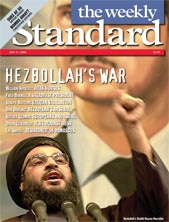 Combining anti-semitic generalizations and anti-Palestinian hate speech, the remarkably ugly: "When Will They Ever Learn... Why do so many American Jews hate the president who stands by Israel? by David Gelernter from the American Enterprise Institute. Concludes:
One thing is certain: Palestinians and left-wing American Jews would understand each other beautifully if they ever got together for a conference on refusing to face reality.
 For more wigging out, see Hezbollah's Arsenal and worst of all, Bill Kristol's It's Our War:
For while Syria and Iran are enemies of Israel, they are also enemies of the United States. We have done a poor job of standing up to them and weakening them. They are now testing us more boldly than one would have thought possible a few years ago. Weakness is provocative. We have been too weak, and have allowed ourselves to be perceived as weak.
The right response is renewed strength--in supporting the governments of Iraq and Afghanistan, in standing with Israel, and in pursuing regime change in Syria and Iran. For that matter, we might consider countering this act of Iranian aggression with a military strike against Iranian nuclear facilities. Why wait? Does anyone think a nuclear Iran can be contained? That the current regime will negotiate in good faith? It would be easier to act sooner rather than later. Yes, there would be repercussions--and they would be healthy ones, showing a strong America that has rejected further appeasement.
But such a military strike would take a while to organize. In the meantime, perhaps President Bush can fly from the silly G8 summit in St. Petersburg--a summit that will most likely convey a message of moral confusion and political indecision--to Jerusalem, the capital of a nation that stands with us, and is willing to fight with us, against our common enemies. This is our war, too.
Holy shit, we're fucked! Too bad this genius helped start the war in Iraq that handed Mesopotamia over to Iran. Small irony, that one. Since of course, the goal was perpetual warfare... Another step closer.