Dan Feidt's log on Minnesota, Information Operations, spinstorms and latent contradictions.
Iraqi intuition: As Joe Biden and Chris Matthews talked about on Hardball the other night, apparently President Bush did not expect Iraqi Shiites to support Hezbollah. This is the shrewd leadership of the War on Terror, folks. Sy Hersh was talking about how Cheney's office spoofed the intelligence on Lebanon and Israel. Again, the rosy shock-and-awe type scenarios failed tactically and stategically, as they always do. Strategic bombing never really works.
Apparently, The Pentagon's Air Force types were convinced Israel's planned tactical air campaign (long planned) would work. According to Hersh and others, the Marines and the Army are very skeptical about attacking Iran, since they would get sent in to invade Iran when the Air Force plan fails. It turns out that the intuitions of the Pentagon skeptics were right, not surprisingly. Any kind of military action on Iran would make our whole Middle East situation completely fall apart – and yes, the Iranians have a lot of fancy missiles they've bought with all the oil money. Iran's mountainous terrain makes South Lebanon look like a golf course.
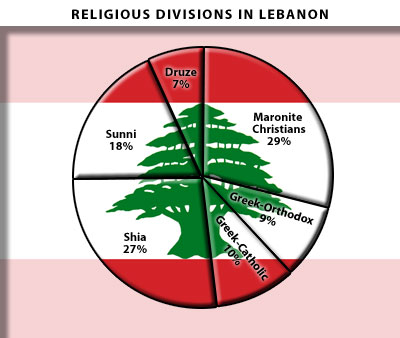 This image comes from former Defense Intelligence Agency officer Pat Lang's blog, Sic Semper Tyrannis, which has had some of the best commentary on the tactics between the IDF and Hezbollah.
Various commentaries: "How I found myself with the Islamic fascists" by Jonathan Cook. This essay would make Bill O'Reilly's head explode. "Israel, Defeated: Round one: Lebanon, 1 – Israel, 0" by Justin Raimondo at AntiWar.com.
Huzzah for Shias: Check out the book review of The Shia Revival.
Hezbollah's suicide bombers in past campaigns were mostly not Shiite: this is fascinating because it indicates that 'religion' per se is not the motivating factor for suicide attacks. What is? Foreign military occupation. Evidence: Professor Robert Pape found this, posted in the Guardian: What we still don't understand about Hizbollah, August 6:
This week, world terrorism expert Robert Pape will share with the FBI the findings of his remarkable study of 462 suicide bombings. He concludes that such acts have little to do with religious extremism and that the West must engage politically to halt the relentless slaughter: Israel has finally conceded that air power alone will not defeat Hizbollah. Over the coming weeks, it will learn that ground power won't work either. The problem is not that the Israelis have insufficient military might, but that they misunderstand the nature of the enemy.
In terms of structure and hierarchy, it is less comparable with, say, a religious cult such as the Taliban than to the multi-dimensional American civil rights movement of the 1960s. What made its rise so rapid, and will make it impossible to defeat militarily, was not its international support but the fact that it evolved from a reorientation of pre-existing Lebanese social groups.
Evidence of the broad nature of Hizbollah's resistance to Israeli occupation can be seen in the identity of its suicide attackers. Hizbollah conducted a broad campaign of suicide bombings against American, French and Israeli targets from 1982 to 1986. Altogether, these attacks, which included the infamous bombing of the marine barracks in Beirut in 1983, involved 41 suicide terrorists. Researching my book, which covered all 462 suicide bombings around the globe, I had colleagues scour Lebanese sources to collect martyr videos, pictures and testimonials and biographies of the Hizbollah bombers. Of the 41, we identified the names, birth places and other personal data for 38. We were shocked to find that only eight were Islamic fundamentalists; 27 were from leftist political groups such as the Lebanese Communist Party and the Arab Socialist Union; three were Christians, including a female secondary school teacher with a college degree. All were born in Lebanon. What these suicide attackers - and their heirs today - shared was not a religious or political ideology but simply a commitment to resisting a foreign occupation. Nearly two decades of Israeli military presence did not root out Hizbollah. The only thing that has proven to end suicide attacks, in Lebanon and elsewhere, is withdrawal by the occupying force.
Previous analyses of suicide terrorism have not had the benefit of a complete survey of all suicide terrorist attacks worldwide. The lack of complete data, together with the fact that many such attacks, including all those against Americans, have been committed by Muslims, has led many in the US to assume that Islamic fundamentalism must be the underlying main cause. This, in turn, has fuelled a belief that anti-American terrorism can be stopped only by wholesale transformation of Muslim societies, which helped create public support of the invasion of Iraq. But study of the phenomenon of suicide terrorism shows that the presumed connection to Islamic fundamentalism is misleading.
There is not the close connection between suicide terrorism and Islamic fundamentalism that many people think. Rather, what nearly all suicide terrorist campaigns have in common is a specific secular and strategic goal: to compel democracies to withdraw military forces from territory that the terrorists consider to be their homeland. Religion is rarely the root cause, although it is often used as a tool by terrorist organisations in recruiting and in other efforts in service of the broader strategic objective. Most often, it is a response to foreign occupation.
Understanding that suicide terrorism is not a product of Islamic fundamentalism has important implications for how the US and its allies should conduct the war on terrorism. Spreading democracy across the Persian Gulf is not likely to be a panacea as long as foreign troops remain on the Arabian peninsula. The obvious solution might well be simply to abandon the region altogether. Isolationism, however, is not possible; America needs a new strategy that pursues its vital interest in oil but does not stimulate the rise of a new generation of suicide terrorists. The same is true of Israel now.....
 The backdrop is energy resources, and water too. From The Wilderness teased a pay story:
AS THE WORLD REELS FROM ISRAELI ATTACKS ON INNOCENT CIVILIANS DURING THE PAST THREE WEEKS, CULMINATING IN THIS WEEKEND'S ATROCITIES AT QANA, WE HEAR LITTLE ABOUT THE PIPELINE POLITICS AND WATER ISSUES BEHIND THE SCENES. BUT ISRAEL'S DESPERATE MILITARY MADNESS CANNOT BE FULLY UNDERSTOOD WITHOUT GRASPING THE FRANTIC RESOURCE WARS THAT FORM THE BACKDROP OF THE CURRENT MIDDLE EAST CARNAGE.
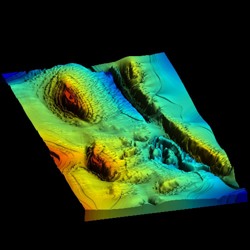
True enough. Encircling the Shiite's area of oilfields is important to guys like Dick Cheney. The situation in Iraq is fueled by the conflict over Iraq's oil revenue, of course. That crazy relief map is from here. It shows the Rumaila and other key oilfields around the Kuwaiti-Iraqi border. Rumaila was one of the key reasons Saddam invaded Kuwait. He claimed they were slant-drilling under the border, which was probably true since the Kuwaitis are dickheads.
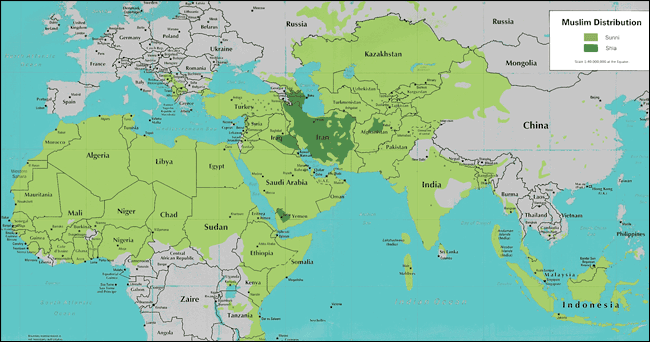
Here is a map of the Sunni-Shiite distribution. In my opinion it actually doesn't show the Shiites of eastern Saudi Arabia correctly, but oh well... Shiites are darker.
And here is the famous Iraq oil map (PDF) from Cheney's energy task force:
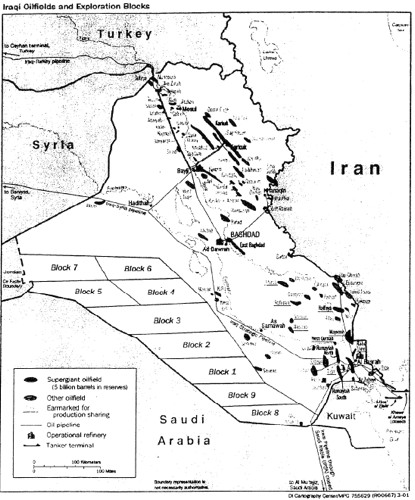
There is this kind of strategy to encircle the general area... The Christian Science Monitor had this badass map showing where American troops are, relative to the pipelines: (more on this here)

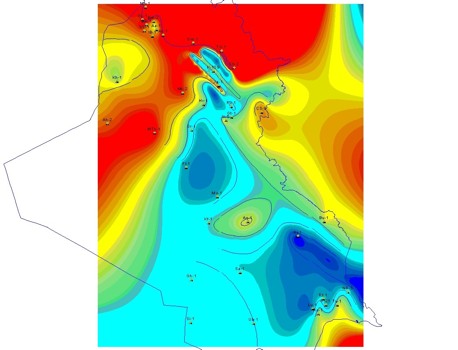
I don't know what the hell this is, some kind of "heat map", but it looks cool from a cool-looking site:
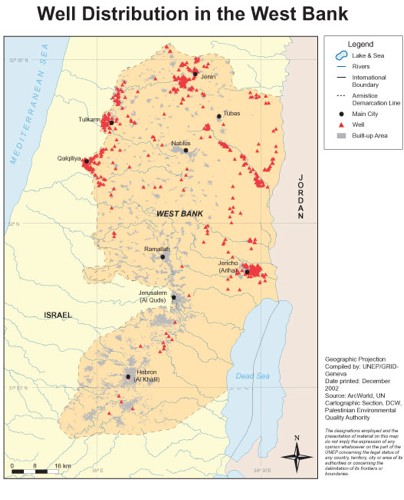
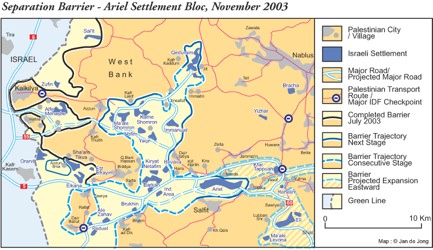
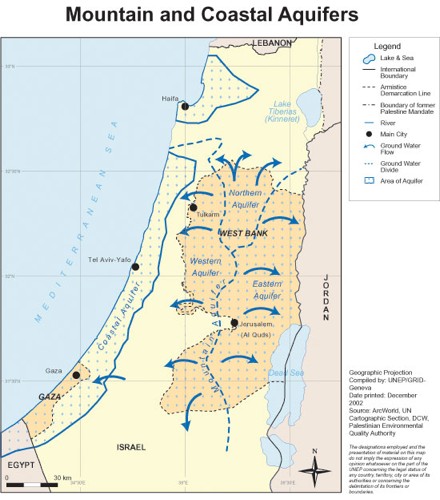
The Israelis are holding the Golan Heights because of water, as they tell you, and the West Bank wall is laid out to cut off many wells from Palestinian access. The largest settlement in the West Bank, Ariel, is situated on a ridge area in the north, directly above the main aquifer. One wonders why the Litani River is such a big deal anyway. More on Ariel.
I recommend reading this page about Israel's water wars. It's very relevant. For your comparison here, the 'nose' of the West Bank that juts just outside of the red mountain aquifer is Kalkilya - the northern West Bank's westernmost Palestinian city. Ariel, the most horizontal blob, is centered on the red aquifer, as you can see with the power of imagination (since the American media is never going to fucking tell you this).

Iran noise: so we've gathered that this whole thing was an overture to a war in Iran (aka "World War III"). As one pretty pissed off international studies professor, Alon Ben-Meir put it:
The war of perception: Israel`s failure will undoubtedly embolden Iran to challenge it at a different time and circumstance, while Syria may decide that Israel is not such a formidable military after all and resort to more aggressive tactics to regain the Golan.
Hamas` resolve to resist Israel may harden, and Hezbollah which, by every objective military standard, suffered a strategic defeat, has already emerged as triumphant in the eyes of the Arab world for having withstood the Israeli onslaught with valor, may be emboldened to lie in wait for the next confrontation.
Having lost the war of perception Israel must be careful not to translate this into real strategic losses in dealing with the Arab-Israeli conflict or with Iran.
.......
The real danger in the future comes from Iran, and it looms extremely large. If it is to respond effectively, Israel must develop strategies that deny Iran not just the opportunity to meddle in the Arab-Israeli conflict but make Tehran fear for its very existence, and so refrain from even contemplating any act of hostility against Israel.
An Israel that is, rightly or wrongly, perceived as weak, will simply invite more serious military challenges because Israel`s real enemies like Iran are relentless, and now they smell blood.
That's all for now. I really like maps!
I had a power failure and lost some goodies. Not a colossal disaster, but lame! I used to have a backup power supply but the damn battery gave out. Anyhow, I discovered that there are some plugins that let Firefox remember what tabs you have open if it crashes or there's a power failure. There are lots of awesome Firefox plugins and extensions, and Tab Mix Plus is among the best. It will save the browser windows and tabs you have open if Firefox or the computer suddenly konks out!
Del.icio.us experimentation: del.icio.us is a 'social bookmarking service' that allows you to save bookmarks to the public, attaching tags so that you can have a sliceable and diceable batch of links. Right now I have a home page on del.icio.us, organized with quite a few bookmarks.
My plan is to have the Del.icio.us bookmarks appear on sidebars in their respective category pages, once I switch to Drupal (this is not too hard to do). In the meantime, I'm going to have del.icio.us spit out my fresh links to the HongPong.com front page every day. Ideally this should produce some more daily bite-sized content. The usual style around here is to aggregate stuff into huge, unwieldy posts, and a good strategy is to give everyone more little things on a more regular basis – and it's easy to do from other computers. Our other occasional contributors will also be able to include their del.icio.us bookmarks when the Drupal site FINALLY comes together. (see del.icio.us tags on Drupal!) Drupal kicks ass, i really gotta get this moving.
Now that the dust is settling, we are hearing reports from the field about what exactly Hezbollah was doing down in South Lebanon. For more military analyses look at this excellent thread on Agonist.org Lessons Learned. Guys like William Lind have good stuff too.
For the moment, we are going to post a big chunk of Anthony Cordesman's summary of the whole damn thing. The press conference is here (PDF), the actual doc is here.
Center for Strategic and International Studies
1800 K Street, N.W. • Suite 400 • Washington, DC 20006
Phone: 1 (202) 775-3270 • Fax: 1 (202) 457-8746
Web: http://www.csis.org/burke/
Preliminary “Lessons” of the Israeli-Hezbollah War (PDF)
Anthony H. Cordesman, Arleigh A. Burke Chair in Strategy acordesman@aol.com
Working Draft for Outside Comment, Revised: August 17, 2006
[Page 16]....
Lessons and Insights into Various Tactical,
Technological, and Other Military Aspects of the War
Once again, it is important to stress that many key details of the tactics, technology, and
other aspects of the fighting are not yet clear. There are, however, several additional
lessons that do seem to emerge from the conflict.
High Technology Asymmetric Warfare
There is virtually no controversy over whether the fighting with the Hezbollah shows just
how well a non-State actor can do when it achieves advanced arms, and has strong
outside support from state actors like Iran and Syria. Top-level Israeli intelligence
personnel and officers stated that most aspects of the Hezbollah build-up did not surprise
them in the six years following Israel’s withdrawal in Lebanon.
Mosad officials stated that they had tracked the deployment of some 13,000 Katyushas,
far more sophisticated Iranian medium and long-range artillery rockets and guided
missiles (Zelzal 3), better surface-to-air missiles like the SA-14, SA-16, and possibly SA-
8 and SA-18, the CS-801 anti-ship missile, and several more capable anti-tank weapons
like the AT-3 Sagger Two and Kornet. They also identified the armed UAV the
Hezbollah used as either the Iranian Mirsad-1 or Ababil-3 Swallow.
Israeli intelligence officials also stated that they knew some 100 Iranian advisors were
working with the Hezbollah, and that they knew Iran not only maintained high volumes
of deliveries, but also had created a Hezbollah command center for targeting and
controlling missile fire with advanced C2 assets and links to UAVs. They noted that they
had warnings of better sniper rifles, night vision devices, and communications as well as
of technical improvements to the IEDs, bombs, and booby traps that the Hezbollah had
used before the Israeli withdrawal.
Israeli officials and officers were not consistent about the scale or nature of the
technology transfer to the Hezbollah or of how many weapons they had. In broad terms,
however, they agreed on several points.
Hezbollah Rocket and Missile Forces
Israel faced a serious local threat from some 10,000-16,000 shorter-range regular and
extended range versions of the Kaytusha. These are small artillery rockets with individual
manportable launchers. The rockets have small warheads and ranges of 19-28 kilometers
(12-18 miles) that can only strike about 11-19 kilometers (7-12 miles) into Israel unless
launched right at the border. They can easily be fired in large numbers from virtually any
position or building, and the Hezbollah had a limited capacity for ripple fire that partly
made up for the fact that such weapons were so inaccurate that they hit at random, could
only be aimed at town-sized targets, and had very small warheads. They were, however,
more than adequate to force substantial evacuations, paralyze local economic activity,
and drive the Israelis that remained to shelters.
Israeli officers and officials made it clear that Israel’s real reason for going to war,
however, was the steady deployment of medium and longer range systems, and the
potential creation of a major Iranian and Syrian proxy missile force that could hit targets
throughout Israel.
This force included Syrian 220mm rockets and systems like the Fajr 3, with ranges of 45-
75 kilometers, capable of striking targets as far south as Haifa and Naharia. The IAF was
able to destroy most of the Iranian Fajr 3 launchers the first night of the war, but the IDF
did not know the Syrian rockets were present.
The Fajr 3, or Ra’ad, has a range of 45 kilometers, a 45-kilogram warhead, a 240-mm
diameter, a 5.2-meter length, and a weight of 408 kilograms.
A total of some 24-30 launchers and launch vehicles, carrying up to 14 rockets each, seem to have been present.
The IAF feels it destroyed virtually all launchers that fired after the first few days, but
Israeli officers did not provide an estimate of how many actually survived.
They also included the Syrian 302-mm artillery rockets and Fajr 5, with ranges of 75 and
higher kilometers. The IAF again feels that it was able to destroy most of the Iranian Fajr
5 launchers the first night of the war, but the IDF again did not know the Syrian 302-mm
rockets were present.
The Fajr 5 is launched from a mobile platform with up to four rockets per launcher, and
has a maximum range of 75 kilometers, a 45-kilogram warhead, a 333-mm diameter, a
6.48-meter length, and a weight of 915 kilograms.
A total of some 24-30 launchers and launch vehicles seem to have been present. Again, the IAF feels it destroyed virtually all
launchers that fired after the first few days, but Israeli officers did not provide an estimate
of how many actually survived.
The level of Hezbollah capabilities with the Zelzal 1, 2, and 3 and other possible systems
has been described earlier. These missiles have ranges of 115-220 kilometers. The Zelzal
2 is known to be in Hezbollah hands and illustrates the level of technology involved. It is
a derivative of the Russian FROG 7, and has a range in excess of 115 kilometers. It has a
610-mm diameter, a 8.46-meter length, and a weight of 3,545 kilograms.
It requires a large TEL vehicle with a large target signature.
Anti-Ship Missiles
The Hezbollah C-802 missile that damaged an Israeli Sa’ar 5, one of Israel’s latest and
most capable ships, struck the ship when it was not using active countermeasures. It may
or may not have had support from the coastal radar operated by Lebanese military fires
destroyed by IAF forces the following day.
According to Global Security, the Yingji YJ-2 (C-802) is powered by a turbojet with
paraffin-based fuel. It is subsonic (0.9 Mach), weighs 715 kilograms, has a range 120
kilometers, and a 165 kilogram (363 lb.). It has a small radar cross section and skims
about five to seven meters above the sea surface when it attacks the target. It has good
anti-jamming capability.
Anti-Armor Systems
The IDF faced both older anti-tank guided missile (ATGM) threats like the AT-3 Sagger,
AT-4 Spigot, and AT-5 Spandrel—each of which is a wire-guided system but which
become progressively more effective and easier to operate as the model number
increases.
The IDF also faced far more advanced weapons like the Russian AT-13 Metis-
M which only requires the operator to track the target, and the AT-14 Kornet-E, a third
generation system, that can be used to attack tanks fitted with explosive reactive armor,
and bunkers, buildings, and entrenched troops. Many of these systems bore serial
numbers that showed they came directly from Syria, but others may have come from Iran.
The AT-14 is a particularly good example of the kind of high technology weapon the US
may face in future asymmetric wars. It can be fitted to vehicles or used as a crew-portable
system.
It has thermal sights for night warfare and tracking heat signatures, and the
missile has semi-automatic command-to-line-of-sight laser beam-riding guidance. It flies
along the line of sight to engage the target head-on in a direct attack profile. It has a
nominal maximum range of 5 kilometers. It can be fitted with tandem shaped charge
HEAT warheads to defeat tanks fitted with reactive armor, or with high
explosive/incendiary warheads, for use against bunkers and fortifications. Maximum
penetration is claimed to be up to 1,200mm.
Other systems include a greatly improved version of the 105.2-mm rocket-propelled
grenade called the RPG-29 or Vampire. This is a much heavier system than most
previous designs. It is a two-man crew weapon with a 450-meter range, and with an
advanced 4.5-kilogram grenade that can be used to attack both armor and bunkers and
buildings. Some versions are equipped with night sights.
The IDF saw such weapons used with great tactical skill, and few technical errors,
reflecting the ease with which third generation ATGMs can be operated. They did serious
damage to buildings as well as armor. The Hezbollah also showed that it could use the
same “swarm” techniques to fire multiple rounds at the same target at the same time often
used in similar ambushes in Iraq. As of August 11th, however, a total of 60 armored
vehicles of all types (reports these were all tanks are wrong) had been hit. Most continued
to operate or were rapidly repaired in the field and restored to service. Only 5-6 of all
types represented a lasting vehicle kill.
Anti-Aircraft
The IDF estimates that the Hezbollah at least have the SA-7 and SA-14 manportable
surface-to-air missile system, probably have the SA-16, and may have the SA-18. The
SA-14 and SA-16 are much more advanced than the SA-7, but still possible to counter
with considerable success. The SA-18 Grouse (Igla 9K38) is more problematic.
According to the Federation of American Scientists, it is an improved variant of the SA-
14 that uses a similar thermal battery/gas bottle, and the same 2 kilogram high-explosive
warhead fitted with a contact and grazing fuse. The missile, however, is a totally new
design and has much greater operational range and speed. It has a maximum range of
5200 meters and a maximum altitude of 3500 meters, and uses an IR guidance system
with proportional convergence logic, and much better protection against electro-optical
jammers.
It is possible that it may have been given a few SA-8 Gecko (Russian 9K33 Osa) SAM
systems that are vehicle mounted, radar-guided systems with up to a 10-kilomter range,
and six missiles per vehicle.
The IDF is concerned that these systems would allow the Hezbollah to set up “ambushes”
of a few IAF aircraft without clear warning—a tactic where only a few SA-8s could
achieve a major propaganda victory. This concern, coupled to the risk of SA-16 and SA-
18 attacks, forced the IAF to actively use countermeasures to an unprecedented degree
during the fighting.
Low Signature; Asymmetric Stealth
One key aspect of the above list is that all of the systems that are not vehicle-mounted
are low signature weapons that very difficult to characterize and target and easy to bury
or conceal in civilian facilities. Stealth is normally thought of as high technology. It is
not. Conventional forces still have sensors geared largely to major military platforms and
operating in environments when any possible target becomes a real target. None of these
conditions applied to most Hezbollah weapons, and the problem was compounded by the
fact that a light weapon is often easier to move and place without detection in a built-up
area than a heavy one.
This signature issue applies to small rockets like the Qassam and Kaytusha that require
only a vestigial launcher that can be place in a house or covert area in seconds, and fired
with a timer. Israeli video showed numerous examples of Hezbollah rushing into a home,
setting up a system, and firing or leaving in a time in less than a minute.
It also applies to UAVs. Israel’s normal surveillance radars could not detect the Iranian
UAVs, and the IDF was forced to rush experiments to find one that could detect such a
small, low-flying platform. (This may be an artillery counterbattery radar but Israeli
sources would not confirm this.)
Technological Surprise
Israeli officers and experts did indicate that the IDF faced technological surprise and
uncertainty in some areas.
Syria evidently supplied nearly as many medium range artillery rockets—220 mm and
302 mm—as Iran, and a major portion of the Katyushas. The RPG-29 anti-tank weapon
and possible deployment of more advanced anti-tank guided weapons was not
anticipated. It was not possible to determine how advanced the surface-to-air missiles
going to Hezbollah forces were. It was not possible to determine the exact types and level
of capability for Iran’s long-range missile transfers because the three types of Zelzal are
so different in performance, and other Iranian systems (including ones with much better
guidance) are similar to what Israel calls the Zelzal 2 and 3.
The fact Israel faced some degree of technological surprise should not, however, be a
source of criticism unless there is evidence of negligence. If there is a lesson to be drawn
from such surprise, it is that it is almost unavoidable when deliveries are high and many
weapons are small and/or are delivered in trucks or containers and never seen used in
practice.
It is even more unavoidable when rapid transfer can occur in wartime, or new facilities
are created, such as the joint Iranian-Syrian-Hezbollah intelligence (and advisory?) center
set up during the fighting in Damascus to give the Hezbollah technical and tactical
intelligence support. The lesson is rather that the war demonstrates a new level of
capability for non-state actors to use such weapons.
Cost
The US and Israel quote figures for the cost of these arms transfers that can reach the
billions, and talk about $100-$250 million in Iranian aid per year. The fact is that some
six years of build-up and arms transfers may have cost closer to $50-$100 million in all.
The bulk of the weapons involved were cheap, disposable or surplus, and transfers put no
strain of any kind on either Syria or Iran.
This is a critical point, not a quibble. Playing the spoiler role in arming non-state actors
even with relatively advanced weapons is cheap by comparison with other military
options. The US must be prepared for a sharp increase in such efforts as its enemies
realize just how cheap and easy this option can be.
Reevaluating the Level of Tactical and Technological Risk in the Forces of
Asymmetric and Non-State Actors
Experts like Sir Rupert Smith have already highlighted the risk posed to modern military
forces and states by opponents that fight below the threshold in which conventional
armies are most effective. Iraq has shown that even comparatively small transfers of
technology like motion sensors, crude shaped charges, and better triggering devices can
have a major impact in increasing the ability of insurgents and terrorists.
The Hezbollah have raised this to a whole new level, operating with effective sanctuary
in a state and with major outside suppliers—which Al Qa’ida has largely lacked. It is also
only the tip of the iceberg. It does not seem to have used the advanced SAMs listed
above, but the very threat forces IAF fighters and helicopters to constantly use
countermeasures. The use of ATGMs and RPG-29 not only inhibits the use of armor, but
sharply reduces the ability to enter buildings and requires dispersal and shelter.
The simple risk of long-range rocket attacks requires constant air and sensor coverage in
detail over the entire Hezbollah launch front to be sure of hitting launchers immediately.
The IDF’s task also could grow sharply if Iran/Syria sent the Hezbollah longer-range
rockets or missiles with precision guidance—allowing one missile to do serious damage
to a power plant, desalination plant, refinery/fuel storage facility with little or no warning.
The lesson here is not simply Hezbollah tactics to date. It is the need to survey all of the
weapons systems and technology that insurgents and terrorists could use in future strikes
and wars with the thesis that technology constraints are sharply weakening, and the US
and its allies face proliferation of a very different kind. It is to explore potential areas of
vulnerability in US forces and tactics non-state or asymmetric attackers can exploit,
carefully examine the holdings of state sponsors of such movements, and reexamine web
sites, training manuals, etc, to track the sharing or exploration of such technology.
Like Israel, the US and its other allies face long wars against enemies that have already
shown they are highly adaptive, and will constantly seek out weaknesses and the ability
to exploit the limits to conventional warfighting capabilities. The US must anticipate and
preempt when it can, and share countermeasure tactics and technologies with its allies.
Informal Networks and Asymmetric "Netcentric Warfare"
Like insurgent and terrorist groups in Iraq and Afghanistan—and in Arab states like
Algeria, Egypt, Saudi Arabia, and other states threatened by such groups—the Hezbollah
showed the ability of non-state actors to fight their own form of netcentric warfare. The
Hezbollah acted as a "distributed network" of small cells and units acting with
considerable independence, and capable of rapidly adapting to local conditions using
media reports on the, verbal communication, etc.
Rather than have to react faster than the IDF's decision cycle, they could largely ignore it,
waiting out Israeli attacks, staying in positions, reinfiltrating or reemerging from cover,
and choosing the time to attack or ambush. Forward fighters could be left behind or
sacrificed, and "self-attrition" became a tactic substituting for speed of maneuver and the
ability to anticipated IDF movements.
Skilled cadres and leadership cadres could be hidden, sheltered, or dispersed. Rear areas
became partial sanctuaries in spite of the IDF. Aside from Nasrallah, who survived, no
given element of the leadership cadre was critical.
A strategy of attrition and slow response substituted for speed and efficiency in command
and control. The lack of a formal and hierarchical supply system meant that disperse
weapons and supplies—the equivalent of "feed forward logistics"—accumulated over six
years ensured the ability to keep operating in spite of IDF attacks on supply facilities and
resupply.
The ability to fight on local religious, ideological, and sectarian grounds the IDF could
not match provided extensive cover and the equivalent of both depth and protection. As
noted earlier, civilians became a defensive weapon, the ability to exploit civilian
casualties and collateral damage became a weapon in political warfare, and the ability to
exploit virtually any built up area and familiar terrain as fortresses or ambush sites at
least partially compensated for IDF armor, air mobility, superior firepower, and sensors.
The value and capability of such asymmetric "netcentric" warfare, and comparatively
slow moving wars of attrition, should not be exaggerated. The IDF could win any clash,
and might have won decisively with different ground tactics. It also should not be
ignored. The kind of Western netcentric warfare that is so effective against conventional
forces has met a major challenge and one it must recognize.
Well that sounds like some badass shit. More later, but for now, dig the asymmetrical networkality of the low apogee swarm missile strategy. It delivers the goods!