
Dan Feidt's log on Minnesota, Information Operations, spinstorms and latent contradictions.
I wonder if Karl Rove had a backup plan for this one: A top-level Republican conspiracy to protect a pedophile among their ranks on Capitol Hill, and *everyone* knows about it, a month to election day. Now that's a scandal for the history books.
Interestingly, the Republicans who claim they are so fucking good at defending America are totally incapable of defending their own teenage pages from predatory Florida congressmen on Capitol Hill. They literally cannot control sexual predators in a 1000-yard radius of the U.S. Capitol. These are the geniuses who are supposed to smoke the evildoers out of their Central Asian hidey-holes?
I want to watch the Daily Show tonight. Jon Stewart's head might explode from eschatonary total irony singularity syndrome (ETISS - the itis of modern politcs). One interesting consequence of this whole matter is that apparently the House Republicans are going to get whomped because in many ways, they are now politically paralyzed until the election. Anything they say can be flipped around to "But can you protect the interns?"
That whooshing sound you hear across America today is the moderate middle dropping out of the program. If this isn't the last straw, I don't know what it could possibly be. Hardball and Keith Olbermann should have a fun time tonight too...
I am reposting this chunk from the excellent political news & commentary site, Josh Marshall's Talking Points Memo.com . This is the big picture, and it seems totally on target:
Here at TPM, as well as at TPMmuckraker and Election Central we're going to be devoting a lot of resources over the coming days to covering the unfolding Foley scandal. But I've gotten a lot of questions about the larger political impact of this debacle. So I'd like to draw back for a moment to take stock of that question.I think it's a pretty safe assumption at this point that Democrat Tim Mahoney will win Mark Foley's seat on November 7th. But I'd say that'll be relatively far down the list of eventual consequences.
The simple fact is that Foley's downfall has pretty nearly decapitated the leadership of the House GOP with just five weeks to go before election day. And that's devastating.
What do I mean by decapitated? Let's assume, for the sake of discussion, that nothing else really comes out about how the House leadership handled this. No more shoes drop. Not a safe assumption from what seems to be in the reporting pipeline. But let's assume it.
Rep. Tom Reynolds (R-NY) is in a tight race for reelection and he's chairman of the NRCC, the Republican House campaign committee. He's in charge of the effort to keep the majority.
What's the number one thing on his mind right now? I doubt it's the NRCC or even his race for reelection. I think Reynolds is, to put it mildly, distracted right now.
How about Denny Hastert and John Boehner? I don't see them going on shows or making any public appearances for a while. They'll get asked awkward and possibly unanswerable questions about Foleygate. I'd say they're out of commission for fundraisers too.
And pretty much any campaign joust or jab at the Democrats from one of these guys, on whatever issue, will be instantly transformed into some sex-with-pages snark. "How can we trust them to protect America when they can't even protect the summer interns on Capitol Hill."
Just to give some sense of how these interviews are going. Yesterday, when Tom Reynolds was asked by the local paper how Rep. Rodney Alexander had characterized Foley's emails when he told him about them, he said "I'm not going to get into all that . . . I'm not into a grand jury witness thing here, or whatever." Well, don't be sure, Tom. The night is still young.
The one thing a pol can't brook is being the object of ridicule and derision. And at the moment that's about the best these characters can hope for.
Add to this the fact that in the final weeks before an election it's critical for each side's leaders to work together seamlessly. And what do you think the Haster-Reynolds relationship is like at the moment? Or how about Boehner and Hastert? They still trust each other?
And what happens when Joe Sestak asks Curt Weldon whether he's lost confidence in Denny Hastert? How does that conversation go?
The simple fact is that to the extant campaigning determines the outcomes of elections, the race goes to the side that can remain on the offensive most consistently and define the national debate on its own terms. Foleygate has made it very hard for the leaders of the House GOP to go on the offensive on anything relevant to the election. For political purposes they're basically out of commission. And they've given Democratic challengers in every district around the country a slew of questions with which to pummel GOP incumbents or any Republican, for that matter, who puts his head up on television. This is in the context of an election that was already going very badly for House Republicans. Foleygate has now made them all but politically defenseless in the final stretch of the campaign. And that is a very big deal.
2. The DEFENDANTS [RJR Nabisco] knowingly sell their products to organized crime, arrange for secret payments from organized crime, and launder such proceeds in the United States or offshore venues known for bank secrecy. DEFENDANTS have laundered the illegal proceeds of members of Italian, Russian, and Colombian organized crime through financial institutions in New York City, including The Bank of New York, Citibank N.A., and Chase Manhattan Bank. DEFENDANTS have even chosen to do business in Iraq, in violation of U.S. sanctions, in transactions that financed both the Iraqi regime and terrorist groups.
3. The RJR DEFENDANTS have, at the highest corporate level, determined that it will be a part of their operating business plan to sell cigarettes to and through criminal organizations and to accept criminal proceeds in payment for cigarettes by secret and surreptitious means, which under United States law constitutes money laundering. The officers and directors of the RJR DEFENDANTS facilitated this overarching money-laundering scheme by restructuring the corporate structure of the RJR DEFENDANTS, for example, by establishing subsidiaries in locations known for bank secrecy such as Switzerland to direct and implement their money-laundering schemes and to avoid detection by U.S. and European law enforcement.
This overarching scheme to establish a corporate structure and business plan to sell cigarettes to criminals and to launder criminal proceeds was implemented through many subsidiary schemes across THE EUROPEAN COMMUNITY. Examples of these subsidiary schemes are described in this Complaint and include: (a.) Laundering criminal proceeds received from the Alfred Bossert money-laundering organization; (b.) Money laundering for Italian organized crime; (c.) Money laundering for Russian organized crime through The Bank of New York; (d.) The Walt money-laundering conspiracy; (e.) Money laundering through cut outs in Ireland and Belgium; (f.) Laundering of the proceeds of narcotics sales throughout THE EUROPEAN COMMUNITY by way of cigarette sales to criminals in Spain; (g.) Laundering criminal proceeds in the United Kingdom; (h.) Laundering criminal proceeds through cigarette sales via Cyprus; and (i.) Illegal cigarette sales into Iraq.
--European Union indictment of RJR Nabisco - (a curiously underplayed story in the United States. Kraft ad money, anyone?)
It's October right now, so I've decided to run a special feature this week on HongPong.com: Republican drug trafficking - the long love affair among America's right-wing with illicit smuggling and narcotics operations. Barry Seal, the great CIA drug trafficker who met his end after he threatened to talk about CIA-Contra-Cocaine activities, would say:
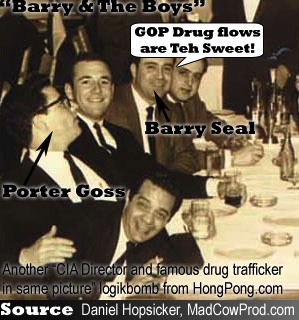
Let's set the scene a bit. NarcoNews.com is the spot to go for the real dish on the "War on Drugs." Why not a bit of Catherine Austin Fitts report on this: I hadn't actually run into this until now, so I suggest everyone check it out. We're gonna take the narco-ball and run with it... Fitts was a top executive at Dillon, Read & Co. Inc, and saw a lot of weird shit go down there, and a vast level of fraud at the Department of Housing and Urban Development in the 1980s.
Catherine Austin Fitts presented: A Six-Part Series for The Narco News Bulletin starting February 27, 2006: Dillon, Read & Co. Inc. and the Aristocracy of Prison Profits: Part I: Inside the Financial World, Government Agencies and their Private Contractors Lies a Hidden System of Money Laundering, Drug Trafficking and Rigged Stock Market Riches
“Make a Law, Make a Business”
— Old New Jersey street saying
There is a strongly held myth in America. The myth says that large corporations are efficient. They have big profits. They have lots of capital to hire the best people, the best accountants and the best law firms. Everyone looks so spiffy. Their technology is the latest. The best thing for the economy, sings the siren song, is for inefficient government to defer to corporate leaders and corporate “survival of the fittest.” Powerful corporations, the myth goes, earned their power through performance in the marketplace by providing the best services and products.
The real truth on the corporate model is far darker, however, and can be found by understanding our current central banking-warfare economic model and the resulting total economic return of activities. That means not just looking at the corporate profits and growth in stock price, but the true cost to people, the environment and government of a particular corporate activity. This necessitates understanding the economy as an ecosystem that is a dynamic living system in places. If corporate profits come from laundering narcotics trafficking used to destroy communities, and from government contracts used to build expensive prisons crammed full of small time non-violent drug distributors and customers, then they are part of a “negative return on investment” economy. This is an economy where the real cost of things is hidden behind secret black budgets, complex government finances, under-the-table deals, market manipulations and economic and military warfare, until they finally show up in the most irrefutable ways: environmental destruction and the exhaustion and death of communities. I refer to this destructive economic force as “the tapeworm” — a financial parasite that weakens and even kills its host.......
...........Bush climbed through Republican politics to become Director of the Central Intelligence Agency (CIA) during the Ford Administration. After spending four years displaced by the Carter Administration, Bush was now Reagan’s Vice President with Executive Order authority for the National Security Council (NSC) and U.S. intelligence and enforcement agencies. Bush’s new authority was married with expanded powers to outsource sensitive work to private contractors. Such work could be funded through the non-transparent financial mechanisms available through the National Security Act of 1947, and the CIA Act of 1949.
This was a secret source of money for funding powerful new weaponry and surveillance technology and operations owned, operated or controlled by private corporations.[3] Carter’s massive layoffs at the CIA had created plenty of private contractor capacity looking for work.[4] An assassination attempt on President Reagan’s life two months after the inauguration meant that Vice President Bush and his team were called on to play an expanded role. Meantime, Nicholas Brady continued as an intimate friend and collaborator from his position as Chairman of Dillon Read.[5]
........According to Dillon Read, the firm’s average return on equity for the years 1982-1989 was 29 percent. This is a very strong performance, and compares to First Boston, Solomon, Shearson and Morgan Stanley’s average returns of 26 percent , 15 percent, 18 percent and 31 percent respectively.[13] Given what we now know from the European Union’s lawsuit and other legal actions against RJR Nabisco and its executives, this begs the question of what Dillon’s profits would have been if the firm had not made a small fortune reinvesting the proceeds of — if we are to believe the European Union — cigarette sales to organized crime including the profits generated by narcotics flowing into the communities of America through the Latin American drug cartels.
To understand the flow of drug money into and through Wall Street and corporate stocks like RJR Nabisco during the 1980s, it is useful to look more closely at the flow of drugs from Latin America during the period — and the implied cash flows of narco dollars that they suggest. Two documented situations involve Mena, Arkansas and South Central Los Angeles, California.
And a little slice from Part II:
Narco Dollars in the 1980s — Mena, Arkansas (March 1, 2006)
During the 1980s, a sometime government agent named Barry Seal lead a smuggling operation that delivered a significant amount of narcotics estimated to be as much as $5 billion from Latin America through an airport in Mena, Arkansas.[1] According to investigative reporters and researchers knowledgable about Mena, the operation had protection from the highest levels of the National Security Council then under the leadership of George H.W. Bush and staffed by Oliver North. According to investigative reporter and author Barry Hopsicker, when Seal was assassinated in February 1986, Vice President George H.W. Bush’s personal phone number was found in his wallet. Through Hopsicker’s efforts, Barry Seal’s records also divulged a little known piece of smuggling trivia — RJR executives in Central America had helped Seal smuggle contraband into the U.S. in the 1970s.[2]
The arms and drug running operation in Mena continued after Seal’s assasination. Eight months later, Seal’s plane, the “Fat Lady,” was shot down in Nicaragua. The plane was carrying arms for the Contras. The only survivor, Eugene Hassenfuss admitted to the illegal operation to arm the Contra forces staged out of the Mena airport. Hassenfuss’ capture inspired Oliver North and his secretary at the National Security Council to embark on several days of shredding. The files that survived North’s shredding that were eventually provided to Congress contain hundreds of references to drugs.
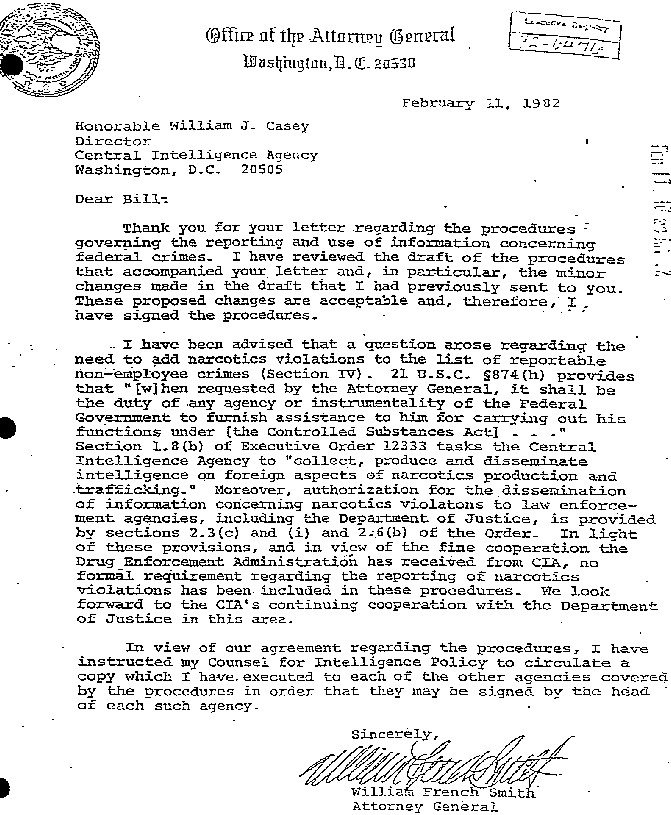
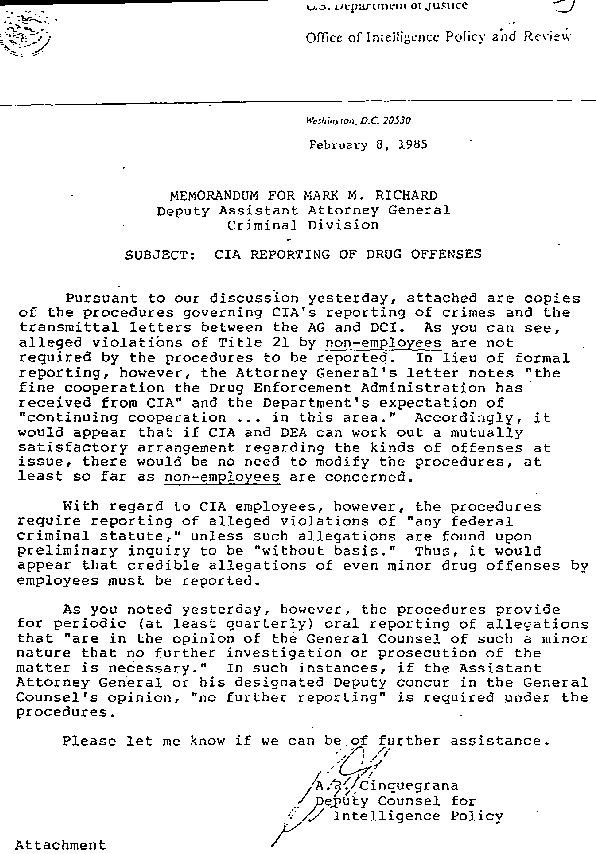
Let's take a quick trip back to the 1980s and enjoy this primary source documentation. Note the part where the Attorney General says that the CIA doesn't have to tell anyone at all about narcotics activity.
These classics deserve a post of their own. Right here, full authorization for the CIA to NEVER tell the DEA or anyone else a damn thing about what the boys are doing. What more can I say? (source / zip file)
A little more context on this from Fitts: (part 2 of the series)
Mike Ruppert is a former Los Angeles Police Department narcotics investigator who was run out of LAPD after declining an offer from the CIA to protect their Los Angeles narcotics trafficking operations. After being accosted by Ruppert and the threat of his formidable evidence in support of Webb’s story in a town hall meeting in South Central Los Angeles in November 1996, then Director of the CIA, John Deutsch promised that the CIA Inspector General would investigate the “Dark Alliance” allegations.
This resulted in a two volume report published by the CIA in March and October of 1998 that included disclosure of one of the most important legal documents of the 1980s — a Memorandum of Understanding (MOU) between the Department of Justice (DOJ) and the CIA dated February 11, 1982 in effect until August 1995.[8] At the time it was created, William French Smith was the U.S. Attorney General and William Casey, former Wall Street law partner and Chairman of the SEC was Director of the CIA. Casey, like Douglas Dillon, had worked for Office of Strategic Services (OSS) founder Bill Donovan and was a former head of the Export-Import Bank. Casey was also a friend of George Schultz. Bechtel looked to the Export-Import Bank to provide the government guarantees that financed billions of big construction contracts worldwide. Casey recruited Stanley Sporkin, former head of SEC Enforcement, to serve as general counsel of the CIA. When Schultz joined the Reagan Administration as Secretary of State, such linkages helped to create some of the personal intimacy between money worlds and national security that make events such as those which occurred during the Iran Contra period possible.
No history of the 1980s is complete without an understanding of the lawyers and legal mechanisms used to legitimize drug dealing and money laundering under the protection of National Security law. Through the MOU, the DOJ relieved the CIA of any legal obligation to report information of drug trafficking and drug law violations with respect to CIA agents, assets, non-staff employees and contractors.[8] Presumably, this included the corporate contractors who, by executive order, were now allowed to handle sensitive intelligence and national security outsourcing.
With the DOJ-CIA Memorandum of Understanding, in effect from 1982 until rescinded in August 1995, a crack cocaine epidemic ravaged the poorer communities of America and disenfranchised hundreds of thousands of poor people into prison who, now classified as felons, were safely off of the voting roles. Meantime, the U.S. financial system gorged on what had grown to an estimated $500 billion-$1 trillion a year of money laundering by the end of the 1990s. Not surprisingly, the rich got richer as corporate power and the concentration of investment capital skyrocketed on the rich margins of state sanctioned criminal enterprise.
These guys were ready to party. To be continued....